


Top 10 Best AI Chatbot Solution for Ecommerce in 2026
Online stores often struggle to answer customer questions quickly, recover abandoned carts, and keep shoppers engaged across multiple channels. The right AI chatbot solution for ecommerce can solve these challenges while improving sales and customer service. In this guide, MOR Software will explore the best AI chatbot solutions for ecommerce and how they help online businesses automate conversations, support customers, and drive conversions in 2026.
What Is An AI Chatbot Solution For Ecommerce?
An AI chatbot solution for ecommerce is a software system designed to support shoppers during their online buying journey, covering everything from product discovery to assistance after a purchase is complete.
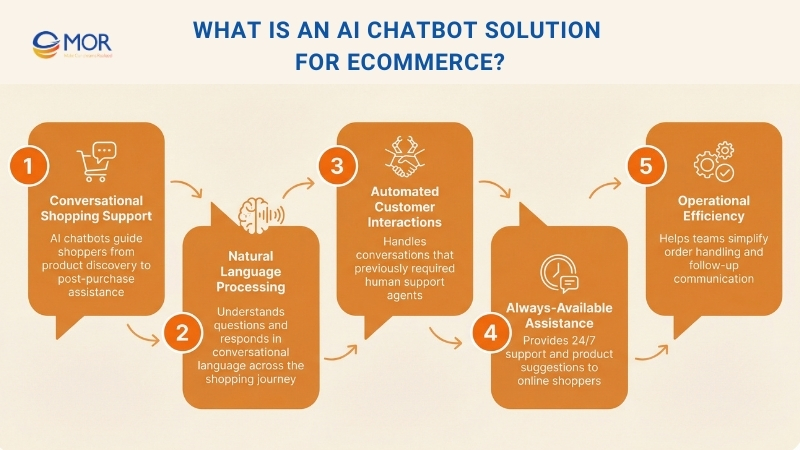
Unlike traditional bots that rely on fixed scripts, modern assistants rely on natural language processing to interpret questions, respond in a conversational way, and manage more advanced tasks across the shopping process. This type of conversational AI chatbot solution for ecommerce helps stores handle interactions that once required human agents.
Conversational AI has reshaped the customer experience in online retail. Through tools built for AI business chat, these chat systems give customers round-the-clock access to helpful support and relevant product suggestions. At the same time, they allow teams to simplify order handling and follow-up communication.
>>> Discover more AI topics on MOR Blog!
Top 10 AI Chatbot Solution For Ecommerce Platforms In 2026
Launching an AI assistant for an online store is easier than many businesses expect today. Still, selecting the right tool for your business goals remains an important step. To support your evaluation process, the following list highlights several leading platforms often mentioned among the best AI chat websites for online retail.
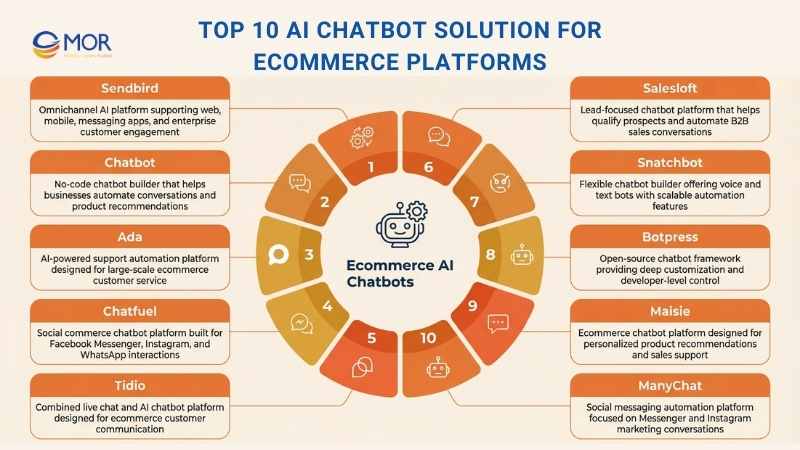
1. Sendbird
Sendbird is an omnichannel platform focused on improving digital customer interactions. It allows companies to create and deploy tailored AI agents framework across websites, mobile applications, WhatsApp, and email. Its AI agent builder helps brands shape chatbot responses so they match brand tone and communication style without requiring heavy development work.
The platform also stays aligned with the latest large language models, which helps deliver more precise and relevant answers. Companies can lock specific responses for key questions and expand capabilities through flexible communication APIs. Many enterprises view this system as an enterprise AI platform for ecommerce when they need scalable messaging infrastructure.
Key features:
- Audience segmentation for targeted engagement
- Support for web, app, and messaging channels
- Real-time analytics
- Integrations with Salesforce, Zendesk, and other CRMs
- Enterprise-grade security
- Multilingual support for 80+ languages
Pricing: Usage-based pricing with discounts for higher volumes. Contact the vendor for details.
2. Chatbot
Chatbot is a no-code chatbot builder designed to help companies introduce conversational AI without complicated development steps. Its interface is simple and visual, which allows businesses of different sizes to automate conversations, capture leads, recommend products, handle orders, and more.
The platform includes a drag-and-drop visual builder, making it suitable for small ecommerce shops that want stronger engagement and support without needing programming skills. Ready-made templates for online retail scenarios such as lead capture and product discovery help teams start quickly.
One strong capability of Chatbot lies in its integrations. The platform connects easily with Shopify, Mailchimp, Facebook Messenger, and other messaging environments, which helps create an automated live chat experience across several channels.
Key features include:
- Pre-built templates for common AI use cases like lead generation and FAQs
- Analytics for monitoring customer experience
- In-platform testing tool
- Live chat integrations for bot to agent handoffs
A limitation of Chatbot is its AI engine, which may not be as advanced as other platforms. This can affect the overall interaction quality, since the assistant may struggle with more complicated questions.
Pricing: Free trial available. Paid plans start at $52.
3. Ada
Ada is an AI-powered customer support platform that offers chatbot technology designed for ecommerce businesses. Built to automate large volumes of service conversations, this platform is often viewed as a reliable customer service AI chatbot solution for ecommerce for larger retailers.
The system integrates with many widely used CRM and ecommerce platforms, including Shopify, Salesforce, Zendesk, and others. Ada also supports multichannel communication, which allows companies to connect email and other messaging tools so they can reach customers across different channels and strengthen engagement.
Its no-code chatbot builder allows teams without technical backgrounds to design a customized AI chatbot solution for ecommerce and structure conversation flows without programming knowledge. Companies can rely on Ada to run targeted campaigns, present limited-time promotions, and recover abandoned carts through a single interface. In many cases, it operates as an AI support system that handles routine service tasks automatically.
Key features:
- No-code chatbot builder for easy customization
- Multilingual support for global ecommerce
- A/B testing to evaluate response quality
- Integrations with Facebook Messenger and Shopify
Despite its strong capabilities and advanced AI technology, Ada usually comes with a higher pricing tier. This cost can be challenging for smaller or newly launched ecommerce stores.
Pricing: Free trial available. Custom pricing.
4. Chatfuel
Chatfuel is a flexible and easy-to-use platform that allows you to build ecommerce chatbots for Facebook Messenger, Instagram, and WhatsApp. This makes it a strong choice for brands that want to strengthen customer engagement through social channels.
The system allows you to present social media users with advertisements, lead capture forms, newsletter sign-ups, or live customer support. You can also retarget people who interact with Facebook or Instagram ads, or reach competitors’ audiences through chatbot campaigns designed to increase conversions with the help of an AI sales bot.
The platform includes a drag-and-drop visual editor, which helps you design and launch a custom AI coding assistant quickly. Ready-made templates for common tasks such as scheduling, lead capture, and FAQ responses also help companies adopt chatbot technology without a long setup process.
Key features:
- Integrations with Instagram, Facebook Messenger, and WhatsApp
- Simple dashboard for order tracking and FAQ management
- Drag-and-drop chatbot builder
Pricing: Free trial available. Paid plans start at $24 per month.
5. Tidio
Tidio brings together live chat, email marketing tools, and ecommerce chatbot technology within one platform. This combination makes it a practical choice for companies that want a unified communication system. Its easy-to-use chatbot builder and competitive pricing make this AI chatbot solution for ecommerce appealing for online stores that want to improve how they interact with customers.
With many ready-made templates and a simple visual chatbot editor, you can quickly create welcome messages and guide visitors through the shopping process. The platform relies on Lyro AI instead of ChatGPT or other large language models to deliver natural conversations, provide tailored product suggestions, support order handling, and more. For many retailers, it functions as one of the most practical AI chatbot solutions for ecommerce customer service available today.
Key features:
- Templates for creating ecommerce conversation flows
- Analytics for tracking engagement and performance
- Omnichannel support of live chat, Messenger, Instagram, WhatsApp, and email
- Integration with Shopify, WooCommerce, and other ecommerce tools
Pricing: Free plan available. Paid plans start at $29 per month.
6. Salesloft
Salesloft is a high-end ecommerce chatbot platform built to help large organizations generate leads, automate sales outreach, and improve service operations.
The platform focuses mainly on B2B environments, where its chatbot tools capture and qualify leads directly on company websites. This helps move potential buyers through the purchasing process with fewer barriers. The AI system studies visitor behavior and intent, then starts conversations and provides relevant responses to increase conversion potential.
A notable capability is the chatbot’s ability to screen users based on predefined conditions. After identifying a qualified lead, it can schedule meetings with sales representatives instantly, which helps shorten the overall sales cycle.
Salesloft also connects with CRM solutions and marketing tools such as Braze, Clevertap, and Salesforce. These integrations help store and track each customer interaction so businesses can deliver more personalized follow-ups.
The platform also includes detailed analytics and reporting features. These tools help organizations review chatbot performance, analyze visitor conversations, and refine how automated interactions work.
Key features:
- Chat integration that supports smooth handoffs from bot to human agents
- Simple quick-reply buttons that guide user actions
- Automated lead capture and qualification
- Personalized product recommendations
Pricing: Free trial available. Custom pricing.
7. Snatchbot
SnatchBot is a versatile chatbot builder that combines reasonable pricing, useful features, and scalable architecture. With a collection of ready-made templates and flexible customization options, it works well for ecommerce stores that want to launch chatbot support quickly while still maintaining their brand style.
Key features
- Support for websites, mobile apps, and messaging platforms
- Text and voice-enabled chatbot functionality
- Several important capabilities included in the free plan
Despite these strengths, SnatchBot has one notable limitation related to its user interface. The chatbot design appears somewhat outdated, and the interface feels less modern and intuitive compared with other platforms.
Pricing: Free plan available. Paid plans start at $99 per month.
8. Botpress
Botpress is an open-source chatbot platform that gives ecommerce companies full control over how their AI assistant works and looks. This AI chatbot solution for ecommerce provides scalable APIs and is well suited for developers or organizations that require deep customization, multichannel communication, and strong security.
One of the platform’s most impressive capabilities is its wide range of integrations. Businesses can connect it easily with many popular ecommerce platforms, messaging applications, and email tools. This approach enables multichannel engagement and helps brands reach shoppers at different points of the purchasing journey. Many teams consider it among the best AI chatbot solutions for ecommerce when flexibility and technical control are priorities.
Key features:
- Multilingual support
- Drag-and-drop visual chatbot builder
- High level of customization and extensibility
- Extensive educational materials and an active developer community
Even though Botpress is powerful for building a tailored ecommerce chatbot, it does require technical knowledge for setup and ongoing maintenance.
Pricing: Free plan available. Paid plans start at $499.
9. Maisie
Maisie is a conversational AI platform designed for ecommerce companies that want to automate support, capture leads, and increase sales. The system works as a flexible chatbot platform that helps businesses manage customer conversations and personalized experiences from one dashboard. Many retailers use it as a chatbot shopping assistant that guides visitors during product discovery and purchasing.
One feature that stands out is its interactive quiz tool. These quizzes help engage shoppers while collecting useful information about customer preferences. The insights can guide product suggestions and support more targeted marketing campaigns. Maisie also includes ready-made templates for common ecommerce situations such as lead capture, order tracking, and frequently asked questions.
Key features:
- Native integrations with Shopify and WooCommerce
- Personalized product recommendations
- Real-time customer assistance and FAQ support
- Extensive help documentation and learning resources
Pricing: Free trial available. Plans start at $29 per month.
10. ManyChat
ManyChat is another no-code chatbot platform that focuses on helping businesses interact with customers through social media and messaging channels, especially Facebook Messenger and Instagram.
The platform includes a visual chatbot builder that is simple to use, which allows companies to launch chatbot campaigns quickly without programming knowledge. Businesses can create marketing campaigns inside messaging apps, promote offers, track orders, and capture qualified leads through automated conversations. Many companies treat it as a practical customer support custom AI solution for ecommerce when social messaging channels are the primary sales channel.
Through integrations with Shopify and other ecommerce platforms, this chatbot tool helps synchronize product catalogs, customer details, and order data between systems.
Key features:
- Automation tools for customer support and lead generation
- Easy visual chatbot builder
- Analytics and reporting tools
ManyChat works very well for social commerce environments, but its functionality for websites and mobile applications is more limited.
Pricing: Free plan available. Paid plans start at $15 per month.
Comparison Table: The 10 Best AI Chatbots For Ecommerce (2026)
Choosing the right AI chatbot solution for ecommerce often depends on your business size, preferred communication channels, and automation needs. The comparison below highlights how leading chatbot platforms differ in strengths, supported channels, and pricing models.
Platform | Best For | Channels Supported | Key Strengths | Limitations | Pricing |
Sendbird | Mid-to-large ecommerce companies that need omnichannel AI support | Website, mobile app, WhatsApp, email | Enterprise security, CRM integrations, 80+ languages, real-time analytics | Pricing structure not fully transparent | Usage-based pricing, contact sales |
Chatbot | Small and mid-sized ecommerce stores | Website, Messenger, Shopify | No-code chatbot builder, ready-made templates, simple integrations | AI capabilities are weaker for complex questions | From $52 per month, free trial |
Ada | Large ecommerce businesses | Website, email, Messenger | Strong automation at scale, multilingual capabilities, A/B testing | Higher pricing for smaller companies | Custom pricing, free trial |
Chatfuel | Ecommerce brands focused on social media sales | Facebook Messenger, Instagram, WhatsApp | Social advertising retargeting, drag-and-drop builder | Limited capabilities outside social channels | From $24 per month, free trial |
Tidio | Stores that want chat, marketing, and automation in one system | Website, Messenger, Instagram, WhatsApp, email | Combination of live chat and AI, affordable pricing, ecommerce templates | AI engine less flexible compared with open LLM models | From $29 per month, free plan available |
Salesloft | B2B ecommerce teams that focus on lead qualification | Website, CRM integrations | Lead scoring, meeting scheduling, advanced analytics | Premium pricing, less suitable for small B2C brands | Custom pricing, free trial |
Snatchbot | Ecommerce businesses with tight budgets | Website, mobile apps, messaging platforms | Free plan with solid core features, voice and text chatbot support | Older interface design | From $99 per month, free plan |
Botpress | Developers and enterprise organizations | Website, messaging apps, email | Open-source architecture, deep customization, strong integrations | Requires programming knowledge | From $499 per month, free plan |
Maisie | Shopify and WooCommerce ecommerce stores | Website, ecommerce platforms | Interactive quizzes, personalized product suggestions | Less suited for advanced enterprise workflows | From $29 per month, free trial |
ManyChat | Brands that sell through social commerce | Facebook Messenger, Instagram | Simple automation, marketing campaigns, low starting cost | Limited support for websites and mobile apps | From $15 per month, free plan |
6 Practical Ways To Use An AI Chatbot Solution For Ecommerce
Traditional chatbots usually answer simple FAQ questions or send automated messages. A modern AI chatbot solution for ecommerce expands these capabilities and allows businesses to automate and personalize customer interactions in more advanced ways that support business growth.
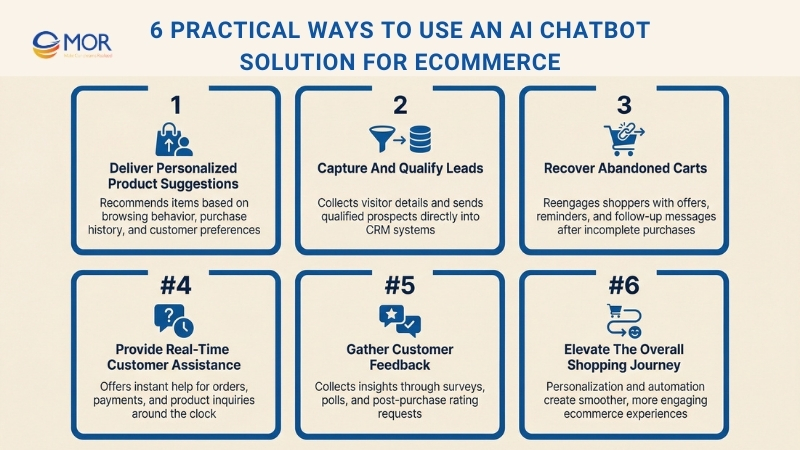
More specifically, you can use this technology to:
1. Deliver Personalized Product Suggestions
Working as a chatbot shopping assistant, AI chatbots can recommend items based on a shopper’s browsing behavior and purchase history. This helps guide customers through product discovery and purchasing decisions.
For instance, the chatbot might ask questions about size preferences, product variations, or budget ranges. These questions help narrow down the best option before presenting personalized suggestions.
When customers quickly find the right item, conversions often improve. Upselling and cross-selling opportunities also increase, and the buying process becomes faster. Research shows that 80% of shoppers are more likely to purchase from brands that provide personalized experiences.
2. Capture And Qualify Leads
Once connected with your CRM, an AI chatbot system can function as a powerful lead generation tool. After it starts a conversation with a visitor on your website, the chatbot can gather information such as the user’s name and email address. It may also invite them to subscribe to your mailing list, join a loyalty program, or respond to a limited-time promotion.
Studies indicate that 55% of companies report more high-quality leads after implementing AI tech stack.
AI chatbots can also qualify prospects during conversations. As the system interacts with visitors, it sends customer information directly into your CRM software. This helps your sales team approach potential customers with more relevant offers and better engagement strategies.
3. Recover Abandoned Carts
AI chatbots can interact with shoppers before they leave the checkout page and help prevent unfinished purchases. They can also re-engage customers after they abandon a cart. For example, Sephora recorded an 11% increase in conversions after launching its ecommerce chatbot on Facebook Messenger.
If a visitor pauses on the checkout screen or begins to exit the page, the chatbot can appear and encourage them to finish the purchase. It may offer a discount code, free shipping, or explain exchange and return policies to reduce hesitation and help close the sale.
If the shopper has already left, the system can still reconnect with them. Chatbots linked to social media channels, websites, or mobile apps can trigger push notifications, in-app messages, or marketing emails to encourage the customer to return and complete the order.
4. Provide Real-Time Customer Assistance
Operating around the clock across your website, mobile application, or social platforms, an AI support system can deliver instant help to shoppers. This includes tracking orders, answering product questions, assisting with payments, and transferring conversations to a human agent when necessary.
Since 76% of consumers prefer using self-service options before speaking with a support representative, automated assistance improves response speed and service quality. At the same time, it allows human agents to focus on more complicated customer issues.
5. Gather Customer Feedback
Chatbots are well positioned to collect insights about shoppers and their experiences with your store. An AI chatbot solution for ecommerce can capture feedback through surveys, quick polls, live conversations, or rating forms that gather opinions during the buying journey or after an order is completed.
Collecting this information allows businesses to understand customer behavior, recognize opportunities for improvement, and build richer customer profiles without relying on manual data collection.
6. Elevate The Overall Shopping Journey
Automation and personalization allow AI chatbots to help customers achieve their goals faster while making the shopping process feel easier and more tailored. Available at all times with proactive assistance, this type of support shows that your brand is responsive and attentive to customer needs.
Beyond simple convenience, these AI assistants help create a shopping journey that feels customized for every visitor. This conversational approach adds a human-like layer to digital shopping experiences, helping your store stand apart from competitors while encouraging loyalty and long-term relationships.
Once you understand how AI chatbots support ecommerce operations, the next step is learning which features matter most so your platform can deliver strong performance and measurable return on investment.
>>> The demand for top talent is surging, with top AI companies hiring across every sector at record speed. Let's explore the top players and where AI companies hiring remote and onsite roles are growing.
Must-Have Features In An AI Chatbot Solution For Ecommerce
A reliable AI chatbot solution for ecommerce should include tools that support automation, personalization, and performance tracking. The following features help ensure the chatbot platform works smoothly with your existing systems and delivers meaningful results for your online store.
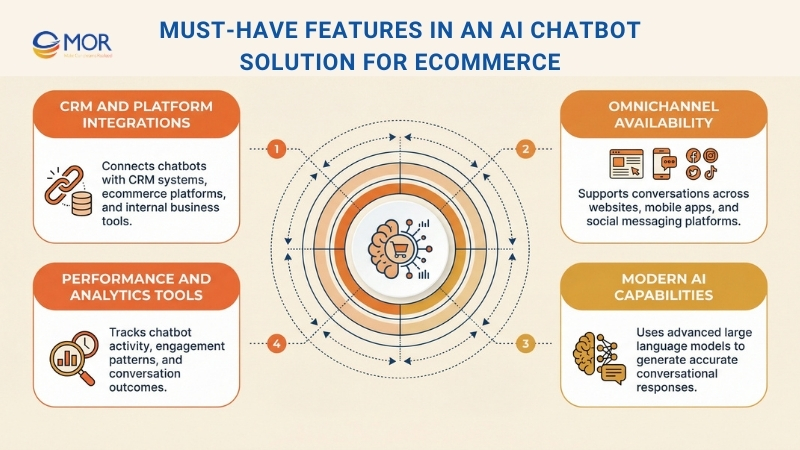
CRM And Platform Integrations
The most effective AI tools for ecommerce connect easily with your CRM, Shopify store, internal databases, and other external software. These integrations allow the chatbot to update customer profiles, send automated emails or in-app messages, and personalize conversations using first-party customer data. At the same time, the system can return valuable insights to your technology stack so you can monitor activity and improve results.
Omnichannel Availability
Modern shoppers interact with brands across many platforms. To reach customers wherever they prefer to communicate, the chatbot should work across your website, mobile application, and social platforms such as Facebook Messenger, Instagram, WhatsApp, and other commonly used channels.
Omnichannel communication also allows follow-up across different touchpoints. For example, a chatbot can trigger an email after a customer inquiry on WhatsApp, or send a reminder message if someone leaves items in their shopping cart.
Modern AI Capabilities
Chatbot effectiveness often depends on the quality of the AI automation technology that powers it. Many of the best AI chatbot solutions for ecommerce rely on advanced large language models such as ChatGPT from OpenAI, Claude from Google, or Llama developed by Meta.
Performance And Analytics Tools
Advanced analytics help you review performance, monitor engagement, and analyze chatbot conversations in detail. A strong ecommerce chatbot platform can provide insights such as:
- How frequently the chatbot detects certain customer emotions and escalates the conversation to a live support agent
- How often the chatbot retrieves information from your CRM or records specific customer data
- Which promotions the chatbot sends to shoppers based on behavior, such as offering a coupon after cart abandonment
When you clearly understand how customers interact with your ecommerce chatbot, it becomes easier to make informed decisions and improve results through data-driven optimization.
3 Smart Tips For Choosing The Right AI Chatbot Solution For Ecommerce
Feeling unsure where to begin? Keep the following three ideas in mind to help you choose the right platform for your needs.
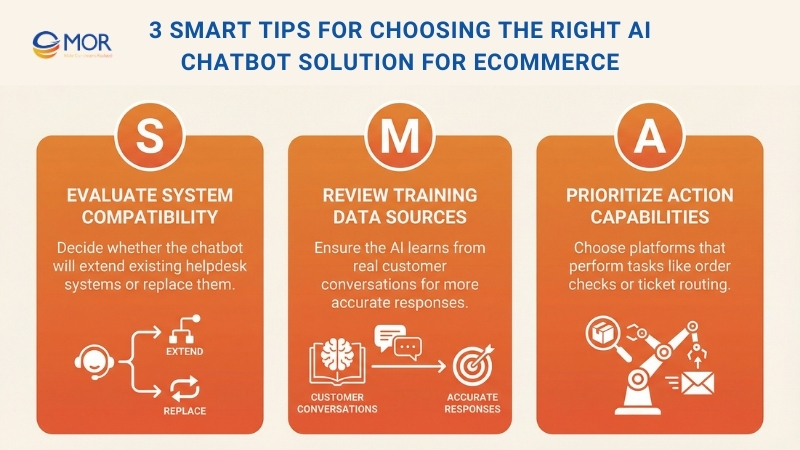
Decide whether you want to extend or replace your current system
Before scheduling a product demo, take time to define your plan. You might want to add AI capabilities to your existing helpdesk, or you may prefer to shift your entire support workflow to a dedicated platform such as Gorgias. Some tools operate as an additional layer on top of current systems, such as eesel AI, which can introduce advanced automation while keeping your present setup intact.
Examine the training data carefully
Any AI chatbot solution for ecommerce becomes valuable only when it learns from relevant information. One of the most important questions you can ask a provider is whether their AI workflow can train on your actual historical customer conversations. Access to real interaction data helps the system produce more natural replies that solve genuine customer issues instead of delivering generic FAQ responses.
Choose tools that perform actions, not only responses
The next generation of AI support focuses on resolving problems, not simply answering questions. Prioritize platforms that can complete tasks directly, such as checking order information in Shopify, generating a return label, or forwarding a ticket with the correct tags to the appropriate team.
Proven Best Practices For AI Chatbot Solution For Ecommerce Success
Strong results from an AI chatbot solution for ecommerce depend on careful setup and continuous improvement. The following practices help ensure your chatbot works effectively, supports customers accurately, and delivers real value for your online store.
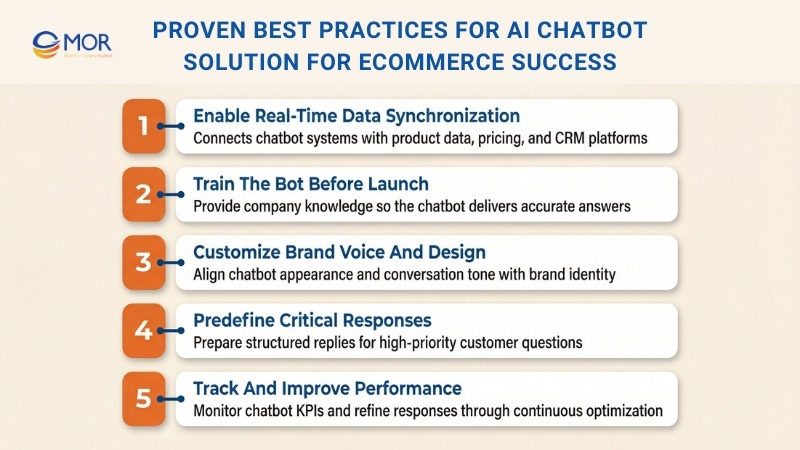
Enable Real-Time Data Synchronization
For the chatbot to perform well, it must connect with both your customer information and your internal data systems. The AI assistant needs access to real-time product availability, current pricing updates, and active marketing promotions so it can deliver useful answers.
Connecting the chatbot platform with your website, CRM, and third-party platforms such as Zapier or Salesforce allows the system to automate workflows and act as a reliable support resource available at any time.
Train The Bot Before Launch
The most effective ecommerce chatbots receive custom training before they go live. This preparation gives the bot access to your company knowledge so it can respond with accurate and helpful information. A simple chatbot builder should allow you to upload and train the AI using product documentation, pricing details, shipping guidelines, return policies, and other important materials.
Customize Brand Voice And Design
Because the chatbot represents your company during customer conversations, its design and personality should reflect your brand identity. A strong custom AI chatbot builder allows you to adjust the visual style, conversation tone, and personality of the bot without requiring any coding skills.
Predefine Critical Responses
One advantage of AI chat systems is their ability to communicate with customers in a natural and conversational way through natural language processing technology. Many modern chatbot platforms rely on large language models (LLMs) such as ChatGPT.
Even though these models can generate conversations on their own, you may still want to prepare specific answers for certain high-priority questions. When you define responses to important topics ahead of time, customers receive consistent and accurate information while your brand keeps a clear and recognizable voice.
Track And Improve Performance
Launching a chatbot platform can be straightforward, but regular monitoring is necessary if you want the system to deliver strong results.
A good starting point is reviewing the chatbot’s responses to confirm they remain accurate and useful for important tasks such as customer support, payment assistance, or product suggestions.
Once the chatbot is active, tracking engagement and performance through important KPIs helps you measure effectiveness and refine the system over time so the project and its campaigns continue to succeed.
Partner With MOR Software To Build Your AI Chatbot Solution For Ecommerce
Choosing the right AI chatbot solution for ecommerce is only the first step. To deliver real value, the chatbot must connect smoothly with your ecommerce platform, customer data, and business workflows. That requires careful planning, reliable development, and long-term support.
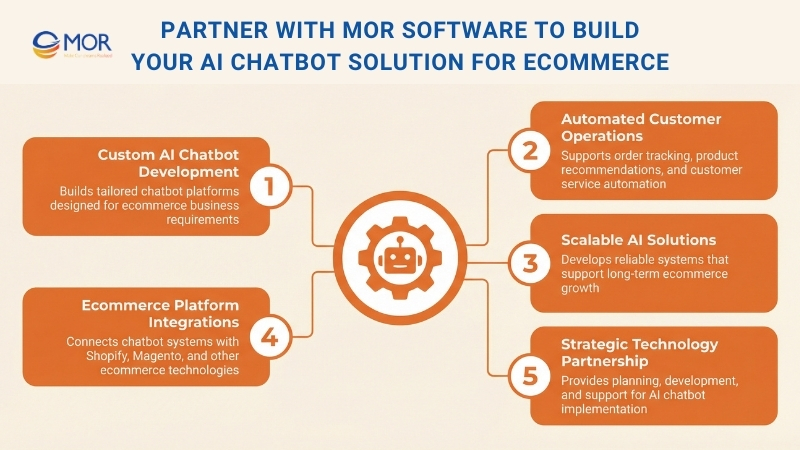
MOR Software helps online retailers design and implement intelligent chatbot systems that improve customer engagement and automate key operations. Our team develops scalable AI solutions that integrate with major ecommerce platforms, CRM systems, and cloud marketing automation tools.
With strong experience in AI development services for enterprise, system integration, and ecommerce technology, MOR Software can help you:
- Build custom AI chatbot platforms tailored to your business needs
- Integrate chatbots with ecommerce systems such as Shopify, Magento, and other platforms
- Automate customer service, order tracking, and product recommendations
- Improve sales performance through intelligent conversational experiences
If your business is ready to adopt a powerful AI chatbot platform for online stores, the MOR Software team is ready to help. Contact us to discuss your project and explore the right AI chatbot strategy for your ecommerce growth.
Conclusion
AI chatbots have moved from simple support tools to powerful assistants that guide shoppers, answer questions, and increase conversions across digital channels. Choosing the right AI chatbot solution for ecommerce helps online stores automate service, personalize interactions, and scale customer engagement without adding pressure to support teams. If you want to implement a reliable chatbot platform tailored to your business needs, MOR Software can help. Contact us today to explore the right AI solution for your ecommerce growth.
MOR SOFTWARE
Frequently Asked Questions (FAQs)
What is an AI chatbot solution for ecommerce?
An AI chatbot solution for ecommerce is a conversational system that helps online stores automate customer interactions. It can answer product questions, recommend items, track orders, recover abandoned carts, and handle support requests without constant human involvement.
How does an AI chatbot improve online sales?
It guides shoppers through product discovery, suggests relevant items based on behavior, and reduces friction at checkout. It can also trigger promotions or reminders, helping increase conversions and average order value.
Can an AI chatbot solution for ecommerce handle customer support 24/7?
Yes. AI chatbots operate around the clock. They manage FAQs, order tracking, return policies, and payment inquiries, then escalate complex issues to human agents when needed.
Does an AI chatbot work with Shopify or WooCommerce?
Most modern chatbot platforms integrate directly with ecommerce systems like Shopify and WooCommerce. This allows real-time access to product catalogs, inventory data, customer profiles, and order history.
Is coding required to set up an AI chatbot for an online store?
Not always. Many platforms provide no-code builders with drag-and-drop workflows. However, advanced customization or enterprise integrations may require technical support.
How much does an AI chatbot solution for ecommerce cost?
Pricing varies widely. Entry-level plans may start around $15 to $50 per month, while enterprise-grade platforms can cost several hundred dollars monthly or use custom pricing models based on usage and features.
Can AI chatbots personalize product recommendations?
Yes. AI chatbots analyze browsing history, purchase behavior, and customer preferences to suggest relevant products. Personalized recommendations often increase engagement and repeat purchases.
How secure is customer data in an AI chatbot system?
Reputable platforms follow strong data protection standards and encryption practices. It is important to choose a solution that complies with relevant privacy regulations and integrates securely with your CRM and ecommerce systems.
Can an AI chatbot reduce cart abandonment?
Yes. Chatbots can detect exit intent or stalled checkout sessions and trigger reminders, discounts, or support messages. This proactive approach helps recover potentially lost sales.
How long does it take to implement an AI chatbot solution for ecommerce?
Basic implementations can be launched in a few days using templates. More advanced setups involving CRM integrations, automation workflows, and custom training may take several weeks.
Share


Make Our-Dreams Realized


© 2023 . MOR Software. All Rights Reserved
Sitemap
Privacy Policy
Terms of Use

Rate this article
0
over 5.0 based on 0 reviews
Your rating on this news:
Name
*Email
*Write your comment
*Send your comment
1