


Top 20 AI Marketing Use Cases (2026 Update)
AI marketing use cases are no longer optional for teams that want growth, speed, and clear results. Many businesses struggle with rising costs, scattered data, and campaigns that fail to convert at scale. In this guide, MOR Software will present practical AI-driven marketing use cases for 2026 and show how companies apply AI to plan smarter, personalize faster, and turn data into real performance.
Best 20 AI Marketing Use Cases
AI marketing use cases show how data, automation, and learning systems now shape daily marketing work. These applications help teams move past assumptions and act on real behavior. Brands use them to understand audiences, personalize messages, and guide decisions with higher accuracy.
Use Case 1. Customer Insights And Behavioral Segmentation With AI
Traditional customer segmentation no longer meets modern marketing needs. Grouping people by age, location, or industry creates broad profiles that miss real intent and behavior. Artificial intelligence shifts how teams analyze audiences by uncovering hidden signals and forecasting likely actions with strong accuracy.
Organizations apply AI-driven marketing use cases to build flexible segments based on actual user activity rather than fixed traits. AI target marketing relies on machine learning to review clicks, page visits, time spent on content, email opens, purchase records, and similar signals to form detailed customer groups. This method helps marketing teams run highly focused campaigns, lower acquisition spend, and raise conversion rates.
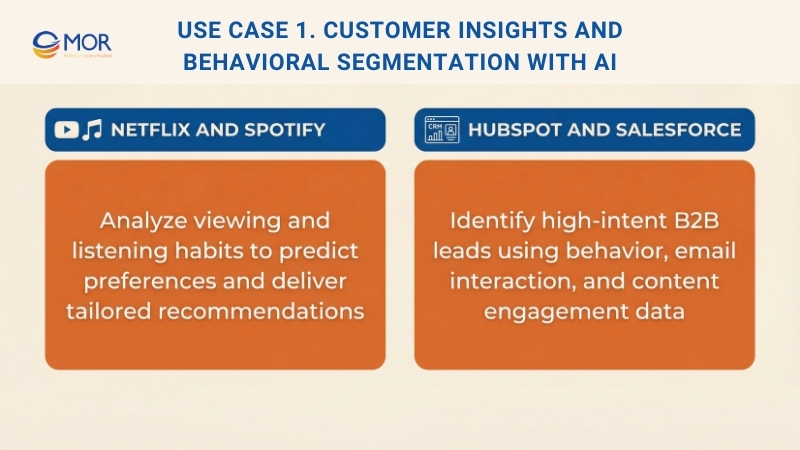
Netflix and Spotify rely on AI-powered marketing scenarios for behavioral segmentation. Instead of sorting users only by demographics, their systems study viewing or listening habits, active hours, and patterns that appear before a subscription starts or ends. These ml models predict preferences with precision and deliver relevant recommendations and tailored promotional messages.
This type of segmentation also plays a major role in B2B marketing. HubSpot and Salesforce apply AI in marketing use cases to spot high-intent leads by reviewing company data together with on-site behavior, email interactions, and content engagement levels. This supports more accurate nurturing efforts and shortens the sales cycle.
AI-based segmentation goes beyond better targeting and reshapes the full marketing approach. Teams gain clarity on which customers are ready to buy, which need more interaction, and which may leave without timely outreach. With an Ideal Customer Profile (ICP) Generator, businesses define valuable segments using real data, allowing AI marketing use cases to focus attention on leads with the strongest likelihood to convert.
Use Case 2. AI-Based Marketing Strategy And Campaign Planning
AI marketing use cases are reshaping how teams plan campaigns, shifting the process toward fast, data-led decisions. Instead of long reviews of competitors, audience splits, and manual budget planning, algorithms now shape a strategy within minutes and estimate how channels and creatives may perform.
Modern platforms like Albert AI, Pathmatics, and Pattern89 study behavior signals, ad trends, and past conversion data to suggest effective marketing paths. These systems set budgets, choose suitable ad formats, and update media plans as results change.
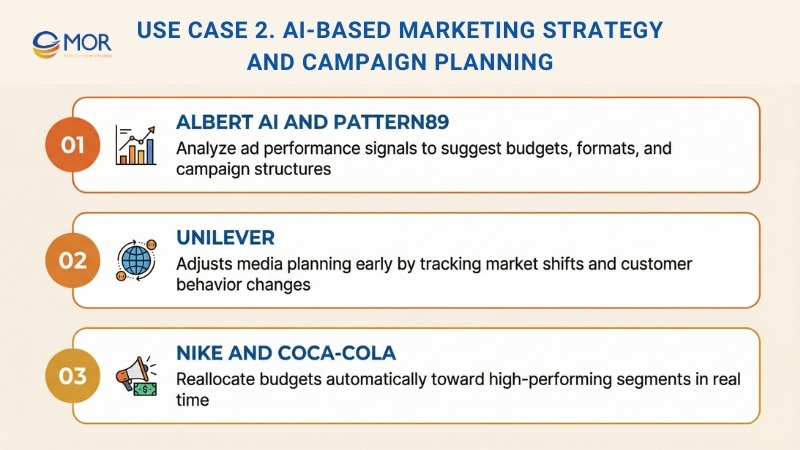
Unilever applies AI to media planning by reviewing market conditions and shifts in customer behavior. This lets the brand adjust campaigns ahead of market changes, lower costs, and improve performance. AI use cases in marketing now go further than task automation and support insight-led plans that strengthen engagement and guide smarter spending.
These tools also handle budget movement across channels automatically. Brands like Nike and Coca-Cola test systems that watch campaign results and send more budget toward segments that perform best. This cuts wasted spend and brings more stability to planning.
AI-driven marketing use cases within strategy help companies react faster and spot growth options without extra expense. A Marketing Strategy Generator powered by this technology reviews large volumes of market data and user behavior to suggest channels, messages, and budget splits that aim for stronger ROI.
Use Case 3. Automated Content Creation And Personalization
Content production has long slowed down marketing teams. Writing articles, email campaigns, and ads by hand takes time, and scaling this work without lowering quality is very hard. AI marketing use cases address this challenge through automation that supports text, video, image creation, and tailored marketing messages.
Many organizations rely on AI automation to produce email newsletters, blog posts, ad headlines, and social updates that match audience needs, brand voice, and campaign goals. Jasper AI, Copy.ai, and ChatGPT now handle routine writing tasks, allowing teams to create content much faster. This technology goes beyond basic writing and adjusts messages to each audience using past data and preference signals, which reflects generative AI marketing use cases in practice.
Personalization plays a central role in content performance. Rather than sending one generic email, algorithms can produce thousands of unique messages that reflect individual behavior and interests. Amazon and eBay apply these methods to deliver customized product suggestions and dynamic email campaigns, raising conversion rates by 20–30%.
Video creation is also becoming automated. Synthesia and Runway ML let teams produce videos with AI-generated avatars and voices, removing the need for studio shoots. Brands like Coca-Cola and Nike already test these tools to adapt campaigns for different regions.
AI used in marketing for content creation lowers production costs and supports growth at scale. Teams can test hundreds of message versions, study performance results, and adjust communication in real time, which makes these marketing use cases powered by AI highly practical for modern campaigns.
>>> Let's compare the top AI automation agencies trusted in 2026, so you can invest wisely and grow with confidence.
Use Case 4. Paid Advertising Optimization Using AI
Manual campaign setup is quickly fading from paid media workflows. AI reviews user actions, finds high-fit audience groups, and adjusts budgets on its own, which makes ads more precise and cost aware. A Facebook Ads Generator powered by this technology can produce and refine ad creatives automatically, so each campaign aligns with the most relevant segments for stronger engagement and conversions.
Teams no longer depend on guesses when selecting targeting. Algorithms evaluate many signals, including browsing activity, engagement levels, behavior trends, and conversion movement, then choose audiences with the highest chance to respond. Platforms from Meta, Google, and TikTok Ads already apply AI for live bid control, automatic targeting updates, and tailored ad delivery, which reflects practical marketing AI use cases.
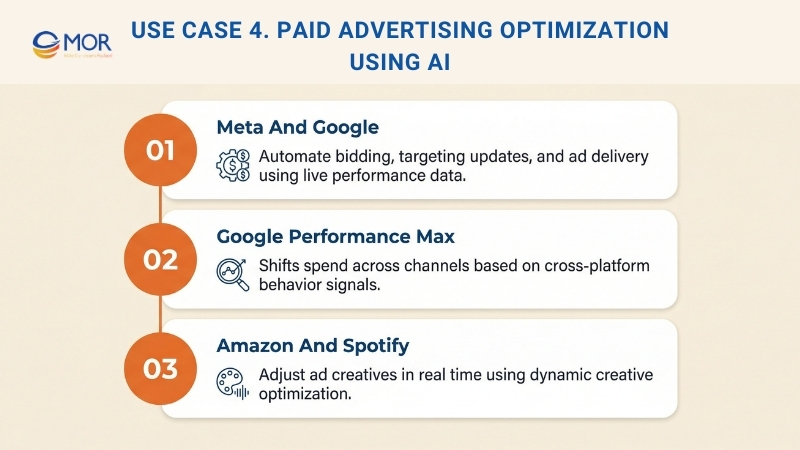
Google Performance Max applies machine learning to shift spend across search, video, and display placements using cross-channel behavior data. The system decides which creatives, formats, and audiences perform best, which lifts conversions by 20–30% compared with traditional setups.
Creative work also follows a new path with AI. Dynamic Creative Optimization allows ads to change automatically based on audience traits. One person may see a product video, another a text message centered on a discount, and another a tailored offer shaped by past brand interactions. Brands like Amazon and Spotify already adjust ad content in real time, letting teams test thousands of messages quickly and raise overall impact.
Using AI to automate paid campaigns cuts operational effort and delivers more personal ad experiences. This approach supports AI use cases for marketing that drive stronger returns and deeper audience involvement.
Use Case 5. Chatbots And Conversational AI For Customer Engagement
Chatbots are no longer limited to simple support replies. AI-driven conversations now handle early customer interactions, helping marketing and sales teams move leads forward faster and with less effort.
Modern conversational AI reviews customer messages, identifies intent, and adjusts replies in real time. Tools like ChatGPT, Drift, and Intercom use AI tech stack to run natural conversations that match how users communicate. Brands rely on these systems for consultations, sales support, lead nurturing, and even deal completion without direct staff involvement.
Sephora applies AI chatbot on Facebook Messenger to deliver personalized beauty suggestions by reviewing preferences and past purchases. This approach raised order conversions by 11%.
In B2B settings, chatbots connect directly with the sales funnel. Drift automates lead qualification through on-site behavior analysis and targeted questions before routing prospects to sales teams. This shortens response time by 25% and removes low-quality inquiries.
Voice-based AI is also expanding. Google Assistant and Amazon Alexa already support service promotion through spoken interactions, while CallRail uses AI to study phone calls and detect intent signals and customer sentiment.
Conversational AI in marketing supports fast, tailored, and scalable interactions. Businesses lower support expenses, lift conversion rates, and handle requests more quickly without reducing communication quality.
Use Case 6. Predictive Analytics For Lead Scoring And Forecasting
AI has reshaped how teams handle leads, turning scoring into a predictive process instead of a subjective one. Within artificial intelligence in digital marketing, lead evaluation no longer depends on manual judgment to assess purchase readiness. This approach reviews hundreds of signals and estimates which prospects are most likely to become customers. This shows practical AI marketing use cases in action.
IBM Watson AI analyzes consumer data and estimates the chance of closing a deal with accuracy levels reaching 85%. This helps sales teams identify which prospects need priority attention and which are close to making a buying decision.
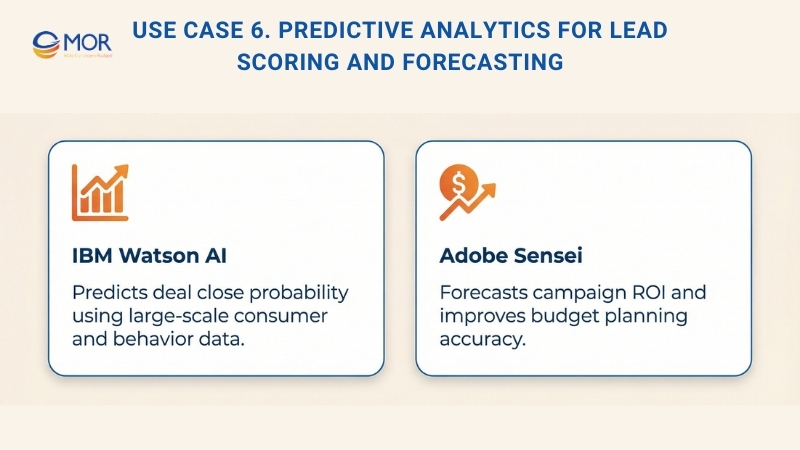
Predictive analytics also improves how budgets are planned and controlled. AI forecasts future sales using past performance, seasonal patterns, and outside factors, which helps marketers time campaigns for better returns. Adobe Sensei applies predictive models to estimate campaign ROI, lowering unnecessary spend and improving planning accuracy.
Applying predictive analytics to lead scoring and forecasting supports automation while keeping decisions data focused. These AI-driven methods cut lead handling costs, raise conversion rates, and shorten the overall sales cycle.
Use Case 7. AI-Driven Email Marketing Optimization
Email marketing continues to deliver strong returns, yet its success depends on personalization, relevance, and timing. AI is shifting email campaigns away from mass sending toward a focused channel that adjusts to each recipient’s behavior, which aligns with modern AI marketing use cases.
Current AI systems study when a user is most likely to open an email, which topics and calls to action attract attention, and what prompts a click. AI vs ML vs DL improves subject lines, message content, and send times, which lifts open rates and conversions for platforms like HubSpot, Mailchimp, and ActiveCampaign.
Airbnb applies AI models to tailor email campaigns through analysis of user interests and booking history. The system selects personalized accommodation suggestions and offers at suitable moments, which raised newsletter click-through rates by 35%.
AI also handles A/B testing automatically. Instead of marketers reviewing results by hand, this solution runs multivariate tests and identifies which content combinations perform best. Phrasee uses AI agent frameworks to generate email subject lines that lift open rates by 10–20% through analysis of past results and language patterns.
Another benefit lies in automated audience segmentation. Rather than dividing lists by age or gender alone, AI forms dynamic groups based on behavior, highlighting who is ready to purchase, who needs more engagement, and who may respond to an upsell.
Use Case 8. Social Media Automation And AI Content Generation
AI tools like Lately, ChatGPT, and Jasper AI automatically create posts from existing content, select an appropriate tone, and adapt messages for different platforms. This allows companies to scale social activity without increasing copywriting costs, which fits well with current AI marketing use cases.
Coca-Cola applied AI to review user-generated content on social networks and produce tailored posts, which lifted organic reach by 30%. These systems scan trends, track popular topics, and suggest matching creatives that drive stronger engagement.
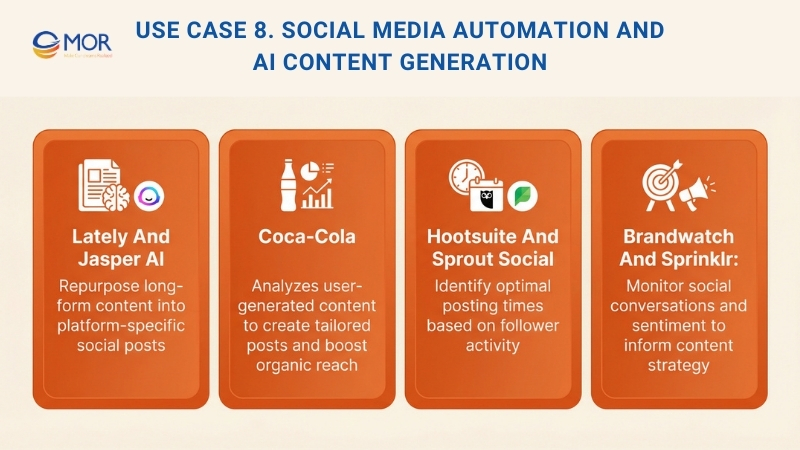
Automation also supports posting schedules. Hootsuite and Sprout Social analyze follower activity to identify the best times to publish. This approach helps you grow reach and interaction without added spend.
Another important area is comment and UGC moderation. Platforms like TikTok and Instagram rely on AI to remove spam, flag harmful comments, and surface trending discussion themes.
AI in social media marketing goes beyond task automation. It helps brands adjust content to audience behavior, which supports higher engagement levels and improved conversion results.
Use Case 9. AI In Seo Strategy And Search Performance
Search optimization now goes far beyond simple keyword use. AI helps marketers forecast which topics can drive higher traffic, track shifts in Google algorithms, and adjust content automatically to match search demand.
Modern tools like Surfer SEO, Clearscope, and MarketMuse review hundreds of ranking signals, spot content gaps, and suggest actions to raise search visibility. These systems guide keyword selection, text structure, and subheadings that improve the chance of ranking in the top results.
The New York Times adopted AI analytics to refine article performance, which led to a 40% increase in organic traffic through better topic choice and clearer structure.
AI also supports technical SEO tasks. Platforms like PageSpeed Insights and SEMrush Site Audit flag issues tied to load speed, indexing, and internal links. Teams rely on AI to refresh outdated pages and adjust meta data as search behavior shifts.
Voice search optimization is another growing focus. Data from Google shows that over 27% of mobile users use voice search, which changes how content should be written. AI studies common spoken questions and phrases, then reshapes content to suit conversational queries.
AI-powered SEO helps brands raise rankings while also forecasting trends, automating review tasks, and delivering content that aligns closely with user intent.
Use Case 10. AI-Powered Video And Visual Content Creation
Visual assets are central to marketing, yet producing them often demands high budgets and time. AI is reshaping this workflow automation, allowing brands to generate videos, display ads, and graphics automatically from text prompts or existing data.
Modern platforms like Runway ML, Synthesia, and DALL·E help teams create visuals without studio shoots or large production crews. AI-driven animation, synthetic voices, and generated imagery speed up output and support real-time testing of different creative options.
Nike applies AI to adjust video ads for local markets. Instead of filming separate versions for each region, the system updates text, narration, and visual elements to suit local audiences. This lowers localization costs and shortens launch timelines.
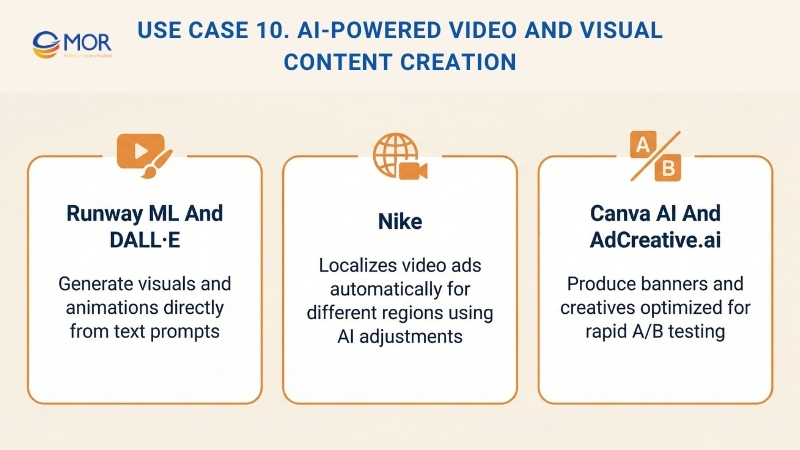
AI also supports automated banner creation. Canva AI and AdCreative.ai review creative performance data and produce banners that follow brand rules and platform standards. This works well for A/B testing, where many versions of a single ad are needed quickly.
Another emerging area involves AI-generated avatars for personalized video messages. Brands test virtual presenters that adjust content for individual viewers. Synthesia and Hour One make it possible to create presenter-led videos at a fraction of traditional costs.
AI-driven video and image creation reduces production time and supports growth at scale. Teams can tailor visuals to different audiences, run rapid experiments, and improve campaign performance without unnecessary spending.
Use Case 11. Real-Time Website Personalization With AI
Website personalization now extends far beyond basic product suggestions. AI reviews each visitor’s behavior in real time and adjusts content, calls to action, pricing, and offers to raise the chance of conversion.
Modern platforms like Dynamic Yield, Optimizely, and Adobe Target track page visits, time spent on content, and products viewed, then tailor the site experience to match user interests. This setup lets brands present different site versions to different audience groups.
Booking.com relies on AI to personalize prices and offers in real time. The system reviews device type, visit frequency to hotel pages, and location data to present targeted discounts. This method raises booking rates and lowers bounce rates.
AI applications in marketing also support changes to site structure based on user type. New visitors may see reviews and case studies to build trust, while returning customers receive tailored deals or added services. Netflix applies AI to update previews and descriptions dynamically to increase click likelihood.
Another application focuses on adjusting content to the sales funnel stage. If a visitor downloaded a whitepaper but has not sent an inquiry, the platform can swap a standard CTA for a personalized offer that includes a free consultation.
AI-powered web personalization turns a website into an adaptive sales channel. It responds to each visitor’s needs, which drives stronger engagement and higher conversion rates.
Use Case 12. Influencer Discovery And Evaluation Using AI
Enterprise AI platforms like Upfluence, HypeAuditor, and CreatorIQ scan millions of social profiles and review real engagement data, bot activity levels, follower demographics, and interaction quality. This analysis helps brands identify creators who genuinely influence their intended audience, which supports reliable AI marketing use cases in influencer selection.
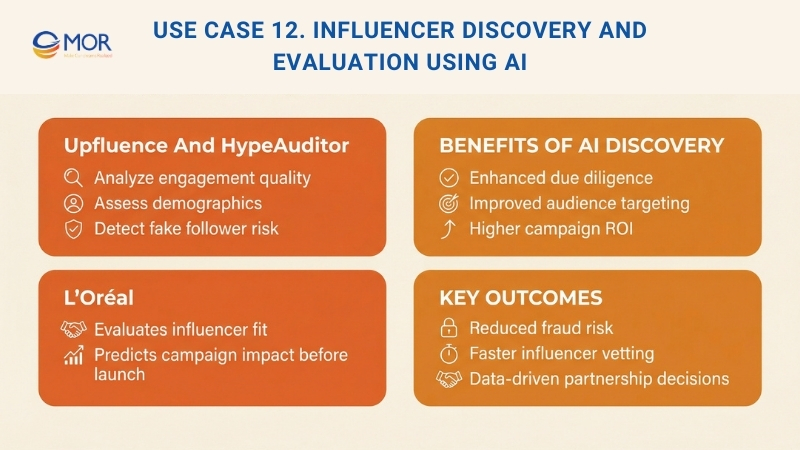
Large brands such as L’Oréal rely on autonomous AI agent to assess influencer impact before campaigns go live. These systems determine which creators fit a specific audience, estimate potential reach and conversion, and flag data patterns that suggest fake followers or inflated metrics.
AI-driven influencer analysis removes guesswork and lowers the risk of poor investments. It helps companies select suitable partners and achieve stronger results across influencer campaigns.
Use Case 13. Voice Search Optimization And AI Assistants
As voice assistants like Google Assistant, Amazon Alexa, and Apple Siri become more common, companies are adjusting marketing plans to support voice search. AI-based content tuning for spoken queries is important because people phrase voice requests differently than typed searches.
AI processes frequent questions asked through voice assistants and shapes content in a natural, conversational style. Text search often relies on short keyword phrases, while voice queries take the form of full questions with longer wording, which suits FAQ pages and long-form articles.
A strong example of voice assistant use in ordering systems comes from Domino’s Pizza. Customers can place orders on its website using voice commands, while the AI reviews preferences and suggests suitable options. This speeds up ordering and lowers pressure on call center teams.
AI-powered voice search changes SEO practices and creates new ways to engage customers. Brands that move early with voice-focused content and campaigns gain an advantage as competition increases across digital channels.
Use Case 14. Sentiment Analysis For Brand Reputation Monitoring
Brands can no longer depend only on basic social and review tracking. With AI, you can observe audience perception of a company, its products, or ad campaigns in real time and respond quickly to possible reputation risks.
Modern AI tools scan large volumes of social content related to a brand and assess the overall tone of conversations. Platforms like Brandwatch, Sprinklr, and Talkwalker use AI and machine learning development services to label comments as positive, neutral, or negative, which helps teams spot trends and early warning signs before issues escalate.
AI-driven sentiment analysis has become a key part of reputation management. It allows brands to move beyond reactive responses and actively shape public opinion through timely and informed action.
Use Case 15. Competitive Intelligence And Market Research With AI
AI now handles the collection, processing, and review of competitive data, which helps brands spot market shifts and adjust strategy ahead of rivals. New AI-driven tools like Crayon, SimilarWeb, and AlphaSense scan websites, press releases, social channels, ad activity, and even competitor pricing changes. This gives marketers a clear view of what works for others, where gaps exist, and which opportunities are starting to appear.
AI also streamlines trend research. Platforms such as NetBase Quid and Trendalytics forecast rising products and services using data from search engines, social media, and online marketplaces. From a planning view, this helps brands release new offerings before a trend becomes widespread.
AI-powered competitive intelligence gives organizations a strong edge. It supports faster responses to industry change, exploration of new niches, and updates to marketing campaigns based on accurate, real-world data.
Use Case 16. AI-Enhanced A/B Testing And Conversion Optimization
Traditional A/B testing was often limited by how many creative teams could produce and how many tests they could manage. AI has changed this process fully. Systems now review hundreds of variables at the same time, test several ideas in real time, and adjust experiences to support higher conversions.
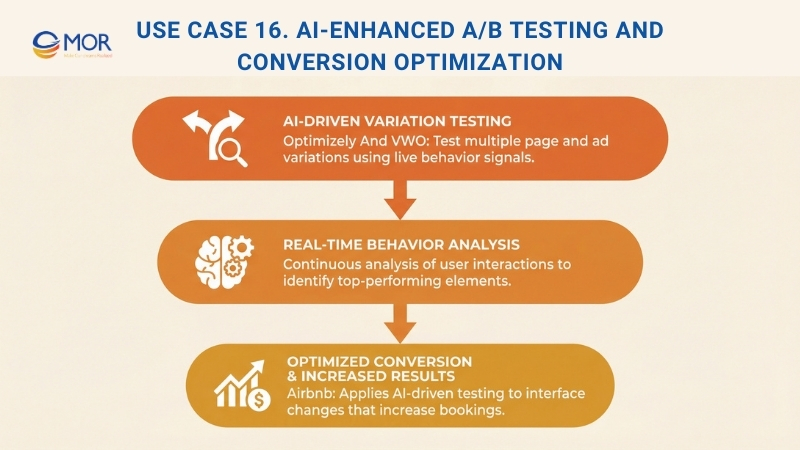
Modern tools like Google Optimize, VWO, and Optimizely compare page or ad versions and update content based on user actions. This helps you identify effective combinations of CTAs, headlines, visuals, and pricing faster and with more accuracy.
Airbnb uses AI to test interface updates automatically. Machine learning algorithms study how visitors interact with the site and use live data to decide which design changes lift conversion rates. This method helped increase bookings without raising advertising spend.
Use Case 17. Product Recommendations And Cross-Selling Automation
Personalized recommendations are among the strongest drivers of sales growth. Machine learning reviews user behavior, purchase history, and interest signals to suggest products or services with the highest chance of conversion.
Advanced platforms like Amazon Personalize, Algolia Recommend, and Dynamic Yield apply learning models to uncover hidden behavior patterns. These systems study browsing paths, buying frequency, reactions to promotions, and even small signals like when users interact with certain items.
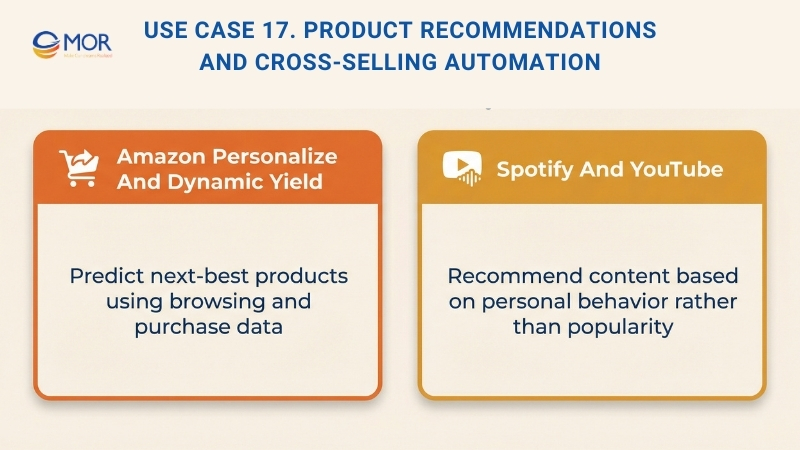
Amazon raised the average order value by 35% through AI-driven recommendations. The models anticipated what each shopper might want next and refined product cards, emails, push notifications, cross-sell, and upsell suggestions to match individual interest.
AI also automates recommendation sections across online stores. Traditional methods rely on simple category links, while predictive models evaluate behavior triggers to surface more relevant options. Spotify and YouTube use similar approaches to suggest content based on personal taste rather than overall popularity.
AI-powered recommendations do more than lift order size. They bring precision to marketing, where tailored experiences drive higher lifetime value and stronger customer retention.
Use Case 18. Dynamic Pricing Strategies Powered By AI
AI is shifting pricing from a fixed model to a flexible system that reacts to market changes, demand levels, and customer behavior in real time. Companies apply this approach to adjust prices, improve margins, and respond to demand shifts faster than competitors.
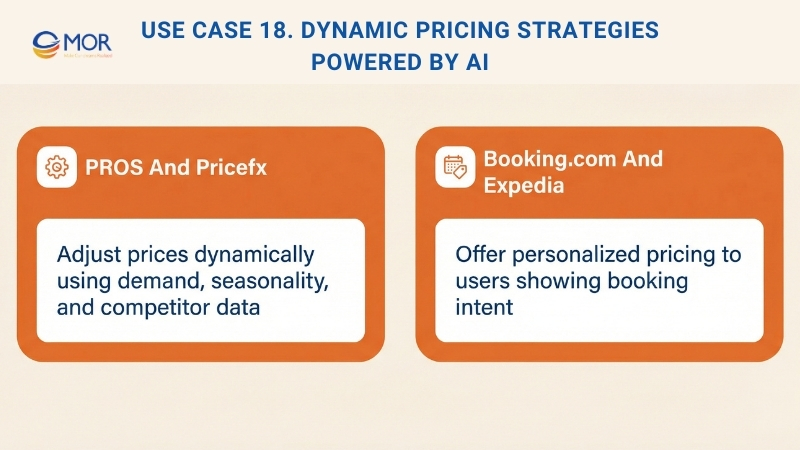
Advanced platforms like PROS, Pricefx, and Dynamic Yield review historical performance, competitor pricing, seasonal patterns, and economic signals to forecast which price points deliver the best returns. These systems update prices dynamically based on demand signals, user behavior, and even time-based factors.
AI also makes discount strategies and one-to-one pricing easier to manage. Companies such as Booking.com and Expedia use AI to present tailored prices to users who show booking intent but hesitate to complete a purchase. This approach reduces cart abandonment and supports revenue growth.
Use Case 19. Customer Retention And Churn Prediction With AI
AI platforms like Zeta Global, Pega, and Salesforce Einstein monitor user activity, engagement frequency, interaction depth, and past purchase behavior. Using these signals, algorithms identify which customers are most likely to leave and trigger targeted actions to keep them engaged, which aligns with advanced AI marketing use cases.
Netflix applies AI to predict churn risk. When the system detects a drop in viewing activity, it sends personalized content suggestions or special offers to bring users back. This approach lowers churn rates and raises customer lifetime value.
AI also supports automated retention campaigns. Online sellers such as Shopify and BigCommerce rely on AI to deliver timely emails, push notifications, or tailored deals to customers who purchase less often.
Another powerful capability is feedback analysis. Information sets used in machine learning reviews product reviews, support tickets, and social interactions to uncover the main causes of dissatisfaction. Brands can act on these insights early, which reduces churn and improves overall satisfaction.
AI-driven retention management brings structure and precision to marketing. It helps brands keep customers through personalized outreach and timely responses when churn risk appears.
Use Case 20. Fraud Detection And Security In AI Marketing Use Cases
Fraud in digital advertising and online marketing costs companies billions each year. AI addresses this risk by spotting unusual behavior patterns, detecting fake traffic, click abuse, and suspicious transactions as they happen.
AI tools like FraudShield, White Ops, and ClickCease apply machine learning to identify threats from bots, click farms, and fake accounts. These systems review IP data, click activity, behavior signals, and related indicators to stop harmful actions before ad budgets are affected.
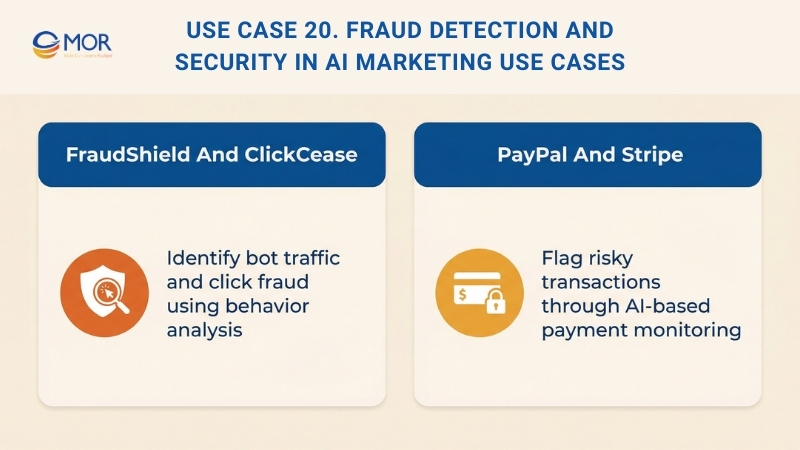
Fraud prevention also plays a major role in eCommerce. PayPal and Stripe use AI to examine transactions and flag risky payments based on behavior patterns, location data, and purchase history. This reduces chargeback rates and limits financial losses.
AI-driven security improves trust across digital marketing efforts. It protects advertising spend, brand credibility, and financial assets, which makes these marketing use cases powered by AI essential for safe and reliable growth.
Key Benefits Of Using AI In Marketing
AI marketing use cases deliver clear value across planning, execution, and measurement. When teams rely on data-driven systems instead of assumptions, they respond faster, spend more wisely, and gain clearer insight into what drives results. These benefits show why marketing using AI has become a practical choice for modern organizations.
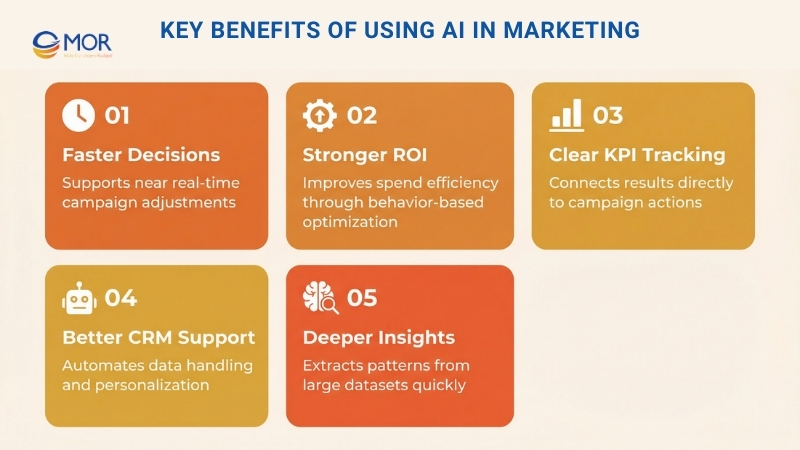
Faster And More Informed Decision-Making
Marketing teams that work with advanced AI automation tools can track the impact of campaigns almost in real time and adjust actions as needed. AI marketing platforms support the creation of AI marketing strategies and process large data volumes faster than manual analysis. These systems rely on machine learning and sentiment signals from past customer data to suggest actions that reflect real audience response.
Stronger Roi Across Marketing Initiatives
AI tools help marketers extract useful insights from campaign data as it is generated. The same systems also guide media buying decisions, including channel selection and ad placement, based on customer behavior patterns. Modern solutions built on AI based marketing help teams confirm that campaign budgets are used effectively and deliver measurable returns.
Clearer And More Accurate KPI Tracking
Digital campaigns produce large volumes of data that are hard to review manually, which makes performance measurement challenging. AI-supported dashboards connect results directly to the tactics used in a campaign, allowing marketers to see what performs well and where changes are needed with greater clarity.
Improved Customer Relationship Management
AI coding assistant tools support customer relationship management by automating routine tasks like organizing and preparing customer data. These systems lower the risk of manual errors, enable more personalized communication, and help teams spot customers who may be at risk of leaving.
Deeper Insights From Large Customer Datasets
Many marketers struggle with the volume of data involved in campaign planning. AI addresses this issue through predictive analytics that process large datasets within seconds using machine learning models. These insights help forecast future behavior, guide personalized content choices, and highlight patterns that teams can act on with confidence.
Will AI In Marketing Replace Human Marketers?
So will AI replace software developers? When applied with care and a clear focus on customer needs, AI in marketing can support steady growth and long-term success in a competitive environment. These tools help teams work with better data, clearer signals, and faster feedback while keeping the audience experience at the center.
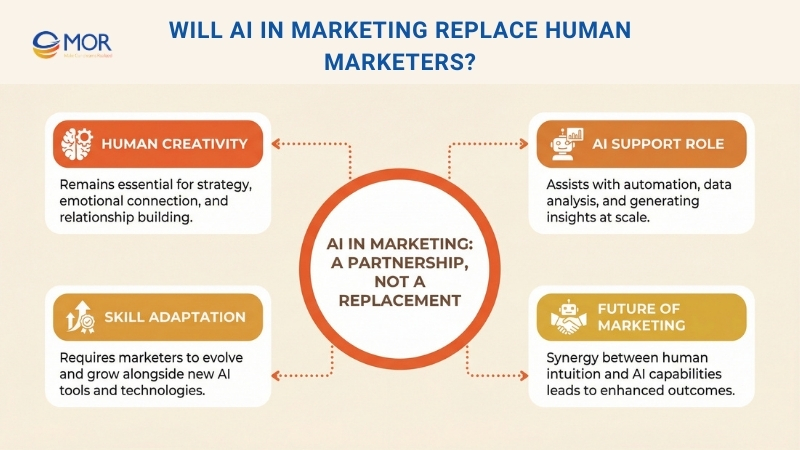
AI will continue to expand its role in digital marketing through support for human work, automation of routine tasks, and delivery of useful insights. Still, creativity, strategic thinking, and relationship building remain human strengths that technology cannot replace. As AI adoption grows, marketers need to build the right skills and knowledge to adapt, stay relevant, and grow with these changes.
Turning AI Marketing Use Cases Into Production Systems
AI marketing often breaks down after the demo stage. Models look promising in notebooks, dashboards show early wins, then progress stalls. The gap appears when teams try to move from experiments to daily operations. Live marketing systems need clean data flows, stable integrations, monitoring, and clear ownership. Without those pieces, even strong models fail to deliver consistent results.
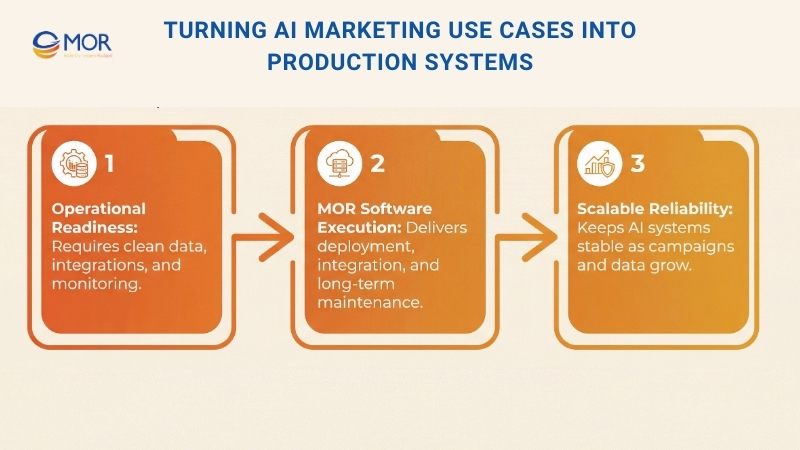
This is where MOR Software steps in as the execution partner. We help teams turn AI marketing ideas into production systems that run inside real business environments. That work covers data pipelines, model deployment, CRM and platform integration, security controls, and long-term maintenance. The goal stays simple. AI should work quietly in the background, support marketers at scale, and stay reliable as data, traffic, and campaigns grow. If you are ready to move beyond pilots and start running AI in real marketing workflows, this is the stage where execution matters most.
Conclusion
AI marketing use cases now shape how teams plan, execute, and scale campaigns with confidence. From personalization to security, these applications help businesses act on data instead of assumptions. The real advantage comes when AI moves from experiments into stable, daily workflows. MOR Software helps companies design, build, and run AI-powered marketing systems that deliver consistent results. Ready to turn AI into a working advantage? Contact us to discuss your goals and next steps.
MOR SOFTWARE
Frequently Asked Questions (FAQs)
What are AI marketing use cases?
AI marketing use cases describe how artificial intelligence is applied to real marketing tasks. Common examples include audience segmentation, content personalization, ad optimization, predictive analytics, and customer retention.
Which marketing areas gain the most value from AI?
AI performs best in areas with large data volumes. These include paid advertising, email campaigns, SEO analysis, customer segmentation, lead scoring, and performance tracking.
How does AI improve customer targeting?
AI studies real behavior instead of static traits. It looks at clicks, browsing patterns, purchases, and engagement to build accurate audience segments that change over time.
Can small teams apply AI marketing use cases effectively?
Yes. Many AI tools are flexible and scale with usage. Smaller teams often start with email optimization, chatbots, or ad targeting before expanding to advanced use cases.
Do AI marketing use cases work outside digital channels?
Yes. AI also supports pricing decisions, demand forecasting, customer insights, and cross-channel attribution that connect online and offline marketing efforts.
How reliable are AI-driven marketing predictions?
Accuracy depends on data quality and consistency. When trained on clean data, AI models can predict customer behavior and campaign outcomes with strong reliability.
Will AI replace marketers in daily operations?
No. AI handles analysis and repetitive tasks. Humans still lead strategy, creative direction, brand voice, and decision-making.
What type of data is needed to use AI in marketing?
AI typically uses website analytics, CRM data, campaign performance metrics, customer behavior logs, and transaction records to learn patterns.
How quickly can teams see results from AI marketing use cases?
Some results appear fast, especially in ad bidding or email timing. Other use cases like forecasting improve gradually as the system learns from new data.
What risks should teams consider when using AI in marketing?
Key risks include poor data quality, over-reliance on automation, and limited visibility into AI decisions. Regular review and human oversight help reduce these issues.
Share


Make Our-Dreams Realized


© 2023 . MOR Software. All Rights Reserved
Sitemap
Privacy Policy
Terms of Use

Rate this article
0
over 5.0 based on 0 reviews
Your rating on this news:
Name
*Email
*Write your comment
*Send your comment
1