


AI Agent vs Chatbot: Which One Aligns Your Business Best?
Many businesses struggle to choose between an AI agent vs chatbot when evaluating new AI technologies for their operations. The challenge is knowing which one actually fits your workflows, customer needs, and business goals. Choosing the wrong solution can lead to wasted investment and limited results. In this guide, MOR Software will help you compare both options and choose the right AI solution for your business.
Key Takeaways
- An AI chatbot is best for simple chats, FAQs, routing, and fixed support flows where speed and clear answers matter most.
- An AI agent fits workflows that need context, system access, decision support, tool use, and multi-step task handling.
- The right choice depends on your business goal, data readiness, process complexity, cost plan, and need for human control.
AI Agent Vs Chatbot: Key Differences
An AI agent is a system that can understand a goal, plan steps, use tools, and act within rules set by the business. A chatbot is built mainly to answer user messages, guide simple flows, and support basic tasks through chat.
The AI agent vs chatbot differences are not only about how smooth the reply feels. They also cover the level of control, the amount of context available, the depth of system connection, and whether the tool is made to answer or to finish real work.
Chatbot | AI Agent | |
Action level | Responds after a user message | Works toward a goal, plans steps, and acts within rules |
Main job | Manages conversations | Manages conversations and carries out tasks |
Chat style | Follows rules, scripts, or preset flows | Talks with users while supporting broader work and choices |
Use of context | Usually stays within the current chat | Can use memory, files, past chats, and linked systems |
Personal fit | Uses simple profile data or basic settings | Uses behavior, history, role, and business data |
Learning ability | Has narrow room to improve | Can get better through feedback, memory, and workflow changes |
Use of tools | Often has limited tool access | Can work with APIs, apps, and business platforms |
Setup needs | Quicker, lighter, and simpler to launch | Needs more planning, rules, system links, and tracking |
Growth fit | Handles larger chat volume well | Handles more process work across systems |
Cost pattern | Starts with a lower setup cost | Needs a higher first spend, but may return more work value |
Best use | FAQs, intake, routing, and simple support | Research, operations, decision support, and workflow automation |
Autonomy
Autonomy is the easiest place to see the gap in an agentic AI vs chatbot comparison. A chatbot sits inside a set chat path and replies after the user asks something. An AI agent can go further than a reply. It can notice a trigger, understand the target, choose the next steps, and carry out tasks under business rules.
That does not mean an agent should always run the whole process alone. In real use, the best setup often gives it guided freedom, which is why chatbot vs agentic AI planning needs guardrails. The agent might collect data, check live information, write a draft, and prepare the next step, then wait for human approval before anything is final. This gives teams faster work without losing control.
Conversational Capabilities
Chatbots and AI agents can both talk to users in plain language, but they support different levels of conversation. A chatbot is made for simple exchanges, like replying to common questions or helping users follow a fixed path. It performs best when the chat stays close to what the team expected.
An AI chatbot agent can manage deeper conversations because the chat is only part of the work. It can ask for missing details, react when facts change, and keep the task moving. This makes it a stronger fit for requests that shift during the process or need action after the first answer.
Context And Memory
A chatbot can do a good job with narrow context when the task is simple and the answer is easy to find. Once the request depends on company rules, older chats, CRM solutions, internal documents, or task history, that limited view starts to hold it back. AI agents fit this kind of work better because they can draw context from linked systems instead of using only the newest message.
Context is a major part of the AI agent vs chatbot gap. A chatbot may only understand the message the user just sent. An AI agent may understand the customer account, the internal rule, the product guide, the open ticket status, and the next action to take. That wider view can make the reply more useful and raise the chance of finishing the task.
Personalization And Learning
AI chatbots can give some personal replies, mainly when they connect with user profiles or support records. AI agents can go deeper because they can work with more signals, including user behavior, past actions, job role, workflow history, and business data.
Still, agents do not improve by magic. Teams need to adjust prompts, clean up workflows, improve retrieval, review results, and send useful feedback back into the system.
Implementation And Scalability
A chatbot can go live faster because the work area is smaller. In many cases, the team needs a clear answer set, one channel for release, and handoff rules for human support. An AI agent asks for more planning at the start. It may need system access, permission rules, tracking, and fallback paths. In an AI agent vs RPA bot review, this is where legacy system links, governance, and missing skills often become real adoption pain points.
Scaling also works in a different way. An AI chatbot helps your team manage more chats. An AI agent helps your team manage more work. If your main issue is a large number of repeat questions, a chatbot can fit well. If people spend hours pulling data, switching tools, and handling repeat process work, an AI agent is more likely to create business value.
Costs And Overall Value
Chatbots often need less money at the start. That makes them a practical choice for teams that want faster replies, lower support pressure, or simple task automation without a large build project. AI agents cost more to start because they need deeper system links, clearer rules, and stronger planning.
Still, the lower-cost choice is not always the best-value choice. In a chatbot vs AI agent decision, a chatbot may save time during the first contact, but an agent can create larger gains across the full workflow by cutting manual effort, waiting time, and handoffs. The better option depends on where your costs are growing now: in answering questions or in the work that comes after them.
>>> Explore the top AI chatbot solutions for customer service and help you compare the leading platforms to find the right fit for your business.
AI Assistants Vs AI Agents Vs Chatbots: How They Differ
People often mix these three terms, but each one has a different level of skill and control. The AI agent vs chatbot vs assistant view becomes easier when you ask one simple thing: is the system built to chat, support a person, or move work ahead with less human direction?
Category | Chatbot | AI Assistant | AI Agent |
Main function | Answers user questions through a chat interface. | Supports people so they can finish tasks faster. | Works toward a goal with more freedom to act. |
Depth of ability | This is often the simplest option in the group. It fits structured and reactive chats best. Modern AI-powered chatbots can sound more human and give better answers, but most still stay inside the conversation itself. | This tool works beside the user, not fully on its own. It can help with summaries, drafts, search, planning, and basic decisions, but the user still leads most of the process. | This option has more independence than a chatbot or assistant. It can read context, use live data, connect with tools, and manage several tasks at once. |
Best use cases | FAQs, request routing, basic customer service, simple lookup, and other fixed chat flows. | Writing help, meeting notes, calendar and email support, research help, daily work tasks, and decision support. | Support operations, triage, reports, workflow automation, process coordination, and multi-step task work. |
How To Choose Between An AI Agent Vs Chatbot?
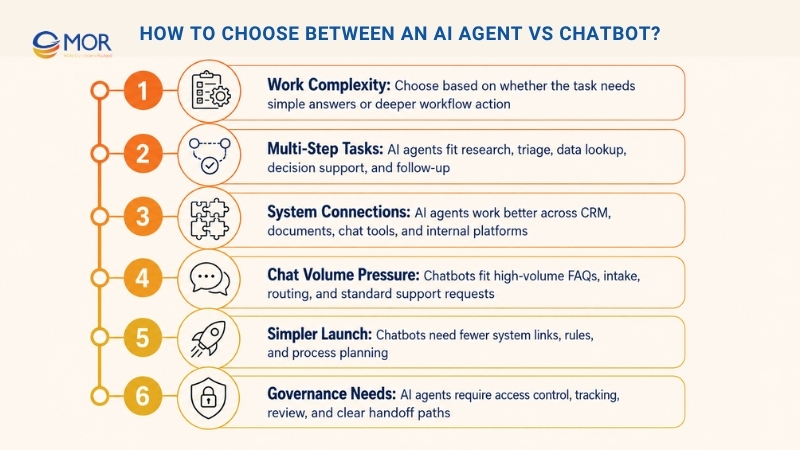
For most companies, the AI agent vs chatbot decision starts with the work you want to fix. Chatbots still work well for front-line customer tasks where speed, steady answers, and light setup matter. AI agents fit better when the job needs richer context, access to business systems, and more than a short chat. Teams with complex workflows, stronger approval needs, or heavier internal tasks often gain more from agents. Smaller companies may begin with a chatbot and add agent workflows when the need becomes clear.
Choose an AI agent when:
- Tasks need several steps, like research, triage, data lookup, decision support, and follow-up.
- Work moves across many systems, including CRM, documents, chat tools, knowledge bases, or internal platforms.
- You need richer personal context, using business data, past records, and user details to shape the result.
- Your team needs more internal output, in work like sales prep, reporting, support tasks, hiring, or knowledge work.
- The task repeats often enough, with enough structure to make stronger automation worth the setup.
- Your business can manage rules and review, since action-taking systems need access control, tracking, and clear handoff paths.
Choose an AI chatbot when:
- Your need is narrow and repeatable, covering FAQs, intake, routing, basic appointments, and standard support requests.
- Your main pressure is chat volume, not the hidden work that happens after the message.
- You need a simpler launch, with fewer system links and less process planning.
- Your use case is a clear customer-facing flow, like policy answers, order status, or appointment details.
- You want fixed and safe conversations, where the tool stays inside a clear scope.
- You are testing demand first, before moving into larger AI agent workflows.
Will AI Agents Replace Chatbots?
As AI keeps improving, AI agents are set to grow fast over the next few years. Their interactions will feel more natural across text, voice, and visual channels, and better context handling will help them return more useful answers over time.
Traditional chatbots may not change as fast as agents, but they will still get better in practical ways. We can expect cleaner user journeys, stronger links with business systems, and easier ways to build custom bot flows and replies.
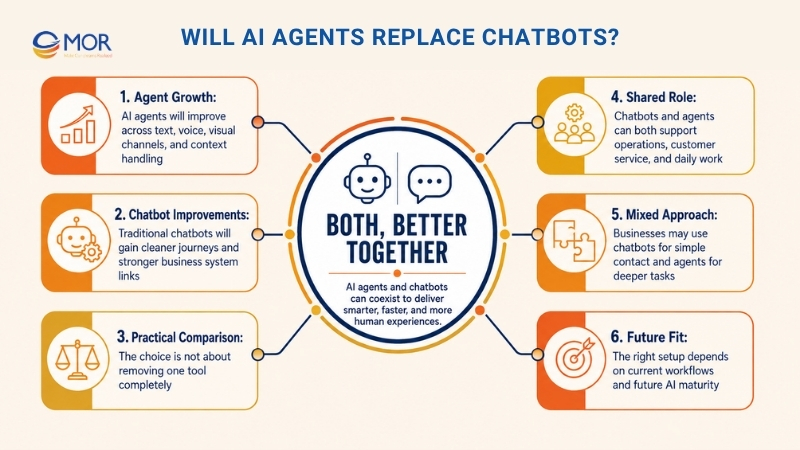
As businesses compare autonomous AI agent vs chatbot options, it helps to see how both can support your work now and later. The agentic AI chatbot vs traditional bots comparison is not about removing one tool and keeping the other. A chatbot, an agent, or a mix of both can all play a real role in daily operations, customer support, and the way people work with technology.
The Future Of AI Agent Vs Chatbot
AI is moving fast, and chatbots and AI agents are improving in different directions. Chatbots are getting stronger at conversation, with more natural replies, better flexibility, and stronger handling of varied user messages. AI agents are moving into broader work, with deeper context and more ability to manage step-by-step tasks with less manual help.
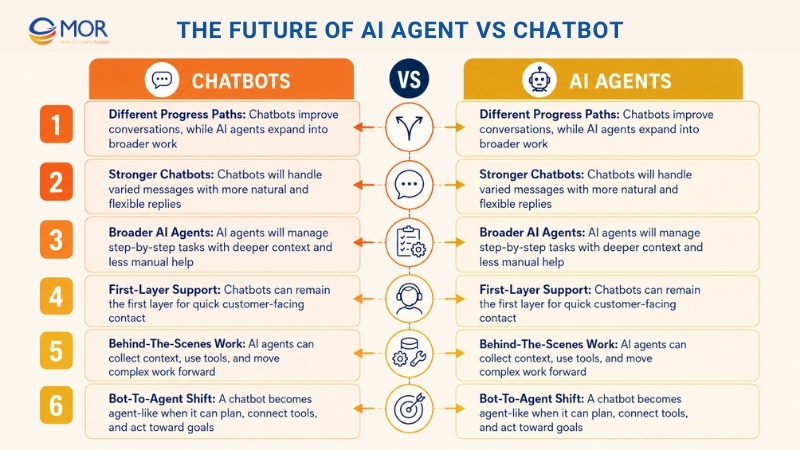
This does not mean agents will simply push chatbots out. In many companies, chatbots will stay as the first layer for quick and simple user contact, mainly in customer-facing work. AI agents can then work behind that layer, taking care of harder tasks: collecting context, using AI automation tools, making choices inside set rules, and moving the work forward.
A chatbot may also turn into an agent when it gains the right abilities. When a chat-based AI system can plan tasks, connect with tools, work with business systems, and act toward goals with limited supervision, it is no longer just a basic bot. The screen may still look like chat, but the system behind it is doing much more.
Invest In An Industry-Leading AI Agent With MOR Software
Choosing between a chatbot and an AI agent is only the first call. The real value comes when that AI agent can read the right data, follow your business rules, work across your systems, and know when to hand a task back to a human.
That is where MOR Software helps. MOR Software works with businesses to design and build AI software development systems that fit real operations, not a neat workflow that only looks good on paper. An AI agent can support customer service, sales, HR, finance, internal support, field work, and many other daily tasks when it is built around the right data and system logic.
Instead of treating AI as a side tool, MOR Software helps you turn it into part of your working system. Our team can support business analysis, AI system design, web and mobile app development, Salesforce connection, system integration, QC testing, and long-term maintenance.
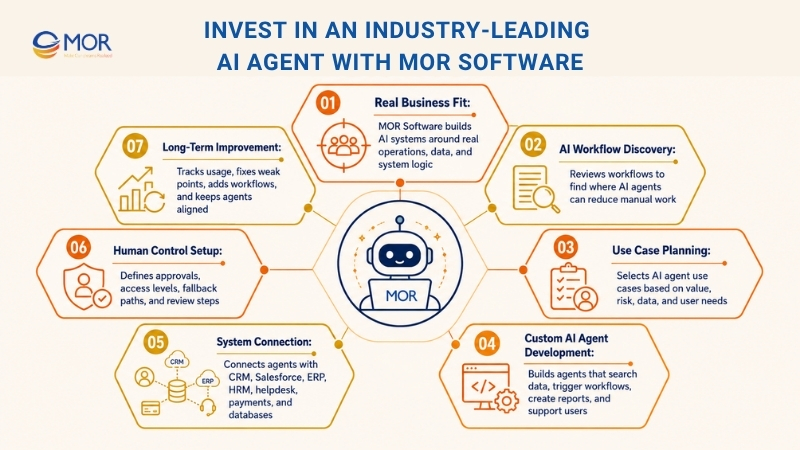
MOR Software can help businesses invest in an industry-leading AI agent through:
- AI Workflow Discovery: Review current customer, employee, and back-office workflows to find where an AI agent can remove manual work.
- Use Case Planning: Choose the right AI agent use cases based on business value, risk, data access, and user needs.
- Custom AI Agent Development: Build AI agents that can search data, trigger workflows, create reports, support users, and carry out task steps.
- System Connection: Connect AI agents with CRM, Salesforce, ERP, HRM, helpdesk, payment gateway integration tools, and internal databases.
- Human Control Setup: Set approval rules, access levels, fallback paths, and review steps so teams stay in control.
- Testing And Security Review: Check system performance, data flow, user experience, and security risks before launch.
- Long-Term Improvement: Track real usage, fix weak points, add new workflows, and keep the AI agent aligned with business needs.
A strong AI agent should not sit outside your business. It should work where your teams already work, with the tools they already trust. MOR Software helps you build that kind of custom AI solution, practical, connected, and ready for real users.
Conclusion
The AI agent vs chatbot choice comes down to the work you need to improve. Chatbots are still useful for fast replies and simple service flows. AI agents make more sense when tasks need context, system access, and follow-up actions. MOR Software helps businesses design, build, test, and maintain AI solutions that fit real operations. Ready to turn AI into part of your working system? Contact MOR Software to discuss your project.
"Evolution is not a destination, it is a disciplined journey of innovation."
Phung Van Tu


CEO MOR AI
MOR SOFTWARE
Frequently Asked Questions (FAQs)
What is the main difference in AI agent vs chatbot?
A chatbot mainly answers questions or guides users through simple flows. An AI agent can understand a goal, collect context, use tools, and take steps to complete a task.
Are an AI agent and a chatbot the same?
No. A chatbot focuses on conversation and direct replies. An AI agent can go further by planning steps, using tools, and acting toward a business goal.
Is an AI agent more advanced than a chatbot?
Yes. An AI agent can handle more complex work because it can reason, plan, and act across connected systems. A chatbot is better for direct replies, FAQs, and guided support.
Can a chatbot use AI?
Yes. Many modern chatbots use NLP or LLMs to understand user questions and reply in a more natural way. Still, they often stay within a limited scope and wait for user prompts.
Is ChatGPT a chatbot or AI agent?
ChatGPT is often used as an AI chatbot or AI assistant because it responds through conversation. In some setups, it can work more like an AI agent when connected to tools, apps, data, and action-based workflows.
Why does the AI agent vs chatbot comparison matter for businesses?
It helps teams avoid buying the wrong tool. A chatbot may solve high-volume support questions, but an AI agent is a better fit when tasks need context, system access, and follow-up actions.
When should a business use a chatbot?
A chatbot works well for FAQs, order tracking, appointment booking, password reset guidance, lead intake, and simple customer routing. It is a good fit when requests are common and predictable.
When should a business use an AI agent?
An AI agent works better for multi-step tasks. It can support ticket triage, sales research, claim follow-up, internal reporting, customer support workflows, and data-based decision support.
Can chatbots and AI agents work together?
Yes. A chatbot can handle simple front-line questions, then pass more complex cases to an AI agent. This setup helps teams keep simple tasks fast and deeper tasks more useful.
Are AI agents safe to use in business workflows?
They can be safe when built with clear rules. Businesses should set permissions, approval steps, human review points, audit trails, and fallback paths before allowing an AI agent to act.
Do AI agents replace human employees?
AI agents are better seen as support tools. They can handle repeat tasks, gather data, and prepare actions, but people still need to review complex cases, manage risk, and make judgment calls.
How should companies approach AI agent vs chatbot adoption?
Start with the workflow, not the tool. Teams should list common requests, map task steps, check data needs, review risk levels, and decide which parts need simple automation or deeper agent-based work.
Share


Make Our-Dreams Realized


© 2023 . MOR Software. All Rights Reserved
Sitemap
Privacy Policy
Terms of Use

Rate this article
0
over 5.0 based on 0 reviews
Your rating on this news:
Name
*Email
*Write your comment
*Send your comment
1