


Top 10 AI Outsourcing Companies in Singapore in 2026
Singapore buyers now choose among local AI firms, regional engineering providers, and global consultancies, often under the same vendor category. This MOR Software guide will compare AI outsourcing companies in Singapore by AI depth, Singapore presence, delivery location, production proof, and project fit. We also separate where a contract is managed from where engineers actually build the system, since those two locations can affect cost, control, and communication.
Key Takeaways
- Singapore works well as an AI contracting and governance hub, but engineering often sits across Vietnam, India, the Philippines, and other regional delivery centers.
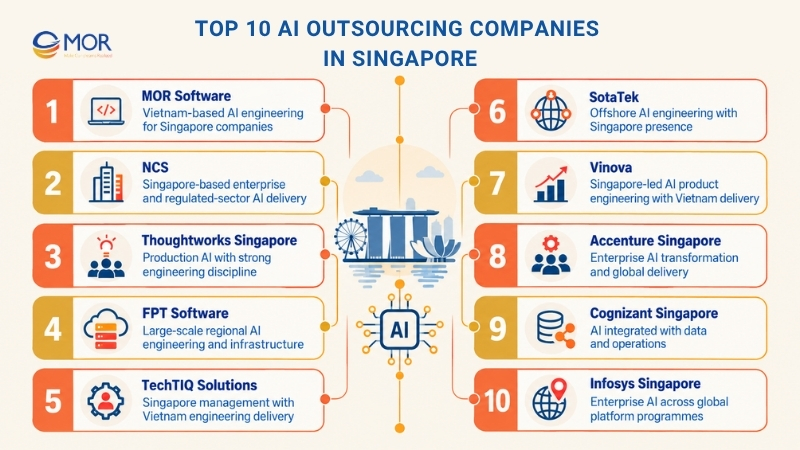
- The ten providers reviewed are MOR Software, NCS, Thoughtworks Singapore, FPT Software, TechTIQ Solutions, SotaTek, Vinova, Accenture Singapore, Cognizant Singapore, and Infosys Singapore.
- Compare production evidence, data ownership, delivery location, MLOps responsibility, and total operating cost before comparing hourly rates alone.
Singapore AI Outsourcing Market in 2026
Demand for AI outsourcing companies in Singapore is growing as more businesses move AI into daily operations. Teams are no longer limiting AI outsourcing to isolated PoCs. Projects now cover GenAI, custom models, agents, predictive systems, data platforms, and AI tied to existing enterprise software.
The latest official data points in the same direction. IMDA reported that SME AI adoption rose from 4.2% in 2023 to 14.5% in 2024, while adoption among non-SMEs moved from 44% to 62.5%.
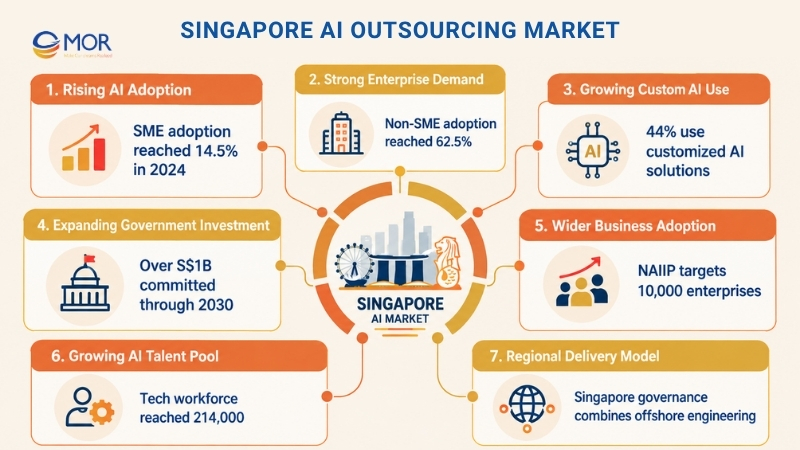
The type of AI firms use is changing too. Among AI-using companies surveyed by IMDA, 84% used off-the-shelf generative AI tools, 52% used domain-specific AI solutions, and 44% had customised or proprietary AI tools. Custom AI has already moved beyond isolated enterprise experiments.
Signal | Latest Evidence | What It Means for AI Outsourcing |
SME AI adoption | 14.5% in 2024 | More mid-market companies are moving beyond early experiments |
Non-SME AI adoption | 62.5% in 2024 | Enterprise demand for production AI is already substantial |
Custom/proprietary AI use | 44% of surveyed AI-using firms | Demand extends past standard GenAI subscriptions |
National AI R&D funding | More than S$1B through 2030 | Singapore continues funding research and talent |
NAIIP target | 10,000 enterprises over 3 years | Public programmes should widen business AI adoption |
Government funding adds another layer. Singapore committed more than S$1 billion from 2025 to 2030 under its National AI Research and Development Plan, covering research and talent development.
The National AI Impact Programme, launched in March 2026, also targets 10,000 enterprises over three years. That programme focuses on moving businesses deeper into practical AI use.
Talent remains part of the buying decision. Singapore's tech workforce reached 214,000 in 2024, and AI and data roles were among the faster-growing job groups. Firms that can't build every AI skill internally can tap an outside team without waiting through a long hiring cycle.
Regional delivery fills the other half of the market. Singapore often handles commercial discussions, project governance, compliance, architecture, or client management, while engineers work in Vietnam, India, or the Philippines.
That split can change the economics considerably. It also explains why two providers with Singapore offices may quote very different prices for similar AI work.
Why Singapore Is the Ideal Choice for AI Outsourcing in 2026
Singapore gives AI outsourcing companies in Singapore a strong base for client management, governance, technology partnerships, and regional project delivery. For buyers, the value comes from combining those local strengths with engineering capacity across Asia.
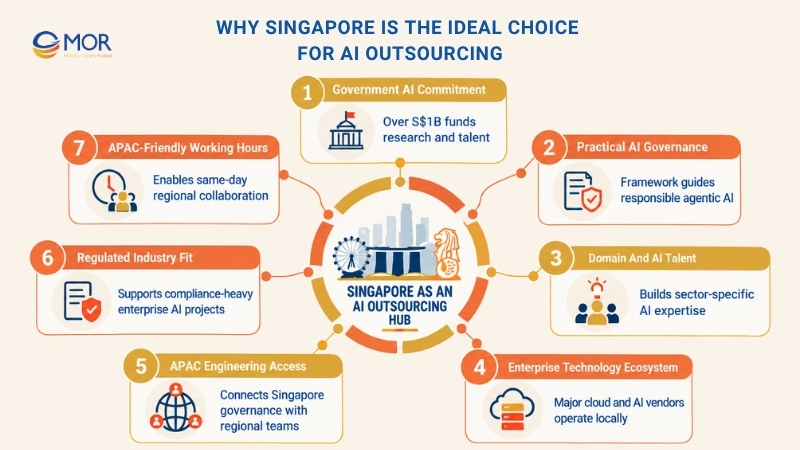
- Government commitment to AI: Singapore refreshed its national AI priorities in 2026 and committed more than S$1 billion to public AI research and talent work through 2030. The policy covers fundamental research, applied AI, and people who can combine sector knowledge with AI skills.
- Practical AI governance: Singapore launched its Model AI Governance Framework for Agentic AI in January 2026 and updated it in May. The guidance covers agent boundaries, human accountability, technical controls, third-party agents, and automation bias.
- Access to domain and AI talent: Singapore's refreshed strategy gives added attention to 'AI bilingual' talent, meaning people who understand a business domain and can apply AI inside it. That mix is useful in finance, healthcare, manufacturing, transport, and public services.
- Deep enterprise technology ecosystem: AWS, Microsoft Azure, Google Cloud, NVIDIA, Salesforce, Databricks, Snowflake, major consulting firms, and local technology groups all operate in Singapore. A buyer can assemble data, cloud, model, security, and software skills in the same regional market.
- Gateway to APAC engineering: Singapore can hold commercial ownership while delivery teams work elsewhere in Asia. Companies studying Vietnam as Southeast Asia's AI development hub will see why the Singapore-Vietnam combination appears often: local governance sits close to the buyer, while a nearby engineering market supplies additional capacity.
- Regional contracting flexibility: Procurement teams sometimes describe this setup as an AI outsourcing company in Singapore APAC model. Singapore handles governance and business coordination, then engineering capacity comes from nearby technology hubs.
- Fit for regulated industries: Singapore has a large concentration of banking, insurance, healthcare, transport, government, and infrastructure work. Vendors serving these sectors regularly deal with data controls, audit requirements, model monitoring, and system integration.
- APAC-friendly working hours: GMT+8 overlaps well with Vietnam, China, Malaysia, the Philippines, Japan, and parts of Australia. Teams can discuss blockers during the same business day instead of waiting overnight for each response.
The result is a practical regional model. Singapore can remain the point of accountability, but buyers still get access to a broader engineering pool when local hiring cost or talent supply becomes restrictive.
Top 10 AI Outsourcing Companies in Singapore for 2026
The providers below were selected for their ability to take responsibility for external AI work, rather than simply selling a software product. In comparing AI outsourcing companies in Singapore, we looked at AI engineering scope, Singapore presence, delivery model, production evidence, and the type of buyer each company suits.
A Singapore presence doesn't always mean the full engineering team works locally. The table makes that distinction explicit.
Company | Singapore Presence | Core AI Capabilities | Delivery Model |
MOR Software | Serves Singapore through regional delivery | GenAI, AI agents, custom AI, ML, data engineering | Offshore team, dedicated team, project-based |
NCS | Singapore-headquartered | Agentic AI, physical AI, video AI, AIOps | Enterprise projects, managed services |
Thoughtworks Singapore | Singapore office + global engineering network | Agentic AI, GenAI, ML, AI factories, data modernization | Technology consulting, product engineering, distributed delivery |
FPT Software | Singapore/APAC presence | GenAI, agentic AI, computer vision, enterprise AI | Global delivery, dedicated teams |
TechTIQ Solutions | Singapore team + Vietnam delivery | ML, GenAI, NLP, computer vision, AI integration | Hybrid delivery, project-based, team extension |
SotaTek | Singapore office + regional delivery | GenAI, AI agents, ML, computer vision, data services | Project-based, dedicated team |
Vinova | Singapore-headquartered | ML, NLP, computer vision, GenAI, AI integration | Product development, dedicated engineering |
Accenture Singapore | Large Singapore practice | GenAI, agentic AI, data, responsible AI | Enterprise transformation programmes |
Cognizant Singapore | Singapore practice | GenAI, Neuro AI, model training, data engineering | Global delivery, managed services |
Infosys Singapore | Singapore/SEA operation | Topaz, agentic AI, data and AI, responsible AI | Global delivery, transformation programmes |
1. MOR Software
Best for: Singapore companies seeking Vietnam-based AI engineering tied to custom software, integrations, QA, and long-term engineering capacity.
MOR Software was founded in Vietnam in 2016 and reports more than 850 completed software projects across 10+ countries. Our current office network covers Vietnam and Japan, so we don't present MOR as a Singapore-incorporated vendor.
Among AI outsourcing companies in Singapore, our position is regional: Singapore businesses can work with a Vietnam engineering team while keeping scope, delivery milestones, and system ownership tied to their internal roadmap.
Core AI outsourcing capabilities:
- AI agents and chatbots: Build task-driven assistants tied to business data, APIs, and internal workflows.
- Generative AI: Connect LLMs to enterprise processes, retrieval systems, and software products.
- Custom AI models: Train Deep Learning and ML models around client-specific data and business logic.
- Data engineering: Prepare acquisition, cleaning, annotation, and pipelines before model work begins.
- Production deployment: Deploy models across cloud or edge setups using containers and modern deployment tooling.
Delivery model and Singapore presence: MOR supports project-based development, dedicated teams, and offshore engineering. Singapore buyers work through cross-border delivery rather than a local MOR office.
Proof of AI delivery: For a Japanese healthcare platform, our team trained an AI model to detect spam reviews and ran the application on AWS for scale and security.
Key strengths:
- Software integration depth: AI work can sit inside mobile, web, Salesforce, cloud, or custom enterprise systems.
- Flexible team setup: Buyers can start around a defined project or extend engineering capacity over time.
- Vietnam delivery base: Offshore engineering gives Singapore buyers access to a nearby GMT+7 talent market.
Considerations: Companies that require a Singapore-incorporated supplier or a fully onshore engineering team should confirm procurement rules before shortlisting MOR.
MOR takeaway: MOR fits companies that need AI tied to real software delivery rather than a strategy-only engagement.
For companies considering that route, our guide to hiring offshore AI developers explains how team structure, technical ownership, time-zone overlap, and vendor management affect delivery.
2. NCS
Best for: Government, healthcare, transport, public safety, and large regulated organisations that need Singapore-based governance and enterprise AI delivery.
NCS is headquartered in Singapore and operates as a Singtel-owned technology services group. Its current AI direction centers on Sunshine.AI, sovereign AI, agentic systems, physical AI, video AI, and enterprise data platforms.
Core AI outsourcing capabilities:
- Agentic AI: AI assistants that can interpret requests, decide on steps, and act within approved controls.
- Sovereign AI: Systems built around local data, security, and governance requirements.
- Video AI: Computer vision for public safety, transport, and operational monitoring.
- Physical AI: AI connected to real-world machines and operational environments.
- AIOps and data platforms: AI applied to enterprise IT and data operations.
Delivery model and Singapore presence: NCS provides strong local leadership in Singapore, backed by delivery resources across Asia Pacific.
Proof of AI delivery: In July 2026, NCS said its latest practitioner playbook drew on more than 100 AI projects, alongside work in healthcare, transport, education, and other enterprise settings.
Key strengths:
- Singapore governance: Strong local contracting and enterprise accountability.
- Regulated-sector experience: Good alignment with public-sector and high-security environments.
- Sovereign AI direction: Relevant when data residency and infrastructure control sit high on the requirement list.
Considerations: The procurement process and programme size may feel heavy for an SME building a small PoC.
MOR takeaway: NCS fits projects where local governance, security, and large-scale operational systems carry more weight than offshore cost savings.
3. Thoughtworks Singapore
Best for: Enterprises that need production AI engineering, agentic systems, data modernization, and strong software engineering practice.
Thoughtworks runs a Singapore office at 18 Cross Street and combines local consulting with a wider international engineering network. Its enterprise AI work covers strategy, AI/ML, GenAI, agentic development, AI factories, and data modernization.
Core AI outsourcing capabilities:
- Agentic AI: Build agents and multi-agent systems tied to enterprise services and controls.
- Generative AI and RAG: Develop knowledge tools, copilots, and retrieval-based systems.
- Machine learning: Create predictive models and software around model outputs.
- AI factories: Establish reusable data, model, and software foundations.
- Data modernization: Prepare older systems for AI workloads.
Delivery model and Singapore presence: Thoughtworks maintains a local Singapore entity but can draw engineering skills from its global office network. Buyers should confirm which roles are local and which are distributed.
Proof of AI delivery: Thoughtworks reports a 90% decrease in manual data search for a life-sciences multi-agent system and 95% target precision for a manufacturing prediction model. The company also works with AI Singapore on GenAI evaluation methods and reliability practices.
Key strengths:
- Engineering discipline: Strong fit where software architecture and AI reliability need equal attention.
- Wide AI scope: Agents, ML, data, GenAI, and platform engineering sit under one practice.
- Singapore ecosystem links: The company has a physical office and a formal collaboration with AI Singapore.
Considerations: Thoughtworks generally suits technically complex programmes better than teams buying low-cost staff augmentation.
MOR takeaway: Consider Thoughtworks when production reliability and software engineering depth drive the vendor decision.
4. FPT Software
Best for: Large enterprises that need sizable regional AI teams, AI infrastructure, and multi-country technology programmes.
FPT Software opened its Singapore operation in 2007. Singapore now plays a regional role in a network backed by a large Vietnam engineering base and delivery locations across more than 30 countries and territories.
Core AI outsourcing capabilities:
- Generative AI: Enterprise applications built around LLMs and domain data.
- Agentic AI: Reasoning and agent workflows for business operations.
- Computer vision: Visual AI used in industrial and enterprise scenarios.
- AI infrastructure: GPU-backed AI Factory services.
- Enterprise modernization: AI linked to data, cloud, automation, and legacy-system work.
Delivery model and Singapore presence: Singapore handles regional business activity, while the broader delivery network gives FPT access to a much larger engineering pool.
Proof of AI delivery: FPT AI Factory expanded its infrastructure in March 2026 using NVIDIA HGX B300 systems. In June, FPT and Singapore's Sembcorp Development signed an MoU covering AI, digital infrastructure, and related APAC initiatives.
Key strengths:
- Large engineering bench: Suitable for programmes that need several technical disciplines.
- AI infrastructure investment: FPT AI Factory gives clients access to enterprise compute and AI services.
- Regional scale: Singapore governance can connect to larger delivery operations abroad.
Considerations: Small companies should confirm minimum scope, team size, and governance overhead before moving forward.
MOR takeaway: FPT fits large AI and modernization programmes where scale and regional engineering capacity are high priorities.
5. TechTIQ Solutions
Best for: Singapore startups, SMEs, and mid-market firms that want local project management backed by Vietnam engineering.
TechTIQ Solutions was founded in Singapore in 2017. The company states that its Singapore staff lead project management and QA, while engineering delivery sits in Vietnam, supported by consultants in the US and Australia.
Core AI outsourcing capabilities:
- Machine learning: Custom predictive models and business AI applications.
- Deep learning: Neural-network work for data-heavy use cases.
- NLP: Text analysis and language-driven applications.
- Computer vision: Image and visual recognition systems.
- AI PoC and MVP work: Early builds used to test feasibility before a wider rollout.
Delivery model and Singapore presence: TechTIQ uses a hybrid setup, with client-facing QA and PM work in Singapore and development resources in Vietnam.
Proof of AI delivery: The company reports 350+ software engineers and 800+ completed software projects, though buyers should separate company-wide software counts from AI-only delivery when reviewing proof.
Key strengths:
- Hybrid operating model: Local management sits close to the client.
- SME fit: PoC and MVP work can suit smaller scopes.
- Technical range: AI can sit beside web, cloud, mobile, and enterprise software.
Considerations: Ask for an AI case tied closely to your industry rather than relying on company-wide project volume.
MOR takeaway: TechTIQ suits buyers that want Singapore-side project control and Vietnam-based engineering in one vendor setup.
For projects centered on predictive models or custom ML workloads, machine learning outsourcing can be evaluated separately from broader GenAI work. Data readiness, model testing, retraining, and MLOps usually carry more weight in those engagements.
6. SotaTek
Best for: Companies that need offshore AI engineering, computer vision, data work, or AI agents through an APAC delivery network.
SotaTek is Vietnam-origin and maintains a Singapore office at 30 Cecil Street. Its current group has delivery locations across Vietnam, Japan, Korea, Singapore, Australia, the US, and Dubai.
Core AI outsourcing capabilities:
- AI agents: SotaAgents supports building and deploying agents linked to enterprise data.
- Computer vision: Visual inspection, recognition, and image-based systems.
- NLP: Language analysis and AI communication tools.
- Data and image annotation: Preparation work for ML and computer vision.
- AI automation: AI assistants and workflow automation tied to business systems.
Delivery model and Singapore presence: Singapore gives SotaTek a local regional contact point, while core engineering capacity remains distributed, particularly through Vietnam.
Proof of AI delivery: At AI Day 2026, SotaTek presented SotaVision for visual inspection, SotaMed for medical imaging workflows, and Saydi for real-time AI voice translation.
Key strengths:
- Broad offshore delivery: Access to AI and general software engineers under one group.
- Computer vision depth: Strong fit for visual inspection and image data.
- Agent development: SotaAgents creates a direct entry point for enterprise agent projects.
Considerations: Confirm the exact location and seniority of engineers assigned to your account.
MOR takeaway: SotaTek is relevant when an AI project needs an offshore team plus a Singapore point of contact.
7. Vinova
Best for: Singapore SMEs and mid-market companies building AI into mobile, web, SaaS, government, or enterprise products.
Vinova is headquartered in Singapore and also runs delivery offices in Ho Chi Minh City, Hanoi, and Da Nang. Its setup combines local business oversight with engineering capacity in Vietnam.
Core AI outsourcing capabilities:
- Machine learning: Predictive models for business workflows and data systems.
- Generative AI: LLM applications and enterprise integration.
- Computer vision: Image analysis and visual automation.
- AI integration: AI connected to existing web, mobile, ERP, and enterprise applications.
- Dedicated engineering: Long-term teams working from Vinova offices in Singapore and Vietnam.
Delivery model and Singapore presence: Singapore is the company headquarters. Vinova's Vietnam centers support offshore development under the same delivery structure.
Proof of AI delivery: Vinova reports a central-banking project for Singapore's Monetary Authority involving secure system architecture and long-term operations. Its 2026 public-sector work also includes ML and GenAI MVP development.
Key strengths:
- Singapore headquarters: Useful for buyers who prefer direct local contracting.
- Vietnam capacity: Gives clients another cost layer for engineering.
- Broader product engineering: AI can sit inside a larger digital platform rather than run as an isolated model.
Considerations: Ask which AI capabilities are delivered by Vinova's own team and which depend on outside model or cloud providers.
MOR takeaway: Vinova works well for Singapore buyers combining local account ownership with offshore product engineering.
8. Accenture Singapore
Best for: Large organisations seeking AI strategy, data work, engineering, operating-model change, and global programme delivery under one supplier.
Accenture has a large Singapore AI & Data practice serving Southeast Asia. Its Singapore AI Refinery Engineering Hub, announced in 2024 with EDB support, focuses on applied AI research, foundation-model development, and responsible AI work.
Core AI outsourcing capabilities:
- Generative AI: Enterprise LLM applications and AI Refinery services.
- Agentic AI: Agents connected to business processes and digital platforms.
- AI strategy: Portfolio planning and enterprise operating-model work.
- Data foundations: Data architecture and preparation for AI programmes.
- Responsible AI: Governance controls connected to model development and deployment.
Delivery model and Singapore presence: Accenture can place programme leadership in Singapore and draw engineering resources from its global delivery network.
Proof of AI delivery: Accenture's Singapore practice points to work with UOB on generative and agentic AI, plus its DIVA digital factory work with Changi Airport Group.
Key strengths:
- Enterprise breadth: Data, cloud, AI, security, and consulting can sit inside one programme.
- Local AI hub: Singapore has dedicated AI engineering and research activity.
- Sector depth: Banking, government, infrastructure, and other large-enterprise work are established areas.
Considerations: Programme size, commercial rates, and procurement process can sit well above what a startup or small MVP needs.
MOR takeaway: Accenture fits enterprise-wide AI programmes that need global delivery and heavy organisational change.
9. Cognizant Singapore
Best for: Enterprises adding AI to broader data, cloud, software engineering, or business-process programmes.
Cognizant's Singapore AI practice covers generative AI, data management, data modernization, business intelligence, AI, and data strategy. Neuro AI adds model, tool, and deployment services for enterprise GenAI.
Core AI outsourcing capabilities:
- Generative AI: Enterprise GenAI applications and model services.
- Neuro AI: Platform services for production enterprise AI.
- AI model training: Model preparation tied to specific business data and tasks.
- Data modernization: Cloud and data architecture work before AI rollout.
- AI business accelerators: Pre-built components for business processes.
Delivery model and Singapore presence: The Singapore operation connects local client work to Cognizant's international engineering and managed-service network.
Proof of AI delivery: In one banking engagement, Cognizant reports automation across more than 10 million daily transactions, 50% faster AML case identification, and 30% cost savings in reporting work.
Key strengths:
- Data plus AI: Useful when AI work depends on large data estates.
- Managed services: Suits long-running enterprise operations after go-live.
- Industry knowledge: Banking, insurance, and life sciences are major areas.
Considerations: Smaller teams may find Cognizant's enterprise delivery model larger than required for an early-stage experiment.
MOR takeaway: Cognizant fits AI projects connected to a wider enterprise data and operations programme.
10. Infosys Singapore
Best for: Global enterprises connecting AI to ERP, data, cloud, governance, and business operations across several markets.
Infosys maintains Singapore offices, including its Suntec location. Infosys Topaz forms the center of its current AI services, covering GenAI, applied AI, agent systems, data, analytics, and responsible AI.
Core AI outsourcing capabilities:
- Infosys Topaz: AI services, models, platforms, and reusable assets.
- Agentic AI: Enterprise agents and orchestration.
- Data and analytics: Data foundations for AI-led operations.
- AI consulting: Business use-case mapping and programme planning.
- Responsible AI: Tools for governance, model risk, security, and privacy.
Delivery model and Singapore presence: Infosys combines local Singapore operations with one of the industry's largest global delivery networks.
Proof of AI delivery: Infosys Topaz lists 12,000+ AI assets, 150+ pre-trained AI models, and 10+ AI platforms. In June 2026, IHH Healthcare selected Infosys for an AI-powered ERP programme covering Hong Kong, Malaysia, and Singapore.
Key strengths:
- Large reusable AI portfolio: Useful for enterprises that want pre-built starting points.
- ERP and data depth: AI can sit inside a wider enterprise system programme.
- Global capacity: Suitable for multi-country rollouts.
Considerations: Procurement complexity and programme scale may make Infosys less suitable for small, narrow AI builds.
MOR takeaway: Infosys fits large organisations that need AI connected to enterprise platforms across markets.
Each provider above brings different strengths in AI expertise, industry focus, and delivery models. Buyers building a broader shortlist can also compare top AI software development companies across other markets before narrowing the list to Singapore.
How to Evaluate AI Outsourcing Companies in Singapore?
A convincing AI demo can hide weak engineering. Vendor evaluation should test how the team handles data, models, software, deployment, ownership, and long-term operation after the presentation ends.
If your project requires software built around proprietary workflows, the same checks apply when choosing a custom AI development company. General consulting strength alone doesn't prove the vendor can own model engineering, integration, testing, and production support.
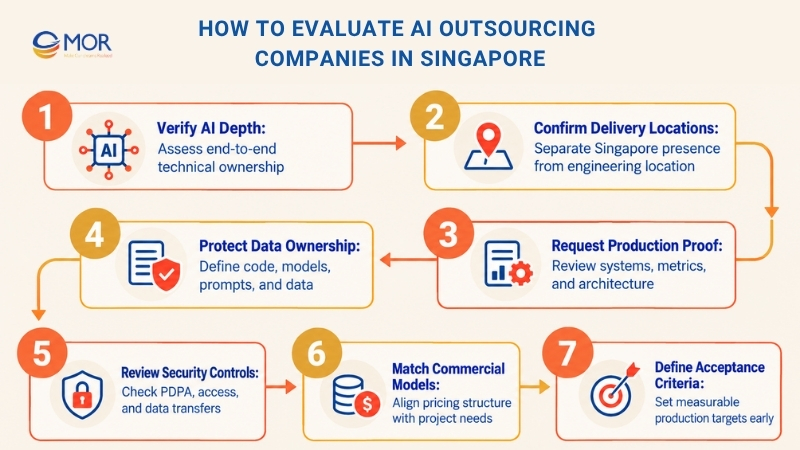
- Verify AI depth: Ask who owns data preparation, architecture, model selection, evaluation, RAG design, agent orchestration, deployment, and MLOps. A vendor that delegates most of those areas to third parties gives you less technical control.
- Separate Singapore presence from engineering location: Confirm where the legal contract sits, where PMs work, where data is processed, and where engineers write code. A buyer comparing an AI outsourcing company in Singapore and China, for instance, should compare data rules and delivery locations separately rather than treating the country name as proof of where work takes place.
- Request production proof: Ask for a working system, architecture diagram, model evaluation results, client reference, or production metric. A logo wall tells you who signed a contract, not what the vendor actually built.
- Check data and model ownership: Put source code, model weights where applicable, fine-tuned models, prompts, vector indexes, training data, generated assets, and documentation into the contract. Ambiguous ownership gets expensive at handover.
- Review PDPA and security controls: Map where personal data is collected, stored, processed, and transferred. Check encryption, role-based access, audit logs, model providers, cloud regions, subprocessors, and cross-border transfer rules.
- Match the commercial model to the work: A fixed-price project suits a tightly scoped PoC. Time and materials works better when requirements will change, and a dedicated team fits a product roadmap where the same engineers need to retain system knowledge.
- Test post-launch responsibility: Ask who monitors drift, hallucination rates, retrieval quality, latency, API failure, token cost, and model changes. Production AI needs care after release.
- Check costs outside engineering: Model APIs, GPU compute, vector databases, data labeling, observability, retraining, cloud storage, security scanning, and support can change total cost well after the development quote has been signed.
- Meet the people doing the work: Ask the solution architect, lead engineer, data engineer, or ML engineer to join the technical review. Sales presentations can sound similar. Engineering answers rarely do.
- Set measurable acceptance criteria: Define target accuracy, precision, recall, latency, cost per transaction, automation rate, or human-review rate before development. Clarion's competitor guide makes a similar point: define the production outcome before the RFP becomes a debate about vendor claims.
The vendor type matters too. Businesses that need strategy, operating-model work, and change management may want to compare the best AI consulting firms separately from engineering-first outsourcing companies.
A structured evaluation also protects you from 'AI wrapper' projects that connect an API to a UI but leave data quality, model evaluation, integration, and production monitoring unresolved.
AI Outsourcing Costs and Delivery Models in Singapore
Pricing across AI outsourcing companies in Singapore changes sharply based on where engineers sit and what the vendor owns. Model complexity matters, but data preparation, integration, security, regulatory work, and production support can move the budget just as quickly.
Teams building early budgets can use our guide to estimating AI development costs alongside vendor quotations. It helps separate development spend from cloud, model APIs, data preparation, infrastructure, testing, and long-term operations.
Second Talent's September 2026 benchmark places a senior AI engineer on a Singapore contract at roughly $110 to $160 per hour. Its Vietnam benchmark puts the same seniority around $55 to $80 per hour, which explains the appeal of Singapore-plus-offshore models.
Delivery Model | Best For | Estimated Cost (USD) | Cost Structure | Buyer Control | Main Trade-Off |
Fixed-price AI project | Defined PoC, MVP, or scoped AI system | $30,000 to $200,000+ per project | Agreed project fee | Medium | Scope changes can increase cost |
Time and materials | AI products with changing requirements | $55 to $160/hour for senior AI engineering | Hourly or daily rate | High | Final budget is less predictable |
Dedicated AI team | 6+ month AI roadmap | $15,000 to $45,000+ per month | Monthly team fee | High | Requires active product ownership |
Staff augmentation | ML, GenAI, data, or MLOps skill gaps | About $9,000 to $26,000 per senior engineer/month | Per-engineer rate | Very high | Client manages delivery directly |
Managed AI service | Monitoring, retraining, MLOps, production support | About 15% to 25% of initial build cost per year | Recurring support fee | Lower | Higher vendor dependency |
Singapore + offshore hybrid | Local governance plus regional engineering | About $25,000 to $50,000+ per month for a small blended team | Blended rate | High | Roles and ownership need clear boundaries |
The project and dedicated-team ranges come from Kaopiz's 2026 Singapore AI outsourcing guide. That source places project work at $30,000 to $200,000+, dedicated AI teams at $15,000 to $45,000 per month, and post-launch MLOps at around 15% to 25% of initial build cost per year.
Staff augmentation can be estimated from the hourly bands. At roughly 160 billable hours per month, senior AI engineering at $55 to $160 per hour maps to about $8,800 to $25,600 monthly before any separate vendor fees.
The hybrid-team figure is an indicative planning range, not a market tariff. The final number depends on how many architects, AI engineers, data engineers, QA staff, and Singapore-side managers sit on the account.
Don't stop at the development invoice. LLM inference, GPUs, data pipelines, vector storage, security work, observability, model evaluation, and retraining all remain part of the operating cost.
When AI Outsourcing Beats Building an In-House Team
Choosing among AI outsourcing companies in Singapore makes sense when your company needs scarce skills quickly, has a defined delivery deadline, or doesn't want to carry a permanent AI team before the business case is proven.
An internal team becomes more attractive once AI turns into long-term intellectual property and product knowledge must stay inside the company. Hybrid delivery sits between the two: internal leaders own the roadmap and architecture, while an outside team supplies engineering capacity.
Situation | Outsourcing | In-House | Hybrid |
Need specialist skills quickly | Strong fit | Slow hiring | Strong fit |
One defined AI project | Strong fit | Often inefficient | Possible |
AI is core long-term IP | Useful for initial build | Strong fit | Strong fit |
Team lacks MLOps expertise | Strong fit | Requires hiring | Strong fit |
Strict internal control required | Depends on vendor | Strong fit | Strong fit |
Need rapid scale-up/down | Strong fit | Difficult | Strong fit |
Outsourcing works well when a company needs a computer vision engineer for six months, wants to test RAG before building an AI department, or needs an ML platform connected to an existing product.
A dedicated internal team makes more sense when models sit at the center of the product and the company can support data science, platform engineering, security, QA, MLOps, and product management for years.
Hybrid delivery gives buyers another route. Internal staff keep product and architecture ownership, and outside engineers fill gaps or take responsibility for defined work packages.
That model also suits an AI outsourcing company in APAC relationship where the client's product owner sits in Singapore, architecture stays internal, and engineering capacity comes from Vietnam or another regional market.
The economics become clearer when projects run for years. Vendor management fees make sense when the vendor owns delivery risk. If your internal team already manages the engineers directly, staff augmentation or direct hiring may cost less.
Conclusion
Choosing among AI outsourcing companies in Singapore comes down to AI depth, delivery geography, production proof, ownership, and long-term operating cost. A Singapore office can support local governance, but engineering location still shapes price and talent access. MOR Software supports Singapore teams through Vietnam-based AI and software engineering across custom models, GenAI, agents, data work, integration, QA, and long-term dedicated teams.
Contact us to share your use case, data situation, timeline, and preferred delivery model so we can discuss a practical project setup.
"Evolution is not a destination, it is a disciplined journey of innovation."
Phung Van Tu


CEO MOR AI
MOR SOFTWARE
Frequently Asked Questions (FAQs)
What is AI outsourcing?
AI outsourcing involves hiring external specialists to handle tasks like AI model creation, machine learning development, and data-related work such as labeling and annotation. It can also include using AI-powered agents to automate processes like data entry and document management, helping businesses save time and improve accuracy.
What AI services can companies outsource in Singapore?
Companies can outsource machine learning, predictive analytics, GenAI applications, RAG systems, AI agents, NLP, computer vision, data engineering, data annotation, AI integration, and MLOps.
The stronger AI outsourcing companies in Singapore usually connect those AI tasks to broader software architecture. That matters when the model must work inside Salesforce, an ERP, a mobile application, an internal data platform, or a customer portal.
How much does AI outsourcing cost in Singapore?
Current published benchmarks vary widely. Project engagements can fall around $30,000 to $200,000+, and dedicated AI teams may sit around $15,000 to $45,000+ per month, depending on composition and delivery geography.
Local engineering generally costs more than Vietnam or the Philippines. Architecture, data readiness, model APIs, compliance work, cloud infrastructure, and post-launch support can also change total spend.
How long does an outsourced AI project usually take?
A narrow PoC may take several weeks. An MVP normally takes longer because data work, software integration, testing, model evaluation, and deployment sit around the AI component.
Production platforms can run for several months or become an ongoing programme. A vendor should set timing after reviewing the use case, available data, integration points, acceptance metrics, and security requirements.
Does an AI outsourcing company need a Singapore office?
No. A Singapore office becomes useful when procurement, local contracting, regulated data, or face-to-face governance requires it. A regional vendor can still serve Singapore through offshore delivery if your company permits cross-border contracting and data processing.
Some cross-border procurement briefs use wording like AI outsourcing company in Singapore for foreigner when the actual requirement is simpler: an overseas buyer needs a supplier that can contract internationally and communicate in English. Verify the legal entity rather than relying on a marketing address.
What is the best engagement model for an AI project?
Fixed-price work fits a defined scope with stable acceptance criteria. Time and materials suits AI products where model behavior or requirements will change during development.
A dedicated team fits a longer roadmap, and staff augmentation works when your company already owns architecture and project management. Managed services suit production systems where the vendor keeps responsibility for monitoring and support.
How should companies check an AI vendor's technical capability?
Ask for production evidence instead of a generic AI portfolio. Review architecture, data pipelines, model evaluation, security controls, deployment approach, MLOps process, and the engineers assigned to the account.
A short technical workshop can expose gaps quickly. Ask how the team tests hallucination, retrieval quality, model drift, latency, failure handling, access control, and human review.
How does Singapore's PDPA affect outsourced AI projects?
PDPA requirements can affect what personal data the AI system collects, where that data is stored, who gets access, and how information moves across borders. Your contract should map data ownership, subprocessors, cloud regions, access controls, retention, and deletion.
Singapore's 2026 Agentic AI governance work adds practical guidance for organisations deploying AI agents, including human accountability and controls over agent access.
Should a company outsource AI or build an internal team?
Outsource when speed, specialist skills, flexible capacity, or a defined project are the main requirements. Build internally when AI is a core product asset and your company can support the full engineering and operations stack for the long term.
Hybrid delivery often works well during the transition. Your team keeps product knowledge and architecture ownership, then the vendor supplies missing AI or software roles.
What should be included in an AI outsourcing contract?
State the deliverables, acceptance criteria, project milestones, data rights, source-code ownership, model ownership, documentation, security duties, cloud costs, third-party model fees, support terms, and handover process.
Cross-border delivery deserves extra detail. A brief that asks for an AI outsourcing company in Singapore and China should also state where engineers may access data, which legal entity signs the contract, and which country's rules apply to each data flow.
Share


Make Our-Dreams Realized


© 2023 . MOR Software. All Rights Reserved
Sitemap
Privacy Policy
Terms of Use

Rate this article
0
over 5.0 based on 0 reviews
Your rating on this news:
Name
*Email
*Write your comment
*Send your comment
1