


Vietnam: Southeast Asia’s Next Destination for AI Development Hub
Finding skilled AI teams at a workable cost is getting harder across Asia. AI development in Vietnam gives companies access to trained engineers, lower project rates, and growing public support for data, cloud, and research. In this guide, MOR Software explains why Vietnam is becoming Southeast Asia’s next AI development hub and what businesses should expect through 2030.
Key Takeaways
- Vietnam combines a growing AI workforce, strong software skills, public funding, and competitive development costs.
- Local teams support AI work across machine learning algorithms, NLP, computer vision, cloud systems, testing, and product delivery.
- MOR Software turns Vietnam’s technical strengths into business-ready AI products for clients across global markets.
Vietnam Current Market Capabilities
Vietnam is home to about 300 recognized machine learning developers, including researchers, system architects, and experts known within the international technology community. The number may look small at first, but it is strong when measured against the country’s population and economy.
A much larger workforce supports this expert group. Around 74,000 technology companies employ more than one million IT workers across Vietnam. These firms help junior developers gain real project experience before moving into focused technical roles.
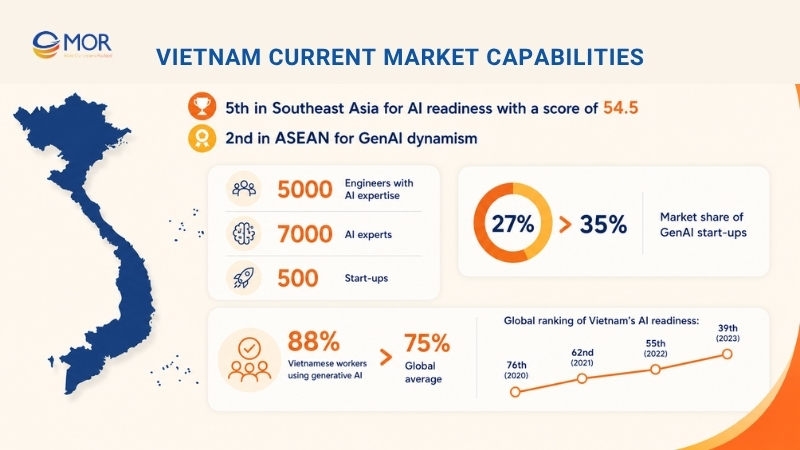
Vietnamese AI teams have built practical skills across several major fields:
- Machine Learning And Data Engineering: Local teams work on model creation, data preparation, parameter tuning, and live system deployment. Many have released machine learning systems at scale and understand the gap between an algorithm that works in testing and one that performs under real business conditions.
- Language AI And Text Processing: This is one of Vietnam’s strongest technical areas. Vietnamese is tonal and mainly monosyllabic, with grammar that differs greatly from most European AI languages. Local engineers build Vietnamese tools for chatbots, document review, search, and opinion analysis. The same knowledge can support work with other Southeast Asian languages and gives Vietnamese teams a clear regional edge.
- Visual Recognition Systems: Development teams handle image grouping, object recognition, semantic segmentation, and video review. Common business uses include factory inspection, smart machines, security monitoring, and medical support tools.
- Cloud Engineering Skills: Certifications in AWS, Google Cloud, and Microsoft Azure are common among established Vietnamese software teams. This knowledge helps AI products connect with the cloud systems already used by large companies.
How AI Systems Are Reshaping Vietnam’s Technology Market
AI use in Vietnam is moving beyond trials and research labs. Banks apply it to detect suspicious payments, online stores use it for product matching and customer support, and factories use visual recognition for inspection work. Hospitals and public agencies are also testing AI for data review and document handling, making the technology part of daily work.
Vietnam’s wider technology sector is helping this shift move faster. The industry reached about $198 billion in 2025, rising 26%, and included more than 80,000 companies. The digital economy reached $39 billion, up 17%, while online retail sales reached $36 billion. This business activity supports wider use of chatbots, recommendation engines, demand forecasts, and related AI tools. AI funding also grew about eight times between 2023 and 2024.
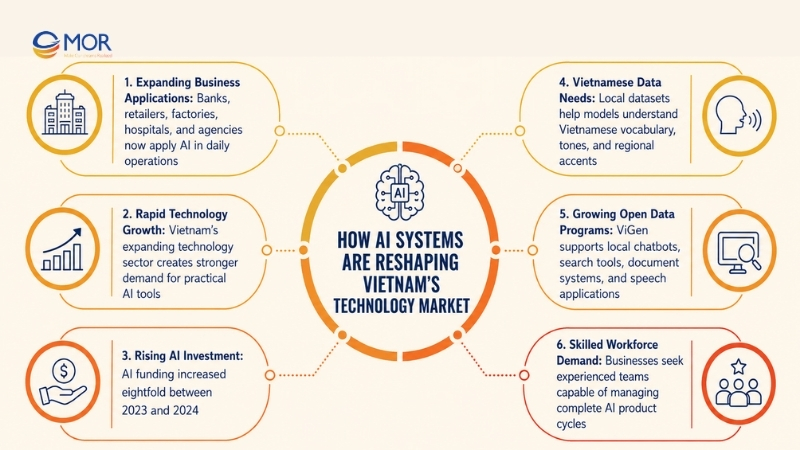
Local information plays a large part in building useful systems. Models created for foreign markets often miss Vietnamese word choice, tone, and local speech patterns. Businesses therefore need systems trained with Vietnamese data. Programs like ViGen are working to create open datasets for local chatbots, search engines, document tools, and speech systems that can understand regional accents.
A shortage of ready workers also affects how companies start AI projects. Vietnam has about 1.2 million technology workers, yet only around 30% of new graduates are ready for full-time technical work. Many businesses now choose experienced development teams that can manage the full AI product cycle. Strong business demand, local data work, and growing regional interest are pushing Vietnam toward AI products built for real local needs.
What Sets Vietnam Apart In Southeast Asia’s AI Market
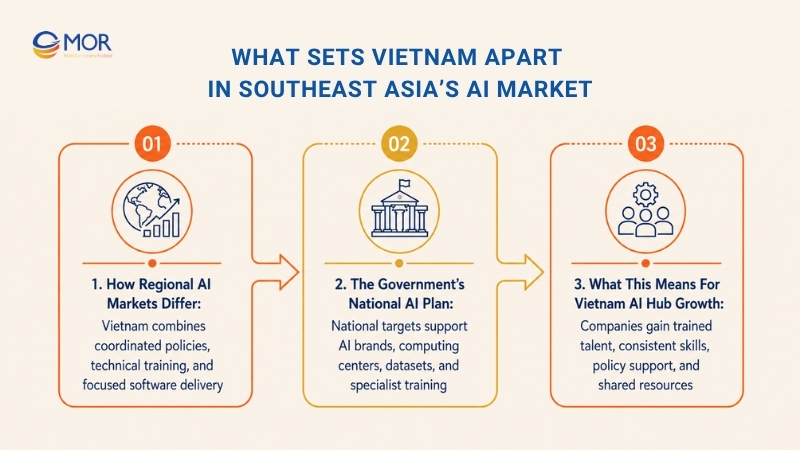
Southeast Asian countries are taking different paths into AI. Vietnam stands out because public planning, technical training, and software delivery are developing at the same time.
How Regional AI Markets Differ
Competition for AI work across Southeast Asia has grown as more governments treat the field as a national priority. Yet the region still lacks one shared machine learning model, since each country follows its own economic and technical plan.
Singapore holds the premium position. About 44% of Southeast Asia’s established AI startups began there, supported by public funding, mature systems, and an early start. Yet engineering work often costs between $80 and $150 per hour, which can place Singapore outside the budget of startups and medium-sized companies.
Indonesia has the region’s largest general technology workforce, but its formal AI training system and public programs remain less coordinated. The Philippines has deep experience in business process outsourcing, though much of that market still centers on customer service and back-office work rather than focused AI engineering.
Vietnam follows a different path. It does not compete mainly through premium branding or large BPO operations. Instead, the country is building a focused AI delivery market through three connected areas: a state-backed AI plan, faster technical training, and wider use of recognized delivery standards within the software outsourcing sector.
The Government’s National AI Plan
Vietnam’s Politburo approved a national AI strategy with targets set for 2030. The plan aims to place Vietnam among the four leading AI markets in ASEAN and within the global top 50. Public funding, training goals, and data programs support this target, so it goes beyond a broad policy statement.
The plan includes set numbers. Vietnam seeks to develop 10 recognized Vietnamese AI brands, build three national data and high-performance computing centers, and connect 50 open datasets across key industries. It also targets 8,000 AI graduates each year by 2030, followed by 15,000 per year by 2035.
This state-led model differs from Singapore’s stronger private market focus and India’s broad company-led growth. Vietnam has chosen to treat AI as national infrastructure, much like earlier public programs for chip production, telecommunications, and vehicle manufacturing.
The Vietnam AI Academy shows how this plan works in practice. The government, Hanoi University of Science and Technology, and NVIDIA created the program together. It plans to train 2,000 learners during its first year, 6,000 in the second, and between 8,000 and 10,000 in later years. This creates a formal training route based on international study standards rather than short private courses alone.
What This Means For Vietnam AI Hub Growth
These national decisions create direct business benefits for companies seeking offshore gen AI platform intergration partnerships in Vietnam:
- Stable Access To Trained People: Companies do not need to depend only on a small freelance market. They can recruit through organized training routes with clear study standards and certificates recognized outside Vietnam.
- More Consistent Technical Skills: Public training programs follow current industry needs. This helps limit large skill gaps between candidates, which often cause delivery problems in less organized outsourcing markets.
- Long-Term Policy Support: A national plan gives the AI sector a more stable direction. Development work is less likely to lose public attention when business trends change.
- Shared Computing And Data Resources: Planned computing centers and connected datasets can remove technical limits faced by countries where companies must fund every data and computing need on their own.
Vietnam’s AI Hub Is Taking Shape Through Global Research Links
Vietnam’s AI growth now reaches beyond hiring and technical training. Universities, research groups, global technology firms, and investors are building closer links that connect local talent with global knowledge and funding.
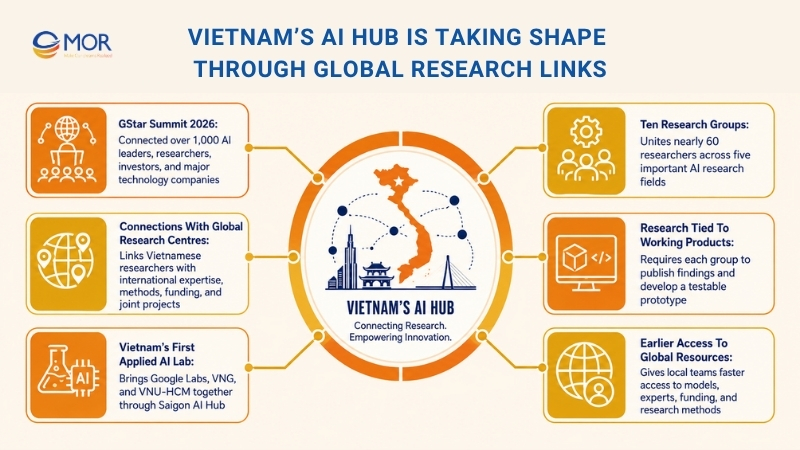
- GStar Summit 2026: More than 1,000 technology leaders, researchers, and investors gathered in Ho Chi Minh City. Speakers from Google, Qualcomm, FPT, Grab, and MoMo discussed agentic AI safety, healthcare, financial access, and language preservation.
- Connections with global research centres: The summit linked Vietnamese researchers with specialists in Silicon Valley and other Asia-Pacific markets. These relationships can bring new research methods, technical support, and joint development projects.
- Vietnam’s first Applied AI Lab: In May 2026, Google Labs’ AI Futures Fund, VNG, and Vietnam National University Ho Chi Minh City launched the lab through Saigon AI Hub.
- Ten research groups: The first cohort includes nearly 60 researchers from universities across Ho Chi Minh City. Their work covers computational linguistics, computer vision, human-robot interaction, healthcare, and cybersecurity.
- Research tied to working products: Each group plans to publish its findings and build at least one working prototype. This creates a shorter path between academic studies and software that businesses can test.
- Earlier access to global resources: International labs can give Vietnamese researchers access to new multimodal AI models, expert guidance, and funding networks. Local teams can study new methods sooner and apply them to real business needs.
These connections add another layer to Vietnam’s AI position. The country can train engineers, run research projects, and turn new ideas into working products instead of competing mainly through labour prices.
The Compute Test Behind Vietnam’s AI Ambition
AI teams need reliable systems to train, test, and run their models. Vietnam’s progress now depends on data centres, cloud services, computing capacity, electricity, secure data systems, and fast network connections.
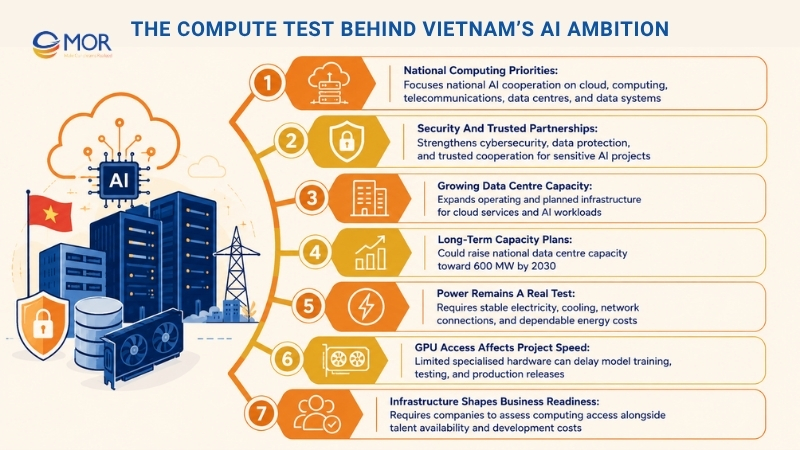
- National computing priorities: The Ministry of Science and Technology has placed data centres, cloud computing, high-performance computing, telecommunications, and national data systems among Vietnam’s AI cooperation priorities.
- Security and trusted partnerships: Current plans also cover cybersecurity, data protection, and trusted agentic AI solution development services. These areas matter when businesses work with sensitive customer, financial, or public data.
- Growing data centre capacity: Industry estimates place Vietnam’s operating capacity above 100 MW. One estimate lists about 148 MW in operation and roughly 80 MW under construction, with larger projects planned for Hanoi and Ho Chi Minh City.
- Long-term capacity plans: Market forecasts suggest national data centre capacity could approach 600 MW by 2030. New projects may support cloud services, AI workloads, and local data storage.
- Power remains a real test: Planned capacity does not always become usable computing power. Data centres need steady grid access, cooling systems, international connections, and dependable energy prices.
- GPU access affects project speed: Larger models require specialised hardware. Limited GPU access can slow model training, testing, and production releases, even when skilled engineers are available.
- Infrastructure shapes business readiness: Salary comparisons show development costs, but they do not show whether local systems can support data-heavy AI products. Companies must review computing access as carefully as talent and rates.
Vietnam is linking talent plans with data, computing, and AI governance. Its next stage will be measured through working research labs, available GPU capacity, reliable power, and AI systems running in real business settings.
Quality Control And Business-Level Dependability
Lower costs have little value when a product fails after launch. Vietnam’s stronger software companies use formal process controls, security rules, and AI testing methods to support business systems that must run at scale.
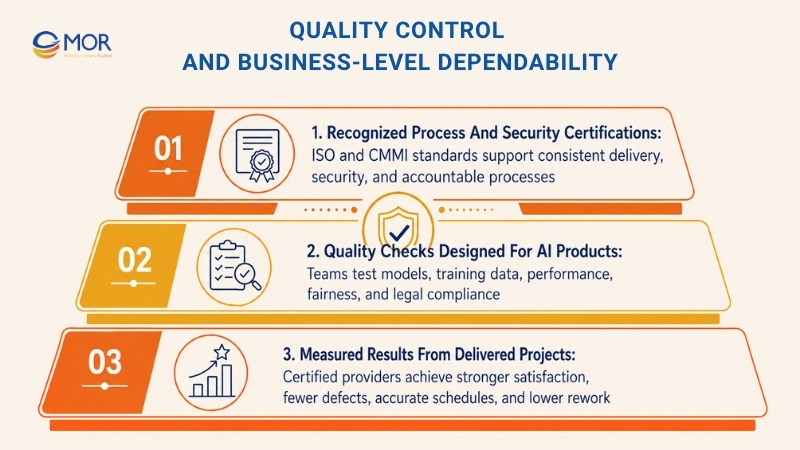
Recognized Process And Security Certifications
AI outsourcing in Southeast Asia includes small studios, general coding firms, and mature business delivery centers. Vietnam’s established providers compete at the higher end through audited processes and clear working rules.
- Structured Quality Management: More than 70% of Vietnam’s large software exporters hold ISO 9001 certification. The standard supports written development steps, change control, links between requirements and tests, and regular process review.
- Measured Delivery Maturity: Several leading Vietnamese software exporters hold CMMI Level 3 or higher. This level requires defined working methods, recorded procedures, shared development rules, and quality measures that teams can track. Companies at this stage usually produce more stable schedules, fewer serious bugs, and more predictable project results.
- Information Protection Controls: ISO/IEC 27001 matters for AI products that handle business or personal data. The standard covers access rules, encryption, security management, and planned responses when an incident occurs.
These certificates are more than logos placed on a company website. Independent reviewers can check the processes behind them. A business choosing a certified Vietnamese AI partner can ask for audit records and confirm that the provider follows recognized international rules.
Quality Checks Designed For AI Products
General software tests do not cover every risk found in a live AI system. Vietnamese AI teams also apply checks made for models, training data, changing results, and responsible use.
Model Review And Testing:
- Test the model against separate data that was not used during training
- Repeat checks across different data groups
- Review results for user groups, unusual cases, and rare inputs
- Check for unfair outcomes and hidden bias
Training Data Review:
- Check whether training records are correct and complete
- Treat missing data and extreme values
- Review label quality in supervised learning projects
- Find data leakage that could make model scores unreliable
System Performance Comparison:
- Compare each model with a basic model and earlier releases
- Run controlled A/B tests after deployment
- Track weaker model results as real data changes over time
- Record known limits, assumptions, and expected use cases
Legal And Responsible AI Checks:
- Review work against GDPR and PDPA rules
- Test whether outputs treat groups fairly
- Prepare clear records that explain model decisions when regulators require them
- Match AI use with the client’s internal rules and risk limits
Measured Results From Delivered Projects
Quality results from Vietnam can be measured through client response, delivery records, and process data:
- Project Satisfaction: Around 90% of completed outsourced projects receive positive client ratings, which matches or exceeds many international averages.
- International Quality Results: More than 70% of Vietnamese IT exports meet recognized international benchmarks, despite the country’s large yearly delivery volume.
- Fewer Serious Defects: Companies using CMMI methods report 30% to 40% fewer major defects and 20% to 30% better schedule accuracy.
- Lower Rework Spending: Certified providers often keep rework near 5% to 10% of the total project budget. Less mature companies may spend between 15% and 25%.
These results show that Vietnamese AI outsourcing does not require a trade between price and quality. Mature teams can deliver business-level systems at lower cost while meeting the process and security needs of international clients.
MOR Software’s Position In Vietnam’s AI Market
Three forces are supporting Vietnam’s AI growth: trained workers, rising company demand, and public investment. Each area supports the others and gives local software firms more space to build AI app generator tools that solve real problems. Businesses in Vietnam no longer need to ask whether AI has value. They need to decide which task should come first and how soon the result can reach users.
MOR Software is already taking part in this work. Its teams connect AI development with web systems, mobile apps, cloud platforms, Salesforce, offshore software testing, and offshore delivery. This lets clients move past small demos and build complete products. Since 2016, MOR Software has completed more than 850 projects in over 10 countries. Its past work includes AI spam review for a healthcare platform, object activity detection in a CCTV system, and motion analysis for a gym exercise counting SDK.
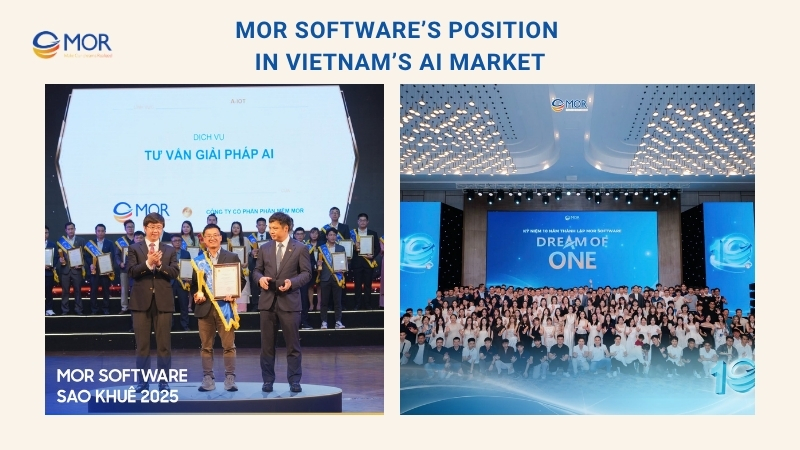
The company’s work has also received national recognition. In April 2025, MOR Software received Sao Khue Awards for the sixth straight year and won three awards during the event. Its enterprise AI consulting work was recognized in the A-IoT category. The company also received awards for HRM and Salesforce CRM consulting. These results show its ability to connect strong engineering with direct business goals.
Vietnam gives MOR Software access to a growing worker base, formal training programs, and long-term public support for AI. Its project groups include business analysts, data workers, software engineers, system specialists, testers, and support teams. Their aim is practical: build AI tools that save work hours, improve business decisions, and produce value that clients can track.
How Vietnam Compares With Other AI Development Hubs
No single AI market is best for every project. Singapore, India, the Philippines, and Vietnam each bring different strengths, costs, and delivery models.
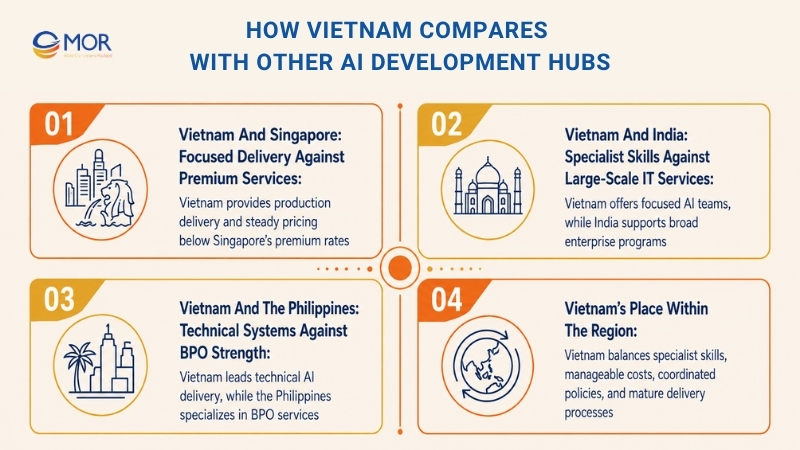
Vietnam And Singapore: Focused Delivery Against Premium Services
Singapore leads the premium AI service market in Southeast Asia. It hosts 44% of the region’s established AI startups and has spent decades building strong research, funding, and business systems. Companies choose it when reputation, research access, and high-end advisory work matter most.
That position also brings higher prices. AI engineering in Singapore often costs between $80 and $150 per hour. The rate remains below many Silicon Valley contracts but stands well above Vietnam. Large companies with open budgets may accept that level. Startups and medium-sized firms often gain better value through Vietnamese delivery teams.
The main difference lies in the type of work each market handles well. Singapore is strong in complex research, early strategy, and premium consulting. Vietnam is strong in building and maintaining production AI systems with larger teams and steadier pricing.
A company may use Singapore-based experts during research or planning, then work with MOR Software in Vietnam for product design, engineering, testing, cloud setup, and long-term support. This approach matches each market with the work it handles best.
Vietnam And India: Specialist Skills Against Large-Scale IT Services
India created the largest technology service export market through huge teams, broad service lists, and long client relationships. Its major firms employ millions of workers, manage global accounts, and run delivery centers in many countries.
Compared with Vietnam, India has a more general service position. Many Indian providers handle ERP, CRM, cloud systems, infrastructure, support work, and business operations, with AI placed inside a much wider service list. This supports very large contracts, but some clients may find it harder to access a small, focused AI team.
The main difference is direct. India works well for company-wide programs that involve many technology areas. Vietnam suits projects that need a focused AI group, close access to engineers, and a clearer link between technical work and one product goal.
A business may use a large Indian integrator for a broad company program, then work with MOR Software for an AI module, web platform, mobile product, cloud connection, or dedicated engineering team. Vietnam’s focused skill base can support the part of the program that needs closer technical attention.
>>> Let's break down outsourcing options in both markets Vietnam vs India from a practical angle, helping you see which market truly fits your growth goals in 2026.
Vietnam And The Philippines: Technical Systems Against BPO Strength
The Philippines has a large English-speaking workforce and long BPO relationships with companies in the United States and Australia. Yet its AI engineering base is still less developed than Vietnam’s. It does not have a national AI plan with the same training, data, and computing targets, and public support remains less connected across the sector.
The market difference is easy to see. The Philippines is strong in customer care, data entry, shared services, and back-office work. Vietnam is stronger in AI engineering, model work, software systems, cloud deployment, and technical product delivery.
Vietnam’s Place Within The Region
Vietnam holds a distinct place among Asian AI development markets:
- More AI-Focused Than India: Vietnam places stronger attention on specialist AI work, while India serves a much wider technology service market.
- Lower-Cost Than Singapore: Vietnam uses emerging-market pricing, while Singapore works at a premium service level.
- More Publicly Coordinated Than The Philippines: Vietnam links government plans, training targets, data programs, and computing investment.
- More Technically Organized Than Indonesia: Vietnam has clearer training routes and a more mature software export base.
This mix explains why more companies are considering Vietnam for offshore AI development. It balances focused skills, manageable costs, tested quality processes, and room for long-term cooperation.
Vietnam’s Expected AI Growth Through 2030
Vietnam’s AI position will not change in one step. Training numbers, public computing systems, salaries, company demand, and international trust will grow at different speeds during the rest of the decade.
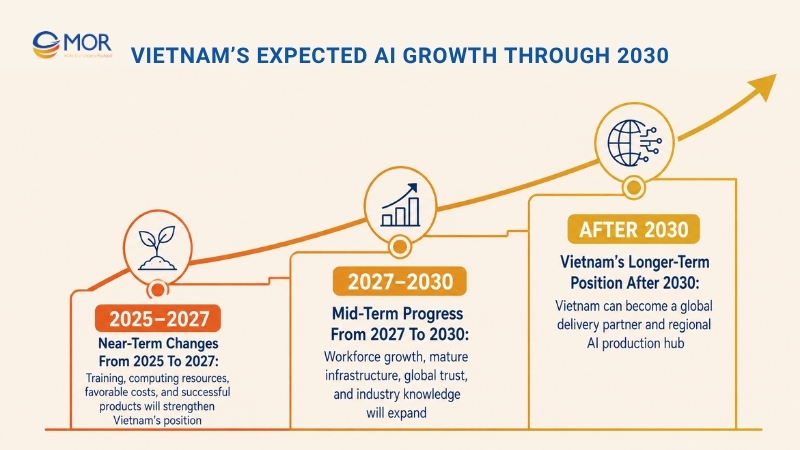
Near-Term Changes From 2025 To 2027
Vietnam’s place as an AI delivery hub should become clearer through several changes happening at the same time:
- Faster Growth In Trained Workers: The first large groups from formal AI programs will finish their studies. The pool can grow beyond roughly 300 known experts toward thousands of trained engineers and data workers. The Vietnam AI Academy is expected to reach larger yearly intakes, with a long-term target above 8,000 learners.
- A Favorable Cost Period: AI pay in Vietnam may rise 10% to 20% each year, yet United States pay may rise much faster. Companies that begin Vietnamese partnerships early can agree on workable rates before local demand pushes prices higher.
- New Public Computing Resources: National computing centers are expected to start operations. They can remove some limits that now affect model training, testing, and research. Connected national datasets can also provide useful local information for model work.
- More Proof Through Delivered Products: Generative AI startups and established companies will build more products with Vietnamese teams. Each working release gives other buyers stronger evidence when they compare offshore markets.
Mid-Term Progress From 2027 To 2030
Vietnam can move toward a leading Southeast Asian AI delivery position through four areas:
- A Larger Specialist Workforce: The country plans to train 8,000 AI workers each year and build a mid-term base of more than 15,000 specialists. This size can support several large company programs at the same time.
- Mature Data And Computing Systems: Public computing centers and shared datasets should reach fuller use. Local teams will then have better access to resources that are often too costly for private companies to create alone.
- Greater International Trust: Vietnam aims to enter the global top 50 for AI. Research work, startup results, and live company systems can support that goal. Stronger outside recognition can lead more international businesses to select Vietnamese delivery partners.
- Deeper Industry Knowledge: Vietnamese teams are likely to build stronger records in healthcare, banking, manufacturing, agriculture, and local-language AI. This domain knowledge can make them more useful than teams that only provide general model development.
Vietnam’s Longer-Term Position After 2030
After 2030, Vietnam aims to hold several lasting roles:
- A Recognized Global Delivery Partner: Vietnam can stand beside established AI centers as a serious source of product engineering, model work, and long-term system support rather than a low-cost coding market.
- A Production Hub For Southeast Asia: Singapore may keep its lead in premium research and strategy. Vietnam can become the main regional base for building, testing, deploying, and maintaining AI products.
- A Center For Local And Regional AI: Vietnamese teams can lead work on Vietnamese-language models and AI products adapted for Southeast Asian users, laws, speech patterns, and business needs.
- A Market With Lasting Cost Value: The current pay gap may drop from about 85% to between 50% and 60%. Yet Vietnam can keep a meaningful cost edge through its large population, steady training routes, software export base, and growing public systems.
Conclusion
Vietnam is building a strong case as Southeast Asia’s next destination for AI development. Its growing talent pool, lower delivery costs, formal quality standards, and national AI plan give businesses a practical base for long-term product work. MOR Software connects these local strengths with AI, cloud, web, mobile, Salesforce, QA, and offshore delivery skills. Contact MOR Software to assess your AI idea, project scope, team needs, and the right path to launch.
"Evolution is not a destination, it is a disciplined journey of innovation."
Phung Van Tu


CEO MOR AI
MOR SOFTWARE
Frequently Asked Questions (FAQs)
Why Is Vietnam Becoming A Major AI Development Destination?
Vietnam combines a large technology workforce, competitive project costs, strong software skills, and growing public support for AI. The country is also investing in local datasets, technical training, and national computing centers.
What AI Skills Are Available In Vietnam?
Vietnamese teams work across machine learning, data science, natural language processing, computer vision, cloud engineering, and AI system testing. Many engineers also have experience in web, mobile, backend, and enterprise software development.
How Much Does AI Development Cost In Vietnam?
Hourly rates often range from $25 to $35 for junior developers, $35 to $45 for mid-level specialists, and $45 to $50 or more for senior architects. Final costs depend on team size, project length, data needs, and system complexity.
Is AI Development In Vietnam Cheaper Than In Singapore Or North America?
Yes. Vietnamese development rates may be 60% to 70% lower than North American rates and 40% to 50% lower than rates in Singapore or Hong Kong. Businesses should still compare testing, management, setup, and maintenance costs.
Which Industries Use AI Systems In Vietnam?
AI use is growing in banking, e-commerce, healthcare, manufacturing, agriculture, logistics, and public services. Common uses include fraud detection, product recommendations, chatbots, document review, visual inspection, and demand forecasting.
Does Vietnam Have Enough AI Talent?
Vietnam has a large IT workforce, but experienced AI specialists remain in high demand. New national training programs aim to expand the talent pool and prepare thousands of AI graduates each year before 2030.
How Does Vietnam Compare With India As An AI Hub?
India has a larger technology service sector and handles broad company-wide programs. Vietnam has a more focused position in AI product development, dedicated engineering teams, and technical systems built for defined business needs.
How Does Vietnam Compare With Singapore For AI Development?
Singapore is strong in premium consulting, research, funding, and early-stage AI strategy. Vietnam has lower engineering rates and a larger cost advantage for production systems, long-term development, testing, and support.
What Quality Standards Do Vietnamese AI Companies Follow?
Established software firms may hold ISO 9001, ISO/IEC 27001, and CMMI certifications. AI projects can also include model testing, data checks, bias review, security controls, performance tracking, and regulatory documentation.
Will Vietnam Remain Cost-Competitive Through 2030?
Vietnamese AI salaries are expected to rise as demand grows. Yet rates should remain below those in the United States, Singapore, and other mature markets. The cost gap may become smaller, but Vietnam is likely to keep a strong pricing advantage through 2030.
Share


Make Our-Dreams Realized


© 2023 . MOR Software. All Rights Reserved
Sitemap
Privacy Policy
Terms of Use

Rate this article
0
over 5.0 based on 0 reviews
Your rating on this news:
Name
*Email
*Write your comment
*Send your comment
1