


Top 8 AI Development Languages for AI Software Development
Projects often stall not because of bad ideas, but because the wrong AI development languages are chosen from the start. With so many AI programming languages available, picking the right one can shape speed, cost, and long-term growth. In this MOR Software’s guide, we’ll explore the most effective languages used for AI development and how to select what truly fits your project.
What Are AI Development Languages?
AI development languages are programming tools used to build software and applications that rely on artificial intelligence. These include areas like machine learning, natural language processing, computer vision, evolutionary algorithms and robotics.
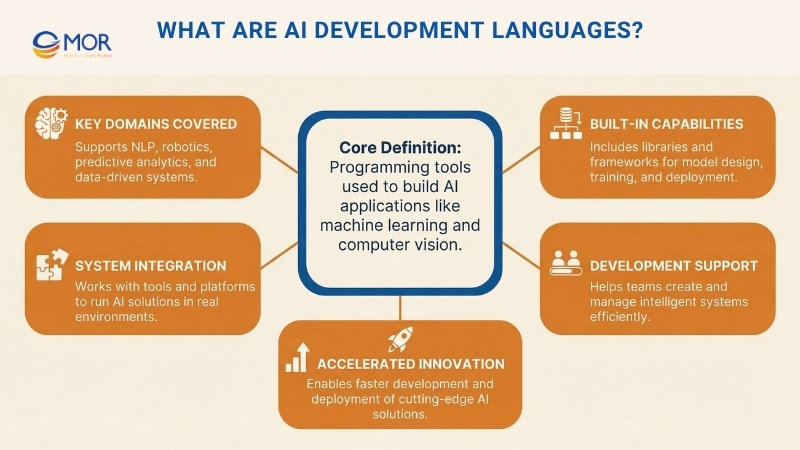
An AI development language comes with libraries, frameworks, and built-in capabilities that help teams design, develop, and run intelligent models and systems.
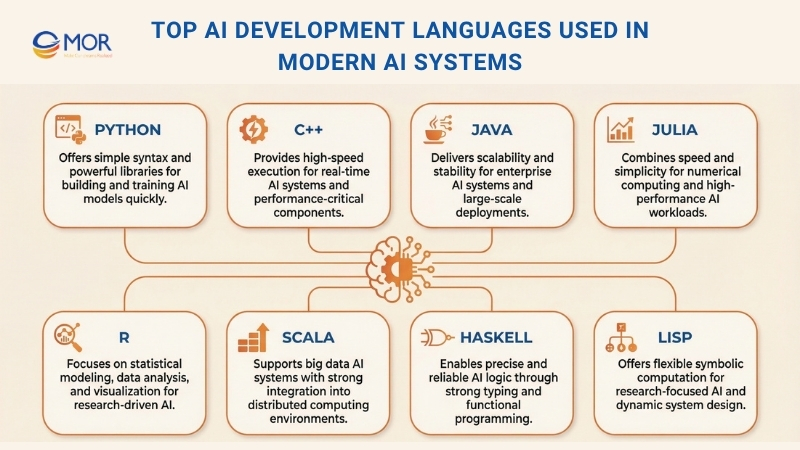
Top AI Development Languages Used In Modern AI Systems
In this section, we break down each option in detail, including its use cases, leading libraries, situations where it may not fit, and its advantages and limitations.
Python
Python remains the preferred choice for AI work due to its simple syntax and extensive library ecosystem. Many developers consider it the best programming language for AI and often the best language to code AI when starting new projects.
With tools like TensorFlow, PyTorch, and scikit-learn, teams can create and train models quickly without working with low-level programming.
It stays flexible, integrates well with other technologies, and covers a wide range of use cases from machine learning and deep learning to NLP, computer vision, and data analysis.
In practice, Python supports solutions like chatbots, recommendation engines, predictive analytics systems, and automation platforms.
Python AI libraries and packages
- TensorFlow: An open-source deep learning framework from Google, widely adopted for building and training large neural networks at scale. It works well in both research and production environments.
- PyTorch: A flexible deep machine learning library developed by Meta, favored in research for its dynamic computation graphs and ease of use.
- scikit-learn: A widely used library for traditional machine learning tasks like classification, regression, and clustering. It is ideal for fast prototyping.
- Keras: A high-level neural network API that runs on top of TensorFlow, helping developers design and test deep learning models with less effort.
- Pandas: A data analysis and manipulation library that makes it easier to work with large datasets. It is often used before training models.
- NumPy: A core package for numerical computing in Python, providing support for arrays and mathematical operations.
- NLTK: The Natural Language Toolkit, used for processing text such as tokenization, sentiment analysis, and tagging parts of speech.
- spaCy: A modern NLP library built for production, supporting tasks like entity recognition, dependency parsing, and text classification.
- OpenCV: An open-source computer vision library used for image and video processing, object detection, and facial recognition.
- XGBoost: A high-performance gradient boosting library, often used in competitions and production systems for predictive modeling.
Cases where Python may not be the right choice
- High-performance and time-sensitive systems: Python runs slower than languages like C++ or Julia. If you are building real-time systems such as autonomous vehicles, robotics, or embedded solutions, performance limits can become a concern.
- AI on mobile devices and edge environments: It is not the best option for mobile applications or edge devices with limited resources. Languages like Java, Swift, or C++ are more suitable in these cases.
- Enterprise-grade systems with heavy concurrency needs: While Python can be part of enterprise AI solutions, Java or Scala may be a better fit when stability, concurrency, and scalability are key priorities.
- Memory-intensive workloads: Python uses more memory compared to lower-level alternatives, which can be an issue for large datasets in limited environments.
- Projects that require strict type safety: Python is dynamically typed, which can lead to runtime errors in complex systems. Statically typed languages like Java, Scala, or C++ provide more reliability.
Pros and cons of using Python for AI
Pros
- Easy to learn
- Large ecosystem
- Flexible
- Strong community support
Cons
- Slower runtime
- Higher memory usage
C++
C++ continues to be a strong option among AI development languages for tasks where performance is critical. Its low-level access and fast execution make it well suited for real-time workloads and intensive computations.
Many AI frameworks, including TensorFlow and PyTorch, depend on C++ at the backend level to improve execution speed.
Although developers do not often build entire AI solutions with it, this language supports the core components where efficiency matters most.
You will see it used in robotics, embedded AI, autonomous vehicles, and high-frequency trading, where even small delays can affect results.
It may not be ideal for quick testing, but in production systems, C++ provides strong speed and dependable performance.
C++ AI libraries and packages
- MLpack: A high-speed and flexible machine learning library written in C++, also offering integrations with other languages.
- Shark: An open-source toolkit designed for machine learning, optimization tasks, and neural network development.
- Dlib: A widely used library that includes various machine learning algorithms along with tools for computer vision and image analysis.
- Caffe: A deep learning framework first created at Berkeley, commonly applied in image classification and convolutional neural networks.
- TensorFlow C++ API: The C++ interface of TensorFlow, allowing models to run with near-native performance.
- DyNet: A neural network library built for dynamic computation graphs, often used in natural language processing tasks.
Cases where C++ may not be the right choice
- Fast prototyping and iterative testing: C++ requires more code and takes longer to write, which makes fast iteration difficult.
- Teams with limited C++ experience or mixed skill levels: Its complexity and steep learning curve can slow teams that lack strong systems programming experience.
- Projects centered on AI research workflows: Most research examples and resources are written in Python, so using C++ may limit experimentation speed.
- Data processing and analysis-heavy tasks: Tasks such as data cleaning, exploration, or analysis are easier to handle in languages like Python or R.
- Situations where development speed outweighs performance needs: If development speed is more important than execution speed, C++ may slow progress.
Pros and cons of using C++ for AI
Pros
- Very fast and efficient
- Well-established language
- Precise control over system resources
Cons
- Difficult syntax
- Harder to learn
Java
Java stands out for its portability, scalability, and stability, which makes it a reliable option for production-level AI systems, especially within enterprise settings.
Although it is not as widely used in research as Python, Java still provides a strong ecosystem for machine learning, big data, and AI integration.
It is commonly applied when deploying multimodal AI models at scale inside existing enterprise platforms.
Typical AI use cases include natural language processing, fraud detection, recommendation engines, and large-scale data analysis.
Its consistency and ability to manage concurrent processes also make it suitable for real-time business and financial systems.
Java AI libraries and packages
- Deeplearning4j (DL4J): A widely adopted deep learning library for Java that supports neural networks, GPU acceleration, and integration with Hadoop and Spark.
- Weka: A well-known machine learning library that offers a wide set of algorithms for classification, regression, clustering, and data visualization.
- MOA (Massive Online Analysis): A framework designed for stream mining, useful for real-time machine learning on continuously changing data.
- Java-ML: A lightweight library that includes common algorithms for clustering, classification, and feature selection tasks.
- H2O.ai: A scalable machine learning platform with Java APIs, often used in enterprise-level AI solutions.
- Spark MLlib: Although written in Scala, it works smoothly with Java for distributed machine learning and large-scale AI workloads.
Cases where Java may not be the right choice
- Fast prototyping and early testing: Java requires more code compared to Python, which slows down quick experimentation in early development stages.
- Advanced AI research work: Most academic and open-source projects are built with Python, so Java is less common in cutting-edge development.
- Small or short-term projects: The setup process and extra boilerplate can feel excessive when a simpler language can handle the task.
- Low-memory environments: Java’s garbage collection can add overhead, which is not ideal for embedded systems or strict real-time use cases.
- Projects focused on statistical analysis: R or Python offer better tools for data science and statistical modeling tasks.
Pros and cons of using Java for AI
Pros
- Highly scalable and stable
- Large and mature ecosystem
- Good overall performance
Cons
- More verbose syntax
- Smaller presence in AI research communities
Julia
Julia is attracting attention because it blends the speed of C++ with the simplicity of Python.
Designed for numerical and scientific computing, it performs well in information sets used in machine learning tasks that require intensive processing.
It delivers performance close to C++ while remaining easy for data scientists to use.
Its ability to handle parallel and distributed computing makes it suitable for large AI workloads such as deep learning, probabilistic programming, and data analysis.
Although its ecosystem is smaller than Python’s, Julia continues to grow and is becoming a strong option for performance-focused AI projects.
Julia AI libraries and packages
- Flux.jl: The most commonly used deep learning library in Julia, providing a simple and flexible way to create neural networks.
- MLJ.jl: A machine learning framework that offers a unified interface for many algorithms, similar to scikit-learn in Python.
- Knet.jl: A deep learning package built for dynamic computation graphs and GPU acceleration.
- Turing.jl: A powerful library used for probabilistic programming and Bayesian inference tasks.
- DataFrames.jl: A tool for data manipulation and analysis, similar to Pandas in Python.
- CUDA.jl: Enables GPU computing in Julia, allowing efficient execution of large-scale AI workloads.
Cases where Julia may not be the right choice
- Small projects or quick prototypes: If you need to build a fast proof of concept, Julia’s smaller ecosystem and limited ready-made tools can slow development compared to Python.
- Teams with varied experience levels: Julia is less widely used, so finding skilled developers can be difficult, which may create onboarding issues.
- Production environments: Julia is still newer than Python, Java, or C++, and its tools and deployment options are not as mature.
- Mobile or web-based AI applications: It lacks strong support for mobile and front-end development, which limits its use in those environments.
- Situations requiring strong community support: Even though it is growing, Julia’s community is still smaller than Python’s, so there are fewer tutorials, libraries, and troubleshooting resources available.
Pros and cons of using Julia for AI
Pros
- High performance with easy-to-read syntax
- Strong support for distributed computing
- Expanding ecosystem
Cons
- Relatively new language
- Fewer production-ready tools
R
R was designed for statistics and data analysis, which makes it a strong choice among AI development languages and a practical AI computer language for projects that focus on understanding data as much as building models.
It performs well in statistical modeling, data visualization, and exploratory analysis, with powerful tools for regression, classification, clustering, and time-series analysis.
Researchers and data scientists prefer R because it creates clear visual outputs that make AI results easier to interpret.
Although it is not widely used in large production systems, R is popular in research, academia, and industries such as healthcare, finance, and bioinformatics, where deep statistical understanding is required.
R AI libraries and packages
- caret: A comprehensive package that offers a unified interface for training and evaluating many types of machine learning models.
- randomForest: An implementation of the random forest method for both classification and regression tasks.
- xgboost: A high-performance gradient boosting library, often used in competitions and real-world predictive modeling.
- nnet: A package designed for training neural networks with a single hidden layer.
- kerasR: An R interface for the Keras deep learning library, allowing access to TensorFlow models.
- mlr3: A modern machine learning framework in R that supports flexible and advanced workflows.
- ggplot2: Not strictly an AI library, but essential for data visualization and for understanding model outcomes.
Cases where R may not be the right choice
- Large-scale production systems: R is not optimized for enterprise-level deployment, so languages like Java or Python are more suitable.
- Performance-sensitive applications: It can be slower than C++, Julia, or even Python when handling heavy computations.
- Mobile or embedded AI use cases: R offers very limited support for mobile platforms or edge devices.
- General-purpose programming needs: Since it is focused on statistics and data analysis, it is less effective for building complete AI systems.
- Projects focused on modern deep learning: Although R connects to tools like TensorFlow and Keras, its ecosystem remains smaller and less active than Python’s.
Pros and cons of using R for AI
Pros
- Strong capabilities in statistical modeling
- Excellent data visualization tools
- Easy to integrate with Python and C++
Cons
- Limited scalability
- Not ideal for general programming tasks
Scala
Scala blends object-oriented and functional programming, which makes it a solid option for AI projects that rely on big data and distributed systems.
Running on the JVM, it brings the stability and scalability of Java while offering cleaner syntax and more modern features.
Its strong connection with Apache Spark makes it well suited for machine learning pipelines that process very large datasets, especially in industries like finance, e-commerce, and telecom, where predictions and recommendations are important.
While it is less common in research, Scala performs well in production systems that require speed, scalability, and strong concurrency support.
For teams already working with Java, it provides a smooth transition toward more modern AI programming approaches.
Scala AI libraries and packages
- Spark MLlib: The main machine learning library for Apache Spark, offering scalable algorithms for classification, regression, clustering, and recommendation systems.
- Breeze: A numerical computing library for Scala, similar to NumPy in Python, used for linear algebra and scientific calculations.
- DeepLearning.scala: A library that adds deep learning capabilities to Scala with a focus on functional programming concepts.
- Smile (Statistical Machine Intelligence & Learning Engine): A fast and complete machine learning library for Scala and Java, covering NLP, computer vision, and data mining tasks.
- TensorFrames: Connects TensorFlow with Spark, allowing developers to run TensorFlow operations on Spark clusters.
- PredictionIO: An open-source machine learning server built on Spark and Hadoop, designed for scalable AI applications.
Cases where Scala may not be the right choice
- Small-scale projects: Scala’s setup and complexity may be unnecessary if you do not need big data processing or distributed systems.
- Rapid prototyping: Python allows faster experimentation and offers more ready-to-use AI automation tools.
- Teams new to functional programming: Its learning curve can be challenging, especially for developers familiar only with object-oriented programming.
- Mobile or embedded AI use cases: Scala does not provide strong support for mobile platforms or edge devices.
- Research-focused projects: Most academic tools and frameworks are built in Python, which makes Scala less convenient for research work.
Pros and cons of using Scala for AI
Pros
- Well suited for big data applications
- Clean and concise syntax
- Easy integration with Java
Cons
- Steep learning curve
- Smaller ecosystem
Haskell
Haskell is a purely functional language known for its strong type system, immutability, and mathematical accuracy, which makes it suitable when correctness and reliability are critical in AI development languages.
Its declarative approach allows you to describe what the program should achieve instead of how it should run, which helps simplify complex AI logic.
Although it is not widely used, Haskell performs well in research-focused AI areas such as symbolic AI, theorem proving, and probabilistic programming, where safety and formal verification are important.
It also manages concurrency and parallelism effectively, but its smaller ecosystem and steeper learning curve limit its use in large production systems.
Haskell AI libraries and packages
- HLearn: A machine learning library built for Haskell, designed around algebraic structures to support scalable learning algorithms.
- Grenade: A functional deep learning library that allows developers to build and train neural networks.
- HMatrix: A numerical computing library used for linear algebra, optimization, and matrix operations, similar to NumPy.
- TensorFlow Haskell bindings: Provides access to TensorFlow features from Haskell, although it is less mature than the Python API.
Cases where Haskell may not be the right choice
- Mainstream AI development: Most modern frameworks and research codebases are written in Python, so Haskell falls behind in tools and community support.
- Large enterprise production systems: Limited ecosystem and fewer available developers make it harder to maintain at scale.
- Rapid prototyping: Its steep learning curve and smaller set of ready libraries slow down experimentation compared to Python or Julia.
- Mobile, web, or embedded AI use cases: Haskell lacks strong support for applied AI outside of research or niche applications.
- Teams with limited functional programming experience: Its purely functional style can be difficult for developers used to imperative or object-oriented programming.
Pros and cons of using Haskell for AI
Pros
- Strong type system
- Concise code structure
- Useful for research applications
Cons
- Difficult learning curve
- Limited tools
- Smaller ecosystem
Lisp
Lisp, one of the earliest programming languages linked to AI, dates back to the 1950s and was created for symbolic computation, which made it well suited for early AI work such as expert systems, natural language processing, and theorem proving.
Its flexibility is one of its strongest features.
Capabilities such as homoiconicity, where code can be treated as data, and its powerful macro system allow developers to build highly adaptable and expressive AI solutions, which is why it has remained popular in academic and research environments.
Although it is less common in modern AI development languages, Lisp still holds a niche role as an AI code language for symbolic AI, rapid prototyping, and systems that require dynamic behavior.
Its concepts continue to influence many modern languages used for building AI systems.
Lisp AI libraries and packages
- CLML (Common Lisp Machine Learning): A library that provides implementations of common machine learning algorithms in Lisp.
- mgl: A machine learning library for Common Lisp that supports neural networks and deep learning.
- Antik & GSLL: Numerical libraries that offer linear algebra and scientific computing features, similar to NumPy in Python.
- AIMA Lisp code: Implementations of algorithms from the book “Artificial Intelligence: A Modern Approach,” written in Lisp.
- CLASP: A Common Lisp environment that integrates with LLVM and C++, used for performance-focused AI and scientific computing projects.
Cases where Lisp may not be the right choice
- Mainstream AI projects: Most modern frameworks and tools are not built with Lisp, so support is limited.
- Large-scale production systems: It lacks the ecosystem and mature tooling found in Python, Java, or C++.
- Teams without Lisp experience: The language has a steep learning curve and is not widely taught, which makes team building more difficult.
- Performance-sensitive applications: Although it can be optimized, languages like C++ and Julia are more suitable for low-level performance.
- Mobile, web, or edge AI environments: Lisp has very limited support in these areas, making it impractical for many modern AI use cases.
Pros and cons of using Lisp for AI
Pros
- Highly flexible
- Supports dynamic and adaptable programming
- Useful for AI research
Cons
- Not widely adopted
- Smaller modern ecosystem
Comparison Overview Of AI Development Languages
Here is a quick summary of how these AI development languages compare:
Language | Performance | AI ecosystem and libraries | Scalability | Top use cases |
Python | Moderate, slower execution but improved through optimized libraries | Large ecosystem (TensorFlow, PyTorch, etc.) | Works well with cloud platforms and distributed systems | Prototyping, machine learning research, data science |
C++ | Very high | Smaller set of tools (MLpack, Shark, Dlib) | Strong for large-scale and performance-focused systems | Real-time AI, robotics, embedded systems |
Java | High, though slower than C++ | Solid ecosystem (Deeplearning4j, WEKA) | Reliable for enterprise-level systems | Enterprise AI, production-ready solutions |
Julia | High | Expanding ecosystem (Flux.jl, MLJ.jl) | Built for parallel and distributed computing | High-performance machine learning, scientific computing |
R | Moderate | Strong in statistical and machine learning packages | Limited when scaling to very large systems | Data analysis, statistical modeling, research |
Scala | High, runs on JVM with parallel processing support | Good libraries (Spark MLlib, Breeze) | Effective for big data and distributed environments | Big data AI, predictive analytics |
Haskell | High | Niche tools (HLearn, Grenade) | Strong in theory, less proven at large scale | Research, symbolic AI, experimental models |
Lisp | Moderate | Niche but historically important AI tools | Limited support for modern scalability | Symbolic AI, academic research, legacy systems |
Why AI Development Languages Influence AI System Success
Some systems are built for research and testing, while others need to run quickly, scale smoothly, or operate inside real products. The programming language you select affects how easily you can create, improve, and deploy an AI solution.
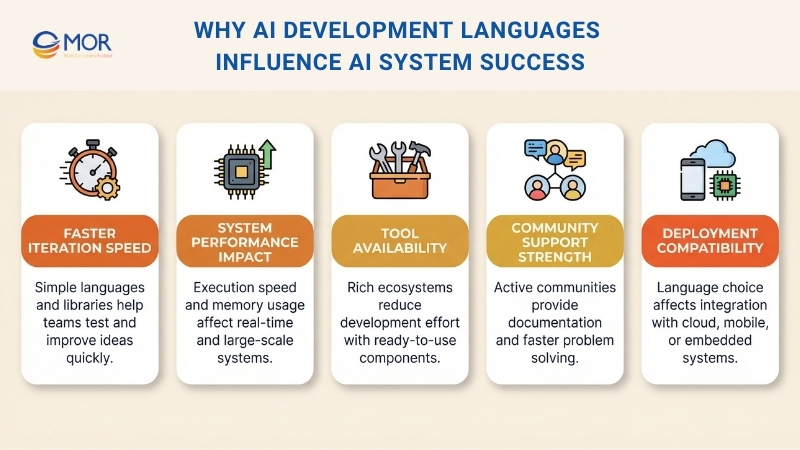
Key areas shaped by this choice include:
- Speed of building and iteration: Languages with simple syntax and strong libraries help you test ideas quickly and move faster in early development stages.
- System speed and resource use: For large ml models or real-time predictions, execution speed and memory usage can directly affect system performance.
- Available tools and frameworks: A rich ecosystem reduces effort by offering ready-to-use components instead of building everything from the ground up.
- Community and support network: Active communities provide better documentation, quicker solutions to issues, and shared expertise.
- Deployment and system compatibility: Some languages integrate more easily with cloud services, mobile platforms, or embedded systems, which affects where and how your AI solution can operate.
Understanding these points helps teams choose from different AI programming languages based on real technical needs, timelines, and long-term goals, instead of following trends alone.
How To Select The Right AI Development Languages For Your Project
With many options available, the “best” choice among AI development languages is not the same for every case.
It depends on your goals, available resources, and working environment, especially in app development using AI and natural language.
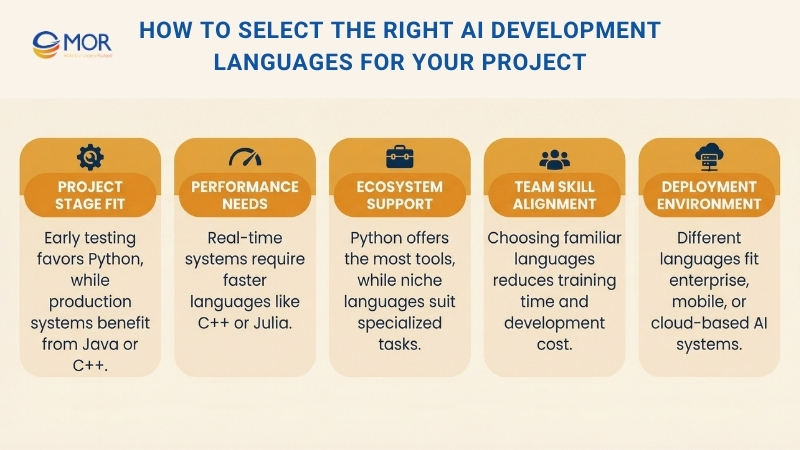
Here are the main factors to think about when selecting the right option for your project:
- Stage of your project: For early testing and quick experiments, Python is often the most suitable choice. For production systems that require stability and strong performance, languages like Java, C++, or Scala are more appropriate.
- System performance requirements: If your AI model needs real-time responses, C++ or Julia will usually perform better than Python or R. For research tasks and data-heavy analysis, Python or R can offer faster development speed.
- Ecosystem and available tools: Python provides the widest range of libraries and frameworks for nearly every AI task. More specialized options like Haskell or Lisp work well for specific research areas, but they do not offer the same level of tooling and support.
- Team skills and experience: Choosing a language your team already understands helps save time and reduce costs. Using less common options such as Julia, Scala, or Haskell may require additional training or hiring experienced developers.
- Target deployment environment: For enterprise systems, Java or Scala fit well because of the JVM ecosystem. For mobile or embedded AI, C++ is often a better option. For cloud-based workflows, Python and Julia both integrate smoothly.
The key point is that there is no single perfect choice among artificial intelligence programming languages, even though Python comes close in many cases.
You should begin with a clear understanding of your project needs, then balance performance, available tools, and team capabilities to select the most suitable solution.
Essential Components Required To Build An AI System
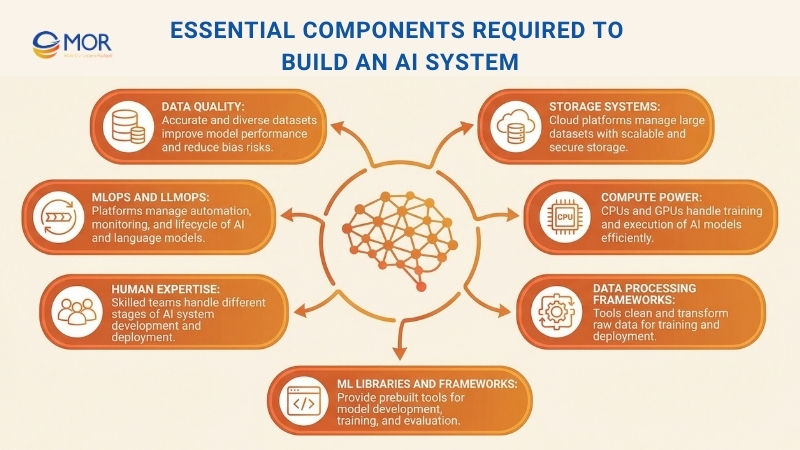
Artificial intelligence systems include many different elements, and the build programming language choice is only one part of the full picture. Building, training, and connecting an intelligent solution to a production-ready product requires careful coordination of all these parts.
Data
The most important element in any AI system is data. The performance of a model depends on the data used during training. Because of this, training datasets must be accurate, reliable, and properly represent the problem the system is designed to solve. Another factor to consider is data volume. The amount required depends on how complex the task is and the type of model used. If the dataset is too small, system performance will suffer. Data variety, which includes different scenarios, user groups, and use cases, is also important since limited diversity can cause a model to perform well during training but fail with new data. A diverse dataset can also help reduce issues related to AI ethics and fairness.
Data storage
A dependable cloud-based storage and management system is essential when working with AI development languages. With scalable and cost-efficient storage capacity, cloud solutions can handle the large volumes of data required for training and validation. Platforms designed for AI programming languages support structured, semi-structured, and unstructured data. They also provide strong data protection features and governance controls to ensure secure and reliable operations.
Compute resources
AI models require a large amount of computing power, so they need processors that are designed for these types of systems. The processor runs the program that performs calculations, logic operations, and input or output tasks that allow the system to function. High-speed processors can greatly reduce the time needed to train a model and keep it running efficiently in production. There are two main types of processors used in AI systems: central processing units (CPUs) and graphics processing units (GPUs). CPUs are often used for training many traditional machine learning models, while GPUs are better suited for deep learning models and large language models (LLMs), as well as for algorithms that rely on visual data.
Data processing framework
Raw data cannot be used directly in AI systems. Before it becomes useful, it must go through processing steps such as cleaning, transformation, and structuring so that it fits the specific use case. A data processing framework is a tool that manages these complex and large-scale transformations needed to build, train, and deploy AI solutions. These frameworks use distributed processing, which spreads computing tasks across multiple machines to speed up data preparation.
Machine learning libraries and frameworks
Libraries are collections of prewritten code that help complete specific tasks. In AI software development, they are used for functions such as data visualization, data analysis, model training, and debugging. Machine learning frameworks go further than libraries. An ML framework includes groups of libraries, ready-made modules, APIs, data processing features, model training tools, and additional capabilities such as GPU acceleration.
Human talent
Every AI software project depends on a skilled team of professionals. While team structure can differ depending on the project, key roles often include data scientists, data engineers, ML architects, DevOps engineers, software developers, and domain experts. Each role contributes to a different stage of the machine learning lifecycle.
MLOps platform
MLOps, or machine learning operations, platforms are end-to-end tools used to manage and automate the development process, covering everything from data collection to deployment in production. From gathering data and training models to deployment and ongoing monitoring, these platforms offer essential features such as model version control, automated training and deployment pipelines, performance tracking, and collaboration support.
LLMOps
LLMOps, which stands for large language model operations, focuses on managing and improving large language models, including tasks such as deployment, fine-tuning, and performance monitoring. Teams working with LLMOps aim to maintain efficiency, accuracy, and responsible use across a wide range of natural language processing applications.
AI Development Languages And Emerging Trends For 2026
Several factors are shaping how people choose AI development languages, including growing debate around whether AI developed its own language in advanced systems. The choice now goes beyond basic capabilities.
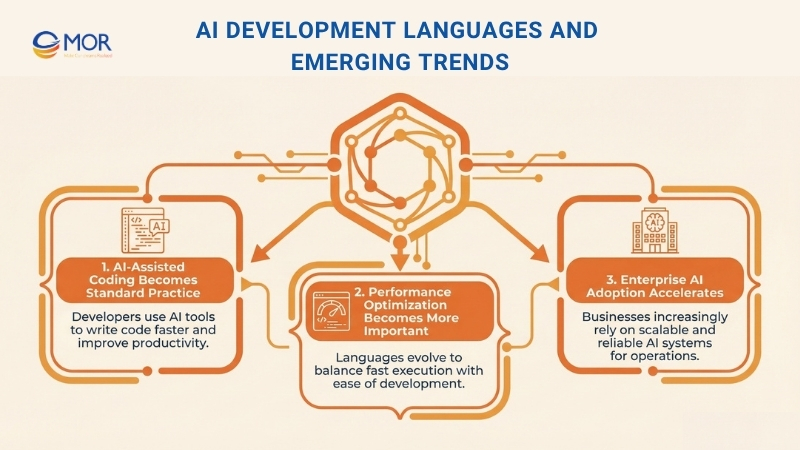
AI-Assisted Coding Becomes Standard Practice
An increasing number of developers now rely on AI tools to support coding tasks. Around 92% of developers use AI in some part of their work, and AI contributes to roughly 41% of code written worldwide. Developers using GitHub Copilot often complete tasks about 55% faster.
This shift changes how languages are selected, especially as teams look for easy coding languages to learn with AI support. Options like TypeScript, which provide clear structure and readable code, work better with AI tools. Simple and well-defined languages are becoming more valuable as AI-assisted coding becomes common.
Performance Optimization Becomes More Important
Python is improving with updates like GIL removal. Mojo is showing strong potential for speed gains. Rust continues to expand its ecosystem. The need to create code that is both easy to write and fast to run is pushing innovation forward.
Organizations running AI systems at scale need both flexibility and efficiency. They must test ideas quickly and also ensure strong performance in production. Languages that can support both needs are becoming more competitive.
Enterprise AI Adoption Accelerates
AI is no longer limited to experimentation. By 2026, about 80% of companies are expected to use AI in some form. This means systems must integrate with existing platforms, follow regulations, and meet production standards.
Languages already common in enterprise environments, such as Java, Python, and C++, are gaining more attention. Their reliability and strong support make them a practical choice for companies building AI systems at scale.
How MOR Software Delivers AI Solutions Across Multiple Programming Languages
AI projects rarely rely on just one programming language. In real-world systems, teams often combine different technologies based on performance goals, system design, and where the solution will run.
At MOR Software, we develop custom AI solutions using the most appropriate AI development languages for each case. Our offshore artificial intelligence developers work with Python, Java, C++, and other modern tools to build scalable systems that are ready for production.
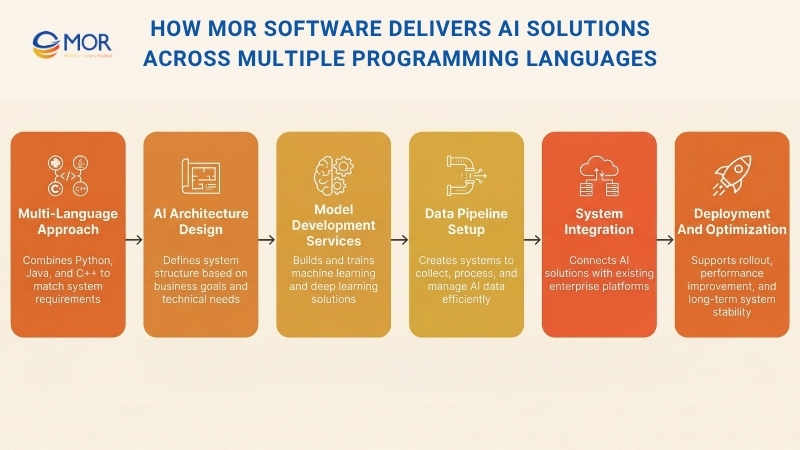
Our AI development services typically include:
- AI solution architecture and technology consulting: We define the right structure and tools based on your business goals and technical needs.
- Machine learning and deep learning model development: We design, train, and refine models for real-world use cases.
- Data pipeline and AI infrastructure design: We set up systems to collect, process, and manage data efficiently.
- AI system integration with existing enterprise platforms: We connect AI outsourcing solutions with your current systems to ensure smooth operation.
- AI deployment, optimization, and maintenance: We support rollout, improve performance, and maintain long-term stability.
We support businesses as they move from early AI testing to stable production systems through careful selection of AI programming languages, frameworks, and infrastructure. If you are ready to take your AI project further, contact us to explore how MOR Software can help you build, deploy, and scale with confidence.
Conclusion
Choosing the right AI development languages shapes how fast you build, how well your system performs, and how easily it scales. Each option has its strengths, so the best choice depends on your goals, data, and technical setup. With the right approach, you can turn ideas into reliable AI solutions. If you are planning your next project, contact us to explore how MOR Software can support your AI journey.
MOR SOFTWARE
Frequently Asked Questions (FAQs)
What are AI development languages?
AI development languages are programming languages used to build artificial intelligence systems. They support tasks like machine learning, natural language processing, computer vision, robotics, and predictive analytics. These languages also provide access to frameworks, libraries, and tools that help developers design, train, and deploy AI models.
Which programming languages are used most often in AI development?
Python is the most widely used language for AI development. Its simple syntax and massive ecosystem of libraries such as TensorFlow, PyTorch, and scikit-learn make it suitable for research, prototyping, and production AI systems.
Why is Python so popular among AI developers?
Python allows developers to build and test AI models quickly. It offers many ready-to-use libraries, strong community support, and integration with data science tools, which helps accelerate machine learning development.
Are AI development languages only used for machine learning?
No. AI development languages support a wide range of artificial intelligence applications including natural language processing, computer vision, robotics, speech recognition, recommendation systems, and predictive analytics.
Which AI development languages are best for high-performance AI systems?
Languages like C++ and Julia are often preferred for performance-focused AI applications. They offer faster execution and greater control over system resources, which is useful for real-time AI workloads.
Is Java still relevant for AI development?
Yes. Java remains widely used for enterprise AI applications. Its stability, scalability, and strong ecosystem make it suitable for large-scale systems such as fraud detection platforms, recommendation engines, and big data AI pipelines.
How do developers choose the right AI development language?
Developers usually evaluate several factors such as project goals, performance needs, ecosystem support, team expertise, and the environment where the AI system will be deployed.
Do AI development languages require specialized libraries or frameworks?
Most AI development relies heavily on libraries and frameworks. These tools provide prebuilt algorithms, data processing utilities, and model training capabilities that simplify AI development.
Can an AI system use more than one programming language?
Yes. Many AI systems combine multiple languages. Python may be used for model training, while C++ or Java may handle performance-sensitive components or large-scale system integration.
What skills are required to work with AI development languages?
Developers typically need programming knowledge, understanding of machine learning concepts, statistics, data processing skills, and experience with AI frameworks and development tools.
What programming language should I learn for AI development?
Python is the best starting point for most people. It is beginner-friendly and widely used across machine learning, deep learning, and data science. Once you gain experience, you can explore other languages like R for statistical analysis, Java for enterprise systems, or C++ for performance-critical AI applications.
What language is AI written in?
AI is not written in a single language. It is built using multiple programming languages depending on the use case. Python is commonly used for training models, while languages like C++, Java, and JavaScript may be used for deployment, optimization, or integration into real-world applications.
Which programming languages are best for beginners in AI development?
Python is the most recommended language for beginners due to its simple syntax and strong community support. It allows new learners to focus on AI concepts instead of complex coding structures, while still offering powerful libraries for building real-world AI applications.
Share


Make Our-Dreams Realized


© 2023 . MOR Software. All Rights Reserved
Sitemap
Privacy Policy
Terms of Use

Rate this article
0
over 5.0 based on 0 reviews
Your rating on this news:
Name
*Email
*Write your comment
*Send your comment
1