


Top 10 Agentic AI Development Services of 2026
Many businesses struggle to move beyond basic automation and turn AI into something that actually works across daily operations. Agentic AI development services solve this gap by building systems that can plan, act, and improve over time. In this MOR Software’s guide, we’ll explore the top services and which providers are worth your attention.
What Are Agentic AI Development Services?
Agentic AI development services center on creating autonomous systems that can plan actions, make decisions, and carry out tasks with limited human input. Unlike traditional tools that only react to prompts, this approach uses intelligent agents that define goals, break them into steps, and complete workflows on their own.
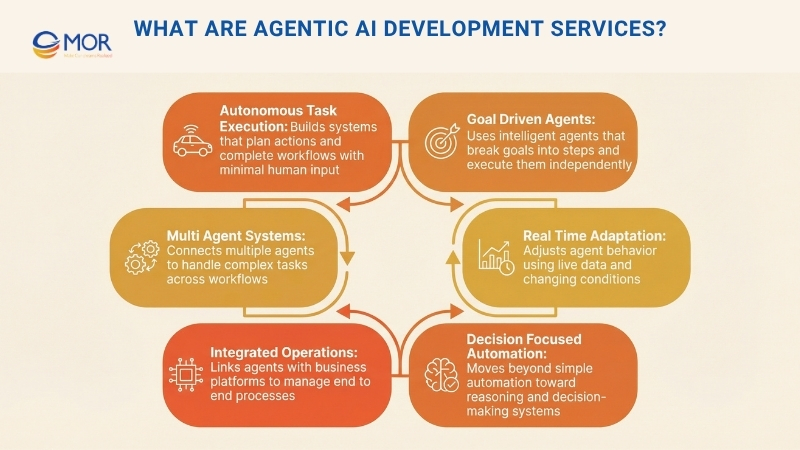
These services often involve building multi-agent environments, connecting them with business platforms, and allowing them to adjust using real-time data. Many agentic AI marketing use cases include operations support, customer workflows, and internal process automation. The aim is to make AI act as an active operator that can manage complex, multi-step activities across different systems.
When combining reasoning, automation, and system integration, this type of intelligent system development allows companies to move beyond basic automation toward fully autonomous, decision-focused operations.
>>> Businesses are turning to AI development services to stay competitive, work smarter, and meet rising customer expectations. Let's break down everything you need to know, from the core technologies and real-world applications to how to choose the right development partner.
Key Services Offered By Agentic AI Development Services
To understand how companies apply agentic AI in real business settings, it helps to examine the services behind these solutions. Agentic AI development services extend well beyond basic model setup or chatbot creation. They focus on building systems that can interpret goals, make decisions, take action, and improve over time. From early planning and system design to deployment, governance, and ongoing support, each service contributes to turning AI into a working part of daily operations.
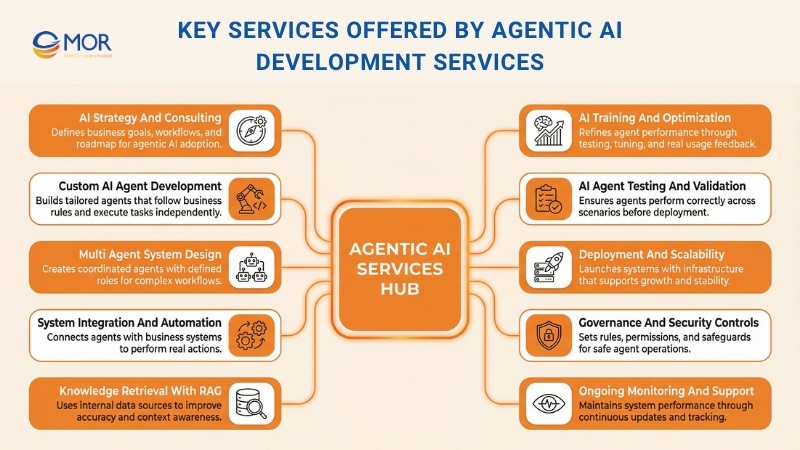
AI Strategy And Consulting
AI strategy and consulting is often the first step in any successful agentic AI project. Before any AI and machine learning development services begins, providers review your current workflows, business goals, data structure, and operational challenges. This process helps identify where autonomous agents can deliver clear value, whether that means reducing manual effort, improving response speed, supporting decisions, or handling repetitive tasks across teams.
This type of agentic AI consulting also prevents businesses from building solutions without a clear purpose. Instead of following trends, you receive a practical roadmap that links agent behavior to real outcomes. This may include defining target areas, selecting the right level of autonomy, estimating technical needs, and planning how human teams will work alongside AI systems in a structured and effective way. Many AI agent development services begin at this stage to align technology with business goals.
Custom AI Agent Development
Custom AI agent development focuses on creating agents that match how your business actually runs. Instead of using generic tools, teams build solutions that understand your internal workflows, follow your rules, and carry out tasks based on your goals. These fully autonomous AI agent can manage customer interactions, process internal requests, support operations, or coordinate complex workflows across several systems.
This work often includes agent logic design, workflow mapping, prompt structuring, tool integration, and behavior testing. The aim is to build agents that go beyond simple text responses. With custom AI agent development services, a well-designed agent can understand context, select the next action, complete tasks on its own, and adjust based on new inputs. That makes it far more useful for businesses that want real automation instead of surface-level AI tools.
Multi-Agent System Design
Some business challenges are too large or complex for a single agent to manage effectively. Multi-agent system design solves this by creating several specialized agents that work together toward a shared goal. One agent may collect data, another may process it, and another may execute actions or deliver results. Each agent has a clear role, which improves accuracy, speed, and task coordination.
These agentic AI development services work well in environments where processes involve many steps, teams, or decision layers. In areas like customer support, operations, logistics, procurement, or internal services, multi-agent systems divide tasks and coordinate actions more effectively than a single system handling everything. These AI agents services define roles, communication paths, escalation rules, and decision limits so the system runs in a clear and reliable way.
System Integration And Automation
Agentic AI becomes far more effective when it connects with the systems your business already depends on. System integration and automation services make this possible by linking AI agents with CRMs, ERPs, support tools, internal platforms, APIs, databases, and communication channels. Through this type of agent AI development service, agents move beyond analysis and start performing actions directly within your business systems.
This can include updating customer data, triggering approval flows, sending alerts, creating support tickets, retrieving inventory details, or transferring data across platforms without manual work. Integration is what turns an AI agent into an active part of your workflow. It also reduces data silos and delays, since the system works with real-time information instead of static inputs. For many businesses, this is the point where intelligent system development begins to deliver clear operational results.
Knowledge Retrieval With RAG
Knowledge retrieval using Retrieval-Augmented Generation (RAG) allows AI agents to access accurate information from your internal documents, databases, and knowledge systems. Instead of relying only on pre-trained data, these systems can fetch up-to-date and relevant information at the exact moment a task is performed. This improves response accuracy and lowers the risk of outdated or generic outputs.
RAG plays a key role in Agentic AI software development services where businesses manage large volumes of internal content, including policy documents, product data, legal files, technical guides, customer records, and operational workflows. With the right setup, often supported by an agentic AI builder, agents can answer questions, create summaries, assist teams, and support decisions using trusted company data. This makes the system more reliable, more context-aware, and much more useful in environments where accuracy matters every day.
AI Training And Optimization
Agentic AI systems require continuous improvement to remain reliable and effective. AI training and optimization services focus on refining how agents understand instructions, access data, make decisions, and react to changing conditions. This work may include prompt adjustments, logic updates, workflow tuning, performance testing, model selection, and fine-tuning based on real usage. Many AI agents development services rely on this stage to keep systems aligned with business needs.
As agents interact with users, platforms, and operational data, teams can see where results are strong and where improvements are needed. Some agents may require better reasoning, clearer task prioritization, or more consistent handling of edge cases. Optimization helps reduce errors and improve performance over time. It also aligns agent behavior with business expectations, which is important when companies want AI to handle real work instead of simple or low-risk tasks.
AI Agent Testing And Validation
Before agentic AI systems go live, they must go through careful testing. AI agent testing and validation services review how agents perform across different situations, inputs, edge cases, and workflow conditions. This includes checking task completion, reasoning ability, response accuracy, failure handling, permission boundaries, and how agents interact with other systems or agents. Many AI development services include this step to confirm that systems behave as expected before deployment.
This step is important because autonomous systems can introduce risks if they are not properly tested. An agent might misinterpret a request, pull incorrect data, or trigger actions that do not follow business rules. Testing helps detect these issues early and builds confidence before launch. It also helps teams understand where human supervision is still required. For businesses using these systems in customer-facing or operational environments, strong validation is a key part of responsible rollout.
Deployment And Scalability
Once an agentic AI system is ready, it must be deployed in a way that matches your infrastructure, security needs, and expected usage. Deployment and scalability services handle the technical setup required to launch agents into production and maintain stable performance as demand increases. This may include cloud environments, private hosting, container-based setups, orchestration tools, and access control systems. Many enterprise AI agent development services focus heavily on this stage to support long-term growth.
Scalability becomes critical when your business expects agents to manage higher workloads, more users, more tasks, or more connected systems over time. A system that performs well during testing may need stronger architecture before it can support enterprise-level use. These agentic AI development services help keep agents responsive, secure, and easy to manage as usage grows. They also allow businesses to plan for long-term adoption instead of treating AI as a short-term project.
Governance And Security Controls
As AI agents become more advanced, governance and security controls move from optional to essential. Businesses need clear rules about what agents can access, what actions they can perform, how decisions are recorded, and when human approval is required. Governance services define these rules so autonomous systems operate within business, legal, and compliance limits.
Security measures may include authentication layers, permission controls, audit logs, data management rules, action limits, and monitoring systems that detect unusual behavior. These safeguards are especially important when agents work with sensitive data, financial information, customer records, or internal operations. Strong governance does not slow progress. It makes AI safer to scale. For companies using AI development services in real workflows, trust and control matter just as much as system intelligence.
Ongoing Monitoring And Support
Agentic AI is not a one-time implementation. After deployment, agents require continuous monitoring and support to keep performance stable, manage changes, and respond to real usage patterns. Ongoing services often include behavior tracking, issue detection, usage insights, workflow updates, prompt tuning, and technical maintenance across connected systems. Many agentic AI software development services focus on this stage to keep systems running smoothly over time.
This type of support helps your business maintain value as processes change. Internal AI automation tools may be updated, business rules may shift, and user expectations may increase. Without continuous support, even a well-built system can lose accuracy or drift away from operational needs. Monitoring also allows teams to spot new automation opportunities based on real usage. For companies treating AI as a long-term capability, post-deployment support keeps the solution stable, relevant, and ready to grow.
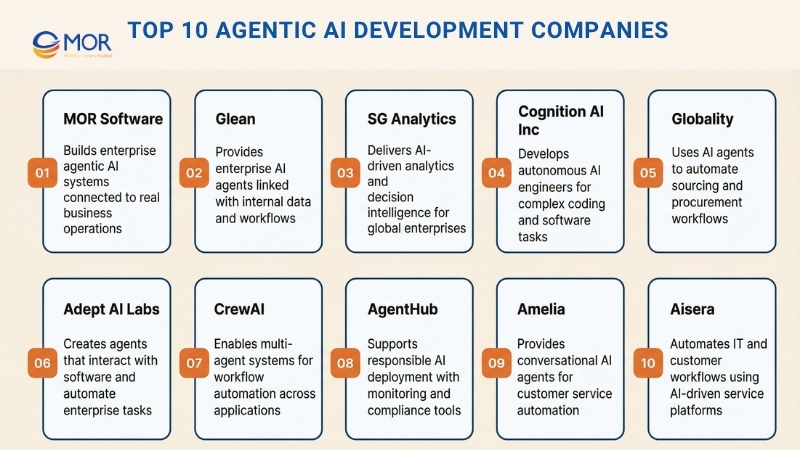
Top 10 Agentic AI Development Partners In 2026
The following company profiles will highlight what each provider of agentic AI development services can deliver and how your business may benefit from working with them.
MOR Software
MOR Software is a Vietnam software development outsourcing technology company that has become a strong choice for organizations building agentic AI platforms, tailored AI tools, and enterprise software development connected to real operations. Founded in 2016, the company reports more than 850+ completed projects across 10+ countries and operates offices in Ho Chi Minh City, Hanoi, Da Nang, Tokyo, Osaka, and Nagoya. Its current service portfolio includes AI Agents & Chatbots, Custom AI Solutions, Generative AI, and AI-powered App Extensions. The company also supports enterprises in building autonomous agents that can plan tasks, operate within existing systems, and follow security and compliance rules, often showcased through its agentic AI website and solution portfolio.
Founders and Leadership
- Tu (Max) Vu serves as CEO of MOR Software.
- Le Manh Hung is CTO, while Phung Van Tu leads MOR AI.
- MOR’s leadership team and regional presence support delivery for clients across Vietnam and Japan.
Key Services
- AI Agents & Chatbots, designed for conversational automation and workflow support.
- Custom AI Solutions, developed to match client-specific processes and internal systems.
- Generative AI, applied for content creation, copilots, and productivity-focused tools.
- AI-powered App Extensions, built to integrate AI capabilities into existing software products.
Core Strengths Market Contribution
MOR Software stands out by linking agentic AI development services with enterprise software delivery, instead of focusing only on isolated prototypes. The company positions its work around autonomous agents, workflow automation, system integration, and long-term deployment within existing platforms. Its experience also spans healthcare, media, construction, ecommerce, Salesforce, and workforce systems, which helps when businesses need AI tied closely to real operations. If you want to apply agentic AI in a way that fits your business, contact us to get started.
Clients And Strategic Partnerships
- Public case studies include work for Dan Tri News and several Japanese clients across healthcare, construction, and enterprise operations.
- MOR also operates within ecosystems connected to Salesforce, AWS, and Slack, supporting integration-heavy automation and intelligent system development use cases.
Glean
Glean is an enterprise AI company that supports organizations in building, deploying, and managing AI agents across internal workflows. Its platform combines enterprise search, AI assistants, and agent-based automation, enabling teams to locate information, generate outputs, and trigger actions using company knowledge and connected systems. Glean places a strong focus on workplace productivity, especially for organizations that need agents grounded in permission-aware enterprise data. Its broader Work AI platform also includes tools for agent building, orchestration, and an agentic engine designed to automate tasks across business functions.
Founders and Leadership
- Arvind Jain is the founder and CEO of Glean.
- Glean describes its founding team as former Google search engineers and experienced industry professionals.
Key Services
- Work enterprise AI platform, combining enterprise search, assistants, analytics, and automation capabilities.
- Glean Assistant, Data Analysis, Deep Research, Canvas, and Companion for productivity and knowledge tasks.
- Agents, Agent Builder, Agent Orchestration, Agent Library, and Agentic Engine for creating and managing enterprise AI agents.
Core Strengths Market Contribution
Glean’s main strength comes from linking AI agents with enterprise data, permissions, and workflows. This makes it a strong choice for organizations that want agentic systems to operate on internal knowledge instead of relying only on public data. The company also positions its technology around adaptive reasoning, workflow execution, and scalable deployment for real business environments.
Clients And Strategic Partnerships
- Glean maintains a partner network that includes resellers and consulting firms.
- The company also highlights partnerships focused on enterprise AI adoption and workflow transformation.
SG Analytics
SG Analytics (SGA) enables tailored agentic AI workflows that improve business decision-making. Along with context-aware automation, its team delivers operational intelligence for global enterprises. With strong expertise in analytics supported by AI software development services, the company integrates generative AI into its business-focused solutions. Its capabilities also support data activation, augmented analytics, and decision intelligence, which continue to gain traction worldwide.
Founders and Leadership
- Sushant Gupta and Ahmed Hakki are co-founders of SG Analytics.
- Sid Banerjee serves as CEO, focusing on making data more understandable and human-centered.
- In late 2024, Mainak Mazumdar, KK Davey, and Shankar Iyer joined SGA to strengthen its leadership team.
Key Services
- AI Studio, supporting ideation, pilot programs, and deployment of enterprise AI initiatives.
- ShastraX, an AI accelerator built for capital markets and contextual intelligence workflows.
- TruNtity, a data management platform for banks, custodians, and fintech companies that uses AI agents for data resolution and compliance workflows.
- Broader AI, technology, advanced analytics, and research services supporting enterprise transformation.
Cognition AI, Inc.
Cognition AI, Inc. develops Devin, an autonomous AI software engineer agent. The company quickly secured strong venture funding and later acquired Windsurf, which strengthens its AI coding capabilities.
Cognition aims to reshape productivity in software engineering. It uses AI agents to support this goal. Its main focus is handling complex coding tasks from start to finish. With strong experience in generative AI solutions and agent-based systems, the company positions Devin as a major shift for developers. Cognition AI also focuses on speeding up innovation, with a clear goal of reducing delays in development cycles across the software industry.
Founders and Leadership
- Scott Wu, Walden Yan, and Steven Hao founded Cognition AI.
- CEO Scott Wu leads with a vision of making software widely accessible.
- Steven Hao serves as CTO, while Walden Yan is CPO.
Key Services
- Devin, an autonomous AI software engineer that can write, execute, and test code.
- Enterprise AI coding support for tasks like ticket handling, bug fixing, internal tools, and feature development.
- Code migration and modernization supported through Microsoft Azure.
- Expanded AI coding workflows through Windsurf after Cognition’s 2025 acquisition agreement.
Core Strengths Market Contribution
Cognition AI stands out for enabling high levels of autonomy in software engineering. Its MultiDevin system coordinates several agentic AI processes. The team behind Devin has helped improve how developers work and deliver results.
Clients And Strategic Partnerships
- Nubank, a large Brazilian fintech company, uses Devin to upgrade legacy systems.
- Ramp, another fintech firm, applies Devin for writing tests and removing unused code.
- Cognition AI, Inc. has an official partnership with Microsoft.
Globality
Globality is an AI-driven enterprise sourcing platform. Its agent-based capabilities improve how organizations manage procurement. The company’s generative agent, Glo, simplifies sourcing workflows. It can define requirements, identify suppliers, and provide negotiation insights. This allows Globality to support faster and clearer decision-making.
The company aims to reduce procurement timelines from months to just a few hours. Its team also reports cost savings of 10–20% alongside efficiency gains of up to 70%.
Founders and Leadership
- Co-founders Lior Delgo and Joel Hyatt hold President and CEO roles.
- Keith McFarlane is CTO, while Doug Kurfess serves as CSO.
Key Services
- Autonomous sourcing solutions for enterprise procurement teams.
- AI-supported requirement definition and supplier discovery through Glo.
- Proposal evaluation, pricing analysis, and negotiation insights.
- Tail spend management and integration with enterprise procurement systems.
Core Strengths Market Contribution
Globality shows clear operational and financial results in the agentic AI space. Its recognition at the enterprise level reflects how it supports companies in improving automation at scale.
Clients And Strategic Partnerships
- Clients include Santander, Tesco, T. Rowe Price, and IQVIA.
- Globality also works with partners such as BT Sourced, KellyOCG, and SAP Ariba.
Adept AI Labs
Adept AI Labs builds autonomous digital agents designed to handle complex workflows across different software environments. Its approach combines multimodal models with custom actuation software to support task execution. These agents can interact with user interfaces, automate processes, and assist with decision-making. The platform also aims to improve productivity through smooth collaboration between humans and machines, often supported by advanced AI engineering services.
Founders and Leadership
- David Luan, Niki Parmar, and Ashish Vaswani founded Adept AI. They are former Google engineers with deep expertise in AI and machine learning.
- David Luan initially led the company, and Zach Brock now serves as CEO of Adept AI.
Key Services
- Enterprise workflow automation for repetitive and manual tasks across business applications.
- Multimodal AI models designed for enterprise-level automation.
- Agent-based solutions supported by in-house models, agentic data, web interaction tools, and custom infrastructure.
- Trust and security frameworks designed for enterprise deployment.
Core Strengths Market Contribution
Adept AI Labs stands out for its ability to develop agents that can understand and interact with complex software systems. This capability helps organizations improve operational efficiency and manage workflows more effectively.
Clients And Strategic Partnerships
- Public details about customers are limited. However, Adept has secured major funding from investors such as Greylock Partners and Addition, showing strong market confidence.
CrewAI
CrewAI provides a platform that helps businesses create and deploy automated workflows powered by large language models and cloud infrastructure. Its system supports the creation of multi-agent teams, often called AI crews. These agentic systems can manage complex tasks across different applications, helping streamline operations and improve efficiency.
Founders and Leadership
- João Moura is the founder of CrewAI.
- The leadership team focuses on advancing AI and automation technologies.
Key Services
- Multi-agent enterprise platform that allows organizations to run AI crews with full control.
- AMP, a system for deploying, monitoring, and scaling agents in production environments.
- Crew Deployments, REST API access, observability tools, webhook streaming, and tool libraries.
- Crew Studio, a no-code and low-code environment for building and customizing automation workflows.
Core Strengths Market Contribution
CrewAI enables businesses to use AI agents framework for automating tasks across operations. Its main strength lies in improving scalability through coordinated automation systems.
Clients And Strategic Partnerships
- Integration-ready partners include Anthropic, AgentOps, Hubspot, Oracle, PwC, and KPMG within the CrewAI ecosystem.
AgentHub
AgentHub is a platform that helps organizations adopt AI in a responsible way. It provides tools for building, managing, and monitoring AI agents across different use cases. The platform focuses on maintaining transparency, compliance, and performance during AI deployment. Many enterprise teams use it as part of broader AI development services to keep systems controlled and visible.
Founders and Leadership
Part of Microsoft Dynamics 365, led by Microsoft’s AI and Dynamics 365 teams.
Key Services
- Guided learning and adoption support through clear overviews of AI capabilities.
- Rollout manager for gradual deployment of AI agents across selected workloads and use cases.
- Agent insights for tracking performance and gaining operational visibility.
- Security, architecture, privacy, and compliance support within the Dynamics 365 ecosystem.
Core Strengths Market Contribution
AgentHub focuses on safe and transparent adoption of agentic AI. It allows organizations to integrate AI into operations while keeping full control and meeting compliance requirements.
Clients And Strategic Partnerships
- Integrated directly into the Microsoft Dynamics 365 ecosystem.
- Used by a wide range of enterprise organizations.
Amelia
Amelia is a conversational agentic AI platform designed to automate customer service and support operations. It uses natural language processing (NLP) along with machine learning models to understand and respond to user requests. The platform supports AI agent development for customer service automation and plays a key role in agentic AI in customer experience. Its goal is to improve user satisfaction while helping businesses manage operations more effectively.
Founders and Leadership
- Amelia is led by Dr. Ball, who has strong experience in finance, mergers and acquisitions, and technology.
Key Services
- Amelia Platform, designed to build enterprise AI agents that can listen, reason, and act.
- Conversational AI solutions for both customer and employee interactions.
- Agentic voice AI and system integration through Amelia 7 and MCP support.
- Autonomics Platform for AI-driven IT consulting service management within the broader SoundHound ecosystem.
Core Strengths Market Contribution
Amelia’s platform delivers reliable conversational AI that helps businesses improve customer engagement and lower operational costs.
Clients And Strategic Partnerships
- Amelia has been recognized by Everest Group as a leader in conversational AI.
Aisera
Aisera delivers an AI-driven platform that automates IT service management, customer support, and other enterprise workflows. Its solutions rely on NLP and machine learning models to create personalized and automated experiences. These systems help lower costs while improving service efficiency.
Founders and Leadership
Founded by Muddu Sudhakar, supported by a leadership team with strong backgrounds in AI and enterprise software.
Key Services
- AI Agent Platform, including Agent Composer, Aisera Unify, integrations, analytics, and the TRAPS security model.
- Aisera Assistant and Agent Assist for improving employee and agent productivity.
- AI Agents, AI Agent Orchestration, Agentic Conversations, Hyperflows, and AI Workflow Builder.
- Industry-focused solutions for AI Service Desk, AI for IT, ITSM, AIOps, and AI Customer Service.
Core Strengths Market Contribution
Aisera is known for its ability to automate workflows and personalize user interactions across enterprise environments.
Clients And Strategic Partnerships
Aisera has been named a Visionary in the 2025 Gartner Magic Quadrant for AI applications in IT service management.
Key Benefits Of Partnering With Agentic AI Development Services Providers
As AI continues to advance, reports show that agentic AI could reshape more than 10 million jobs by 2030 across different industries. This shift highlights how important agentic AI development services are becoming for modern businesses. Working with the right provider helps improve decision-making and customer experience while supporting long-term growth.
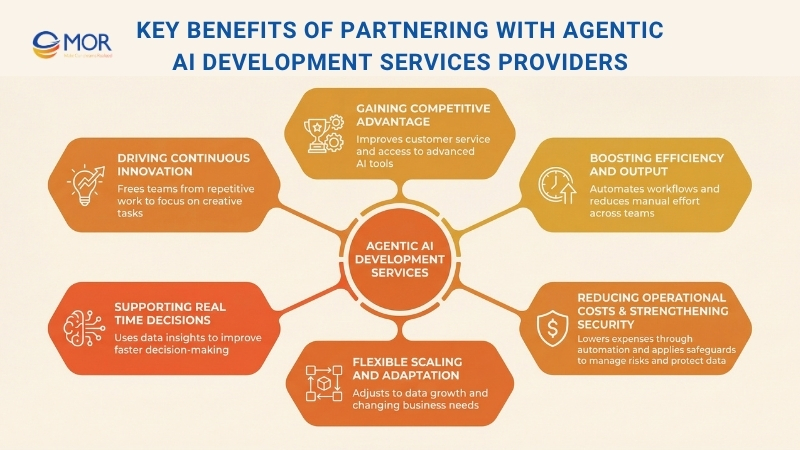
Driving Continuous Innovation
Agentic AI handles repetitive work, allowing your team to focus on creative thinking and new ideas. It also supports faster experimentation through quick prototyping and testing.
Gaining Competitive Advantage
A reliable AI project management partner helps you support customers around the clock and improve service quality. It also gives access to modern tools that help your business stay competitive.
Boosting Efficiency And Output
One of the main benefits is higher productivity. These systems automate routine tasks and reduce manual effort. AI agents can manage complex workflows across teams, which helps improve overall efficiency.
Supporting Real-Time Decisions
These systems process large amounts of data in real time and provide useful insights. Decision tools help your leadership team detect risks and improve operations faster.
Flexible Scaling And Adaptation
Whether your data volume is small or large, these systems can scale as needed. They also adjust to new data and market changes. A skilled partner can connect them with tools like Slack or internal APIs without disruption.
Reducing Operational Costs
Automation reduces manual processes and lowers costs. These systems can also identify underused or overused resources and improve how they are allocated.
Strengthening Security And Risk Control
Most providers apply strict security measures and follow compliance standards. When risks appear, agents can respond quickly and suggest ways to reduce potential issues.
How To Evaluate Agentic AI Development Services Providers
Selecting the right partner for agentic AI development services can shape how effectively your business uses automation and intelligent systems. The best choice depends on your goals, your data environment, and your current level of technical readiness. To guide your decision, consider the following points before working with a provider:
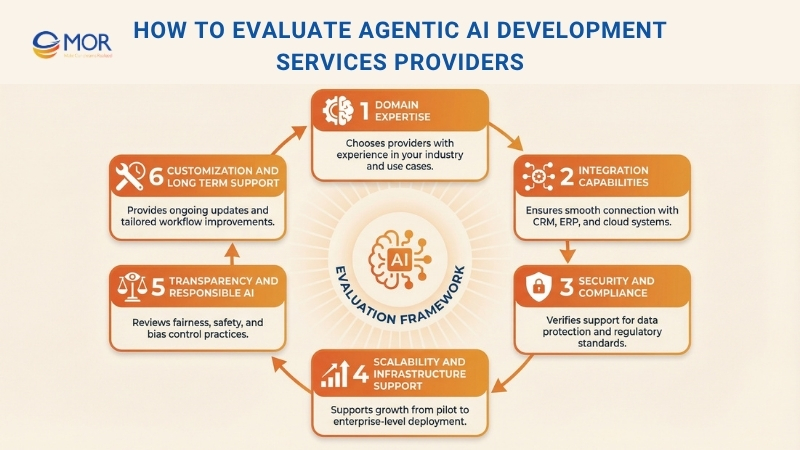
Domain Expertise
Choose providers with proven experience in your industry, whether it is finance, retail, healthcare, or logistics. For example, some companies specialize in enterprise AI and data automation, aligning AI solutions with real business results.
Integration Capabilities
Strong platforms should connect smoothly with your current systems such as CRM, ERP, or cloud infrastructure. Solutions like Microsoft Copilot and OpenAI-based agents are known for their flexibility when integrating into enterprise environments, which is a key part of modern AI development services.
Security And Compliance
Check that the provider supports data protection, access control, and regulatory compliance standards like GDPR, SOC 2, and HIPAA. Security becomes especially important when deploying autonomous systems at scale.
Scalability And Infrastructure Support
The system should support both small pilot projects and large-scale enterprise use. Some providers focus on cloud-based architectures and API-driven setups to help businesses scale without major system changes.
Transparency And Responsible AI
Review how the provider handles fairness, transparency, and bias control. Companies like Anthropic and Google DeepMind focus on safety and responsible AI practices to build trust in automated systems.
Customization And Long-Term Support
Look for a partner that supports fine-tuning, custom workflows, and ongoing improvements instead of fixed solutions. Continuous updates and support help your system stay aligned with business needs over time.
What’s Next For Agentic AI Development Services
Agentic AI development services will continue to grow as businesses demand more advanced orchestration and multi-agent integration across systems. Companies will also refine agent capabilities to fit specific use cases while managing computing resources more carefully.
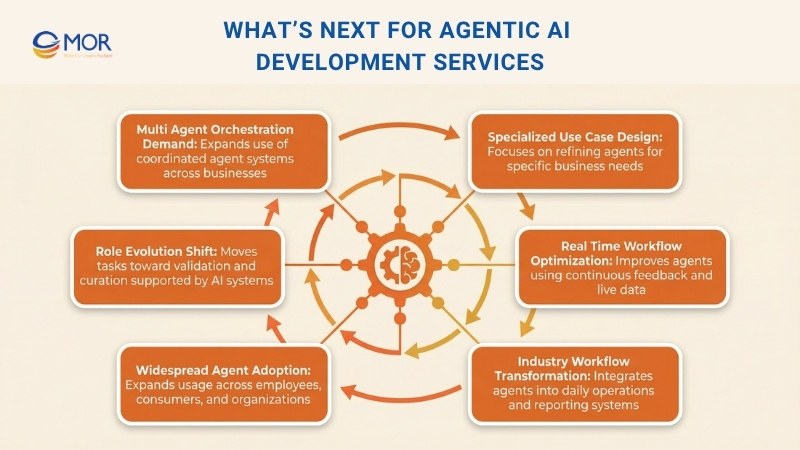
- Providers will see increasing demand for multi-agent orchestration and coordinated system design.
- Companies will fine-tune agent features for clearly defined business cases, with attention to efficient resource usage.
- At the same time, improving agent workflows using real-time feedback will become a standard requirement.
- Industry specialists in supply chain, hiring, and documentation will rethink how work is completed, with AI agents becoming part of most reporting dashboards to support daily tasks.
- Over time, individuals across roles, including consumers, employees, founders, investors, and public sector workers, will rely on dedicated agents for more secure and efficient operations.
- Roles focused on data entry and content creation will shift toward data validation and content curation, supported by higher productivity gains.
Conclusion
Agentic AI is moving from experiments to real business systems that plan, act, and improve over time. The right partner makes a big difference when you want results that fit your operations, not just demos. We’ve covered the top agentic AI development services and leading providers to help you decide. If you want a solution built around your workflows, MOR Software is ready to support you. Contact us to start your next AI project with a clear direction.
MOR SOFTWARE
Frequently Asked Questions (FAQs)
What are agentic AI development services?
Agentic AI development services focus on building systems where AI agents can plan tasks, make decisions, and complete workflows with minimal human input. These systems go beyond basic automation and can handle multi-step processes across different tools and data sources.
How is agentic AI different from traditional AI solutions?
Traditional AI responds to prompts or follows fixed rules. Agentic AI works more independently. It can break down goals, decide next steps, and act across systems without constant instructions.
What types of businesses can benefit from agentic AI development services?
Companies in finance, healthcare, ecommerce, logistics, and SaaS often see strong results. Any business with repetitive workflows, complex decision paths, or large data flows can benefit.
What are common use cases for agentic AI systems?
Typical use cases include customer support automation, internal workflow management, sales process automation, IT operations, and data analysis tasks that require multiple steps.
How long does it take to build an agentic AI solution?
A small proof of concept can take a few weeks. A full production system may take several months, depending on complexity, integrations, and data requirements.
Do agentic AI systems require large amounts of data?
Not always. Some systems can start with existing structured data and improve over time. More data usually leads to better accuracy, but many projects begin with limited datasets.
How do agentic AI systems integrate with existing software?
They connect through APIs, databases, and cloud services. This allows agents to interact with CRMs, ERPs, internal tools, and third-party platforms as part of their workflows.
What are the main challenges when adopting agentic AI development services?
Common issues include unclear use cases, poor data quality, and weak system integration. Security and governance also need careful planning from the start.
How do companies maintain control over autonomous AI agents?
Control comes from setting rules, permissions, and monitoring systems. Businesses define what agents can access and what actions they can take, with logging and oversight in place.
Are agentic AI systems secure for enterprise use?
Yes, if built correctly. Strong security practices include access control, encryption, audit logs, and compliance with standards like GDPR or SOC 2.
Share


Make Our-Dreams Realized


© 2023 . MOR Software. All Rights Reserved
Sitemap
Privacy Policy
Terms of Use

Rate this article
0
over 5.0 based on 0 reviews
Your rating on this news:
Name
*Email
*Write your comment
*Send your comment
1