


20 Best Data Labeling Quality Assurance Tools Vendors to Outsource in 2026
A low annotation rate means little when mislabeled data reaches model training. This guide compares data labeling quality assurance tools vendors across consensus, error detection, audit trails, managed QA, pricing, and secure enterprise AI workflows. MOR Software also explains where a ready-made platform fits and where a custom QA system makes better business sense.
Key Takeaways
- Label quality needs several controls. Consensus mechanisms, gold tasks, reviewer checks, model disagreement, and label history catch different error types.
- The right vendor depends on your data, risk level, internal skills, deployment rules, and need for a managed workforce.
- Compare total accepted-label cost. Platform fees, repeated labels, expert review, storage, integration, security, and rework change the real budget.
What Are Data Labeling Quality Assurance Tools?
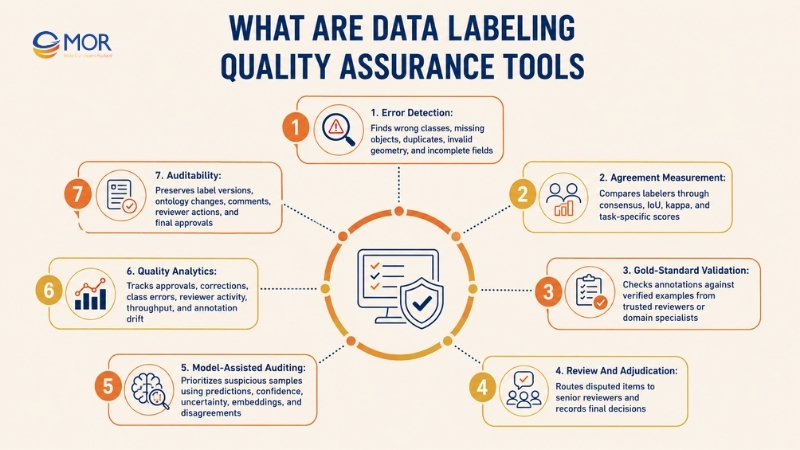
Data labeling quality assurance tools vendors help teams detect, measure, and correct annotation errors before those errors distort model training or evaluation. The category covers annotation platforms, independent auditing software, managed labeling providers, and custom QA systems.
A NeurIPS study found at least 3.3% label errors on average across 10 widely used benchmark datasets, including at least 6% in the ImageNet validation set. That level of noise can change model rankings and weaken test results, so a final manual spot check is rarely enough.
- Error detection: Find wrong classes, missing objects, duplicate records, invalid geometry, incomplete fields, and conflicting labels.
- Agreement measurement: Compare independent labelers through consensus scores, inter-annotator agreement, IoU, kappa, or task-specific measures.
- Gold-standard validation: Check work against verified examples prepared by trusted reviewers or domain specialists.
- Review and adjudication: Route rejected or disputed items to senior reviewers, then record the final decision.
- Model-assisted auditing: Rank suspicious samples through predictions, confidence values, uncertainty, embeddings, or model-label disagreement.
- Quality analytics: Track approval rates, correction rates, class-level errors, reviewer activity, throughput, and annotation drift.
- Auditability: Preserve label versions, ontology changes, comments, reviewer actions, and final approvals.
Annotation software handles production work. Dedicated auditing tools inspect existing datasets, managed vendors add workforce operations, and internal review relies on your own staff. Mature QA programs often combine two or more of these layers.
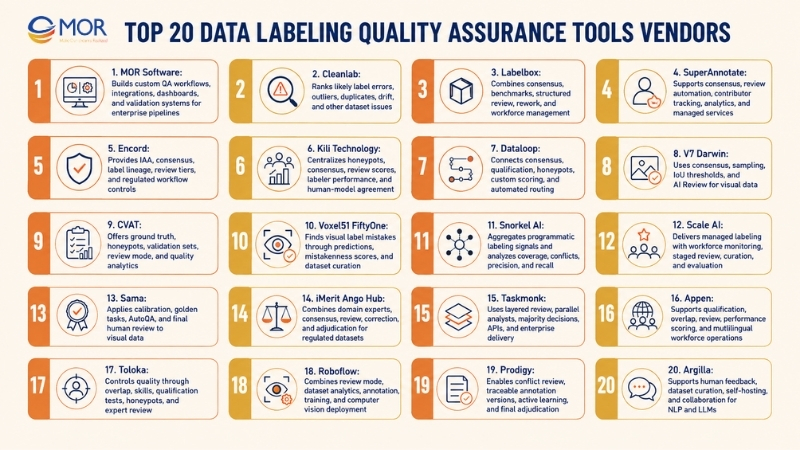
Top 20 Data Labeling Quality Assurance Tools Vendors
This data labeling quality assurance tools vendors list covers custom engineering partners, annotation platforms, auditing software, and managed providers. Buyers searching for data labeling quality assurance tools vendors in USA should still compare deployment, domain skill, and workflow ownership instead of treating headquarters as the main buying signal.
This table also works as a practical list of data annotation companies and software products. The vendor profiles explain where each option fits and where extra controls may still be needed.
Rank | Vendor | Vendor model | Core QA strength | Main modalities | Deployment | Pricing approach | Best for |
1 | MOR Software | Custom AI software development and QA engineering partner | Custom validation workflows, QA automation, integration, and testing | Project-defined data pipelines | Cloud, private cloud, or on-premises | Project-based, fixed-price, or dedicated team | Enterprises building tailored data labeling QA systems |
2 | Cleanlab | Label-auditing software | Automated label-error detection | Text, tabular, image, object detection | Python or managed platform | Open-source plus paid | Auditing existing datasets |
3 | Labelbox | Enterprise platform and services | Benchmarks, consensus, multi-step review | Multimodal | Cloud | Free tier plus enterprise | Complex enterprise workflows |
4 | SuperAnnotate | Platform and managed services | Consensus, review automation, analytics | Multimodal | Cloud and enterprise options | Custom | Distributed annotation teams |
5 | Encord | Multimodal data platform | Native IAA, consensus, and quality analytics | Image, video, audio, text, DICOM | Cloud and enterprise options | Custom | Regulated and visual AI |
6 | Kili Technology | Platform and managed services | Honeypots, consensus, review scores | Image, video, text, PDF, geospatial | Cloud or private deployment | Custom | Auditable enterprise labeling |
7 | Dataloop | Data operations platform | Consensus, qualification, honeypots | Multimodal | Cloud and enterprise | Custom | Automated data pipelines |
8 | V7 Darwin | Visual data platform | Consensus stages and AI Review | Image, video, DICOM | Cloud | Custom | Medical and visual AI |
9 | CVAT | Open-source annotation platform | Validation sets, honeypots, quality analytics | Image, video, 3D | Cloud or self-hosted | Open-source plus paid | Computer vision teams |
10 | Voxel51 FiftyOne | Dataset curation platform | Model-assisted label mistake discovery | Image, video, 3D | Open-source or enterprise | Open-source plus paid | Post-labeling visual QA |
11 | Snorkel AI | Programmatic labeling platform | Weak supervision and label aggregation | Text, documents, tabular, image | Enterprise | Custom | Technical data-centric AI teams |
12 | Scale AI | Managed data platform | Workforce monitoring and multi-stage QA | LLM, text, image, video, robotics | Managed enterprise | Custom | Large-scale outsourced programs |
13 | Sama | Managed annotation provider | Structured review and visual QA | Image and video | Managed service | Custom | Automotive and retail AI |
14 | iMerit Ango Hub | Platform and managed experts | Domain-expert review and consensus | Multimodal | Enterprise | Custom | Healthcare and regulated AI |
15 | Taskmonk | Platform and managed workforce | Gold sets, IAA, adjudication, drift control | Multimodal | SaaS, VPC, or on-premises | Custom | Continuous enterprise labeling |
16 | Appen | Managed workforce and platform | Workforce qualification and multi-stage QC | Text, speech, image, video | Managed enterprise | Custom | Multilingual global datasets |
17 | Toloka | Platform and distributed workforce | Overlap, skill filters, and expert review | Text, image, audio, LLM evaluation | Cloud | Usage-based or custom | Flexible global annotation |
18 | Roboflow | Computer vision platform | Review mode and dataset analytics | Image and video | Cloud | Freemium and paid | Fast computer vision iteration |
19 | Prodigy | Developer annotation tool | Conflict review and traceable annotation versions | Primarily NLP | Local or private infrastructure | Paid license | Python and spaCy teams |
20 | Argilla | Open-source feedback platform | Human-feedback review and dataset curation | Text, image, LLM feedback | Cloud or self-hosted | Open-source plus managed | NLP and LLM feedback datasets |
MOR Software
MOR Software fits enterprises that need a custom QA layer around existing annotation tools, data stores, and ML pipelines. It builds the system around your ontology, reviewer roles, security rules, and reporting needs.
- Solution category: Custom AI and QA engineering partner
- Primary QA capability: Validation logic, workflow automation, integration, and testing
- Ideal customer: Enterprises with project-specific data and controls
- Commercial structure: Fixed-price project or dedicated team
- Important limitation: No ready-made annotation marketplace
MOR can build video annotation services, review, rework, escalation, and approval screens. Engineering teams can add checks for missing labels, duplicates, invalid values, schema conflicts, and incomplete reviews, then connect APIs, ETL jobs, cloud storage, internal databases, and model pipelines.
Testing can cover functions, integrations, performance, security, usability, and regression. QA dashboards may track defect rates, rejection patterns, reviewer activity, throughput, and task status, which makes MOR a distinct option among data labeling quality assurance tools vendors that mainly sell standard software.
Cleanlab
Cleanlab audits labeled datasets after annotation and ranks examples that are likely to contain errors. It suits teams that already have labels and model outputs but need an independent QA pass.
- Solution category: Data and label auditing software
- Primary QA capability: Automated error ranking
- Ideal customer: ML teams checking existing datasets
- Commercial structure: Open-source library plus paid products
- Important limitation: Good predictions or embeddings are usually needed
Cleanlab supports classification, multi-label classification, text, regression, segmentation, and object detection workflows. Datalab can also flag outliers, near duplicates, drift, and other dataset issues.
Use it beside an annotation platform rather than as the main workforce system. Its value lies in prioritization: reviewers inspect the most suspicious items before spending time on cleaner records.
Labelbox
Labelbox joins annotation production, workforce management, and structured QA in one enterprise platform. Consensus scores compare labelers, while benchmarks act as verified reference labels.
- Solution category: Enterprise annotation platform and services
- Primary QA capability: Consensus, benchmarks, review, and rework
- Ideal customer: Complex multimodal programs
- Commercial structure: Free tier plus paid plans
- Important limitation: Setup and pricing can become complex
Custom workflows move data through labeling, review, rejection, correction, and approval stages. Performance dashboards track labeling activity and project progress across teams.
Managed experts are also available for buyers that need delivery capacity. Confirm LBU usage, workforce charges, storage, and enterprise controls before committing.
SuperAnnotate
SuperAnnotate supports annotation, dataset work, model evaluation, and managed data services. Its workflow tools suit distributed teams working across several data types.
- Solution category: Platform and managed services
- Primary QA capability: Consensus, review automation, and analytics
- Ideal customer: Distributed enterprise AI teams
- Commercial structure: Custom quote
- Important limitation: Small projects may face setup overhead
Teams can design consensus mechanisms, reviewer routes, contributor tracking, and project-level controls. Analytics can be split by contributor, label type, metadata, and project.
The platform also connects with data sources and model pipelines. Buyers should test configuration time and reporting depth on a real sample, since flexible systems often need careful setup.
Encord
Encord combines annotation, data curation, model evaluation, and failure analysis. Its QA tools are built for visual and regulated workloads where traceability carries real business weight.
- Solution category: Multimodal data platform
- Primary QA capability: IAA, consensus, review tiers, and analytics
- Ideal customer: Medical imaging, robotics, and visual AI teams
- Commercial structure: Enterprise quote
- Important limitation: Platform depth may exceed simple project needs
Consensus workflows assign the same task to independent annotators and surface disagreements. Teams can apply IoU and other modality-specific agreement measures.
Label lineage, stage history, and configurable review routes support audits and controlled rework. Evaluate deployment, access controls, DICOM support, and integration work during the pilot.
Kili Technology
Kili Technology combines annotation software, review workflows, and optional managed services. Quality Insights centralizes consensus, honeypot, review, and labeler performance signals.
- Solution category: Platform and managed services
- Primary QA capability: Honeypots, consensus, review scores, and human-model IoU
- Ideal customer: Auditable multimodal projects
- Commercial structure: Custom quote
- Important limitation: Integration and price need pilot validation
Quality scores can be viewed by class, job, or labeler. Project managers can target low-agreement assets instead of reviewing a random pile of work.
Kili supports image, video, text, PDF, and geospatial data. Set clear sampling rates and reviewer checkpoints before launch, since dashboards only help when the underlying rules match your acceptance policy.
Dataloop
Dataloop treats QA as part of a larger data operations pipeline. Consensus, qualification, honeypot, review, and score functions can be connected to automated routing.
- Solution category: Data operations platform
- Primary QA capability: Consensus, qualification, honeypots, and custom scoring
- Ideal customer: Enterprise data pipeline teams
- Commercial structure: Custom quote
- Important limitation: Implementation needs technical ownership
Consensus tasks compare contributor labels and support majority-vote results. Qualification tasks test skills against ground truth, while hidden honeypots monitor work during production.
Custom score functions allow project-specific checks. The tradeoff is setup effort: pipeline logic, roles, scoring, and exception handling need clear design before the first large batch.
V7 Darwin
V7 Darwin focuses on image, video, and DICOM workflows. Its consensus stage can compare independent annotators, models, or a mix of human and model outputs.
- Solution category: Visual data platform
- Primary QA capability: Consensus, review, sampling, and AI Review
- Ideal customer: Medical and computer vision teams
- Commercial structure: Custom quote
- Important limitation: Less suited to text-first programs
Class-level IoU thresholds decide which files pass and which enter review. Sampling stages can send only a chosen share of items through manual QA.
That design helps control reviewer cost without dropping all human checks. Medical teams should test blind annotation, specialist review, DICOM handling, and disagreement resolution on representative cases.
CVAT
CVAT gives computer vision teams open-source annotation plus paid cloud and enterprise choices. QA functions include validation sets, ground-truth jobs, immediate feedback, honeypots, review mode, and analytics.
- Solution category: Open-source computer vision platform
- Primary QA capability: Ground truth, honeypots, quality reports, and consensus
- Ideal customer: Teams needing control and self-hosting
- Commercial structure: Free, subscription, or enterprise license
- Important limitation: Administration needs technical staff
CVAT supports image, video, and 3D annotation. Teams can review conflicts against ground truth and calculate job-level quality metrics.
Self-hosting can support tighter data control, but infrastructure, upgrades, access, backups, and monitoring remain your responsibility.
Voxel51 FiftyOne
FiftyOne audits visual datasets after labels exist. It compares ground truth with model predictions to rank suspected classification and detection mistakes.
- Solution category: Dataset curation and auditing platform
- Primary QA capability: Model-assisted label mistake discovery
- Ideal customer: Computer vision and MLOps teams
- Commercial structure: Open-source plus enterprise
- Important limitation: It doesn’t manage a labeling workforce
Mistakenness scores can expose wrong classes, poor box placement, missing objects, and possible spurious labels. Reviewers can inspect, tag, and send selected samples back to an annotation tool.
Python integration fits CI and MLOps pipelines. Pair FiftyOne with CVAT, Label Studio, V7, or Labelbox when you need production labeling plus an independent visual audit.
Snorkel AI
Snorkel AI creates labels through rules, heuristics, foundation models, and other weak supervision sources. A label model combines those signals into probabilistic training labels.
- Solution category: Programmatic labeling platform
- Primary QA capability: Signal aggregation and conflict analysis
- Ideal customer: Technically mature data teams
- Commercial structure: Enterprise quote
- Important limitation: Requires coding and data science skill
Teams can measure labeling-function precision, recall, coverage, conflict, and label density. Versioned functions also make taxonomy changes easier than restarting a large manual project.
The method fits NLP, documents, search, fraud, and similar rule-rich tasks. It works best when domain experts can express reliable logic and engineers can test weak supervision sources.
Scale AI
Scale AI runs managed data programs for frontier models, robotics, autonomy, and enterprise AI. Its model mixes workforce operations, ML-assisted labeling, data curation, and evaluation.
- Solution category: Managed data platform
- Primary QA capability: Contributor monitoring and staged review
- Ideal customer: Large outsourced AI programs
- Commercial structure: Custom enterprise quote
- Important limitation: Less pricing transparency and software control
Scale supports text, image, video, audio, LiDAR, and model evaluation. Domain experts can handle harder reasoning and alignment tasks.
Large operational capacity is the main draw. Buyers should define acceptance metrics, benchmark ownership, correction terms, data access, and export rights before signing.
Sama
Sama provides managed image, video, and 3D point-cloud annotation through an in-house workforce. Quality calibration, golden tasks, AutoQA, and final human review form its control chain.
- Solution category: Managed annotation provider
- Primary QA capability: Structured calibration and multi-level visual QA
- Ideal customer: Automotive, retail, mapping, and physical AI
- Commercial structure: Custom quote
- Important limitation: Not a general self-service QA tool
Sama states a 99% first-batch client acceptance rate across 10 billion points per month. Its teams also complete project-specific training before production, which supports consistent work on domain-heavy visual tasks.
Buyers still need their own acceptance tests. Check how the vendor defines acceptance, handles instruction changes, records errors, and charges for rework.
iMerit Ango Hub
Ango Hub joins annotation software with iMerit’s managed domain experts. Consensus stages duplicate tasks across annotators and route results through agreement or disagreement paths.
- Solution category: Platform and managed experts
- Primary QA capability: Consensus, review, and adjudication
- Ideal customer: Healthcare, geospatial, autonomy, and GenAI teams
- Commercial structure: Enterprise quote
- Important limitation: Specialist work raises cost and setup time
Review stages accept, reject, or send tasks back for correction. Adjudication can select the best answer or merge all answers, depending on the workflow.
Credentialed experts are useful where general labelers can’t judge the data reliably. Test tool-level consensus limits, video handling, reviewer credentials, and audit records during discovery.
Taskmonk
Taskmonk combines annotation software, workforce partners, and API-based delivery. Tasks may pass through several levels, use parallel analysts, and apply majority rules.
- Solution category: Platform and managed workforce
- Primary QA capability: Layered review, parallel work, and majority decisions
- Ideal customer: Continuous enterprise labeling programs
- Commercial structure: Custom quote
- Important limitation: Public QA detail is less extensive than some rivals
REST, Java, and Python connections support batch upload, progress checks, and result retrieval. Project roles and integration tests help connect vendor work to internal systems.
Claims around gold sets, IAA, adjudication, drift controls, and SLAs should be tested in a production-style pilot. Ask for sample reports, error logs, ontology history, and reviewer evidence.
Appen
Appen provides managed annotation across image, text, video, audio, search, and LLM evaluation. Its platform links contributor jobs, test questions, judgments, QA jobs, reviewer assignments, and performance scores.
- Solution category: Managed workforce and platform
- Primary QA capability: Qualification, overlapping work, review, and scoring
- Ideal customer: Global multilingual datasets
- Commercial structure: Enterprise quote
- Important limitation: Quality can vary across large distributed workforces
Appen lists expert human annotation across more than 80 languages. Newer evaluation services also use golden sets, human sampling, confidence thresholds, and expert adjudication.
Define the workforce tier, language coverage, review depth, acceptance target, and reporting package for your project. A famous brand name doesn’t replace project-level controls.
Toloka
Toloka supports distributed crowd work and expert-led projects across text, image, audio, search, and LLM evaluation. Quality controls can include qualification tests, overlap, worker skills, acceptance rules, and honeypots.
- Solution category: Platform and distributed workforce
- Primary QA capability: Overlap, skills, known-answer tasks, and review
- Ideal customer: Flexible global and multilingual work
- Commercial structure: Usage-based or custom
- Important limitation: Instructions and thresholds need careful design
Crowd workflows fit clear tasks that can be checked through repeated judgments. Expert programs suit harder reasoning, science, legal, or technical work.
Separate those models during comparison because their cost and risk differ. A vague task sent to a large crowd can create a large pile of consistent-looking mistakes.
Roboflow
Roboflow combines computer vision annotation, review, dataset analytics, model training, and deployment tools. Review mode moves approved batches into the dataset and rejected work back to annotation.
- Solution category: Computer vision platform
- Primary QA capability: Review workflow and dataset analytics
- Ideal customer: Fast vision prototypes and production cycles
- Commercial structure: Freemium and paid plans
- Important limitation: Narrower modality scope than general platforms
Dataset Analytics reports missing annotations, null annotations, class counts, image dimensions, object histograms, and annotation heatmaps. Metadata can also record review status and annotator IDs.
Roboflow is easy to place inside a vision workflow, but high-risk programs may still need consensus statistics, gold tasks, or an independent audit layer.
Prodigy
Prodigy is a developer-led annotation tool built around Python recipes and active learning. Its review workflow compares annotation versions, highlights disagreements, and creates one final master record.
- Solution category: Developer annotation tool
- Primary QA capability: Conflict review and traceable versions
- Ideal customer: NLP engineers and spaCy teams
- Commercial structure: Paid license
- Important limitation: Coding is required for many workflows
Prodigy keeps prior versions in task data, so teams can trace the final decision. A single adjudicator can resolve conflicts and maintain consistent choices.
The tool works well for small expert teams close to model development. Nontechnical workforce managers may prefer a platform with visual administration, broader role controls, and built-in dashboards.
Argilla
Argilla is an open-source collaboration tool for AI engineers and domain experts. It supports NLP, RAG, preference tuning, chat data, images, and other human-feedback workflows.
- Solution category: Open-source feedback and curation platform
- Primary QA capability: Human feedback, review, and dataset ownership
- Ideal customer: NLP and LLM data teams
- Commercial structure: Open-source plus managed choices
- Important limitation: No native annotation workforce
Teams can deploy Argilla through Docker or the Hugging Face Hub and manage users, workspaces, datasets, records, suggestions, and responses. Self-hosting keeps data and workflow control inside your environment.
Argilla fits feedback-rich LLM work better than classic LiDAR or video tracking. Internal annotators or an outside provider must still supply the human judgments.
How We Evaluated Data Labeling QA Vendors
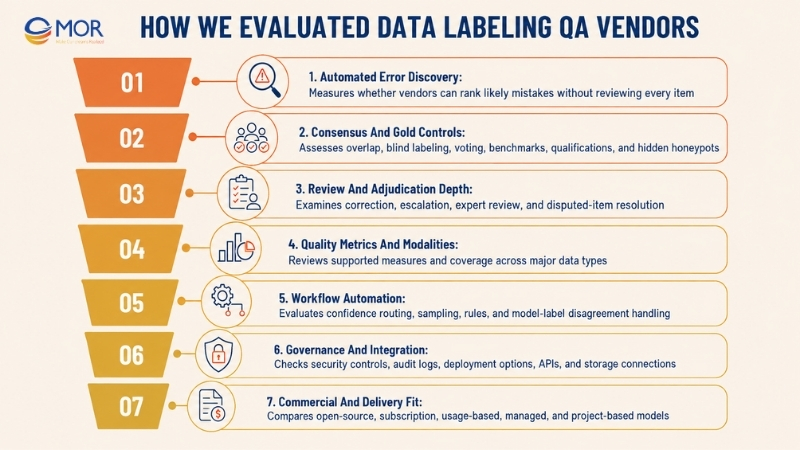
We ranked data labeling quality assurance tools vendors for demonstrated QA capability, not general popularity. The assessment looks at how each product or provider finds errors, controls work, records decisions, and fits a real delivery model.
Google researchers interviewed 53 practitioners working in high-stakes AI and found 92% had experienced at least one data cascade. Many failures started upstream in data work and surfaced later as model or product problems, which supports a broader review than a basic annotation checklist.
- Automated discovery: Can the system rank likely mistakes without reading every item?
- Consensus controls: Does it support overlap, blind labeling, voting, and agreement thresholds?
- Gold tasks: Can teams run qualification tests, benchmarks, or hidden honeypots?
- Review depth: Can disputed work move through correction, escalation, and expert adjudication?
- Quality measures: Does it support IoU, kappa, alpha, accuracy, precision, recall, or custom scores?
- Data coverage: Which image, video, text, audio, document, LiDAR, and DICOM tasks are supported?
- Automation: Can confidence, sampling, rules, and model disagreement route work?
- Governance: Are RBAC, SSO, audit logs, encryption, residency, and private deployment available?
- Integration: Are APIs, SDKs, webhooks, storage connections, and export formats practical?
- Commercial fit: Is the model open source, subscription, usage-based, managed, or project-based?
Match QA Tools to Your Data and Workflow
Picking among data labeling quality assurance tools vendors starts with your current failure point. A team auditing old labels needs a different product than a company building a new global workforce program.
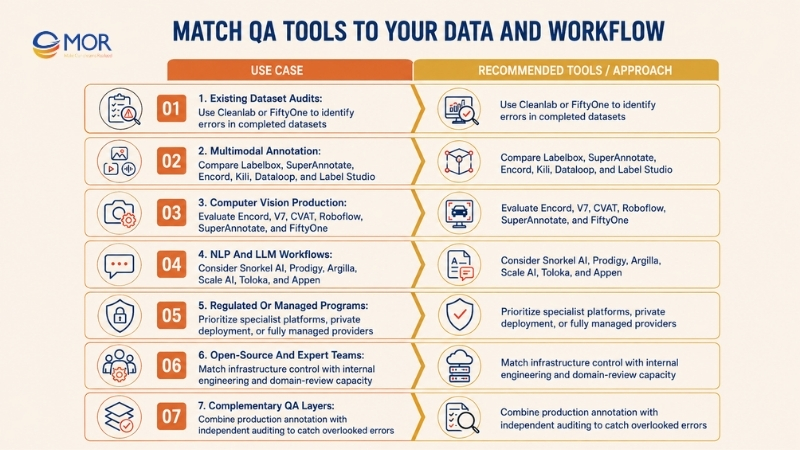
- Suspected errors in an existing dataset: Use Cleanlab for broad label auditing or FiftyOne for image and video analysis.
- General multimodal annotation: Compare Label Studio, Labelbox, SuperAnnotate, Encord, Kili, and Dataloop.
- Computer vision production: Review Encord, V7, CVAT, Roboflow, SuperAnnotate, and FiftyOne.
- NLP and document work: Consider Label Studio, Snorkel AI, Prodigy, and Argilla.
- LLM feedback and alignment: Compare Scale AI, Labelbox, SuperAnnotate, Argilla, Toloka, and Appen.
- Medical or regulated data: Prioritize Encord, V7, iMerit, Sama, or a private Label Studio deployment.
- Fully managed annotation: Shortlist Scale AI, Sama, iMerit, Taskmonk, Appen, and Toloka.
- Open-source deployment: Label Studio, Cleanlab, CVAT, FiftyOne, and Argilla are common data labelling tools for teams that need code and infrastructure control.
- Programmatic labels: Snorkel AI suits rule-rich work managed by technical teams.
- Small expert teams: Prodigy and Argilla keep domain reviewers close to the dataset.
A search for a data labeling tool open source often ends with a false choice between 'free' and 'enterprise.' Open-source licensing cuts software fees, but engineering, hosting, upgrades, security, and support still carry costs.
Many teams need two complementary systems. One platform runs annotation and review, while an independent auditor searches for errors the first workflow missed.
Require These QA Features Before You Buy
A strong data labeling quality assurance tools vendors comparison must test controls inside a real workflow. Product pages can name the same capability while applying very different rules, metrics, and access limits.
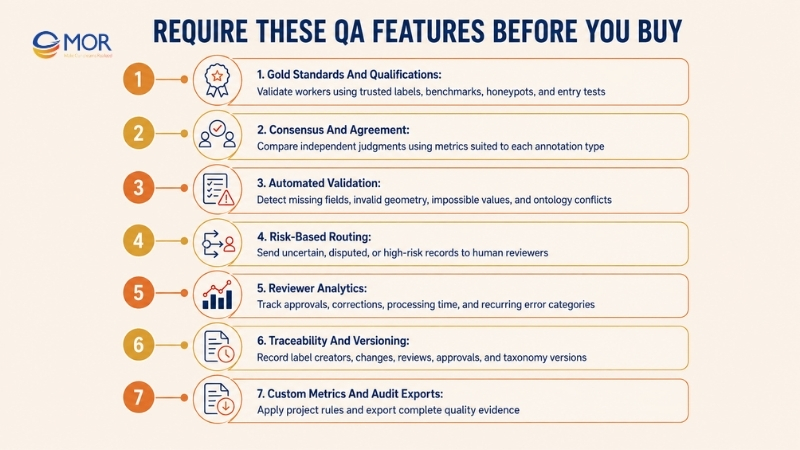
- Gold-standard tasks: Measure work against trusted labels prepared before production.
- Consensus scoring: Compare independent judgments on the same item.
- Inter-annotator agreement: Choose a measure that fits classification, text spans, boxes, masks, rankings, or free text.
- Adjudication: Send unresolved cases to a senior reviewer or domain specialist.
- Honeypots: Mix hidden known-answer tasks into live queues.
- Qualification tests: Block production access until a worker reaches the required score.
- Automated validation: Catch missing fields, invalid geometry, impossible values, and ontology conflicts.
- Model disagreement: Flag cases where labels and predictions diverge sharply.
- Confidence routing: Send uncertain or high-risk records to human review.
- Reviewer analytics: Track approval rate, correction rate, time, and error categories.
- Label lineage: Record who created, changed, reviewed, and approved every annotation.
- Ontology versioning: Tie labels to the taxonomy used when they were created.
- Sampling controls: Review a risk-based share instead of a flat random percentage.
- Custom metrics: Apply project rules for safety, domain accuracy, or class-specific tolerance.
- Audit exports: Export quality records, label versions, comments, and reviewer decisions.
Stanford’s 2025 AI Index reported that 78% of organizations used AI in 2024, up from 55% one year earlier. More deployed systems mean more datasets passing through production, so repeatable QA records now carry operational value beyond a single model release.
Estimate Data Labeling QA Pricing and Total Cost
Most data labeling quality assurance tools vendors use custom quotes because data type, label density, accuracy targets, expert skill, security, and volume change the work. Treat the ranges below as 2026 planning figures, then request a quote tied to your own sample and acceptance rules.
Cost component | Common pricing method | Typical 2026 cost ($) | What buyers should verify |
Platform access | Per seat or enterprise license | $0 to $66 per user/month; enterprise from about $12,000/year | Reviewer and admin seats, project caps, storage, and annual commitments. CVAT lists team pricing at $66 per month for two users and enterprise plans starting at $12,000 per year. |
Annotation volume | Per task, asset, frame, object, or label | $0.03 to $5.00 per label | The exact billable unit, object density, frame sampling, and correction terms. |
Managed workforce | Hourly rate or project quote | $6 to $12 per hour for standard work | Training, supervision, project control, idle capacity, and replacement staff. |
Consensus review | Two or three labels per item | About $0.06 to $15 per item before adjudication | Duplication factor, agreement threshold, winner selection, and reviewer cost. |
Expert adjudication | Hourly specialist rate | $30 to $100 per hour | Credentials, domain depth, escalation volume, and documentation time. |
Automated labeling | Usage unit, API call, token, or compute | About $0.10 per platform unit, or $2 to $5+ per GPU hour | Inference, hosting, retries, idle endpoints, and human validation. Labelbox lists a fixed Starter rate of $0.10 per LBU. |
Storage | Data volume and retention | About $0.023 per GB/month, or $23 per TB/month | Raw assets, versions, backups, API requests, retrieval, and data transfer. AWS lists $0.023 per GB for the first S3 Standard tier in common regions. |
Integration | Setup or professional services | $5,000 to $50,000+ | APIs, ETL, exports, authentication, private networking, and migration. |
Security | Enterprise add-on or private deployment | About $12,000 to $30,000+ per year | SSO, RBAC, logs, VPC, residency, encryption, and support terms. |
Rework | Included under SLA or billed again | $0 under warranty; otherwise add 20% to 30% of labeling spend | Error warranty, correction window, root-cause review, and guideline-change rules. |
Compare cost per accepted label, reviewed dataset, and first-year ownership. A cheap unit rate can disappear after repeated labels, specialist review, integration, storage, security, and rework are added.
Run a QA Vendor Pilot Before Signing
These data labeling quality assurance tools vendors examples become measurable evidence during a controlled pilot. Use the same representative batch, instructions, gold set, and pass rules across every shortlisted provider.
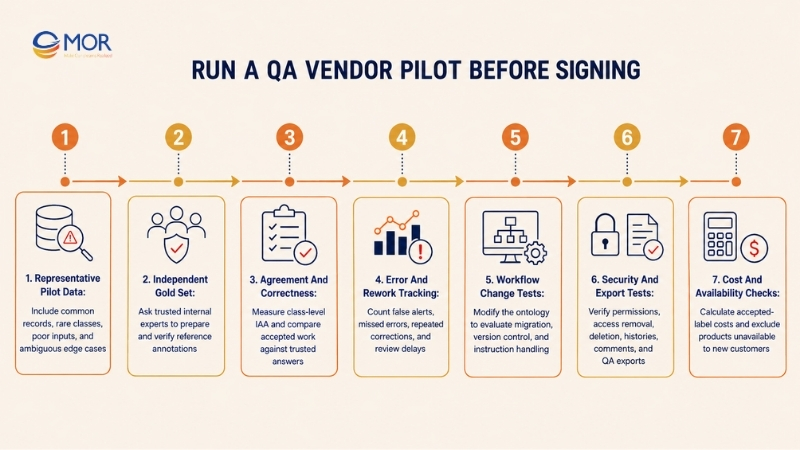
- Select representative data: Include common records, rare classes, poor-quality inputs, and ambiguous edge cases.
- Create an independent gold set: Ask trusted internal experts to prepare and review it.
- Test instruction quality: Record how quickly the vendor finds unclear terms and conflicting rules.
- Measure agreement: Track overall and class-level IAA, not one blended score.
- Measure correctness: Compare accepted work with the independent gold set.
- Track false alerts: Count correct labels that automated QA sends to review.
- Track missed errors: Record mistakes that pass every control.
- Measure review latency: Time the path between submission and final approval.
- Calculate rework: Measure the share of items returned and corrected more than once.
- Change the ontology: Add or revise a class to test migration and version control.
- Test exports: Export labels, metadata, history, comments, and QA records.
- Test security: Check roles, access removal, deletion, and audit logs.
- Calculate unit economics: Use total accepted-label cost, not the sales quote.
- Set pass criteria: Define quality, throughput, security, and integration targets before launch.
Keep Amazon SageMaker Ground Truth out of a normal new-buyer shortlist. AWS closed new customer access on July 30, 2026, though existing customers may continue using the service.
Custom Data Labeling QA System With MOR Software
Standard products don’t fit every ontology, approval chain, data policy, or ML stack. MOR Software helps companies build a tailored layer around their chosen data labeling quality assurance tools vendors, existing systems, and internal delivery rules.
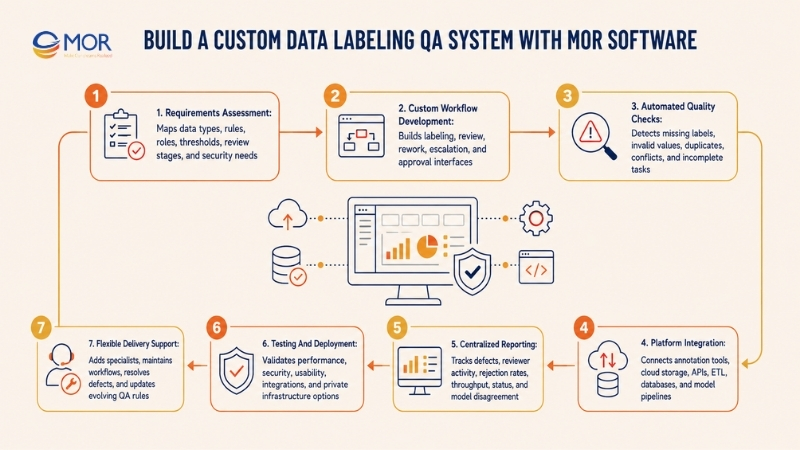
- Assess requirements: Map data types, labeling rules, roles, thresholds, review stages, and security needs.
- Build custom workflows: Develop labeling, review, rework, escalation, and approval interfaces around your ontology.
- Automate checks: Flag missing labels, invalid values, duplicate records, annotation conflicts, and incomplete tasks.
- Integrate platforms: Connect Label Studio, Labelbox, Encord, CVAT, cloud storage, model pipelines, APIs, ETL, and internal databases.
- Centralize reporting: Build dashboards for defect rates, reviewer activity, rejection rates, throughput, status, and model disagreement.
- Test the system: Apply functional, integration, performance, security, usability, and regression testing.
- Support private deployment: Design cloud, private cloud, VPC, on-premises, or internal infrastructure.
- Extend your team: Add agentic AI developers, business analysts, QA teams, QC staff, architects, and project managers.
- Maintain delivery: Monitor performance, resolve defects, add workflows, and update rules as the dataset changes.
MOR’s services cover AI development, data engineering, custom software development outsourcing, system integration, QC and testing, IT consulting, Agile delivery, DevOps support, and offshore teams. Share your data type, current process, preferred tools, integration needs, and acceptance targets so our team can map the right architecture and delivery plan.
Conclusion
The right data labeling quality assurance tools vendors match your modality, risk level, workforce model, deployment rules, and audit needs. Compare accepted-label cost and pilot evidence instead of relying on platform claims alone. MOR Software can design, integrate, test, and maintain a custom QA system around your annotation tools and ML pipeline. Contact MOR Software to map the workflow, architecture, team, and delivery stages for your project.
"Evolution is not a destination, it is a disciplined journey of innovation."
Phung Van Tu


CEO MOR AI
MOR SOFTWARE
Frequently Asked Questions (FAQs)
What are data labeling quality assurance tools?
They are platforms or software layers that detect annotation errors, measure agreement, run gold tasks, manage review and adjudication, record label history, and report quality. Managed vendors add workforce training, supervision, and correction services.
Which tool is best for finding mislabeled training data?
Cleanlab is a strong general choice for ranking likely label errors across several ML tasks. FiftyOne fits image and video datasets where teams want visual review, embedding search, and model-assisted detection of missing, wrong, or poorly placed annotations.
What is inter-annotator agreement in data labeling?
Inter-annotator agreement measures how consistently independent labelers judge the same items. The right measure depends on the task, with common choices including IoU, Cohen’s kappa, Fleiss’ kappa, Krippendorff’s alpha, precision, recall, and F1.
Can AI automatically detect annotation errors?
Yes, AI can rank suspicious labels through model predictions, confidence values, uncertainty, embeddings, and rule checks. Human review still handles ambiguous classes, weak model signals, domain judgment, and cases where the model shares the same blind spot as the labeler.
Which data labeling QA tools are open source?
Cleanlab, CVAT, FiftyOne, Argilla, and Label Studio have open-source editions or libraries. Their paid editions add areas including team controls, security, managed hosting, analytics, support, or enterprise deployment.
How much do data labeling quality assurance tools cost?
Costs range from free open-source software to enterprise contracts above $12,000 per year. Workforce, consensus duplication, expert adjudication, model inference, storage, integration, private deployment, and rework can exceed the base platform fee.
How should companies compare managed labeling vendors?
Run the same pilot batch and compare accepted-label cost, gold accuracy, class-level agreement, missed errors, false alerts, review time, rework, export quality, security, and response to instruction changes. Sales claims need task-level evidence.
What QA metrics should a data labeling platform provide?
Useful metrics include gold accuracy, consensus, IAA, IoU, precision, recall, F1, correction rate, rejection rate, reviewer time, class-level error rate, drift, and cost per accepted label. Custom domain rules should also be possible.
Should companies use one QA tool or combine several tools?
A combination often works better. Use one annotation platform for production, review, and workforce control, then add an independent auditing tool or custom validation layer to find errors that pass the first process.
What is the difference between consensus and gold-standard QA?
Consensus compares labelers with each other and looks for agreement. Gold-standard QA compares their work against a trusted answer, so several labelers can agree with one another and still fail the gold check.
Share


Make Our-Dreams Realized


© 2023 . MOR Software. All Rights Reserved
Sitemap
Privacy Policy
Terms of Use

Rate this article
0
over 5.0 based on 0 reviews
Your rating on this news:
Name
*Email
*Write your comment
*Send your comment
1