


Data Warehouse Implementation in 2026: Steps, Costs and Planning
Disconnected business data makes reporting slow, creates inconsistent metrics, and limits the value of analytics. Data warehouse implementation addresses these problems by bringing information from different systems into a central platform built for analysis. Yet getting it right requires careful planning around architecture, data quality, security, and integration. In this guide, MOR Software will explain the nine implementation steps, architecture components, project planning, costs, deployment risks, and emerging trends that businesses should consider before getting started.
Key Takeaways
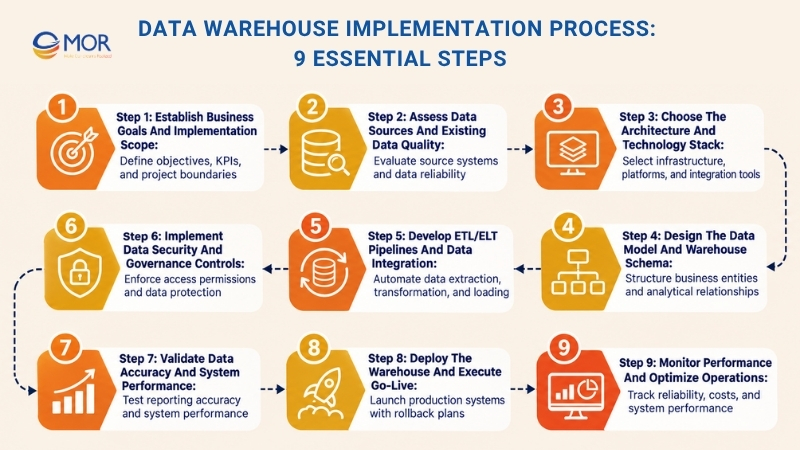
- Data warehouse implementation follows nine main steps, covering business requirements, data assessment, architecture, modeling, integration, security, testing, deployment, and ongoing management.
- Successful projects start with clear reporting goals and reliable source data. Architecture decisions, ETL/ELT pipelines, and governance controls should reflect those requirements.
- Implementation costs and timelines depend on data volume, system complexity, integration requirements, and team capacity. Phased delivery and clear acceptance criteria help control project risks.
What Is Data Warehouse Implementation?
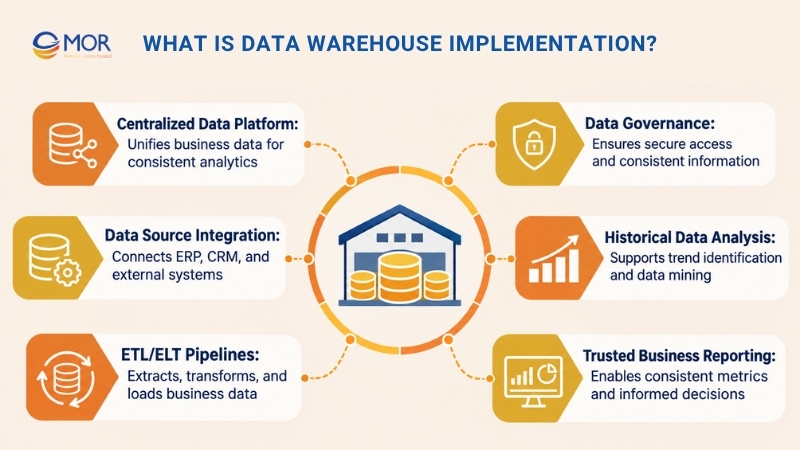
Data warehouse implementation is the process of designing, building, integrating, testing, and deploying a centralized platform for storing and analyzing business data. It combines information from ERP, CRM, transactional databases, and external systems to support consistent reporting and decision-making.
Unlike data warehouse design, which focuses on architecture and data models, implementation covers the entire delivery process. It includes connecting source systems, developing ETL/ELT pipelines, applying governance rules, and preparing the platform for production use.
The need for connected enterprise data remains substantial. Salesforce's 2025 Connectivity Benchmark Report found that organizations had connected only 29% of their applications on average, leaving considerable information distributed across separate systems.
A completed warehouse provides unified business metrics, historical reporting, and controlled access to analytical datasets. Data warehouse implementation in data mining projects also gives analytical models consistent historical records for identifying patterns and trends.
The expected result is a shared source of trusted data that supports finance, sales, operations, and business intelligence teams.
Key Components of a Data Warehouse Architecture
A data warehouse connects business applications, data pipelines, storage systems, and analytics tools. Understanding data warehouse architecture and implementation helps businesses plan how information moves across these components and identify technical requirements before development.
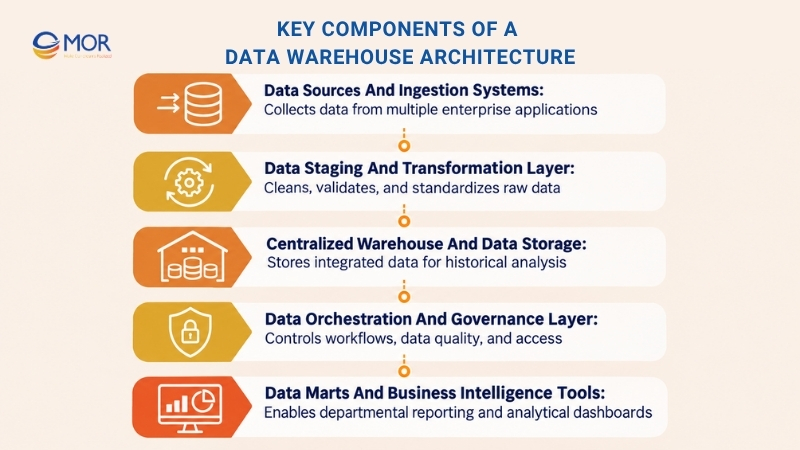
Data Sources and Ingestion Systems
ERP, CRM, POS, and legacy applications generate data in different formats and at different intervals. The ingestion layer brings these records into the warehouse through suitable connections.
- Source System Connectivity: Connect operational databases, enterprise applications, APIs, and external files.
- Batch and Streaming Ingestion: Schedule periodic transfers or capture events continuously based on reporting needs.
- Incremental Data Extraction: Use Change Data Capture (CDC) to load modified records without repeatedly processing entire datasets.
Data Staging and Transformation Layer
Raw data often contains duplicate records, missing values, and inconsistent formats. A staging layer allows teams to inspect and prepare information before publishing it for analysis.
- Data Cleansing and Validation: Standardize formats, resolve duplicates, and check records against approved quality rules.
- ETL and ELT Processing: Choose whether to transform data before loading or process it inside the warehouse, depending on infrastructure and workload requirements.
Centralized Warehouse and Data Storage
The central repository stores integrated business data for reporting and historical analysis. Its structure determines how easily analysts can access information and how the system handles growing workloads.
- Deployment Architecture: Select cloud, on-premises, or hybrid infrastructure based on business requirements.
- Data Modeling: Organize transactions and business entities through fact and dimension tables.
- Historical Data Management: Retain past records and track changes needed for trend analysis.
- Storage and Query Performance: Plan partitioning, clustering, and resource allocation based on expected analytical workloads.
Data Orchestration and Governance Layer
Reliable reporting depends on controlled data movement and consistent business definitions. Orchestration manages pipeline execution, while governance defines how information is owned, protected, and maintained.
- Workflow Orchestration: Schedule dependent jobs, manage retries, and handle failed data transfers.
- Data Quality Monitoring: Track pipeline status, data freshness, and validation errors.
- Metadata and Access Governance: Maintain data lineage, ownership records, role-based permissions, and retention policies.
Data Marts and Business Intelligence Tools
Once the warehouse contains validated information, business teams need practical ways to use it. Departmental data marts and BI platforms provide access to relevant datasets without exposing unnecessary technical complexity.
- Department-Specific Data Marts: Organize approved datasets for finance, sales, marketing, and operations.
- BI and Reporting Integration: Connect Power BI, Tableau, and SQL tools to create dashboards, reports, and analytical queries.
Data Warehouse Implementation Process
The data warehouse implementation steps follow a sequence that begins with business requirements and continues through operational monitoring. Each stage produces deliverables that support the activities that follow.
Some workstreams overlap, particularly data modeling, pipeline development, and security configuration. Still, teams should define acceptance criteria before advancing to major delivery milestones.
Step 1: Establish Business Goals and Implementation Scope
Start with the business decisions your warehouse must support. Clear objectives help teams define useful data requirements instead of collecting information without a specific purpose.
For example, a retailer may need a consolidated sales dashboard covering online stores, physical locations, and inventory movements. That requirement determines the source systems, reporting metrics, and initial project scope.
- Business Requirements: Interview stakeholders across finance, sales, operations, and IT. Document reporting objectives, required KPIs, data refresh expectations, and current analytical limitations.
- Project Scope: Identify priority business domains and select the first release based on expected value and technical feasibility. A focused implementation may begin with sales and inventory before expanding into procurement or finance.
- Success Criteria: Define measurable targets for data accuracy, report availability, query response time, and data freshness. Assign business owners to approve each metric and its calculation rules.
- Expected Deliverables: Complete the requirements specification, prioritized use-case backlog, KPI definitions, and approved project scope. Obtain stakeholder sign-off before selecting architecture and technology.
A small proof of concept can also test uncertain requirements before the full build. Understanding POC vs MVP helps project teams distinguish technical validation from a usable first release.
Avoid making 'centralize all business data' the initial objective. A project needs clear boundaries and measurable results to support delivery decisions.
Step 2: Assess Data Sources and Existing Data Quality
Source assessment identifies where business information resides and whether it can support reliable reporting. Teams should inspect actual records rather than assume operational systems contain complete, consistent data.
Data quality deserves early attention. The 2025 State of Analytics Engineering Report by dbt Labs found that more than 56% of respondents cited poor data quality as a challenge.
- Source Inventory: Record each source system, data owner, connection method, format, volume, and update frequency. Include ERP applications, CRM platforms, transactional databases, and external APIs.
- Data Profiling: Check missing values, duplicate records, inconsistent identifiers, invalid dates, and gaps in historical transactions. Review differences in how departments record the same business entities.
- Data Ownership: Identify who can approve data definitions, authorize access, and resolve source-level problems. Technical teams should not make business decisions about financial or customer records without the relevant owners.
- Expected Deliverables: Produce a source inventory, data quality assessment, and source-to-target mapping requirements. Document unresolved problems and assign corrective actions before pipeline development.
For instance, two systems may store the same customer under different identifiers. The warehouse needs approved matching rules to prevent duplicate customer counts across reports.
Data profiling also supports data preprocessing in machine learning, where incomplete or inconsistent records can affect analytical results.
The work completed here directly influences migration effort, pipeline design, and the accuracy of future reports.
Step 3: Choose the Architecture and Technology Stack
Architecture selection determines where data is stored, how it is processed, and which systems manage analytical workloads. The right choice depends on business requirements and existing infrastructure.
Teams should evaluate technologies against real workloads rather than vendor demonstrations alone. Storage needs, query frequency, data residency, and internal expertise all affect the decision.
- Architecture Selection: Compare cloud-native, on-premises, hybrid, and lakehouse approaches. Cloud services simplify infrastructure management, while on-premises systems provide direct control over deployment environments.
- Technology Stack Evaluation: Assess Snowflake, Amazon Redshift, Google BigQuery, and Microsoft Fabric based on existing infrastructure, data processing needs, pricing models, and operational responsibilities. Test representative queries before final selection.
- ETL/ELT Tool Selection: Choose suitable ingestion, transformation, and orchestration technologies based on source connectivity and update requirements. Consider native connectors, custom APIs, transformation tools, and scheduling systems.
- Expected Deliverables: Prepare an approved architecture blueprint, platform decision record, technology specifications, and infrastructure requirements. Document expected costs and technical limitations.
A data warehouse implementation diagram should show source systems, ingestion pipelines, transformation layers, storage components, and business intelligence connections.
Architecture decisions also influence long-term operating costs. Our guide to cloud vs on-premises software explains the infrastructure trade-offs businesses should review.
For high-risk technical assumptions, run a limited proof of concept using actual datasets. Measure processing time, query performance, and resource consumption before committing to the wider design.
Step 4: Design the Data Model and Warehouse Schema
Data modeling determines how the warehouse represents business entities, transactions, and relationships. A well-defined model helps analysts retrieve consistent results without rebuilding business logic for every report.
Modeling decisions should reflect reporting requirements, historical data needs, and the expected volume of records. Business owners must validate the definitions before physical development begins.
- Data Modeling: Create conceptual, logical, and physical models. Define business entities, relationships, identifiers, and the level of detail required for analytical records.
- Schema Selection: Evaluate star schemas, snowflake schemas, and dimensional modeling techniques. A star schema commonly connects transaction fact tables to dimensions representing customers, products, dates, and locations.
- Historical Data Management: Define how the warehouse tracks changes to customer details, product classifications, or organizational structures. Slowly Changing Dimensions (SCDs) can preserve historical values when reporting requires them.
- Expected Deliverables: Complete the validated data model, schema definitions, fact-to-dimension relationships, and data dictionary. Confirm that the model supports approved KPIs and reporting scenarios.
For example, a sales fact table may contain one record per order line, linked to product, customer, and date dimensions. Finance and sales teams can then analyze revenue using the same underlying transaction records.
Pay attention to data granularity. Mixing order-level totals with individual line items can produce incorrect sums and duplicated metrics.
Review the model against actual reporting queries before implementation. Late modeling changes often require updates to transformation logic, tests, and dashboards.
Step 5: Develop ETL/ELT Pipelines and Data Integration
Data pipelines move information from source applications into the warehouse. They also apply business rules that make records consistent across systems.
When implementing data warehouse pipelines, teams must account for source changes, incomplete loads, failed jobs, and historical corrections. Reliable processing requires repeatable execution and clear error handling.
- Pipeline Development: Build connectors for databases, APIs, files, and enterprise applications. Configure extraction schedules, transformation logic, and loading processes according to approved data mappings.
- Incremental Processing: Apply incremental loading or Change Data Capture (CDC) when appropriate. These methods process changed records rather than repeatedly extracting complete datasets.
- Transformation Rules: Standardize currencies, timestamps, customer identifiers, and business classifications. Document calculations used for shared reporting metrics.
- Error Handling and Recovery: Configure logs, retry rules, rejected-record handling, and alerts. Test whether failed jobs can resume without creating duplicate transactions.
- Expected Deliverables: Complete operational ETL/ELT pipelines, transformation specifications, orchestration schedules, and data lineage documentation. Validate initial loads and recurring updates.
For example, an e-commerce business may collect daily transactions from several marketplaces. Its pipelines must standardize product identifiers, currencies, and order statuses before sales teams compare performance across channels.
Automation should cover deployment and testing as well. The same software development lifecycle phases used in application engineering can guide pipeline development, version control, and release management.
A working pipeline demonstration is not enough for production approval. The team must also verify recovery procedures, data accuracy, and operational ownership.
Step 6: Implement Data Security and Governance Controls
Warehouse security protects sensitive information and limits access to approved users. Governance establishes who owns datasets, how metrics are defined, and how changes are tracked.
These controls should be incorporated during development rather than postponed until deployment. Sensitive information may already exist in staging environments, test datasets, and integration logs.
- Access Management: Configure role-based access control (RBAC), authentication, and least-privilege permissions. Restrict sensitive financial, customer, and employee information according to business responsibilities.
- Data Protection: Apply encryption at rest and in transit. Use masking, tokenization, or restricted views when analytical users don't require access to raw personal information.
- Governance Policies: Assign data owners and define metadata standards, retention rules, data lineage requirements, and approval procedures. Maintain consistent definitions across published datasets.
- Expected Deliverables: Complete the approved access model, governance policies, audit logging configuration, and security validation records. Obtain sign-off from the responsible security and business teams.
For enterprises handling regulated information, security requirements may affect storage locations, data retention, and access to historical records.
Governance also needs ongoing ownership. When a department changes the definition of a reporting metric, the update should follow an approval process and appear in the data dictionary.
Step 7: Validate Data Accuracy and System Performance
Testing confirms that the warehouse processes information correctly and supports expected analytical workloads. Teams must check transformed records against their sources and verify the results that business users see.
A technically successful data load does not prove reporting accuracy. Reconciliation, transformation testing, and User Acceptance Testing (UAT) address different parts of the problem.
- Data Testing: Compare source and target record counts, totals, identifiers, and key business measures. Validate transformation rules, historical changes, and handling of missing or invalid records.
- Performance Testing: Measure query response times, concurrent workloads, pipeline completion times, and resource consumption. Run tests using realistic data volumes rather than small development samples.
- Business Validation: Ask finance, sales, and operations users to test actual reporting scenarios. Investigate discrepancies between warehouse outputs and approved source-system figures.
- Expected Deliverables: Produce test reports, reconciliation records, performance results, resolved defect logs, and signed UAT documentation. Record any accepted limitations before release.
For example, a finance team may compare monthly revenue totals between the existing ERP system and the new warehouse. Differences require investigation before the reports become official.
Testing also includes failure conditions. Teams should verify recovery after incomplete loads, API interruptions, and changes to upstream database schemas.
The practices covered in software testing best practices can support structured test planning and defect management.
Step 8: Deploy the Warehouse and Execute Go-Live
Go-live moves approved data pipelines, models, and reporting connections into production. The release must protect business reporting continuity and provide a clear recovery path.
Deployment planning should begin before the final testing cycle. Teams need documented responsibilities, production access, communication plans, and rollback conditions.
- Deployment Strategy: Select a phased release, parallel operation, or full cutover based on operational risk. Confirm production configuration, deployment windows, and dependencies between pipelines and reporting tools.
- Production Readiness: Verify that scheduled jobs, security permissions, monitoring systems, and reporting connections work in the production environment. Recheck key reconciliation results after the final data transfer.
- Rollback Planning: Define conditions that trigger a rollback, the responsible decision-maker, and the required technical actions. Keep legacy reporting available during the agreed transition period when necessary.
- Expected Deliverables: Complete the production release, approved cutover runbook, user communication, rollback instructions, and go-live sign-off.
A relevant real-world example comes from Future Processing's data warehouse project for a Fortune 100 company. The company transitioned data ingestion from on-premises Microsoft SQL Server sources toward an AWS-based architecture involving Amazon Redshift.
The previous reporting environment remained available during the transition. Future Processing reported that management and end-user feedback tripled the client's internal NPS satisfaction score.
This case demonstrates how staged migration can support business continuity during warehouse modernization.
Step 9: Monitor Performance and Optimize Operations
A warehouse requires ongoing monitoring after production launch. Source-system changes, increasing data volumes, and new reporting requirements can affect reliability and operating costs.
Operational management should track data freshness, failed pipelines, query performance, and resource consumption. Each alert must reach a team responsible for investigating the problem.
- Operational Monitoring: Track pipeline status, data latency, failed records, query response times, and system availability. Configure alerts that distinguish minor delays from business reporting incidents.
- Cost Management: Review warehouse compute consumption, storage growth, and expensive queries. Use workload scheduling, resource limits, and budget alerts to manage recurring cloud expenses.
- Continuous Improvement: Add new sources and reporting domains through controlled releases. Review existing transformation logic when business rules or source schemas change.
- Expected Deliverables: Maintain monitoring dashboards, operational service-level agreements (SLAs), support documentation, and a prioritized improvement backlog.
For example, a warehouse that originally supports daily sales reports may later need hourly updates. The team should assess pipeline capacity and cost before changing the refresh schedule.
Operational ownership also matters. Analysts need a clear support channel when dashboards show stale or inconsistent information.
How to Create a Data Warehouse Implementation Project Plan
A data warehouse implementation plan connects technical activities with owners, deliverables, and approval checkpoints. The plan should also account for dependencies between requirements, modeling, pipeline development, testing, and production deployment.
Implementation Phase | Responsible Role | Key Deliverable | Acceptance Criterion |
Business requirements | Business analyst and business sponsor | Requirements document and prioritized use cases | Stakeholder approval of scope and KPIs |
Data source assessment | Data engineer and source owners | Source inventory and quality report | Data sources mapped and major issues assigned |
Architecture selection | Data architect | Architecture blueprint and platform decision | Technical and security approval |
Data modeling | Data architect and business analyst | Data model and schema definitions | Approved data relationships and metrics |
ETL/ELT development | Data engineering team | Integrated pipelines and transformation rules | Successful pipeline and data validation tests |
Security and governance | Security lead and data owners | Access model and governance policies | Security and governance sign-off |
Testing and UAT | QA team and business users | Validation report and defect records | Accuracy thresholds met and UAT approved |
Deployment | Project manager and operations team | Production release and cutover plan | Go-live approval |
Monitoring and support | Data platform operations team | Monitoring dashboards and operational SLAs | Alerting, ownership, and support processes confirmed |
The data warehouse implementation timeline should reflect project scope and source complexity. A focused first release may take a few months, while enterprise programs involving legacy migration and several business domains may require a year or longer.
Budget planning deserves the same attention. The main cost categories include architecture and engineering work, ETL/ELT development, storage, compute consumption, integration tools, testing, and ongoing support.
A smaller cloud deployment may avoid large infrastructure purchases but still incur substantial engineering costs. Larger programs often need additional resources for data cleansing, complex integrations, governance, and user training.
Rather than relying on a single industry-average figure, businesses should estimate project costs from the number of sources, expected data volumes, workload tests, and delivery team requirements. Our guide on how to estimate project costs and timelines provides a broader method for planning software development budgets.
A suitable data warehouse implementation strategy also includes contingency funding and clear change control. Review projected cloud consumption and maintenance expenses alongside initial development costs.
Common Data Warehouse Implementation Challenges
Data warehouse implementation projects commonly encounter problems involving data quality, legacy integration, changing requirements, and system performance. These issues can delay delivery and weaken trust in analytical reports.
Challenge | Implementation Impact | Recommended Mitigation |
Poor data quality | Incorrect calculations, duplicate records, and repeated rework | Profile source data early, define validation rules, and assign data owners |
Legacy system integration | Difficult extraction, inconsistent formats, and pipeline delays | Complete source inventories and test difficult connections before development |
Changing requirements | Scope expansion, revised models, and schedule delays | Prioritize the first release and apply formal change control |
Performance bottlenecks | Slow queries, delayed reporting, and rising compute consumption | Test representative workloads and tune queries, models, and resource allocation |
Security gaps | Unauthorized access or exposure of sensitive records | Apply access policies, encryption, masking, and security testing |
Budget overruns | Delayed releases, resource shortages, or abandoned requirements | Use phased budgets, consumption monitoring, and regular cost reviews |
Limited technical expertise | Development delays and difficult long-term maintenance | Assign experienced engineers, document systems, and train internal teams |
Addressing these challenges early helps businesses avoid costly rework, inaccurate reporting, and deployment delays. Regular data quality checks, early integration testing, clear scope control, and performance monitoring keep implementation projects on track and support reliable analytics after launch.
Best Practices for Successful Data Warehouse Implementation
The best practices in data warehouse implementation focus on business value, consistent data definitions, repeatable delivery processes, and clear operational ownership. These principles apply throughout planning, development, deployment, and maintenance.
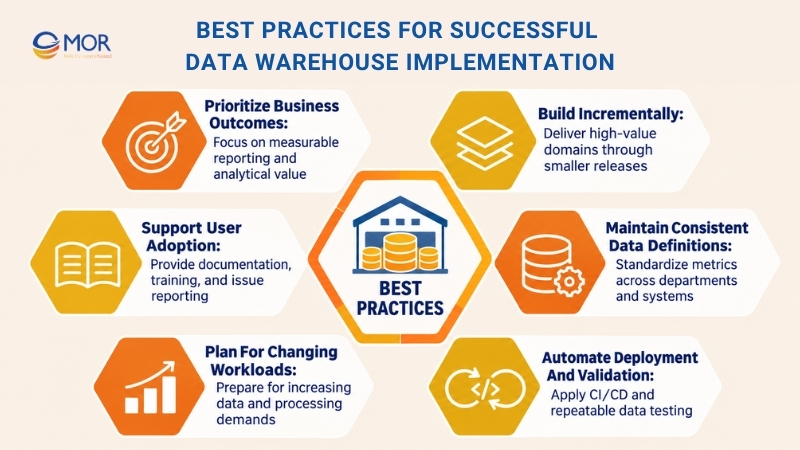
- Prioritize Business Outcomes: Start with reporting problems that have measurable business value. Define the decisions each dataset should support and confirm the required metrics with stakeholders.
- Build Incrementally: Deliver high-value domains before expanding across the enterprise. Smaller releases make testing, user feedback, and scope management easier.
- Maintain Consistent Data Definitions: Establish shared definitions for revenue, active customers, inventory levels, and other business metrics. Assign owners who approve changes and resolve conflicting calculations.
- Automate Deployment and Validation: Use version control, CI/CD pipelines, automated data tests, and repeatable ETL/ELT workflows. Apply the same validation rules across development, testing, and production environments.
- Plan for Changing Workloads: Account for growing data volumes, new source systems, and changes in reporting frequency. Test architecture assumptions using representative workloads and review capacity requirements regularly.
- Support User Adoption: Provide data dictionaries, reporting documentation, and analyst training. Give business teams a clear process for requesting changes and reporting data issues.
These practices work best when teams apply them throughout the project rather than adding them before go-live.
For development teams working across several releases, agile software development best practices can help organize delivery, testing, and stakeholder feedback.
Data Warehouse Go-Live Readiness Checklist
Production deployment should begin only after technical teams and business owners approve the required checkpoints. A formal readiness review helps prevent unresolved data quality, security, or reporting problems from reaching production.
Readiness Checkpoint | Required Evidence | Sign-Off Owner |
Data accuracy | Completed source-to-target reconciliation and approved KPI results | Data quality lead |
Business acceptance | Signed UAT results and accepted reporting scenarios | Business owner |
Performance | Query and pipeline tests meeting agreed thresholds | Technical lead |
Security | Verified access permissions, encryption, masking, and audit logs | Security lead |
Data pipeline operations | Successful scheduled runs, monitoring, and alert tests | Data engineering lead |
Backup and recovery | Tested backup, restoration, and rollback procedures | Operations lead |
User readiness | Training records, documentation, and support contacts | Business process owner |
Go-live approval | Approved deployment plan, risk review, and rollback conditions | Project sponsor |
The final GO/NO-GO decision must reflect business acceptance and operational readiness. Critical failures involving data accuracy, security, or reporting availability should block deployment until resolved.
Minor issues can proceed only when the project sponsor accepts the documented risk and assigns a resolution owner.
For projects replacing an existing reporting system, keep the previous environment available until reconciliation and business acceptance are complete.
Data Warehouse Implementation Trends in 2026
Enterprise analytics requirements are changing how teams design and operate data platforms. Data warehouse implementation increasingly involves cloud-managed infrastructure, automated engineering, near-real-time processing, and integration with AI systems.
These developments affect architecture choices, delivery processes, and long-term maintenance requirements.
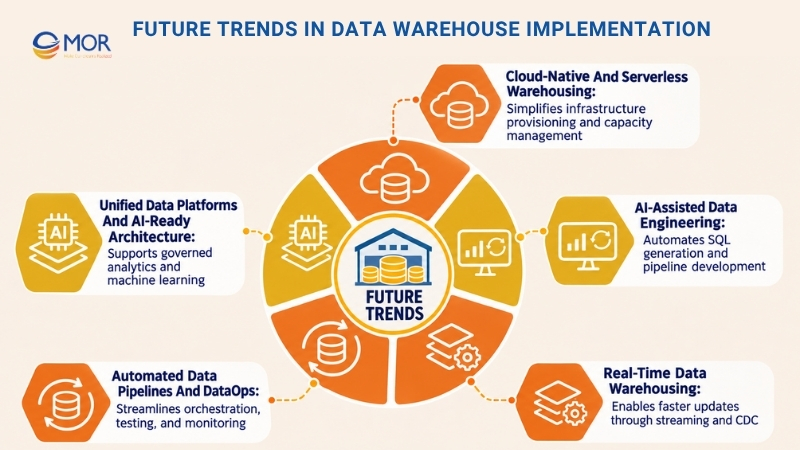
- Cloud-Native and Serverless Warehousing: Managed cloud platforms handle much of the infrastructure provisioning and capacity management. Separation of compute and storage also gives teams more control over workloads and consumption-based costs. Implementation planning must still account for query patterns, data transfer, and resource usage.
- AI-Assisted Data Engineering: AI tools support SQL generation, data mapping, pipeline development, anomaly detection, and documentation. The 2025 State of Analytics Engineering Report found widespread AI adoption among data professionals, reflecting growing use of these tools in engineering workflows. Human review remains necessary for business logic, security, and data quality.
- Real-Time Data Warehousing: Streaming ingestion and CDC support faster updates than traditional batch processing. Gartner's June 2026 analysis predicts that adoption of data streaming for agentic AI will exceed 60% by 2028, compared with under 15% in 2025. Teams examining how to implement real-time data warehouse pipelines should begin with use cases that genuinely require low-latency information.
- Automated Data Pipelines and DataOps: Modern platforms increasingly support automated transformation, pipeline orchestration, testing, and monitoring. For example, Snowflake Dynamic Tables can refresh transformed datasets according to configured freshness targets. These capabilities change how teams develop and maintain analytical pipelines.
- Unified Data Platforms and AI-Ready Architecture: Data warehouses and lakehouses increasingly support shared analytics, machine learning, and AI workloads. Organizations must plan for consistent metadata, governed access, and reusable data models. Architecture decisions should account for future analytical requirements without adding unnecessary complexity to the initial release.
These trends create new implementation options, but technology selection should still follow business requirements. Teams should test costs, performance, and data quality before introducing new processing methods into production.
How MOR Software Helps Businesses with Data Warehouse Implementation
Enterprise analytics projects depend on reliable applications, connected business systems, and accurate data processing. MOR Software JSC supports these technical foundations through custom software development, system integration, cloud engineering, and quality assurance.
Our experience covers enterprise applications that collect, process, manage, and exchange information across departments and external platforms.
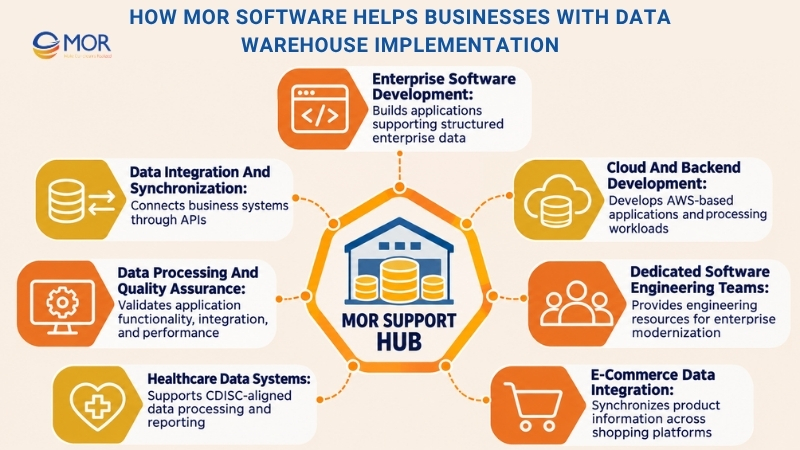
- Enterprise Software Development: We develop business applications that manage operational records and support data exchange. These systems can provide structured information for reporting and enterprise analytics.
- Data Integration and Synchronization: Our teams connect business applications through APIs and custom integration solutions. We focus on consistent records, reliable data transfers, and clear system responsibilities.
- Cloud and Backend Development: MOR works with AWS and backend technologies including Java, Python, and Node.js. Our engineering teams develop applications that support data processing and integration workloads.
- Data Processing and Quality Assurance: We build data processing functions and conduct functional, integration, and performance testing. These practices support reliable enterprise software operations.
- Dedicated Software Engineering Teams: Our offshore development services help businesses assemble teams for application development, integration, maintenance, and modernization.
Our Medical Management System project involved developing connected subsystems for healthcare data collection, processing, analysis, and reporting. The solution followed CDISC standards and supported controlled information sharing.
Another example is MOR Software's E-commerce Management System, which connected product information across shopping platforms. Our team developed backend services using PHP, NestJS, Next.js, and AWS, including data synchronization functions.
These projects demonstrate relevant enterprise data engineering experience rather than a dedicated data warehouse implementation service.
Businesses planning enterprise data initiatives can also explore our IT consulting services or review additional MOR Software case studies to assess our technical capabilities.
Conclusion
Successful data warehouse implementation starts with clear business requirements and continues through careful architecture design, data integration, testing, and long-term management. A phased approach helps businesses control technical risks and build reporting systems they can trust. MOR Software supports related enterprise data initiatives through custom applications, cloud engineering, system integration, and dedicated development teams.
Contact us to discuss your enterprise software requirements and the technical support your project needs.
"Evolution is not a destination, it is a disciplined journey of innovation."
Phung Van Tu


CEO MOR AI
MOR SOFTWARE
Frequently Asked Questions (FAQs)
What are the main stages of data warehouse implementation?
The main stages include business requirements, source assessment, architecture selection, data modeling, ETL/ELT development, security configuration, testing, deployment, and operational monitoring. Each stage has defined deliverables and approval requirements. Some technical activities overlap during development.
How long does it take to implement a data warehouse?
A focused warehouse project may take a few months, while complex enterprise programs can require a year or longer. Duration depends on source-system complexity, data quality, reporting scope, integrations, and team resources. Phased deployment can make larger projects easier to manage.
What is the average cost of data warehouse implementation?
There is no reliable universal average. Costs depend on architecture, development effort, data volume, pipeline complexity, and cloud consumption. Businesses should budget for engineering, infrastructure, integration tools, testing, governance, and ongoing support. A workload-based estimate is more useful than a generic price.
What are the key requirements for implementing a data warehouse?
Key requirements include defined reporting objectives, accessible source systems, reliable data, suitable infrastructure, approved business metrics, and security controls. Organizations also need data engineers, business owners, testing processes, and operational support arrangements before production deployment.
Which data warehouse architecture is best for enterprises?
The best architecture depends on existing systems, workload requirements, data residency, and technical expertise. Cloud warehouses suit many managed analytics workloads, while hybrid designs support organizations retaining on-premises systems. Lakehouse architectures may fit businesses combining reporting, machine learning, and broader data processing.
What is the difference between ETL and ELT in data warehousing?
ETL extracts data, transforms it, and loads the processed records into the warehouse. ELT loads data first and performs transformations within the target platform. ELT is common in cloud environments, but the better approach depends on source requirements, governance, and processing needs.
What roles are needed in a data warehouse implementation team?
A typical team includes a project manager, business analyst, data architect, data engineers, QA specialists, security personnel, and business stakeholders. Larger projects may also require database administrators and data governance specialists. Clear ownership of requirements, testing, and operations is necessary.
How do you test a data warehouse before deployment?
Testing should cover data reconciliation, transformation rules, source-to-target mappings, query performance, security permissions, and business reporting scenarios. Teams should also verify pipeline recovery and error handling. User Acceptance Testing confirms that outputs meet approved business requirements.
Should businesses build a cloud or on-premises data warehouse?
Cloud warehouses suit organizations seeking managed infrastructure and flexible capacity. On-premises deployment gives businesses direct control over infrastructure but requires more internal management. The decision should account for data residency, existing systems, security policies, operating costs, and available expertise.
How can businesses measure data warehouse implementation success?
Measure success through data accuracy, report consistency, pipeline reliability, query performance, user adoption, and business KPIs. Compare results against the targets defined during planning. Cost tracking and incident monitoring also help determine whether the platform remains effective after launch.
Share


Make Our-Dreams Realized


© 2023 . MOR Software. All Rights Reserved
Sitemap
Privacy Policy
Terms of Use

Rate this article
0
over 5.0 based on 0 reviews
Your rating on this news:
Name
*Email
*Write your comment
*Send your comment
1