


iOS App Development Cost in 2026: Pricing and Budget Guide 2026
A commercial iOS app can cost anywhere from $8,000 for a lean offshore MVP to $400,000+ for a regulated enterprise product. Your final iOS app development cost depends on scope, backend work, developer rates, QA, security, and post-launch expenses. In this guide, MOR Software will break down those numbers by complexity, features, development phase, region, hiring model, and ongoing costs so you can build a realistic budget before requesting quotes.
Key Takeaways
- A lean offshore MVP may start around $8,000-$25,000, but a complex enterprise iOS platform can exceed $300,000 when built through a premium US or UK agency.
- Scope drives the largest budget swings. Real-time workflows, AI automation, custom backends, integrations, security requirements, and compliance add far more work than a simple increase in screen count.
- Your launch budget isn't your lifetime budget. Hosting, APIs, maintenance, Apple fees, security work, and later releases continue after the first App Store submission.
How Much Does iOS App Development Cost in 2026?
The cost of custom iOS app development varies widely because companies use the term 'iOS app' for very different products. A six-screen utility and a healthcare platform with video calls, patient data, role permissions, and cloud infrastructure don't belong in the same price bracket.
For a market reference, Clutch's August 2026 pricing data puts the average app development project cost at $90,780.11, and most reviewed projects fall between $10,000 and $49,999. Scope, UX complexity, and backend requirements remain major pricing variables.
iOS App Tier | Typical Scope | Estimated Effort | Timeline | Cost-Efficient Offshore Team | US/UK Agency Benchmark |
Simple MVP | 3-8 screens, one core workflow, basic authentication, basic backend | 400-800 hrs | 1.5-3 months | $8,000-$25,000 | $30,000-$70,000 |
Standard Business App | 10-20 screens, REST API, payments, push notifications, admin panel | 800-1,600 hrs | 3-6 months | $25,000-$60,000 | $80,000-$180,000 |
Complex App | Real-time functions, custom backend, several APIs, custom UX, location or media | 1,600-3,000 hrs | 6-9 months | $60,000-$150,000 | $180,000-$350,000 |
Enterprise / Regulated App | Strong security, AI/ML, compliance, offline sync, enterprise integrations | 3,000-5,000+ hrs | 9-18+ months | $100,000-$250,000+ | $300,000-$600,000+ |
Geography explains much of the gap between offshore and premium-market prices, but it doesn't explain everything. Seniority, team structure, discovery work, project management, and QA can shift the final number inside each range.
Treat these figures as build estimates, not lifetime ownership costs. A production MVP still needs working backend logic, testing, security checks, analytics, and App Store preparation, so it costs more than a clickable prototype.
The iOS app development cost 2026 range becomes useful only after you define what the quote includes. A $20,000 proposal that leaves backend development and QA outside the scope isn't directly comparable with a $40,000 full-cycle proposal.
How to Calculate iOS App Development Cost
A practical estimate begins with hours rather than a single lump-sum figure. The cost of developing an iOS app can be modeled through this formula:
iOS App Development Cost = Total Project Hours × Blended Team Rate + Infrastructure + Third-Party Services + Contingency
Suppose your app includes Sign in with Apple, Face ID, a customer dashboard, payments, push notifications, messaging, an admin portal, a Swift frontend, and a custom backend. A four-to-five-month build might look like this:
Cost Component | Estimated Hours | Working Rate | Estimated Cost |
Discovery and requirements | 80 hrs | $40/hr | $3,200 |
UI/UX design | 240 hrs | $38/hr | $9,120 |
Native iOS development | 640 hrs | $42/hr | $26,880 |
Backend development | 480 hrs | $42/hr | $20,160 |
QA and device testing | 200 hrs | $32/hr | $6,400 |
App Store preparation and submission | 40 hrs | $42/hr | $1,680 |
Development subtotal | 1,680 hrs |
| $67,440 |
Third-party services, year 1 |
|
| ~$3,000 |
Apple Developer Program |
|
| $99/year |
Estimated initial build |
|
| ~$70,500 |
Year-1 maintenance |
|
| ~$10,600 |
Approx. first-year total | ~$81,100 |
Coding hours alone understate the cost to develop an iOS app. Designers, QA teams, business analysts, solution architects, and project managers all contribute work that affects delivery.
Backend development can also approach frontend spending. Payments, permissions, messaging, data synchronization, APIs, and admin controls may look simple inside the mobile UI but require substantial server-side logic.
A blended rate gives you a better estimate than charging every hour at a senior iOS engineer's price. Add a separate contingency for unclear requirements or approved scope changes, so you can see known spending and project risk as two different budget lines.
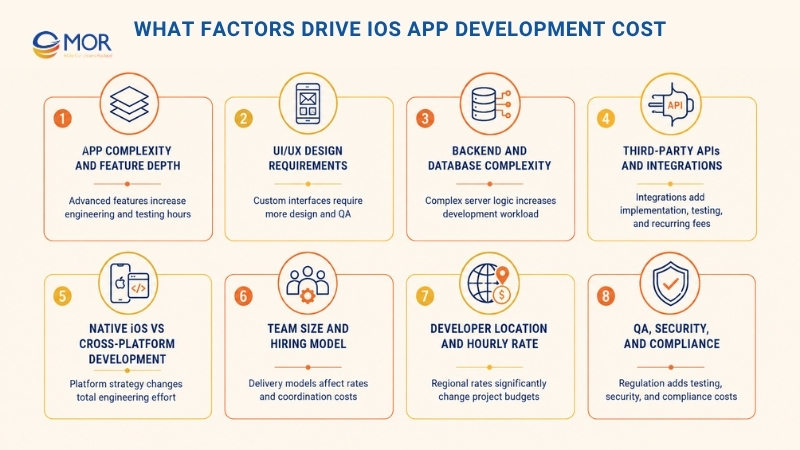
What Factors Drive iOS App Development Cost?
Several variables can move an estimate by tens of thousands of dollars. The strongest ones add engineering hours, specialist skills, backend work, or extra testing.
App Complexity and Feature Depth
Complexity comes from what happens after a user taps a button. One screen that reads static content is cheap; another that checks permissions, calls three APIs, writes data, triggers notifications, and handles network failure takes much longer.
Industry pricing benchmarks for 2026 suggest that AI, Core ML, LLM, or ARKit capabilities can add about $8,000-$80,000 per function, and regulated apps may carry a 15%-30% compliance premium.
- Business rules: Conditional pricing, approval chains, workflows, calculations, and exception states add coding and testing time.
- User roles: Customer, seller, staff, driver, provider, and administrator accounts need separate permissions and screens.
- Real-time operations: Live chat, tracking, live feeds, and instant synchronization require server connections and event handling.
- Offline access: Local databases, sync queues, and conflict resolution make the data layer harder to build.
- AI and AR: Core ML, Vision, LLM APIs, ARKit, or image processing require specialist engineering and extra validation.
UI/UX Design Requirements
Custom UI adds cost when your product needs more than Apple's standard controls. A branded design system, custom transitions, interactive charts, motion, and unusual navigation patterns increase design, coding, and QA hours.
Prototype depth also affects the custom iOS app development cost. A basic wireframe takes less work than a tested interactive prototype covering empty states, errors, permissions, accessibility, and different screen sizes.
- Standard components: Apple Human Interface Guidelines and established UI patterns keep design time lower.
- Custom visual systems: Brand-specific components require more design documentation and frontend work.
- Motion and interaction: Custom animations create extra implementation and testing tasks.
- Accessibility: VoiceOver, Dynamic Type, contrast, and touch-target rules need design and QA time.
- Late revisions: Changes after development starts can trigger UI updates, code edits, and regression testing.
Backend and Database Complexity
The backend often becomes one of the largest cost blocks in a business app. User accounts, permissions, databases, media storage, notifications, reporting, and admin tools all sit behind the mobile interface.
A booking app is a simple example. The screen might show only a calendar and a confirmation button, yet the backend must check availability, prevent double booking, store transactions, notify users, and update the admin portal.
- Authentication: User sessions, password recovery, OAuth, Face ID flows, and permissions require secure server logic.
- Data architecture: Large datasets, relationships, history, and reporting increase database work.
- Admin systems: Staff dashboards create another interface that needs development and QA.
- Scale requirements: High traffic calls for caching, queues, monitoring, and stronger cloud architecture.
- Media storage: Images, audio, and video raise storage and bandwidth spending after launch.
Third-Party APIs and Integrations
External systems save development time when they replace work you would otherwise build internally. Yet every integration brings implementation, testing, error handling, and recurring fees.
Stripe, Apple Pay, Google Maps, CRM platforms, ERP systems, analytics services, SMS gateways, AI APIs, and messaging tools all follow different authentication and billing models.
- Payment systems: Teams must handle success, failure, refund, and subscription states.
- Maps: Location permissions, geocoding, routing, and usage charges need planning.
- Enterprise systems: CRM and ERP connections may require middleware or custom API work.
- AI APIs: Model calls introduce usage fees and require controls for failures and response quality.
- Vendor changes: API version updates can create maintenance work later.
Native iOS vs Cross-Platform Development
Swift and SwiftUI suit products built around Apple devices and APIs. Flutter and React Native become attractive when one business needs iOS and Android under the same budget.
For two-platform projects, cross-platform development may cut combined engineering work because much of the application logic is shared. The android and iOS app development cost can still rise when platform-specific modules require native bridges or separate QA.
- Choose Swift: iOS-only apps, deep Apple API access, ARKit, Core ML, Watch integrations, or demanding graphics.
- Choose Flutter or React Native: Business apps, marketplaces, booking products, internal tools, and MVPs targeting two platforms.
- Check native dependencies: Shared code saves less when many requirements rely on device-specific functions.
Team Size and Hiring Model
A freelancer can work well for a small module or prototype. A commercial product usually needs several roles, including engineering, design, QA, analysis, and project management.
Dedicated teams spread responsibility across specialists. Agencies add management and delivery processes, so their rate may be higher, but the client spends less internal time coordinating each contributor.
- Freelancer: Lower entry price, greater dependency on one person.
- In-house team: Strong product ownership, higher hiring and employment overhead.
- Offshore dedicated team: Flexible team size and lower labor rates in many markets.
- Boutique studio: Senior access and smaller management layers.
- Full-service agency: Broader delivery coverage, usually at a higher blended rate.
Developer Location and Hourly Rate
Developer location can change the project total before scope changes at all. Salaries, business overhead, and local labor markets create very different rates across regions.
A Vietnam team can sit far below US agency pricing. That price difference makes geography one of the strongest budget variables for long projects.
QA, Security, and Compliance
QA covers much more than tapping through the happy path. Test teams check device versions, permissions, network loss, payments, API failures, performance, security, and regression after every release.
Regulated industries add another layer. Healthcare, finance, and products handling sensitive customer data may require more access controls, audit records, documentation, security testing, and privacy work.
- Functional QA: Confirms each workflow behaves as specified.
- Device testing: Covers target iPhones, iPads, screen sizes, and iOS versions.
- Performance testing: Finds slow API calls, memory issues, and bottlenecks.
- Security testing: Checks authentication, permissions, storage, and data exchange.
- Compliance work: HIPAA, PCI DSS, GDPR, and internal controls create extra development and review tasks.
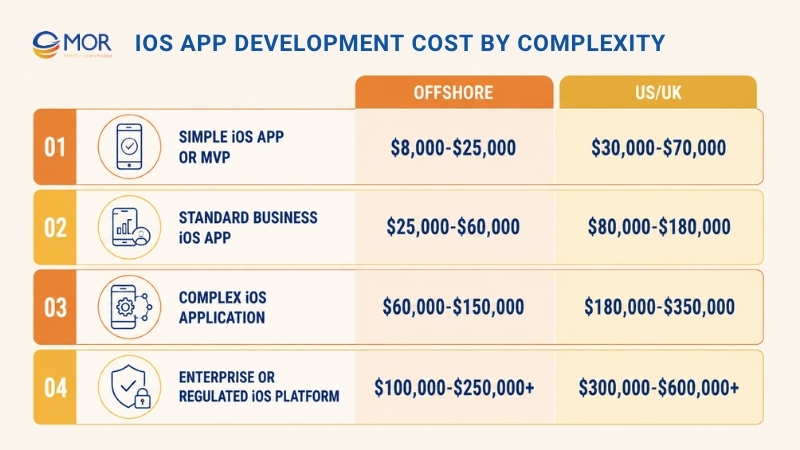
iOS App Development Cost by Complexity
The average cost of iOS app development becomes easier to interpret when you group products by complexity. The table below pairs common scope with hours, timeline, and delivery region.
Complexity | Typical Features | Approx. Hours | Timeline | Offshore Cost | US/UK Cost |
Simple / MVP | Login, profiles, 3-8 screens, simple API/backend, push notifications | 400-800 | 6-12 weeks | $8,000-$25,000 | $30,000-$70,000 |
Medium / Standard | 10-20 screens, payments, search, APIs, admin dashboard | 800-1,600 | 3-6 months | $25,000-$60,000 | $80,000-$180,000 |
Complex | Chat, real-time updates, maps, multi-role workflows, custom backend | 1,600-3,000 | 6-10 months | $60,000-$150,000 | $180,000-$350,000 |
Enterprise / Regulated | AI/ML, compliance, complex security, offline sync, enterprise systems | 3,000-5,000+ | 9-18+ months | $100,000-$250,000+ | $300,000-$600,000+ |
Simple iOS App or MVP
A production MVP tests one core value proposition through a working product. It still needs stable authentication, backend logic, basic analytics, testing, and store submission.
- Scope: Usually 3-8 screens and one main user journey.
- Backend: Basic API, data storage, and authentication.
- Integrations: Few external services.
- Budget: Around $8,000-$25,000 offshore or $30,000-$70,000 in the US/UK.
- Timeline: Roughly 6-12 weeks.
Standard Business iOS App
A standard business app connects several workflows and needs more server logic. Think booking, ecommerce, learning, fitness, or customer-service products.
- Scope: Around 10-20 screens with user profiles and permissions.
- Commerce: Payments, subscriptions, or transaction records.
- Operations: Search, notifications, analytics, and an admin portal.
- Budget: Around $25,000-$60,000 offshore or $80,000-$180,000 in the US/UK.
- Timeline: Roughly 3-6 months.
Complex iOS Application
Complex apps tie several systems together and must handle live data or rich media. The iphone app development cost rises quickly when chat, maps, media processing, and offline behavior share the same backend.
- Real-time work: Messaging, tracking, live updates, or status changes.
- Data: Custom backend and heavier synchronization.
- Roles: Separate flows for customers, staff, vendors, or administrators.
- Budget: Around $60,000-$150,000 offshore or $180,000-$350,000 in the US/UK.
- Timeline: Usually 6-10 months.
Enterprise or Regulated iOS Platform
Enterprise platforms serve large teams, sensitive data, or high transaction volumes. Their architecture must support security controls, auditability, system integrations, and long-term growth.
- Enterprise connections: ERP, CRM, identity systems, and internal APIs.
- Security: Audit trails, encryption, policy controls, and detailed access rules.
- Specialist work: AI, ML, offline sync, or regulated data.
- Budget: Around $100,000-$250,000+ offshore or $300,000-$600,000+ in the US/UK.
- Timeline: Often 9-18+ months.
iOS App Development Cost by Feature
A feature list gives you a faster way to estimate the cost to develop iOS app requirements before discovery begins. The prices below are planning benchmarks rather than menu prices, since shared backend work changes the total.
iOS Feature | Complexity | Offshore / India Benchmark | US Agency Benchmark | Typical Development Time |
Email registration and login | Low | $500-$1,200 | $2,000-$5,000 | 3-5 days |
Social login / Sign in with Apple | Low | $800-$1,800 | $3,000-$7,000 | 4-7 days |
Face ID / biometric authentication | Low | $400-$1,000 | $1,500-$4,000 | 2-3 days |
Push notifications | Low | $600-$1,500 | $2,500-$5,000 | 3-5 days |
Payment integration | Medium | $1,500-$3,500 | $6,000-$15,000 | 1-2 weeks |
App Store subscriptions | Medium | $1,200-$2,800 | $5,000-$12,000 | ~1 week |
GPS and maps | Medium | $1,000-$2,500 | $4,000-$10,000 | ~1 week |
Real-time location tracking | Medium-High | $2,000-$5,000 | $8,000-$20,000 | 1-2 weeks |
Text chat / messaging | Medium-High | $2,500-$6,000 | $10,000-$25,000 | 2-3 weeks |
Voice and video calling | High | $4,000-$10,000 | $15,000-$40,000 | 3-5 weeks |
Camera and media upload | Medium | $1,500-$3,500 | $6,000-$14,000 | 1-2 weeks |
Social feed | Medium-High | $3,000-$7,000 | $12,000-$28,000 | 2-3 weeks |
Advanced search and filters | Medium | $1,500-$4,000 | $6,000-$16,000 | 1-2 weeks |
Admin dashboard | Medium-High | $2,500-$6,000 | $10,000-$25,000 | 2-3 weeks |
Analytics integration | Low | $500-$1,500 | $2,000-$6,000 | 3-5 days |
AI recommendation engine | High | $5,000-$14,000 | $20,000-$55,000 | 4-8 weeks |
Core ML / Vision capability | High | $3,000-$8,000 | $12,000-$35,000 | 3-5 weeks |
ARKit capability | High | $5,000-$15,000 | $20,000-$60,000 | 4-8 weeks |
App Store setup/submission support | Low | $500-$1,200 | $2,000-$5,000 | 2-4 days |
Don't add every row to produce a final quote. Login, profiles, chat, payments, and admin tools may share authentication, databases, cloud services, or notification infrastructure.
That overlap works the other way too. A 'simple' chat screen can become expensive once you add message history, delivery status, attachments, moderation, unread counts, push notifications, and offline recovery.
AI also creates costs after implementation. LLM calls, embeddings, image generation, model monitoring, and data storage may produce monthly usage charges that don't appear in the first development estimate.
iOS Developer Rates by Region and Hiring Model
Labor rates shape the average iOS app development cost, especially when a project runs for thousands of engineering hours. Comparing regions makes this effect easier to see.
iOS Developer Hourly Rates by Region
For Vietnam, Second Talent reports international client rates ranging from $15-$25/hour for junior iOS developers to $60-$85/hour for expert architects. Experienced freelance developers can reach $70-$100/hour at architect level.
Region | Typical 2026 iOS Rate | Approx. Cost for 1,000 Dev Hours | Cost Position |
United States / Canada | $100-$250/hr | $100,000-$250,000 | Very high |
Western Europe / UK | $80-$180/hr | $80,000-$180,000 | High |
Eastern Europe | $40-$100/hr | $40,000-$100,000 | Medium |
Australia | $80-$200/hr | $80,000-$200,000 | High |
India / South Asia | $20-$60/hr | $20,000-$60,000 | Low-Medium |
Vietnam / Southeast Asia | $22-$85/hr | $22,000-$85,000 | Low-Medium |
These ranges don't mean a $30/hour developer always creates a cheaper product than a $70/hour developer. Rework, unclear communication, weak architecture, and missed testing can erase the rate advantage.
The iOS app development cost per hour also changes with seniority. A project needs a mix of roles, so calculate a blended rate rather than multiplying every hour by the highest specialist price.
iOS Development Cost by Hiring Model
Your hiring model decides who carries recruiting, management, QA, and delivery responsibility. That choice affects cost predictability as much as the rate itself.
Hiring Model | Typical 2026 Rate / Cost Structure | Management Responsibility | Cost Predictability | Best Fit | Main Cost Risk |
Freelance iOS Developer | ~$20-$100+/hr | Mostly client | Medium | Small modules, prototypes, staff gaps | Availability, rework, one-person dependency |
Offshore Dedicated Team | ~$25-$70/hr blended | Shared | Medium-High | MVPs, scale-ups, longer products | Process and communication |
Boutique Development Studio | ~$60-$120/hr | Vendor | High | Startups needing product and engineering support | Higher hourly rate |
US/Western Agency | ~$100-$250/hr | Vendor | High | Enterprise and regulated projects | High labor overhead |
In-House Team | Salary + benefits + recruiting + equipment | Client | Low-Medium initially | Long-term core products | Hiring time and fixed overhead |
Freelancers fit narrow, well-defined tasks. An offshore team makes more sense when you need developers, QA, PM, and other roles over several months.
In-house development can suit a product that needs permanent internal ownership. Yet recruiting delays, employee benefits, equipment, management time, and unused capacity all sit outside the salary figure.
iOS App Cost Breakdown by Development Phase
A good proposal shows where each dollar goes. Goodfirms' June 2026 research assigns roughly 5%-10% to discovery, 15%-20% to UI/UX, 35%-45% to iOS development, 20%-30% to backend work, 10%-15% to QA, and 5%-10% to deployment.
The following simplified model groups frontend and backend development into one line so project owners can compare larger budget blocks.
Development Phase | Typical Share of Budget | Example on $75K App | Example on $150K App | Main Cost Items |
Discovery and scoping | 5-8% | $3,750-$6,000 | $7,500-$12,000 | Requirements, workflows, architecture, estimates |
UI/UX design | 15-20% | $11,250-$15,000 | $22,500-$30,000 | Wireframes, prototype, visual design, interaction states |
iOS + backend development | 50-60% | $37,500-$45,000 | $75,000-$90,000 | Swift/SwiftUI, APIs, database, admin tools, integrations |
QA and testing | 12-18% | $9,000-$13,500 | $18,000-$27,000 | Functional, device, security, regression, UAT |
Deployment and launch | 3-7% | $2,250-$5,250 | $4,500-$10,500 | App Store preparation, builds, submission, review fixes |
Cheap quotes often become cheap by excluding work rather than performing the same work for less money. Discovery, project management, device testing, deployment support, and stabilization are common areas to check.
Ask vendors to separate frontend and backend effort if your app has heavy data logic. An admin portal, ERP integration, payment system, or real-time service can make backend work a major budget line.
QA deserves its own allocation too. Cutting two weeks from testing may move the launch date forward, but defects can return as expensive post-release work and poor App Store reviews.
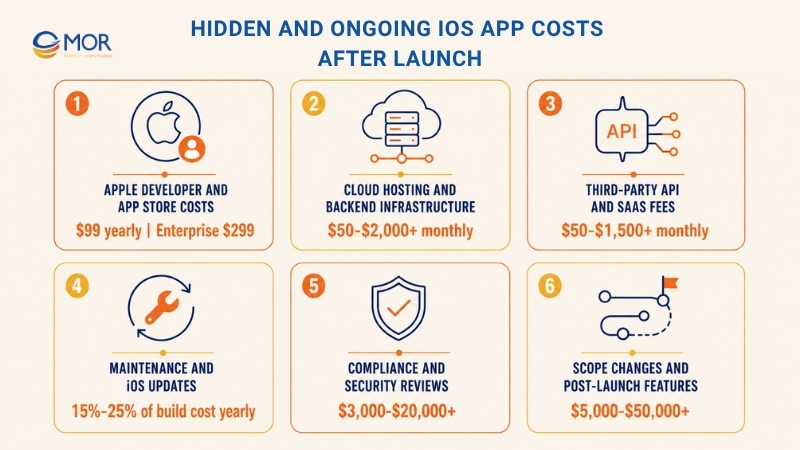
Hidden and Ongoing iOS App Costs After Launch
The initial build covers only part of total ownership. Hosting, APIs, maintenance, security work, and Apple-related charges continue after users download the app.
Ongoing Cost Item | Frequency | 2026 Planning Cost | What Drives the Cost |
Apple Developer Program | Annual | $99/year | Standard App Store distribution |
Apple Developer Enterprise Program | Annual | $299/year | Eligible private employee distribution |
Cloud/server hosting | Monthly | ~$50-$2,000+/month | Users, storage, traffic, media, compute |
Third-party APIs | Monthly / usage-based | ~$50-$1,500+/month | Maps, SMS, email, analytics, AI, communication |
Crash/performance monitoring | Monthly | $0-$200+/month | Tool tier, events, users, retention |
Maintenance and updates | Annual | ~15%-25% of initial build cost/year | Bugs, iOS releases, SDK changes, small improvements |
Security audit | Annual / periodic | ~$3,000-$20,000+ | Product complexity and regulation |
App Store marketing assets | Initial + ongoing | ~$2,000-$8,000 | Screenshots, preview video, metadata, localization |
Major product updates | Per release | $5,000-$50,000+ | New scope and complexity |
Compliance work | Initial + recurring | ~15%-30% project premium for regulated apps | HIPAA, PCI DSS, GDPR, audit requirements |
Apple Developer and App Store Costs
The iOS app developer account cost is small compared with engineering, but it belongs in every budget. Apple lists the Developer Program at $99 per membership year and the Enterprise Program at $299 per year; Apple also lists a 30% commission for many digital goods and services, with 15% rates applying under qualifying programs or subscriptions.
App submission still requires staff time. Screenshots, privacy declarations, test accounts, metadata, signing, build configuration, and review responses all need preparation.
Cloud Hosting and Backend Infrastructure
A small MVP may run on inexpensive managed cloud services. Traffic growth, media storage, database load, background jobs, and AI processing can move monthly spending upward quickly.
Track cloud cost against real usage rather than a fixed launch estimate. A video-heavy product and a lightweight booking tool may have similar development budgets but very different monthly infrastructure bills.
Third-Party API and SaaS Fees
Maps, SMS, email, analytics, support chat, payment gateways, AI services, and identity tools may charge per request, message, user, or transaction. Many start cheap and become meaningful operating costs at scale.
Estimate at three levels: launch traffic, expected year-one traffic, and a higher growth case. That simple exercise prevents a low initial API bill from hiding future unit economics.
Maintenance and iOS Updates
Annual maintenance commonly sits around 15%-25% of the initial build budget. A $100,000 app may need roughly $15,000-$25,000 per year for fixes, compatibility work, dependency updates, security patches, and small changes.
The figure isn't a subscription to unlimited new development. Large modules, redesigns, and new business workflows should remain separate project scope.
Compliance and Security Reviews
Fintech and healthcare apps need more than routine bug fixing. Security audits, penetration tests, privacy updates, access-control reviews, and regulatory changes can create recurring work.
Budget these activities before procurement if your product handles payments, health data, identity records, or sensitive corporate information. A quote that excludes them will look cheaper on paper and cost more later.
Scope Changes and Post-Launch Features
Users will ask for changes after launch. Product analytics may also reveal that a workflow needs revision, or the business may add another market, role, payment method, or integration.
Keep a separate product-development budget beside maintenance. Maintenance keeps the existing system healthy; new scope changes what the system does.
How to Reduce iOS App Development Cost Without Cutting Quality
Lowering iOS app development cost works best when you remove unnecessary work before coding begins. Cutting QA or security creates savings on the proposal and cost somewhere else later.
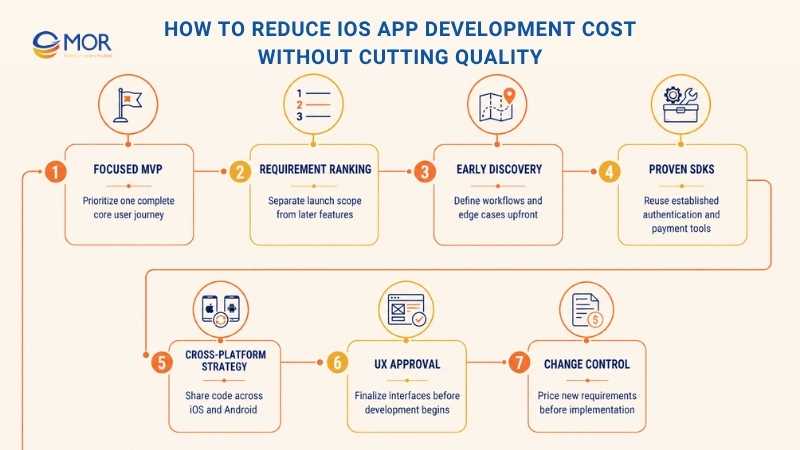
- Launch a focused MVP: Pick one user problem and complete that journey well before funding secondary modules.
- Rank requirements: Divide scope into launch, phase two, and later ideas. This keeps optional work away from the first release.
- Complete discovery early: Define roles, flows, edge cases, data rules, integrations, and acceptance criteria before engineering starts.
- Reuse proven SDKs: Authentication, payments, analytics, maps, and notifications rarely need a custom implementation from zero.
- Choose cross-platform carefully: Flutter or React Native can lower combined iOS and Android engineering work when your app doesn't depend heavily on Apple-only APIs.
- Approve UX before coding: A wireframe change costs less than changing design, frontend code, automated tests, and documentation later.
- Use managed backend services where they fit: Authentication, storage, notifications, and basic databases can shorten early development for smaller products.
- Evaluate total delivery cost: A low hourly rate has little value if weak code or poor communication creates repeated work.
- Phase costly integrations: Add secondary AI, AR, data, or enterprise connections after the main user flow has proven value.
- Control change requests: Attach a cost and schedule change to each new requirement before development begins.
A disciplined MVP can preserve runway without creating a disposable product. The goal is a smaller first scope built on architecture that still supports later releases.
How to Get an Accurate iOS App Development Estimate
A useful estimate starts with enough information for two vendors to price the same product. Without that shared baseline, comparing quotes becomes guesswork.
Prepare the following before requesting a proposal:
- Feature scope: List primary workflows, user roles, business rules, and edge cases.
- Platform scope: State iPhone, iPad, Apple Watch, Vision Pro, Android, or web requirements.
- Backend scope: Document APIs, database needs, admin tools, reporting, and infrastructure.
- Design scope: Confirm whether you already have UX/UI files or need full product design.
- Integration scope: List payments, maps, CRM, ERP, analytics, AI services, and communication tools.
- Testing scope: Define supported devices, iOS versions, QA types, and UAT responsibilities.
- Security scope: Document authentication, encryption, privacy, permissions, and regulatory requirements.
- Team assumptions: Ask for roles, seniority, hours, and blended rates.
- Launch scope: Include TestFlight, App Store assets, submission, and review-response work.
- Recurring costs: Ask vendors to separate hosting, APIs, maintenance, Apple fees, and support.
- Change control: Confirm how added scope is estimated, approved, and billed.
Apple says incomplete App Review information can delay review or stop a submission from passing, so launch estimates should include preparation and response time instead of treating upload day as the finish line.
Two proposals become comparable only when they price the same scope, backend, QA coverage, delivery team, launch work, and support period. That standard gives you a much better view of the real cost to develop an iOS app.
MOR Software: Strategic Partner for Cost-Effective iOS App Development
Controlling the iOS app development cost requires good scoping, suitable architecture, disciplined QA, and a team model that fits the roadmap. At MOR Software, our mobile services cover consulting, UI/UX, native and cross-platform development, integration, testing, modernization, maintenance, and support.
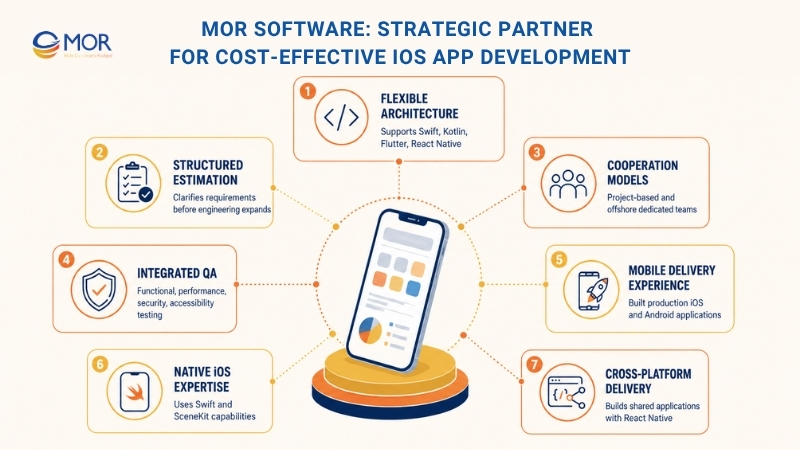
- Match architecture to your budget: We work across native, cross-platform, and hybrid mobile app development service, including iOS, watchOS, Android, and Wear OS. Our mobile stack includes Swift, Kotlin, Flutter, and React Native, which lets teams choose an approach based on product needs rather than a fixed delivery model.
- Define cost before engineering expands: MOR's process covers requirement clarification, consultation, estimation, planning, business analysis, architecture, implementation, testing, and maintenance. Project managers plan resources and schedules, and business analysts clarify business rules before development moves forward.
- Choose the right cooperation model: Defined projects can use project-based delivery. Longer roadmaps can use our Offshore Development Center model, where clients shape team composition and MOR handles operational work tied to recruitment and team management.
- Keep QA inside the budget: Our mobile work includes functional, performance, security, accessibility, and UX testing. MOR's materials also document ISTQB-certified testing talent plus quality and information-security management systems.
- Apply delivery experience from real mobile products: MOR built the Dan Tri News App through a 10-person team over 24 months using Swift, Kotlin, .NET, and Python. The product supports iOS and Android, push notifications, customizable layouts, and social sharing.
Our native portfolio also includes the 3D Map SDK, built with Swift and SceneKit for 360-degree content, video streaming, 3D objects, and spatial measurement. A Japanese construction project shows the cross-platform side: seven team members built an iOS and Android app with React Native and FastAPI over eight months.
This model fits startups planning a focused MVP, companies modernizing an existing mobile product, and businesses that need native iOS or shared iOS/Android delivery backed by integration and QA. If you already have a feature list, target platforms, integrations, and launch target, contact MOR Software to review the scope and turn those requirements into a practical project estimate.
Conclusion
A realistic iOS app development cost comes from scope, engineering effort, team rates, QA, integrations, and the expenses that continue after launch. Price each of those parts before comparing vendor totals, and keep optional functions outside the first release when budget is tight. MOR Software supports native and cross-platform mobile development, consulting, integration, testing, and maintenance.
Contact us to review your requirements and build a cost estimate around the product you actually need.
MOR SOFTWARE
Frequently Asked Questions (FAQs)
How much does it cost to develop an iOS app in 2026?
The iOS app development cost can range from about $8,000-$25,000 for a lean offshore MVP to $100,000-$250,000+ for complex enterprise work. Premium US or UK agencies may quote $300,000-$600,000+ for regulated or large-scale products.
How much does an iOS MVP cost?
A focused MVP often sits around $8,000-$25,000 with a cost-conscious offshore team. US and UK agency pricing can reach $30,000-$70,000 for comparable scope, depending on backend work, integrations, design depth, and QA.
How much does an iOS developer charge per hour?
Rates depend on seniority and region. Vietnam and South Asia commonly sit below North American pricing, and senior architects cost more than mid-level engineers. Project owners should calculate a blended team rate rather than one developer's headline rate.
What is the biggest factor affecting iOS app development cost?
Scope and business-logic complexity create the largest changes. Real-time workflows, custom backend rules, several user roles, offline sync, AI, security, and external systems increase engineering and testing hours much faster than screen count alone.
How much do login, payments, chat, and push notifications cost?
Authentication can range from hundreds to several thousand dollars. Payments and real-time chat may run into several thousand or tens of thousands because implementation also covers backend rules, security, failure states, testing, and data storage.
Is native iOS more expensive than Flutter or React Native?
Not always. Swift can be the better financial choice for an iOS-only app using Apple-specific APIs. Flutter or React Native may cost less when one codebase needs to serve iOS and Android.
Is iOS app development more expensive than Android?
Platform choice alone rarely creates the biggest cost difference. Device testing, developer rates, backend work, and scope matter more. Two separate native apps usually cost more than building one platform or a suitable cross-platform product.
What hidden costs should an iOS app budget include?
Plan for Apple membership, hosting, API usage, payment charges, monitoring tools, security work, compliance, App Store preparation, maintenance, and future product releases. These expenses sit outside many initial development quotes.
How much does iOS app maintenance cost per year?
A practical planning range is around 15%-25% of the original development budget each year. A $100,000 app may need roughly $15,000-$25,000 for fixes, iOS compatibility, dependency changes, security patches, and smaller improvements.
Can you build a professional iOS app for under $10,000?
Yes, under tight limits. That budget fits a small MVP, prototype, template-based product, or low-cost offshore build. Custom design, heavy backend logic, real-time systems, AI, compliance, and broad QA will move the price above that level.
How much does it cost to make an app by yourself?
Your cash expense can stay low if you already know Swift, backend development, design, QA, and App Store submission. You still need the $99 Apple membership and may pay for hosting or APIs. The larger cost is your time, especially when learning unfamiliar parts of the stack.
Share


Make Our-Dreams Realized


© 2023 . MOR Software. All Rights Reserved
Sitemap
Privacy Policy
Terms of Use

Rate this article
0
over 5.0 based on 0 reviews
Your rating on this news:
Name
*Email
*Write your comment
*Send your comment
1