


Machine Learning in Ecommerce: Businesses Guide in 2026
Online retailers struggle to personalize at scale, forecast demand accurately, and control rising acquisition costs. Machine learning in ecommerce is helping businesses turn raw data into smarter pricing, targeting, and customer experiences. In this guide, MOR Software will break down practical use cases, real statistics, and proven strategies to apply AI-powered retail systems effectively in 2026.
What Is Machine Learning In Ecommerce?
Machine learning in ecommerce describes computer systems that learn from data and generate predictions or decisions without being programmed for every single situation.
Within online retail, this refers to machine learning algorithms that study shopper actions, product details, and other behavioral signals to create more intelligent and relevant experiences. Through AI in e-commerce, businesses can react to customer behavior and market shifts with speed and accuracy, delivering results that static rule-based platforms cannot achieve.
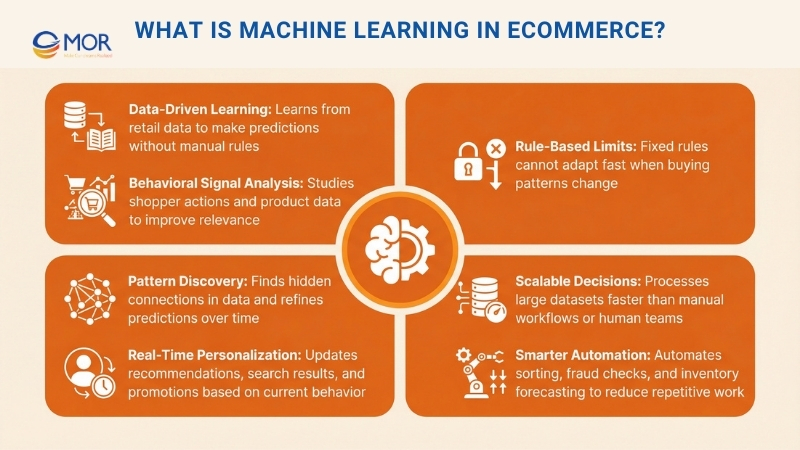
Traditional ecommerce platforms depend on fixed logic. For instance, “if a customer purchases Product X, recommend Product Y.” These predefined rules lack flexibility and cannot adjust when new buying patterns appear.
In contrast, machine learning models analyze real data to uncover patterns and connections, refining predictions as customer behavior evolves. In ML ecommerce, this technology enables:
- Real-time personalization: The system adjusts immediately to new inputs, so product suggestions, search rankings, and promotions align with current shopper behavior rather than outdated trends.
- Scalable decision-making: These ml models process vast amounts of data simultaneously, far exceeding what manual workflows or human teams can handle.
- Smarter automation: It automates processes such as product sorting, fraud detection, and inventory forecasting, allowing your team to focus on strategic priorities instead of repetitive tasks.
How Does Machine Learning In Ecommerce Systems Work?
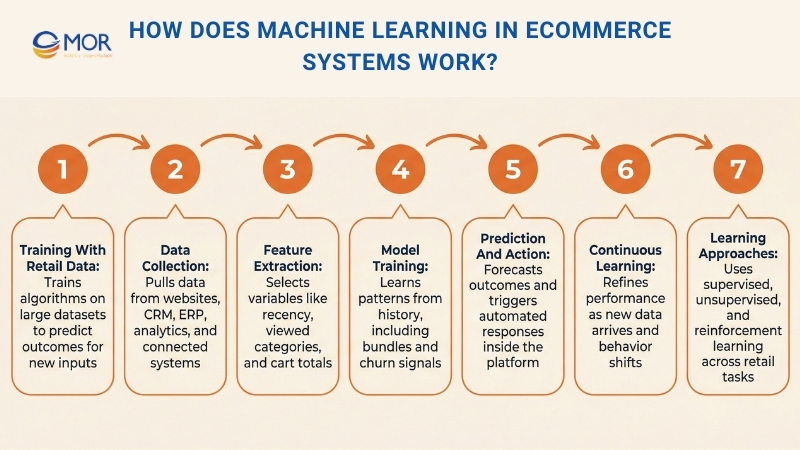
Machine learning in ecommerce operates through training algorithms on extensive datasets so they can detect patterns and generate predictions for new inputs. In online retail environments, this data may include purchase history, product specifications, browsing sessions, search terms, and even visual or text content taken from reviews. These machine learning algorithms in ecommerce form the core of many AI-powered retail systems.
The workflow generally follows these stages:
- Data collection: The platform gathers relevant information from your ecommerce website, CRM systems such as retail CRM, ERP, analytics platforms, and other connected systems.
- Feature extraction: Important variables are selected, such as the time since a customer’s last order, the categories they viewed, or their cart total.
- Model training: The algorithm studies historical records to identify recurring trends. For instance, it can detect which products are commonly purchased together or which user behaviors signal a potential churn.
- Prediction and action: After training, the model forecasts likely outcomes, such as which customers may convert or which items to recommend, and it activates automated responses.
- Continuous learning: When new data becomes available, the system refines itself, gradually improving precision and performance.
Across retail scenarios, several types of training approaches are widely applied:
- Supervised learning: These models rely on labeled datasets, such as transactions marked “converted” or “not converted,” to estimate future results.
- Unsupervised learning: The system explores unlabeled data to uncover hidden structures, such as grouping customers into behavioral clusters.
- Reinforcement learning: The model improves strategies through repeated feedback, which is often used in real-time pricing and automated personalization technology.
Modern ecommerce platforms frequently integrate these methods to enable capabilities like dynamic search ranking, relevant product suggestions, and automatic tagging. The outcome is faster decision-making powered by predictive analytics for online stores, improving each step of the customer journey.
Top Machine Learning Use Cases In Ecommerce
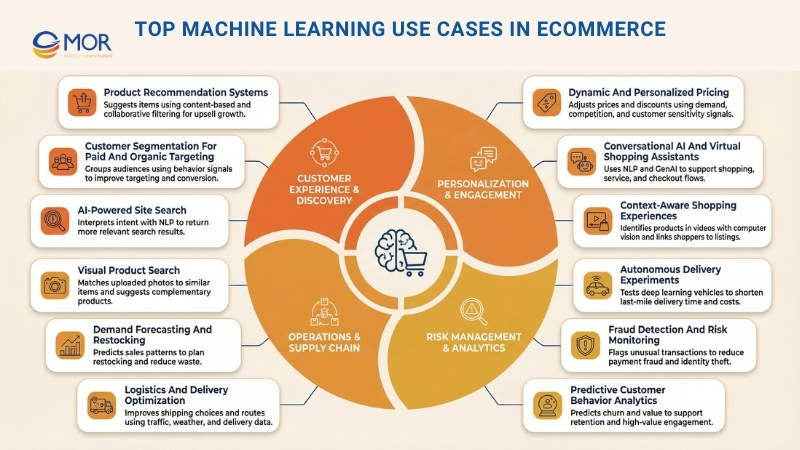
From marketing and customer support to logistics and security, machine learning in ecommerce is transforming how companies operate across departments. These machine learning use cases in ecommerce show how advanced models support daily retail activities. Let’s explore how modern AI-powered retail systems apply intelligent automation in this sector and what benefits online businesses gain when they implement these solutions.
Product Recommendation Systems
ML-based recommendation systems are now standard features across leading ecommerce websites and digital marketplaces because they help increase upselling opportunities. These intelligent product recommendation engines typically follow two main methods to generate suggestions. Content-based filtering analyzes a shopper’s purchase record and proposes similar items based on shared attributes. Collaborative filtering, in contrast, recommends products that other customers with comparable buying behavior have purchased and rated positively. This approach plays a central role in AI personalization in marketing.
Benefits: Higher average order value, stronger customer lifetime value
Customer Segmentation For Paid And Organic Targeting
Like recommendation engines, this method focuses on personalization to boost revenue. Retail machine learning solutions divide potential customers into segments and deliver customized advertising based on multiple data points, including social media activity, past online purchases, transactions completed in virtual stores, search engine history, and other large datasets. These models apply AI audience segmentation to analyze behavior and buying patterns, predicting which products users are most likely to purchase.
Benefits: Improved lead conversion, better marketing efficiency and return on investment
AI-Powered Site Search
Conventional search tools within online stores match user queries with product descriptions and indexed keywords. When enhanced with advanced natural language processing and machine learning in ecommerce systems, these tools achieve deeper contextual understanding. An AI-powered search engine evaluates customer preferences, purchase history, and prior interactions to interpret intent more accurately and deliver more relevant search results.
Benefits: Faster product discovery and a more seamless shopping experience
Dynamic And Personalized Pricing
An increasing number of ecommerce businesses rely on intelligent automation to refine their pricing models and tailor discounts or promotional campaigns. This method, commonly known as dynamic pricing, uses data-driven ecommerce optimization to adjust prices at regular intervals, sometimes within minutes as seen on Amazon. These updates are based on customer insights, historical pricing of comparable products, sales performance, competitor activity, supply and demand balance, price sensitivity, and other influencing factors.
Benefits: Increased revenue and reduced customer churn
Conversational AI And Virtual Shopping Assistants
Unlike traditional rule-based bots that respond only to basic questions, modern chatbots and virtual shopping assistants use natural language processing and generative AI to understand context and improve through past interactions. Many retailers partner with an AI chatbot development service to launch these assistants faster and keep them aligned with business workflows.
These conversational systems analyze previous conversations to deliver more accurate responses over time. This allows conversational AI solutions to engage customers in realistic dialogue and support or replace human agents across marketing, sales, and customer service functions. For example, they can create product listings, explain shipping details, ask questions to identify preferences, provide personalized discounts, complete purchases, and submit warranty service requests.
Benefits: Higher engagement with 24/7 support, improved customer satisfaction, stronger customer loyalty
Context-Aware Shopping Experiences
Context-aware shopping tools guide customers toward the items they are most likely to need while creating a more engaging journey. Using machine learning in ecommerce together with computer vision technologies, these systems detect and highlight particular products or brands that appear inside online videos. Retailers can attach direct links to the related product pages, which lets shoppers purchase featured items without leaving the video or other media content.
Benefits: Higher customer engagement and improved lead conversion
Visual Product Search
Online retail platforms that include computer vision-based visual search let users capture a photo of a product they like, upload it into the search tool, and discover similar items available for purchase based on shared visual traits. These solutions can also suggest complementary products, such as clothing pieces that match the item shown in the image to complete an outfit. First popularized by Google Lens, this feature is now integrated into many ecommerce platforms and retail apps, including Amazon and H&M.
Benefits: A smoother shopping journey and stronger sales performance
Demand Forecasting And Restocking
Machine learning models support advanced ecommerce predictive analytics tools, allowing retailers to estimate future sales patterns and prepare restocking plans that align supply with demand. These approaches often overlap with AI in inventory management, where models automate reorder points and restocking priorities. They also improve catalog planning, which lowers storage costs and reduces the risk of product spoilage. The data analyzed includes economic indicators, seasonal buying behavior, social media feedback, customer reviews, and product ratings. These inputs are gathered from different channels such as social networks, ecommerce websites, and POS systems.
Benefits: Better inventory control and reduced operational waste
Logistics And Delivery Optimization
Machine learning in ecommerce and retail supports smarter product distribution through advanced delivery optimization tools that review data from previous orders and recommend the most suitable shipping options, including free or same-day delivery, based on customer preferences. For physical transportation, these retail machine learning solutions also improve route planning. They evaluate live traffic updates, weather forecasts, and driver performance records to determine the quickest and most reliable path.
Benefits: Stronger logistics performance and quicker deliveries
Autonomous Delivery Experiments
Although still largely in the testing phase rather than full deployment, autonomous vehicles powered by deep learning models are expected to reshape product shipping in the coming years. Companies such as Amazon and Kroger are actively investing in this innovation, reporting encouraging progress in reducing last-mile delivery times and operational expenses.
Benefits: More rapid and cost-effective order fulfillment
Fraud Detection And Risk Monitoring
Many organizations have adopted machine learning in ecommerce to safeguard their online stores and digital platforms from various types of fraud, including identity theft and unauthorized online payments. These systems review large volumes of transaction data to detect repeating patterns and also identify behaviors that do not follow normal rules. ML in fraud detection is widely used to uncover unusual activity within credit card accounts, such as a sudden rise in transaction frequency, which may signal fraudulent actions.
Benefits: Stronger business protection and more secure transactions
Predictive Customer Behavior Analytics
Machine learning models give retailers advanced customer behavior analytics, helping them estimate how shoppers are likely to act based on their previous and current interactions across ecommerce channels. For example, companies can calculate customer lifetime value, meaning the total spending of each buyer, and focus their communication and promotions on high-value segments. These predictive analytics for online stores also help detect customers who may leave your site, allowing you to launch retention campaigns like targeted discounts.
Benefits: Higher customer retention rates
Real-World Examples Of Machine Learning In Ecommerce
Many companies across the retail sector have already adopted machine learning in ecommerce to improve performance and customer experience. Below are practical examples from well-known retailers and ecommerce-focused technology providers.
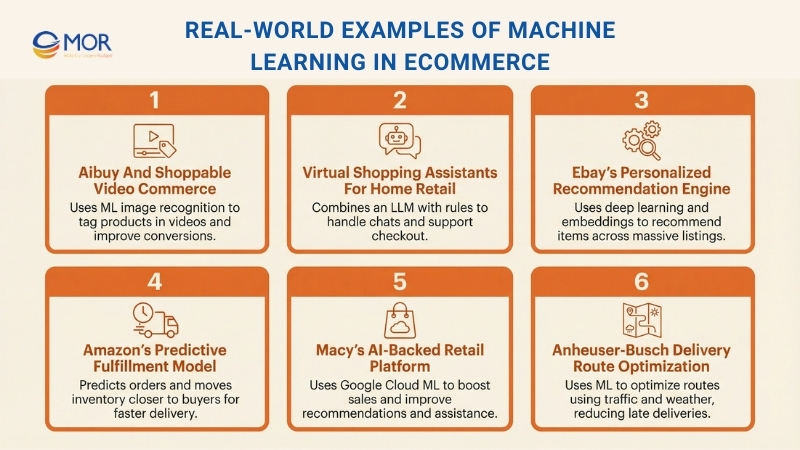
AiBUY And Shoppable Video Commerce
AiBUY, a leading US company in shoppable media technology, collaborated with Itransition to upgrade its core video commerce platform with advanced machine learning capabilities. The solution uses transformer-based neural network image recognition to identify products within millions of online images and videos and mark them with interactive overlays. It also reviews affiliate marketing networks to locate the most relevant matching products in their catalogs, allowing viewers to purchase directly from the content and improving overall conversion rates.
Virtual Shopping Assistants For Home Retail
Itransition also supported a US online home goods retailer by deploying a virtual shopping assistant to expand customer service capacity. The conversational system combines a large language model (LLM) with a rule-based engine to deliver personalized product suggestions based on current stock and assist customers during checkout. After launch, the assistant independently managed 30% of customer conversations and supported human agents in another 40% of interactions, leading to a 50% reduction in total manual workload.
EBay’s Personalized Recommendation Engine
eBay created its own recommendation engine powered by deep neural networks to help more than 150 million users explore over 1.5 billion active listings. This system applies natural language processing to analyze product descriptions and user-related text, then converts that information into embeddings, which are numerical values that represent semantic meaning. Through item-based collaborative filtering, the platform compares item and user embeddings to deliver suggestions based on previous purchases and browsing behavior. This case highlights how machine learning in ecommerce can scale intelligent product recommendation engines for global marketplaces.
Amazon’s Predictive Fulfillment Model
Amazon advanced ML-driven logistics further with its innovative anticipatory shipping program. The retail giant uses predictive models to monitor customer buying patterns and platform interactions, estimate future orders, and reposition selected products to warehouses closer to expected buyers. As a result, when customers place an order, the items are already nearby, which allows one-day delivery through standard and cost-efficient shipping options.
Macy’s AI-Backed Retail Platform
Macy’s, one of the largest American department store chains, launched a broad technology platform built on Google Cloud to strengthen different areas of its operations. The retailer applies ML-powered predictive analytics to support marketing initiatives, which led to a 10% increase in online sales during the first three months after implementation. It also added an intelligent recommendation engine and an AI-driven virtual assistant to its ecommerce site. In addition, the company used retail machine learning solutions to improve warehouse workflows, including inventory allocation, and refine its pricing strategy.
Anheuser-Busch Delivery Route Optimization
Anheuser-Busch, the world’s largest brewing company, introduced an ML-based route optimization system to manage its expanding customer base and improve ecommerce logistics. The platform analyzes past data related to traffic trends, parking availability, and weather updates to identify the most efficient and cost-effective delivery routes. It then provides drivers and dispatch teams with real-time guidance, including turn-by-turn directions and dock location details, through a mobile application. After deployment, the company lowered late deliveries by 80%.
Challenges And Limitations Of Machine Learning In Ecommerce
Machine learning in ecommerce supports personalized shopping journeys, predicts buyer intent, and improves decision-making with strong accuracy. Yet behind these benefits, businesses still face practical challenges that cannot be ignored.
Below is a closer look at the main obstacles that retail machine learning solutions may encounter and the actions companies can take to address them.
Challenge | Solution |
ML models depend on large amounts of reliable data, but many online retailers deal with incomplete, inconsistent, or low-quality datasets. | Apply data cleansing tools and preprocessing methods to correct errors before training models. Collaborating with external data enrichment providers can also help complete missing information. |
Integrating these systems into existing ecommerce platforms such as CRMs or ERPs can be technically demanding and time-intensive. | Select AI-powered retail systems that include ready-to-use APIs and connectors for common CRM, ERP, and marketing applications. Experienced integration teams can help connect new tools with current systems in a structured way. |
Historical datasets used for training may include bias, for example by overlooking certain customer groups or seasonal trends. | Conduct regular audits of datasets and algorithms to uncover bias. Use re-sampling techniques, fairness adjustments, and broader data collection to balance outcomes. |
Designing, training, and deploying predictive models requires meaningful investment in skilled professionals, infrastructure, and supporting technology. | Begin with limited pilot initiatives and expand once measurable results appear. Partnering with experienced vendors can lower initial expenses while still providing specialist knowledge. For some companies, machine learning outsourcing is the fastest way to access that expertise. |
Models created for limited datasets may struggle when transaction volumes and operational complexity grow. | Implement modular architectures and cloud-based infrastructure to prepare for expansion. AutoML tools and pre-trained models can assist scaling efforts and decrease technical strain. |
Best Practices For Applying Machine Learning In Ecommerce
Applying machine learning in ecommerce can improve many areas of your operations, from tailored shopping journeys to smarter inventory control. It also supports machine learning solutions for multi-brand campaign management in ecommerce, helping teams coordinate targeting, timing, and performance across different storefronts and product lines. The following practices help you implement this technology in a structured and results-focused way.
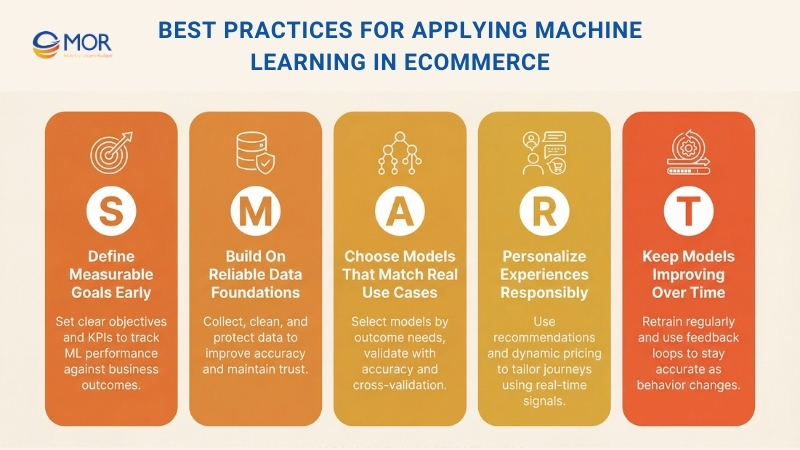
Define Measurable Goals Early
Begin by defining the clear business objectives you want to achieve with machine learning in ecommerce, such as increasing conversion rates, improving customer support, or optimizing supply chain performance. Establish specific and measurable KPIs to evaluate how well your initiatives are performing. Establish specific and measurable KPIs to evaluate how well your initiatives are performing. If you need to move quickly, you can hire machine learning developer support for a focused pilot.
For example, if your goal is to elevate customer experience, you may track metrics like higher satisfaction ratings or reduced bounce rates. Clear targets and performance indicators guide your predictive analytics for online stores and keep your efforts aligned with broader business priorities.
Build On Reliable Data Foundations
High-quality data is a key requirement for successful retail machine learning solutions. Collect and manage information from different sources, including customer interactions, transaction histories, and website behavior.
Make sure this data is carefully cleaned and prepared to remove errors, duplicates, or inconsistencies that could weaken model accuracy. At the same time, apply strong data protection practices to comply with regulations, safeguard personal information, and maintain customer trust. Strong cloud data governance also helps keep information consistent, secure, and accessible across teams.
Choose Models That Match Real Use Cases
Selecting suitable machine learning models for ecommerce depends on the specific outcomes you expect. For example, collaborative filtering works well when you aim to create intelligent product recommendation engines. When your priority is detecting suspicious transactions, anomaly detection models often deliver strong results.
Assess each model with performance indicators such as accuracy and precision to confirm that it supports your operational goals. Cross-validation also matters, as it verifies that the model performs reliably with new datasets instead of only fitting the original training data.
Personalize Experiences Responsibly
Customization remains one of the strongest applications of automated personalization technology in online retail. Content-based filtering algorithms can power recommendation systems that suggest items based on what customers previously viewed or purchased.
You should also consider dynamic pricing algorithms that adjust product prices in real time according to demand levels, competitor pricing, and available stock. This method builds a more tailored shopping journey and can increase overall revenue.
Keep Models Improving Over Time
Machine learning models require ongoing updates and adjustments to remain accurate and relevant. Retrain your systems on a regular basis with new data so they reflect changing customer behavior and market conditions.
Create feedback loops that gather insights from users and internal teams to support further refinement. This continuous optimization process helps your retail machine learning solutions maintain strong performance and deliver consistent value as your business and the ecommerce ecosystem evolve.
Trends And Statistics Shaping Machine Learning In Ecommerce
AI and machine learning in ecommerce continue to influence how retailers invest, compete, and design digital experiences. Market data shows strong growth, wider adoption, and rising customer expectations for intelligent retail platforms.
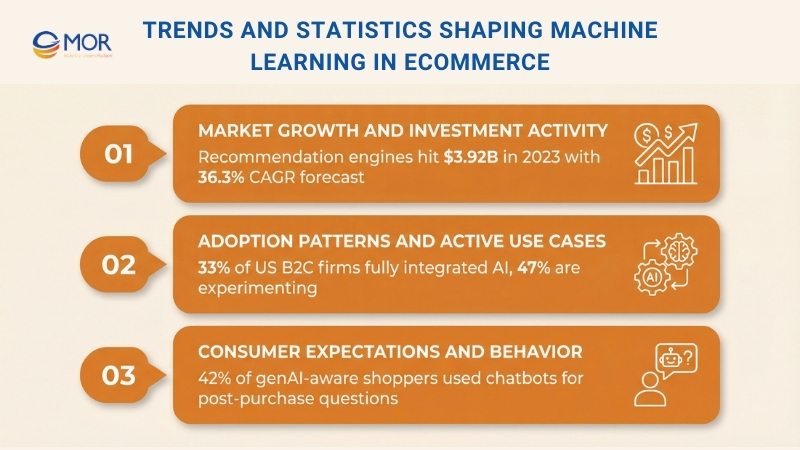
Market Growth And Investment Activity
The global recommendation engine market reached a value of $3.92 billion in 2023 and is projected to expand at a 36.3% CAGR from 2024 to 2030, with retail and ecommerce representing the largest share. This rapid expansion reflects how intelligent product recommendation engines are reshaping the advertising landscape and digital sales strategies.
Around 20% of ecommerce innovation leaders now rank generative AI as a top investment priority. Close to 30% of them intend to allocate more than 10% of their ecommerce budget to generative AI initiatives over the next year.
Global retail expenditure on chatbots is forecast to reach $72 billion by 2028, highlighting the growth of automated personalization technology across online stores.
Retail and ecommerce contribute 21% of the global conversational AI market, showing the strong role of AI-powered retail systems in digital commerce.
Adoption Patterns And Active Use Cases
Adoption of machine learning in ecommerce is no longer limited to large enterprises. Many mid-sized and growing retailers are testing predictive analytics for online stores to improve operations and customer engagement.
- 33% of B2C organizations in the United States have fully integrated AI technologies into their ecommerce processes, while another 47% report that they are experimenting with such tools.
- Retailers currently invest most in personalized product recommendations (47%), conversational AI solutions (36%), and adaptive advertising, promotions, and pricing strategies (28%) according to this report.
- By 2025, the top 10 global retailers are expected to use AI to facilitate prescriptive product recommendations, support transactions, and position inventory closer to customers for faster delivery.
- 34% of retailers have deployed AI in at least one operational area, with common applications including demand forecasting, personalization, chat systems, and threat detection.
- Generative AI-driven conversational commerce can lower customer service expenses by about 30% while increasing revenue through more tailored shopping journeys and more efficient digital marketing and sales efforts.
Consumer Expectations And Behavior
Customer expectations continue to shape how machine learning in ecommerce evolves. Shoppers increasingly prefer intelligent support tools that respond quickly, personalize interactions, and explain their recommendations clearly.
- 42% of consumers who are familiar with generative AI in online shopping have used chatbots to handle post-purchase questions. Other frequent applications include personalized loyalty programs and automatically generated product review summaries.
- Around six in ten US consumers believe ecommerce chatbots save time because they are available at any hour. An additional 45% value instant responses to their inquiries.
- 44% of surveyed shoppers appreciate chatbot assistance when searching for product information before making a purchase.
- 66% of US respondents expressed strong interest in trying GenAI-driven conversational commerce, which could potentially double usage of this channel.
- More than 80% of retail customers prefer conversational AI tools that clearly explain why specific products are recommended, highlighting the demand for transparency similar to what users expect from the best marketing planning software platforms. This push for transparency is closely tied to interpretability in machine learning.
Building Production-Ready ML For Ecommerce With MOR Software
Machine learning in ecommerce only creates value when it works inside real systems. That means live data, real users, and real business pressure. This is where MOR Software comes in.
MOR Software helps ecommerce teams move machine learning from ideas and experiments into production environments. We focus on the parts that usually block progress, fragmented data, legacy platforms, and complex integrations. Our teams connect ecommerce platforms with CRM, ERP, POS, and analytics tools, then prepare clean, usable data that machine learning models can actually rely on. Our generative AI integration services also help connect LLM-based assistants with your ecommerce data and workflows.
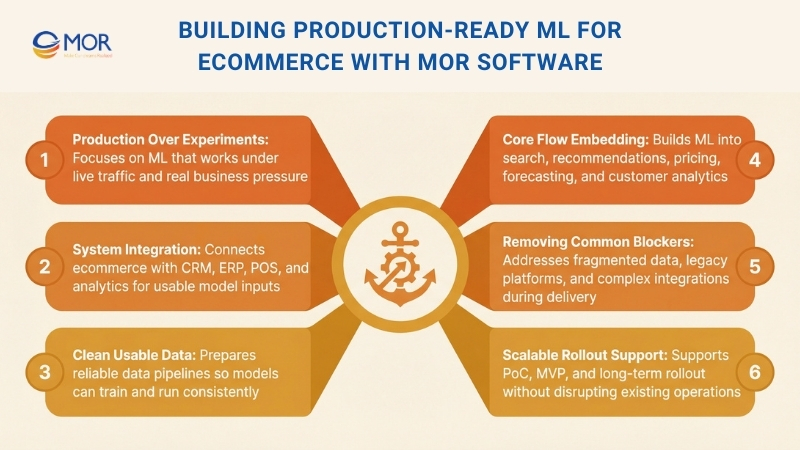
Instead of building isolated AI features, MOR Software integrates machine learning directly into core ecommerce flows. That includes search, recommendations, pricing logic, inventory forecasting, and customer analytics. The goal is simple. Make machine learning practical, measurable, and scalable.
By supporting projects from early PoC to MVP and long-term rollout, MOR Software helps businesses adopt machine learning in ecommerce without overcommitting budget or disrupting existing operations.
Conclusion
Machine learning in ecommerce is no longer experimental. It now drives personalization, pricing, fraud prevention, logistics, and customer retention across modern online stores. Businesses that invest in predictive models and automated personalization technology gain faster decisions and measurable growth. The opportunity is clear, but execution matters. If you are ready to apply machine learning to your ecommerce strategy, contact MOR Software to discuss a tailored solution built for your business goals.
"Evolution is not a destination, it is a disciplined journey of innovation."
Phung Van Tu


CEO MOR AI
MOR SOFTWARE
Frequently Asked Questions (FAQs)
What is machine learning in ecommerce?
Machine learning in ecommerce refers to using data-driven models to predict, automate, and personalize shopping experiences. These models learn from customer behavior, transactions, and product data to improve decisions over time.
How is machine learning different from traditional ecommerce automation?
Traditional automation relies on fixed rules set in advance. Machine learning adapts continuously by learning from new data, which allows systems to respond to changing customer behavior and market conditions.
What data is required to apply machine learning in ecommerce?
Common data sources include browsing behavior, purchase history, search queries, product attributes, customer profiles, and inventory records. Higher data quality usually leads to better model performance.
Which ecommerce features benefit most from machine learning?
Product recommendations, site search, demand forecasting, pricing adjustments, fraud detection, and customer segmentation often see the fastest gains when machine learning is applied correctly.
Is machine learning in ecommerce only for large enterprises?
No. Smaller ecommerce businesses can start with focused use cases like recommendations or search optimization, then expand gradually as data volume and operational needs grow.
How long does it take to see results from machine learning in ecommerce?
Timelines vary by use case. Some applications, like personalized recommendations or search improvements, can show measurable results within weeks. More complex use cases may take several months.
What are the main challenges when adopting machine learning in ecommerce?
Common challenges include poor data quality, integration complexity, high initial costs, and difficulty scaling models as the business grows.
Does machine learning replace human decision-making in ecommerce?
No. Machine learning supports decision-making by handling large volumes of data and identifying patterns. Human oversight is still needed to guide strategy, validate results, and manage edge cases.
How is machine learning used to improve customer experience?
Machine learning enables personalized product suggestions, faster search results, relevant promotions, and proactive customer support, all based on individual behavior and preferences.
Is machine learning in ecommerce secure and privacy-friendly?
It can be, when implemented with proper data governance, security controls, and compliance with privacy regulations. Responsible data handling is essential for long-term success.
Share


Make Our-Dreams Realized


© 2023 . MOR Software. All Rights Reserved
Sitemap
Privacy Policy
Terms of Use

Rate this article
0
over 5.0 based on 0 reviews
Your rating on this news:
Name
*Email
*Write your comment
*Send your comment
1