


How to Find the Right Salesforce Nonprofit Consultant in 2026?
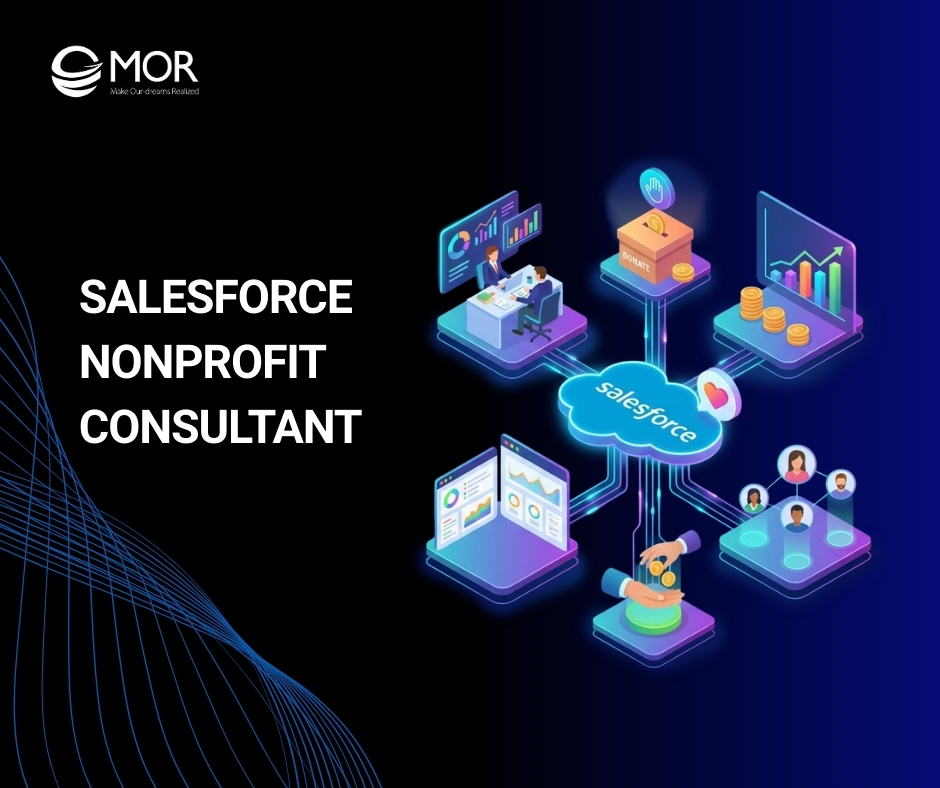
Finding the right Salesforce nonprofit consultant is no longer a simple technical decision. Many nonprofits struggle with low adoption, rising costs, and systems that never quite fit their mission. This guide of MOR Software will show how Salesforce consulting for nonprofits really works in 2026, what to watch out for, and how to avoid costly mistakes before they slow you down.
Key Takeaways
- A Salesforce nonprofit consultant helps nonprofits plan, configure, customize, and improve Salesforce for fundraising, program management, reporting, and donor engagement.
- The right consultant should offer more than technical setup. They should support discovery, data migration, automation, integration, staff training, and long-term system improvement.
- Nonprofits should choose a Salesforce consulting partner based on nonprofit experience, NPSP or Nonprofit Cloud knowledge, delivery process, communication style, references, and post-launch support.
Why Nonprofits Hire A Salesforce Nonprofit Consultant
Many nonprofits rely on Salesforce to manage donors, fundraising activities, program delivery, volunteer engagement, and reporting. However, without the right strategy and configuration, organizations may struggle to connect data, streamline workflows, and gain meaningful insights. A Salesforce nonprofit consultant helps ensure the platform is aligned with operational needs and mission objectives.
The need for expert Salesforce support continues to grow as nonprofits become more data-driven. According to Salesforce’s Nonprofit Trends Report, many nonprofit organizations are increasing investments in digital tools to improve fundraising performance, stakeholder engagement, and operational efficiency. As technology ecosystems become more complex, consultants play a critical role in helping organizations maximize the value of their CRM investment.
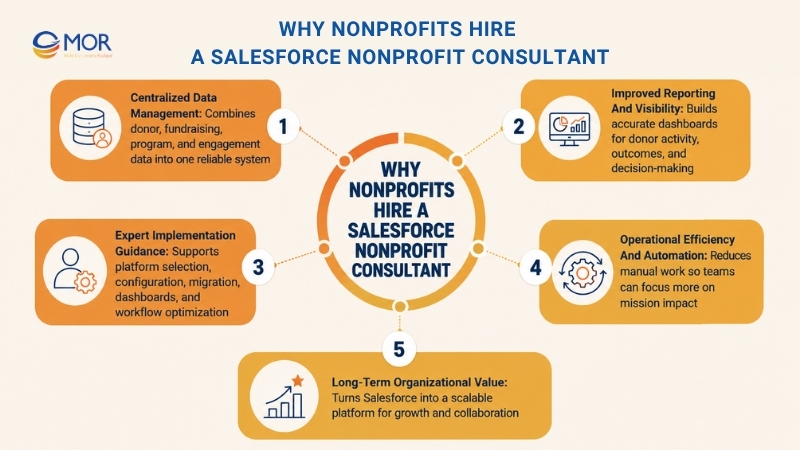
Centralized Data Management
A Salesforce nonprofit consultant helps consolidate information from spreadsheets, donor databases, email marketing tools, fundraising platforms, and program management systems into a single source of truth. Research from Salesforce indicates that organizations using integrated CRM systems can significantly improve data accessibility and collaboration across teams.
Improved Reporting And Visibility
When systems are disconnected, organizations often face challenges tracking donor engagement, measuring program outcomes, and generating accurate reports. Consultants create structured Salesforce environments that support reliable reporting and informed decision-making. According to Salesforce research, 72% of nonprofit leaders say data and analytics are important for achieving their mission, highlighting the need for accurate reporting systems.
Expert Implementation Guidance
Salesforce implementations can become complex without proper planning. Consultants assist with selecting between NPSP and Nonprofit Cloud, configuring fundraising processes, migrating data, building dashboards, and optimizing workflows.
Operational Efficiency And Automation
By designing workflows and automating repetitive tasks, consultants help nonprofits reduce manual work, improve team productivity, and strengthen stakeholder relationship management. Automation can free staff from administrative tasks, allowing more time to focus on fundraising, program delivery, and community impact.
Long-Term Organizational Value
With the right consultant, Salesforce becomes more than a CRM database. It evolves into a strategic platform that supports growth, enhances collaboration, and helps nonprofits achieve their mission more effectively. By aligning technology with organizational goals, consultants help nonprofits build scalable systems that support sustainable growth and measurable outcomes.
>>> Explore why hire salesforce consultants and how to choose the right partner.
Salesforce Nonprofit Consultant Services For Nonprofits
A strong Salesforce consulting for nonprofits should provide services that support the full CRM journey, from planning to post-launch improvement. Before choosing a partner, nonprofits should understand what support they actually need.
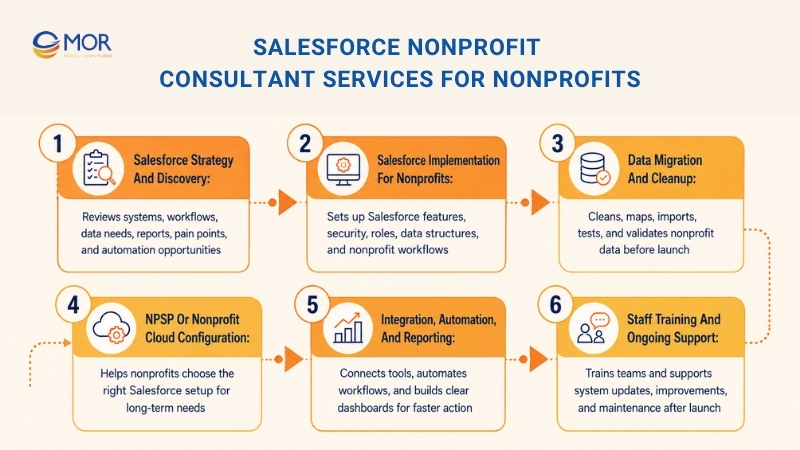
Salesforce Strategy And Discovery
The first step is understanding how the organization works. A consultant reviews current systems, data sources, fundraising processes, program workflows, reporting needs, and staff pain points.
This stage helps answer important questions:
- What problems should Salesforce solve?
- Which teams will use the platform?
- What data needs to be moved into Salesforce?
- What reports and dashboards are required?
- Which manual tasks can be automated?
- Which tools need to connect with Salesforce?
A clear discovery process helps avoid building a system that looks good technically but does not match daily operations.
Salesforce Implementation For Nonprofits
Salesforce implementation covers the core setup of the platform. This may include license planning, system configuration, user roles, permissions, security settings, data structure, and nonprofit-specific features.
For nonprofits using Salesforce Nonprofit Cloud, implementation may also include features for fundraising, program management, case management, outcome tracking, and stakeholder engagement.
For organizations using NPSP, the consultant may configure donor records, household accounts, relationships, donations, campaigns, rollups, and fundraising reports.
The goal is to build a Salesforce environment that is clean, usable, and aligned with the organization’s mission.
Data Migration And Cleanup
Many nonprofits move to Salesforce from spreadsheets, legacy systems, donor platforms, or disconnected internal tools. Data migration is one of the most important parts of the project because poor data can affect reporting, donor management, and team adoption.
A Salesforce nonprofit consultant can help with:
- Reviewing existing data quality
- Removing duplicate records
- Mapping fields from old systems to Salesforce
- Cleaning donor, program, and contact records
- Testing sample imports before full migration
- Validating migrated data after launch
Good data migration helps nonprofits start with a stronger foundation and avoid future reporting problems.
NPSP Or Nonprofit Cloud Configuration
Nonprofits often need guidance when choosing between Salesforce NPSP and Nonprofit Cloud. Each option has different strengths, data models, features, and long-term considerations.
A consultant can help nonprofits compare both options based on:
- Fundraising needs
- Program management requirements
- Reporting goals
- Existing Salesforce setup
- Team size and technical skill
- Integration needs
- Budget and timeline
This support is important because the wrong setup can create extra customization work, adoption problems, or future migration challenges.
Integration, Automation, And Reporting
Salesforce becomes more useful when it connects with other tools and reduces manual work. A consultant can support integrations with email marketing tools, donation platforms, finance systems, websites, event tools, or third-party apps.
They can also build automation for common nonprofit workflows, such as donor follow-ups, task reminders, grant tracking, volunteer coordination, or program updates.
Reporting is another key service. Nonprofits often need dashboards for:
- Fundraising performance
- Donor engagement
- Campaign results
- Program outcomes
- Case management
- Volunteer activity
- Leadership and board reporting
Clear dashboards help teams see what is happening and take action faster.
Staff Training And Ongoing Support
A successful Salesforce project does not end at launch. Staff need training, documentation, and support to use the system confidently.
A Salesforce nonprofit consultant can provide role-based training for fundraising teams, program staff, leadership, administrators, and operations teams. This helps each team understand the parts of Salesforce they use most.
Ongoing support may also include system updates, new feature rollout, user support, automation improvements, dashboard changes, and integration maintenance.
For many nonprofits, this long-term support is what keeps Salesforce useful after the first implementation.
When Should Your Nonprofit Hire A Salesforce Consultant?
Not every nonprofit needs a consultant at the same stage. However, hiring one becomes valuable when Salesforce affects important operations, reporting, or donor relationships.
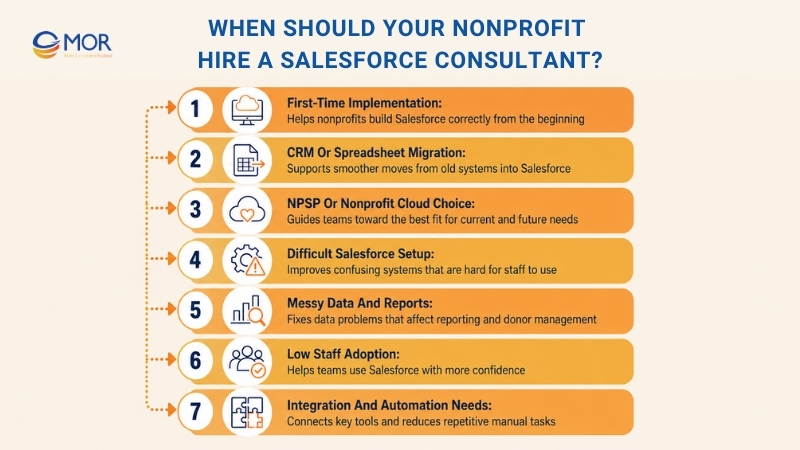
Your nonprofit should consider working with a Salesforce nonprofit consultant when:
- You are implementing Salesforce for the first time
- You are moving from spreadsheets or another CRM
- Your team is choosing between NPSP and Nonprofit Cloud
- Your current Salesforce setup is hard to use
- Your donor or program data is messy
- Staff adoption is low
- Reports are inaccurate or difficult to build
- You need integrations with donation, finance, email, or program tools
- You want to automate manual tasks
- You need long-term Salesforce support
Hiring a consultant early can help prevent costly mistakes. Instead of fixing problems after launch, nonprofits can build a stronger system from the beginning.
What To Look For In A Salesforce Nonprofit Consultant
Choosing the right consultant is a commercial decision, not just a technical one. The right partner should understand your mission, your team, and your long-term goals.
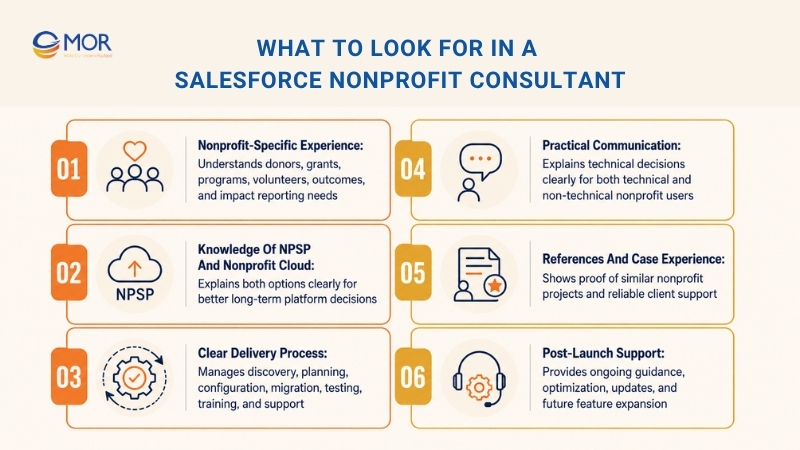
Nonprofit-Specific Experience
A general Salesforce consultant may understand the platform, but nonprofit work has different needs. Nonprofits manage donors, grants, programs, volunteers, outcomes, and impact reports. The consultant should understand these use cases clearly.
Ask whether the consultant has worked with organizations similar to yours. Look for experience in fundraising, donor management, program tracking, case management tools, or impact reporting.
Knowledge Of NPSP And Nonprofit Cloud
The consultant should understand both Salesforce NPSP and Salesforce Nonprofit Cloud. This helps your organization make a better decision about which solution fits your current needs and future plans.
They should be able to explain the difference in simple terms, including data model, features, migration effort, reporting, integrations, and long-term maintenance.
Clear Delivery Process
A strong Salesforce consultants for nonprofits should have a clear process for discovery, planning, configuration, migration, testing, training, and post-launch support.
Before hiring, ask how they manage timelines, collect requirements, communicate updates, handle feedback, and measure project success. A clear process reduces confusion and helps your team stay aligned during implementation.
Practical Communication
Salesforce projects often involve both technical and non-technical users. The consultant should explain decisions clearly so your staff can understand what is being built and why it matters.
Good communication also helps prevent scope issues, training gaps, and adoption problems.
References And Case Experience
References help confirm whether the consultant delivers what they promise. Ask for examples of similar projects or feedback from past nonprofit clients.
Useful questions include:
- Did the consultant understand nonprofit workflows?
- Was the project delivered on time?
- Was communication clear?
- Did staff feel supported after launch?
- Did the final Salesforce setup solve real problems?
Post-Launch Support
Nonprofits should ask what happens after implementation. Salesforce needs updates, improvements, and support as teams grow or processes change.
A good consultant should offer options for continued support, system optimization, admin guidance, and future feature expansion.
>>> Let's break down key factors influencing salesforce consultant hourly rate to help your business make informed financial decisions and maximize its investment.
Key Questions To Ask A Salesforce Nonprofit Consultant Before Hiring
Choosing the right specialist goes beyond basic technical skills. For nonprofits comparing the best Salesforce consulting firms for nonprofits, asking the right questions helps confirm whether this role truly fits your organization and whether the partnership will work well over time.
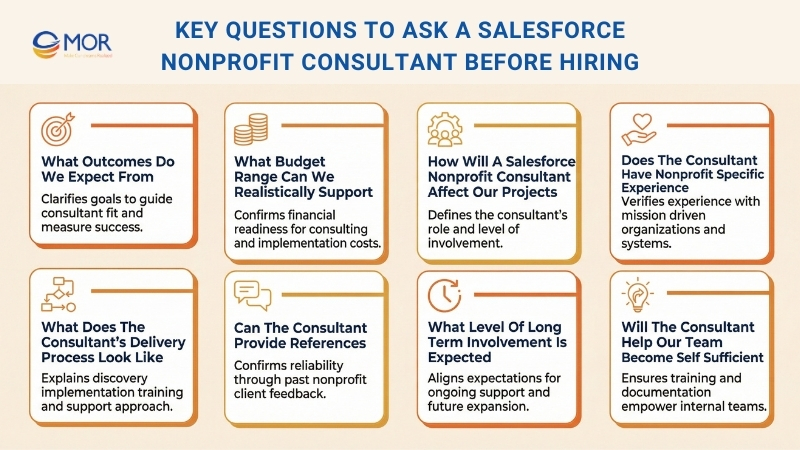
What Outcomes Do We Expect From Salesforce?
Without clear objectives, it becomes difficult to decide whether working with a Salesforce advisor for mission-driven organizations is even necessary. Take time to define what you want to achieve after adopting Salesforce, including qualitative goals like better personalization and broader platform usage, as well as measurable targets such as expected growth, timelines, and team size. Clarifying these outcomes is the first and most important step when engaging a nonprofit Salesforce consultant, and it often determines whether you select the right professional for your needs.
What Budget Range Can We Realistically Support?
Working with Salesforce nonprofit consulting often requires a meaningful investment, so defining a clear budget before reviewing options is critical. Several elements affect this budget, including:
- Salesforce NPSP deployment costs
- Third-party tools required for integration
- Consulting and advisory fees
Beyond the standard Salesforce subscription, CRM adoption involves additional expenses. To confirm that this role fits your financial capacity, review consulting costs that vary by project scope, implementation fees that depend on user count, and integration costs that may arise when connecting third-party apps from AppExchange.
How Will A Salesforce Nonprofit Consultant Affect Our Projects?
It is important to understand what kind of support you expect from the consultant before starting the search. During early discussions, this specialist may ask questions to confirm whether they are a good fit for your needs. Salesforce consultants for nonprofits bring different skills and areas of focus, and they can contribute in many ways. One professional may focus on advanced website work and CRM integrations, while another may concentrate on Salesforce nonprofit training and ongoing support.
To ask the right questions, review how well your current technology approach performs. If Salesforce is not yet in place, assess whether your existing system supports your mission and how many users depend on it. Also clarify your goals for Salesforce, which features matter most, where you need the strongest support, how detailed training should be, and whether your organization is ready to engage a Salesforce implementation specialist for nonprofits.
Does The Consultant Have Nonprofit-Specific Experience?
Consultants come with varied backgrounds and areas of expertise. During the hiring process, ask about the projects they have delivered and how those efforts connect to your organization’s objectives. Questions around experience help reveal which technologies they know best. While Salesforce knowledge is expected, it also matters which other platforms they have worked with, especially when data migration or multi-system integration is part of your plan. Learning about the types of organizations they have supported and the projects they have completed can show whether their focus and values align with your mission. The right Salesforce nonprofit consultant should clearly understand how to guide your nonprofit toward its goals.
What Does The Consultant’s Delivery Process Look Like?
This question helps you find a consultant whose approach to salesforce implementation and customization matches your organization’s needs. Start by asking about their discovery and evaluation process. The consultant should understand your current workflows and Salesforce requirements. During interviews, ask how they decide whether a project fits their expertise and how they plan to support your organization.
It is also important to consider timing. Ask how soon the consultant can begin the project and whether this schedule aligns with your planned timeline. In addition, discuss training methods. Clarify if they remain involved after launch to resolve technical issues and train staff, whether training is delivered on site or remotely, and if sessions are tailored for individuals or conducted with the full team.
Can The Consultant Provide References?
Many consultants may appear suitable at first glance. Asking for references helps confirm whether they delivered on their commitments and supported nonprofits effectively. Reach out to their previous nonprofit clients and ask about the level of involvement throughout the project. This helps you understand how engaged the consultant is likely to be in future work and whether their working style matches your expectations. Also ask if projects were completed on schedule and whether the organizations were satisfied with the final results. These insights help determine if the consultant is a strong match for your organization.
What Level Of Long-Term Involvement Is Expected?
Revisit your long-term goals and consider whether you want the consultant to remain involved beyond the initial project. If you plan additional integrations or future system expansion, ask what role they expect to play as your technology evolves. It is also important to discuss post-project communication. When your Salesforce setup is tailored to your organization, continued support may be necessary even after the main work is finished. Clarify how long they are willing to stay engaged and what communication methods they support, so expectations align on both sides after the project concludes.
Will The Consultant Help Our Team Become Self-Sufficient?
The consultant should focus on strong processes by reviewing your current workflows, recommending ways to improve operations, and sharing proven practices that support growth. Clear documentation also matters. Well-prepared guides and records allow your team to solve minor issues independently without reaching out for help each time. Staff engagement is equally important. The right specialist helps teams feel confident using technology and encourages open questions throughout the collaboration.
When evaluating a Salesforce nonprofit consultant, these questions play a key role in making the right choice. They help confirm that you receive dependable support and real value from the partnership. Salesforce supports organizations that aim to create positive change, and experienced nonprofit Salesforce consulting partners share that commitment. With clear communication and patience, teams can gain a solid understanding of how Salesforce supports their mission and community goals.
Salesforce Nonprofit Consultant Cost Factors
The cost of hiring a Salesforce nonprofit consultant varies based on the scope of work, the complexity of your Salesforce environment, and the level of ongoing support required. According to Salesforce consulting market rates and nonprofit implementation benchmarks, most Salesforce consultants charge between $100 and $250 per hour, while specialized Salesforce nonprofit consulting partners may charge $150 to $300+ per hour depending on expertise and certifications. For nonprofits, total project costs can range from a few thousand dollars for basic setup to more than $100,000 for enterprise-level implementations involving multiple integrations, custom development, and extensive data migration.
The table below provides typical cost ranges nonprofits can expect when working with a Salesforce nonprofit consultant:
Cost Factor | Typical Cost Range (USD) | Notes |
Salesforce Consultant Hourly Rate | $100–$250/hour | Independent consultants and smaller consulting firms |
Specialized Nonprofit Salesforce Consultant | $150–$300+/hour | Consultants with deep nonprofit, NPSP, or Nonprofit Cloud expertise |
Basic Salesforce Setup & Configuration | $3,000–$10,000 | Suitable for small nonprofits with limited customization |
NPSP Implementation | $5,000–$25,000 | Includes donor management setup, fundraising workflows, and reporting |
Nonprofit Cloud Implementation | $15,000–$75,000+ | More advanced implementation with broader nonprofit functionality |
Data Migration | $2,000–$20,000+ | Depends on data volume, quality, and source systems |
Third-Party Integrations | $1,500–$15,000+ per integration | Examples include donation platforms, accounting systems, and marketing tools |
Custom Automation & Workflows | $2,000–$25,000+ | Based on complexity and business requirements |
Reporting & Dashboard Development | $1,000–$10,000 | Executive dashboards, fundraising reports, and impact tracking |
Staff Training | $500–$5,000+ | Varies by team size and training format |
Ongoing Salesforce Support | $500–$5,000+ per month | Managed services, enhancements, and user support |
Several factors influence the final project budget, including the number of users, Salesforce edition and licensing requirements, NPSP or Nonprofit Cloud configuration needs, data migration complexity, integration requirements, reporting demands, automation scope, training needs, project timeline, and post-launch support expectations. In some cases, nonprofits may also work with a broader Salesforce consulting firm that serves as a Salesforce sales cloud implementation partner, especially when the organization requires both nonprofit CRM capabilities and sales-oriented processes for sponsorships, partnerships, or revenue-generating initiatives.
For example, a small nonprofit implementing Salesforce for donor management may spend between $5,000 and $15,000. A mid-sized organization requiring data migration, integrations, automation, and custom reporting may invest between $20,000 and $60,000. Large nonprofits or multi-program organizations with complex requirements can spend $75,000 to $150,000 or more on a full Salesforce transformation project.
Rather than focusing solely on the lowest price, nonprofits should evaluate the consultant's nonprofit experience, implementation methodology, support capabilities, and long-term value. A well-planned Salesforce implementation often reduces operational costs, improves fundraising efficiency, and delivers a stronger return on investment over time.
Common Challenges When Working With A Salesforce Nonprofit Consultant
Even with the right partner in place, nonprofits may face obstacles during implementation and long-term use. Understanding these challenges early helps organizations plan more effectively and reduce risk.
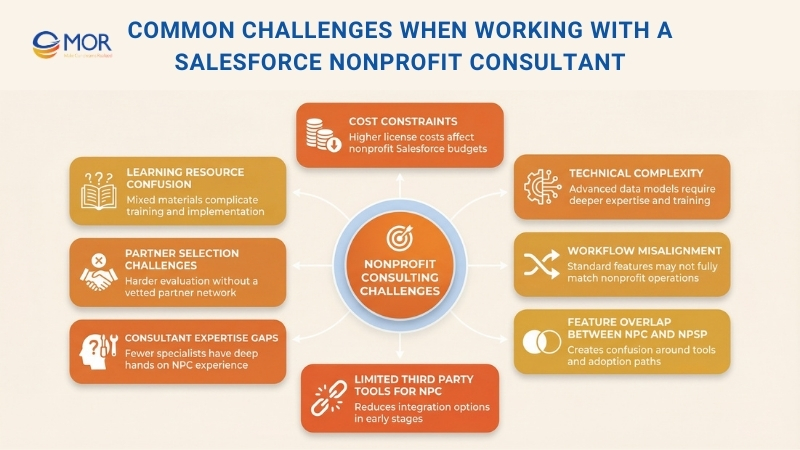
Cost Constraints
With the release of Nonprofit Cloud (NPC), the base price of Salesforce Enterprise Edition licenses has increased, which makes Salesforce for nonprofits less affordable for some organizations. Although Salesforce continues to provide ten free NPC licenses, similar to the NPSP model, the higher cost of additional licenses can place pressure on the budgets of Salesforce nonprofit partners.
Solution: Nonprofits can look into Salesforce grant programs, available discounts, and thoughtful license planning to manage costs more effectively.
Technical Complexity
NPC is more complex than earlier solutions like NPSP. It uses a more advanced data model and technical structure that requires stronger expertise to set up and maintain. For many nonprofits, especially smaller teams or those with limited technical resources, this complexity can be difficult to manage and may require extra training or support. Working with a Salesforce nonprofit consultant can help address these challenges, though it may increase overall project costs.
Solution: Investing in Salesforce nonprofit training or partnering with experienced Salesforce consultants for nonprofits can help close skill gaps and reduce technical risk.
Workflow Misalignment
Although NPC was built using features adapted from other industries to speed up its release, these capabilities do not always align with how nonprofits operate in practice. This gap can require extra customization or temporary workarounds, which adds complexity to the Salesforce for nonprofits experience.
Solution: Tailored configurations and custom automation help adjust NPC to match specific nonprofit workflows.
Feature Overlap Between NPC And NPSP
With newer options like NPC existing alongside older solutions such as NPSP, organizations may face confusion around product updates, support materials, community forums, Independent Software Vendor applications, consulting services, and required staff skills.
Solution: Nonprofits should review both solutions carefully and create a clear adoption plan before moving forward.
Limited Third-Party Tools For NPC
Since NPC is still relatively new, fewer third-party vendors currently provide applications that support it compared to those built for NPSP. This situation can reduce the number of available integrations within Salesforce CRM for nonprofits.
Solution: Prioritize native Salesforce features while keeping a shortlist of preferred integrations for future rollout as more compatible tools become available.
Consultant Expertise Gaps
Because NPC is a newer solution, there are fewer professionals with deep experience compared to the long-established NPSP ecosystem. In addition, the Salesforce nonprofit cloud consultant certification has not yet fully evolved to cover NPC in detail. This makes it harder to find a Salesforce nonprofit consultant with current, hands-on expertise in the latest nonprofit products.
Solution: Invest in internal Salesforce nonprofit training and Salesforce NPSP certification paths to grow in-house skills while working with experienced implementation partners.
Partner Selection Challenges
Salesforce’s decision to remove its vetted nonprofit partner network means organizations must use other methods to assess and select partners. This change makes the evaluation process more complex, especially for teams without prior Salesforce experience.
Solution: Nonprofits can depend on peer referrals, community feedback, and independent partner directories to identify trusted providers.
Learning Resource Confusion
Although learning materials for NPC are available, it can be difficult to separate content related to Salesforce NPSP from resources focused on Salesforce Nonprofit Cloud. This creates challenges when selecting accurate and relevant materials for training or implementation.
Solution: Rely on official Salesforce channels and verified nonprofit communities to access up-to-date and reliable information.
Why Choose MOR Software As Your Salesforce Nonprofit Consultant
Nonprofits need a Salesforce partner that understands both technology and real operations. A Salesforce nonprofit consultant should not only configure fields and dashboards. They should help your team build a system that supports fundraising, programs, reporting, and long-term growth.
MOR Software helps organizations plan, build, customize, integrate, and maintain Salesforce solutions based on practical business needs. For nonprofit teams, this means creating Salesforce systems that are clear, reliable, and easy to use.
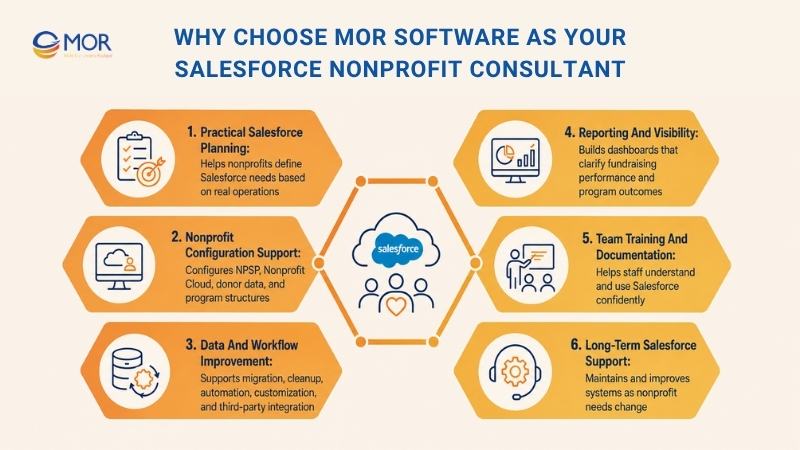
MOR Software can support nonprofits with:
- Salesforce consulting services
- NPSP and Nonprofit Cloud configuration
- Donor and program data structure
- Data migration and cleanup
- CRM customization
- Workflow automation
- Third-party system integration
- Reporting and dashboard setup
- Staff training and documentation
- Ongoing Salesforce support
MOR Software focuses on building systems that match how teams work every day. This approach helps nonprofits improve adoption, reduce manual tasks, and gain clearer visibility into fundraising and program outcomes.
If your nonprofit is planning a new Salesforce project or improving an existing setup, MOR Software can help you turn Salesforce into a practical platform for mission-driven work.
Conclusion
Choosing the right Salesforce nonprofit consultant shapes how well your organization uses Salesforce in the years ahead. The right partner helps teams avoid wasted effort, improve adoption, and build systems that truly support mission goals. With the right guidance, Salesforce becomes a tool your staff trusts and uses every day.
If you are planning your next Salesforce initiative, contact us to see how MOR Software can support your nonprofit with clarity, care, and long-term focus.
"Mr. Cong’s guiding philosophy is simplicity, believing that the simplest solutions are often the most powerful. He sees trust, empowerment, and the opportunity to demonstrate one’s abilities as the key elements that set MOR apart from traditional IT companies."
Mac Tien Cong


Division Manager (Hanoi Branch)
MOR SOFTWARE
Frequently Asked Questions (FAQs)
What does a Salesforce nonprofit consultant do?
A Salesforce nonprofit consultant helps nonprofits plan, configure, and maintain Salesforce so it supports fundraising, programs, and reporting. The role covers strategy, setup, customization, training, and ongoing improvements.
When should a nonprofit hire a Salesforce nonprofit consultant?
Many nonprofits hire a consultant during initial implementation, major system changes, or when adoption is low. Support is also useful when moving from NPSP to Nonprofit Cloud.
What is the difference between NPSP and Nonprofit Cloud?
NPSP is a legacy nonprofit data model built on Sales Cloud. Nonprofit Cloud is a newer, industry-focused solution with prebuilt features for programs, fundraising, and outcomes.
How long does a typical Salesforce nonprofit implementation take?
Smaller projects may take a few weeks. Larger implementations with data migration, integrations, and training often take several months.
How much does a Salesforce nonprofit consultant cost?
Costs vary based on scope, timeline, and complexity. Pricing often depends on configuration needs, integrations, and level of ongoing support.
Can a consultant help with data migration from another CRM?
Yes. Many consultants support data cleanup, mapping, testing, and migration from legacy systems or spreadsheets into Salesforce.
Will a consultant train nonprofit staff to use Salesforce?
Most consultants provide role-based training, documentation, and hands-on sessions so staff can manage Salesforce independently.
Does a Salesforce nonprofit consultant help with reporting and dashboards?
Yes. Consultants often build reports and dashboards that track fundraising performance, program outcomes, and operational metrics.
Is ongoing support required after implementation?
Not always, but many nonprofits choose ongoing support for system updates, new features, and process improvements.
How do nonprofits choose the right Salesforce nonprofit consultant?
Nonprofits usually evaluate experience with nonprofit use cases, understanding of NPSP or Nonprofit Cloud, communication style, and references from similar organizations.
Share


Make Our-Dreams Realized


© 2023 . MOR Software. All Rights Reserved
Sitemap
Privacy Policy
Terms of Use
Rate this article
0
over 5.0 based on 0 reviews
Your rating on this news:
Name
*Email
*Write your comment
*Send your comment
1