


SMART Information Retrieval System: Meaning, Models & How It Works

The smart information retrieval system began as a research project for finding relevant text automatically, yet its ideas still appear across search engineering today. Gerard Salton’s work at Harvard and Cornell shaped vector-space retrieval, term weighting, relevance feedback, and ranked results. In this MOR Software guide, we’ll trace how SMART worked, why its models mattered, and where its ideas still connect with modern search and AI.
Key Takeaways
- SMART turned documents and queries into weighted vectors so a system could rank results by similarity rather than rely on exact matches.
- Research around SMART helped establish vector-space retrieval, term weighting, relevance feedback, Rocchio methods, and systematic evaluation.
- Modern semantic search and RAG use different models, but they still depend on strong retrieval, ranking, data preparation, and measurable relevance.
What Is the SMART Information Retrieval System?
The smart information retrieval system stands for the System for the Mechanical Analysis and Retrieval of Text. It was built as an experimental environment for automatic text search, where documents could be indexed, compared with a query, scored, and returned in ranked order.
That goal matters because a classic database lookup expects known fields and exact conditions. A database information retrieval system may return a record because an ID, date, or field matches. SMART focused on a different problem: finding documents that are relevant even when the wording does not match perfectly.
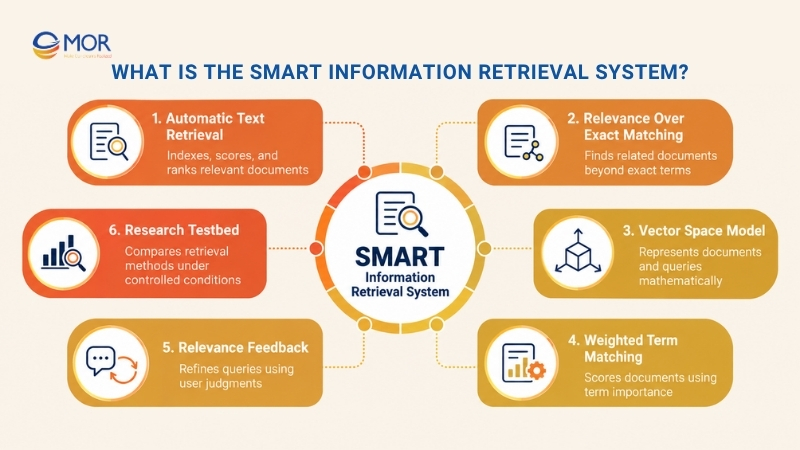
A useful definition of information retrieval is the process of finding material that best meets a user’s need inside a collection. SMART gave researchers a practical way to test that idea through document vectors, weighted terms, similarity scores, and user feedback. The system served as a research testbed where teams could compare retrieval methods under controlled conditions.
Take a simple example. A user may ask for papers about “aircraft wing design.” A useful document may instead use terms like “aerodynamic structures” or “airfoil construction.” Exact matching can miss that relationship. A ranked information retrieval system can assign scores across several terms and surface a document that is close enough to the request.
If you need an introduction to information retrieval, SMART is a strong starting point because many familiar concepts meet in one system. The vector space model represents documents mathematically. Relevance feedback adjusts a query after users judge results. Rocchio methods move the query toward relevant documents and away from poor matches.
SMART is also different from the vague phrase smart recovery information. The name refers to a specific historical research system, not a general label for any search tool that looks intelligent.
Who Created SMART Information Retrieval System
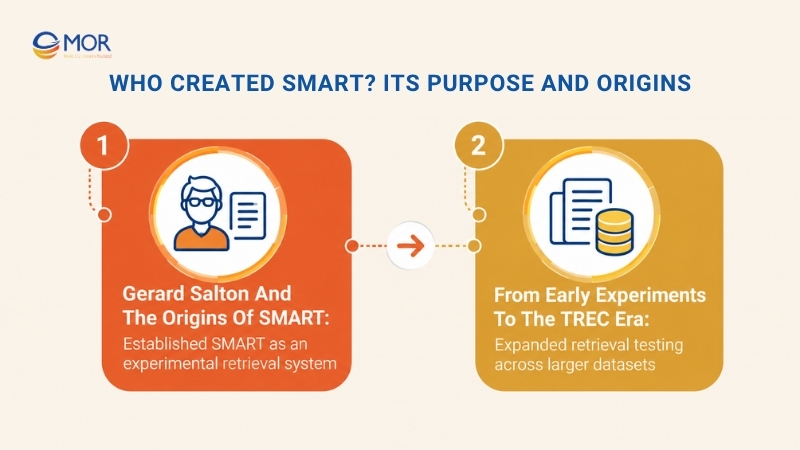
The SMART project began as an academic effort to improve how computers search and rank text. Led by Gerard Salton, the research moved from Harvard to Cornell and grew into a long-running program that tested new ideas in indexing, retrieval, relevance, and search evaluation.
Gerard Salton and the Origins of SMART
Gerard Salton led the research behind the smart information retrieval system. The work began at Harvard and later expanded at Cornell University, where Salton joined the newly formed computer science department and continued the project with researchers including Michael Lesk.
Cornell records that a grant in 1961 allowed Salton’s group to start SMART. The same university account says the project continued for 34 years and became one of the most widely used research tools in the field.
The timing explains its purpose. Computerized text collections were growing, but manual indexing could not scale well. Researchers needed methods that could represent documents, compare them with queries, and measure the usefulness of returned results.
SMART became that test environment. Teams could change a weighting rule, indexing method, or feedback method, then compare the retrieval result against reference judgments. That research mindset helped turn information retrieval into a field where methods could be tested rather than discussed only in theory.
From Early Experiments to the TREC Era
SMART did not stop after its first versions. Later releases incorporated new term-weighting schemes, relevance methods, query expansion, and evaluation routines. Version 12 appeared in Cornell’s work during the Text REtrieval Conference, or TREC, in the 1990s.
This long development cycle matters because search quality depends on repeated testing. A method that works on one small collection may behave differently on a larger or noisier one. SMART gave researchers a common system for running those comparisons across changing datasets and retrieval tasks.
How the SMART Information Retrieval System Works
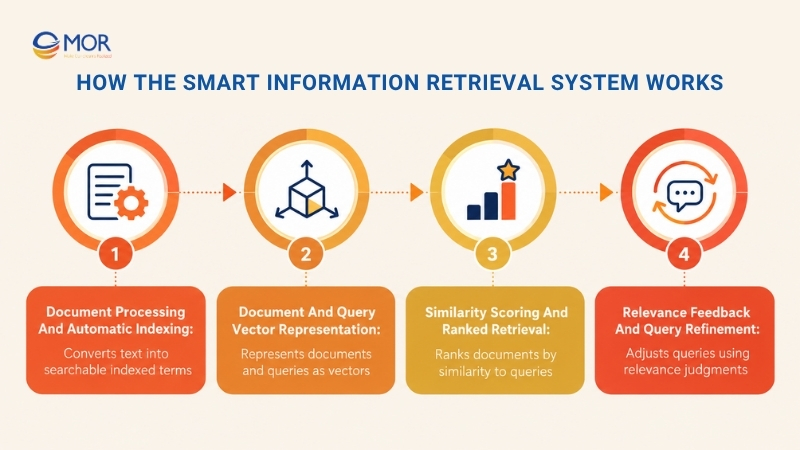
The smart information retrieval system follows a pipeline that still looks familiar to search engineers: process documents, represent them in a searchable form, process the query, calculate similarity, rank candidates, and adjust the query when feedback is available. That sequence captures the core information retrieval process without requiring an exact database match.
Document Processing and Automatic Indexing
SMART first converts raw text into terms that a machine can work with. The system identifies useful words, applies processing rules, and builds an index that links terms to documents. Term statistics then describe how strongly each term represents a document.
Automatic indexing shifted work away from manual subject labels. Instead of asking a person to classify every document, the system could create searchable representations from the text itself. This also made experiments easier to repeat across large collections.
In practical terms, work grouped under algorithms for search in informaaiton tretiveal includes token weighting, index construction, similarity scoring, and query refinement. SMART provided a place to test how changes in those operations affected ranking quality.
Document and Query Vector Representation
The vector space model represents each document as a vector. Every dimension corresponds to a term, and its value shows how much that term contributes to the document’s representation.
Queries receive a similar vector representation. Once the document and query sit in the same mathematical space, the system can compare them even when they are not identical. A small information retrieval system in python can reproduce the basic idea with a term-document matrix, TF-IDF weights, and cosine similarity.
Partial matching becomes possible here. A document can rank well because several important query terms align strongly, even if one term is missing. Boolean retrieval may remove that document when a strict condition fails.
Similarity Scoring and Ranked Retrieval
After vector creation, SMART measures how close each document is to the query. Cosine similarity became a common way to compare vector direction and limit the effect of raw vector size.
The output is a ranked list. Higher-scoring documents appear before weaker matches, so users do not have to inspect the whole collection. This ranked approach is one reason the smart information retrieval system remains useful when studying the roots of modern search relevance.
Relevance Feedback and Query Refinement
SMART could use user judgments after an initial search. A user marks documents as relevant or non-relevant, then the system adjusts the query vector to better reflect useful material.
Rocchio-style feedback captures the idea in geometric terms. The updated query moves closer to vectors from relevant documents and farther from vectors tied to poor results. Search becomes a cycle: retrieve, judge, reformulate, and retrieve again.
Core Innovations Introduced by the SMART Information Retrieval System
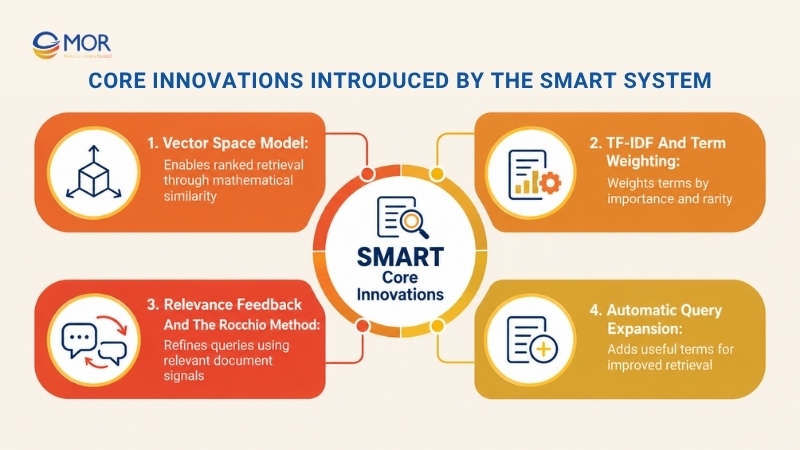
Research around the smart information retrieval system helped establish several ideas that became standard topics in IR courses and search engineering. The value came from putting those ideas into an experimental system where researchers could compare results across real collections.
Vector Space Model
The vector space model gives documents and queries a shared mathematical representation. It replaces a strict match/no-match view with degrees of similarity, which supports ranked retrieval.
A 1975 paper by Salton, Wong, and Yang described the vector space model for automatic indexing. The model gave researchers a practical way to compare text objects through weighted terms rather than handcrafted categories.
Its strength was flexibility. A team could keep the same vector model, change the weighting rule, and measure how the ranking changed. That made the model useful for controlled experiments rather than one fixed search recipe.
TF-IDF and Term Weighting
Term frequency asks how often a term appears in a document. Inverse document frequency asks how rare that term is across the collection. TF-IDF combines those signals so a word can receive weight based on local importance and collection-wide discrimination.
Salton and Chris Buckley reviewed two decades of experimental evidence on automatic term weighting and reported that appropriately weighted single terms produced strong retrieval results compared with more elaborate text representations.
This explains why raw word counts are not enough. A term that appears everywhere carries little power to separate one document from another. A rarer term tied closely to the query can carry more weight.
Relevance Feedback and the Rocchio Method
Relevance feedback uses judgments from an initial result set to reformulate the query. The system raises the influence of terms associated with relevant documents and weakens signals tied to poor matches.
Cornell’s 1988 technical report described relevance feedback as an automatic process that had already been studied for more than 20 years. It compared major methods and included evaluation data on retrieval performance.
The Rocchio method provides a practical rule for that update. It combines the original query with information from relevant and non-relevant document vectors.
Automatic Query Expansion
Query expansion adds useful terms that were not present in the first request. SMART research tested expansion methods based on relevant documents and collection statistics, giving later retrieval rounds more evidence.
Expansion can help when a query is short or uses different vocabulary from the source documents. Extra terms can also add noise, so the method must be measured against the target collection.
How SMART Triple Notation Represents Term Weighting
The smart information retrieval system used a compact notation to describe weighting choices for documents and queries. The pattern ddd.qqq separates the document scheme from the query scheme, so researchers can read the setup without spelling out every formula.
Each triplet has three positions. The first letter controls term-frequency treatment, the second controls document-frequency treatment, and the third controls normalization. Researchers could apply one scheme to documents and another to queries, then compare how the pair changed ranking quality.
Element | Represents | Purpose | Example |
First triplet | Document weighting | Sets weights for document vectors | ltc |
Second triplet | Query weighting | Sets weights for query vectors | lnn |
TF position | Term frequency | Changes how within-document frequency is counted | l |
IDF position | Collection frequency | Changes how collection rarity affects weight | t |
Normalization | Vector normalization | Controls the effect of vector length | c |
The letters act as shorthand. n usually means a natural or unchanged form, l points to logarithmic term-frequency weighting, t represents an IDF-style collection weight, and c marks cosine normalization. Other letters can describe other choices, which gave researchers many combinations to test without inventing a new naming scheme each time.
Take ltc.lnn. The document side uses logarithmic term frequency, an IDF component, and cosine normalization. The query side uses logarithmic term frequency, no collection-frequency adjustment, and no normalization. That difference is intentional: document and query vectors do not need identical weighting rules.
Suppose a document repeats one query term 20 times. A raw frequency scheme can let that term dominate the vector. Log weighting compresses the gap between 20 mentions and a smaller count, so repetition does not grow linearly. IDF then gives more weight to terms that separate documents across the collection.
The notation made experiments easier to report. A paper could state the weighting pair, rerun the same collection with another pair, and compare precision or recall. For modern readers, SMART notation also gives a compact map of the decisions hidden inside a TF-IDF retrieval setup. It also makes old research papers easier to read because the weighting choices are visible at a glance.
SMART Test Collections and Retrieval Evaluation
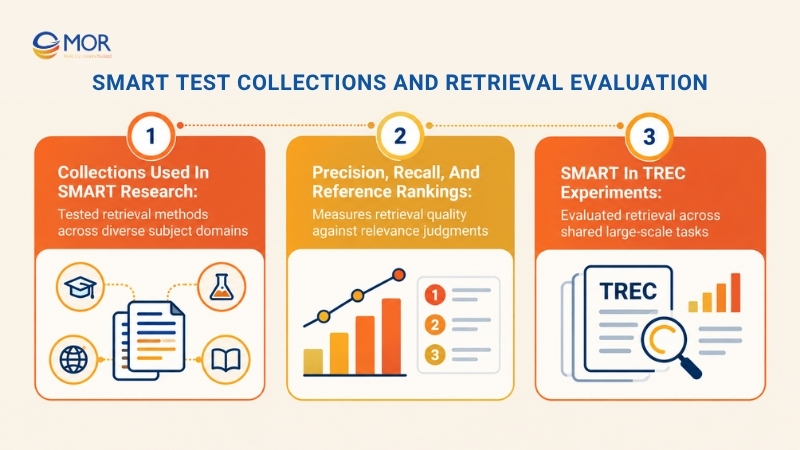
A retrieval model means little if researchers cannot test it against known relevance judgments. The smart information retrieval system included collections, queries, and reference rankings that supported controlled evaluation across different subjects.
Collections Used in SMART Research
SMART research drew on several well-known collections, including ADI material in information science, CACM material in computer science, the Cranfield aeronautics collection, CISI library-science records, MEDLARS medical material, and a Time magazine archive.
The mix mattered. A weighting scheme that performs well on one vocabulary may behave differently in medicine, aeronautics, or general news. Different collections gave researchers a better view of retrieval stability across domains.
Precision, Recall, and Reference Rankings
Precision measures how much of the retrieved material is relevant. Recall measures how much of the relevant material in the collection was successfully retrieved. Together, they help distinguish a useful ranking from one that simply returns many documents.
Reference judgments provide the comparison point. A team can change a term weight, feedback rule, or query expansion method, then check how the evaluation numbers move. The same discipline still matters when teams test embeddings, rerankers, or hybrid retrieval today.
SMART in TREC Experiments
SMART later appeared in TREC, where teams tested systems on larger shared tasks. In TREC-4, Cornell’s SMART team ran experiments across routing, ad-hoc, confused-text, interactive, and foreign-language environments.
That breadth pushed evaluation beyond one clean query-and-document setup. Systems had to deal with noisy text, language differences, interactive behavior, and routing tasks. Results still had to remain measurable against shared test conditions.
That common setup gave teams a fairer basis for comparing retrieval methods. Shared topics and relevance judgments also made results easier to reproduce across participating systems.
SMART vs Modern Information Retrieval Systems
The smart information retrieval system belongs to an earlier generation of search technology, but several design questions remain familiar. Modern systems still need a document representation, a query representation, a matching method, a ranking rule, and an evaluation set. The answers now include methods that SMART never had.
Dimension | SMART | Modern IR Systems |
Representation | Sparse term vectors | Sparse vectors, dense embeddings, or hybrid representations |
Ranking | Vector similarity and term weighting | BM25, learned ranking, neural rerankers, hybrid search |
Feedback | Explicit relevance judgments | Explicit feedback plus clicks, behavior, and model signals |
Semantics | Mainly lexical and statistical | NLP and embedding-based semantic matching |
Output | Ranked documents | Documents, passages, direct answers, or RAG input |
Modern types of information retrieval systems often mix several retrieval stages. A search engine may start with BM25 to retrieve exact terminology, add dense vectors to find semantically close passages, apply metadata filters for permissions or freshness, then rerank the best candidates with a learned model.
Dense embeddings also change representation. Instead of assigning one dimension to each visible term, an embedding model maps text into a dense numerical space learned from data. Similar ideas can be applied to queries, documents, images, or mixed content. This supports matches where two texts express related meaning with different words.
RAG adds generation after retrieval. The retriever selects passages, a reranker can reorder them, and a large language model uses selected text to form an answer. Teams planning this kind of system need a clear AI implementation planning process before choosing chunking rules, vector databases, rerankers, access controls, and evaluation metrics.
Modern systems also face production concerns that were less central to early laboratory setups. Freshness, document permissions, latency, monitoring, and source traceability can affect search usefulness in real work.
The connection to SMART is conceptual, not architectural. Dense embeddings and LLMs were not part of SMART. Yet representation, matching, ranking, feedback, and measurement still sit at the center of retrieval engineering.
The models changed, but search teams still have to decide what to index, how to score it, and how to test the result.
Why the SMART System Still Matters for Search and AI
The smart information retrieval system still matters because it shows how search became an engineering discipline built around measurable relevance. Its methods are historical, but the problems they address have not disappeared.
Ranked Retrieval Became a Core Search Principle
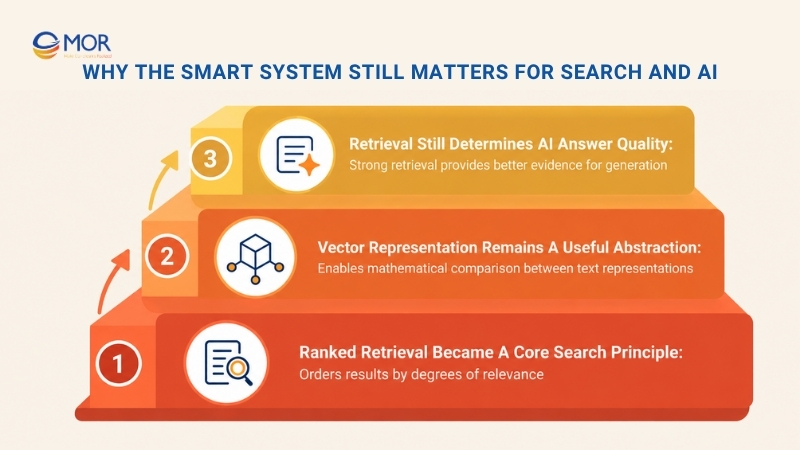
Ranked retrieval accepts that relevance has degrees. A result can be stronger than another result even when neither is an exact match. That approach fits web search, enterprise search, ecommerce discovery, legal retrieval, and other search tasks.
Ranking also creates room for measurement. Teams can examine top-k relevance, precision, recall, or mean reciprocal rank instead of checking only record existence.
Vector Representation Remains a Useful Abstraction
SMART used sparse vectors built from terms and weights. Modern vector search often uses dense embeddings learned by neural models. These are different technologies, but each turns text into a mathematical representation that can be compared.
A modern intelligent information retrieval system may mix dense search with lexical retrieval. This hybrid pattern can preserve exact-match strength for names, IDs, codes, and technical terms. It also adds semantic matching for natural-language questions.
Retrieval Still Determines AI Answer Quality
RAG systems depend on the material retrieved before generation. If the retriever selects stale or unrelated passages, the language model starts from poor evidence. Generative AI integration services often need retrieval testing as part of production design.
A 2024 study of 716 employees across four Israeli government offices found that 22.34% spent about half a workday per week searching for information. Another 10.47% spent one and a half workdays.
The old SMART lesson still holds: retrieval quality must be tested against real user needs. A polished AI interface cannot compensate for a weak index, poor source data, or unreliable ranking.
Modernize Enterprise Search With MOR Software
Companies building semantic search face a different stack from the original SMART project, but familiar delivery problems remain: weak source data, unclear relevance goals, model choice, system integration, and production deployment. MOR Software’s AI services cover feasibility assessment, data engineering, custom model work, Generative AI integration, and edge or cloud deployment.
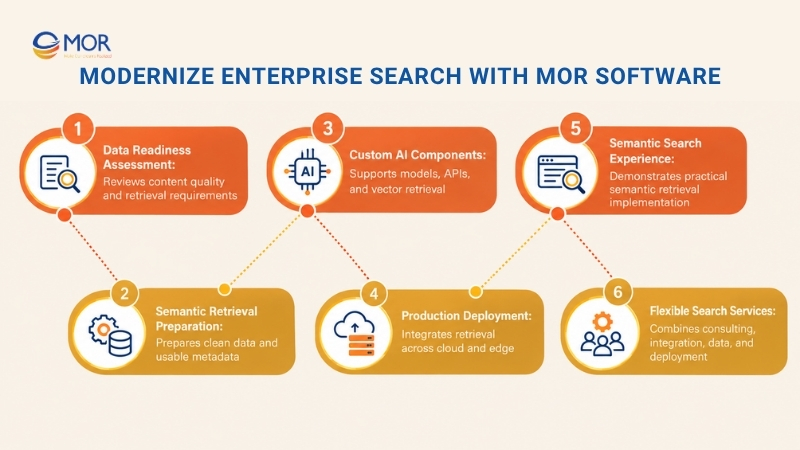
- Assess data readiness before development: MOR Software lists feasibility assessment as part of its AI services. For a search project, this stage can review available content, data condition, expected retrieval goals, and integration scope before a production build begins.
- Prepare data for semantic retrieval: Data engineering supports clean source content, usable metadata, and model-ready data before semantic retrieval starts. Search quality depends heavily on what enters the index, so data work belongs near the start of the project rather than after model selection.
- Develop custom AI components: MOR Software lists custom model services and Generative AI integration. Its documented AI stack includes TensorFlow, OpenCV, Amazon SageMaker, PyTorch, FastAPI, Databricks, vLLM, Qdrant, Docker, and Kubernetes. MOR Software Services Teams reviewing the right AI tech stack can map these tools to model work, APIs, vector retrieval, and deployment.
- Move retrieval into production: MOR Software documents edge and cloud deployment plus an AI delivery flow across Audit, Strategy, Development, and Integration. Engagement models include Staff Augmentation, Fixed-Price, and Dedicated Team. MOR Software Services
- Use semantic search work as a proof point: MOR Software’s AI materials list an AI-Powered Semantic Search Transformation among its case studies. The project is directly relevant to companies moving beyond keyword-only search toward semantic matching. MOR Software Services
- Match the service to the search problem: Companies seeking information retrieval services may also need consulting, data work, integration, and deployment support. Professional AI consulting services can support feasibility and scope. Teams choosing the right custom AI development company should also assess data engineering, integration, deployment, and ownership.
This fit is strongest for companies that need custom semantic search, NLP-based retrieval, AI model integration, or a production search layer built around existing business data. Contact MOR Software to review your data sources, retrieval goals, system dependencies, and delivery model before development starts.
Conclusion
The smart information retrieval system helped establish a practical model for representing text, ranking results, refining queries, and measuring relevance. Today’s models and infrastructure are very different, yet those ideas still give search teams a useful base for understanding semantic retrieval and RAG. If your company needs to turn scattered business knowledge into searchable, AI-ready data, contact MOR Software to assess the sources, retrieval design, integration needs, and production path.
"Evolution is not a destination, it is a disciplined journey of innovation."
Phung Van Tu


CEO MOR AI
MOR SOFTWARE
Frequently Asked Questions (FAQs)
What does SMART stand for in information retrieval?
SMART is commonly expanded as System for the Mechanical Analysis and Retrieval of Text in descriptions of the historical project. The name refers to an experimental information retrieval system built around automatic text indexing, weighted representations, matching, ranking, and retrieval research rather than a general label for AI search.
Who developed the SMART Information Retrieval System?
Gerard Salton led the research group behind the smart information retrieval system. The project began at Harvard and later became closely associated with Cornell University. Researchers including Michael Lesk and later Chris Buckley contributed to the wider SMART research program, retrieval experiments, and evaluation work.
When was the SMART Information Retrieval System developed?
The work began in the early 1960s and continued across several decades. SMART went through new versions as researchers studied vector models, term weighting, feedback, query expansion, and evaluation. Its long research life made it useful for comparing search methods under changing experimental conditions.
How does the SMART Information Retrieval System work?
SMART processes documents, creates weighted term representations, converts a query into a compatible vector, compares that query with candidate documents, and ranks results by similarity. Relevance feedback can then adjust the query after users judge which returned documents are useful or poor matches.
What is the vector space model in SMART?
The vector space model represents documents and queries as vectors whose dimensions correspond to terms. Term weights show the relative contribution of each dimension. A similarity measure can compare a query vector with document vectors, assign scores, and order results by relevance.
What is SMART notation in information retrieval?
SMART notation is a compact way to describe document and query weighting schemes. A form like ddd.qqq uses the first triplet for document weighting and the second for query weighting. Each triplet records choices for term frequency, document frequency, and vector normalization.
Did SMART introduce TF-IDF?
It is safer to say SMART research helped develop, test, and formalize influential term-weighting methods rather than attribute TF-IDF to one single system. Salton and other researchers studied how term frequency and collection frequency could be combined to improve ranking across document collections.
What is relevance feedback in the SMART system?
Relevance feedback changes the query after an initial search. Users identify useful and poor results, then the system adjusts the query representation. Rocchio-style methods move the query toward relevant document vectors and away from non-relevant vectors before another retrieval round begins.
How is SMART different from modern vector search?
SMART mainly used sparse vectors based on terms and statistical weights. Modern vector search often uses dense embeddings produced by neural models. Current systems may also combine vector retrieval with BM25, metadata filters, neural rerankers, permissions, monitoring, and RAG pipelines for answer generation.
Is the SMART Information Retrieval System still used today?
The historical SMART software is mainly relevant as a research milestone rather than a current enterprise search platform. Its ideas remain visible in ranked retrieval, vector representation, term weighting, relevance feedback, query refinement, and systematic evaluation that later search research continued to develop.
Share


Make Our-Dreams Realized


© 2023 . MOR Software. All Rights Reserved
Sitemap
Privacy Policy
Terms of Use

Rate this article
0
over 5.0 based on 0 reviews
Your rating on this news:
Name
*Email
*Write your comment
*Send your comment
1