


Software Outsourcing Latin America: Definitive Guide 2026

Rising U.S. engineering costs, long hiring cycles, and slow feedback across distant time zones have pushed more companies toward software outsourcing Latin America. The region combines lower development costs with strong U.S. workday overlap, but Mexico, Brazil, Colombia, Argentina, and other markets differ sharply in talent, rates, and delivery fit. This MOR Software guide will compare costs, countries, outsourcing models, risks, and vendor-selection criteria for 2026.
Key Takeaways
- Latin America works well for U.S. teams that need real-time collaboration, wider engineering access, and lower development costs than many domestic hiring options.
- Country choice changes the talent pool, hourly rate, language profile, legal setup, and scaling capacity. Mexico, Brazil, Colombia, Argentina, Chile, Costa Rica, Uruguay, and Peru serve different project needs.
- The outsourcing model matters as much as geography. Project-based delivery, dedicated teams, and staff augmentation give buyers different levels of control, vendor ownership, cost predictability, and flexibility.
Latin America Software Outsourcing Market Outlook
Latin America software outsourcing has grown into a sizable IT services market rather than a narrow source of lower-cost developers. Companies now contract teams across application development, cloud engineering, managed security, infrastructure, data services, AI, QA, and product modernization.
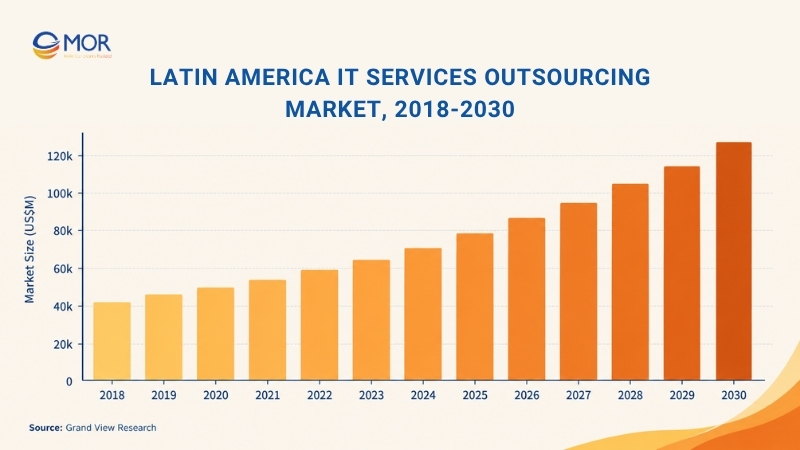
The long-term market direction supports that shift. The chart below tracks the expansion of Latin America's IT services outsourcing market across the 2018–2030 period.
The chart shows steady expansion across the period. Grand View Research's newer July 2026 dataset extends that outlook: the LATAM IT services outsourcing market generated $42.53 billion in 2025, is estimated at $46.37 billion in 2026, and is forecast to reach $86.89 billion by 2033, based on a 9.39% CAGR. Application services were the largest service segment in 2025, and Emerging Technology Services is forecast as the fastest-growing segment.
Source: Grand View Research / Grand View Horizon
That mix matters for software outsourcing Latin America buyers. Demand now covers new product builds, application maintenance, modernization, managed security, cloud operations, and specialized technology work rather than basic coding capacity alone.
Brazil is forecast to record the highest country-level CAGR in the region through 2033. But growth isn't uniform. Mexico, Colombia, Argentina, Chile, Costa Rica, Uruguay, and Peru carry different rate bands, engineering strengths, language profiles, and hiring constraints.
Market growth explains the attention, but market size alone doesn't tell you if the region fits your product. Cost, role availability, workday overlap, technical depth, and vendor delivery practices make the practical difference.
Why Companies Choose Latin America for Software Outsourcing
The main case for software outsourcing Latin America comes down to operating fit. U.S. companies can add engineering capacity without accepting the long communication gaps that often come with distant offshore delivery.
Readers comparing this approach with other sourcing regions can also review MOR Software's guide to nearshore software outsourcing model.
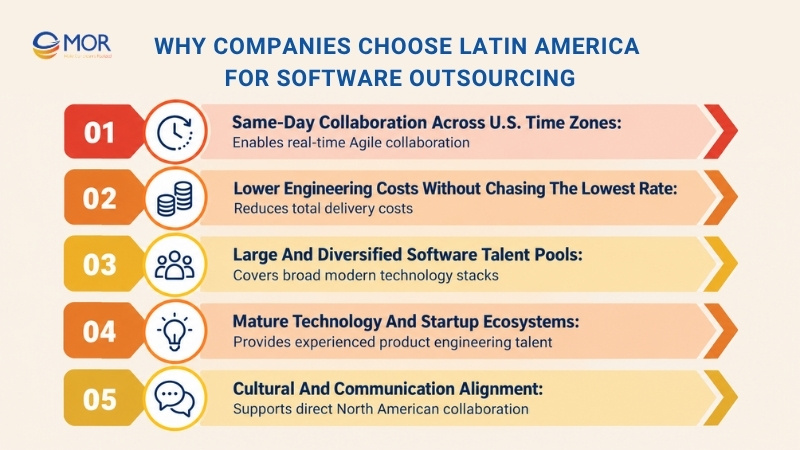
Same-Day Collaboration Across U.S. Time Zones
Mexico, Colombia, Costa Rica, and Peru sit close to major U.S. business hours. Argentina, Brazil, Chile, and Uruguay run a few hours ahead of some U.S. teams but still share a large part of the working day.
That overlap changes daily delivery. Engineers can join standups, review pull requests, debug production issues, discuss architecture, and answer product questions before another workday passes.
For teams outsourcing software development to Latin America, this is one of the strongest differences from delivery centers eight or more hours away. Async work can still succeed, but real-time Agile teams usually spend less time waiting for decisions.
Lower Engineering Costs Without Chasing the Lowest Rate
Regional wage structures let U.S. companies access experienced engineers at lower rates than many domestic contracts. The saving comes mainly from local labor economics, not an assumption that engineering standards are lower.
Seniority still moves pricing more than a flag on a map. A senior AI engineer in Buenos Aires may cost more than a mid-level full-stack developer in Mexico City, so the cheapest country rarely gives the cheapest final team.
The better measure is total delivery cost. Include team management, rework, recruitment, time-to-hire, QA, tooling, and staff turnover alongside the hourly figure.
Large and Diversified Software Talent Pools
Brazil and Mexico have some of the region's broadest engineering markets. Colombia and Argentina add sizable communities in product development, fintech, SaaS, mobile, data, and backend engineering.
Across the region, companies can source JavaScript, TypeScript, Java, Python, .NET, React, Node.js, cloud, DevOps, data engineering, mobile, and AI skills. That range makes software outsourcing Latin America relevant to more than basic web development.
Companies that plan to outsource software development team Latin America capacity should still recruit around actual production experience. A résumé listing Python or AWS tells you far less than a candidate's record of shipping and maintaining a comparable system.
Mature Technology and Startup Ecosystems
São Paulo, Mexico City, Buenos Aires, Bogotá, Medellín, Santiago, and San José now host established startup, fintech, SaaS, cloud, and enterprise technology communities. Engineers working in these hubs often gain exposure to fast-growth products and international client requirements.
Large domestic companies also create demand for enterprise architecture, data platforms, cloud migration, cybersecurity, and payment systems. That gives buyers more room to find engineers who understand business systems, not just isolated coding tasks.
Cultural and Communication Alignment
Many LATAM engineers already work with North American clients, so common Agile routines, Jira workflows, code reviews, sprint planning, and direct stakeholder communication won't feel unusual. Still, communication ability varies by candidate and country.
The 2025 EF English Proficiency Index highlights that variation. Argentina ranked 26th globally, Uruguay 34th, Chile 54th, Costa Rica 55th, Brazil 75th, and Colombia 76th, so country averages differ widely and shouldn't replace individual screening.
Treat communication as part of technical vetting. Ask candidates to explain a design decision, challenge a requirement, document a bug, and talk through production trade-offs.
Software Outsourcing Costs in Latin America for 2026
Cost discussions around software outsourcing Latin America get messy because salary, freelancer rate, staffing bill rate, and all-in vendor cost are different numbers. Keep them separate before comparing providers.
For software development outsourcing Latin America, seniority, stack, employment model, country, vendor margin, and included services all change the final bill.
Developer Rates by Seniority
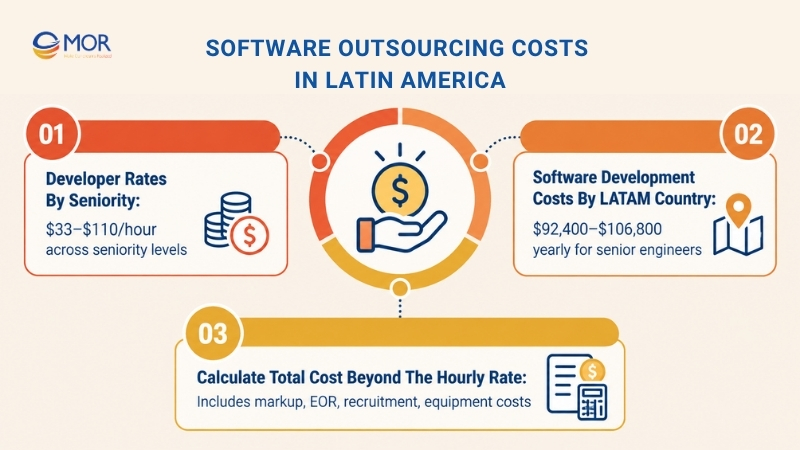
Seniority creates a wide pricing spread. Bertoni Solutions cites Accelerance's 2026 partner survey at roughly 33–45 per hour for junior LATAM developers and 60–75 for senior developers, with role scarcity creating additional premiums.
Seniority | Typical LATAM Rate ($/hr) | Approx. Monthly Cost ($)* | U.S. Comparison ($/hr) | Suitable Work |
Junior | 33–45 | 5,280–7,200
| 45–65
| Bug fixes, testing support, basic frontend/backend work |
Mid-Level | 40–60
| 6,400–9,600
| 70–100
| Product work, APIs, integrations, standard cloud tasks |
Senior | 60–75
| 9,600–12,000
| 100–180+
| System design, complex workflows, performance work, mentoring |
Lead / Architect | 75–110
| 12,000–17,600
| ~175–275
| Architecture, technical governance, cross-team decisions |
AI/ML, cloud architecture, cybersecurity, data engineering, and niche enterprise platforms can move beyond general developer bands. A team with two senior specialists and three mid-level developers can also cost less than five senior engineers without sacrificing ownership in every area.
Don't treat these ranges as a universal rate card. Contract length, expected overlap, management scope, QA coverage, and replacement terms can move a quote in either direction.
Software Development Costs by LATAM Country
Country comparison becomes clearer when one pricing method is used across every market. BEON.tech's September 2026 benchmark estimates all-in annual cost for a senior contract software engineer and includes salary, onboarding, talent management, equipment, and benefits.
Country | Senior Engineer Cost ($/year) | Approx. Cost ($/month) | Talent Depth | Main Cost Drivers | Best Budget Fit |
Mexico | $96,000 | $8,000 | Very high | U.S. demand, large hubs, workday overlap | Teams prioritizing scale and U.S. collaboration |
Brazil | $99,000 | $8,250 | Very high | Large market, fintech and specialist demand | Large or technically complex teams |
Colombia | $92,400 | $7,700 | High | Nearshore demand, Bogotá and Medellín competition | Cost-conscious product teams |
Argentina | $96,000 | $8,000 | High | Senior depth, USD contracts, specialist demand | Senior engineering, data, AI, architecture |
Chile | $93,600 | $7,800 | Moderate | Smaller senior pool, specialist premiums | Stable mid-sized product teams |
Costa Rica | $98,400 | $8,200 | Moderate | Bilingual talent, enterprise demand, smaller pool | Client-facing enterprise projects |
Uruguay | $106,800 | $8,900 | Smaller but senior-heavy | Limited supply, experienced product engineers | Specialist, senior-led teams |
Peru | $94,800 | $7,900 | Growing | Emerging market, less competition than larger hubs | Mid-sized, cost-sensitive projects |
BEON.tech bases these 2026 figures on what 5,174 senior engineers interviewed across Latin America asked for, plus its own provider rate structure, checked against closed placements.
Mexico and Brazil don't automatically cost less because they have larger talent pools. Demand is also larger in their main hubs, especially for cloud, AI, fintech, data, and senior platform roles.
Uruguay sits higher in this dataset because its engineering market is much smaller. Colombia, Chile, and Peru come in lower, but role availability can erase a country-level saving when a project needs niche skills.
Calculate Total Cost Beyond the Hourly Rate
The quoted engineer rate only means something once you know what sits inside it. Staff augmentation vendors often bundle recruitment, payroll, employment administration, benefits, compliance, and replacement, whereas direct hiring separates many of those charges.
Cost Component | Typical Extra Cost ($) | Often Included? | Pricing Basis | What to Verify |
Vendor / staffing markup | ~25–40% above worker pay
| Usually | Hourly or monthly bill rate | Worker cost vs vendor margin |
Recruitment | ~$3,500 flat or ~18–25% of first-year salary
| Sometimes | Per hire | Replacement guarantee and refund terms |
Payroll / EOR | ~300–600 per employee/month
| Sometimes | Monthly per employee | Payroll, taxes, contracts, local compliance |
Benefits | $0 if bundled; country-specific otherwise
| Often | Monthly / statutory | Health, leave, pension, statutory benefits |
Equipment | ~1,000–3,000 planning allowance
| Sometimes | Per engineer | Laptop, monitor, security setup |
Onboarding | Often bundled | Often | One-time / internal time | Accounts, documentation, knowledge transfer |
Project management | Quote-dependent | Sometimes | Hourly / allocation | Dedicated PM vs fractional PM |
Travel | Quote-dependent | Rarely | Per trip | Flights, hotels, local travel |
Turnover / replacement | May be $0 if covered | Sometimes | Per replacement | Replacement window and notice period |
Compliance / legal support | Often part of EOR fee | Sometimes | Monthly / advisory | IP, classification, labor law |
Upwork's 2026 staffing guide puts direct-hire agency fees around 18–25% of first-year salary and contract staffing markups around 25–40%, with hard-to-fill roles sometimes higher.
For another reference point, Deel currently lists its Employer of Record plan at $599 per employee per month. EOR pricing covers the service fee, but employer taxes, statutory costs, benefits, and salary still need to be modeled separately.
Check every bundled item before adding these numbers together. Double-counting payroll, recruitment, or equipment can make one vendor look far more expensive than it really is.
Best Latin American Countries for Software Outsourcing
There isn't one universal winner for software outsourcing Latin America. The right location depends on your target roles, expected team size, time-zone needs, budget, product domain, and tolerance for a smaller hiring pool.
If you're building a broader shortlist, MOR Software's comparison of the best countries to outsource software development gives another way to compare geography.
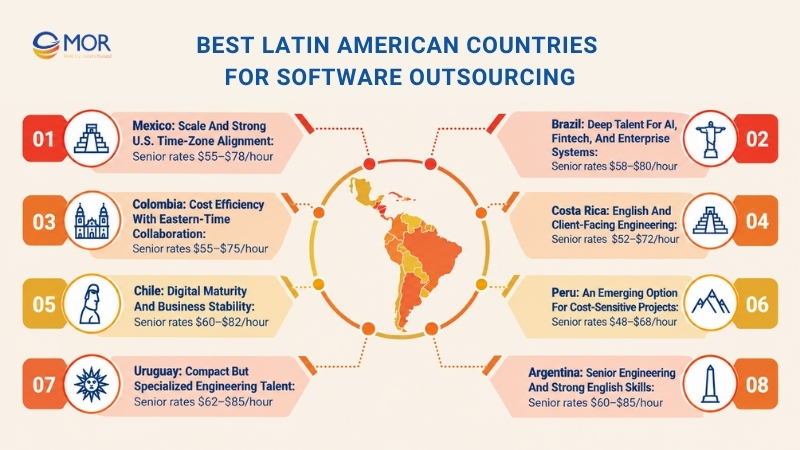
Country | Main Tech Hubs | Talent Pool | Typical Senior Cost ($/hr) | Cost Position | Time-Zone Fit | Key Strengths | Watchouts | Best For |
Mexico | Mexico City, Guadalajara, Monterrey | Very large | 55–78
| Mid to high | Strong U.S. overlap | Enterprise, cloud, fintech, manufacturing tech | Higher rates in major hubs | Large teams needing close U.S. collaboration |
Brazil | São Paulo, Rio de Janeiro, Florianópolis | Very large | 58–80
| Mid to high | Strong shared workday | AI, data, fintech, enterprise systems | Portuguese, regulatory complexity | Large-scale specialist engineering |
Colombia | Bogotá, Medellín, Cali | Large | 55–75
| Competitive | Strong Eastern Time fit | Full-stack, backend, JavaScript, product teams | Senior demand keeps rising | Cost-conscious product teams |
Argentina | Buenos Aires, Córdoba, Mendoza | Large | 60–85
| Mid to high | Strong U.S. overlap | Senior engineering, AI, SaaS, architecture | Currency volatility | Senior-heavy technical work |
Chile | Santiago, Valparaíso | Moderate | 60–82
| Mid to high | Good overlap | Cloud, fintech, data | Smaller pool | Mid-sized specialist projects |
Costa Rica | San José, Heredia | Moderate | 52–72
| Mid-range | Strong U.S. overlap | English, enterprise services, QA, DevOps | Limited scale | Client-facing enterprise teams |
Uruguay | Montevideo | Small | 62–85
| High | Good overlap | Senior talent, AI, cloud, custom software | Small hiring pool | Specialist teams |
Peru | Lima, Arequipa | Growing | 48–68
| Lower | Strong Eastern Time fit | Web, mobile, cloud, QA | Smaller senior market | Budget-sensitive mid-sized projects |
The rate bands above reflect ProLatamWork's May 2026 market data for senior developers working with international clients. Its reported ranges run from 48–68 in Peru at the lower end to 62–85 in Uruguay at the higher end.
Mexico: Scale and Strong U.S. Time-Zone Alignment
Mexico works well when geographic proximity and a large engineering market sit high on your priority list. Mexico City, Guadalajara, and Monterrey support enterprise software, cloud systems, fintech, SaaS, and manufacturing technology teams.
Its senior pricing sits above some smaller LATAM markets, especially in mature hubs. The trade-off is easier travel, strong U.S. workday overlap, and a deeper recruiting base for larger teams.
Brazil: Deep Talent for AI, Fintech, and Enterprise Systems
Brazil has one of Latin America's broadest engineering bases, centered around São Paulo, Rio de Janeiro, Florianópolis, Campinas, and other major cities. AI, data engineering, fintech, backend systems, mobile, and enterprise platforms stand out.
Portuguese creates an extra communication check for English-speaking buyers, and local employment rules require attention. Still, Brazil deserves a place on shortlists that prioritize team scale or specialist roles.
Colombia: Cost Efficiency with Eastern-Time Collaboration
Bogotá, Medellín, and Cali have become established nearshore engineering centers. Colombia's UTC-5 position gives many U.S. East Coast teams direct workday alignment, which supports live product discussions and same-day code review.
Full-stack, JavaScript, backend, mobile, and startup product experience are common strengths. Colombia also sits below several mature markets on current senior rate bands, which makes it relevant for Latin America software development outsourcing programs that need balanced cost and collaboration.
Argentina: Senior Engineering and Strong English Skills
Buenos Aires and Córdoba have long-standing software communities and a strong concentration of experienced engineers. Fintech, SaaS, data, AI, architecture, and product development are common areas of depth.
English proficiency is another draw for international clients. Currency and economic changes still require careful contract design, so USD billing, rate-review terms, and payment rules should be clear before onboarding.
Chile: Digital Maturity and Business Stability
Santiago holds most of Chile's technology activity, with Valparaíso adding another smaller hub. Cloud, fintech, data engineering, and enterprise software have strong representation.
Chile's talent pool is smaller than Mexico or Brazil, so specialist hiring can take longer and senior rates can move close to Argentina's range. It suits companies that value established business processes and don't need to add dozens of engineers at once.
Costa Rica: English and Client-Facing Engineering
San José and Heredia support a mature enterprise-services base with experienced engineers working across QA, DevOps, cloud, support engineering, and software development. English ability also makes the country useful for roles that spend more time with U.S. stakeholders.
The pool is smaller than Mexico, Brazil, or Colombia. Large team ramps may require a wider regional search instead of relying on Costa Rica alone.
Uruguay: Compact but Specialized Engineering Talent
Montevideo anchors Uruguay's software-export sector. The country produces experienced engineers across cloud, AI, fintech, product development, and custom applications.
Its small population limits hiring volume and creates a premium for senior roles. Uruguay fits specialist teams better than very large ramps, especially when product maturity and direct client communication carry more weight than the lowest rate.
Peru: An Emerging Option for Cost-Sensitive Projects
Lima leads Peru's technology market, with Arequipa adding another growing base. Web development, mobile, cloud, QA, backend engineering, and general product work are common hiring areas.
Peru currently sits toward the lower end of senior LATAM rates. The senior pool is smaller than Brazil or Mexico, so it works best when project scale is moderate and roles don't require a very narrow skill combination.
A buyer should treat outsourcing Latin America software work as a portfolio decision rather than a single-country bet. Some vendors recruit across several markets, which can give you a better match for seniority, stack, and budget than forcing every role into one location.
Latin America vs Eastern Europe and Asia
The strongest case for software outsourcing Latin America isn't that it always costs least. Asia often wins on headline price, and Eastern Europe competes closely on specialist engineering.
The distinction is operating rhythm. Latin America gives U.S. teams much more shared work time, which changes meetings, review cycles, debugging, product discussions, and response times.
Factor | Latin America | Eastern Europe | Asia |
Typical senior outsourcing cost | ~35–75/hr
| ~40–80/hr
| ~25–60/hr
|
U.S. workday overlap | Usually 6–9 shared hours
| Usually 2–4 hours with U.S. East Coast
| Often 0–2 hours for South Asia |
Typical cost position | Mid-range | Mid-range | Generally lowest |
Talent scale | Large | Large specialist pools | Very large |
English availability | Good in major tech hubs, varies by country | Generally strong in established outsourcing markets | Wide variation |
Real-time Agile collaboration | Strong for U.S. teams | Moderate | More async for U.S. teams |
Specialized engineering | AI, fintech, cloud, product engineering | Deep tech, cybersecurity, enterprise, data | Broad cloud, enterprise, mobile, AI capacity |
Travel proximity to U.S. | Highest | Moderate to low | Lowest |
Best-fit scenario | U.S. teams prioritizing same-day collaboration | Complex engineering with shorter overlap tolerance | Cost-sensitive work and large talent needs |
Match.dev's July 2026 regional estimate places senior engineers at 35–75/hour in Latin America, 40–80 in Central and Eastern Europe, and 25–60 in South Asia. It also estimates 6–9 hours of U.S. workday overlap for LATAM against 2–4 hours for Eastern Europe and 0–2 for South Asia.
Asia can make sense for teams designed around handoffs and async work. Eastern Europe fits complex backend, cloud, security, and data programs where several shared hours are enough.
Teams that outsource Latin America engineering capacity usually place more value on live collaboration. That can offset a higher hourly price when same-day decisions keep work moving.
Which Outsourcing Model Works Best in Latin America?
Geography only answers where the team works. The delivery model decides who manages people, who owns output, how costs are billed, and how easily headcount changes.
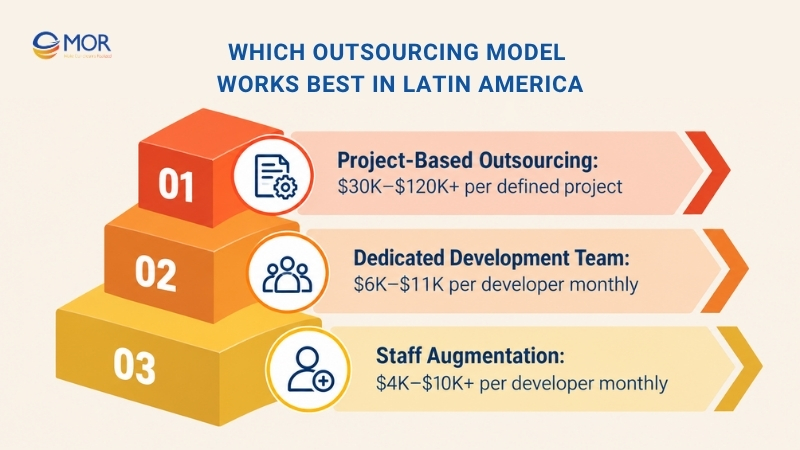
Your software outsourcing Latin America plan usually falls into project-based outsourcing, a dedicated team, or staff augmentation. MOR also compares related types of software development outsourcing models for buyers assessing ownership and control.
Project-Based Outsourcing
Project-based outsourcing gives the vendor responsibility for a defined scope, agreed milestones, and delivery. It works best when requirements and acceptance criteria can be documented early.
Fixed-price contracts give stronger budget certainty but make scope changes harder. Time-and-material arrangements accept requirement changes more easily, but monthly spend moves with actual effort.
A 2026 LATAM project-cost dataset from Ab4cus uses a blended rate near $45/hour and estimates about $30,000 for a defined MVP, around $76,800 for a marketplace, $90,200 for a SaaS platform, and more than $120,000 for a KYC/AML platform.
This model fits companies that want the vendor to own execution rather than manage individual engineers. Detailed change control becomes important once product requirements start moving.
Dedicated Development Team
A dedicated development team stays attached to one client, product, or roadmap for a longer period. The group can include developers, QA, DevOps, business analysts, project managers, and technical leads.
This setup gives the external team time to learn architecture, domain rules, release processes, and product history. It fits ongoing SaaS development, modernization programs, large backlogs, and products that need continued engineering capacity.
Current 2026 dedicated-team benchmarks put LATAM around 35–65 per hour or roughly 6,000–11,000 per developer per month. nCube places the region below North America and Eastern Europe on average, but above South and Southeast Asia.
Companies planning to hire dedicated developers from LATAM should examine team composition rather than only headcount. A well-balanced seniority mix usually gives better budget control than filling every seat with a senior title.
For a deeper model breakdown, see MOR Software's guide to the dedicated development team model.
Staff Augmentation
Staff augmentation adds individual engineers or specialists to your existing team. Your internal leads keep control over architecture, backlog, sprint planning, priorities, code review, and daily delivery.
It works well for temporary capacity, niche skills, leave coverage, backlog pressure, or short-term scaling. It also demands stronger internal leadership because the vendor supplies people rather than taking full responsibility for the product.
Cloud Employee's August 2026 LATAM pricing guide puts junior staff augmentation around 18–35/hour, mid-level developers at 28–50, and seniors at 40–80. Its fixed monthly benchmark runs roughly 4,000–7,000 per developer, with senior roles often higher.
This model suits agile software development outsourcing Latin America programs where an internal product team already owns delivery. Buyers comparing this route with vendor-led projects can review staff augmentation vs outsourcing.
Model | Typical LATAM Cost | Pricing Structure | Client Control | Vendor Ownership | Flexibility | Best For |
Project-Based Outsourcing | ~30K–120K+ per project
| Fixed price or T&M | Moderate | High | Moderate | Defined projects and deliverables |
Dedicated Development Team | ~30K–55K/month for 5 people
| Monthly team or per-developer fee | Shared | Shared | High | Long-term product development |
Staff Augmentation | ~4K–10K+ per developer/month
| Monthly or hourly | High | Low | Very high | Skill gaps and flexible scaling |
Treat these figures as planning ranges. Team seniority, QA coverage, AI or DevOps roles, security requirements, management scope, and contract term can change the final quote.
Key Risks of Software Outsourcing in Latin America
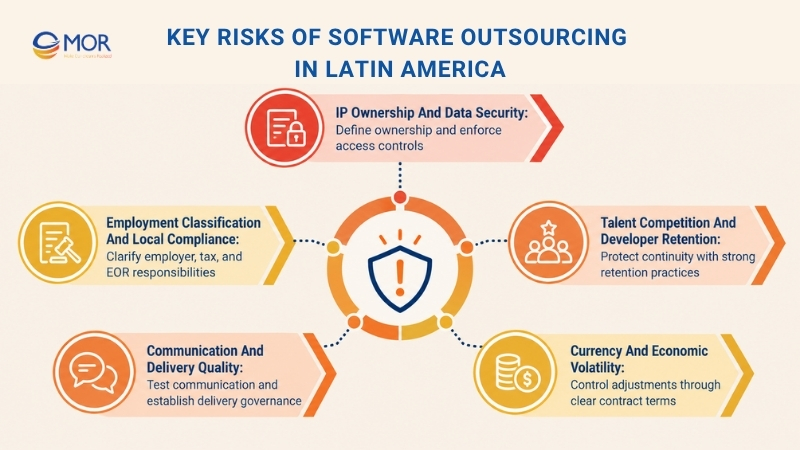
Most software outsourcing Latin America risks aren't unique to the region. Weak IP clauses, poor access controls, unclear ownership, shallow vetting, and high turnover can damage an outsourcing program anywhere.
Country differences still matter. Labor law, data rules, currency conditions, and contractor classification vary, so a standard contract copied across every LATAM market creates unnecessary exposure.
A broader review of the pros and cons of outsourcing software development can help teams separate model risk from location risk.
IP Ownership and Data Security
Contracts should state who owns source code, designs, documentation, models, data pipelines, and work produced during the engagement. NDAs alone aren't enough if the service agreement leaves IP assignment vague.
- Define IP transfer: State when ownership transfers and whether payment, acceptance, or creation triggers that transfer.
- Control repository access: Give engineers only the repositories, cloud accounts, and production data needed for their work.
- Set security requirements: Document MFA, device rules, secret management, branch protection, logging, vulnerability handling, and offboarding.
- Check data location: Regulated sectors may need rules for where customer or production data can be processed and stored.
Security controls should be tested during vendor review, not discovered after onboarding.
Employment Classification and Local Compliance
Directly contracting developers can create worker-classification, tax, payroll, and local labor questions. The legal setup changes when an engineer works as an independent contractor, employee of an EOR, or employee of your software vendor.
- Clarify the legal employer: Identify who signs the employment agreement and handles statutory obligations.
- Map EOR responsibilities: Confirm payroll, taxes, benefits, termination, and local filings.
- Review contractor control: Heavy client control over hours, exclusivity, and work methods can affect classification in some jurisdictions.
- Check cross-border payments: Document currency, invoice rules, withholding obligations, and payment schedules.
Legal counsel familiar with the relevant country should review higher-risk or regulated engagements.
Talent Competition and Developer Retention
Large hubs attract local employers, global vendors, U.S. startups, and international remote recruiters at the same time. Strong engineers can receive several opportunities, especially in AI, cloud, data, DevOps, and senior product roles.
- Benchmark compensation: Check rates during renewal periods instead of relying on a two-year-old contract.
- Track turnover: Ask vendors for team-tenure data and replacement history.
- Protect continuity: Keep architecture notes, runbooks, decision logs, and ownership maps current.
- Set replacement terms: Agree on notice, replacement timing, handover, and any extra cost before signing.
A low quote loses value quickly when the same role needs to be replaced every six months.
Communication and Delivery Quality
Language is only one part of communication fit. Engineers also need to raise blockers early, explain trade-offs, document decisions, and challenge weak requirements.
- Test communication during vetting: Ask the candidate to explain a production issue or architecture choice.
- Share product background: Give external engineers access to domain rules, user goals, and technical history.
- Set code-review standards: Agree on branch rules, review ownership, test coverage, and deployment gates.
- Define escalation paths: Everyone should know who handles blocked work, security incidents, missed milestones, and requirement disputes.
Good delivery governance removes guesswork before a sprint gets into trouble.
Currency and Economic Volatility
Latin America isn't one economic market. Argentina, Brazil, Mexico, Chile, Colombia, and smaller markets face different inflation, currency, tax, and policy conditions.
Many international engineering contracts use USD billing to limit exchange-rate uncertainty. Rate-review clauses also need a fixed schedule, notice period, and clear method rather than open-ended adjustments.
For companies planning to outsource software Latin America work for several years, financial terms deserve the same attention as technical scope. A cheap first-year rate can turn expensive if annual adjustments have no cap or reference point.
How to Choose a Software Outsourcing Partner in LATAM
Selecting a country is only the first filter. Vendor quality determines whether software outsourcing Latin America produces a reliable engineering team or a recurring management problem.
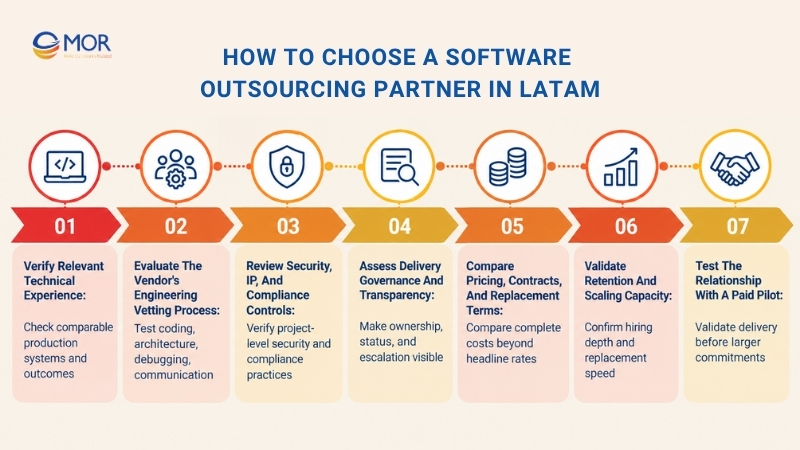
The shortlist should test real delivery evidence, team quality, security, commercial terms, and the vendor's ability to keep people on the project. Companies that outsource LATAM engineering work should ask the same hard questions they would ask a domestic partner.
Verify Relevant Technical Experience
Ask for systems that resemble your project in architecture, load, integration complexity, and domain rules. A provider that has built a production payments platform gives stronger evidence for fintech work than one that merely lists Java, React, and AWS.
Read case studies for team size, project duration, technical decisions, constraints, and measurable results. Client references should confirm what the vendor actually owned.
Evaluate the Vendor's Engineering Vetting Process
Good screening goes past résumé keywords. Ask how candidates are tested for coding, architecture, debugging, communication, and role seniority.
A live discussion often exposes more than a generic coding test. Give candidates a real problem: an API under load, a failed deployment, slow database query, or unclear product requirement.
Review Security, IP, and Compliance Controls
Request the vendor's access-control process, device rules, secure development practices, incident handling, employee offboarding steps, and relevant certifications. For regulated data, add country-level privacy and storage requirements.
ISO 27001, SOC 2, or similar credentials can support due diligence, but certificates don't replace project-level controls. Ask how the team applies them to repositories, cloud accounts, test data, secrets, and production access.
Assess Delivery Governance and Transparency
Good vendors make project health visible. Sprint goals, Jira boards, delivery status, defects, blockers, ownership, and release plans should be available without waiting for a monthly management deck.
Ask who owns architecture, backlog refinement, QA approval, deployment, and stakeholder communication. Clarify escalation routes before the first missed milestone occurs.
Compare Pricing, Contracts, and Replacement Terms
A rate card doesn't show the complete commercial model. Check minimum commitments, billing unit, bench charges, overtime, annual increases, replacement terms, termination notice, conversion fees, and travel costs.
Transparent vendors can explain what sits inside their margin. If a quote excludes payroll, recruitment, equipment, account management, or replacement, compare the full cost rather than the headline rate.
Validate Retention and Scaling Capacity
A five-person pilot proves little about a vendor's ability to build a 30-person program. Ask how many people the company can source for your stack, how quickly it replaces departures, and which roles remain hard to recruit.
Retention matters for product knowledge. Long-term engineers remember architecture decisions, workarounds, customer history, and operational edge cases that documentation rarely captures completely.
Test the Relationship with a Paid Pilot
A paid pilot gives you evidence before a large commitment. Use a representative piece of work that touches your real codebase, standards, communication flow, and deployment process.
Define acceptance criteria before kickoff. Measure code quality, review responsiveness, requirement handling, ownership, estimation accuracy, and documentation rather than output volume alone.
Expand Your Outsourcing Options with MOR Software
Latin America can fit U.S.-aligned nearshore teams well, but geography should stay one factor in the vendor decision. Companies comparing outsourcing software development Latin America options may also want to test offshore markets when engineering structure, delivery ownership, technical fit, and long-term scaling carry greater weight.
MOR Software JSC provides project-based development and an Offshore Development Center model. Our ODC is structured as an extension of the client's team and can include project management, business analysis, development, QA, quality control, and other roles across the software development lifecycle.
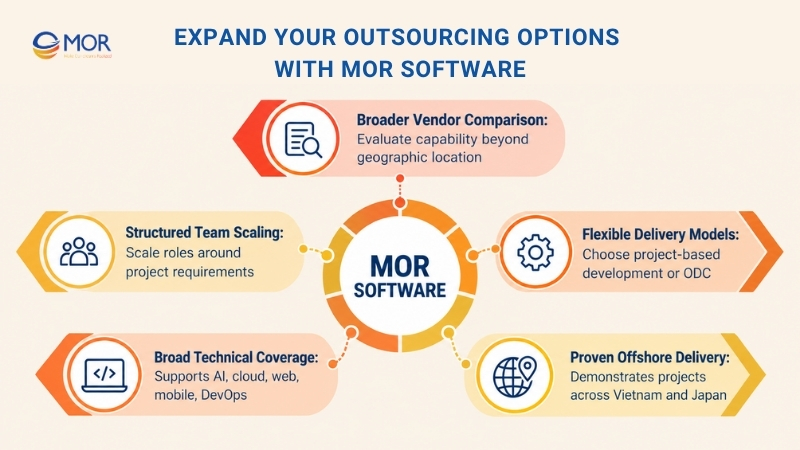
- Look beyond location alone: Compare engineering capability, delivery governance, QA, information security, team composition, technical fit, and the provider's ability to add the roles your roadmap needs.
- Choose the right delivery model: MOR Software supports Project-Based Development and Offshore Development Center engagements. Project-based work fits defined deliverables, whereas ODC suits companies that need sustained external engineering capacity.
- Build and scale teams around project requirements: Our ODC process starts with the dedicated-team brief, resource estimate, and proposal. Candidate screening, onboarding, evaluation, team management, feedback, and scaling follow as the engagement moves forward.
- Support delivery across a broader technical base: MOR Software's service materials cover web, mobile, Salesforce, offshore development, QA, DevOps support, backend, frontend, infrastructure, AI, IoT, AR/VR, and digital transformation. The same materials list ISTQB and CMMI Level 3 among MOR Software's credentials.
- Compare delivery proof, not geography alone: MOR's ODC materials cite projects including the N-CLOUD CCTV Management System for Korea, built with Python, and the Narosu e-commerce management system using AWS and PHP. MOR also maintains delivery presence across Vietnam and Japan, including Ho Chi Minh City, Hanoi, Da Nang, Tokyo, Osaka, and Nagoya.
This model fits companies that know the product scope or engineering roles they need and want a structured offshore alternative to a LATAM shortlist. Share your required stack, team size, delivery timeline, and ownership expectations with our team so we can compare a project-based setup against an ODC structure.
Conclusion
Software outsourcing Latin America gives U.S. companies access to strong engineering markets, shared work hours, and more flexible cost structures, but country and vendor fit still decide the outcome. Compare all-in cost, role availability, delivery ownership, security, and scaling needs before signing. If you also want to compare LATAM against a structured Vietnam-based offshore team, contact us with your project scope, stack, timeline, and target team size.
MOR SOFTWARE
Frequently Asked Questions (FAQs)
Is Latin America a good region for software outsourcing?
Yes, when your project benefits from U.S. workday overlap, a large engineering pool, and lower contract costs than many domestic options. Mexico, Brazil, Colombia, Argentina, Chile, Costa Rica, Uruguay, and Peru cover different combinations of scale, technical depth, communication, and pricing.
The region isn't automatically the right choice for every project. Regulatory requirements, specialist availability, procurement rules, or an async-friendly delivery model may make another market a better fit.
How much does software outsourcing in Latin America cost?
Junior partner rates commonly start in the $30s per hour, whereas senior engineers often land around 55–85 depending on country and sourcing model. Tech leads, architects, AI engineers, cloud specialists, and security roles can exceed those bands.
The full bill also depends on recruitment, vendor margin, QA, project management, payroll/EOR, equipment, benefits, and replacement coverage. Compare all-in cost before choosing between providers.
Which Latin American country is best for software outsourcing?
No single country fits every project. Mexico and Brazil suit larger team builds, Colombia combines competitive pricing with U.S. East Coast alignment, Argentina has strong senior engineering depth, and Costa Rica works well for English-heavy client-facing roles.
Uruguay suits specialist teams, Chile fits mature mid-sized programs, and Peru can work well for moderate-scale projects on tighter budgets. Match the country to the roles you need.
Is Latin America considered nearshore or offshore outsourcing?
For U.S. companies, Latin America is normally classified as nearshore because the region is geographically closer and shares much of the U.S. workday. Offshore usually refers to more distant delivery locations with larger time differences.
The terms describe location, not the commercial model. A LATAM team can still work under staff augmentation, dedicated-team, or project-based contracts.
Do Latin American developers work U.S. business hours?
Many do. Colombia and Peru run on UTC-5, Costa Rica on UTC-6, and several major Mexican hubs closely match U.S. Central or Mountain schedules.
Argentina, Uruguay, Brazil, and Chile sit somewhat farther ahead depending on season and U.S. location, but they still share several hours with U.S. teams. Always confirm the exact schedule in the contract.
How can companies protect IP when outsourcing to Latin America?
Use a service agreement that assigns IP ownership clearly and covers source code, documentation, designs, data models, and other project work. Add confidentiality terms, repository controls, MFA, least-privilege access, logging, and documented offboarding.
Data location also needs review for healthcare, finance, government, and other regulated sectors. Country-specific legal advice is appropriate when the project carries higher compliance exposure.
Is staff augmentation or a dedicated team better for LATAM outsourcing?
Staff augmentation fits companies that already have strong internal product and engineering leadership. Your team keeps control over architecture, backlog, reviews, and sprint work.
A dedicated team works better when you need stable external capacity for a longer roadmap. It creates more continuity and gives the external group time to learn the product deeply.
How long does it take to build a software team in Latin America?
The timeline depends on country, stack, role seniority, interview stages, vendor pipeline, and contract setup. Common full-stack roles are faster to source than senior architects, AI specialists, security engineers, or niche enterprise-platform experts.
Hiring several people also takes longer than filling one position. A good vendor should give you an estimated shortlist date, interview plan, onboarding target, and fallback process before the search begins.
What technologies are Latin American developers strongest in?
Common engineering stacks include JavaScript, TypeScript, React, Node.js, Python, Java, .NET, mobile development, AWS, Azure, Google Cloud, DevOps, data engineering, and QA automation. AI/ML, fintech, cloud, and SaaS product engineering have also grown across major hubs.
Strength still varies by country and candidate. Test production experience in your exact stack instead of relying on regional assumptions.
How should I evaluate a LATAM software outsourcing company before signing?
Check comparable project work, named engineering roles, technical vetting, communication screening, team retention, security processes, QA ownership, contract terms, IP assignment, pricing transparency, and scaling capacity. A paid pilot can validate those claims before you expand the engagement.
The strongest Latin America outsourcing partner should make delivery ownership clear. You should know who manages people, who approves releases, how problems escalate, and what happens when a team member leaves.
Share


Make Our-Dreams Realized


© 2023 . MOR Software. All Rights Reserved
Sitemap
Privacy Policy
Terms of Use

Rate this article
0
over 5.0 based on 0 reviews
Your rating on this news:
Name
*Email
*Write your comment
*Send your comment
1