


Vendor Transition Management: How to Switch Vendors Without Disruption
Signing a new vendor doesn’t finish the change. The riskiest period starts when services, system access, data, operational knowledge, and accountability begin moving between providers. Strong vendor transition management keeps that transfer controlled when poor service, cost pressure, new technology, compliance needs, or capability gaps force a switch. In this guide, MOR Software will explain how to manage the handover, control risks, and keep operations stable during a vendor transition.
Key Takeaways
- Start vendor transition management before formal notice so your team has time to map dependencies, secure knowledge, and define ownership.
- Use phased handover, parallel validation, and measurable acceptance criteria to keep operations stable while responsibility moves to the new vendor.
- Treat documentation, access, data, KPIs, and governance as one connected transition process rather than separate workstreams.
What Is Vendor Transition Management?
Vendor transition management is the structured process of moving services, responsibilities, knowledge, systems, data, assets, access, and accountability from an incumbent vendor to a new provider. The process keeps business operations running until the incoming team has proved it can work independently.
A transition differs from standard onboarding. Vendor onboarding prepares a provider to start work, while offboarding closes the outgoing relationship. Transition connects those activities and manages the risky period where ownership is still shifting.
It also sits within the wider vendor management lifecycle. Procurement, IT, legal, finance, security, operations, and business teams may all need to coordinate during the handover, depending on the service involved.
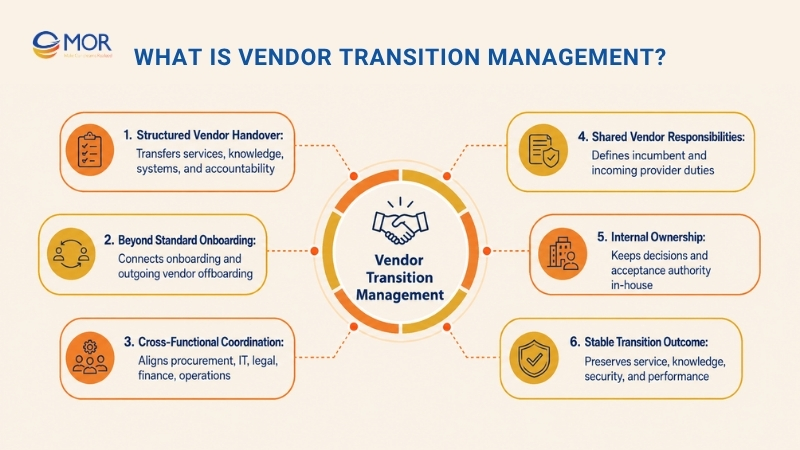
The three main parties carry different responsibilities. The incumbent needs to maintain contracted service, return assets, provide agreed documentation, and support knowledge transfer. The incoming provider needs to prepare people, environments, processes, tests, and support routes before accepting ownership.
Your internal team still owns the outcome. This point separates strong supplier transition management from a simple provider-to-provider handoff. Decision rights, data ownership, business priorities, and acceptance authority shouldn’t disappear outside the company.
The scope can cover IT outsourcing, SaaS software development platforms, cloud services, BPO, customer support, software engineering, managed salesforce services, or operational suppliers. A successful handover leaves the business with stable service, retained knowledge, secure access, verified performance, and a controlled exit for the previous provider.
Why Vendor Transitions Fail Before the Cutover
Failures often begin weeks or months before go-live. Weak preparation creates hidden gaps, then cutover merely exposes them.
Deloitte reports that 74% of organizations faced at least one third-party-related incident within three years, and one in five experienced a complete third-party failure or an incident with major consequences. Those figures put dependency visibility and transition controls much higher on the agenda than a basic handover checklist.
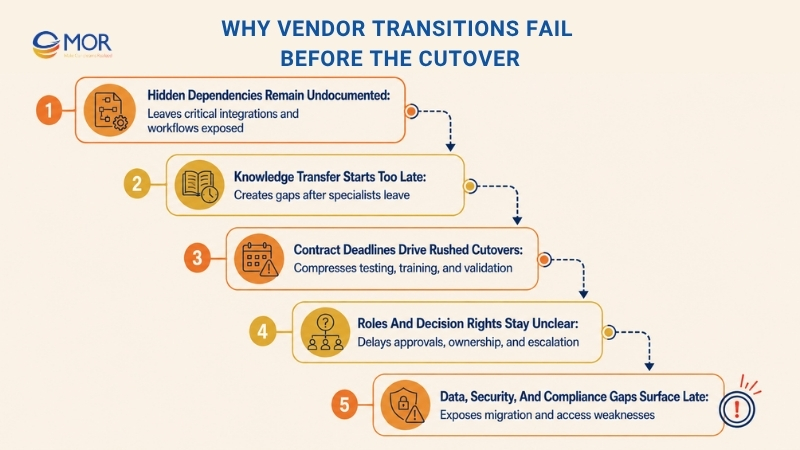
Hidden Dependencies Remain Undocumented
Vendor-held systems often contain dependencies that internal teams don’t fully see. APIs, manual workarounds, scheduled jobs, custom configuration, third-party tools, special data formats, and administrator accounts may sit outside formal documentation.
A dependency can look minor until it fails. One undocumented batch job may feed finance reporting, a hidden integration may trigger customer notifications, or an old credential may still control production access.
Map these connections before responsibility starts moving. The work should cover systems, people, business rules, data flows, infrastructure, external services, and known failure points.
Knowledge Transfer Starts Too Late
Documentation captures procedures, but experienced team members often hold the reasoning behind them. They know why a workaround exists, which errors can wait, which customer workflows behave differently, and which system changes have caused trouble before.
Starting knowledge transfer near contract expiry leaves little time to find those gaps. The new team then learns through incidents, often after the outgoing specialists have already left.
A stronger approach starts knowledge capture early and tests understanding through real work. Shadowing, reverse shadowing, incident drills, walkthroughs, and supervised execution reveal knowledge gaps that document reviews miss.
Contract Deadlines Drive Rushed Cutovers
A contract end date is a commercial milestone, not proof that the incoming provider is ready. Yet teams often build the cutover date around that deadline because renewing the incumbent adds cost.
That pressure can compress testing, training, knowledge transfer, and data validation. Big-bang handovers then transfer several unresolved risks at the same time.
Extend transition support when operational evidence doesn’t support the planned date. Paying for a short overlap may cost less than recovering a failed cutover, lost data, or extended service interruption.
Roles and Decision Rights Stay Unclear
Transitions bring more people into the room. Procurement manages contracts, IT manages systems, security reviews access, finance tracks cost, the outgoing provider supports handover, and the incoming team prepares delivery.
Problems grow when nobody knows who can approve a change or stop a cutover. A risk can sit open because two teams assume the other owns it.
Assign one transition lead and define decision authority before execution. Each deliverable, risk, milestone, and approval needs a named owner and a clear escalation route.
Data, Security, and Compliance Gaps Surface Late
Old platforms can hide years of inconsistent records, missing fields, weak permissions, or incomplete audit trails. Migration exposes those weaknesses because data must move into a new model and new access structure.
Security gaps can appear at the same time. Temporary accounts, duplicated environments, shared credentials, and overlapping provider access create a sensitive window that needs tighter control.
Compliance requirements continue during the handover. Audit records, data-retention rules, privacy controls, contractual obligations, and deletion evidence need to remain traceable throughout the change.
Build the Transition Plan Before You Give Notice
Good vendor transition management begins before the incumbent receives formal notice. Once notice is served, cooperation can change, so gather system knowledge, contract details, dependency data, and internal ownership information while access remains stable.
Planning also needs room for disruption. McKinsey research found that companies experience material disruptions lasting one month or longer every 3.7 years on average. A vendor change adds another period where operational dependencies deserve closer attention.
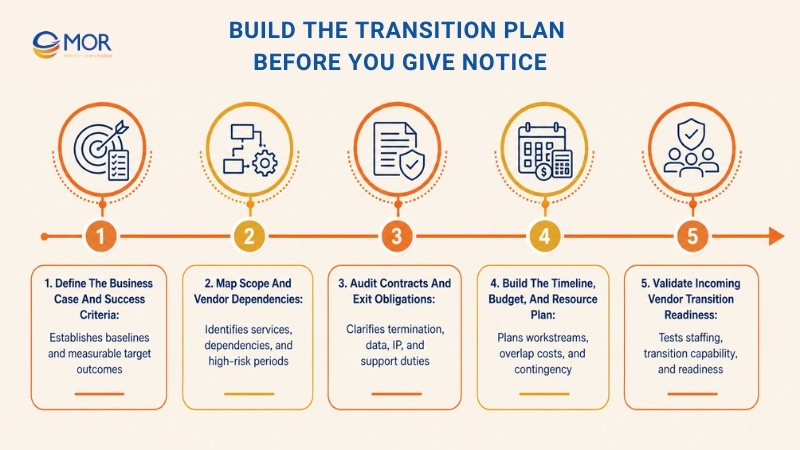
Define the Business Case and Success Criteria
Write down why the company is changing providers before discussing the transition schedule. Reasons may include recurring SLA misses, delivery delays, cost concerns, missing skills, compliance gaps, technology limits, or a need to consolidate suppliers.
Then record the current baseline. Track present uptime, incident volume, MTTR, delivery speed, defect levels, service cost, user complaints, or other measures tied to the service.
Set target outcomes against that baseline. 'No outage' is too narrow. Success may require stronger documentation, faster incident response, lower defect rates, better release control, stronger access governance, or a delivery team that can scale.
Map Scope and Vendor Dependencies
Create one inventory covering every service moving to the new provider. Include applications, integrations, APIs, data stores, cloud services, infrastructure, business processes, reports, scheduled jobs, users, locations, third parties, and support routes.
Add operational calendars as well. Payroll runs, month-end reporting, seasonal demand, regulatory submissions, product launches, and promotional periods can make certain dates unsuitable for handover.
Rank dependencies by business risk. A customer payment flow deserves tighter controls than an internal reporting tool that can tolerate a short delay.
Audit Contracts and Exit Obligations
Review the existing agreement before notice. Confirm termination clauses, notice periods, transition assistance, data-return requirements, IP ownership, asset ownership, access rights, knowledge-transfer duties, and post-exit obligations.
Pay close attention to data formats and deletion terms. 'Return customer data' means little if the agreement doesn’t say how the data must be exported or when copies must be removed.
A transition service agreement may fill gaps in the original contract. It can define support hours, knowledge-transfer sessions, data exports, access continuity, milestone responsibilities, and post-exit assistance.
Build the Timeline, Budget, and Resource Plan
Break the program into workstreams rather than one long schedule. Governance, knowledge transfer, infrastructure, data migration, security, training, testing, cutover, and contract closure often move at different speeds.
Budget for overlap. Dual vendor fees, temporary licenses, migration tooling, extra QA, travel, specialist support, and temporary staffing can all appear before the new operating model settles.
Leave contingency capacity as well. If undocumented modules or poor source-code quality appear during discovery, the plan needs space to absorb additional analysis without forcing a risky go-live.
Validate Incoming Vendor Transition Readiness
Evaluate the new provider on transition ability, not only technical talent. Ask how it assesses an inherited environment, captures undocumented knowledge, validates data, manages parallel operation, reports risk, and proves readiness.
Check staffing early. Named engineers, architects, QA specialists, business analysts, security personnel, and transition leads should be available when each workstream begins.
Transition experience deserves its own evaluation criterion. A capable development company may still struggle if its delivery model assumes a clean new project rather than an inherited production system.
Define Governance and Vendor Responsibilities
A vendor change management process needs tighter governance during handover because responsibility is split across organizations. One shared plan, named owners, short escalation paths, and visible risks keep decisions moving.
For larger programs, a vendor management system can hold contracts, deliverables, service records, risks, approvals, and performance data in one place. The tool doesn’t replace accountability, but it gives every party a common record of what has been agreed.
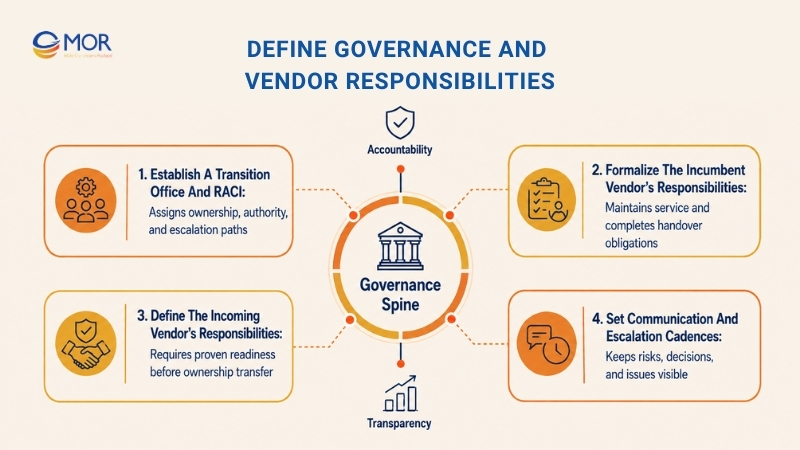
Establish a Transition Office and RACI
Assign an executive sponsor who can settle major commercial or operational conflicts. A transition manager should run the day-to-day program and coordinate workstream owners.
The RACI should cover procurement, legal, IT, security, finance, operations, HR or change teams, and leads from each vendor. Every milestone needs one accountable owner rather than several people who are 'involved'.
Decision rights deserve the same care. Define who can approve scope changes, accept residual risk, extend overlap, postpone cutover, or authorize rollback.
Formalize the Incumbent Vendor’s Responsibilities
The outgoing provider remains responsible for the service until the agreed handover point. Contract expiry shouldn’t become an excuse for falling SLA performance or unfinished transition work.
Document expected support in practical terms: people available for knowledge sessions, documentation to be delivered, data export dates, asset transfer, access continuity, incident support, and unresolved project work.
Keep the relationship professional. An adversarial exit may hurt knowledge transfer at the exact moment your team still depends on the incumbent’s cooperation.
Define the Incoming Vendor’s Responsibilities
The new provider should own its transition plan, staffing, environment preparation, training, tests, data validation, incident routes, and readiness evidence.
Acceptance shouldn’t rest on attendance at knowledge sessions. Ask the team to perform representative tasks, diagnose real problems, explain business rules, and demonstrate recovery steps.
Readiness evidence makes the transfer defensible. If the provider can’t meet agreed thresholds, ownership should remain where it is until the gap closes.
Set Communication and Escalation Cadences
Weekly transition meetings work during planning, but the cadence should increase around pilots and cutover. A short daily review may be needed when production responsibility starts moving.
Maintain a RAID log for risks, assumptions, issues, and dependencies. Add a decision log and escalation matrix so open questions don’t disappear inside email threads.
A steering committee should focus on exceptions and decisions rather than routine status reporting. Detailed work belongs with workstream teams; leaders need the items that threaten scope, cost, readiness, or continuity.
Transfer Knowledge, Data, Assets, and Access Securely
Transfer work is where vendor transition management becomes tangible. The incoming team needs more than files and credentials. It needs enough operational understanding to run the service, respond to failures, change the system safely, and explain how major components interact.
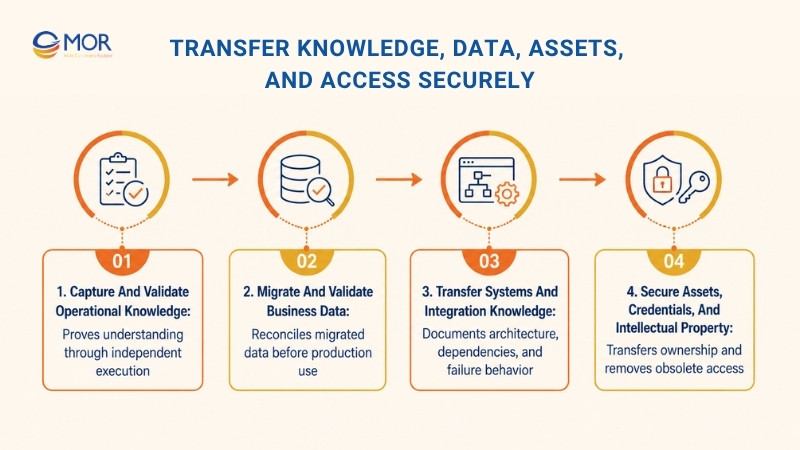
Capture and Validate Operational Knowledge
Treat knowledge as something the incoming team must demonstrate, not something the incumbent simply 'delivers'. Documents are useful, but real operating knowledge also lives in routines, exceptions, history, and judgment.
- Document explicit knowledge: Gather SOPs, runbooks, architecture diagrams, escalation paths, support scripts, known defects, deployment steps, recovery procedures, and business rules.
- Capture tacit knowledge: Interview subject-matter experts about workarounds, historical decisions, recurring incidents, fragile modules, and unusual operating conditions.
- Run shadow sessions: Let the new provider observe live activities and ask why decisions are made, rather than recording steps without their purpose.
- Use reverse shadowing: Ask the incoming team to perform work while experienced staff observe. Gaps become visible before full responsibility moves.
- Validate independent execution: Test representative incidents, releases, support requests, and operational tasks without intervention from the incumbent.
Migrate and Validate Business Data
Data migration needs its own workstream, owners, acceptance rules, and reconciliation plan. Years of production data rarely fit neatly into a new structure on the first attempt.
- Extract: Obtain complete source data in a usable format. Confirm row counts, attachments, metadata, historical records, and relationships before transformation.
- Cleanse: Remove duplicate records, flag outdated values, correct inconsistent fields, and resolve missing values that affect the target system.
- Map: Define how each source field, key, relationship, and business rule maps into the target model.
- Transform: Convert structures, formats, identifiers, and reference values according to approved mapping rules.
- Validate: Compare migrated records with trusted reference sets. Reconcile totals, relationships, permissions, and business calculations before production use.
- Archive: Keep historical data required for legal, audit, operational, or customer needs, then define who owns access after exit.
Transfer Systems and Integration Knowledge
Architecture documents should show more than application boxes. Record APIs, middleware, CI/CD pipelines, batch jobs, event queues, monitoring, cloud resources, third-party SaaS, network paths, and recovery dependencies.
The incoming team also needs failure behavior. Which retry mechanism runs after an API timeout? Which service must start first after an outage? Which integration causes downstream delays if it misses a schedule?
Test these assumptions. A controlled failure or recovery exercise often exposes missing information faster than another document review.
Secure Assets, Credentials, and Intellectual Property
Create an asset register before access begins moving. Source-code repositories, cloud accounts, domains, certificates, API keys, administrator accounts, MFA devices, licenses, design files, deployment systems, and project tools need named owners.
Third-party access deserves special attention. Verizon's 2025 Data Breach Investigations Report found that third-party involvement in breaches doubled to 30%, based on more than 22,000 security incidents and 12,195 confirmed breaches. Transition teams should treat overlapping provider access as a temporary condition, not a new normal.
Rotate credentials when responsibility changes. Revoke obsolete accounts, transfer ownership of shared services, check privileged roles, and record evidence that the outgoing provider no longer retains unnecessary access.
IP needs the same discipline. Confirm ownership of source code, custom modules, documentation, datasets, designs, scripts, and configuration created under the previous agreement.
Execute a Phased Cutover Without Disrupting Operations
The safest vendor transition strategies in outsourcing move responsibility in controlled stages. A phased handoff creates room to test assumptions, compare outputs, correct gaps, and preserve rollback options before the new provider carries the full operational load.
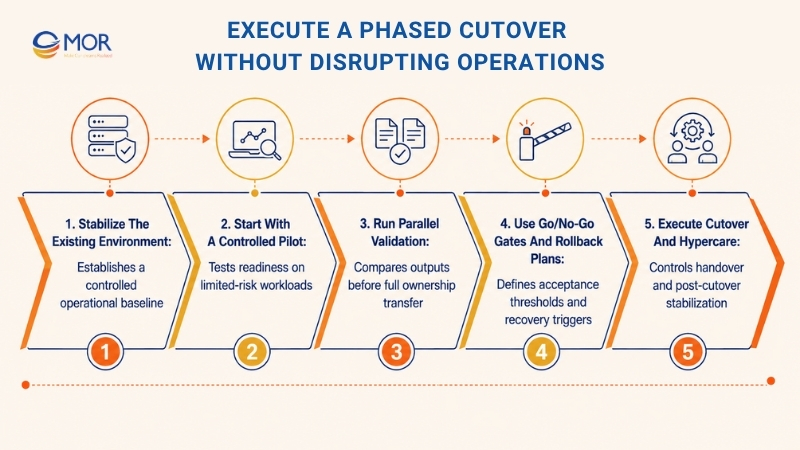
Stabilize the Existing Environment
Start from the most stable baseline possible. Resolve major incidents, secure documentation, confirm dependencies, and pause non-urgent changes that would create new variables.
Record baseline performance before the handoff. Uptime, incident rates, transaction volumes, defect levels, latency, queue depth, and support response times give you a reference for later comparison.
A short configuration freeze may also help. The purpose is controlled change, not stopping all development for weeks.
Start With a Controlled Pilot
Choose a contained workload where failure won’t create widespread business disruption. A region, internal process, low-risk module, support queue, or selected group of users can work well.
Define entry criteria before the pilot starts. Required documentation, trained staff, access, test completion, support coverage, and rollback procedures should already be in place.
Set exit rules too. The pilot should prove data accuracy, process execution, incident handling, and agreed service levels before the scope expands.
Run Parallel Validation
Parallel operation lets the new provider work while the incumbent still retains enough capability to intervene. This overlap is especially useful for complex business processes or systems that can’t tolerate long outages.
Compare transaction results, data outputs, SLA performance, response times, incident handling, and operational quality. Differences need investigation before the incoming team takes sole ownership.
Parallel work also tests communication. A team may understand the technology but still struggle with escalation routes, approval steps, or business priorities.
Use Go/No-Go Gates and Rollback Plans
Set acceptance thresholds before the planned cutover date. Open severity-one defects, failed reconciliation, incomplete access controls, or weak incident performance may justify a no-go decision.
Name the person who can stop the cutover. During a high-pressure release window, unclear authority costs valuable time.
Rollback plans need exact triggers and restoration steps. Record required backups, recovery points, data reconciliation rules, communications, technical owners, and the maximum acceptable recovery window.
Execute Cutover and Hypercare
The cutover runbook should assign every activity, time slot, dependency, validation check, and owner. Teams need one live source of truth during execution.
Set up a focused command structure for the handover period. Incident routing, communications, security review, technical validation, vendor coordination, and business approval should have clear owners.
Hypercare continues after the cutover. Track incidents, defects, SLA performance, user feedback, and business measures daily until results stay inside agreed limits for a defined period.
Control Risk, Compliance, and Business Continuity
Risk control should run through vendor transition management rather than sit in a separate spreadsheet reviewed once a month. Each major risk needs a trigger, owner, response action, and escalation route.
Security deserves more attention as vendor ecosystems grow. The World Economic Forum's Global Cybersecurity Outlook 2026 reports that 65% of large companies now see third-party and supply-chain vulnerabilities as their greatest cyber-resilience challenge, up from 54% in 2025.
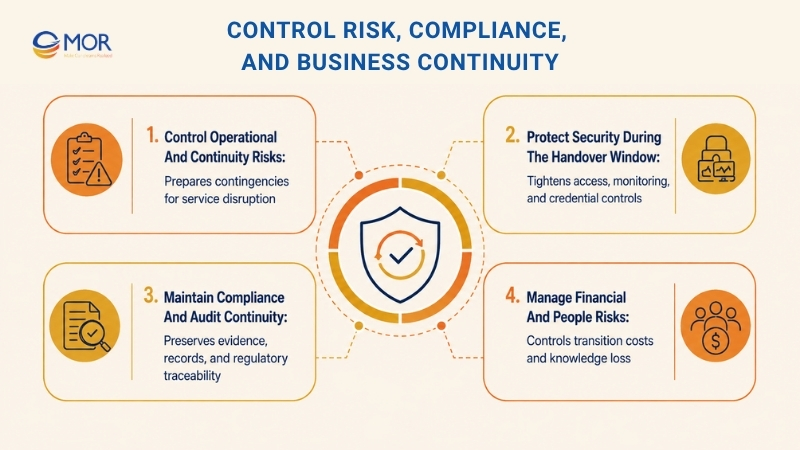
Control Operational and Continuity Risks
Operational risk grows when people, processes, and systems move at different speeds. Keep continuity plans practical enough to execute under pressure.
- Map service interruption scenarios: Identify events that could stop delivery, customer access, payments, reporting, or other high-value operations.
- Plan for capacity gaps: Keep backup resources available when transition work adds load to teams already supporting production.
- Track dependency failures: Monitor third-party services and shared systems that can block the incoming provider.
- Prepare for vendor non-cooperation: Secure documentation, data, access, and internal subject-matter knowledge early.
- Keep contingency capacity: Reserve time and people for issues that discovery cannot predict.
Protect Security During the Handover Window
Two providers may temporarily need access to the same environment. That overlap makes identity control and logging especially sensitive.
- Apply role-based access: Give each person only the permissions needed for current transition tasks.
- Require MFA: Protect privileged and remote accounts before expanding access to the incoming team.
- Rotate credentials: Replace shared or vendor-held secrets as soon as ownership changes.
- Monitor provider activity: Log privileged actions, administrator access, data exports, and configuration changes.
- Test security controls: Check authentication, permissions, network rules, logging, and incident response before cutover.
Maintain Compliance and Audit Continuity
Regulatory duties don’t stop because the provider changes. Design compliance evidence into the plan so auditors can trace what happened during the transition.
- Preserve audit trails: Keep logs and records accessible across old and new environments.
- Check data residency: Confirm where data sits during migration, backup, testing, and archival.
- Retain required records: Carry legal and regulatory retention rules into the target environment.
- Document control changes: Record who approved access, data movement, exceptions, and final deletion.
- Confirm vendor deletion: Collect evidence that unnecessary client data has been removed after exit.
Manage Financial and People Risks
Transition cost often rises before it falls. Dual-running fees, temporary licenses, training, specialist support, and extra QA need to sit in the budget from the start.
- Track overlap cost: Compare actual incumbent and incoming vendor spend against the approved transition budget.
- Protect knowledge holders: Identify people whose departure would leave major knowledge gaps and plan retention or accelerated capture.
- Reserve training capacity: Operational teams need time to learn new tools, processes, and escalation routes.
- Watch hidden implementation work: Legacy defects and undocumented dependencies can add effort after assessment begins.
Measure Transition Success With KPIs and Acceptance Criteria
Completion should depend on evidence rather than a calendar date. Vendor transition management works best when each stage has measurable acceptance criteria tied to service, knowledge, data, security, user readiness, delivery, and cost.
Baseline each measure before migration. Without a starting point, you won’t know whether the new provider has matched existing performance or whether a post-cutover change represents progress or regression.
Area | Example Transition KPI | What It Validates | Evidence / Owner |
Service continuity | Uptime / availability | Business operations remain stable | Monitoring dashboard / IT |
Incident management | MTTR | Incoming vendor resolves issues | Incident platform / Operations |
Knowledge transfer | % tasks completed independently | Incoming team can operate without incumbent support | KT scorecard / Transition lead |
Data migration | Reconciliation accuracy | Data moved completely and correctly | Validation report / Data team |
SLA performance | SLA attainment rate | Service meets contracted expectations | SLA dashboard / Vendor manager |
Defects | Critical defects open | System readiness for handoff | Defect register / QA |
User readiness | Training completion / adoption | Teams can operate new processes | LMS / Change lead |
Transition delivery | Milestones completed on time | Program remains controlled | Project plan / PMO |
Compliance | Controls validated | Regulatory continuity remains intact | Audit evidence / Compliance |
Financial performance | Actual vs. transition budget | Spending remains within approved limits | Finance report / Finance |
Assign an owner to every KPI and define the minimum acceptable result. A dashboard without decision rules only reports problems after they appear.
Use the same measures for go/no-go reviews and hypercare exit. For instance, the team may require zero unresolved severity-one defects, full reconciliation of priority data, and a defined period of stable SLA performance before closing the transition.
Acceptance criteria should also include knowledge. If the new provider still needs the incumbent to resolve common incidents, the handover isn’t complete.
Stabilize Operations and Close the Vendor Transition
Cutover moves service responsibility, but closure ends the dependency on the outgoing provider. Keep monitoring tight until the new operating model has performed reliably under normal business conditions.
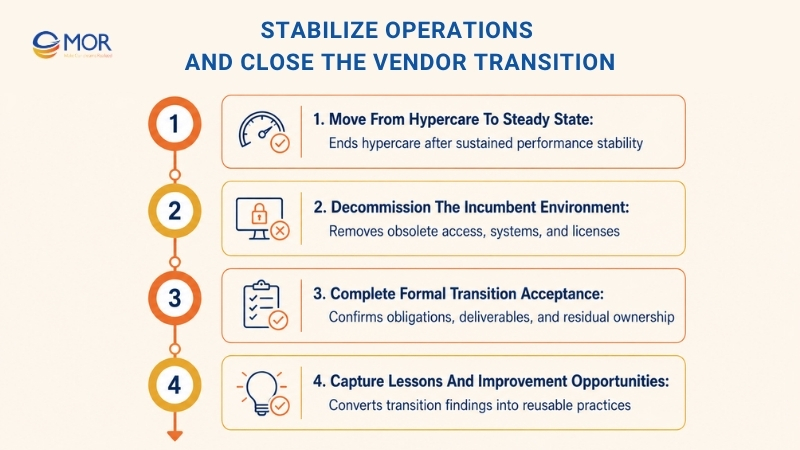
Move From Hypercare to Steady State
Hypercare should end only after agreed measures remain stable for a set period. Incident levels, SLA results, transaction accuracy, backlog, system performance, and user issues should all sit within accepted thresholds.
Transfer open items into normal governance rather than leaving a temporary transition team alive indefinitely. Name operational owners for residual risks and unfinished improvement work.
Decommission the Incumbent Environment
Revoke user and service accounts that the outgoing provider no longer needs. Rotate credentials, remove old VPN routes, terminate unused integrations, close redundant licenses, and transfer physical or digital assets.
Confirm archival requirements before deleting anything. The company may still need old logs, data, support history, or records for audit and regulatory purposes.
Finish with documented deletion confirmation where the contract requires it. Access reviews should also verify that administrator privileges have moved to current owners.
Complete Formal Transition Acceptance
Formal acceptance should confirm delivery of documents, data, assets, service responsibilities, support procedures, and contractual obligations. Open risks need named owners and dates rather than disappearing at project closure.
Teams that follow project closure PMI practices can apply the same discipline here: confirm acceptance, close outstanding commercial items, capture lessons, and hand ownership into normal operations. PMI's vendor-transition guidance also calls for lessons learned, contract closeout, data destruction where required, and continued SLA monitoring.
Capture Lessons and Improvement Opportunities
Run a post-transition review once operations settle. Ask what created delay, which assumptions failed, where documentation was weak, and which controls prevented larger problems.
Turn those findings into reusable assets. Update templates, risk registers, acceptance rules, contract clauses, knowledge-transfer methods, and cutover runbooks before the next supplier change.
A good transition leaves the organization less dependent on hidden knowledge than it was before. That operational learning may be one of the most valuable outcomes of the entire program.
Vendor Transition Management Checklist by Phase
A vendor transition checklist gives leaders a compact view of what must happen before responsibility moves. Use it as a control summary, then keep detailed tasks, owners, evidence, and deadlines in the main project plan.
Phase | Key Actions | Exit Criteria |
Assess | Confirm business case, risks, target outcomes | Decision to transition approved |
Prepare | Audit dependencies, contracts, data, assets, access | Transition scope validated |
Govern | Assign sponsor, transition lead, RACI, escalation paths | Decision rights confirmed |
Mobilize | Confirm vendor teams, timeline, tools, environments | Both vendors ready |
Transfer | Complete documentation, KT, data and asset handover | Incoming vendor demonstrates capability |
Validate | Pilot, parallel run, testing, security validation | Acceptance thresholds met |
Cut over | Execute runbook and move responsibility | Go-live approved |
Hypercare | Monitor incidents, KPIs, defects, user effects | Performance stabilized |
Close | Revoke old access, close contracts, capture lessons | Formal transition sign-off |
Improve | Move improvement backlog into normal governance | Steady-state model active |
Don’t treat the table as a fixed template. Service type, dependency depth, regulation, data volume, provider cooperation, and business timing can change the sequence or add extra gates.
The main control rule stays consistent: vendor transition management should move to the next phase only when the current phase has produced enough evidence to support that decision.
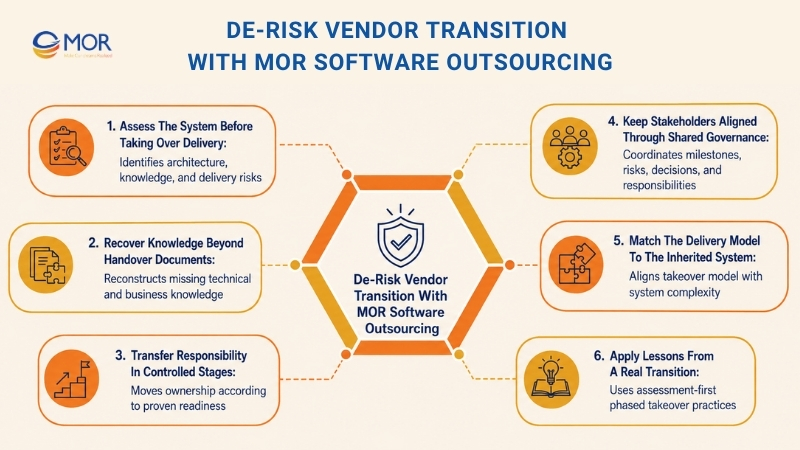
De-Risk Vendor Transition with MOR Software Outsourcing
Replacing an outsourcing provider becomes harder when a live system has years of undocumented business logic, legacy code, weak testing, active release commitments, and knowledge concentrated in the existing team. MOR Software JSC approaches vendor transition management as an operational takeover where system stability must continue while knowledge and delivery responsibility move behind the scenes.
MOR supports this work through software outsourcing, IT consulting, QC and testing, project-based development, and Offshore Development Center models. Its service materials also document business analysis, software architecture consulting, infrastructure management, DevOps and QA support, and development teams covering back-end, front-end, mobile, Salesforce, and AWS environments.
Assess the system before taking over delivery
MOR company reviews business goals, functions that can’t be interrupted, current architecture, source code, documentation, development practices, and known project risks before assigning full delivery responsibility. Warning signs include outdated documents, knowledge concentrated in a few people, hard-to-maintain legacy code, limited testing, and difficult communication with the incumbent. Assessment findings then shape staffing, transition timing, knowledge-transfer depth, milestones, and risk controls rather than forcing the project into a standard template.
Recover knowledge beyond handover documents
MOR combines documentation review with source-code analysis, observation of the running system, workshops with the client, and communication with the outgoing team when that team remains available. If information is missing, engineers can break the application into modules, reconstruct business rules, record technical findings, and update the shared knowledge base as understanding grows.
Transfer responsibility in controlled stages
MOR favors a phased takeover when project conditions support it. The incoming team can learn the environment while the incumbent continues current operations, then assume responsibility for selected components as readiness improves. Business-sensitive functions, revenue-related workflows, production stability, and time-bound releases receive closer monitoring during that period.
Keep stakeholders aligned through shared governance
The transition plan defines responsibilities for the client, MOR, the outgoing provider, and relevant third parties. Teams work against common milestones, risk logs, reporting routines, and decision records. MOR's ODC model outsourcing setup also covers resource planning, collaboration methods, communication channels, risk control, quality planning, onboarding, team management, and later scaling.
Match the delivery model to the inherited system
A contained migration, modernization, or takeover may fit project-based delivery. Companies needing longer-term development, maintenance, and product ownership can build an ODC or dedicated team spanning business analysis, project management, engineering, architecture, QA/QC, and bridge communication. MOR's documented service material references ISO 9001:2015, ISO 27001:2013, Agile development practices, DevOps support, and ISTQB-related testing capabilities.
Apply lessons from a real transition
In a construction-sector transition discussed by MOR Software CEO Vu Van Tu, the client had relied on its previous vendor for years. The live system still served users, feature work was behind schedule, documentation was limited, and much of the business knowledge remained with the incumbent team. MOR assessed the high-risk parts first, rebuilt missing knowledge, documented findings, and assigned experienced engineers. Vu Van Tu's vendor transition article describes the same assessment-first, step-by-step philosophy behind this approach.
MOR then assumed new-feature development while the previous provider continued maintenance and daily operations. When undocumented behavior, code-quality problems, and technical limits appeared, the teams adjusted the plan with the client rather than forcing the original schedule.
The new functionality was released under the revised plan, maintenance responsibility followed later, and the system stayed stable. The client also received updated system documentation, turning transition work into a stronger knowledge base for future development.
This model fits companies replacing an outsourcing vendor for a live software platform, especially where legacy technology, incomplete documentation, complex integrations, active delivery commitments, or concentrated system knowledge raise takeover risk. If your team is preparing a switch, talk to MOR Software about the current architecture, documentation gaps, delivery obligations, transition risks, and the delivery model needed before locking the cutover date.
Conclusion
Strong vendor transition management moves responsibility only as fast as knowledge, controls, and operational readiness can move with it. Plan before notice, retain internal ownership, prove knowledge through real work, validate each handoff, measure acceptance objectively, and close old access securely. Companies facing a complex outsourcing switch can work with MOR Software to assess the current system and build a controlled takeover plan that protects delivery while the new team assumes responsibility. Contact MOR Software to review your transition scope, documentation gaps, and handover risks before setting the cutover date.
MOR SOFTWARE
Frequently Asked Questions (FAQs)
What is vendor transition management?
It is the planned transfer of services, knowledge, data, assets, system access, and operating responsibility from one vendor to another. The process starts before the outgoing provider leaves and continues until the incoming team proves it can meet agreed service, security, knowledge, and performance requirements without relying on the previous provider.
What are the main phases of a vendor transition?
Most transitions move through assessment, preparation, governance setup, mobilization, knowledge and data transfer, validation, cutover, hypercare, and formal closure. Complex environments may add pilots, parallel operation, security testing, or several phased handoffs. Each stage should have clear entry and exit rules rather than moving forward because a date arrived.
How long does a vendor transition usually take?
There is no standard duration. Timing depends on service complexity, integration depth, data volume, documentation quality, regulatory controls, resource availability, incumbent cooperation, and the number of business processes moving. A small SaaS replacement may take weeks, while a large outsourcing takeover can require several months of assessment, knowledge transfer, parallel work, testing, and staged ownership.
What should be included in a vendor transition plan?
The plan should cover scope, dependencies, milestones, budget, staffing, RACI, contracts, knowledge transfer, data migration, access management, testing, risk controls, communication, cutover, rollback, hypercare, KPIs, and closure. Add acceptance criteria to major milestones so leaders can judge readiness through evidence rather than status reports or schedule pressure.
Who should own a vendor transition project?
Your organization should retain overall ownership, even when a provider runs much of the work. One internal transition lead should coordinate decisions, risks, milestones, and stakeholders under an executive sponsor. Workstream owners can then manage areas including IT, operations, procurement, legal, security, finance, data, HR, and change management.
How should knowledge transfer be managed between vendors?
Start early and use several knowledge sources. Combine documentation, source-code reviews, live walkthroughs, interviews, shadowing, reverse shadowing, incident exercises, and supervised tasks. The incoming team should then demonstrate independent execution. Attendance at training sessions doesn’t prove operational readiness if the team still depends on the outgoing provider during real incidents.
Should outgoing and incoming vendors operate in parallel?
Parallel operation is useful when service interruption carries high business risk and the outgoing provider remains available. The incoming team can perform selected work under observation while outputs, incidents, response times, and service levels are compared. Responsibility then moves gradually after the new provider meets agreed acceptance thresholds.
What KPIs should be tracked during a vendor transition?
Track measures tied to continuity, readiness, quality, data, service, cost, and user operation. Common KPIs include uptime, MTTR, SLA attainment, data reconciliation accuracy, open high-severity defects, independent task completion, training completion, milestone status, validated compliance controls, and actual spend against the approved transition budget.
How can companies lower vendor transition risks?
Start preparation before formal notice, map hidden dependencies, secure company-owned access, capture knowledge early, and assign clear decision rights. Use pilots or parallel operation for high-risk services, define rollback conditions, test data and security controls, and keep contingency resources available. The transition pace should follow demonstrated readiness rather than contract pressure.
When is a vendor transition considered complete?
Completion occurs when the incoming provider meets agreed service and acceptance criteria, knowledge transfer has been proven through independent work, data and assets have been reconciled, and normal governance has started. The outgoing provider's unnecessary access should be removed, remaining obligations closed, deletion evidence collected where required, and lessons transferred into the organization's transition playbook.
Share


Make Our-Dreams Realized


© 2023 . MOR Software. All Rights Reserved
Sitemap
Privacy Policy
Terms of Use

Rate this article
0
over 5.0 based on 0 reviews
Your rating on this news:
Name
*Email
*Write your comment
*Send your comment
1