


AI MVP Development: A Complete Guide From Idea to Launch 2026
AI MVP development helps businesses test an AI product before committing to a full build. A focused MVP can validate user value, model reliability, and commercial fit through real workflows, real data, and measurable outcomes. That matters as AI adoption outpaces scaling. McKinsey found that 88% of organizations used AI in at least one business function in 2025, yet only 7% had fully scaled it. In this MOR Software guide, you will know what to build, how to test it, what it may cost, and when the evidence supports further investment.
Key Takeaways
- An AI MVP should validate one user problem, one AI capability, and one measurable business outcome before the scope grows.
- Data quality, evaluation cases, fallback logic, user testing, latency, and AI running costs belong in the first release plan.
- The decision after launch should come from evidence. Scale when users return, AI quality meets the agreed threshold, and the economics remain workable.
What Is AI MVP Development?
AI MVP development is the process of building the smallest usable version of an AI product that can test a real business hypothesis with target users. AI has to perform part of the job that creates the product's main value, rather than sit beside the workflow as a novelty.
A customer-support product is a simple example. The MVP might read a support ticket, retrieve approved company knowledge, draft an answer, cite its source, and send uncertain cases to an employee. That narrow flow can test usefulness much faster than building a full service platform.
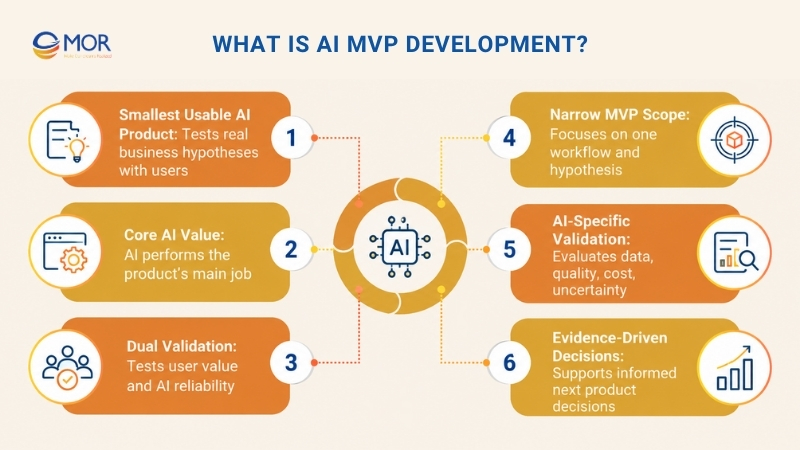
The first release should answer two questions. Do users gain enough value to keep using the product, and can the AI produce acceptable results under normal operating conditions?
That second question changes the MVP model. AI output can vary across similar inputs, so product teams need real examples, acceptance rules, fallback paths, and usage logging before they can judge viability.
A useful scope normally contains one target user, one main workflow, and one measurable hypothesis. A team building a document-review product, for instance, might test whether analysts can process contracts faster without increasing material review errors.
The approach fits closely with broader MVP development services, but AI adds a second validation layer around model quality, data, inference cost, and uncertain output. Teams considering AI assisted MVP development should define these factors before coding begins.
At this stage, polished screens and a long roadmap carry less value than a working loop. The MVP must produce enough evidence to support the next product decision.
How Is an AI MVP Different From a Traditional MVP?
A traditional MVP mainly tests product demand and workflow fit. AI MVP development has to test those areas plus model behavior, data dependence, output quality, latency, and variable AI costs.
Traditional software also follows defined logic more consistently. An AI system may answer the same task in slightly different ways, which means QA has to examine quality distributions and failure patterns rather than pass or fail states alone.
Comparison Area | Traditional MVP | AI MVP |
Core hypothesis | Workflow and product demand | Workflow demand plus AI capability |
Output behavior | Mostly deterministic | Probabilistic |
Data dependency | Moderate in many products | Often central to output quality |
Testing | Functional QA | Functional QA plus AI evaluation |
Failure handling | Bugs and error states | Guardrails, fallback, human review |
Monitoring | Application health | Application health plus model/output quality |
Cost model | Development and hosting | Development, hosting, inference, data, evaluation |
Success measures | Adoption and retention | Adoption, output quality, human effort, cost, retention |
An AI demo proves that a model can perform a task under selected conditions. It may rely on clean prompts, hand-picked documents, or a developer who knows exactly how to operate it.
A prototype serves a different purpose. It tests interaction, flow, or screen design and may use mocked AI output. If your team is uncertain about these stages, our PoC vs MVP comparison can help separate technical feasibility testing from market-facing validation.
A proof of concept usually asks a narrower technical question: can this model classify the documents, extract the fields, detect the objects, or answer questions against the dataset? AI PoC and MVP development services may cover adjacent stages, but the deliverables shouldn't be treated as interchangeable.
The MVP goes further. Real users interact with the product, real or representative data passes through the system, and the team tracks what happens when the AI is right, wrong, slow, uncertain, or expensive.
That distinction becomes especially important for an AI MVP generator or rapid builder. A tool may assemble a working interface very quickly, yet the resulting app still needs representative evaluation, user behavior data, and operating controls before it provides strong product evidence.
When Should Businesses Build an AI MVP?
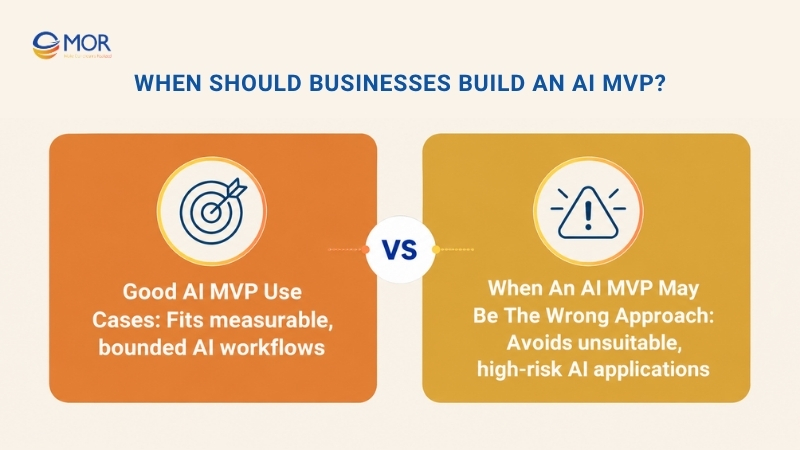
Businesses should consider AI MVP development when AI can improve a defined task in a measurable way and the idea still contains enough uncertainty to justify a smaller first investment. The strongest candidates usually involve pattern recognition, natural language, large document sets, prediction, or workflows where manual work takes substantial time.
The commercial case is becoming easier to see. PwC's 2026 AI Jobs Barometer found that companies in the most AI-exposed sectors recorded 34% productivity growth in 2025 relative to a 2018 baseline, compared with 24% among the least exposed companies. A product still needs its own evidence, but the broader data supports testing focused business uses rather than adopting AI without a target outcome.
Good AI in MVP development starts with a process that already has a known pain point. If the business can't state the current problem, baseline time, error rate, cost, or user friction, the MVP will struggle to prove anything meaningful.
Good AI MVP Use Cases
The first use case should have a narrow boundary and an output that a user can judge. AI for MVP development fits well when the product can learn from real usage without exposing the business to unacceptable failure.
- Knowledge retrieval and RAG: Connect an LLM to approved policies, manuals, contracts, or product documentation so users can retrieve grounded answers.
- Document extraction: Pull names, dates, values, clauses, categories, or structured fields from invoices, forms, reports, and other files.
- AI customer support: Classify tickets, retrieve supporting information, draft replies, or route cases to the correct team.
- Content generation: Produce first drafts under clear rules for tone, format, facts, and approval.
- Recommendations: Rank products, content, actions, or cases using user and business data.
- Workflow automation: Read an input, make a bounded decision, call an API, and pass the result to the next system or human reviewer.
- Classification: Sort text, images, transactions, leads, support cases, or operational records into predefined groups.
- Forecasting and prediction: Estimate demand, churn, maintenance needs, risk, or another result where historical data supports testing.
When an AI MVP May Be the Wrong Approach
AI adds variable behavior, data requirements, and running costs. A standard software workflow may be the better first release when rules already solve the task reliably.
- Fixed rules already work: A deterministic process can be cheaper, easier to test, and easier to maintain.
- Near-perfect output is mandatory: An autonomous AI flow may be unsuitable if one wrong answer creates unacceptable operational or legal exposure.
- Representative data isn't available: The team can't judge model performance against real conditions without relevant examples.
- AI adds little product value: A standard SaaS workflow may solve the same customer problem with fewer dependencies.
- Operating controls exceed MVP scope: Sensitive workflows may require identity controls, audits, human approval, and data restrictions before pilot use.
- Existing software already covers the job: Buying or integrating an existing tool can make more sense than funding a custom build.
For early product teams, this decision also connects to app development for startups. The product should start with the customer's job, then determine whether AI deserves a place in the first release.
What Should an AI MVP Include?
Minimum scope should still form a complete product loop. AI-powered MVP development needs enough product, data, AI, and operating logic to test the core assumption without building all the capabilities planned for later versions.
The table below separates work that normally belongs in V1 from work that can wait until evidence supports expansion.
MVP Component | Include in V1 | Usually Defer |
User journey | One complete core workflow | Several personas and secondary workflows |
AI capability | One validated use case | Multi-model orchestration |
Data | Minimum authoritative dataset | Enterprise-wide ingestion |
Model layer | Managed model or API where practical | Custom training without supporting evidence |
Evaluation | Representative evaluation set | Broad benchmark suites |
UX | Functional, trust-oriented flow | Full design system |
Feedback | Corrections, ratings, review notes | Deep feedback analytics |
Guardrails | Error states, refusal, fallback | Heavy policy automation |
Monitoring | Quality, errors, latency, cost | Full enterprise observability |
Infrastructure | Production-lean deployment | Peak-scale architecture |
A good AI powered MVP development services scope keeps the investment tied to what the pilot must prove. It also prevents an AI powered MVP from becoming a half-built enterprise platform before target users have validated the main workflow.
Several items usually belong outside V1. Secondary use cases, deep personalization, complex admin functions, premature fine-tuning, wide integration coverage, and infrastructure for traffic the product doesn't yet have can wait.
The interface can stay lean, but it still needs to communicate AI behavior. Users should understand where output came from, what they can edit, what happens after a failure, and when a person takes over.
The product also needs a way to capture feedback. A simple approve, edit, reject, or flag action can tell the team far more than a polished dashboard with no link to output quality.
AI powered MVP development works best when every V1 component connects to a testable assumption. Anything that doesn't support the main user outcome, manage a known risk, or collect decision data should face a high bar for inclusion.
AI MVP Development Process: 7 Steps From Idea to Launch
The AI MVP development process should turn unknowns into evidence in a deliberate order. Each phase needs an output that the product, engineering, or business team can inspect before more budget moves into the build.
That discipline matters because enterprise AI spending alone doesn't guarantee returns. IBM reported in 2025 that only 25% of surveyed CEOs said their AI initiatives had delivered expected ROI, and just 16% said AI had scaled across the enterprise.
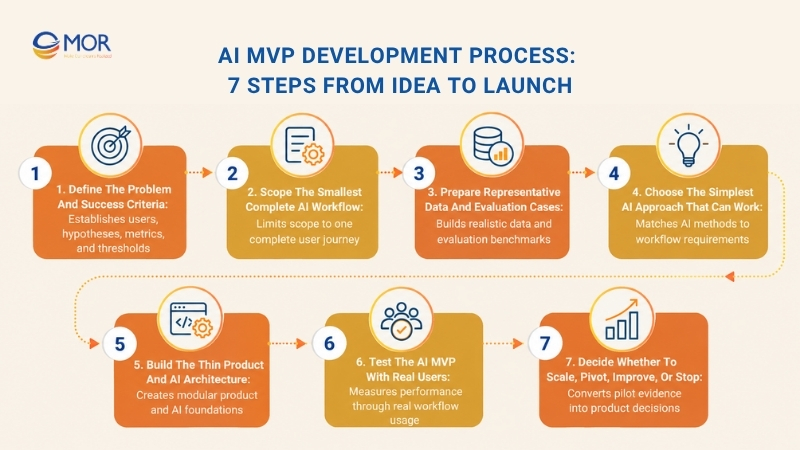
1. Define the Problem and Success Criteria
Start with the user and the job that needs improvement. Write down who performs the task, how it works now, where time or money is lost, and what result would make the proposed AI product worth adopting.
Turn that into one falsifiable hypothesis. A support MVP might test whether agents can resolve a defined class of tickets 30% faster while keeping escalation and correction rates within an agreed threshold.
- Name the first user: Avoid broad targets such as 'operations teams.' Pick one role with one repeatable job.
- Record the current method: Document time, handoffs, tools, manual checks, and known failure points.
- Define the AI contribution: State exactly which part of the task the model performs.
- Choose product metrics: Track completion, repeat use, time saved, adoption, or willingness to pay.
- Choose AI metrics: Track acceptance, correction, refusal, material errors, latency, and cost.
- Set stop conditions: Agree on evidence that would cause the team to narrow, change, or stop the product.
This stage also prevents teams from treating AI assisted MVP development as a race to generate code. A faster build has little value if nobody agrees on what the release is supposed to prove.
2. Scope the Smallest Complete AI Workflow
Map one journey that users can complete without a developer sitting beside them. The flow should include input, AI processing, user review, the resulting action, and a visible failure path.
Keep every planned function tied to that path. If a capability doesn't change the experiment, move it to a later backlog.
- Map the start and finish: Define what triggers the workflow and what counts as completion.
- Separate must-haves: Include only functions needed to deliver the outcome or manage material risk.
- Mark AI touchpoints: Show where the model reads, creates, classifies, retrieves, predicts, or acts.
- Define human checkpoints: Add approval where low-confidence or high-risk results need review.
- Write exclusions: Record what the MVP won't support so scope doesn't drift during development.
For example, a sales proposal MVP might need CRM data retrieval, a proposal draft, source references, user editing, and save/export. Team analytics, template marketplaces, and ten CRM connectors can come later.
3. Prepare Representative Data and Evaluation Cases
Data determines what the team can test. A clean demo dataset may create impressive output, yet it won't tell you how the product behaves when documents are incomplete, old, duplicated, contradictory, or written differently.
Before tuning prompts or selecting a final model, create a small set of representative cases. Include normal tasks, hard tasks, missing information, conflicting sources, invalid requests, and cases that should go to a person.
- Audit availability: Confirm the data needed for the main workflow actually exists.
- Check permissions: Record who may access each source and what information the model can receive.
- Inspect quality: Find missing values, duplicates, stale records, inconsistent formats, and weak labels.
- Build evaluation cases: Pair representative inputs with expected outcomes or expert grading rules.
- Protect a test set: Keep part of the data away from routine tuning so later comparisons remain useful.
A custom MVP development AI plan may need proprietary training or domain data, but custom modeling shouldn't be the default. The evidence should show that managed models, prompting, or retrieval cannot meet the agreed threshold before the team funds heavier model work.
4. Choose the Simplest AI Approach That Can Work
Model choice should follow the job, data, and risk level. Teams often start with OpenAI, Anthropic Claude, Google Gemini, or another managed model because API access removes a large amount of model infrastructure from the first release.
RAG makes sense when answers need current or proprietary knowledge. Traditional machine learning may fit classification or prediction tasks with structured historical data, and an agent may fit workflows that need tool calls and several dependent actions.
- Prompting: Use it when the model can complete the job from the user's input and supplied instructions.
- RAG: Add retrieval when the answer depends on company documents or frequently changing knowledge.
- Traditional ML: Consider it for repeatable prediction, scoring, detection, or classification tasks with suitable historical data.
- Fine-tuning: Reserve it for demonstrated gaps that prompting and retrieval can't close.
- Agents: Use them when the task requires controlled tool calls, state, or several ordered actions.
Model quality is only one selection factor. The team also needs to compare response time, security requirements, expected usage cost, model availability, structured-output support, and how easy it is to switch providers later.
5. Build the Thin Product and AI Architecture
Now the team turns the tested workflow into a usable product. The architecture needs enough separation between the user interface, business logic, AI provider, data, and monitoring to make changes without rewriting the application.
For teams planning broader AI app development after validation, clean boundaries at the MVP stage make later migration easier.
- Frontend: Build the screens needed for the main user path.
- Backend/API: Handle business rules, model requests, integrations, and retries.
- Authentication: Protect accounts and any user-specific information.
- Database: Store product data, user state, feedback, and relevant logs.
- AI layer: Keep model prompts, routing, retrieval, and output rules under version control.
- Data pipeline: Ingest, clean, chunk, index, or transform information when the use case requires it.
- Validation: Check structure, required fields, citations, and rules before AI output moves deeper into the workflow.
- Failure handling: Define timeouts, refusals, retries, manual fallback, and unavailable-service behavior.
- Monitoring: Log model version, latency, cost, errors, and relevant quality signals.
- Feedback: Give users a quick way to accept, correct, reject, or report output.
A vibe code app builder can speed up early interface work or internal prototypes. Teams comparing that route with standard engineering can also review the best AI tools for vibe coding before deciding which parts of the MVP need custom code.
6. Test the AI MVP With Real Users
Internal QA can confirm functions and catch known failures, but it can't recreate the full range of user behavior. A bounded pilot brings the product into actual workflows without exposing a large audience too early.
Select users who match the target persona and give them real tasks. Watch what they do before asking what they think, since behavior often reveals friction that interviews miss.
- Track task completion: Did users finish the intended job?
- Measure accepted output: How often could users use the AI result without material correction?
- Record edits: Large or repeated changes often reveal a prompt, retrieval, or workflow problem.
- Group failures: Separate wrong answers, missing data, retrieval misses, tool errors, latency, and UX confusion.
- Measure repeat use: A useful first experience matters less if users don't return.
- Capture cost: Record model and infrastructure cost per completed task, not only total API spend.
This stage is where AI MVP development best practices become measurable. Real behavior gives the team evidence to tune the product, narrow the use case, or rethink the AI approach.
7. Decide Whether to Scale, Pivot, Improve, or Stop
The pilot should end with a decision, not an automatic extension of development. Compare actual results with the thresholds agreed before the build.
Look at model quality and product value separately. High AI accuracy with weak repeat use points to a product problem, whereas strong adoption with heavy correction work points to an AI quality or workflow problem.
- Scale: Move forward when user value, AI quality, operating cost, and risk stay inside the target range.
- Improve: Keep the same hypothesis but fix recurring prompt, data, retrieval, UX, or integration problems.
- Pivot: Change the user, workflow, or technical method when evidence shows value in a different direction.
- Narrow: Remove edge cases that create disproportionate cost or failure.
- Stop: End the project when demand, economics, reliability, or operating constraints don't support further investment.
Stopping can still be a useful MVP result. A small failed test is cheaper than discovering the same issue after a full product build.
How Much Does AI MVP Development Cost and How Long?
There is no fixed AI MVP development price. A single API-backed workflow, a RAG knowledge assistant, an AI SaaS platform, and a regulated product carry very different data, integration, evaluation, security, and infrastructure work.
Current 2026 vendor guides illustrate that spread. MarsDevs lists AI functions in an existing app at $5,000 to $15,000 and RAG-oriented MVPs at $10,000 to $30,000 in one guide, with a separate RAG estimate reaching $20,000 to $80,000 depending on document and pipeline complexity. Infinity Sky AI places many AI SaaS MVPs between $15,000 and $60,000, and Bitsens places regulated builds much higher once audit and compliance work enters scope.
Treat the ranges below as planning bands rather than fixed market averages.
MVP Complexity | Typical Scope | Estimated Cost ($) | Main Cost Drivers | Typical Timeline |
Lean AI feature | One AI workflow using OpenAI, Anthropic, Gemini, or another managed API | 5,000–20,000
| API integration, prompt engineering, basic UX, output handling | 2–6 weeks |
RAG MVP | Proprietary documents, embeddings, retrieval, grounding, citations, evaluation | 15,000–50,000
| Data ingestion, vector search, permissions, retrieval quality, evaluation | 4–8 weeks |
AI SaaS MVP | Authentication, user roles, database, billing, dashboard, AI workflow, integrations | 20,000–60,000
| Product engineering, AI integration, user management, billing, analytics | 6–12 weeks |
Agentic AI workflow | LLM agents that call tools, APIs, CRMs, databases, or execute multi-step actions | 15,000–50,000+
| Tool integration, orchestration, permissions, guardrails, failure handling | 4–12 weeks |
Regulated AI MVP | Sensitive data, human review, audit logs, stronger access control and compliance | 60,000–200,000+
| Security, compliance, auditability, data governance, integrations, testing | 12–24 weeks |
These categories overlap. An AI SaaS product may use RAG, and an agentic workflow may process regulated information, so adding each row together would produce a misleading estimate.
A broader 2026 pricing survey from Ciphernutz places AI MVP builds at roughly $15,000 to $150,000+, with regulated or heavily customized systems moving beyond that range. The spread reflects architecture and operating risk, rather than the label 'AI MVP' alone.
Several cost drivers deserve attention before a team accepts an estimate:
- Data preparation: Messy documents, weak labels, access restrictions, and inconsistent records create extra engineering work.
- Integrations: Salesforce, ERP systems, payment tools, internal databases, and external APIs add backend work and testing.
- Model/API usage: Model choice, token volume, image processing, reasoning calls, and retries change monthly spend.
- RAG or custom ML: Retrieval pipelines, embeddings, fine-tuning, and custom models add data and evaluation work.
- Evaluation: Representative test sets, regression tests, output checks, and expert review take time but keep tuning measurable.
- Security and compliance: PII, healthcare data, financial data, audit logs, RBAC, and human approval can move a project into a higher band.
- Product complexity: Billing, several user roles, admin panels, mobile apps, and detailed dashboards increase non-AI engineering.
- Production volume: More traffic changes database, queue, caching, hosting, and inference requirements.
- Post-launch inference: API, hosting, storage, vector database, monitoring, and support costs continue after the build.
For a broader breakdown of these expenses, MOR Software's guide to AI development costs can help connect MVP scope with later production spending.
Common AI MVP Development Mistakes and How to Avoid Them
Many AI MVP development failures start before the model enters production. Weak scope, unrealistic evaluation, and poor operating plans create problems that a better prompt can't repair.
Deloitte's enterprise GenAI research found that more than two-thirds of respondents expected 30% or fewer of their experiments to be fully scaled over the following three to six months. That gap between experimentation and scale is a useful reminder: shipping a demo is much easier than building repeatable operating value.
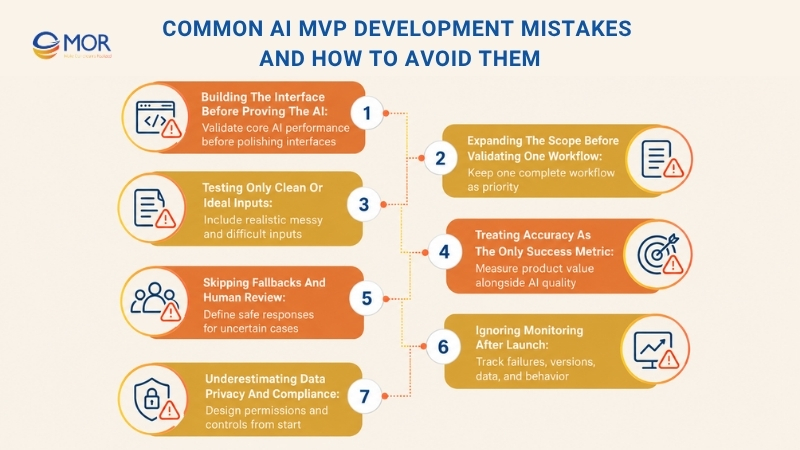
Building the Interface Before Proving the AI
A polished UI can't compensate for weak model performance or unavailable data. Test the hardest technical assumption early, using representative examples and a basic interaction flow.
If the product depends on extracting fields from noisy documents, prove extraction quality before spending heavily on dashboards and account settings. The same logic applies to retrieval, classification, prediction, and agent tool calls.
Expanding the Scope Before Validating One Workflow
Feature creep delays the point where real evidence appears. Adding another persona, integration, dashboard, or AI capability also creates more combinations to test.
Keep one complete job as the center of the release. A reliable support-drafting workflow provides stronger evidence than five half-tested AI functions that users barely touch.
Testing Only Clean or Ideal Inputs
Teams often tune prompts against examples they already understand. Performance then drops when users introduce abbreviations, incomplete information, unusual document formats, conflicting data, or unexpected instructions.
Build the evaluation set around normal messiness. Include easy cases, hard cases, missing data, invalid requests, and inputs that should trigger refusal or human review.
Treating Accuracy as the Only Success Metric
A model can score well in testing and still produce a poor product. Users may spend too much time editing the output, wait too long for responses, or abandon the workflow because the result doesn't fit how they work.
Track business and AI measures together. Task completion, return use, acceptance, correction effort, latency, and cost per completed job tell a fuller story than one accuracy score.
Skipping Fallbacks and Human Review
AI will encounter inputs outside the intended boundary. The product needs a defined response when confidence falls, retrieval fails, a tool is unavailable, or the requested action carries too much risk.
A fallback may ask for missing information, return no answer, switch to a simpler method, or send the case to a person. The right choice depends on the cost of a wrong result.
Ignoring Monitoring After Launch
Model behavior can shift after prompt changes, retrieval updates, provider changes, or new user patterns. Product teams need enough logging to connect a bad result to the model version, source data, tool call, and user path.
Track failure classes rather than raw error totals. Ten small formatting errors and one unsafe external action shouldn't receive the same priority.
Underestimating Data Privacy and Compliance
Permissions need to follow the data through ingestion, retrieval, model calls, storage, logging, and user access. Sensitive information also changes which providers, regions, retention settings, and human review processes are acceptable.
Address those requirements during scope and architecture planning. Retrofitting access rules after a pilot has copied sensitive information across several services can turn a small change into a large rebuild.
How to Scale an AI MVP Into a Production Product
Validated demand changes the engineering goal. AI MVP development focuses on evidence, but production work must support more users, more data, stronger controls, predictable releases, and a cost model that still works at higher volume.
The timing matters. Gartner's September 2026 forecast places worldwide AI spending at $2.7 trillion for 2026, up 49.5% year over year, yet high spending doesn't remove the need for disciplined product economics.
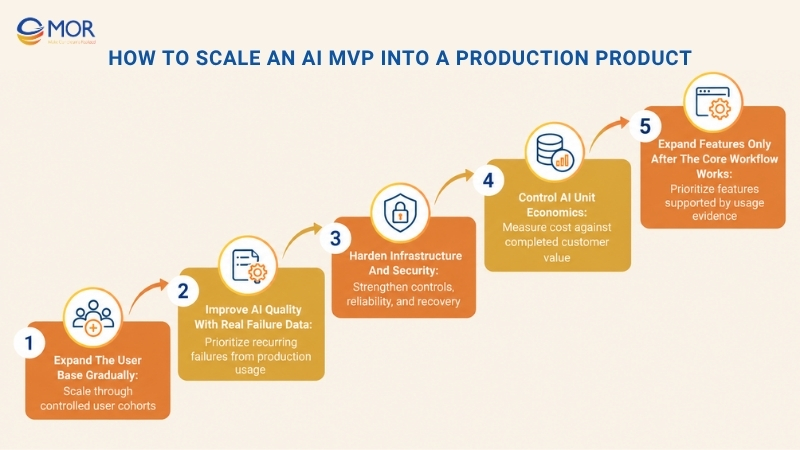
Expand the User Base Gradually
A larger cohort introduces new inputs and operating conditions. Grow in controlled stages so the team can compare quality before and after each increase.
- Use release groups: Move from internal users to pilot customers, then broader segments.
- Compare cohorts: Watch acceptance, errors, latency, retention, and support load.
- Set rollback rules: Define the signals that pause or reverse a rollout.
Improve AI Quality With Real Failure Data
Production tuning should start with recurring failures observed in real use. Group them by cause before changing prompts or models.
- Fix repeated retrieval misses: Improve source selection, chunking, metadata, or ranking.
- Study human corrections: Repeated edits often expose missing instructions or business rules.
- Protect solved cases: Keep regression tests so one fix doesn't break another group.
Harden Infrastructure and Security
A validated product usually needs stronger operational controls. Add CI/CD, model and prompt versioning, access management, backups, alerting, queue controls, and incident procedures according to actual production needs.
- Separate environments: Keep development, testing, and production data and settings apart.
- Add traceability: Record model, prompt, retrieval source, and tool actions where the use case requires it.
- Plan recovery: Define behavior during provider, database, API, or retrieval outages.
Control AI Unit Economics
Higher usage can expose costs that looked small during a pilot. Measure spending against completed customer value rather than token volume alone.
- Track cost per task: Tie inference and infrastructure cost to a successful outcome.
- Route models deliberately: Smaller models may handle simple work at lower cost.
- Cache safe results: Avoid repeat calls when the same stable answer can be reused.
Expand Features Only After the Core Workflow Works
Use real user requests, drop-off points, and support patterns to shape V2. A requested function deserves priority when it repeatedly blocks the target user's job, rather than because one pilot user mentioned it.
Keep the same test discipline as the product grows. Each major addition should have a defined user outcome, acceptance criteria, and measurement plan before release.
Why Choose MOR Software for AI MVP Development
MOR Software supports AI MVP development as part of a wider software engineering capability, rather than treating AI as an isolated API integration. Our AI services cover feasibility assessment, data engineering, custom model work, generative AI integration, and edge or cloud deployment.
That mix lets our teams work across the AI layer and the product around it: frontend, backend, APIs, databases, cloud infrastructure, QA, and existing enterprise systems.
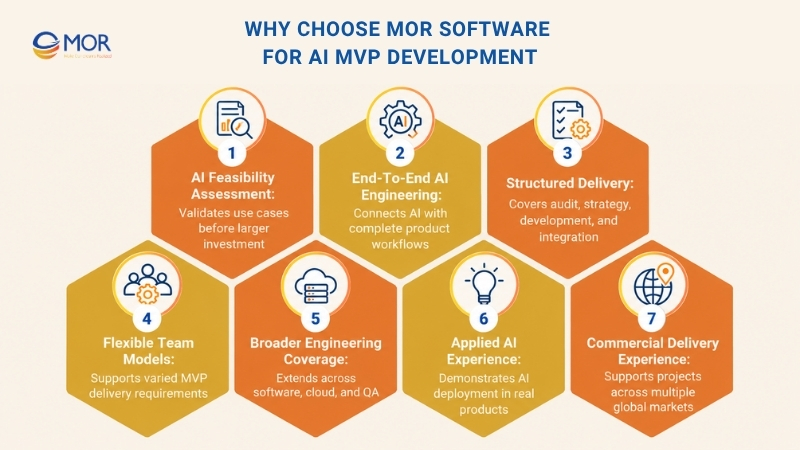
- AI feasibility before development: We assess the use case, available data, technical limits, target output, and build direction before a larger investment. MOR Software's AI materials list feasibility assessment, data engineering, and custom model service among our core AI capabilities.
- End-to-end AI engineering: Our scope includes generative AI integration plus edge and cloud deployment, so the AI component can connect to the application and operating workflow rather than stop at a model demo.
- Structured delivery: MOR Software maps AI work across audit, strategy, development, and integration. That structure supports early use-case checks, architecture decisions, build work, and production integration.
- Flexible team models: Staff augmentation, fixed-price delivery, and dedicated teams let clients match team structure to MVP scope and post-validation plans.
- Broader engineering coverage: AI sits beside our web, mobile, QA, cloud, consulting, offshore, and custom software capabilities, which helps when an MVP grows into a larger product.
- Evidence in applied AI: In Hospital Review And Job Platform With AI-driven Spam Filtering project, MOR Software trained AI models to detect and filter spam reviews. The team also deployed the platform on AWS to support scalability, reliability, and security as user volume increased.
- Commercial delivery experience: MOR Software reports 850+ projects for clients across 10+ countries, giving our teams experience beyond short experimental builds.
Businesses comparing AI MVP development companies should check whether a vendor can handle product engineering, data, testing, integrations, and the post-pilot path. An AI MVP development agency that only wires a model API into a UI may leave major production work unresolved after validation.
For clients that need AI PoC and MVP development services, we can start at feasibility and continue into a working product. Our broader AI and software capabilities also let teams keep the same partner when the validated MVP needs deeper integration, stronger infrastructure, QA, or a dedicated engineering team.
Conclusion
AI MVP development gives your team a practical way to test user demand, AI quality, cost, and operating risk before committing to a larger product. A focused workflow, representative data, measurable thresholds, and real-user testing create stronger evidence for the next decision. MOR Software can support that path through AI engineering, product development, cloud, integration, and QA.
Contact us to discuss your use case, MVP scope, data needs, and delivery plan.
"Evolution is not a destination, it is a disciplined journey of innovation."
Phung Van Tu


CEO MOR AI
MOR SOFTWARE
Frequently Asked Questions (FAQs)
What is AI MVP development?
AI MVP development builds a small but usable AI product to test a defined user problem, AI capability, and business assumption. It uses real or representative inputs and measurable success criteria so the team can decide whether further investment makes sense.
How is an AI MVP different from a traditional MVP?
A traditional MVP mainly tests workflow and market demand through deterministic software. An AI MVP also has to test probabilistic output quality, data dependence, failure handling, latency, model cost, and human review requirements.
How long does it take to develop an AI MVP?
A focused API-based MVP can take roughly 2 to 6 weeks. RAG, SaaS, agentic, and regulated products often take 4 to 24 weeks depending on data preparation, integrations, user roles, security, evaluation, and the number of workflows.
How much does AI MVP development cost?
Planning ranges often start around $5,000 to $20,000 for a narrow API-based build and can exceed $100,000 for regulated or technically demanding products. Scope, data readiness, integrations, evaluation work, security, and product depth drive the final budget.
What features should an AI MVP include?
The first release normally needs one complete user flow, the AI capability, required data, basic UX, output validation, fallback behavior, feedback collection, monitoring, and enough infrastructure for the pilot. Secondary personas and broad customization can wait.
Should an AI MVP use an existing AI API or a custom model?
Start with an existing model when it meets the target quality, privacy, latency, and cost requirements. Custom training makes more sense when proprietary data patterns or domain performance create a gap that prompting, RAG, or managed models can't close.
How much data do you need for an AI MVP?
There is no fixed volume. The MVP needs enough representative data to test the target workflow across normal cases, hard cases, edge cases, missing information, and unacceptable outputs. Data relevance and coverage carry more weight than raw volume.
What metrics should you track for an AI MVP?
Track task completion, repeat usage, output acceptance, correction effort, error severity, refusals, escalation, latency, cost per completed task, retention, and commercial signals. Choose thresholds before launch so the final decision doesn't depend on opinion.
What is the difference between an AI MVP and an AI prototype?
A prototype tests interaction and product ideas and may contain simulated output. An AI MVP runs a real AI capability inside a usable workflow and collects evidence on user behavior, quality, reliability, cost, and technical feasibility.
When should you scale an AI MVP into a full product?
Scale after the main hypothesis has evidence behind it. Users should complete the target job, return without constant prompting, accept the AI output at an agreed rate, and generate unit economics that remain workable as usage increases.
Share


Make Our-Dreams Realized


© 2023 . MOR Software. All Rights Reserved
Sitemap
Privacy Policy
Terms of Use

Rate this article
0
over 5.0 based on 0 reviews
Your rating on this news:
Name
*Email
*Write your comment
*Send your comment
1