


Top 10 MVP Development Services for Startups in 2026
Building a product without testing demand can drain time and budget before you see real results. Many founders turn to MVP development services to validate ideas faster, reduce early risks, and move from concept to launch with clarity. In this guide, MOR Software will explain how minimum viable product development helps startups build smarter, test quicker, and scale with confidence.
What Are MVP Development Services?
MVP development services are specialized solutions designed to support companies, particularly early-stage startups, in creating a minimum viable product (MVP). This is the most basic functional version of a product that can be introduced to initial users to validate concepts and collect real-world feedback before committing to a complete product build. An MVP concentrates on essential features that address a clear user need, avoiding unnecessary extras in the early phase.
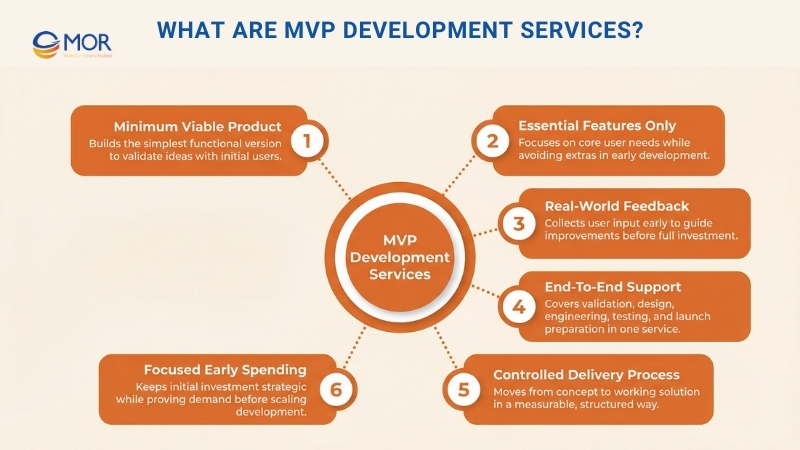
An effective MVP development service typically covers validation, design, engineering, testing, and launch preparation, forming an MVP development services end-to-end process ideation to deployment. This structured approach allows businesses to move from concept to working solution in a controlled and measurable way while keeping early investment focused and strategic.
TechCrunch shared that Dropbox’s beta waiting list grew from 5,000 to 75,000 literally overnight after a simple demo video. This shows how an MVP can test demand before a full build.
Top 10 MVP Development Services For Startups In 2026
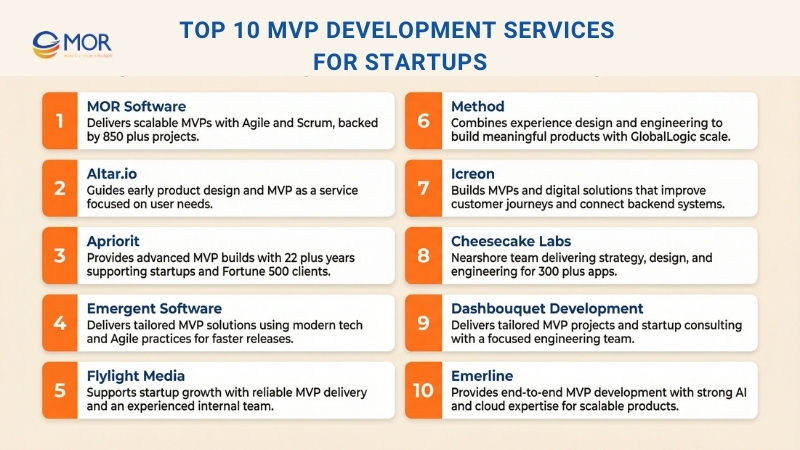
The companies listed below are recognized for delivering reliable and scalable solutions tailored for early-stage businesses. These providers are known for offering strong startup MVP development services that help founders move from idea validation to market entry with clarity and speed.
1. MOR Software
When startups search for a dependable partner to handle MVP development services in Asia, MOR Software consistently appears as a leading option. With 10+ years of experience in software outsourcing and engineering, MOR Software has successfully completed 850+ projects for clients in 10+ countries, including Japan, Vietnam, and other markets across the APAC region.
The company concentrates on delivering practical, scalable MVP solutions that are ready for real users. Its teams collaborate closely with founders to validate concepts, define essential features, and release functional products without adding unnecessary complexity at the early stage. This method allows startups to manage budgets carefully while accelerating real market validation.
Recognized as a Top 10 ICT company in Vietnam, MOR Software provides strong technical expertise across offshore website development, mobile apps, cloud systems, and emerging technologies. The firm follows Agile and Scrum frameworks throughout product delivery, maintaining clear milestones, rapid iteration cycles, and transparent communication. Long-standing relationships with enterprises and startups demonstrate its stable quality standards and strong business focus.
USPs | Values |
Client Rating (Clutch) | 4.9 |
Years of Experience | 8+ years |
Hourly Rate | $25 to $49 / hr |
Minimum Engagement Size | $10,000+ |
Team Size | 300+ |
Google Review Score | 4.9 |
Headquarters Location | Ho Chi Minh City, Vietnam |
Other Offices | Hanoi, Da Nang, Tokyo, Osaka, Nagoya |
Core Service Offerings:
- MVP development services
- Web Application Development
- Mobile App Development
- Salesforce Outsourcing Development
- Software Outsourcing & Offshore Teams
Primary Industry Focus:
- Finance and Banking
- Healthcare
- Manufacturing
- Food and Beverage
- Human Resource Management
Key Recognitions:
- Recognized as a top IT outsourcing companies in the world
- Trusted partner for Japanese enterprises and regional startups
- Delivered large-scale systems across healthcare, fintech, and enterprise platforms
2. Altar.io
Altar.io ranks among the leading providers that support startups through early-stage product creation. The company brings together specialists from diverse professional backgrounds who collaborate to design products centered on user needs. Its experts guide businesses through custom MVP as a service, ensuring that each solution includes only the features that matter most to target users.
The firm focuses on delivering high-quality minimum viable products that can reach the market in a shorter timeframe. Even with limited resources, it provides effective strategies that help you stay competitive in demanding industries. Altar.io holds a 4.9 rating on Clutch, reflecting strong client satisfaction.
USPs | Values |
Client Rating (Clutch) | 4.9 |
Years of Experience | 9+ years |
Hourly Rate | $50 to $99 / hr |
Minimum Engagement Size | $25,000+ |
Team Size | 50+ |
Google Rating | 5.0 |
Headquarters Location | Lisboa, Portugal |
Core Service Offerings:
- Custom Software Development
- AI Development
- Full Stack App Development
- UI/UX Development
Primary Industry Focus:
- Financial Services
- Information Technology
- Business Services
Key Recognitions
- Clutch Top AI Deployment Company 2024
- Clutch Top AI Consulting Company 2024
Featured in the Clutch 1000 (2023) list for outstanding performance and client satisfaction.
3. Apriorit
Apriorit is a forward-thinking software engineering firm that supports startups and technology companies in building advanced digital products. It has earned recognition among respected providers of MVP development services, and it has maintained client trust for over 22 years. With a team of more than 250 highly skilled professionals, the company delivers software solutions that drive measurable business growth. Apriorit works with Fortune 500 companies and international startups, demonstrating strong standards in minimum viable product development.
USPs | Values |
Client Rating (Clutch) | 4.9 |
Years of Experience | 22+ years |
Hourly Rate | $100 to $149 / hr |
Time Zone Availability | ACT, CET, EET, GMT, IDT, PST, UTC, EST, AET, NST |
Minimum Engagement Size | $25,000+ |
Team Size | 250+ |
Google Rating | 4.8 |
Headquarters Location | Dnipro, Ukraine |
Core Service Offerings:
- MVP Development
- Mobile Application Development
- Cybersecurity Solutions
- Blockchain Development
- Artificial Intelligence (AI)
- Custom Software Development
For Web3-focused MVPs, working with a blockchain development company can help you validate security assumptions early.
Primary Industry Focus:
- Automotive
- Education
- Government
- Media
Key Recognitions
- Clutch Top Company Software Developers 2024
- Clutch Top Artificial Intelligence Company 2024
- Clutch Top Rust Development Company 2024
4. Emergent Software
Emergent Software has built a strong reputation as a trusted provider of high-standard MVP product development solutions. The company holds a 4.9 rating on Clutch. It has a solid history of delivering reliable services to hundreds of clients across different sectors.
With a skilled technical team, the firm focuses on delivering real value and achieving high customer satisfaction. Its specialists use modern technologies and Agile practices to support faster product releases. The company offers tailored development solutions and continuous support to clients from various industries.
USPs | Values |
Client Rating (Clutch) | 4.9 |
Years of Experience | 9+ years |
Projects Completed | 300+ |
Hourly Rate | $150 to $199 / hr |
Time Zone Availability | CST, EST, MST, PST |
Minimum Engagement Size | $25,000+ |
Team Size | 250+ |
Google Rating | 4.7 |
Headquarters Location | Minneapolis, MN |
Core Service Offerings:
- Custom Software Development
- Website Development Services
- Software Product Development
- Azure Cloud Services
Primary Industry Focus:
- Business Services
- Government
- Legal
- Hospitality & Leisure
Key Recognitions
- Clutch Top .Net Developers United States 2025
- Top Software Developers Clutch Minnesota 2025
- Listed in Clutch Global Fall 2024
5. Flylight Media
Flylight Media, Inc. is another recognized name among providers delivering professional custom MVP software development services that support startups in scaling successfully. Established in 2011, the company has strengthened its position within the technology sector. It maintains a 5.0 rating on Clutch, which reflects the consistent quality of its work.
The firm has an internal team of experienced specialists who can manage complex product requirements with confidence. It provides reliable MVP development services and assists businesses in achieving their growth objectives. The company supports startups in addressing user needs and expanding their customer base effectively.
USPs | Values |
Client Rating (Clutch) | 5.0 |
Years of Experience | 13+ years |
Projects Completed | 10+ |
Hourly Rate | $150 to $199 / hr |
Minimum Engagement Size | $25,000+ |
Team Size | 10+ |
Google Rating | 4.9 |
Headquarters Location | Portsmouth, NH |
Core Service Offerings:
- Website Development
- Mobile App Development
- Software Product Engineering Company
- Digital Marketing Services
Primary Industry Focus:
- Advertising & Marketing
- Manufacturing
- Supply Chain
- Legal
Key Recognitions
- Listed in Clutch Global Fall 2023
- Featured in top web design companies in New Hampshire
- Among the 5 best Digital Marketing Agencies in New Hampshire
6. Method
Since 1999, Method, recognized among leading MVP development companies, has been a pioneer in experience design. The company combines creative thinking with the enterprise capabilities of GlobalLogic to support international brands. With more than 25 years of experience and a team of over 250 experts, Method continues to deliver high-level services. Its global presence allows every client to receive a tailored experience. The team’s strength in design and engineering supports the creation of meaningful and long-lasting products.
USPs | Values |
Client Rating (Clutch) | 4.8 |
Years of Experience | 25+ years |
Hourly Rate | $150 to $199 / hr |
Time Zone Availability | GMT, PST, MST, EST |
Minimum Engagement Size | $50,000+ |
Team Size | 250+ |
Google Rating | 4.4 |
Headquarters Location | New York, NY |
Core Service Offerings:
- MVP Development
- Product Design
- Digital Transformation
- Intelligent Product Engineering
- Sustainability Consulting
Primary Industry Focus:
- Medical
- Telecommunication
- Arts, Entertainment & Music
- Consumer Products & Services
Key Recognitions
- Indigo Design Award Winners 2023
- Featured in Creative Review Annual Awards
- Recognized among the Top Workplaces
7. Icreon
Icreon is widely regarded as one of the top US MVP development services delivering MVP product development and digital solutions. With more than 24 years of experience in custom digital experience design, Icreon develops tailored solutions that enhance customer journeys and connect smoothly with backend systems. The company also works closely with Fortune 500 enterprises and nonprofit organizations, which strengthens its industry expertise. Icreon combines strategic thinking with advanced engineering to accelerate business expansion and innovation. This combination positions Icreon as a preferred MVP development company for long-term growth.
USPs | Values |
Client Rating (Clutch) | 5.0 |
Years of Experience | 24+ years |
Hourly Rate | $100 to $149 / hr |
Time Zone Availability | EST |
Minimum Engagement Size | $50,000+ |
Team Size | 250+ |
Google Rating | 4.5 |
Headquarters Location | New York, NY |
Core Service Offerings:
- Digital Product Development
- Customer Experience Solutions
- Strategy & Consulting Services
- Commerce Solutions
Primary Industry Focus:
- Manufacturing
- Non-profit
- Retail
- Legal
Key Recognitions
- Featured in top web development companies in USA
- Icreon Receives Strategic Investment From Incline
- Listed among TOP AI and ML Companies in 2024
8. CHEESECAKE Labs
Cheesecake Labs is a nearshore backend development and generative AI integration firm that supports U.S. startups and Fortune 500 companies in designing, building, and expanding MVPs into products ready for the market. With more than 10 years of experience and over 300+ successful apps, the company combines strategy, design, and technical execution to deliver clear business outcomes. It also has strong capabilities in SaaS MVP development, helping digital products scale with stability.
Recognized by brands such as MoneyGram International and Tapcart, Cheesecake Labs provides flexible engagement options ranging from staff augmentation to complete product delivery. This structure enables smooth execution and faster validation of early-stage solutions, while still maintaining high development standards aligned with modern MVP development services.
USPs | Values |
Client Rating (Clutch) | 4.9 |
Years of Experience | 12+ years |
Time Zone Availability | PST, CST, EST, BET |
Hourly Rate | $50 – $99 / hr |
Minimum Engagement Size | $50,000+ |
Team Size | 250+ |
Google Rating | 4.8 |
Headquarters Location | San Francisco, CA |
Core Service Offerings:-
- Mobile App Development
- Custom Software Development
- Blockchain Development
- Software Outsourcing
Primary Industry Focus:
- Information Technology
- eCommerce
- Automotive
- Real Estate
Key Recognitions
- Top Blockchain Company Clutch San Francisco 2025
- Listed in Clutch Global Spring 2025
- Clutch Top Software Developers 2025
9. Dashbouquet Development
Dashbouquet Development is a dependable MVP development team delivering high-quality solutions to international businesses and technology startups. Since its founding in 2014, the firm has supported hundreds of clients worldwide. With a team of 40 skilled engineers, Dashbouquet concentrates on providing tailored development solutions.
The company delivers a broad range of MVP development services to its clients. In addition, it offers consulting support for startups looking to refine their product ideas. It applies modern technologies to complete projects efficiently and support successful product launches.
USPs | Values |
Client Rating (Clutch) | 4.9 |
Years of Experience | 10+ years |
Hourly Rate | $25 to $49 / hr |
Time Zone Availability | UTC, CET, PST, CST, CNT |
Minimum Engagement Size | $10,000+ |
Team Size | 250+ |
Google Rating | 4.5 |
Headquarters Location | Tallinn, Estonia |
Core Service Offerings:
- Custom Application Development
- Mobile App Development
- AI Development & Research
- Machine Learning Software Development Services
- Web App Development
Primary Industry Focus:
- Medical
- Financial Services
- Education
- Media
Key Recognitions
- Top React Native Developer Clutch Poland 2025
- Listed in Clutch Global Fall 2024
- Featured in Top MVP development companies to work with
10. Emerline
Emerline is an international software engineering firm that provides end-to-end MVP development services along with digital transformation capabilities. With solid expertise in AI, cloud platforms, and infrastructure engineering, the company supports startups and enterprises across the U.S. and Europe in building scalable products that are ready for investors and long-term growth.
Supported through partnerships with AWS, Microsoft, Google, and Databricks, and holding certifications such as ISO 27001, ISO 55001, ISO 9001, and ISO 22301, Emerline delivers secure and reliable solutions for clients in Fintech, Healthcare, and E-commerce.
USPs | Values |
Client Rating (Clutch) | 4.9 |
Years of Experience | 14+ years |
Hourly Rate | $50 – $99 / hr |
Minimum Engagement Size | $25,000+ |
Team Size | 250+ |
GoodFirms Rating | 5.0 |
Headquarters Location | Miami, FL |
Core Service Offerings:
- Custom Software Development
- AI Agents
- Generative AI
- Low/No Code Development
Primary Industry Focus:
- Medical
- Education
- Retail
- Information Technology
Key Recognitions
- Top Magento Company Clutch 2025
- Top Google Cloud Company Clutch Lithuania 2025
- Top Software Developers Clutch Manufacturing 2025
Why Startups Invest In MVP Development Services
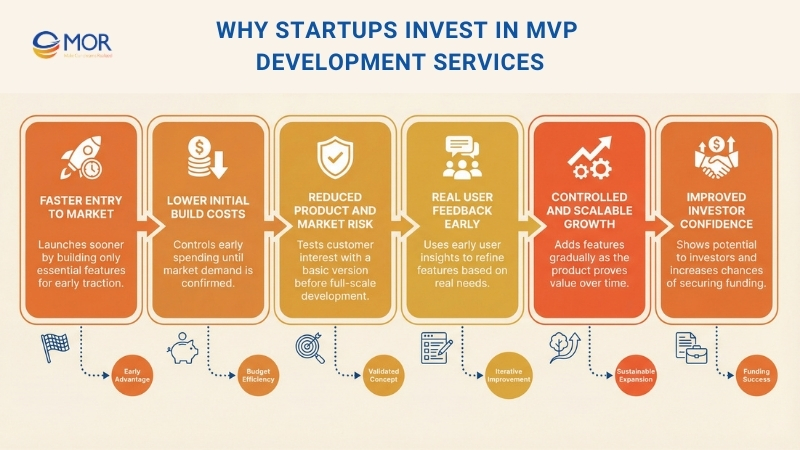
In March 2023, only 34.7% of U.S. private-sector business establishments born in March 2013 were still in operation. So, many founders try to validate early instead of betting everything on a full launch. Startups adopt a Minimum Viable Product (MVP) strategy because it allows them to test ideas with limited resources and validate demand early. MVP development services support this approach by helping founders launch faster, collect user feedback quickly, and improve the product step by step without wasting time.
Faster Entry To Market
An MVP enables a quicker product launch since it concentrates only on essential features. This allows startups to enter the market sooner and gain early traction within a short period.
Harvard Business Review notes that a product shipped six months late can mean 33% less after-tax profit over five years, while being 50% over budget can mean only 3.5% less profit, which is why speed matters for many startups.
Lower Initial Build Costs
An MVP provides a practical way to shape your idea while keeping early expenses under control. It helps you avoid spending too much before confirming that your concept has real market demand.
A Standish study cited by Martin Fowler found that 45% of features were never used, and only 20% were used often or always. Keeping the first version small can cut a lot of waste.
Reduced Product And Market Risk
Startups can lower the risk of failure by releasing a basic version first and evaluating actual customer interest before investing in full-scale product development.
Real User Feedback Early
Nielsen Norman Group shows that testing with 5 users can find about 85% of usability problems. When you gather insights from early users, you gain a clearer understanding of their needs. This feedback allows businesses to refine features and make improvements based on real customer responses.
Controlled And Scalable Growth
With an MVP, you can begin with a focused product and expand gradually. New features are added over time as your solution proves its value and addresses user challenges effectively.
Improved Investor Confidence
Startups can demonstrate the product’s potential and strengthen their appeal to investors. This increases the likelihood of securing funding to support future growth and expansion.
Crunchbase reports global venture funding in 2022 reached $445 billion, a 35% decline from the $681 billion invested in 2021. Showing real traction with an MVP can help a startup stand out in a tougher funding market.
>>> Discover more topics on MOR Blog right now!
Core Responsibilities Within Professional MVP Development Services
Professional teams delivering MVP development services follow a structured approach to turn ideas into working products. Their responsibilities cover strategy, validation, design, development, and continuous improvement to support a successful launch and long-term growth.
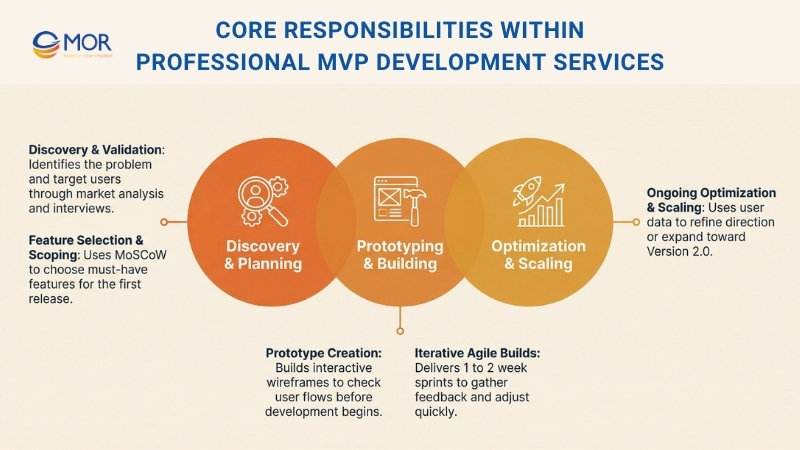
- Discovery & Validation: Defining the main problem and identifying the right target users through market analysis and direct user interviews.
- Feature Selection & Scoping: Applying frameworks such as MoSCoW (Must-have, Should-have, Could-have, Won't-have) to determine the essential feature set for the first release.
- Prototype Creation: Designing interactive wireframes, often with AI-powered design tools, to validate user flows before development begins.
- Iterative Agile Builds: Delivering incremental builds in 1–2 week sprint cycles to collect regular feedback and make timely adjustments.
- Ongoing Optimization & Scaling: Reviewing user behavior data and customer input to decide whether to refine the product direction or expand toward Version 2.0.
How To Select The Right MVP Development Services Partner
Although each company listed above can help you launch a successful Minimum Viable Product (MVP), you should always conduct your own evaluation before entering into any agreement. When assessing providers of MVP development services, take time to review their background carefully and follow a structured selection process.
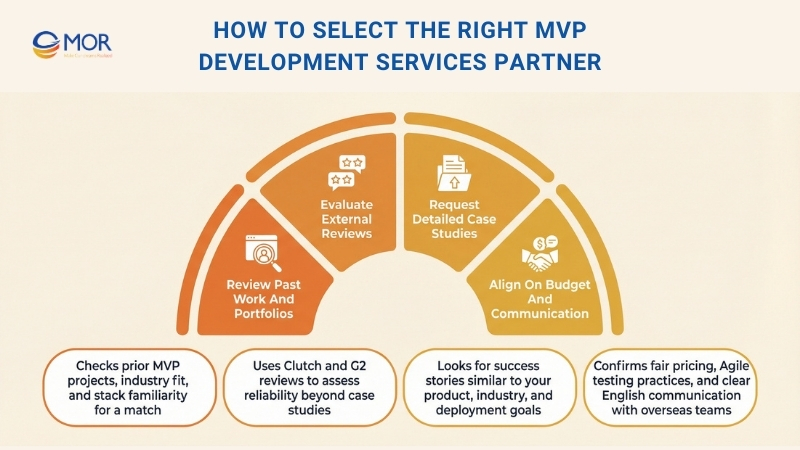
Review Past Work And Portfolios
You can gain valuable insights into a company by examining its previous projects. While analyzing their portfolio, pay close attention to the following:
- MVP app development projects
- Proven project management capabilities
- Experience within your specific industry
- A history of delivering products similar to the MVP you plan to build
- Familiarity with the modern technology stack your solution may require
A company that matches your needs should present a diverse portfolio showcasing successful MVP builds for startups and larger organizations.
Evaluate External Reviews
Case studies provide detailed explanations of selected projects and highlight how the development team handled them. However, they should not replace independent customer feedback.
Reviews on trusted platforms such as Clutch.co and G2 Reviews present objective opinions that help you assess performance and reliability. If the provider delivers quality MVP software development services, it will usually have strong ratings and a consistent record of positive client feedback.
Request Detailed Case Studies
Any reputable firm will maintain a dedicated section on its website that presents a broad collection of case studies showing experience across various industries and product categories.
When reviewing a company’s case study portfolio, focus on success stories connected to:
- Industries that are close to your own
- Products that resemble the solution you intend to develop
- A clear strategic approach to MVP product development that reflects strong product management from initial design to final deployment
- Proper application of the MVP method that supports faster market entry, collects insights from early users, and prioritizes essential features effectively
Search for case studies that explore projects within sectors similar to yours. Ask the agency to recommend examples that highlight MVP development services aligned with your specific objectives.
Align On Budget And Communication
Budget plays a major role when choosing an outsourcing partner. Although selecting a provider based only on low pricing may create issues later, you can still secure a reliable MVP development partner at a fair cost. This becomes even more achievable when you consider options outside the U.S., Canada, and Europe.
Because labor rates are lower in countries such as India and Mexico, you may access quality MVP development services at competitive pricing.
When working with an overseas team, confirm that the provider has solid experience in market research, product design, Agile workflows, testing practices, and iterative improvement based on user input.
You should also schedule detailed discussions with their representatives to confirm clear English communication and confirm that cultural differences will not affect collaboration.
MVP Development Services Pricing Outlook For 2026
Pricing for MVP development in 2026 depends on product complexity, AI integration, and geographic location. Global averages have increased by nearly 15% compared to 2025 due to growing demand and talent shortages. The cost of engaging MVP development services may begin at a lower range for simple builds but rises significantly when advanced AI features are included. For infrastructure planning, understanding the cost of cloud computing is essential when forecasting a runway.
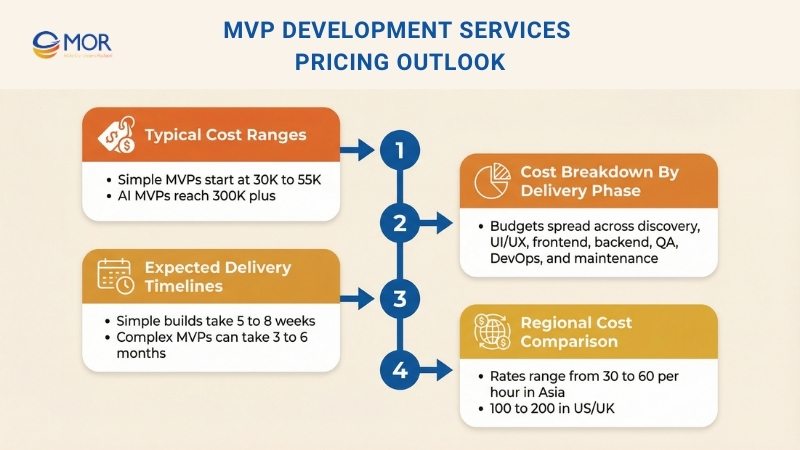
Typical Cost Ranges
The total investment varies based on scope, architecture, and technical depth. Below are common budget ranges for different types of MVP product development:
- Simple MVP: $30,000–$55,000 (for example, a landing page with basic CRUD functionality).
- Standard SaaS MVP: $55,000–$140,000 (such as a multi-tenant dashboard solution).
- AI-Powered MVP: $140,000–$300,000+ (including LLM integrations and predictive capabilities).
- Enterprise MVP: $200,000–$500,000+ (compliance-focused solutions for sectors like healthcare or fintech).
Cost Breakdown By Delivery Phase
A typical MVP build includes several development stages, and each stage contributes a specific percentage to the overall budget. Understanding this structure helps you plan resources more accurately when evaluating MVP development services.
Component | Description | Cost Range | % of Total |
Discovery | AI research and concept validation | $5K–$15K | 10% |
UI/UX | Generative wireframes and interactive prototypes | $8K–$20K | 15% |
Frontend | React or Flutter implementation | $15K–$40K | 20% |
Backend | Node.js or Python API development | $20K–$50K | 25% |
Database | PostgreSQL configuration | $5K–$15K | 8% |
Integrations | Stripe, Mixpanel integrations | $5K–$20K | 10% |
AI Modules | LLM embedding such as Claude or Llama | $20K–$80K | 15% (AI MVPs) |
DevOps | AWS or GCP deployment setup | $5K–$15K | 7% |
QA | Automated and manual testing | $8K–$20K | 10% |
PM | Agile project coordination | $10K–$25K | 10% |
Maintenance | Post-launch support, around 20% of development cost per year | $6K–$60K | Ongoing |
Expected Delivery Timelines
The timeline for MVP development depends on scope, technical depth, and validation goals. More advanced features and compliance requirements extend the schedule, while lean product launch services focus on speed and early testing.
- Simple MVP: 5–8 weeks (for example, micro-MVP validation).
- Mid-Level MVP: 8–14 weeks (SaaS solution with integrations).
- Complex MVP: 3–6 months (AI features combined with enterprise compliance needs).
Regional Cost Comparison
Development rates vary significantly across regions due to labor costs, market maturity, and talent availability. When evaluating MVP development services in USA or comparing global vendors, understanding these differences helps you set realistic expectations.
- US/UK: $100–$200 per hour; total project cost often $100K+ (high expertise and premium pricing).
- Eastern Europe: $50–$80 per hour; total $40K–$100K (strong balance between quality and cost).
- LATAM: $40–$70 per hour; total $30K–$80K (agile teams with strong English communication).
- Asia: $30–$60 per hour; total $25K–$70K (fast execution and scalable talent pools).
Real-World Examples That Started As MVPs
An MVP is not only a simple test version or an early prototype that disappears later. Many well-known platforms and services first launched as minimum viable product development efforts and later grew into major global brands.
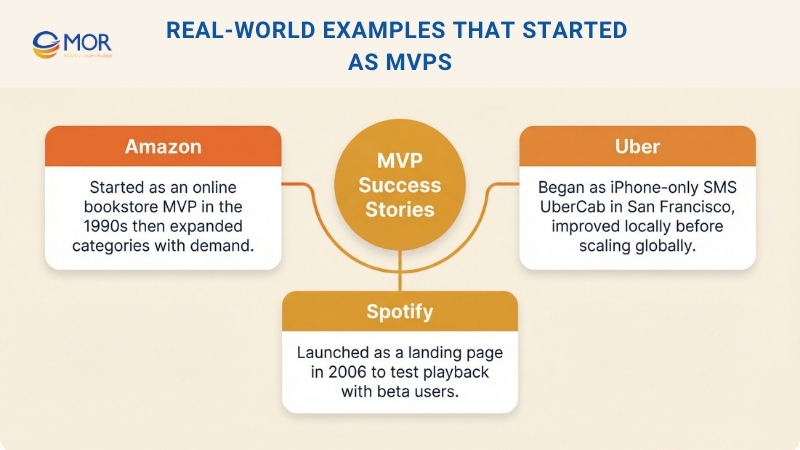
Amazon
In the early 1990s, Jeff Bezos learned that the e-commerce sector was expected to grow rapidly and decided to explore which product category had the strongest potential. He chose an online bookstore as his first minimum viable product and operated it from his garage. The strong response to the bookstore created demand for additional items such as electronics, apparel, and footwear. That initial step, where books served as the MVP product development focus, gave him valuable user insight that helped scale Amazon further. Few could imagine that a small online bookstore on a simple website would become the third-largest company in the world within just 20 years.
Uber
Yes, the ride-sharing platform many people use today did not begin as a full mobile application. Founders Garret Camp and Travis Kalanick applied a lean product launch approach and introduced an iPhone-only SMS service named UberCab in San Francisco. They tested the experience with local users and improved it inside the city before securing venture funding and creating the app that now supports 19 million trips globally each day.
The company moved through several versions, expanding its services each year based on feedback from riders. While UberCab started with traditional taxis only, the second phase added black cars and independent drivers to shape the ridesharing model used today. Across multiple iterations, the platform grew far beyond its initial MVP product development stage to include shared rides, accessibility options, and in select cities, even helicopter services.
Spotify
In 2006, many streaming platforms were launching and shutting down repeatedly because of small and low-quality music libraries, expensive subscription plans, and unreliable playback. In response, Daniel Ek and Martin Lorentzon introduced Spotify as a simple landing page to test their streaming system with beta users and support it through on-page advertising revenue. Their main objective was to ensure playback remained quick and stable so they could gain trust from music labels and potential investors. After completing market validation, the platform and its mobile application were launched publicly and later grew into the global streaming leader recognized today.
MVP Development Services Trends Shaping 2026
This section highlights important software development trends influencing MVP development services as we move into 2026. Below is additional explanation and key factors to keep in mind for each direction.
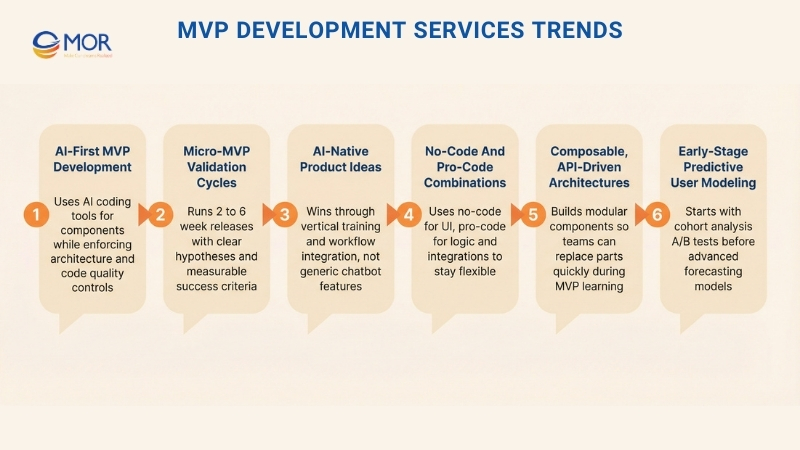
AI-First MVP Development
The move toward autonomous coding is already visible, as tools like Cursor, v0, and GitHub Copilot can now generate production-ready components. An AI code generator can speed up UI scaffolding, but quality controls still matter. The main difficulty will be protecting code quality and maintaining strong architecture when AI creates a larger share of the codebase. Teams that perform well will treat prompt engineering techniques and set firm guidelines to control AI-generated output.
Micro-MVP Validation Cycles
The 2–6 week release cycle is quickly becoming common, yet it carries a concern: validation must not suffer in the pursuit of speed. The faster you launch a rapid MVP build, the more important it becomes to define clear hypotheses and measurable success criteria. Micro-MVPs deliver the best results when they test a single primary assumption at a time.
AI-Native Product Ideas
Multi-agent systems and industry-focused copilots are emerging as the strongest areas for product distinction. Standard AI features are now widely available, so the true value lies in vertical-specific training and workflow integration. The focus should shift toward solutions that understand your users’ industry language rather than simply adding a generic chatbot feature. In many cases, an AI chatbot development service helps teams ship a conversational layer without rebuilding the core workflow.
No-Code And Pro-Code Combinations
Achieving a 40–60% improvement in speed is possible, yet the claim about long-term maintainability should be examined carefully. The most effective structure appears to be using no-code for UI and workflows, and pro-code for business logic and integrations. This setup allows flexibility when custom features are required later.
Composable, API-Driven Architectures
API-first and modular design are not new ideas, but they are now essential. The direction is moving toward smaller, replaceable components instead of large, monolithic systems. This structure supports faster adjustments based on what teams learn during the MVP process.
Early-Stage Predictive User Modeling
This capability is valuable, though it is frequently overbuilt in early product stages. For real early-stage product development, begin with basic cohort analysis and A/B testing before committing to advanced predictive systems. Early user data is often too limited to support accurate forecasting models.
The meta-trend: In 2026, MVP product development will focus less on building quickly and more on learning quickly. The constraint is moving away from coding speed and toward insight creation and decision-making speed.
Conclusion
Choosing the right MVP development services can define how fast your startup validates ideas, attracts users, and secures funding. From cost planning to partner selection and 2026 trends, a clear MVP strategy helps you reduce risk and focus on real market demand. If you are ready to turn your concept into a scalable product, MOR Software is here to support your journey. Contact us today to discuss your MVP roadmap.
MOR SOFTWARE
Frequently Asked Questions (FAQs)
What are MVP development services?
MVP development services help businesses build a minimum viable product with only essential features. The goal is to test an idea quickly, gather user feedback, and validate market demand before committing to full-scale development.
Who should use MVP development services?
Startups, founders, and innovation teams use MVP development services when launching a new product, testing a new business model, or entering a new market with limited risk and budget.
What is included in MVP development services?
These services usually cover product discovery, feature prioritization, UX design, core development, testing, and initial launch support. Some providers also help analyze feedback after release.
How is an MVP different from a prototype?
A prototype demonstrates how a product might work, often without full functionality. An MVP is a working product that real users can use, interact with, and give feedback on.
How long does MVP development usually take?
Most MVPs take between 6 and 14 weeks, depending on complexity, integrations, and whether AI or advanced features are involved.
How much do MVP development services cost?
Costs vary by scope and region. A simple MVP may start around $30,000, while more complex or AI-driven MVPs can exceed $100,000.
What features should be included in an MVP?
Only features that solve the main user problem should be included. Nice-to-have ideas are typically postponed until real usage data confirms their value.
Can MVP development services help attract investors?
Yes. A working MVP shows traction, user interest, and execution ability, which often makes fundraising conversations more credible.
Is MVP development suitable for non-startups?
Yes. Enterprises use MVP development services to test new internal tools, digital products, or process improvements without disrupting core systems.
What happens after the MVP is launched?
Teams usually review user behavior, feedback, and performance metrics. Based on the results, the product may be improved, scaled, redesigned, or discontinued.
Share


Make Our-Dreams Realized


© 2023 . MOR Software. All Rights Reserved
Sitemap
Privacy Policy
Terms of Use

Rate this article
0
over 5.0 based on 0 reviews
Your rating on this news:
Name
*Email
*Write your comment
*Send your comment
1