


AI Readiness Assessment: Is Your Organization Ready for AI?
AI pilots can work in a demo and still fail in production. An AI readiness assessment checks whether strategy, data, technology, governance, security, people, and operations can support real deployment. In this MOR Software guide, we’ll show you how to assess readiness, score gaps, prioritize use cases, and turn findings into an execution roadmap before major AI spending begins.
Key Takeaways
- AI readiness depends on business fit, data, systems, governance, security, people, operating processes, and measurable value, not access to an AI model alone.
- Evidence matters more than a headline score. Architecture records, data quality reports, policies, workflow maps, KPIs, and ownership should support each rating.
- The assessment should end with priorities, accountable owners, pilot gates, investment needs, and a phased roadmap that teams can execute.
What Is an AI Readiness Assessment?
An AI readiness review is a structured evaluation of your organization’s ability to implement, govern, operate, and scale AI. It looks at the conditions around the technology, including business goals, data access, architecture, security controls, skills, process ownership, and measurement.
Having ChatGPT licenses, an internal chatbot, or a successful proof of concept doesn’t mean the company is production-ready. Real readiness asks a harder question: can a defined AI use case work safely and reliably inside the systems, permissions, workflows, and accountability model you already have?
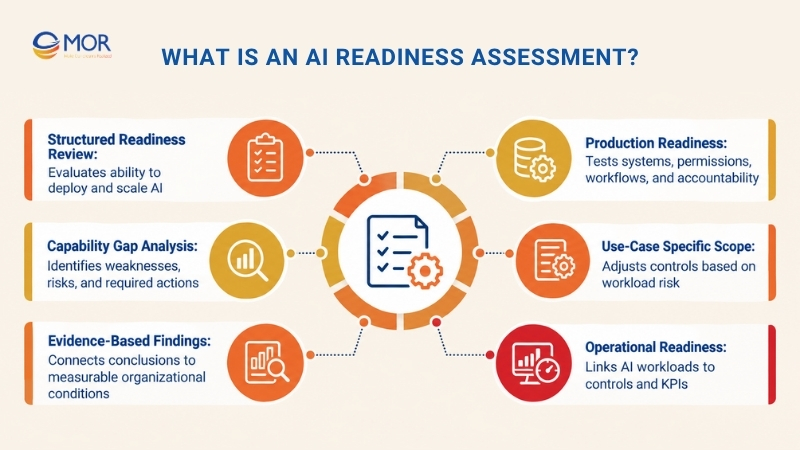
A practical assessment for AI readiness should produce more than a score. Teams need a current-state view, named capability gaps, use cases worth pursuing, known risks, evidence behind each finding, and a set of actions that can be funded and assigned.
Scope also changes the answer. A customer-support drafting assistant may need approved knowledge sources and human review, whereas an agent that can alter customer accounts adds stricter identity, authorization, audit, and exception requirements.
Research into treated readiness as an organizational adoption question years before the current generative AI wave. That principle still holds: the technology can be available before the company is prepared to use it well.
An enterprise AI readiness assessment should connect every finding to real business use cases. “We use AI” describes adoption activity. “We can deploy this AI workload in production under defined controls and KPIs” describes operational readiness.
Why Assess AI Readiness Before Investing in AI?
AI adoption is already widespread, yet enterprise-scale deployment remains much rarer. McKinsey found that 88% of organizations used AI in at least one business function, but only 7% had fully scaled AI across the organization. That gap is where readiness work earns its place.
A readiness review should help leadership decide what can move now, what needs repair, and what should wait. Done before a large implementation, it gives budget decisions a firmer base than vendor demos or internal enthusiasm.
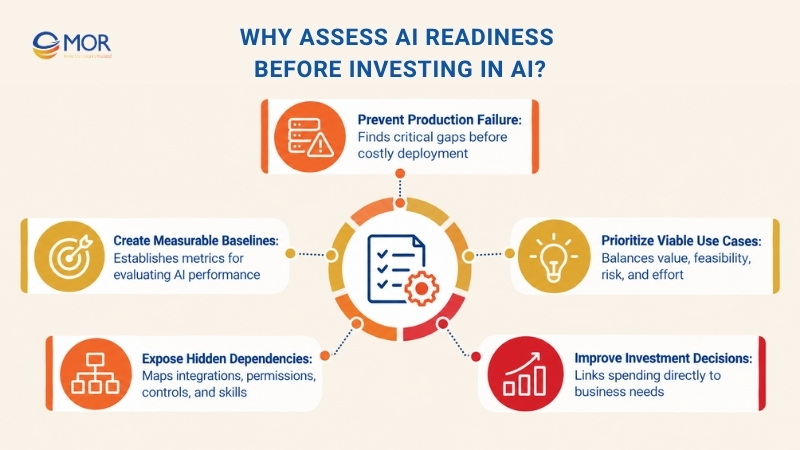
- Prevent pilot-to-production failure: Find weak data, missing integrations, unclear ownership, security gaps, or absent controls before they become expensive production problems. A pilot can hide manual work that won’t survive wider rollout.
- Prioritize viable use cases: Compare business value against feasibility, dependency, risk, and effort. A technically interesting idea may sit behind a simpler use case that has cleaner data, clearer ownership, and faster time to value.
- Expose hidden dependencies: Map API access, identity controls, data permissions, process exceptions, model monitoring, and skills before development starts. These dependencies often decide the real schedule.
- Improve investment decisions: Sequence spending around business needs instead of buying platforms first. Tie each budget request to a named use case, dependency, owner, and measurable outcome so leadership can compare investments on the same basis.
- Create measurable baselines: Record current cycle time, cost, error rate, revenue, service quality, or risk before the pilot. Later, the team can judge performance against a known starting point rather than a vague claim that the AI ‘worked.’
What Should an AI Readiness Assessment Evaluate?
Providers divide readiness into different categories, but the same enterprise conditions keep appearing. A useful AI readiness assessment framework connects business intent to data, systems, controls, people, processes, and measurable value.
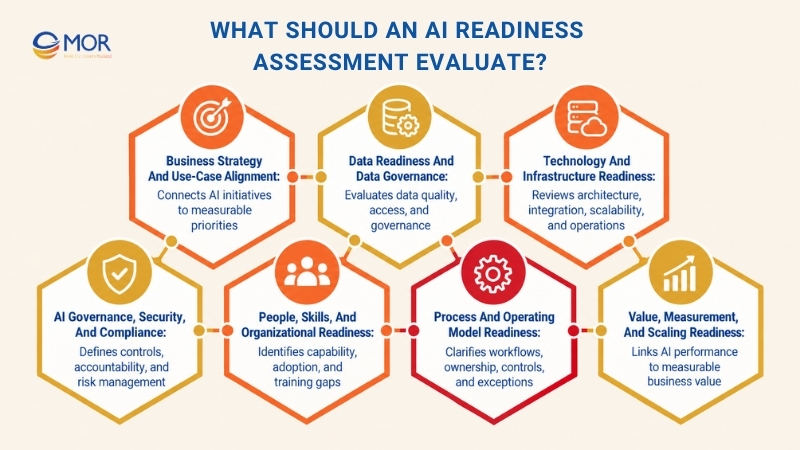
Business Strategy and Use-Case Alignment
Strategy gives the review a target. Define the business problem, then test whether AI fits the work and has accountable ownership.
- Business problem: Describe the workflow, decision, or task that needs improvement in operational terms.
- Strategic alignment: Tie the use case to a measurable business priority and a named outcome.
- Executive ownership: Assign a sponsor who can approve scope, budget, and cross-team changes.
- Use-case fit: Check whether AI is preferable to rules, search, workflow automation, or standard software.
- Success metrics: Set baseline and target measures before technology selection or pilot funding.
A generative AI readiness assessment also tests grounding data, review duties, acceptable error rates, and content controls. Probabilistic output changes the controls needed around the workflow.
Data Readiness and Data Governance
AI quality depends on the data available to the use case. Review its ownership, movement, permissions, and maintenance.
- Availability: Confirm required data exists and can be reached by the planned workload.
- Quality: Check completeness, consistency, accuracy, freshness, and representativeness on real samples.
- Integration: Map source systems, APIs, pipelines, synchronization, and manual data movement.
- Permissions: Verify the proposed AI use is allowed for each sensitive or licensed data source.
- Governance: Record ownership, classification, lineage, retention, stewardship, and change control.
Technology and Infrastructure Readiness
Technical readiness covers the AI workload. Review architecture, compute, APIs, identity, monitoring, and deployment practices.
- Architecture: Map cloud, on-premise, hybrid, application, network, and data dependencies.
- Compute capacity: Match model, inference, storage, latency, and accelerator needs to available resources.
- Integration readiness: Define how AI connects to CRM, ERP, ticketing, content, and data platforms.
- Scalability: Test concurrency, data volume, latency, cost, failover, and regional requirements.
- MLOps/LLMOps: Review versioning, evaluation, release control, logging, monitoring, rollback, and incident handling.
IBM estimated that companies with IT systems ready for AI would rise from 26% in 2024 to 45% in 2026. Even at that projected level, more than half would remain short of complete technical readiness.
An AWS AI readiness assessment can narrow the review to workloads around Amazon SageMaker, Amazon Bedrock, data, security, and AWS architecture. It keeps cloud-specific dependencies visible before workload design begins.
AI Governance, Security, and Compliance
Governance defines approved AI use and accountability. Security and compliance turn those rules into access, review, and incident practices.
- AI policies: Set approved tools, data boundaries, prohibited uses, review rules, and escalation paths.
- Security: Test identity, access, secrets, vendor settings, logging, and data exposure paths.
- Compliance: Map regulatory, contractual, retention, and intellectual-property duties tied to the use case.
- Human oversight: Define who reviews outputs, approves actions, and handles exceptions.
- Model risk: Plan for hallucination, bias, drift, prompt injection, misuse, and vendor changes.
- Shadow AI: Identify unapproved tools, extensions, embedded assistants, and unofficial workflows.
A platform review can narrow scope. The AI readiness assessment ServiceNow provides for Now Assist focuses on selected capabilities, roles, and recommendations.
People, Skills, and Organizational Readiness
AI changes who performs, reviews, and owns work. Assess users, domain experts, engineers, and control teams.
- AI literacy: Check understanding of approved uses, limits, review duties, and common failure modes.
- Technical capability: Identify gaps in ML, data engineering, AI engineering, cloud, security, and architecture.
- Business capability: Confirm domain experts can judge outputs and define acceptable results.
- Change readiness: Review role changes, incentives, communication, and adoption barriers.
- Enablement model: Define training paths, champions, playbooks, support channels, and knowledge sharing.
Process and Operating Model Readiness
Map how work happens before adding AI. Informal handoffs and exceptions often expose gaps that a process diagram misses.
- Process maturity: Document inputs, outputs, decisions, handoffs, and exception paths.
- Accountability: Name the owner of the AI-enabled process after deployment.
- Exception handling: Define responses when the model is wrong, uncertain, unavailable, or outside scope.
- Operational controls: Set review, audit, incident, quality-check, logging, and rollback procedures.
- Cross-functional collaboration: Clarify approval duties across business, IT, data, security, legal, and risk teams.
Value, Measurement, and Scaling Readiness
Technical success doesn’t guarantee value. Connect model performance to adoption, cost, operating conditions, and measurable outcomes.
- Value baseline: Record current cost, cycle time, quality, revenue, error, backlog, or risk.
- ROI criteria: Include implementation, integration, model, infrastructure, security, training, and support costs.
- Pilot success criteria: Define scale, adjust, or stop thresholds before testing begins.
- Production readiness: Review ownership, monitoring, service levels, model changes, adoption, and cost controls.
- Scaling path: Check whether data, architecture, governance, training, and support can expand safely.
Deloitte reported that more than two-thirds of respondents expected 30% or fewer of their GenAI experiments to be fully scaled within three to six months. Readiness work makes those scaling constraints visible before wider rollout.
AI Readiness Assessment Checklist for Enterprises
A checklist is useful when it forces the team to inspect evidence rather than tick boxes. Treat it as an entry screen for deeper review, not as proof that the organization is ready.
This differs from a generic digital transformation checklist. AI adds model behavior, grounding data, human review, model monitoring, prompt or retrieval changes, and new failure modes that standard modernization reviews may not cover.
Assessment area | Questions to ask | Evidence to review | Warning signs |
Business strategy | Is the use case tied to a measurable business problem? Who owns the result? | Strategy documents, business case, KPI baseline, sponsor records | No accountable business owner, vague AI mandate, no success target |
Data | Is the required data accurate, current, permitted, and accessible? | Data samples, catalogues, quality reports, lineage, access records | Manual exports, fragmented sources, unknown ownership, stale records |
Technology | Can current architecture support the workload at production scale? | Architecture diagrams, API inventory, network design, cloud environment | Missing APIs, unsupported legacy systems, unknown latency or capacity |
Governance | Are AI usage rules, approvals, review duties, and escalation paths defined? | AI policy, risk register, approval workflow, vendor review records | No approved usage boundaries, informal decisions, unclear ownership |
Security | Is sensitive data protected through identity and access controls? | IAM roles, permissions, logging, security tests, vendor settings | Broad access, weak logging, unmanaged secrets, unclear data exposure |
People | Do teams have the AI, engineering, domain, and review skills needed? | Skills matrix, training records, role descriptions, support model | Heavy dependence on one specialist, low user confidence, no training plan |
Process | Is the target workflow documented, including exceptions? | SOPs, process maps, exception logs, handoff records | Different teams follow different processes, hidden manual work |
Measurement | Are baseline and success metrics agreed before the pilot? | KPI reports, cost and time baselines, acceptance criteria | Pilot success defined only as “it works” |
Operations | Can the AI workload be supported, monitored, changed, and rolled back? | Monitoring plan, incident flow, release process, service ownership | Nobody owns production quality or model changes |
Scaling | Can a successful pilot expand without breaking cost, control, or architecture limits? | Capacity plans, rollout roadmap, adoption plan, cost model | Pilot design can’t support wider usage or regional requirements |
An AI readiness assessment tool can collect responses and calculate scores quickly, but automation doesn’t verify the answers. Ask for architecture records, samples, policies, logs, baselines, and named owners behind high ratings.
Review red flags by use case, too. The same weakness can be minor for an internal drafting assistant and a release blocker for an autonomous customer-facing workflow.
The same rule applies to a louder AI readiness assessment packed with workshops and slides. If the team can’t trace a score to evidence or tie a gap to a real use case, the output won’t support a funding or deployment decision.
How to Conduct an AI Readiness Assessment
A good assessment follows the decision path of the proposed AI work. Scope comes before scoring because readiness can differ sharply between a low-risk internal assistant and an AI agent that changes customer records.
The process below keeps the review tied to evidence, ownership, and execution. It also fits naturally into an AI implementation planning process when the organization is preparing to move from assessment into delivery.
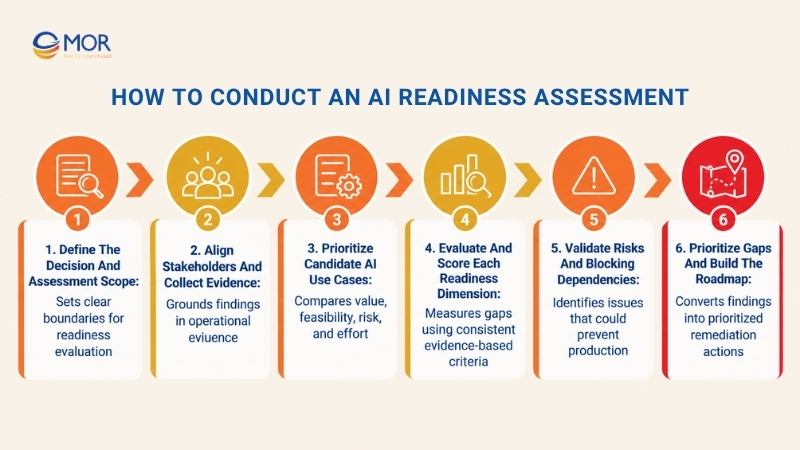
Step 1. Define the Decision and Assessment Scope
Start by writing down the decision the assessment must support. That decision might be “Can we pilot a support drafting assistant this quarter?” or “Which three finance use cases should enter discovery?” rather than “Are we ready for AI?”
Bound the scope around a workflow, business unit, capability, or small portfolio of use cases. Record users, affected customers, systems, data sources, expected outputs, actions the AI may take, review duties, geographic scope, and risk level.
Specificity keeps the assessment testable. “Use AI in HR” creates vague answers, whereas “draft job descriptions from approved competency data for recruiter review” tells the team which data, permissions, systems, users, and controls to inspect.
Step 2. Align Stakeholders and Collect Evidence
Bring in the people who own the business result and the systems around it. Depending on scope, that group can include business leaders, product owners, IT, data, security, legal, compliance, finance, HR, operations, and end users.
Evidence should come from real operating records. Gather architecture diagrams, API inventories, data quality reports, access policies, process maps, security controls, training records, vendor contracts, KPI baselines, incident logs, and support procedures.
Separate what teams believe from what the records prove. “Our data is clean” is an opinion until sample testing, quality reports, and ownership records support it.
Step 3. Prioritize Candidate AI Use Cases
Compare candidate use cases against business value, feasibility, dependency, risk, implementation effort, and time to value. A short list keeps the review useful and reveals which gaps affect one workflow versus the entire organization.
Score the problem before the technology. A high-volume repetitive task with clear inputs and measurable outputs may deserve attention sooner than a flashy use case with unclear ownership or hard-to-access data.
For generative AI, also inspect grounding needs, acceptable error rates, human review, content permissions, and the cost of model usage. Teams considering generative AI integration services should settle these points before choosing an integration pattern.
Step 4. Evaluate and Score Each Readiness Dimension
Apply one rating scale across strategy, data, technology, governance, security, people, process, operations, and value. Each score should have a short explanation and a reference to the evidence used.
Don’t hide disagreement by averaging it away. If the data team rates access as strong and security rates it as weak, record the disagreement, inspect permissions and logs, then resolve the underlying issue.
Use scorecards to compare gaps, not to create a false sense of precision. A 3.6 out of 5 means little unless the team knows which capability sits below the threshold for the selected use case.
Step 5. Validate Risks and Blocking Dependencies
Stress-test the points that could block production. Review privacy, security, regulatory duties, model behavior, vendor terms, identity, integration, human review, rollback, and failure scenarios against the proposed workflow.
Ask operational questions, too. What happens if the retrieval index is stale? Who responds if model cost spikes? Can users challenge an output? Which team can shut the workflow down without waiting for the vendor?
Platform choices can shape these dependencies. Teams building the right AI tech stack should map model, data, orchestration, vector search, security, observability, and application components against the risks found in the assessment.
Step 6. Prioritize Gaps and Build the Roadmap
Rank gaps by business effect, risk, dependency, effort, and urgency. Separate hard blockers from improvements that can wait until after the pilot so the plan doesn’t turn into a multi-year modernization program before any use case gets tested.
Give every remediation item an owner, due date, dependency, and completion test. “Improve data governance” is too broad. “Assign owners to the three product knowledge sources and publish access rules before pilot UAT” can be tracked.
Connect each action to the use case it unlocks. That link helps finance and leadership see why a data, security, architecture, or training investment exists and what decision becomes possible when the work is done.
How to Score and Interpret AI Readiness
There is no universal scoring standard that certifies an organization as ‘AI ready.’ Different assessments use different dimensions, weights, and scales, so the scoring method must be stated upfront and applied consistently.
External benchmarks can add market reference without becoming a universal pass mark. Cisco found only 13% of companies globally said they were fully ready to capture AI’s potential.
Dimension scores are usually more useful than one company-wide number. A strong infrastructure rating shouldn’t hide weak data permissions, missing process owners, or no way to measure business value.
Use the table below as MOR Software’s proposed 1-to-5 model for this guide. It is a practical decision aid, not an industry certification.
Score | Readiness stage | Interpretation | Recommended action |
1 | Initial | Major foundation gaps block reliable testing or deployment | Resolve blockers before funding a pilot |
2 | Emerging | Some capabilities exist, but they are inconsistent or poorly owned | Build basic data, governance, ownership, and technical foundations |
3 | Pilot-ready | Conditions support selected, bounded use cases under defined controls | Launch controlled pilots with acceptance criteria and KPIs |
4 | Operational | Teams can deploy and support AI in repeatable production workflows | Standardize controls, support, monitoring, and release practices |
5 | Scalable | Strategy, systems, controls, data, people, and operations support wider rollout | Expand proven use cases under portfolio governance |
Score each dimension separately, then add decision thresholds for the use case. For example, a drafting assistant might require no score below 3, but an agent authorized to execute financial changes may require higher security, governance, and operational ratings.
A score also needs confidence. Mark ratings as verified, partly verified, or assumption-based so leadership can distinguish a proven 3 from a 3 based mostly on interviews.
Weights should follow the use case rather than a generic corporate average. A public FAQ assistant and an AI agent that approves payments shouldn’t carry the same security, oversight, and operational thresholds. Record the weighting logic beside the score so another reviewer can reproduce the result.
Set minimum gates as well as averages. A total score of 4 can still hide a governance score of 2 that blocks production, so flag any dimension that sits below the minimum required for the selected workload.
Use a digital scoring tool to collect responses if it saves time, but keep evidence attached to the rating. The useful output is the gap behind the score, its business consequence, and the action needed to close it.
Common AI Readiness Gaps and How to Close Them
Readiness problems tend to cluster around the same points: vague use cases, weak data, old systems, unclear governance, broad permissions, skills shortages, undocumented processes, and no production operating model. Spotting them early changes the order of investment.
The cost of ignoring these gaps is visible in production rates. Gartner’s January 2026 analysis states that at least 50% of generative AI projects had been abandoned after proof of concept by the end of 2025, citing poor data quality, inadequate risk controls, rising costs, or unclear business value.
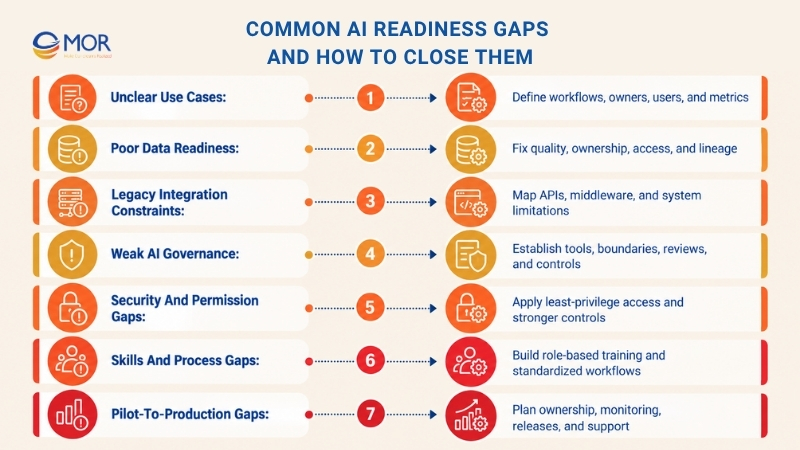
- Unclear use cases: Replace broad mandates like “deploy AI across operations” with a defined workflow, users, data, output, owner, and target metric. A narrow scope gives the team something it can test and fund.
- Fragmented or low-quality data: Focus remediation on data needed for the selected use cases. Assign owners, test representative samples, fix access paths, and document lineage before launching a large data-cleanup program with no link to delivery.
- Legacy and integration constraints: Map required APIs, middleware, batch processes, identity flows, and unsupported applications early. If an old ERP can only export nightly CSV files, a real-time AI workflow needs a different design or an integration project first.
- Weak AI governance: Define approved tools, data boundaries, model or vendor approval, review duties, incident ownership, and change control. Keep rules tied to actual workflows so teams can follow them during daily work.
- Security and permission gaps: Apply least-privilege access, data classification, logging, secrets management, tenant controls, and periodic permission reviews. AI-assisted search can expose information users were never meant to retrieve together.
- Skills and adoption gaps: Build role-based training for end users, reviewers, managers, engineers, and control teams. Generic AI awareness sessions won’t teach a support agent how to verify a grounded answer or a product owner how to set acceptance criteria.
- Poor process maturity: Standardize the workflow before automating it. If three teams handle the same exception three different ways, the AI design will inherit that confusion.
- Pilot-to-production gaps: Plan service ownership, monitoring, release control, cost limits, incident handling, adoption, and model changes during discovery. Production work starts before the pilot ends.
Close gaps in dependency order rather than treating every weakness as equal. If a pilot needs customer records from a legacy CRM, missing API access may block the work before model selection matters. If permissions are too broad, fixing retrieval quality first won’t make the workflow safe to release.
Use the selected use case as the filter for remediation. Assign each gap a business consequence, owner, completion test, and the decision it unlocks. That keeps the backlog focused and gives leadership a clearer reason to fund data, security, architecture, or training work.
An external readiness consulting engagement can be useful when internal teams lack time, cross-functional authority, or independent technical review. The external team should still work from your evidence and use cases rather than replacing them with a generic maturity template. Its recommendations should map back to owners, dependencies, and delivery decisions.
What Should an AI Readiness Assessment Deliver?
The final output should support decisions. A maturity chart can be useful for executive communication, but it doesn’t tell engineering what to fix, finance where funding goes, or a product owner when a pilot may start.
Teams comparing AI readiness assessment services should ask what they receive after the workshops end. The strongest deliverables connect score, evidence, gap, owner, investment, and implementation sequence.
Deliverable | What it should contain | Decision it supports |
Readiness scorecard | Dimension-level ratings, rationale, evidence status, use-case relevance | Where are we ready, partly ready, or blocked? |
Gap analysis | Missing capabilities, risks, dependencies, and affected use cases | What must change before pilot or production? |
Prioritized use cases | Business value, feasibility, risk, dependency, effort | Which use cases should move first? |
Evidence register | Documents, systems, samples, owners, assumptions | Can reviewers verify each conclusion? |
Remediation backlog | Action, owner, priority, dependency, target date, completion test | Who fixes what, and in which order? |
Investment priorities | Data, platform, integration, people, security, support needs | Where should the budget go? |
Phased roadmap | Immediate actions, pilot prerequisites, production work, scaling work | What happens after the assessment? |
KPI model | Baselines, target measures, acceptance criteria, stop or scale gates | How will value and performance be judged? |
Reassessment plan | Review cadence and trigger events | When should readiness be checked again? |
A good report makes assumptions visible. If a score depends on a future API, an unfinished data catalog, or a security control that hasn’t been tested, the reader should see that dependency beside the recommendation.
Decision owners should also see what evidence can change the recommendation. A blocked use case may become pilot-ready after one permission change, whereas another may require months of data or integration work. That distinction helps leaders sequence spending instead of treating every gap as the same size.
Budget planning belongs here too. Model fees are only one line item, so review data engineering, integration, cloud, licenses, testing, security, training, support, and maintenance. Our guide to the cost of AI development can help teams connect readiness gaps to likely delivery costs.
AI Readiness Assessment vs AI Maturity Assessment
Readiness and maturity answer different questions. Readiness is decision-oriented: can your organization pursue a defined AI initiative under the conditions it has now, and what needs to change before it does?
Maturity looks at how developed and embedded the organization’s AI capabilities are across time. A company may be mature in analytics and ML operations yet still be unready for one high-risk agentic use case because data permissions or human approval rules are missing.
Factor | AI readiness assessment | AI maturity assessment |
Core question | Can we pursue this AI initiative under acceptable conditions? | How developed are our AI capabilities today? |
Orientation | Forward-looking and decision-led | Current-state capability benchmarking |
Scope | Often use-case, workflow, or capability specific | Often enterprise-wide |
Primary output | Gaps, blockers, priorities, evidence, action roadmap | Maturity level and capability profile |
Best timing | Before pilots, major investment, production, or scaling | During strategic benchmarking and capability planning |
Decision supported | What can proceed, what must change, and in what order | Where the organization sits on a maturity curve |
The two methods can work together. A maturity review provides a broad baseline, then readiness testing applies that baseline to a real workload with specific data, systems, users, permissions, and risks.
This distinction also matters for AI consultancy and advisory services. A company asking for long-term capability development needs a different engagement from a team deciding whether one AI product should enter production this quarter.
Turn AI Readiness Assessment Into an Execution Roadmap with MOR Software
An assessment creates value when teams can act on the findings. At MOR Software JSC, we connect readiness gaps to technical work, accountable owners, delivery gates, and business outcomes so the result can move into planning rather than sit as a standalone scorecard.
Our AI readiness assessment service can support the path between early AI ambition and implementation. We can review business objectives, candidate use cases, data foundations, application architecture, integrations, security requirements, and delivery feasibility, then translate the findings into a phased plan.
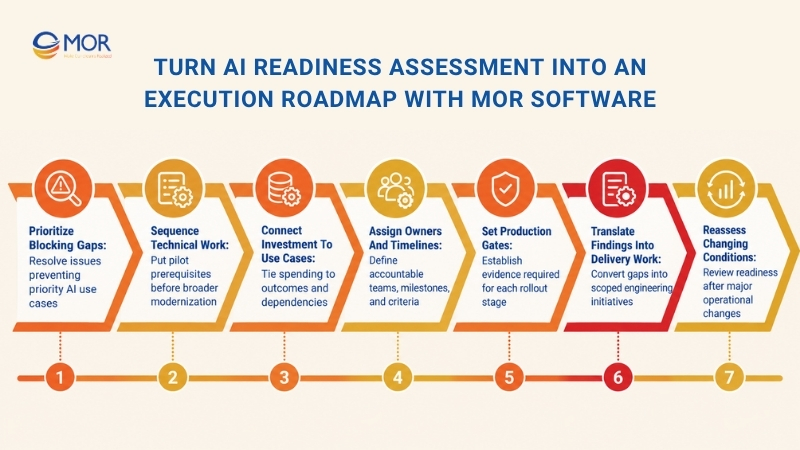
- Prioritize blocking gaps: Separate issues that stop a priority use case from lower-priority improvements. Data permissions, missing APIs, security controls, or unclear ownership may need resolution before development begins.
- Sequence near-term and longer work: Put pilot prerequisites first, then plan larger data, cloud, architecture, governance, and operating changes around the use cases they unlock.
- Connect investment to use cases: Tie each technical initiative to a business outcome, dependency, and acceptance test. This gives leadership a reason for every spend line.
- Assign owners and timelines: Give remediation work to named teams with milestones and completion criteria. Architecture, data, security, and business owners should know where their work enters the plan.
- Set pilot-to-production gates: Define the evidence required to move from PoC to pilot, production, and broader rollout. Gates can cover model quality, data access, security tests, user acceptance, cost, latency, and support readiness.
- Translate findings into delivery work: Readiness gaps may lead to PoC development, data engineering, cloud modernization, API integration, application changes, security work, or a custom AI product. Teams considering choosing the right custom AI development company can use the assessment to define that scope before vendor selection.
- Build the execution plan: Our professional AI consulting services can connect discovery, architecture, implementation planning, engineering, testing, and rollout around the priorities found during readiness work.
- Reassess when conditions change: Revisit affected dimensions after changes to models, data sources, vendors, regulations, architecture, user scope, or permissions. Readiness isn’t permanent once the operating conditions move.
Companies looking for AI readiness assessment consulting should expect a path to delivery, not a bigger report. MOR Software can help turn assessment findings into scoped engineering work and a roadmap that teams can fund, assign, test, and scale.
Conclusion
An AI readiness assessment gives leaders a grounded view of what can move, what needs repair, and what should wait before AI spending grows. The best result is a prioritized execution plan tied to evidence, owners, KPIs, and real use cases. MOR Software can help assess your current state, shape the roadmap, and carry priority initiatives into engineering and production. Contact us to discuss your AI goals and readiness gaps.
"Evolution is not a destination, it is a disciplined journey of innovation."
Phung Van Tu


CEO MOR AI
MOR SOFTWARE
Frequently Asked Questions (FAQs)
What is an AI readiness assessment?
It is a structured review of whether an organization can implement and operate a defined AI use case under acceptable business, data, technical, security, governance, people, and process conditions. The output should identify gaps and actions, not just produce a maturity score. A useful result tells leaders what can proceed now and what needs work first.
What does an AI readiness assessment evaluate?
It usually covers business alignment, use-case fit, data quality and access, architecture, integration, infrastructure, security, governance, workforce skills, process ownership, operational support, KPIs, and scaling conditions. The exact scope should match the use cases being considered. High-risk use cases need deeper review of permissions, oversight, and failure handling.
How long does an AI readiness assessment take?
There is no fixed duration. A bounded review of one or two use cases can move faster than a company-wide assessment involving many systems, business units, countries, and control functions. Evidence availability and stakeholder access also affect the schedule. Poor documentation usually adds time because teams must verify assumptions before scoring.
Who should participate in an AI readiness assessment?
Include the business owner plus the teams that control the data, systems, risk, money, and daily workflow. That can mean IT, data, security, legal, compliance, operations, finance, HR, product teams, architects, engineers, and end users, depending on scope. Participation should reflect the decisions the AI will make or support.
What is a good AI readiness score?
A score is only meaningful inside the method that produced it. Look at the rating scale, evidence, use-case requirements, and dimension-level gaps instead of assuming one universal percentage means “ready.” High technical readiness can’t cancel a blocking security or governance issue. Minimum gates are often more useful than a simple average.
What is the difference between AI readiness and AI maturity?
Readiness asks whether you can pursue a defined AI initiative now and what must change before it proceeds. Maturity measures how developed and embedded the organization’s AI capabilities are overall. Readiness is usually closer to an investment or deployment decision. Maturity works better for broad benchmarking and long-term capability planning.
Can a company conduct an AI readiness assessment internally?
Yes, if internal teams can gather evidence, challenge assumptions, and bring the right business and technical owners into the review. External advisory support can add independent architecture, data, security, or delivery expertise when internal capacity is limited. Outside review can also help resolve disagreements between teams that score the same capability differently.
Do companies need to be fully AI-ready before starting a pilot?
No. A bounded, low-risk pilot can proceed when its own prerequisites are met and broader company gaps don’t threaten the test. The pilot still needs defined data, controls, ownership, acceptance criteria, and a plan for what must change before production. Keep scope and permissions narrow enough that the team can learn without creating avoidable exposure.
How often should AI readiness be reassessed?
Reassess affected areas after major changes in use cases, models, vendors, data, architecture, regulations, permissions, operating scope, or production requirements. Teams can also schedule periodic reviews for AI programs that add new workloads throughout the year. A material change should trigger a targeted review rather than waiting for an annual cycle.
What should happen after an AI readiness assessment?
Turn findings into a prioritized remediation backlog, named owners, investment decisions, pilot gates, KPIs, and a phased implementation plan. An external consulting partner should help connect those findings to executable work rather than ending at a score presentation. Each action should state what use case it unlocks and how the team will confirm completion.
Share


Make Our-Dreams Realized


© 2023 . MOR Software. All Rights Reserved
Sitemap
Privacy Policy
Terms of Use

Rate this article
0
over 5.0 based on 0 reviews
Your rating on this news:
Name
*Email
*Write your comment
*Send your comment
1