


Data Governance Models Explained: 3 Types + How to Select
Data teams often agree on policies but still disagree on who owns decisions, who fixes bad data, and who can approve access. Data governance models solve that operating problem. In this guide, MOR Software will explain the three main structures, how they differ, and how to select one that fits your organization.
Key Takeaways
- Governance structure decides who owns data, sets rules, resolves conflicts, and carries out controls across business units.
- Centralized, decentralized, and federated approaches trade different levels of control, speed, local ownership, and coordination.
- The right choice depends on company structure, data maturity, regulation, culture, technology, and the ability to put governance into daily workflows.
What Is Data Governance Model?
A data governance model is the operating structure that assigns data ownership, decision rights, policies, and accountability across an organization. It tells teams who can make a decision, who carries it out, and who steps in when data rules conflict.
At a practical level, data governance models turn governance goals into working responsibilities. They connect business teams, data owners, data stewards, IT, security, legal, and compliance around one shared way of managing data.
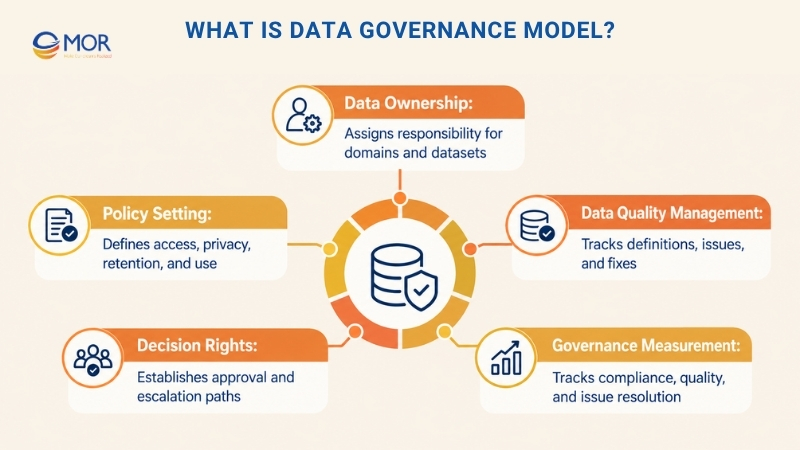
The model answers several questions:
- Who owns the data: A named business owner takes responsibility for a domain, dataset, or business term. Ownership should cover decisions, not just a job title on a chart.
- Who manages data quality: Data stewards track definitions, quality issues, and day-to-day use. They also coordinate fixes when the same data appears across several systems.
- Who sets policies: A governance council, central data office, or domain team defines rules for access, privacy, retention, classification, and acceptable use.
- Who has decision rights: The model sets approval paths and escalation rules. A team should know who decides when two departments use different definitions for the same metric.
- Who checks results: Governance needs measures for ownership coverage, data quality, access requests, policy adherence, and issue resolution time.
A governance model differs from a governance framework. The model defines authority and ownership, while the second documents the roles, policies, processes, standards, and controls used to carry out that structure.
Teams also use the term data governance operating models for these decision structures. Data management models describe how organizations manage data through its life cycle, while data model governance focuses on logical and physical data structures. Data modeling governance sets rules for creating, reviewing, naming, and changing those structures.
Deloitte’s 2026 CDO playbook data governance body analysis reports that 85% of surveyed government data leaders named data governance a top mission priority, yet 57% still struggled to mature it. The gap shows why a policy document alone rarely fixes ownership and execution problems.
Key Components of an Effective Data Governance Model
The structure only works when people can carry it into daily operations. Strong data governance models connect ownership, policy, data quality, access, metadata, and measurement instead of treating each area as a separate program.
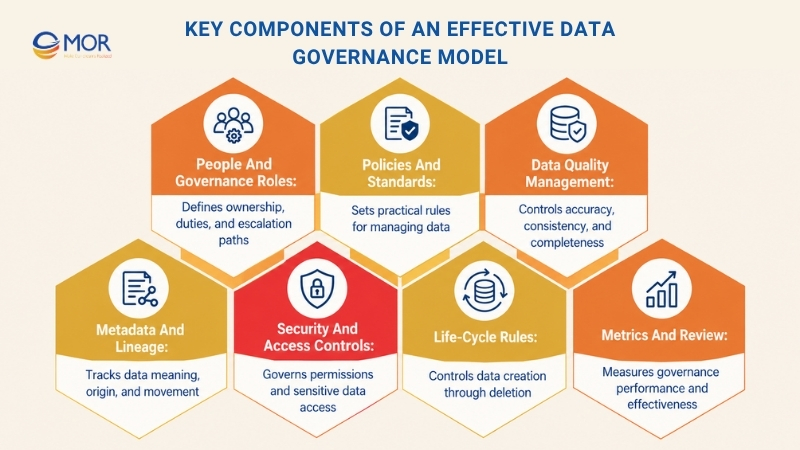
A useful data governance model template should document these parts in plain terms:
- People and governance roles: Define data owners, stewards, custodians, governance council members, security teams, and business users. Each role needs decision rights, duties, and escalation paths so issues don’t sit between departments.
- Policies and standards: Set rules for classification, privacy, retention, naming, business definitions, acceptable use, and data sharing. Keep policies tied to real workflows so teams can apply them without reading a long policy manual every time.
- Data quality management: Decide who sets quality rules, who monitors them, and who fixes failures. Common measures include completeness, accuracy, consistency, timeliness, uniqueness, and validity. Quality programs also depend on routine data hygiene practices that identify duplicate, incomplete, outdated, or inconsistent records before they spread across downstream systems.
- Metadata and lineage: Record what data means, where it came from, where it moves, and which reports or applications depend on it. Clear lineage makes it easier to trace an error back to its source and assess the reach of a change.
- Security and access controls: Map roles to data permissions, approval paths, and review cycles. Access rules should cover sensitive data, privileged users, third parties, and AI systems that read enterprise information. Cloud environments add another layer of ownership, access, and policy control. A structured approach to cloud data governance helps teams apply these rules across cloud-based data stores and services.
- Life-cycle rules: Set expectations for creation, storage, use, sharing, archiving, and deletion. A shared process prevents teams from keeping stale data forever or deleting records that still have legal or business value.
- Metrics and review: Track ownership coverage, issue resolution time, quality scores, access request SLAs, policy exceptions, and audit findings. These measures tell leaders if governance works in daily operations.
Security deserves special attention as AI use grows. IBM’s 2025 Cost of a Data Breach research 2025 Cost of a Data Breach Report found that 63% of organizations lacked AI governance policies, and 97% of organizations reporting an AI-related security incident lacked proper AI access controls. Access, ownership, and policy enforcement now need to cover people and machine users.
The exact setup will vary. A smaller company may use one council and a few data owners, while a global group may need domain stewards and enterprise policy owners working together.
3 Main Types of Data Governance Models Explained
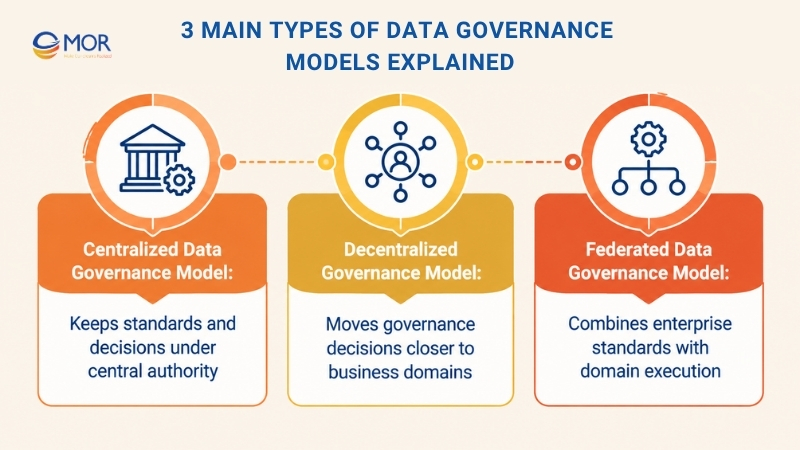
Most data governance model types fall into three operating structures: centralized, decentralized, and federated. Each assigns authority differently, so the right choice depends on how your organization already makes decisions and manages data.
Centralized Data Governance Model
A centralized approach puts governance authority in one enterprise team, often a data office, IT function, or council led by a chief data officer. That team sets standards, approves major decisions, and monitors how departments apply governance rules.
For many organizations, this is the simplest data governance models structure to start with because ownership and escalation stay easy to see.
- Strong central control: One team sets definitions, classification rules, access policies, and stewardship standards. This creates one source of direction across departments.
- Consistent compliance: Central review works well when one regulation or policy set applies across the business. Audit teams also have a clear place to find controls, owners, and evidence.
- Clear accountability: A central office can settle disputes when departments use different terms or quality rules. Escalation is direct because authority sits in one place.
- Possible bottlenecks: Every access request, policy change, or data issue can end up waiting for the same team. Growth can turn a tidy model into a long approval queue.
- Less local freedom: Central policies may miss the needs of product teams, regions, or business units. Teams may create unofficial workarounds if governance moves slower than operations.
A common data governance model example is a bank that keeps customer definitions, access rules, retention policies, and regulatory controls under a central data office. Government agencies and healthcare organizations can follow a similar structure.
Decentralized Governance Model
This decentralized structure moves decision authority into business units, regions, products, or data domains. Local teams set many of their own rules and manage the data closest to their operations.
This structure gives teams room to act quickly, but it also puts more pressure on local ownership. Data governance models built this way need strong communication if data crosses department boundaries.
- Faster local decisions: Teams don’t need to send every question through a central office. Product, finance, sales, or regional teams can resolve many issues where the work happens.
- Stronger domain knowledge: The people closest to the data often understand its business meaning best. That can lead to better definitions and quality rules inside each domain.
- More local flexibility: A regional unit can adapt policies to local laws or operating needs. A product team can also set controls that match its own data flows.
- Higher risk of silos: Departments may create different definitions for customer, revenue, product, or active user. Those differences become painful when leaders need one enterprise report.
- Duplicated work: Separate teams may build similar policies, quality checks, catalogs, or dashboards. Costs rise and coordination becomes harder.
This model can fit diversified groups where business units operate with real independence. It also suits organizations whose domains already have mature data leaders and strong accountability.
Federated Data Governance Model
This federated structure combines central standards with local execution. A central council sets enterprise rules, while domains or business units manage data within those shared boundaries.
Among the three data governance models, federation often fits large organizations that need common definitions but can’t route every decision through one team.
- Shared standards: The central body defines enterprise policies, business terms, classification rules, and minimum controls. Domain teams apply them to their own systems and workflows.
- Domain ownership: Local stewards and owners manage quality, access, and issue resolution close to the data. Their business knowledge stays part of the governance process.
- Better scale: Governance work spreads across domains rather than collecting in one central queue. A central team can focus on policy, conflict resolution, measurement, and shared tooling.
- Harder coordination: Federation depends on clear boundaries between enterprise and domain decisions. Poor role design can create duplicate authority or leave gaps between teams.
- Higher maturity needs: Local owners need training, time, and enough authority to do the work. Shared catalogs, lineage, policy repositories, and access systems also become more useful as domains grow.
Federated governance becomes more relevant when data spans private systems and public cloud services. A clear enterprise hybrid cloud strategy helps keep ownership, access rules, and governance controls consistent across those environments.
You can see this pattern in data governance models in healthcare, where a health system sets enterprise privacy rules while hospitals or clinical domains manage local stewardship. Manufacturers, retailers, and global groups can use a similar structure for product, customer, finance, and supply chain data.
Data Governance Models Comparison: Centralized vs Decentralized vs Federated
The differences become easier to judge side by side. Data governance models vary mainly in where authority sits, how quickly local teams can act, and how much coordination the organization must maintain.
Model | Decision authority | Key advantages | Main challenges | Best fit |
Centralized | Central data office, council, or enterprise function | Common standards, direct accountability, easier audit control | Slow approvals, central bottlenecks, less local freedom | Regulated organizations, smaller structures, early governance programs |
Decentralized | Business units, regions, products, or domains | Fast local decisions, strong domain knowledge, flexible rules | Silos, conflicting definitions, duplicated work | Independent business units, mature local teams, diversified groups |
Federated | Central standards plus domain-level execution | Shared control, domain ownership, better scale | Coordination load, role overlap, higher maturity needs | Large enterprises, global groups, many data domains |
No model removes trade-offs. Centralization gives leaders tighter control, decentralization gives domains more independence, and federation asks the organization to manage shared rules and local execution at the same time.
A company may also change structures as it grows. Teams often start with central ownership to create common rules, then distribute selected decisions once stewardship and data practices become more mature.
How to Choose the Right Data Governance Model
The answer to how organizations choose a data governance model starts with how the business already works. A governance design that fights the company’s reporting lines, culture, systems, and decision habits will be hard to sustain.
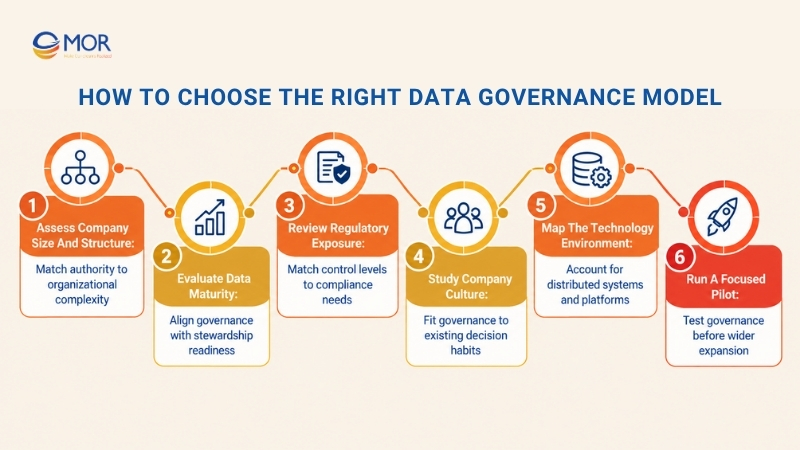
Use six lenses to test which data governance models fit your needs:
- Assess company size and structure: A smaller business with one main data platform can keep authority central. A global company with independent regions, brands, or product lines may need domain-level ownership.
- Evaluate data maturity: Early programs often need central rules for naming, ownership, quality, and access. Data governance maturity models can help teams judge when local stewardship and decision rights are ready to expand.
- Review regulatory exposure: Banks, insurers, healthcare providers, and public bodies may need stronger central control over sensitive data and audit evidence. Global companies also need room for country-level rules where laws differ.
- Study company culture: A highly autonomous business may resist a strict top-down design. A company used to shared enterprise standards may find a fully decentralized structure harder to control.
- Map the technology environment: Count the main data platforms, SaaS applications, cloud services, legacy systems, and analytics tools that governance must cover. Distributed systems usually require clearer domain boundaries, metadata, lineage, and shared controls.
- Run a focused pilot: Test the structure on one data domain, business unit, or high-value use case. Track decision speed, issue resolution, policy exceptions, and ownership gaps before expanding the design.
AI adds another selection test. Gartner reported in 2025 that 63% of organizations either lacked or were unsure they had the right data management practices for AI. Its research also predicted that through 2026, organizations would abandon 60% of AI projects unsupported by AI-ready data.
The same requirement becomes more visible in big data machine learning, where model outputs depend on large datasets that need consistent quality rules, lineage, ownership, and access controls.
Governance requirements grow further when organizations deploy enterprise AI platforms across departments and connected systems. The selected model needs clear responsibility for the data, permissions, lineage, and workflows feeding those AI applications.
The choice also doesn’t need to stay fixed forever. Governance can move from central control toward federation as business units gain stronger stewardship skills, shared tools, and clearer accountability.
Common Data Governance Model Mistakes to Avoid
Most governance failures start before the first policy goes live. Weak data governance models often create unclear ownership, slow decisions, or rules that teams can’t apply to the systems they use every day.
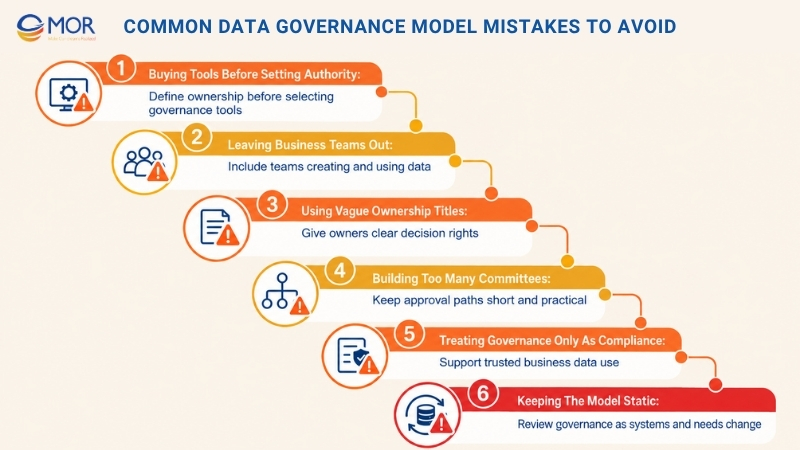
- Buying tools before setting authority: A catalog or quality platform can support governance, but it can’t decide who owns customer data or who settles a definition dispute. Set roles and decision rights before choosing tools around them. The same rule applies to AI governance tools. Software can support monitoring, policy enforcement, and model oversight, but governance teams still need to define ownership and decision rights first.
- Leaving business teams out: Governance handled only by IT misses the people who create and use business data. Finance, sales, operations, risk, legal, product, and other domain teams need defined ownership where their decisions affect data.
- Using vague ownership titles: Calling someone a data owner means little if the role has no decision rights, time, or escalation path. Write down what owners approve, what stewards manage, and which issues move to a council.
- Building too many committees: Extra approval layers can slow access, data fixes, and policy changes. Keep decision paths short enough that teams can follow them during normal work.
- Treating governance only as compliance: Regulation is one reason to govern data, but business use also depends on trusted definitions, quality, access, and lineage. This becomes especially visible in business intelligence solution integration, where disconnected source systems can create conflicting metrics and unreliable reports.
- Keeping the model static: Cloud services, SaaS tools, new data products, and AI change where data lives and who uses it. Review decision rights when systems, business units, regulations, or major use cases change.
McKinsey’s 2025 global AI survey found that 88% of organizations used AI in at least one business function, yet only 7% reported AI fully scaled across the organization. Governance teams now need to prepare for AI use that spreads faster than older approval structures were designed to handle.
The practical fix is simple: connect governance design to real operating work. Policies should map to system controls, named owners, measurable service levels, and review cycles that teams can follow.
Transform Data Governance Strategies Into Scalable Enterprise Systems
Selecting the right structure is only part of the job. Data governance models still need data pipelines, business applications, integrations, access controls, and engineering processes that can carry governance rules into real systems.
MOR Software JSC supports that technical layer through software development, data engineering, cloud work, system integration, and flexible delivery models. Its service materials list Data Engineering under AI solutions and project-based development plus ODC as cooperation models.
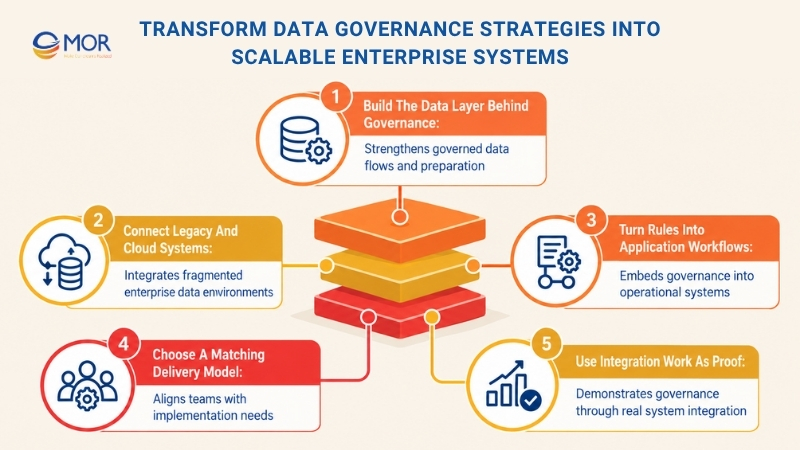
- Build the data layer behind governance: MOR Software’s AI service portfolio includes feasibility assessment, Data Engineering, and custom model services. This fits projects that need cleaner data flows, stronger preparation for analytics or AI, and engineering work around governed enterprise data.
- Connect legacy and cloud systems: Governance breaks down when the same information sits in disconnected applications. We have delivered API and ETL integration work that moves data between legacy environments, Salesforce, Slack, and AWS-based services.
- Turn rules into application workflows: Custom software can place access steps, validation, approvals, and business logic inside the systems employees already use. That moves governance closer to daily operations instead of leaving it only in documents.
- Choose a delivery model that matches the program: MOR lists project-based development and ODC model among its cooperation models, while its service materials also reference dedicated-team and fixed-scope engagement. Companies can match team structure to a defined implementation or a longer data program.
- Use integration work as proof: In one workforce management project, we connected a client’s internal data with Salesforce through API synchronization and ETL migration, then added Slack-based attendance workflows. The project used Force.com, Apex, VisualForce, AWS Lambda, Slack SDK, and Jsforce, and ran for five months with eight specialists.
This approach fits companies dealing with fragmented enterprise data, legacy integration, cloud adoption, Salesforce data flows, or AI projects that need stronger data foundations. Start with the domains causing the most governance friction, then define the engineering work needed for ownership, quality, access, and traceability.
Conclusion
The right data governance models give people clear ownership, practical decision rights, and controls that match how the business actually uses data. Centralized, decentralized, and federated structures each fit different levels of scale, autonomy, and regulation. MOR Software can help turn that operating choice into working data flows, integrations, cloud systems, and applications. Contact us to discuss the technical gaps, delivery options, and system priorities behind your governance program.
"Evolution is not a destination, it is a disciplined journey of innovation."
Phung Van Tu


CEO MOR AI
MOR SOFTWARE
Frequently Asked Questions (FAQs)
What is a data governance model?
It defines who owns data, who sets rules, who manages quality and access, and how data decisions get made across an organization. It turns governance policy into named responsibilities and decision paths.
What are the main types of data governance models?
The three common structures are centralized, decentralized, and federated. They differ mainly in how authority is split between an enterprise governance team and local business or data domains.
What is the difference between centralized and decentralized governance?
Centralized governance keeps most authority in one enterprise team. Decentralized governance gives business units or domains far more control over their own data policies, quality, and decisions.
Is a federated model better for large enterprises?
It can fit large, distributed companies because common enterprise rules can sit beside domain ownership. Success depends on clear roles, shared standards, strong stewardship, and enough coordination across domains.
How do you choose the right governance model?
Check company structure, regulation, data maturity, culture, technology, and the speed at which teams need decisions. A pilot can test the model before a larger rollout.
What roles are needed in a governance model?
Common roles include data owners, data stewards, data custodians, governance council members, security teams, and business users. The exact mix depends on company size and the chosen operating structure.
Can organizations change their governance model over time?
Yes. A company may start centrally to set common rules, then move selected ownership into domains as stewardship, tooling, and accountability become stronger.
How does AI affect data governance models?
AI increases the need for trusted source data, clear lineage, controlled access, ownership, and common business definitions. Machine users can spread data errors quickly when those controls are weak.
What tools support data governance models?
Common tools include data catalogs, metadata repositories, lineage platforms, data quality systems, identity and access management, policy repositories, and monitoring tools. The operating structure should define responsibilities before tool selection.
What happens if an organization has poor data governance?
Teams may work with conflicting definitions, weak quality, unclear access, duplicate reports, and slow issue resolution. Those gaps can also raise audit, privacy, security, analytics, and AI risks.
Share


Make Our-Dreams Realized


© 2023 . MOR Software. All Rights Reserved
Sitemap
Privacy Policy
Terms of Use

Rate this article
0
over 5.0 based on 0 reviews
Your rating on this news:
Name
*Email
*Write your comment
*Send your comment
1