


15 Best AI Governance Tools Reviewed in 2026
AI estates now span internal models, third-party LLMs, copilots, agents, APIs, and embedded AI. The Stanford AI Index 2026 recorded 362 documented AI incidents in 2025, up from 233 in 2024, so oversight now sits on the operating agenda. Yet AI governance tools solve very different jobs. This MOR Software guide will compare 15 options across scope, controls, deployment, limits, and pricing.
Key Takeaways
- No single platform covers policy management, model oversight, shadow AI, production controls, data security, and autonomous AI agents at the same depth. Buyers should match each product to the risk layer they need to control.
- AI adoption is moving much faster than formal oversight. Credo AI's 2026 State of AI Governance findings report that 60% of enterprises are scaling AI, yet only 4% govern it at scale.
- Runtime control now deserves the same attention as policy records. Agents can call tools, access company data, trigger workflows, and act before a monthly review process has time to react.
What Are AI Governance?
AI governance refers to the policies, processes, roles, and controls used to manage AI systems across their lifecycle. It defines how an organization approves AI use, assigns accountability, manages risk, monitors performance, and records evidence for audits or internal reviews.
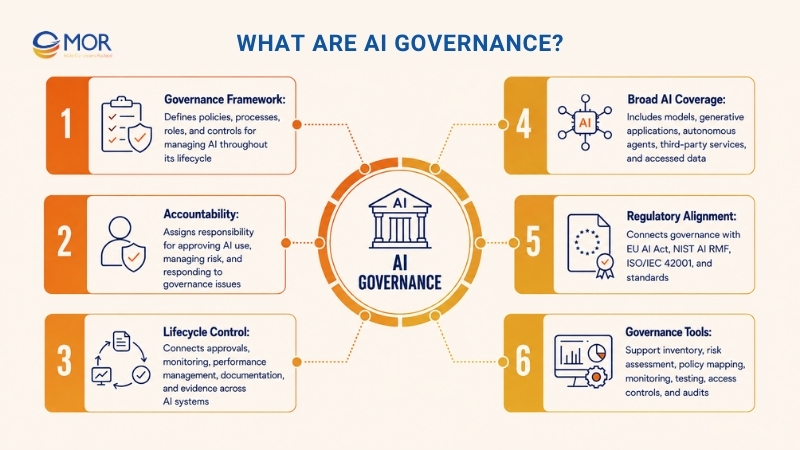
A practical AI governance program covers models, generative AI applications, autonomous agents, third-party AI development services, and the data they access. It also connects business rules with requirements from the EU AI Act, NIST AI RMF, ISO/IEC 42001, and other applicable standards.
Organizations apply AI governance to keep AI use visible, traceable, and controlled. AI governance tools support this work through inventory management, risk assessment, policy mapping, monitoring, testing, access controls, and audit records.
15 Best AI Governance Tools for 2026
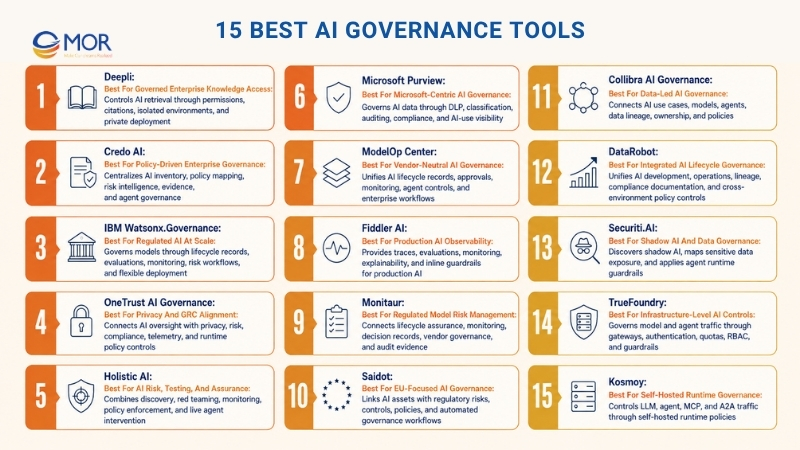
The market includes GRC-led systems, model lifecycle products, observability platforms, data-security suites, AI gateways, and agent control planes. Treating all of them as interchangeable makes an AI governance tools list less useful for buyers.
Our comparison focuses on where each product fits and where its boundary sits. That makes it easier to compare the best AI governance tools without assuming every vendor solves the same problem.
Tool | Best For | Primary Governance Layer | AI/Agent Inventory | Runtime Controls | Main Regulatory Coverage | Deployment | Pricing |
Governed enterprise knowledge access | Knowledge access and retrieval | Knowledge sources rather than enterprise-wide AI registry | Permission-aware retrieval | Security and access controls | Cloud, VPC, on-prem, air-gapped options | Quote-based; 14-day trial | |
Credo AI | Policy-led enterprise governance | AI GRC and policy | Yes | Runtime observability and policy enforcement capabilities | EU AI Act, NIST AI RMF, ISO/IEC 42001 and more | Enterprise platform | Custom quote |
IBM watsonx.governance | Regulated AI at scale | Model lifecycle and risk | Yes | Monitoring, evaluations and connected controls | EU AI Act, NIST AI RMF, ISO/IEC 42001 and industry rules | IBM Cloud, AWS, software | Free trial; usage and enterprise tiers |
OneTrust AI Governance | Privacy and GRC alignment | AI GRC plus runtime policy | Yes | Yes | EU AI Act, NIST AI RMF, ISO/IEC 42001 | Enterprise cloud platform | Custom quote |
Holistic AI | Risk testing and runtime assurance | Discovery, testing and enforcement | Yes | Yes | EU AI Act, NIST AI RMF, ISO/IEC 42001 | API/SDK-connected enterprise deployment | Custom quote |
Microsoft Purview | Microsoft-centric governance | Data, AI use and compliance | AI usage visibility | DLP and policy controls | Microsoft compliance ecosystem | Microsoft cloud services | Purview Suite $12/user/month plus PAYG options |
ModelOp Center | Vendor-neutral lifecycle governance | Enterprise AI lifecycle | Yes | Yes, directly or through integrations | EU AI Act, NIST AI RMF, ISO/IEC 42001, SR 11-7 | On-prem, private cloud, hybrid | Custom quote |
Fiddler AI | Production observability | Monitoring, evaluation and safety | Agent observability | Yes | Technical risk controls | SaaS, VPC, on-prem | Free; $0.002/trace Developer; Enterprise quote |
Monitaur | Regulated model risk | Assurance and lifecycle records | Yes | Monitoring-led | NIST AI RMF, ISO/IEC 42001, EU AI Act, NAIC | Enterprise platform | Custom quote |
Saidot | EU-focused governance | Risk, controls and policy | Yes | API-led governance actions | EU AI Act, ISO/IEC 42001, NIST AI RMF | SaaS | Subscription plans |
Collibra AI Governance | Data-led AI governance | Data, model and agent records | Yes | Limited compared with gateway products | Policy and regulatory mapping | Collibra cloud platform | Custom quote |
DataRobot | Integrated AI lifecycle | Build, operate and govern | Yes | Policy enforcement | Enterprise AI compliance controls | Cloud, private cloud, hybrid, on-prem, edge | Custom quote |
Securiti.ai | Shadow AI and data governance | Data security and AI usage | Yes | LLM and agent guardrails | Privacy, security and AI regulations | Enterprise DataAI platform | Personalized quote |
TrueFoundry | Infrastructure-level AI controls | Gateway and MCP | Yes, through gateway assets | Yes | Policy, security and compliance controls | SaaS, VPC, on-prem, air-gapped | Free; Pro $499/month; Enterprise custom |
Kosmoy | Self-hosted runtime governance | Gateway, agent and MCP control | Yes | Yes | EU AI Act, ISO/IEC 42001, NIST AI RMF mapping | Customer Kubernetes | Enterprise subscription |
1. Deepli: Best for Governed Enterprise Knowledge Access
Deepli sits beside conventional governance suites rather than competing with them head-on. The AI product turns company knowledge across Slack, Google Drive, Notion, Salesforce, GitHub, Jira, Gmail, and other systems into cited AI automation answers.
Its strongest governance contribution comes from controlled retrieval. Deepli mirrors source permissions, keeps customer environments isolated, logs queries, cites information sources, and states that customer data isn't used for model training. English and Japanese retrieval also suits distributed enterprise teams.
That distinction matters. A compliance team looking for enterprise-wide model risk classification should choose a classic governance suite, while a company trying to control how internal knowledge reaches AI users has a different requirement.
Strengths
- Permission-aware retrieval: Existing file permissions carry into search results, which limits exposure of restricted internal records.
- Source-backed answers: Responses point users to source material, giving teams a traceable path behind an AI-generated answer.
- Private deployment choices: Business and Enterprise plans include VPC, on-premises, and air-gapped options depending on tier.
Limits
- Different product category: Deepli's public material positions it as enterprise AI platform search and knowledge intelligence, not a full AI GRC suite.
- No enterprise-wide model registry claim: Its public pages don't document a central inventory for every external AI model and agent used across a company.
- Narrower compliance scope: Buyers needing formal risk classification and control mapping will need another governance layer.
Deployment: Cloud-hosted Team plan, cloud or VPC Business plan, plus on-premises and air-gapped Enterprise options.
Pricing: Custom quote based on seats, indexed data, connectors, and deployment. Deepli also lists a 14-day trial without a credit card.
2. Credo AI: Best for Policy-Driven Enterprise Governance
Credo AI targets organizations that need one governance record across agents, applications, models, vendors, and related risks. Its current platform combines an AI Registry, Risk Intelligence, Policy Engine, and GAIA governance assistant.
The registry can track AI assets, agent dependencies, shadow AI, and risk classifications. Policy Packs translate major regulations and standards into governance requirements, while evidence recording connects policy work to audit preparation.
Credo AI has also moved further into agent governance. Current product material describes runtime observability, agentic risk controls, trace-level policy enforcement, and connections with Snowflake, Databricks, AWS, Azure, ServiceNow, Jira, GitHub, and MLflow.
Strengths
- Central AI inventory: Agents, applications, models, and vendors can sit under one risk and ownership structure.
- Policy intelligence: Prebuilt Policy Packs connect regulatory requirements with controls, evidence, and governance workflows.
- Agent governance: Agent Registry, dependency graphs, monitoring links, and agent-focused risk libraries address autonomous workloads.
Limits
- Enterprise adoption effort: A broad governance program still requires owners, policies, integrations, evidence sources, and internal decision rules.
- Runtime depth varies by integration: Buyers should test what can actually be blocked or changed inside their own stack rather than treating every 'runtime' capability as equal.
- Public pricing is limited: Credo AI directs enterprise buyers to sales rather than publishing a standard numeric plan.
Deployment: Enterprise SaaS-oriented platform connected to existing cloud, data, development, and risk systems.
Pricing: Enterprise quote. Public product pages don't list a standard self-service price as of August 11, 2026.
3. IBM watsonx.governance: Best for Regulated AI at Scale
IBM watsonx.governance covers predictive machine learning, gen AI platform intergration, third-party models, and newer agentic workloads. It combines model inventory, documentation, evaluation, monitoring, and risk workflows, making it one of the deeper AI model governance tools for large regulated estates.
AI Factsheets store lifecycle information and supporting evidence. IBM also supports third-party environments and gives buyers cloud plus software deployment choices, which can carry weight in banking, healthcare, government, and other data-sensitive settings.
The trade-off is product breadth. Some security, discovery, orchestration, and inference controls sit elsewhere in IBM's product family, so buyers need to map the complete architecture before licensing.
Strengths
- Lifecycle records: Factsheets collect model and governance information through development, evaluation, deployment, and monitoring.
- Third-party coverage: IBM documents governance for models outside its own machine learning tech stack, including major cloud and model providers.
- Deployment choice: Buyers can use IBM Cloud, AWS, or software priced around virtual processor cores.
Limits
- Product-family complexity: Security, agent execution, model building, and governance can involve separate IBM products.
- Runtime blocking isn't the whole product: watsonx.governance centers on lifecycle control, evaluation, accountability, and monitoring rather than acting solely as an inline LLM gateway.
- Enterprise tiers carry higher entry costs: Risk & Compliance plans start far above lightweight SaaS products.
Deployment: IBM Cloud, AWS Cloud, or enterprise software.
Pricing: 14-day free trial; Model Management starts at $0.64 on IBM Cloud. Risk & Compliance Basic starts at $44,000, Advanced at $79,800, and AWS watsonx.governance starts at $42,000, subject to IBM's pricing conditions.
4. OneTrust AI Governance: Best for Privacy and GRC Alignment
OneTrust connects AI oversight with a broader privacy, data, third-party risk, and compliance program. Its AI Governance product tracks AI assets, owners, risk levels, regulatory duties, models, and agents inside a central program layer.
The 2026 product has moved well beyond static questionnaires. OneTrust documents real-time telemetry, policy-violation detection, prompt and output filtering, block-or-allow actions, sensitive-data masking, production guardrails, and controls that connect policy decisions with AI workloads.
That makes OneTrust appealing to companies already using its privacy or risk products. Teams buying only for model experimentation may find the wider suite heavier than a focused evaluation or observability platform.
Strengths
- Privacy connection: AI assets can sit beside established privacy, data, and risk processes rather than forming a separate governance silo.
- Runtime actions: Current controls include filtering, redaction, blocking, escalation, and policy-led decisions.
- Live monitoring: Models and agents can send quality, safety, performance, and telemetry signals into governance decisions.
Limits
- Large platform scope: Organizations may need more configuration than they would with a narrow model-monitoring product.
- Value depends on operating fit: Existing OneTrust customers have a shorter path because privacy and risk records already live in the suite.
- No simple public unit price: AI Governance pricing requires a sales conversation.
Deployment: Enterprise platform integrated with AI, data, privacy, cloud, and risk systems.
Pricing: Custom enterprise quote; OneTrust does not publish a standard numeric AI Governance plan on its current product page.
5. Holistic AI: Best for AI Risk, Testing, and Assurance
Holistic AI combines AI discovery, inventory, risk assessment, red teaming, monitoring, and policy enforcement. Its current product divides the work into Identify, Protect, and Enforce layers, backed by Guardian Agents.
The Protect layer runs automated tests for risks that include bias, prompt injection, data extraction, hallucinations, and security weaknesses. Runtime enforcement goes further through Sentinel Agents that watch behavior and Operative Agents that can block requests, revoke privileges, trigger kill switches, or route cases for human review.
This technical assurance layer separates Holistic AI from products built mainly around questionnaires. Yet buyers should still test latency, integration depth, intervention rules, and false-positive handling against their own production architecture.
Strengths
- Discovery plus testing: The platform can find AI assets and then run automated red-team and risk tests against them.
- Runtime intervention: Guardian Agents support live monitoring and action when policy thresholds are crossed.
- Agent coverage: Agent Graph maps relationships among agents, APIs, models, data pipelines, and workflows.
Limits
- Runtime claims need pilot proof: Buyers should measure intervention accuracy and operational overhead against real agent workflows.
- Pricing remains sales-led: Public product material focuses on demos rather than a numeric price list.
- Broad scope can require integration work: Discovery, testing, APIs, policy configuration, and runtime actions still need connection to your production estate.
Deployment: Integrates through APIs and SDKs across cloud, AI, code, and data systems. Holistic AI also documents coverage across AWS, Azure, GCP, and on-premises environments.
Pricing: Enterprise sales model; public numeric pricing isn't listed on the current platform page.
6. Microsoft Purview: Best for Microsoft-Centric AI Governance
Microsoft Purview approaches AI governance through data security, compliance, classification, auditing, and AI-use visibility. That makes it a practical choice when Microsoft 365, Copilot, Azure, Entra, and related services already carry much of your business data.
Purview can apply DLP, sensitivity labels, audit, eDiscovery, insider-risk controls, and compliance management to Microsoft workloads. DSPM for AI extends visibility to AI interactions and helps security teams identify risky data use across supported Microsoft and third-party AI surfaces.
The product's center of gravity is data and compliance. Companies that need a vendor-neutral system for model validation, agent evaluation, and lifecycle approvals may still pair Purview with another platform.
Strengths
- Microsoft integration: Purview sits close to Microsoft 365, Copilot, Azure subscriptions, and enterprise security controls.
- Data protection: DLP, classification, information protection, auditing, and investigation workflows address sensitive AI data use.
- AI activity visibility: DSPM for AI extends governance toward AI apps and interactions across supported systems.
Limits
- Microsoft weighting: Its value rises sharply inside a Microsoft-heavy estate and falls when most AI activity sits elsewhere.
- Licensing needs careful review: User licenses, Microsoft 365 prerequisites, Azure subscriptions, and consumption charges may apply across different capabilities.
- Different model-risk focus: Purview doesn't replace a deep, vendor-neutral model-validation system.
Deployment: Microsoft cloud services, tied to Microsoft 365 and Azure for many capabilities.
Pricing: Microsoft Purview Suite is listed at $12 per user/month, paid yearly, and requires qualifying Microsoft 365 or Office 365 plans. Several data governance and compliance products use pay-as-you-go pricing.
7. ModelOp Center: Best for Vendor-Neutral AI Governance
ModelOp's Enterprise AI Command Center acts as a system of record above an organization's existing AI, MLOps, GRC, security, data, and ITSM systems. It manages ML, GenAI, agentic systems, and third-party AI through common lifecycle records and workflows.
Among platforms that offer governance tools for AI model lifecycle management, ModelOp stands out for its vendor-neutral operating layer. Current support covers intake, risk tiering, approvals, monitoring, audit work, MCP and A2A imports, agent cards, tool inventories, and inline protections for selected agent risks.
A July 2026 partnership with Kong adds another enforcement path. ModelOp can send approval and risk decisions to Kong so model, agent, and tool access can be allowed, restricted, or blocked at the connectivity layer.
Strengths
- Vendor-neutral record: ML, GenAI, vendor AI, and agents can share one lifecycle layer.
- Enterprise workflows: Intake, risk review, approvals, monitoring, and audit can connect technical and business teams.
- Private deployment: ModelOp documents on-premises, private-cloud, and hybrid installation in the customer's environment.
Limits
- Enterprise setup: A command-center model needs substantial integration into existing risk, data, development, and delivery systems.
- Some enforcement relies on connected products: Kong is one example where ModelOp supplies risk decisions and the traffic layer executes access control.
- No public standard price: Buyers need a vendor quote.
Deployment: On-premises, private cloud, or hybrid; ModelOp states that the product references data in place.
Pricing: Custom enterprise quote.
8. Fiddler AI: Best for Production AI Observability
Fiddler focuses on production visibility, evaluation, explainability, and runtime safety. Its platform covers predictive AI, generative systems, and agentic workloads through traces, experiments, evaluators, monitoring, and guardrails.
The runtime layer checks risks including hallucinations, toxicity, PII/PHI leakage, prompt injection, and jailbreak attempts. Fiddler lists guardrail latency below 80ms on its current pricing page and supports SaaS, VPC, or on-premises deployment at Enterprise level.
Engineering teams get stronger technical telemetry than they would from a paperwork-led GRC product. Enterprises often need a policy or compliance system beside it when board-level approvals and regulatory evidence extend well beyond model behavior.
Strengths
- Production traces: Teams can investigate agent and model behavior at a technical level rather than relying only on periodic assessments.
- Inline guardrails: Runtime checks address unsafe prompts and responses before downstream use.
- Flexible hosting: Enterprise plans support SaaS, VPC, and on-premises deployments.
Limits
- GRC breadth is smaller: Fiddler's strongest area is observability, testing, and runtime control rather than enterprise policy administration.
- Trace cost can grow: The Developer plan charges per trace, so high-volume agent estates need cost modeling before rollout.
- Pairing may be necessary: A regulated company may still need a separate policy, evidence, or third-party AI governance system.
Deployment: SaaS for Developer; SaaS, VPC, or on-premises for Enterprise.
Pricing: Free guardrail tier; Developer costs $0.002 per trace; Enterprise uses custom sales pricing.
Teams researching the best AI automation software for government contractors should also screen for data residency, government cloud support, audit requirements, and contractual controls rather than ranking products only by general enterprise capability.
9. Monitaur: Best for Regulated Model Risk Management
Monitaur focuses on lifecycle assurance, decision records, controls, monitoring, and audit evidence. Insurance remains a strong fit because the product connects AI governance with model-risk practices and industry-specific regulatory work.
GovernML, RecordML, MonitorML, and AuditML connect policy, evidence, monitoring, and assurance work. Vendor Governance also addresses third-party models, which matters when insurers or financial firms depend on external AI that they didn't build themselves.
A useful market signal comes from regulators themselves. The NAIC AI Systems Evaluation Tool was being piloted by 12 participating U.S. states as of March 2026, covering AI use, governance practices, risk controls, higher-risk models, and input data.
Strengths
- Insurance specialization: Monitaur aligns product workflows closely with carrier model-risk and regulatory needs.
- Evidence continuity: Decisions, controls, monitoring records, and audit work remain connected across the lifecycle.
- Third-party governance: Vendor AI can enter the same assurance process as internally built systems.
Limits
- Sector shape: Insurance-centric teams get more value from its domain depth than buyers seeking a general LLM gateway.
- Runtime scope: The product centers on governance and assurance rather than functioning as a broad inline traffic broker.
- Pricing transparency: Current public pages don't provide a standard price list.
Deployment: Enterprise governance platform; buyers should confirm hosting and residency requirements during scoping.
Pricing: Custom enterprise quote.
10. Saidot: Best for EU-Focused AI Governance
Saidot uses a connected risk-and-control knowledge graph to help organizations document AI systems, models, datasets, products, and agents. The platform then links those assets with applicable policies, controls, and risk records.
Its maintained library currently lists more than 260 AI-related risks, 620 controls, and 110 policies, plus information on more than 100 commonly used AI models and products. Azure AI Foundry and Amazon Bedrock have built-in integrations, while REST APIs, webhooks, and MCP servers connect other systems.
Saidot fits teams that want guided regulatory work without buying a much larger enterprise risk suite. Its European base and EU AI Act tooling also make it relevant where regulatory classification drives the buying process.
Strengths
- Curated risk library: Governance teams get maintained risk, control, policy, and model information instead of building every mapping manually.
- Connected asset records: Models, systems, datasets, and agents can inherit relevant control requirements through relationships in the graph.
- Agent integration: MCP support lets agents query governance records, register systems, and run risk assessments programmatically.
Limits
- Less focused on inline traffic blocking: Public material emphasizes governance intelligence and automation over functioning as a dedicated LLM gateway.
- Smaller ecosystem: Buyers may find fewer surrounding products and services than with IBM, Microsoft, or OneTrust.
- Plan values aren't fully exposed in page text: Buyers may need the live pricing flow for exact subscription amounts.
Deployment: SaaS platform with Azure marketplace availability and API connections.
Pricing: Subscription model; Saidot states that plans can be changed and subscriptions can be cancelled before the next payment.
11. Collibra AI Governance: Best for Data-Led AI Governance
Collibra connects AI oversight to the data catalog, lineage, ownership, policies, and metadata already used across a data-governance program. Current 2026 product documentation contains dedicated registries for AI use cases, AI models, and AI agents.
The product traces relationships among use cases, models, agents, data, and policies. That structure answers a practical governance question: which data supports an AI application, who owns each asset, and which controls apply as the use case changes?
Collibra makes the most sense when data lineage is already central to your operating model. Security teams that mainly need a live inference firewall will get deeper traffic controls elsewhere.
Strengths
- Data lineage: AI governance records can connect directly to the data used by models and agents.
- Dedicated registries: Current product pages distinguish AI use cases, models, agents, agent tools, and agent versions.
- Shared ownership: Working records let technical and governance stakeholders capture business value, risk, and lifecycle details in one system.
Limits
- Runtime controls are not its main strength: Collibra's architecture centers on records, metadata, lineage, workflow, and policy.
- Existing Collibra adoption changes the business case: Organizations already using the data platform gain more reuse.
- Configuration still matters: Asset types, roles, permissions, lifecycle stages, and integrations need careful design.
Deployment: Part of the Collibra platform and its enterprise cloud environment.
Pricing: Quote-based enterprise licensing; buyers should request current AI Governance packaging from Collibra.
12. DataRobot: Best for Integrated AI Lifecycle Governance
DataRobot joins AI creation, operation, lineage, compliance documentation, and policy control in one platform. Current governance support extends to models, LLMs, agents, tools, applications, and vector databases.
Its 2026 direction centers on policy consistency across different runtime locations. DataRobot states that governance can operate across public cloud, private cloud, hybrid, on-premises, edge, air-gapped, and sovereign environments.
That makes DataRobot relevant among governance tools for enterprise AI model lifecycle management when development teams already want a broad AI platform. A business that only needs regulatory intake and approvals may pay for more technical platform than it needs.
Strengths
- Build-and-govern connection: Development and governance live closer together than they do in a standalone GRC product.
- Cross-environment policy: DataRobot describes common governance controls across cloud, private infrastructure, edge, and restricted environments.
- Asset coverage: Its central hub covers agents, models, LLMs, tools, applications, and vector databases.
Limits
- Platform commitment: Buyers may need to adopt a wider DataRobot operating model instead of adding one narrow governance module.
- Overlap with existing MLOps: Teams that already standardized another model platform should test integration depth carefully.
- Public pricing remains limited: Enterprise costs require vendor scoping.
Deployment: Cloud, private cloud, hybrid, on-premises, edge, plus regulated deployment patterns documented by DataRobot.
Pricing: Custom enterprise pricing.
13. Securiti.ai: Best for Shadow AI and Data Governance
Securiti.ai starts with a different risk: sensitive enterprise data flowing into models, copilots, agents, and unapproved AI services. Its DataAI Command Center combines data discovery, privacy, AI governance, DSPM, LLM security, and related controls.
Shadow AI discovery helps teams find unapproved use and understand which sensitive information reaches AI services. Agent Commander extends that model to agents, mapping models, data access, risk, and agent behavior while applying runtime controls.
This makes Securiti a strong option when your governance program starts with 'where is our data going?' It is less narrowly focused than classic model-risk products that spend most of their attention on validation evidence and model approval stages.
Strengths
- Shadow AI discovery: The platform finds unmanaged AI use and ties it back to enterprise data exposure.
- Data classification: Sensitive-data records can inform AI policy and security decisions across the DataAI platform.
- Agent controls: Agent Commander adds discovery, risk mapping, runtime guardrails, and action oversight.
Limits
- Data-security center of gravity: Model validation teams may still want dedicated evaluation tooling.
- Broad suite: Privacy, DSPM, AI security, and governance create a larger buying decision than a single-purpose product.
- No standard public price: Securiti asks companies for details before preparing pricing.
Deployment: Enterprise DataAI Command Center across connected cloud, SaaS, data, and AI estates.
Pricing: Personalized enterprise quote.
14. TrueFoundry: Best for Infrastructure-Level AI Controls
TrueFoundry places governance inside the technical path between applications, models, and agent tools. Its AI Gateway centralizes authentication, model access, routing, budgets, quotas, request logs, guardrails, and usage records.
The MCP Gateway adds control around agent tools. Teams can register MCP servers, set RBAC policies, inspect tool calls, and centralize authentication instead of letting every agent connect to tools on its own.
TrueFoundry fits engineering teams looking for enterprise-grade AI safety and governance tools close to live inference. Risk and legal departments that need regulatory questionnaires, formal policy libraries, and third-party assessment portals may still need a GRC-oriented product.
Strengths
- Gateway control: Model access, budgets, rate limits, authentication, routing, and logs sit at one technical control point.
- MCP governance: Plans include MCP server registration, tool-call controls, RBAC, metrics, and authentication support.
- Private hosting: Enterprise customers can use VPC, on-premises, and air-gapped deployment patterns.
Limits
- Not classic enterprise GRC: TrueFoundry focuses more on infrastructure policy than regulatory program administration.
- Engineering ownership: Teams need people who understand gateways, models, auth, observability, and runtime architecture.
- Usage adds cost: Pro tiers have request limits and extra usage charges after included volumes.
Deployment: SaaS, managed gateway plus customer storage, self-hosted gateway plane, VPC/on-premises, or air-gapped Enterprise setups.
Pricing: Developer $0/month, Pro $499/month, Pro Plus $2,999/month, and Enterprise custom.
15. Kosmoy: Best for Self-Hosted Runtime Governance
Kosmoy takes a control-plane approach around live LLM, agent, MCP, and A2A traffic. Its product set includes an AI Gateway, inventories for AI assets and agents, runtime policy controls, compliance evidence, and Action Capsule for restricted agent execution.
The agent registry can collect agents from environments that include Azure AI Foundry, AWS Bedrock, Google Vertex AI, Salesforce, and ServiceNow. Runtime controls then govern model access, budgets, traffic, credentials, and tool behavior through one self-hosted layer.
Action Capsule adds containment. Rather than letting an autonomous process act with broad shared credentials, the system can scope execution and provide a kill mechanism when an agent crosses approved boundaries.
Strengths
- Customer-controlled infrastructure: Kosmoy's positioning centers on self-hosting inside the customer's Kubernetes environment.
- Runtime policy: Its gateway applies controls across LLM, MCP, and A2A traffic rather than stopping at documentation.
- Agent containment: Action Capsule adds scoped execution, short-lived credentials, and intervention controls.
Limits
- Program-management depth: Mature GRC specialists provide broader questionnaire, third-party risk, and policy administration workflows.
- Evaluation isn't the main product: Buyers seeking deep experiment management or dedicated evaluation operations should compare specialist products.
- No self-service buying path: Kosmoy uses an enterprise sales model.
Deployment: Self-hosted, single-tenant Kubernetes in customer-controlled infrastructure, including restricted deployment patterns.
Pricing: Enterprise subscription; no standard self-service tier is publicly listed.
How We Evaluated the 15 AI Governance Tools
A vendor can look strong on a comparison page yet miss the one control your team actually needs. Our evaluation separates documentation, monitoring, and enforcement, then checks where each product sits across the AI lifecycle.
The same approach applies when comparing AI governance tools for enterprise use. A product receives stronger buyer fit when its published capabilities match a real governance job rather than a broad marketing label.
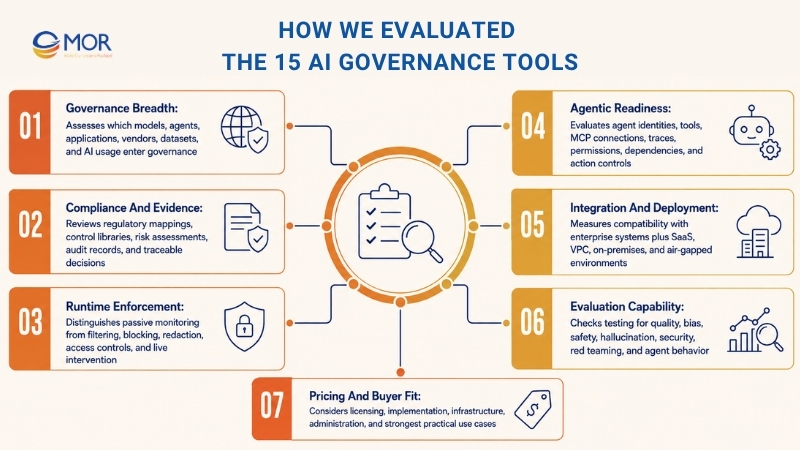
- Governance breadth: We checked which assets enter the product, including ml models, applications, agents, vendors, datasets, and employee AI use.
- AI and agent discovery: Inventory should show what exists, who owns it, where it runs, and which systems or tools it can reach.
- Compliance depth: We reviewed regulatory mappings, risk assessments, control libraries, evidence records, and audit workflows.
- Runtime enforcement: We separated products that record issues after execution from products that can filter, redact, block, constrain, revoke, or route actions during operation.
- Evaluation capability: Testing coverage includes model quality, safety, bias, hallucination, prompt injection, red teaming, and agent behavior where supported.
- Agentic readiness: Modern governance needs agent identities, tool access, MCP connections, dependency maps, traces, delegated permissions, and action controls.
- Auditability: We looked for traceable decisions, policy status, model or agent ownership, evaluation records, logs, and evidence.
- Integration depth: A platform has more practical value when it connects to the cloud, data, development, security, IAM, GRC, and MLOps systems already in use.
- Deployment choice: SaaS can fit many teams, while VPC, on-premises, sovereign, or air-gapped requirements can remove vendors from a regulated shortlist immediately.
- Pricing clarity and TCO: Published license fees tell only part of the story. Integration, storage, evaluation compute, private infrastructure, support, and internal administration add to ownership cost.
- Buyer fit: We rank products around their strongest use case instead of claiming one vendor wins every category.
The ranking reflects editorial buyer fit for this guide. It doesn't claim that one product is universally superior across every governance layer, industry, architecture, or regulatory requirement.
What AI Governance Tools Must Cover in 2026
A useful governance program starts with visibility and continues into evidence and action. The exact controls depend on risk, but mature AI governance tools should cover enough of the following areas to connect policy decisions with real AI systems.
IBM's 2025 Cost of a Data Breach Report gives the security side of that problem a hard number: 97% of organizations that reported an AI-related security incident lacked proper AI access controls, and 63% lacked AI governance policies or were still developing them.
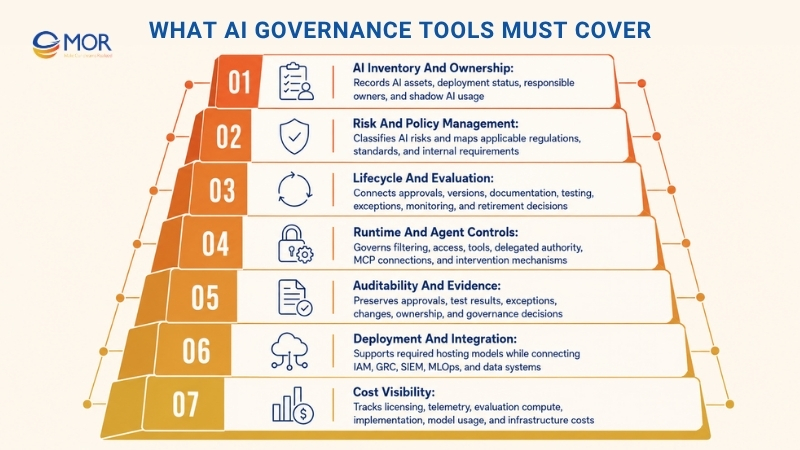
- AI inventory and discovery: Record approved and unapproved models, applications, agents, datasets, third-party services, APIs, and shadow AI. Inventory needs ownership and deployment status, not just a product name.
- Ownership and accountability: Assign business owners, developers, risk reviewers, approvers, data owners, and escalation contacts. A flagged system has little value when nobody owns the response.
- Risk classification: Score AI according to intended use, autonomy, affected users, data sensitivity, geography, model type, and business consequence.
- Policy and regulatory mapping: Connect company requirements to the AI governance framework that applies to the organization, along with regulations and technical standards relevant to each use case.
- Lifecycle governance: Keep approvals, versions, model cards, factsheets, change records, test results, exceptions, and retirement decisions connected.
- Evaluation and testing: Measure quality, bias, safety, security, hallucination, drift, model behavior, and agent actions before and after release.
- Runtime controls: Apply filtering, redaction, blocking, rate limits, access rules, human approval, tool restrictions, or kill controls when business risk requires intervention.
- Agent governance: Record identities, tools, MCP servers, data access, delegated authority, agent dependencies, traces, decisions, and actions.
- Audit evidence: Preserve who approved a system, which tests ran, what failed, which exception was granted, and what changed after release.
- Deployment and sovereignty: Match SaaS, customer VPC, private cloud, on-premises, sovereign, or air-gapped requirements to the organization's data rules.
- Integration: Connect governance records with IAM, GRC, cloud AI services, ticketing, data catalogs, model platforms, SIEM, observability, and development systems.
- Cost visibility: Track software licensing, telemetry, evaluation compute, model usage, implementation work, and private infrastructure where those costs matter.
Regulatory timing also affects tool selection. The European Commission confirmed that AI Act transparency duties under Article 50 start applying on August 2, 2026, including disclosure requirements for certain AI interactions and generated content.
How to Choose the Right AI Governance Tool
Start with the control gap you need to close. A compliance team preparing EU AI Act records has a different buying problem from an engineering team that needs to stop an agent from calling an unapproved payment API.
That difference should shape your shortlist before demos begin. AI governance tools and platforms become easier to compare once every candidate is tied to a specific operating requirement.
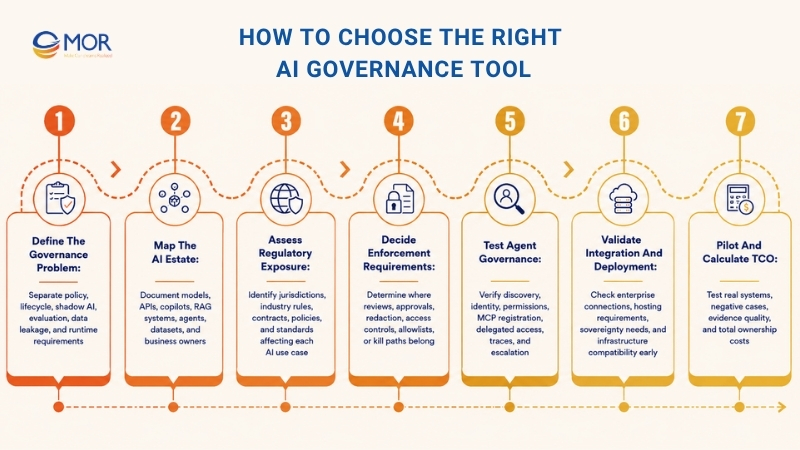
- Define the governance problem: Separate policy administration, model lifecycle, shadow AI, data leakage, runtime enforcement, evaluation, and agent governance. Don't buy one category while expecting another.
- Map the AI estate: Record internal models, third-party APIs, SaaS copilots, embedded AI, RAG systems, agents, MCP servers, datasets, and business owners. Unknown assets create blind spots before any product is installed.
- Map regulatory exposure: Identify jurisdictions, industry rules, internal policies, customer contract terms, and technical standards that apply to each AI marketing use case.
- Decide where enforcement belongs: Some systems only need review and evidence. Higher-risk systems may need hard runtime policies, approval gates, redaction, access limits, tool allowlists, or a kill path.
- Test agent governance: Ask the vendor to show agent discovery, agent identity, tool permissions, MCP registration, delegated access, trace records, and human escalation. A static model registry won't answer those questions.
- Inspect evidence quality: Pick several audit questions and ask the vendor to retrieve the proof. Useful evidence should connect policy, owner, system version, test result, approval, incident, and remediation.
- Review deployment early: VPC, customer cloud, on-premises, sovereign, and air-gapped requirements can disqualify a SaaS-only product before a lengthy procurement cycle starts.
- Check integration fit: IAM, SIEM, GRC, ITSM, cloud AI, MLOps, data catalog, source control, and observability connections determine how much manual work remains after purchase.
- Pilot real systems: Run a representative model, RAG application, or agent through the product. Include normal traffic and deliberately failed controls rather than testing a polished vendor demo only.
- Test negative cases: Send sensitive data, trigger an unapproved tool, fail an evaluation threshold, change a model version, revoke access, and create a policy exception. The response tells you more than a feature checklist.
- Calculate TCO: Add licenses, telemetry storage, model evaluations, professional services, integrations, customer-hosted infrastructure, support, and internal governance staffing.
- Accept a layered architecture when needed: A bank might use OneTrust or Credo AI for policy records, Fiddler for runtime model behavior, Purview or Securiti for sensitive data, and a gateway for live enforcement. Forcing one vendor into every role can create weaker controls.
The best AI governance tool is the one that closes your actual risk gap inside your architecture. A larger capability list doesn't automatically produce a better fit.
Conclusion
The right AI governance tools give your teams visibility, ownership, evidence, and control at the AI layer that carries real business risk. Your shortlist should reflect your models, agents, data, regulations, architecture, and deployment rules. MOR Software supports AI development, custom software outsourcing, IT consulting, system integration, and QC/testing across enterprise projects. Contact MOR Software to turn your governance requirements into a practical AI architecture and delivery plan.
"Evolution is not a destination, it is a disciplined journey of innovation."
Phung Van Tu


CEO MOR AI
MOR SOFTWARE
Frequently Asked Questions (FAQs)
What are AI governance tools?
AI governance tools help organizations inventory AI, assign ownership, assess risk, apply policies, collect evidence, monitor behavior, and control AI use. Some focus on policy and compliance, while others specialize in models, data, agents, security, observability, or runtime enforcement.
What is the best AI governance tool for enterprises in 2026?
There isn't one universal winner. Credo AI and OneTrust fit policy-led programs, IBM and ModelOp suit large lifecycle estates, Fiddler focuses on production behavior, Microsoft Purview and Securiti cover data-centric risk, and TrueFoundry or Kosmoy fit gateway and runtime needs.
How are AI governance tools different from AI security tools?
Governance connects ownership, policy, risk decisions, approvals, evidence, lifecycle records, and regulatory duties. AI security focuses more heavily on threats including data leakage, prompt injection, unsafe access, model attacks, identity abuse, and malicious agent activity.
What is the difference between AI governance and model monitoring?
Model monitoring measures behavior after deployment, including quality, drift, latency, bias, or safety signals. Governance adds ownership, approvals, policy, risk classification, evidence, exceptions, access rules, lifecycle decisions, and accountability around those signals.
Which AI governance tools support the EU AI Act, NIST AI RMF, and ISO 42001?
Credo AI, IBM watsonx.governance, OneTrust, Holistic AI, ModelOp, Monitaur, Saidot, and several other enterprise vendors document support or mappings for these standards and regulations. Coverage depth differs, so buyers should ask vendors to demonstrate the exact controls and evidence they need.
Can AI governance tools manage autonomous AI agents and MCP servers?
Yes, but support varies widely. ModelOp handles agent inventories plus MCP and A2A imports; TrueFoundry provides MCP gateway controls; Kosmoy inventories MCP servers and agents; several GRC-led platforms now track agent identities, risks, dependencies, and runtime signals.
Do AI governance tools detect shadow AI?
Some do. Credo AI, Holistic AI, Securiti.ai, Microsoft security products, and several newer governance platforms provide discovery capabilities for unregistered AI assets or employee AI use, though discovery methods and coverage differ.
How much do AI governance tools cost?
Pricing ranges from free developer tiers to large enterprise contracts. Teams searching for AI governance tools free can start with limited plans or trials from vendors including IBM, Fiddler, and TrueFoundry, while broader GRC suites commonly use custom quotes.
Searches for AI governance tools open source also surface libraries and technical components, but open-source pieces rarely replace an enterprise program on their own. You still need ownership, integrations, evidence retention, security operations, deployment management, and internal policy processes.
Should enterprises use one AI governance platform or several tools?
One platform can work when its strongest layer matches most of your AI estate. Larger organizations often combine policy management, data security, model observability, and runtime controls because each layer has different technical requirements.
How do SaaS, VPC, on-premises, and air-gapped deployments differ?
SaaS runs in vendor-managed infrastructure. VPC deployment places workloads inside a dedicated cloud environment, on-premises deployment keeps software in customer-controlled infrastructure, and air-gapped systems isolate workloads from public network access.
Deployment choice affects security review, data residency, operations, upgrade responsibility, cost, and procurement. Regulated buyers should make this requirement explicit before vendor evaluation starts.
Share


Make Our-Dreams Realized


© 2023 . MOR Software. All Rights Reserved
Sitemap
Privacy Policy
Terms of Use

Rate this article
0
over 5.0 based on 0 reviews
Your rating on this news:
Name
*Email
*Write your comment
*Send your comment
1