


Data Management and Governance: Key Differences Explained
Companies can collect huge volumes of data and still struggle with ownership, quality, access, and trust. Data management and governance solve different parts of that problem: governance defines how data should be controlled, while management puts those rules into daily operation. In this guide, MOR Software will cover where each discipline starts, where they overlap, and how enterprises can connect them.
Key Takeaways
- Data management and governance serve different jobs. Governance defines ownership, policies, quality rules, and accountability, while management runs the systems and processes that apply those decisions.
- Strong governance needs technical execution. Access policies, retention rules, quality thresholds, and classifications need RBAC, ETL pipelines, monitoring, catalogs, and lifecycle controls behind them.
- Enterprises get more value when governance teams and technical teams share ownership of quality, lineage, metadata, access, and AI-ready data.
What Is The Difference Between Data Management And Governance?
The difference between data governance and data management comes down to decision rights versus execution. Governance decides what data means, who owns it, how people may use it, and which rules apply. Management handles collection, storage, movement, transformation, protection, and delivery.
Put another way, the difference between data management and governance is strategic control versus technical operation. Governance answers 'what, who, and why.' Management answers 'how.'
Aspect | Data management | Data governance |
Main purpose | Make data usable, available, accurate, and maintainable | Define how data should be owned, controlled, classified, and used |
Scope | Storage, pipelines, integration, processing, quality operations | Policies, ownership, stewardship, compliance, standards |
Main responsibilities | Move, store, clean, transform, monitor, and deliver data | Define rules, assign accountability, approve access, set standards |
Typical teams | Data engineers, DBAs, architects, platform teams | CDOs, data owners, data stewards, compliance teams |
Typical outputs | Pipelines, curated datasets, databases, warehouses, reports | Policies, business definitions, access rules, quality thresholds |
Common tools | ETL/ELT, databases, warehouses, APIs, monitoring tools | Data catalogs, policy systems, glossaries, lineage and audit tools |
The distinction matters because companies can have technically available data that nobody fully trusts. Salesforce reports that data and analytics leaders consider 26% of organizational data 'untrustworthy', even as overall data volumes are estimated to grow 25% per year.
A strong data management and governance model closes that gap. Governance sets the conditions for trustworthy use, then management carries those conditions into databases, APIs, cloud platforms, analytics systems, and operating workflows.
The comparison of data management vs. data governance also helps teams assign ownership correctly. A data steward shouldn't be expected to repair a failed ETL pipeline, just as a data engineer shouldn't decide company-wide privacy policy alone.
What Is Data Governance?
Data governance defines how an organization controls data as a business asset. It assigns decision rights, sets standards, documents ownership, and establishes rules for access, quality, privacy, retention, and acceptable use.
Interest in governance has grown quickly. Research from Precisely and Drexel University's LeBow College of Business found that 71% of organizations reported having a data governance program, up from 60% the previous year.
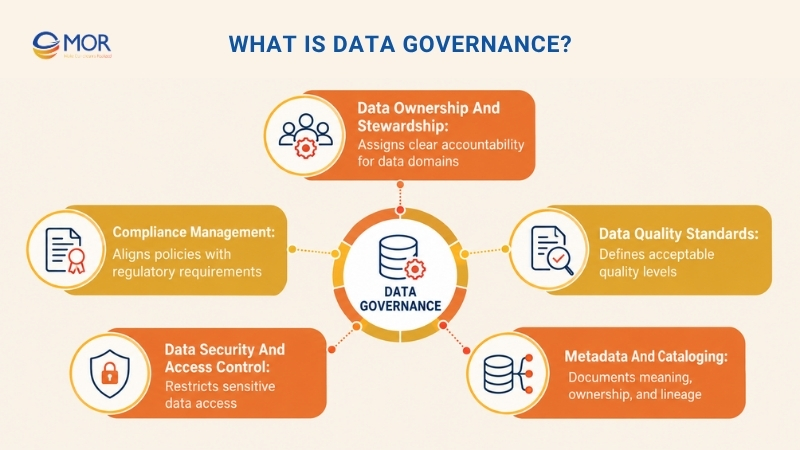
The core areas usually include:
- Data ownership and stewardship: Assign named owners for datasets and domains. Data stewards handle day-to-day quality, definitions, issue management, and policy application.
- Data quality standards: Define acceptable levels for accuracy, completeness, consistency, freshness, and validity. Teams then know when a dataset is ready for analytics or needs correction.
- Data security and access control: Set rules for who may view, edit, export, or share sensitive records. Classification levels can connect these policies to IAM and RBAC systems.
- Metadata and cataloging: Document definitions, owners, classifications, lineage, and usage information. A catalog gives teams one place to understand what a dataset means before using it.
- Compliance management: Map internal policies to laws and industry requirements, including GDPR, HIPAA, CCPA, and record-retention rules.
Data quality sits especially close to governance. MOR Software's guide to data hygiene and quality management tools covers the technical side of finding duplicate, incomplete, invalid, and outdated records.
Cloud environments add another layer because data can move across regions, services, and user groups. Our guide to cloud data governance best practices examines controls for ownership, access, classification, and compliance in cloud-based systems.
Good data management and governance connects these business rules to real systems. Policies become far more useful when technical teams can trace them to workflows, permissions, validation rules, and monitoring.
The phrase data governance and management is sometimes treated as one discipline. Keeping their responsibilities separate makes accountability easier to assign.
What Is Data Management?
Data management covers the operational work required to collect, organize, store, integrate, maintain, and deliver data. A mature data management and governance program treats those activities as one connected lifecycle rather than separate technical projects.
Gartner surveyed 1,203 data management leaders and found that 63% of organizations either didn't have or weren't sure they had the right data management practices for AI. Gartner also expects many AI projects without AI-ready data to be abandoned through 2026.
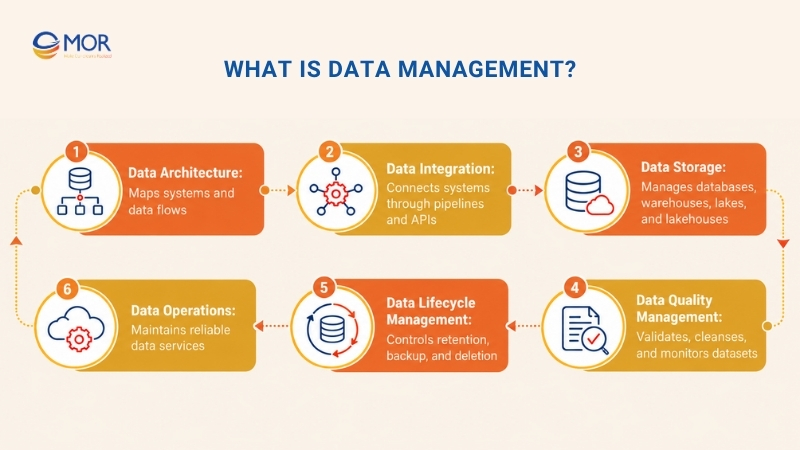
Core data management capabilities include:
- Data architecture: Define how databases, applications, warehouses, lakes, APIs, and analytics systems fit together. Architecture also maps how data travels between them.
- Data integration: Connect operational systems through ETL, ELT, APIs, event streams, and synchronization jobs. Our guide to data integration in business intelligence explains how integrated sources support reporting and analytics.
- Data storage: Manage relational databases, cloud object stores, warehouses, lakes, and lakehouses according to workload needs. Teams evaluating scale can also review enterprise big data platforms.
- Data quality management: Run profiling, validation, deduplication, cleansing, and anomaly checks against agreed standards.
- Data lifecycle management: Apply retention, archival, backup, recovery, and deletion rules according to business and regulatory requirements.
- Data operations: Monitor pipelines, resolve failures, manage capacity, track freshness, and keep data services available.
The phrase data management and data governance describes two connected layers. Governance decides what the organization expects from data; management carries that expectation into infrastructure and day-to-day processing.
Master data management is narrower. The difference between master data management and data governance is that MDM maintains authoritative records for core entities like customers or products, while governance defines the rules and accountability applied to those records.
How Data Management Strengthens Governance
Governance becomes useful when rules appear inside operational systems. Data management and governance connect policy decisions with permissions, pipelines, monitoring, quality checks, and lifecycle automation.
That execution layer becomes more pressing as AI adoption grows. IBM's 2025 Cost of a Data Breach research found that 97% of organizations reporting an AI-related security incident lacked proper AI access controls.
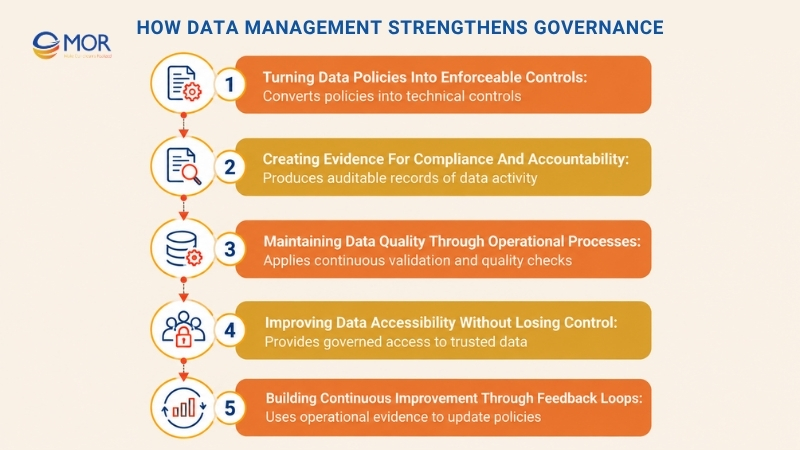
1. Turning data policies into enforceable controls
Governance may say that payroll records are confidential and limited to HR and finance. That statement needs technical controls before it changes user behavior.
- Access policies become permission controls: RBAC and IAM map approved roles to datasets.
- Data classifications become security controls: Encryption, masking, tokenization, and monitoring follow sensitivity labels.
- Usage policies become workflows: Applications can require approvals before users export, share, or alter restricted records.
Consider patient information inside a healthcare system. Governance defines authorized users and permitted use, while management systems configure roles, authentication, database permissions, and logs.
Policy and execution now match. That connection makes unauthorized access harder and gives governance teams something measurable to review.
2. Creating evidence for compliance and accountability
Governance teams also need proof that policies are being followed. A policy document can't answer who opened a dataset last Tuesday or who changed a sensitive field.
Management systems create that evidence through:
- Audit trails: Record data access, changes, exports, and administrative actions.
- Metadata records: Track ownership, source, classification, and lineage.
- Monitoring reports: Surface policy breaches, unusual access, and failed controls.
A bank preparing for an audit may need records showing which employees accessed transaction data. Database and IAM logs can provide timestamps, user IDs, access events, and changes.
Governance defines what must be accountable. Management supplies the evidence needed for internal reviews and regulatory checks.
3. Maintaining data quality through operational processes
Governance sets the definition of acceptable data quality. Management keeps checking real datasets against those definitions.
A customer-data policy may require a valid email, a unique customer ID, a complete address, and an approved country code. Data teams can apply profiling, duplicate detection, validation rules, and anomaly checks as records move through ETL pipelines.
That work turns abstract quality targets into repeatable controls. Missing fields can be flagged early, duplicate accounts can enter remediation queues, and inconsistent formats can be corrected before analytics teams use them.
Quality controls also create feedback for data stewards. Recurring errors point to source-system problems that policy alone won't fix.
4. Improving data accessibility without losing control
Good governance shouldn't make approved data hard to find. Users still need fast access to trusted datasets for reporting, analytics, customer service, and planning.
- Data catalogs: Give teams searchable inventories of approved assets.
- Metadata management: Explains meaning, ownership, source, and sensitivity.
- Self-service analytics: Lets approved users work with governed datasets without direct access to raw operational stores.
A sales analyst, for example, may need customer segmentation data but not raw payment information. A catalog can expose an approved analytical dataset while keeping restricted fields behind tighter permissions.
This model supports access and control at the same time. Users spend less time hunting for data, and governance teams retain authority over sensitive information.
5. Building continuous improvement through feedback loops
Static governance rules can become outdated when systems, laws, teams, and data usage change. Operational data gives governance teams evidence for policy updates.
Access logs may reveal repeated exception requests. Quality monitoring may show the same field failing validation each week, while incident reports can expose permissions that are too broad.
Governance teams can use those signals to revise standards, ownership rules, or access policies. Management teams then apply the revised controls across applications and data platforms.
That cycle keeps data management and governance tied to real operating conditions rather than a policy document that gets reviewed once a year.
How Data Management And Governance Work Together
Data governance and data management intersect wherever a business rule needs technical execution. The relationship becomes most visible in data quality, lineage, access control, and metadata.
A healthy data management and governance model also separates responsibilities. Governance teams decide acceptable standards and decision rights. Technical teams build and run the mechanisms that apply them.
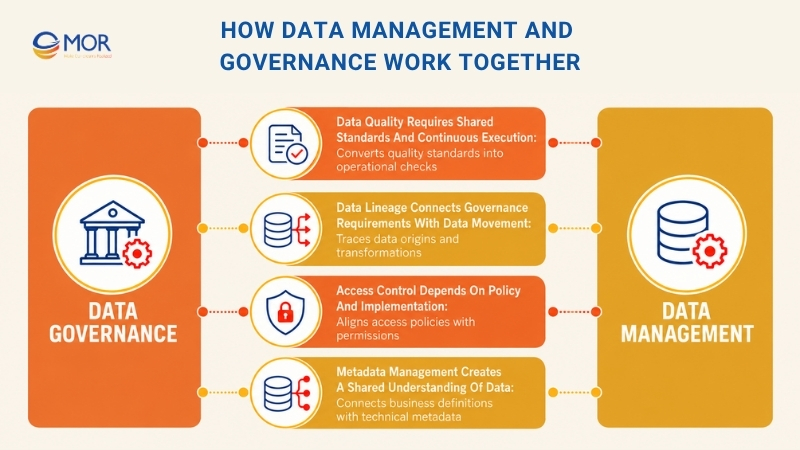
Data quality requires shared standards and continuous execution
Data quality starts with a shared definition of 'good enough.' Governance teams decide which dimensions matter, including accuracy, completeness, consistency, freshness, and validity.
They may set a rule that product records require a SKU, price, category, supplier ID, and active inventory status. Data owners also decide who handles exceptions and which quality threshold allows certification.
Management teams turn these decisions into profiling jobs, validation logic, cleansing processes, and automated monitoring. ETL pipelines can reject incomplete records or route them to a remediation queue.
Take an ecommerce catalog as an example. Governance defines required product fields, while management checks each incoming record before publishing it to commerce and reporting systems.
Data lineage connects governance requirements with data movement
Lineage explains where data originated, how it changed, and which systems consumed it. Governance needs that record for accountability, audit work, quality analysis, and ownership.
Management teams generate lineage through pipeline metadata, transformation logs, schema information, job histories, and catalog integrations. Those records connect a business report back to the systems and transformations behind it.
Consider a bank investigating an incorrect revenue figure. Teams may trace a dashboard metric through a warehouse model, ETL transformation, and source transaction system.
Governance determines why that traceability must exist. Management supplies the technical trail required to follow the data.
Access control depends on policy and implementation
Governance decides which users or roles should access each class of data. It also defines approval paths and conditions for elevated access.
Management applies those decisions through RBAC, IAM, authentication, database permissions, masking, and security monitoring. The policy and the technical control need to stay aligned as users change jobs or leave the company.
For instance, governance may restrict payroll data to HR and selected finance roles. Technical teams then configure permissions that block other departments while recording authorized access.
The shared responsibility closes a common gap: a good policy paired with outdated permissions.
Metadata management creates a shared understanding of data
Different teams often use the same term with different meanings. 'Active customer' might mean a recent buyer to marketing and a contract holder to finance.
Governance establishes approved definitions, owners, classifications, and usage rules. Data stewards maintain the business meaning and settle conflicts between teams.
Management handles technical metadata, including schemas, field types, table relationships, pipeline history, and source-system information. Catalog tools connect these details to the business definition.
Together, those layers create a common language. Analysts can see what a field means, where it came from, who owns it, and whether they should use it.
Benefits Of Integrating Data Management And Governance
Companies gain more value when data management and governance operate as one coordinated model. The benefits appear in everyday reporting, regulatory work, system integration, and AI programs.
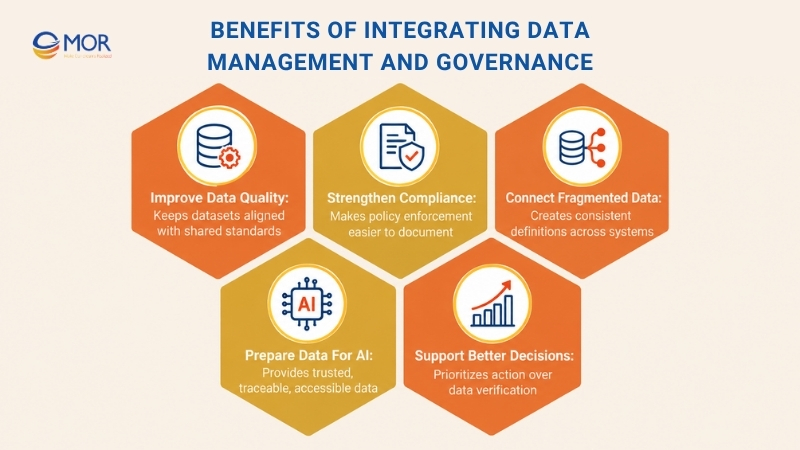
- Improve data quality: Shared standards give engineers and stewards the same target. Validation, monitoring, and ownership processes then keep datasets closer to agreed quality levels.
- Strengthen compliance: Clear classifications, lineage, retention rules, and audit trails make policy enforcement easier to document.
- Connect fragmented data: Common definitions and integration rules help teams join CRM, ERP, analytics, cloud, and internal application data without creating conflicting meanings.
- Prepare data for AI: AI models and agents need trusted, traceable, accessible data. McKinsey reported in June 2026 that only 7% of companies had fully scaled AI across their organizations, and more than two-thirds of high-performing companies cited data as the main obstacle to enabling AI.
- Support better decisions: Teams can spend less time checking which dataset is correct and more time acting on approved information.
AI also expands governance beyond traditional databases. Teams managing models, prompts, agents, and generated content may need dedicated AI governance tools alongside existing data controls.
Best Practices For Implementing Data Management And Governance
Successful data management and governance programs start with business ownership and then connect that ownership to technical processes. Buying a catalog or writing a policy manual won't fix unclear responsibilities on its own.
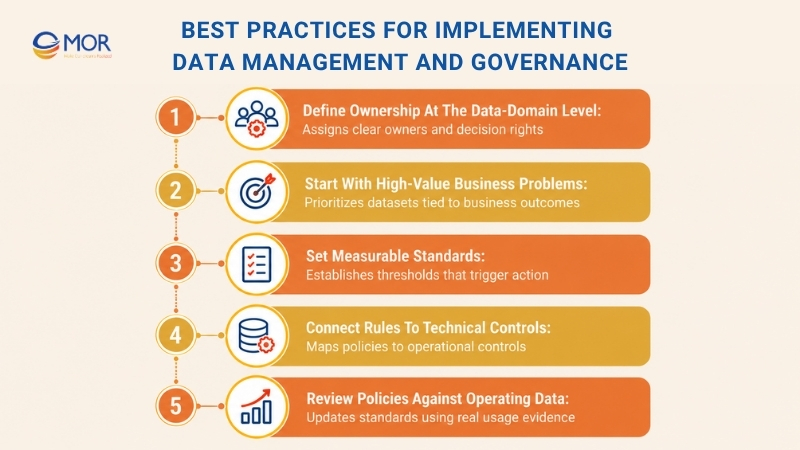
- Define ownership at the data-domain level: Assign owners and stewards for customer, product, finance, employee, and operational data. Give each role clear decision rights and escalation paths.
- Start with high-value business problems: Prioritize datasets tied to revenue, compliance, customer operations, AI, or executive reporting. A focused scope gives teams measurable results before they expand.
- Set measurable standards: Define thresholds for completeness, freshness, duplicates, validation errors, access exceptions, and policy breaches. Teams need metrics that can trigger action.
- Connect rules to technical controls: Map governance requirements to RBAC, IAM, ETL validation, masking, retention jobs, catalogs, and monitoring. Document which control applies each policy.
- Review policies against operating data: Use incidents, quality reports, user requests, and audit findings to update standards. Governance should change when real usage shows a rule is outdated or hard to apply.
Cloud architecture also affects these choices. Companies splitting workloads across private infrastructure and public cloud services can review MOR Software's guide to a hybrid cloud strategy for data management before mapping storage, access, and governance controls.
Implement Data Management And Governance With MOR Software
A policy has limited value if your applications, databases, and integrations can't apply it. MOR Software supports data management and governance projects at the technical execution layer through custom software development outsourcing, enterprise integration, Salesforce engineering, and dedicated development teams.
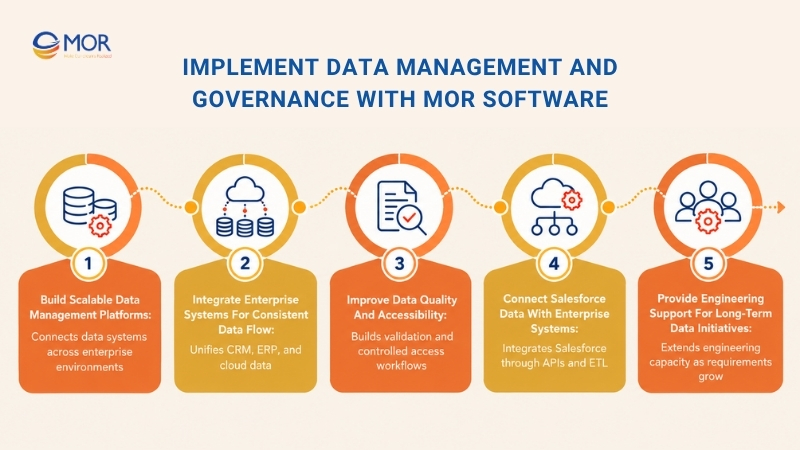
Our role can cover five practical areas:
- Build scalable data management platforms: We develop custom systems that collect, process, store, and expose business data according to project requirements. Architecture can connect databases, cloud services, APIs, internal applications, and reporting layers.
- Integrate enterprise systems for consistent data flow: We connect CRM, ERP, legacy applications, and cloud services through APIs, ETL processes, and custom integration logic. Shared data flows make governance rules easier to apply across systems.
- Improve data quality and accessibility: Our teams can build validation workflows, internal reporting tools, monitoring services, and controlled access layers. These systems give business users trusted data without opening unrestricted access to underlying databases.
- Connect Salesforce data with enterprise systems: MOR Software works on Salesforce customization, migration, and third-party integration. One MOR Software project connected internal employee data with Salesforce through API Gateway and ETL, while Slack commands supported attendance operations.
- Provide engineering support for long-term data initiatives: Dedicated teams can work on integration, platform development, maintenance, testing, and system changes as data requirements grow. That model gives enterprises additional engineering capacity without rebuilding the internal team for every initiative.
MOR Software can help turn governance requirements into software, integrations, and operating controls that fit your current systems. Contact us to discuss your data platforms, integration gaps, Salesforce environment, or long-term engineering needs.
Conclusion
Data management and governance work best when policy and technical execution stay connected. Governance defines ownership, standards, access, and accountability, while data management turns those decisions into pipelines, controls, metadata, quality processes, and usable data services. MOR supports that execution through custom development, system integration, Salesforce engineering, and dedicated teams.
Contact us to discuss your data systems and integration needs.
"Evolution is not a destination, it is a disciplined journey of innovation."
Phung Van Tu


CEO MOR AI
MOR SOFTWARE
Frequently Asked Questions (FAQs)
What is the difference between data management and data governance?
Governance defines policies, ownership, quality standards, access rules, and accountability. Management runs the systems and processes that store, move, clean, integrate, and deliver data under those rules.
Is data governance part of data management?
Many models place governance within the broader data management discipline. In practice, governance has its own decision rights because business owners, stewards, legal teams, compliance teams, and executives share responsibility.
Why is data governance important for businesses?
Governance gives teams common rules for ownership, definitions, access, quality, privacy, and retention. That structure lowers ambiguity and gives technical teams clear requirements to apply.
What are the main components of data management?
Common components include architecture, integration, storage, quality management, metadata, lifecycle management, master data management, and operations. The difference between master data management and data governance lies in scope: MDM manages authoritative entity records, while governance defines rules around them.
Who is responsible for data governance?
Responsibility usually spans a governance council, data owners, data stewards, security teams, compliance staff, and business leaders. Technical teams support those roles through systems and controls.
How does data governance improve data quality?
Governance defines quality metrics, owners, thresholds, and remediation duties. Management then applies profiling, validation, monitoring, and cleansing processes against those standards.
What tools are used for data management and governance?
Organizations may use catalogs, metadata tools, lineage systems, IAM, ETL/ELT platforms, databases, warehouses, and quality tools. Related comparisons, including data governance vs information management and data asset management vs data governance, depend on whether the focus is enterprise data rules, information practices, or governed digital assets.
Can organizations implement data management without governance?
Yes, but technical teams may build systems without shared definitions, ownership, retention rules, or approved access policies. That raises the risk of fragmented data and inconsistent controls.
How do data management and governance support AI adoption?
They provide AI systems with better quality, traceability, access controls, metadata, and lineage. AI teams can then identify approved sources and understand how input data was created or changed.
How should companies start building a data management and governance strategy?
Start with a high-value data domain, assign owners, define quality and access rules, then map those rules to technical controls. Expand data management and governance after teams can measure results and resolve issues consistently.
Share


Make Our-Dreams Realized


© 2023 . MOR Software. All Rights Reserved
Sitemap
Privacy Policy
Terms of Use
Rate this article
0
over 5.0 based on 0 reviews
Your rating on this news:
Name
*Email
*Write your comment
*Send your comment
1