


Data Warehouse Outsourcing: How to Get It Right
Data warehouse outsourcing gives businesses access to skilled data engineers without building a full internal team. Disconnected systems, slow reports, hiring gaps, and rising maintenance costs often drive this decision. But outsourcing also raises questions about data control and security. In this guide, MOR Software will explain the services, costs, risks, and steps involved in choosing the right approach.
Key Takeaways
- Data warehouse outsourcing covers architecture, ETL/ELT development, cloud migration, performance tuning, and maintenance. Businesses can outsource selected tasks or complete technical projects.
- The right outsourcing model depends on your internal skills, budget, data complexity, and security requirements. Clear ownership rules and measurable service agreements help keep projects on track.
- A reliable provider should demonstrate relevant data engineering experience, strong security practices, clear communication, and a documented handover process.
What Is Data Warehouse Outsourcing?
Data warehouse outsourcing is the practice of hiring an external technology provider to design, build, integrate, migrate, or maintain a data warehouse. Instead of recruiting an entire in-house data engineering team, companies assign selected technical responsibilities to outside specialists.
The service can cover a defined project, like moving an existing warehouse to the cloud, or ongoing tasks like pipeline monitoring and database maintenance. Businesses still own their data, set reporting priorities, and approve major architecture decisions.
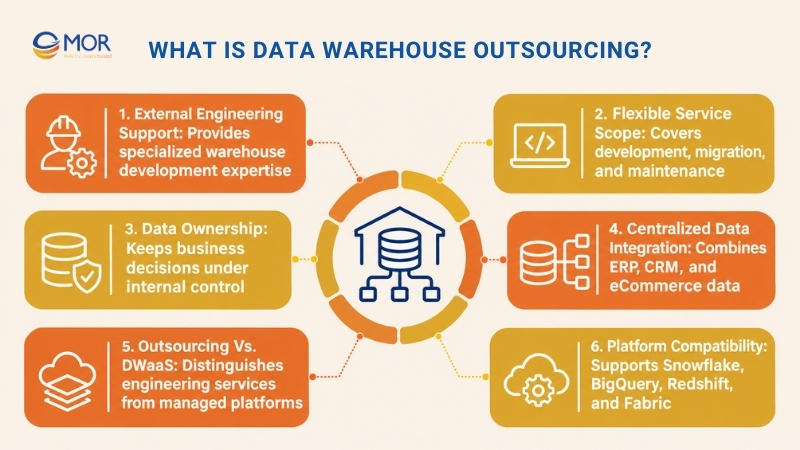
For example, a retailer might hire external engineers to connect its ERP, CRM, and eCommerce data to a central warehouse. The engineering team builds the pipelines and data models, while the retailer decides which sales metrics and customer records the warehouse must support.
Data warehouse outsourcing also differs from Data Warehouse as a Service (DWaaS). DWaaS providers operate managed warehouse platforms, while outsourcing partners supply engineering skills or take responsibility for development and operations.
Platforms like Snowflake, Google BigQuery, Amazon Redshift, and Microsoft Fabric can support either arrangement. The platform handles defined infrastructure functions, and the external team works on the agreed technical scope.
Which Data Warehouse Services Can You Outsource?
Companies can outsource individual warehouse tasks or hire a provider for a wider data engineering project. The scope usually depends on existing infrastructure, data quality, and reporting needs.
Common data warehouse outsourcing services include the following.
Service | Outsourced Tasks | Typical Deliverables | Business Value |
Data Warehouse Consulting and Architecture | Assess systems, gather requirements, select technologies, and plan data architecture. | Architecture diagrams, technical specifications, implementation roadmap. | Clear technical direction before development starts. |
Data Warehouse Development | Build database schemas, dimensional models, data marts, and warehouse structures. | Configured warehouse, data models, SQL scripts, technical documentation. | Consistent data structures for reporting and analysis. |
ETL/ELT and Data Integration | Connect source systems, develop transformations, schedule loads, and manage pipeline errors. | Data connectors, ETL/ELT workflows, transformation scripts, pipeline tests. | Reliable movement of enterprise data into the warehouse. |
Cloud Data Warehouse Migration | Assess legacy workloads, transfer historical data, convert pipelines, and plan cutover. | Migration plan, migrated datasets, converted workflows, validation records. | Access to modern cloud capabilities without an internal migration team. |
Data Quality and Governance Support | Set validation rules, manage metadata, track lineage, and apply access controls. | Data quality rules, lineage records, access configurations, data dictionaries. | More reliable datasets and clearer accountability. |
Performance and Maintenance | Tune queries, monitor workloads, resolve incidents, and review resource usage. | Performance reports, monitoring alerts, runbooks, maintenance updates. | More stable reporting and better control of operating costs. |
Business Intelligence Integration | Connect analytical tools, build semantic models, and prepare reporting datasets. | Power BI or Tableau connections, semantic models, reporting tables. | Consistent business metrics across departments. |
ETL/ELT work often consumes considerable engineering time. Fivetran's 2026 Enterprise Data Infrastructure Benchmark Report found that 53% of engineering time among surveyed enterprises was spent on pipeline maintenance.
Businesses with broader analytical needs may combine warehouse work with big data analytics platform development, big data services, or business intelligence and data analytics services. These projects may also require machine learning outsourcing when predictive models need access to prepared enterprise data.
The scope should match the current problem. A company struggling with failed nightly data loads may need pipeline support rather than a complete warehouse rebuild.
When Should You Outsource Your Data Warehouse?
Data warehouse outsourcing makes sense when internal capacity can no longer support your reporting needs, integration backlog, or migration plans. The strongest reasons usually involve specific technical gaps rather than a general goal to cut spending.
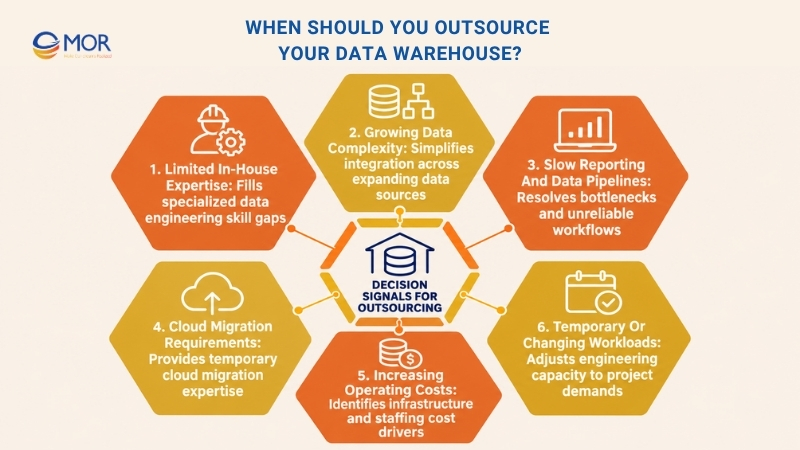
Several situations point toward external engineering support:
- Limited In-House Expertise: Your business needs experienced data architects, SQL developers, or cloud engineers but cannot recruit them quickly. An external team fills the gap for a defined period.
- Growing Data Complexity: More applications and data sources make integration harder to manage. Specialists can develop consistent data models and reliable ingestion workflows.
- Slow Reporting and Data Pipelines: Failed jobs, manual reconciliation, and delayed dashboards disrupt daily reporting. External engineers can investigate bottlenecks and rebuild unreliable processes.
- Cloud Migration Requirements: Legacy warehouse migration requires skills in cloud configuration, pipeline conversion, and testing. These skills may only be needed during the project.
- Increasing Operating Costs: Database maintenance, resource usage, and specialist staffing exceed the planned budget. A focused outsourcing engagement can help review the main cost drivers.
- Temporary or Changing Workloads: A migration or integration program needs extra capacity for several months. Dedicated teams can expand for delivery and contract again after completion.
Recruitment can be a barrier on its own. Eurofound's 2026 research reports that 57% of EU firms with open IT vacancies in 2024 faced difficulties filling those positions.
For an internal comparison, the phrase 'developing a data warehouse outsource vs in-house' captures the staffing decision, but the financial review should include management time, cloud charges, training, and ongoing support. Our in house vs outsourcing software development guide covers the wider differences between these approaches.
Data Warehouse Outsourcing Benefits and Risks
Data warehouse outsourcing can give businesses faster access to specialist skills and more flexible project staffing. Yet external delivery also introduces risks related to security, project coordination, vendor dependence, and knowledge retention.
Each potential benefit needs a matching control.
Decision Area | Potential Benefit | Main Risk | Risk Control |
Project Delivery | Access experienced engineers without a full recruitment cycle. | Slow onboarding, unclear requirements, or missed deadlines. | Define milestones, acceptance tests, and regular delivery reviews. |
Costs and Resources | Adjust engineering capacity as workloads change. | Hidden vendor fees, higher cloud bills, or added support charges. | Review total cost of ownership and set spending limits. |
Technical Expertise | Bring in skills for data modeling, ETL/ELT, and migration. | Heavy dependence on specialists who hold undocumented knowledge. | Require shared repositories, technical reviews, and documentation. |
Data Security | Gain support for secure integration and access controls. | External access exposes sensitive records and business systems. | Apply NDAs, least-privilege access, encryption, and activity logs. |
System Scalability | Add development resources for growing data workloads. | Poor architecture may increase query latency and cloud usage. | Test expected workloads and review architecture decisions. |
Knowledge Retention | Complete technical work without maintaining every skill internally. | Business logic and operational knowledge leave with the vendor. | Maintain data dictionaries, runbooks, and a handover plan. |
Cloud spending deserves close attention. The Flexera 2026 State of the Cloud Report found that organizations estimated 29% of their IaaS and PaaS spending was wasted.
This figure covers cloud spending broadly, rather than warehouse outsourcing alone. Still, a warehouse that runs expensive queries or leaves compute resources active can create the same budgeting problem.
Companies should review the cost of outsourcing IT services alongside cloud usage and internal oversight costs. Vendor fees alone won't reflect the complete expense.
Poor contracts create another common problem. Our guide to the risks of outsourcing software development explains how unclear deliverables and weak oversight can affect outsourced technical work.
The practical approach is to keep business decisions internal and make the vendor accountable for measurable technical results.
How to Outsource Data Warehousing in 6 Steps
A successful data warehouse outsourcing project starts with clear business requirements and a well-defined division of responsibilities. Each stage should produce measurable results that your internal team can review before approving further development.
The following six steps explain how to prepare your data environment, work with an external engineering team, validate the warehouse, and maintain control after deployment.
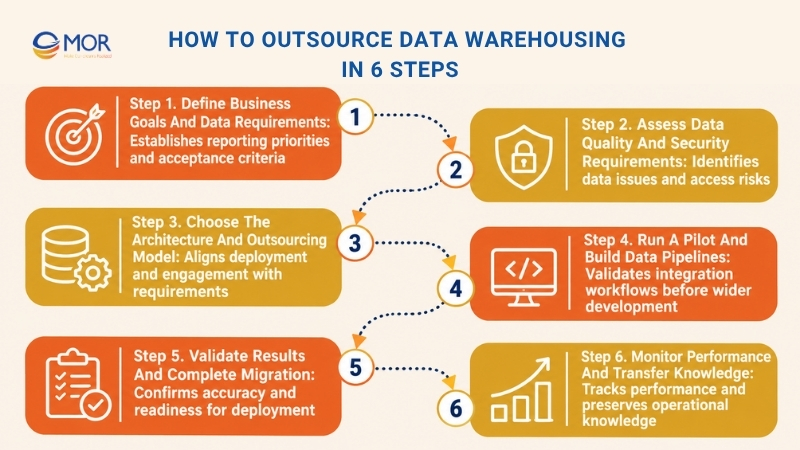
Step 1. Define Business Goals and Data Requirements
Start by identifying the business problems your data warehouse must solve. Meet with stakeholders from finance, sales, operations, and IT to determine which reports take too long, which data sources remain disconnected, and which metrics need more reliable data.
Translate these problems into measurable project objectives. For example, a retail company may want to combine Shopify orders, Salesforce customer records, and ERP inventory data into one reporting system. The goal could be to replace manual spreadsheet consolidation with automated daily sales and inventory reports.
Then create a detailed inventory of your data sources. For each system, document its database type, available API or connector, data volume, update frequency, historical data requirements, and current data owner. Identify dependencies that could affect integration, including API rate limits, legacy database restrictions, and inconsistent customer identifiers.
Define the reporting requirements before discussing technical solutions with vendors. Specify the KPIs, expected dashboard users, required data freshness, and acceptable query response times. Separate mandatory requirements from features that can wait until a later phase.
The main deliverable is a requirements document containing the project scope, source inventory, reporting specifications, target performance, and acceptance criteria. External providers use this document to estimate engineering effort, propose a delivery plan, and identify potential integration risks.
A well-defined scope also prevents disagreements over deliverables. Your team can evaluate the provider's proposal against documented business needs rather than a general promise to build a data warehouse.
Step 2. Assess Data Quality and Security Requirements
Review the current data environment before granting access to an outsourcing provider. A data warehouse built on inconsistent source records will reproduce those errors in reports, regardless of the technology selected.
Start with data profiling. Examine sample datasets for missing values, duplicate records, incorrect data types, inconsistent date formats, and conflicting business identifiers. For instance, the same customer may appear under different IDs in Salesforce and the billing system, causing duplicate revenue attribution.
Document the rules needed to resolve these issues. Your internal team should approve how duplicate customers are matched, how missing values are handled, and which system takes priority when records disagree. The outsourcing provider can then implement these rules during transformation.
Review existing ETL/ELT pipelines, reporting queries, and database dependencies. Record the current processing time, failed-job frequency, data quality issues, and manual correction effort. These baseline measurements help assess improvements after development.
Security assessment should happen alongside the technical review. Classify datasets according to their sensitivity, including customer information, financial records, employee details, and other regulated data. Identify applicable requirements under GDPR, HIPAA, or relevant local regulations.
Create an access matrix defining which engineers can read source data, modify transformation code, deploy pipelines, or access production systems. Use least-privilege permissions, encryption, audit logs, and separate development and production environments.
The expected outputs include a data quality assessment, approved transformation rules, a security requirements document, and an access control matrix. These records help the external team develop accurate pipelines without exposing unnecessary business information.
Step 3. Choose the Architecture and Outsourcing Model
Use the requirements and technical assessment to select a suitable warehouse architecture. Evaluate expected data volumes, query workloads, refresh schedules, integration methods, security requirements, and available internal skills.
Compare platforms like Snowflake, Google BigQuery, Amazon Redshift, and Microsoft Fabric against these requirements. For example, a business already using Microsoft Azure and Power BI may consider Microsoft Fabric, while an AWS-based company may assess Redshift. The final choice should reflect technical fit and total operating cost.
Ask shortlisted providers to prepare a high-level architecture proposal. It should identify data sources, ingestion methods, storage layers, transformation tools, orchestration workflows, reporting connections, and monitoring components.
Review how data will move through the proposed system. Confirm whether pipelines will use batch processing, incremental loading, or change data capture (CDC). Examine how the architecture handles failed jobs, schema changes, historical data, and future source integrations.
Once the technical direction is clear, select the outsourcing model:
- Project-Based Outsourcing: Choose this for a defined warehouse implementation, migration, or integration project with agreed deliverables and milestones.
- Dedicated Development Team: Use this model when the warehouse requires ongoing engineering work, regular changes, or close collaboration with internal teams.
- Managed Data Warehouse Services: Assign defined monitoring, maintenance, incident response, and performance tasks to a provider under an agreed service contract.
Evaluate vendors based on relevant project evidence, the experience of assigned engineers, security controls, and their ability to explain technical decisions. Request a technical workshop to identify gaps in their proposed approach.
Before signing, define who approves architecture changes, manages cloud accounts, owns source code, and authorizes production access. Include the delivery schedule, pricing terms, change request process, documentation requirements, and service expectations.
This stage should produce an approved architecture, outsourcing agreement, responsibility matrix, and delivery plan. These documents give the provider clear technical boundaries and help your company retain control over cost and project direction.
Step 4. Run a Pilot and Build Data Pipelines
Begin implementation with a limited pilot instead of integrating every business system at once. Select a dataset that represents real integration challenges and produces a report stakeholders can validate.
For example, a retail business could start by connecting Salesforce customer information with ERP sales transactions. The pilot would test whether the warehouse can match customer records, process transactions, and generate consistent revenue reports.
Ask the engineering team to create source-to-target mappings before writing transformation code. These mappings should identify each source field, its destination, required data type, transformation rule, and validation method.
The provider can then develop the ingestion pipelines using approved connectors, APIs, or database access methods. Depending on the architecture, transformations may run before loading through ETL or inside the warehouse through ELT, using SQL or tools like dbt.
Pay attention to incremental data processing. Loading every historical record on each run can increase processing time and cloud costs. Engineers should assess incremental loading or CDC when the source systems and reporting requirements support these methods.
Build error handling into the pipeline rather than treating it as a later maintenance task. Include automated checks for missing records, duplicate keys, schema mismatches, and failed transformations. Configure logs and retry rules so engineers can investigate problems without restarting the entire workflow unnecessarily.
Test the pilot against its acceptance criteria. Compare warehouse outputs with source records, measure processing time, and confirm that business users can generate the required reports.
The pilot should deliver working pipelines, validated data models, test results, and documented technical issues. These findings help determine whether the architecture and engineering approach can support the remaining data sources.
Expand development only after stakeholders approve the pilot. This limits the cost of correcting design problems discovered during early implementation.
Step 5. Validate Results and Complete Migration
Once development is complete, verify that the warehouse produces accurate data under expected business workloads. Functional testing alone is insufficient because a pipeline can run successfully while loading incorrect values.
Start with data reconciliation. Compare source and destination record counts, transaction totals, date ranges, unique identifiers, and aggregated business metrics. Investigate discrepancies rather than accepting a successful pipeline execution as proof of data accuracy.
Run integration tests to confirm that upstream systems, transformation workflows, warehouse tables, and BI tools work together correctly. Test how pipelines respond to delayed source updates, missing fields, duplicate events, and temporary connection failures.
Performance testing should cover expected data volumes and reporting workloads. Measure load duration, query response times, and resource consumption. Identify expensive queries, unnecessary scans, or transformations that could increase cloud charges as data grows.
Then conduct User Acceptance Testing (UAT) with the employees who will use the reports. Ask finance teams to validate revenue figures, sales managers to review customer metrics, and operations teams to confirm inventory calculations. Technical accuracy must align with approved business definitions.
For migration projects, run the existing warehouse and replacement system in parallel during an agreed validation period. Compare their results across representative reporting cycles, including month-end or other business events when relevant.
Prepare a cutover plan covering data synchronization, deployment order, production access, monitoring, and rollback procedures. Assign owners to each activity and define conditions that would require postponing the release.
The required outputs include reconciliation reports, performance test results, UAT approval, and a production cutover plan. Move to production only after the agreed acceptance criteria are met.
These checks protect business reporting from missing data, inconsistent calculations, and avoidable disruption during migration.
Step 6. Monitor Performance and Transfer Knowledge
Production deployment marks the start of ongoing warehouse operations. Establish monitoring and support procedures before the external development team completes its delivery obligations.
Track pipeline execution status, failed jobs, data freshness, query latency, storage growth, and compute spending. Configure alerts when loads miss agreed deadlines or data quality checks fail. A reporting system that refreshes late may be technically available but still unusable for daily decisions.
Define Service Level Agreements (SLAs) based on business requirements. These should cover monitoring hours, incident severity, response and recovery targets, escalation procedures, and maintenance responsibilities.
For example, a business that depends on warehouse data for daily operations may require failed overnight loads to trigger an alert before reporting begins. The provider should have documented procedures for identifying the failed stage, correcting the issue, and validating recovered data.
Review operating costs alongside technical performance. Examine cloud compute usage, storage consumption, query patterns, and pipeline schedules. Adjust workloads when the data shows unnecessary spending or capacity problems.
Knowledge transfer is equally important. Require the provider to deliver architecture diagrams, source-to-target mappings, data dictionaries, transformation rules, code repositories, deployment instructions, and operational runbooks.
Arrange technical walkthroughs with your internal IT team. Engineers should demonstrate how to monitor pipelines, investigate failed loads, apply approved changes, and recover services after common incidents.
Before closing the engagement, confirm that your company has the agreed ownership rights and access to code, configurations, documentation, and infrastructure accounts. Review vendor permissions and revoke access that is no longer needed.
The final deliverables should include an operational warehouse, monitoring procedures, SLA reports, complete technical documentation, and a signed handover checklist. These materials allow your business to continue operating the system internally or transfer support to another provider.
A structured vendor transition solution can support that process when a future change in outsourcing partners becomes necessary.
What Data Warehouse Responsibilities Should Stay In-House?
A data warehouse outsourcing agreement must define the decisions your company will continue to own. External engineers can manage technical delivery, but they shouldn't decide what a customer, transaction, or business KPI means without your approval.
The split below is a practical starting point.
Responsibility | Client Ownership | Outsourcing Partner's Role |
Data Strategy and Business KPIs | Define reporting priorities, business metrics, and success criteria. | Translate approved requirements into technical designs. |
Data Ownership and Access Approval | Retain data rights and approve access to sensitive systems. | Access only approved datasets and environments. |
Data Modeling and Architecture | Approve business definitions and major design decisions. | Design schemas, models, and technical architecture. |
ETL/ELT Pipeline Development | Approve transformation rules and expected results. | Build, test, document, and maintain pipelines. |
Infrastructure Operations | Set cost limits, hosting requirements, and operating policies. | Manage assigned resources under the agreed contract. |
Security and Compliance | Retain organizational accountability and approve policies. | Apply assigned controls, maintain evidence, and report incidents. |
Code, Documentation, and Handover | Hold contractual rights to deliverables and required access. | Maintain repositories, runbooks, and transition materials. |
Data ownership needs more attention than a simple contract clause. The dbt Labs 2026 State of Analytics Engineering Report found that 41% of respondents cited unclear data ownership as an ongoing challenge.
For example, an outside engineer may define how customer records join across Salesforce and an ERP database. Your business still needs to decide which account status counts as an active customer.
Document those definitions in a data dictionary and assign an internal owner. Clear responsibility makes reporting more consistent and helps future teams understand the system.
How to Choose a Data Warehouse Outsourcing Provider
Choosing a data warehouse outsourcing provider requires evidence of technical ability, delivery discipline, and secure data handling. A vendor's platform knowledge means little if its engineers cannot explain how they will manage your source systems and reporting rules.
Review the following areas before signing an agreement.
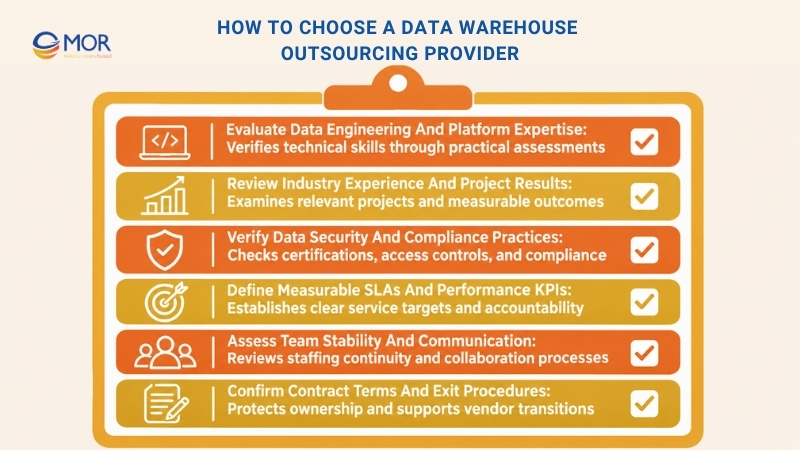
Evaluate Data Engineering and Platform Expertise
Check the provider's experience with SQL, Python, ETL/ELT development, dimensional modeling, and cloud warehouse platforms. Ask which engineers have worked with your existing tools and source systems.
Strong data science consultants may support analytical modeling, but warehouse projects also need engineers who understand ingestion, transformation, query behavior, and database administration.
Request a technical review or proof of concept. A small integration exercise can reveal more than a long list of technologies on a company website.
Review Industry Experience and Project Results
Look for projects involving similar data complexity and business requirements. Finance, healthcare, manufacturing, and retail each have their own reporting rules and access needs.
Ask providers to explain the starting problem, technical work, and measured result. Evidence might include shorter loading times, improved reconciliation accuracy, fewer pipeline failures, or successful migration.
Check who delivered the referenced project and whether those specialists will join your engagement. A company's past results don't automatically reflect the skills of every proposed team.
Verify Data Security and Compliance Practices
Request current security certifications, access policies, incident response procedures, and evidence of secure development practices. Confirm the scope and validity of any ISO/IEC 27001 or SOC 2 documentation.
The financial exposure from a breach is substantial. IBM's July 2026 Cost of a Data Breach announcement reported a $4.99 million global average breach cost.
Review encryption, role-based permissions, audit logging, data residency, and subcontractor access. Regulated projects also need contracts that reflect applicable requirements under rules like GDPR or HIPAA.
Define Measurable SLAs and Performance KPIs
A good SLA describes observable results. Useful measures include pipeline completion rates, data freshness deadlines, query latency, incident response time, and validation accuracy.
Agree on measurement methods before development begins. For instance, a scheduled sales report might require verified warehouse data by 7 a.m. on each business day.
Include escalation rules and review periods in the contract. The provider should explain how missed service targets will be investigated and resolved.
Assess Team Stability and Communication
Ask about the proposed engineers, seniority levels, staff replacement process, and available backup resources. Data warehouse work depends heavily on knowledge of business rules and existing data structures.
Review communication channels, time-zone overlap, sprint schedules, and approval procedures. Regular technical demonstrations and shared task tracking help internal teams spot problems early.
Our guide to managing outsourced development teams covers practical coordination methods for distributed engineering projects.
Confirm Contract Terms and Exit Procedures
Define deliverables, intellectual property ownership, source code rights, and documentation obligations. The agreement should also cover changes in scope, support periods, and termination conditions.
For a full source to contract outsourcing review, pay particular attention to data access, repository ownership, security duties, and service handover.
Your company should be able to retrieve its code, data models, configurations, and operating documents without depending on one vendor indefinitely. Include a transition period and clear access revocation steps.
MOR Software's Data Integration Expertise for Warehouse Projects
At MOR Software, we connect enterprise systems and build software around complex data flows. Established in 2016, our company has delivered 850+ projects for clients across 10+ countries. Our experience in ETL, API integration, cloud development, and dedicated engineering teams relates directly to several technical tasks found in data warehouse projects.
- Proven ETL and Enterprise Integration Experience: In our documented Salesforce and Slack workforce management project, an eight-person team spent five months connecting internal employee data with Salesforce through APIs and ETL, then added Slack-based attendance workflows. The work involved moving historical records and synchronizing data across systems. These are foundational tasks in warehouse ingestion and integration pipelines, though the project itself wasn't a data warehouse implementation.
- Flexible Engineering Capacity: Our offshore development model lets clients assemble teams based on project scope and adjust staffing as requirements change. Companies can access additional engineering skills without building a permanent internal department. Clients retain control over technical priorities, architecture approvals, and business requirements, while we handle recruitment and team operations.
- Documented Security and Quality Practices: Our corporate records document ISO 9001:2015 and ISO/IEC 27001:2013 certification in 2021. Current certificate versions, validity, and scope should be confirmed during vendor review. Our published security and outsourcing practices include NDA-based engagement, access restrictions, and information security controls. Project-level safeguards must be agreed according to the client's data requirements.
- Cloud Integration and Structured Delivery: Our engineering work covers AWS, APIs, legacy systems, and Agile/Scrum delivery. We use defined requirements, short development cycles, technical reviews, and QA activities to support controlled releases. This experience is relevant to data integration, migration testing, and backend engineering tasks that support a warehouse environment.
Businesses planning warehouse development or migration can share their existing systems, target platform, data volumes, and security requirements with our team. We can discuss the relevant engineering capabilities and delivery model before defining a project scope.
Conclusion
Data warehouse outsourcing works best when businesses define the technical scope, retain ownership of their data, and hold providers accountable for measurable results. The right partner should bring relevant engineering skills, sound security practices, and a clear handover plan. MOR Software's experience in ETL, API integration, and offshore engineering provides a starting point for discussing your data needs.
Contact us to review your existing systems, integration requirements, and suitable outsourcing options.
"Evolution is not a destination, it is a disciplined journey of innovation."
Phung Van Tu


CEO MOR AI
MOR SOFTWARE
Frequently Asked Questions (FAQs)
What is the difference between data warehouse outsourcing and DWaaS?
Data warehouse outsourcing involves hiring external engineers or service providers to design, build, migrate, or maintain a warehouse. DWaaS is a cloud service model where the platform vendor operates the underlying warehouse infrastructure. A business can use DWaaS and an outsourcing partner together.
Can a company outsource data warehouse development without moving its data?
Yes. External engineers can work in client-controlled cloud or on-premises environments without transferring ownership of the underlying datasets. Access should follow approved permissions, security agreements, and data residency requirements. Sensitive data can remain in the company's existing environment.
What tasks are commonly included in data warehouse outsourcing?
Common tasks include architecture planning, database design, dimensional modeling, ETL/ELT development, cloud migration, data quality checks, system integration, query tuning, and maintenance. The exact service scope depends on the client's infrastructure, internal skills, and reporting requirements.
How much does data warehouse outsourcing typically cost?
Costs depend on team size, engineer seniority, project scope, source systems, data complexity, and support needs. Project-based work may use fixed pricing, while dedicated teams often use monthly rates. Cloud storage, compute, licensing, testing, and internal oversight add to total expenses.
How long does an outsourced data warehouse project take?
A small integration or pilot may take several weeks, while a larger warehouse build or migration can require months. Delivery time depends on data quality, source connections, historical data volume, technical dependencies, testing, and the speed of client approvals.
Is data warehouse outsourcing suitable for small businesses?
Yes. Small businesses can outsource a limited reporting project, data integration task, or cloud warehouse setup without hiring an entire data engineering department. A focused engagement helps validate the business need before expanding the system or committing to ongoing support.
How can businesses protect sensitive data when outsourcing?
Use NDAs, data processing agreements, least-privilege permissions, encryption, audit logging, and controlled development environments. Confirm where data will be stored and who may access it. The client should approve security requirements and review vendor compliance evidence throughout the engagement.
Can outsourced data engineers integrate ERP and CRM systems?
Yes. Data engineers can connect ERP and CRM platforms through APIs, database connectors, and ETL/ELT pipelines. Systems like SAP, Oracle, and Salesforce may require different integration methods. The provider must preserve approved business rules and validate records during synchronization.
What KPIs should businesses track in outsourced data warehouse projects?
Track pipeline success rates, data freshness, validation accuracy, query response times, incident resolution, and cloud spending. Compare each metric against a documented starting point. Technical KPIs should connect to business needs, including reliable financial reports and timely operational dashboards.
What happens if a business changes its data warehouse outsourcing provider?
A planned transition transfers code, configurations, data models, documentation, and operational knowledge to the new team. The client should retain access to repositories and infrastructure accounts. Revoke the former provider's permissions after verifying that the replacement team can maintain critical workloads.
Share


Make Our-Dreams Realized


© 2023 . MOR Software. All Rights Reserved
Sitemap
Privacy Policy
Terms of Use

Rate this article
0
over 5.0 based on 0 reviews
Your rating on this news:
Name
*Email
*Write your comment
*Send your comment
1