


Nearshore Salesforce Development: A US Enterprise Guide for 2026
Growing Salesforce orgs create work that internal teams can’t always absorb, including Apex development, integrations, automation, data migration, testing, and production support. For US enterprises, nearshore Salesforce development adds external Salesforce skills while keeping more working hours aligned. In this guide, MOR Software will explain how the model works, where it fits, how much it costs, and how to manage and vet external Salesforce teams.
Key Takeaways
- Nearshore Salesforce delivery works best when external engineers need frequent access to US product owners, RevOps teams, architects, and business users during the same working day.
- Cost depends heavily on the commercial model. Current LATAM benchmarks range from direct-hire salaries around 30K-72K per year to specialist consulting rates near 80-95 per hour for Salesforce Architects.
- Technical screening must go past certifications. Apex, Lightning Web Components, Flow judgment, integration design, Salesforce security, testing, deployment, and communication all need direct evaluation.
What Is Nearshore Salesforce Development?
Nearshore Salesforce development means assigning Salesforce engineering work to external professionals in a nearby region where working hours substantially overlap with your internal team. For US companies, this commonly points to Latin American markets including Mexico, Colombia, Brazil, Argentina, and nearby countries.
Geography depends on the buyer. A US company may look south to Latin America, whereas nearshore development Europe usually involves teams in nearby European countries. The operating principle stays the same: shorten the distance between the people making business decisions and the engineers implementing them.
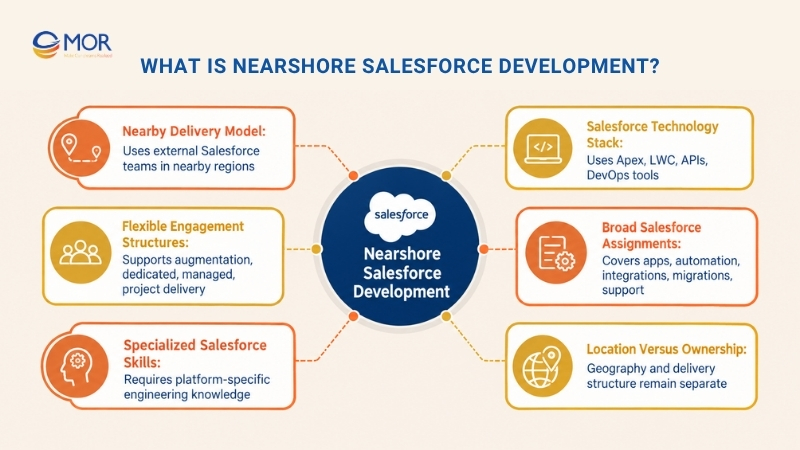
Salesforce nearshore development also describes location, not the contract structure. Companies can use a nearshore provider through staff augmentation, a dedicated team, managed delivery, or a project agreement.
Staff augmentation places external specialists inside your existing delivery process. A dedicated team creates a stable group around an ongoing roadmap, whereas project-based delivery gives the provider greater ownership over a defined scope. Our guide to the nearshore software outsourcing model covers this distinction in a wider software engineering setting.
Salesforce work also demands a different skill base than java development nearshore or general web engineering. Developers work inside Salesforce's metadata model, governor limits, release process, security model, and proprietary tools.
A typical nearshore Salesforce development language stack may include Apex, Lightning Web Components and JavaScript, SOQL, SOSL, Salesforce Flow, REST and SOAP APIs, MuleSoft, Salesforce DX, Git, and CI/CD tooling. The exact mix changes with your Salesforce Clouds and integration architecture.
Common assignments include custom apps, CRM configuration, Apex logic, Lightning interfaces, workflow automation, ERP integrations, ETL migration, Data Cloud work, Agentforce projects, and production support. Companies that need temporary Salesforce engineers can also compare salesforce staff augmentation services against dedicated delivery.
The delivery location defines nearshore Salesforce development. Team ownership and commercial terms define how that delivery relationship actually works.
Why US Companies Rely on Nearshore Salesforce Development
US companies often choose nearshore Salesforce development when their Salesforce roadmap requires more capacity, specialist skills, or closer collaboration than a distant external team can provide. Cost matters, but working-hour access often determines how productive the arrangement becomes.
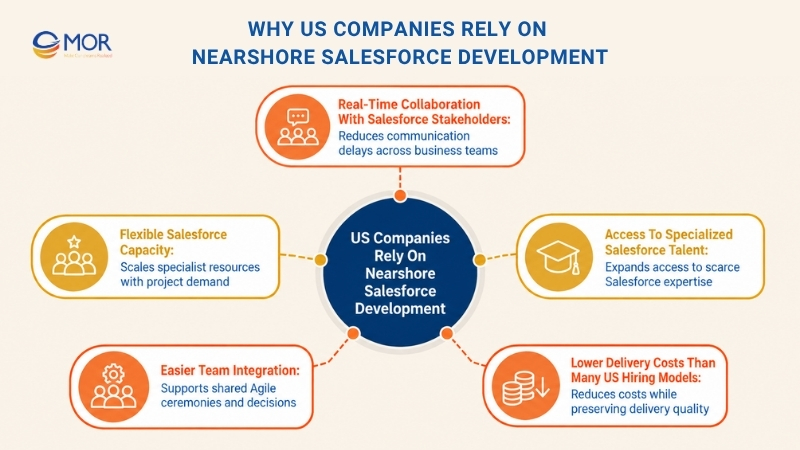
Real-Time Collaboration With Salesforce Stakeholders
Salesforce development rarely happens in isolation. Developers need answers from RevOps, sales leaders, service teams, product owners, architects, and administrators before changing objects, Flows, permissions, integrations, or automation.
Time difference changes those conversations. Research covering more than 12,000 employees found that an extra hour of temporal distance cut synchronous communication by an average of 11%. The study also found more work-related communication shifting outside normal business hours as the gap increased.
That matters when a broken integration reaches production at 10 a.m. A developer online during the same working window can speak with the business owner, trace the issue, and confirm the fix without waiting for another communication cycle.
Access to Specialized Salesforce Talent
The Salesforce ecosystem now stretches well beyond Sales Cloud. Enterprise roadmaps can require Apex, LWC, CPQ, Experience Cloud, MuleSoft, Marketing Cloud, Data Cloud, Agentforce, security, DevOps, and architecture skills in the same program.
Salesforce cites an IDC forecast that its AI-powered ecosystem will generate 11.6 million jobs and $2.02 trillion in business revenue worldwide between 2022 and 2028. That scale helps explain why companies compete for specialists who already know specific Salesforce products.
Companies that hire nearshore Salesforce developers can widen the candidate pool without forcing every technical role into a US-only search. The value grows when a project needs scarce combinations, for example MuleSoft plus Service Cloud or Apex plus Data Cloud.
Lower Delivery Costs Than Many US Hiring Models
Compensation gaps between the US and Latin America can change the economics of a Salesforce roadmap. A company may fund a larger delivery team or add a specialist without matching the payroll level of a comparable US hire.
Cost should stay tied to output, though. Cheap code that creates rework, fragile Flows, poor test coverage, or undocumented integrations raises the real project bill.
For that reason, nearshore Salesforce development works better when buyers compare skill level, delivery responsibility, and total cost rather than selecting the lowest hourly number.
Easier Team Integration
Nearshore teams can join the same sprint planning, backlog refinement, demos, architecture reviews, and incident calls as US staff. Shared working windows also make informal questions easier to resolve before they become backlog blockers.
That approach fits agile nearshore outsourcing well because Salesforce requirements often change after users see a working Flow, Lightning component, or integrated process. Real-time discussion lets the team adjust the next sprint without a long communication loop.
Flexible Salesforce Capacity
Salesforce demand isn't always flat. A company may need three extra developers during an ERP integration, one Marketing Cloud specialist for a migration, or a Data Cloud engineer for a defined program.
A nearshore development center can support that changing capacity without turning every temporary skill need into a permanent local hire. Experienced nearshore Salesforce developers can then leave or move to another workstream after the heavy delivery period ends.
Offshore vs Nearshore Salesforce Development: Key Differences
Nearshore Salesforce development and offshore Salesforce delivery can use similar technical roles. The main difference is geographic and temporal distance, which changes communication patterns, travel, meeting schedules, and day-to-day stakeholder access.
Factor | Nearshore Salesforce Development | Offshore Salesforce Development |
Location | Nearby region | More distant region |
US working-hour overlap | Usually high | Varies by country |
Real-time communication | Easier to schedule | Often needs planned windows |
Agile ceremonies | Fits US hours more easily | Some meetings may shift |
Stakeholder access | High during the workday | Depends on overlap |
Cost | Moderate to strong savings | Hourly rates can be lower |
Travel | Shorter in many cases | Usually longer |
Collaboration style | More synchronous | Often more asynchronous |
Best fit | Collaborative Salesforce delivery | Structured, well-documented work |
Offshore development can work very well when backlog items are well defined, architecture decisions are settled, and teams can progress independently. A disciplined offshore team may also support follow-the-sun development or overnight testing.
The trade-off becomes more visible when a Salesforce developer needs repeated clarification from sales, finance, service, or RevOps. In that case, the value of nearshore Salesforce development rises because the work depends on conversation rather than task handoff alone.
An offshore sales team is also different from an offshore Salesforce engineering team. The former runs revenue activities, whereas the latter builds or supports the CRM systems behind them.
Compare total delivery cost before choosing. An hourly saving can disappear through rework, longer issue resolution, late meetings, extra project management, and weak knowledge transfer.
Readers comparing the two structures can review our detailed offshore salesforce development model.
How to Manage Nearshore Salesforce Development Teams Effectively?
A nearshore Salesforce development team still needs firm ownership, technical rules, and measurable delivery goals. Close time zones don't fix an unclear backlog or weak release process on their own.
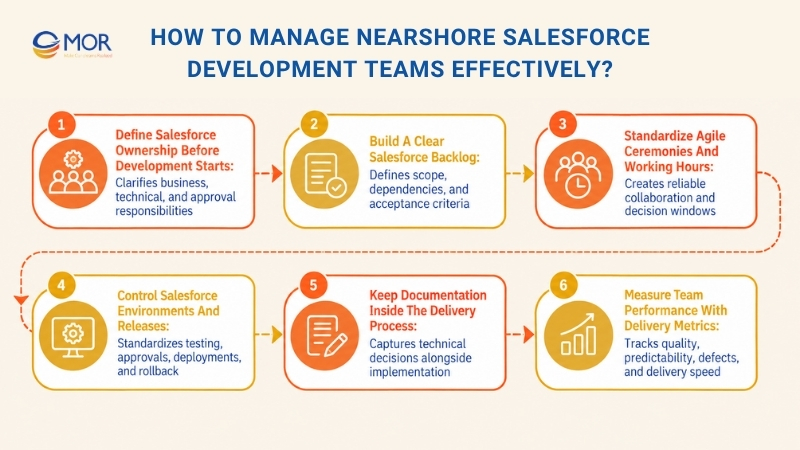
Define Salesforce Ownership Before Development Starts
Assign a business owner for priorities and a technical owner for architecture. Also define who approves production deployments, integration changes, security decisions, and data-model updates.
The nearshore team should know where it can decide independently. For instance, a senior developer may choose an Apex implementation pattern, but a change to the enterprise integration architecture may require internal architect approval.
Build a Clear Salesforce Backlog
Separate bugs, technical debt, integrations, automation, migration, support, and new functionality. Each item should identify the affected Salesforce Cloud, objects, APIs, user groups, acceptance criteria, and dependencies.
A backlog item called 'fix opportunity process' gives developers little direction. A stronger ticket names the failing Flow, entry criteria, expected user path, affected profiles, test cases, and business result.
Standardize Agile Ceremonies and Working Hours
Set core overlap hours before the team starts. Use those hours for standups, sprint planning, backlog refinement, code reviews, demos, architecture discussion, and incident escalation.
Nearshore agile outsourcing becomes much easier to manage when each ceremony has a purpose. Teams don't need meetings all day; they need reliable windows where blockers and decisions can move quickly.
Control Salesforce Environments and Releases
Define how work moves through developer environments, sandboxes, scratch orgs where relevant, Git branches, pull requests, UAT, and production. The nearshore Salesforce development lifecycle should document who can deploy, who approves releases, and how rollback works.
Testing deserves a hard rule. Salesforce states that unit tests must cover at least 75% of Apex code for deployment or packaging, and the tests must pass. Salesforce also recommends testing positive, negative, bulk, and single-record use cases rather than chasing the percentage alone.
Keep Documentation Inside the Delivery Process
Document architecture decisions when they happen. The same applies to Apex classes, Flows, integration contracts, object relationships, deployment instructions, error handling, and runbooks.
Waiting until handover creates a predictable problem: the person writing the document has already forgotten part of the reasoning. Documentation should move through review alongside the code or configuration it describes.
Measure Team Performance With Delivery Metrics
Measure outcomes that expose delivery quality. Useful signals include sprint predictability, escaped defects, rework, deployment failure rate, lead time, incident response time, code-review findings, and documentation completion.
Avoid using story points or ticket counts as productivity scores. A senior architect preventing a bad integration decision can create more value than a developer closing ten low-risk tickets.
How to Maximize Efficiency in Nearshore Salesforce Development?
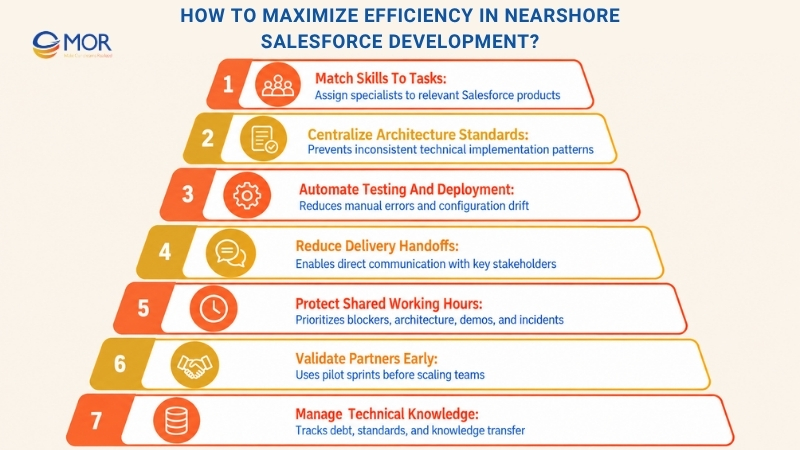
Efficiency in nearshore Salesforce development comes from matching the right skill to the right task and removing avoidable delivery friction. More developers won't fix conflicting architecture, weak testing, or poor requirements.
- Use Flow before custom code where appropriate: Salesforce Flow can handle many automation needs without adding Apex maintenance. Code still makes sense for complex logic, high-volume processing, or cases where declarative tools become difficult to control.
- Assign work by Salesforce specialization: Match CPQ, Data Cloud, MuleSoft, Agentforce, Marketing Cloud, and LWC work to people who have already shipped similar solutions. General Salesforce experience doesn't equal deep product knowledge.
- Keep architecture decisions centralized: Create agreed patterns for integrations, error handling, naming, security, data access, and automation. This stops several developers from solving the same problem in incompatible ways.
- Automate testing and deployment: Connect Git, CI/CD, static analysis, Apex tests, deployment validation, and release approvals. Repeated manual deployment steps create room for missed metadata and configuration drift.
- Cut unnecessary handoffs: Let developers speak directly with analysts, administrators, architects, and relevant business users. Requirements lose detail when every question passes through several intermediaries.
- Protect overlap hours: Reserve shared time for blockers, architecture questions, demos, and production incidents. Routine status updates can remain asynchronous.
- Start with a pilot sprint: Give a new partner a contained piece of production-relevant work. Review estimation accuracy, code quality, communication, documentation, testing, and review behavior before adding headcount.
- Track technical debt openly: Add obsolete Flows, duplicate automation, weak tests, integration cleanup, and refactoring to the backlog. Hiding this work eventually slows every new release.
- Create reusable Salesforce standards: Set coding conventions, integration patterns, logging rules, test expectations, and pull-request criteria. Consistency makes new engineers productive faster.
- Plan knowledge transfer throughout delivery: Pair developers across major components and rotate review responsibility. One engineer shouldn't become the only person who understands a business-critical integration.
For teams planning Salesforce custom development nearshore, our guide to custom salesforce development solutions gives more detail on where custom code fits.
The same discipline applies to nearshore agile outsourcing outside Salesforce. Short feedback loops create value only when requirements, ownership, testing, and release controls support them.
Choosing a Trusted Nearshore Salesforce Development Partner
A nearshore Salesforce development partner should prove relevant Salesforce delivery experience before commercial discussions go too far. Certifications help, but production work, technical judgment, security practices, and team transparency carry more weight.
Evaluation area | What to verify | Evidence to request |
Salesforce expertise | Apex, LWC, Flow, SOQL, APIs | Technical interview |
Salesforce Clouds | Experience with your products | Similar project examples |
Integration capability | REST, SOAP, MuleSoft, ETL | Integration case studies |
Team composition | Developer, admin, architect, QA | Named team profiles |
Certifications | Relevant current credentials | Certification records |
DevOps maturity | Git, CI/CD, testing, sandboxes | Release workflow |
Security | Access, IP, data controls | Policies and procedures |
Communication | Business-facing English | Meeting with engineers |
Retention | Continuity and replacements | Replacement process |
Scalability | Access to extra skill sets | Staffing plan |
Transparency | Clear responsibilities | Delivery plan |
References | Comparable Salesforce work | Client references |
Meet the people who'll actually work on your Salesforce org. A polished sales presentation doesn't tell you how the assigned developer thinks through governor limits, integration failures, Flow design, or deployment risk.
Ask the provider how it handles underperformance and replacement. Also check who owns documentation, code repositories, credentials, intellectual property, and knowledge transfer when someone leaves.
Procurement teams sometimes group very different vendors under labels like nearshore company Salesforce PDO product development outsourcers. That label can include staffing firms, Salesforce consulting partners, product development outsourcers, and Salesforce Product Development Outsourcers, so compare actual responsibility rather than vendor category.
A good nearshore Salesforce development company should also show work that resembles your intended scope. A provider experienced mainly in Sales Cloud administration isn't automatically the right choice for Data Cloud architecture or a MuleSoft-heavy integration program.
How Much Does Nearshore Salesforce Development Cost in 2026?
Nearshore Salesforce development pricing varies by seniority, specialization, country, delivery responsibility, and contract type. Salary, all-in monthly staffing cost, project billing, and consulting rates measure different commercial arrangements, so averaging them creates a misleading number.
Salesforce talent / model | Typical cost ($) | Pricing basis | Common use case |
LATAM Salesforce Developer | 30K-72K/year
| Direct-hire salary | Long-term internal role |
Mid-level LATAM Salesforce Developer | 36K-48K/year
| Direct-hire salary | Ongoing Salesforce development |
Dedicated LATAM Salesforce Developer | About $5,270/month | All-in monthly rate | Full-time capacity |
Project-based Salesforce Developer | 40-90/hour
| Hourly/project | Defined development work |
Nearshore Salesforce Administrator | 35-55/hour
| Consulting rate | Admin, Flow, platform support |
Nearshore Salesforce Developer | 45-70/hour
| Consulting rate | Apex, LWC, integrations |
Nearshore Marketing Cloud Developer | 45-70/hour
| Consulting rate | Marketing Cloud work |
Nearshore Salesforce Architect | 80-95/hour
| Consulting rate | Architecture and enterprise programs |
Hire With Near's 2026 benchmark places general LATAM Salesforce developer salaries at 30K-72K per year and mid-level developers at 36K-48K, compared with 92K-172K and 99K-151K respectively in the US.
South publishes an all-in monthly Salesforce Developer rate of $5,270 and separately lists project-based Salesforce work at 40-90 per hour depending on certification and specialization.
FoundHQ's published nearshore consultant benchmarks put Administrators at 35-55 per hour, Developers at 45-70, Marketing Cloud Developers at 45-70, and Architects at 80-95.
These numbers shouldn't be compared as if they include the same services. A direct salary doesn't include recruiting, payroll administration, vendor management, replacement cover, or delivery leadership in the same way that a staffing or consulting rate may.
Price also rises with CPQ, MuleSoft, Data Cloud, Agentforce, architecture, security requirements, integration complexity, QA, DevOps, and production support SLAs. A regulated enterprise program can need several roles around the developer rather than one developer alone.
Total cost of ownership should include recruitment, onboarding, supervision, QA, rework, turnover, documentation, knowledge transfer, security controls, release management, and vendor administration. The cheapest hourly rate can become expensive if the team repeatedly creates technical debt.
How to Vet Experts for Nearshore Salesforce Development?
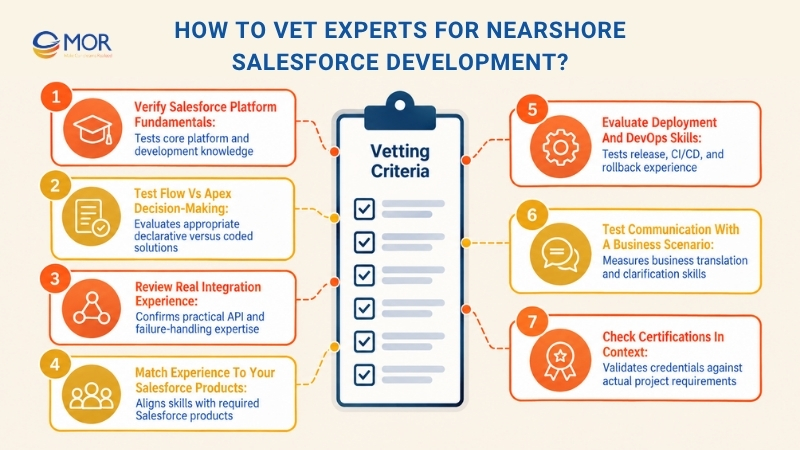
Vetting for nearshore Salesforce development should test how candidates solve real Salesforce problems. Resume keywords and certification badges give useful signals, but they don't show how someone handles production limits, business trade-offs, or a failed integration.
Verify Salesforce Platform Fundamentals
Test Apex, Lightning Web Components, SOQL, SOSL, Flow, governor limits, sharing, profiles, permission sets, testing, and deployment. The depth should match the seniority you're hiring.
A senior developer should explain how bulk processing changes an Apex design and how Salesforce limits affect transaction structure. An administrator-level candidate needs different depth.
Test Flow vs Apex Decision-Making
Give the candidate an automation scenario and ask for an implementation choice. Then change the volume, exception handling, or integration requirement and see whether the answer changes.
Strong developers don't default to code. They can explain where Flow stays maintainable and where Apex gives better control.
Review Real Integration Experience
Ask for one integration the candidate actually built. They should explain authentication, API limits, retry handling, failures, middleware, data mapping, ETL, and synchronization behavior.
Generic answers like 'we connected the API' aren't enough. Ask what broke, how they detected it, and what they changed afterward.
Match Experience to Your Salesforce Products
Sales Cloud, Service Cloud, Experience Cloud, Marketing Cloud, CPQ, Data Cloud, Agentforce, and MuleSoft require different working knowledge. Years of generic Salesforce experience don't automatically translate into expertise across all of them.
Match candidate history to your actual roadmap. A developer who spent five years on Sales Cloud may still need significant ramp-up time for Marketing Cloud or Data Cloud.
Evaluate Deployment and DevOps Skills
Ask candidates to walk through Git, branching, Salesforce DX, sandboxes, tests, CI/CD, UAT, deployment validation, rollback, and production release controls. Their answer should describe a process they've used, not a list of tools.
Teams that release regularly need engineers who understand what happens after code review. Deployment discipline protects production stability.
Test Communication With a Business Scenario
Ask the candidate to explain a prior Salesforce decision to a nontechnical manager. Then introduce a vague requirement and see what questions they ask before proposing a solution.
Salesforce developers regularly translate business processes into data models, automation, permissions, and integrations. Communication quality affects technical quality.
Our guide on how to hire a dedicated salesforce developer gives a wider hiring checklist for long-term roles.
Check Certifications in Context
Certifications confirm formal Salesforce knowledge, but production evidence should carry more weight. Match each credential to the work the developer will actually perform.
A Platform Developer certification supports an Apex-focused role. A complex enterprise architecture program needs deeper evidence around integration, security, data, and system design.
Accelerate Salesforce Development With MOR Software
For companies comparing nearshore Salesforce development with other distributed delivery models, MOR Software provides salesforce advisory and consulting, implementation, development, integration, management, and maintenance. Our Salesforce teams can combine Developers, Product Consultants, Administrators, and Architects around the work rather than forcing every project into one staffing pattern.
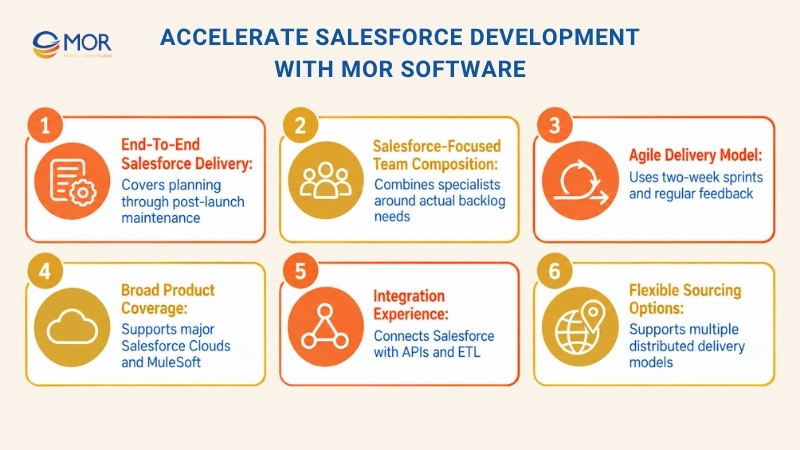
- End-to-end Salesforce delivery: We support planning, implementation, customization, integration, migration, management, and post-launch maintenance across the Salesforce lifecycle.
- Salesforce-focused team composition: Our delivery model can include developers, administrators, consultants, architects, QA, and integration specialists based on the actual backlog.
- Agile delivery: MOR Software's Salesforce practice works in two-week sprints with defined deliverables and regular feedback cycles.
- Product coverage: Our Salesforce material covers Sales Cloud, Service Cloud, Marketing Cloud, Community Cloud, Pardot, Field Service Lightning, MuleSoft, and related custom development.
- Integration experience: In one workforce-management project, our team connected a client's internal system with Salesforce through APIs and ETL, then added Slack-based attendance workflows. The five-month project used Force.com, Apex, Visualforce, AWS, Slack SDK, and related web technologies with an eight-person Agile Scrum team. MOR also documents the Salesforce and Slack project publicly.
MOR Software isn't positioned as a US-LATAM nearshore provider. We support companies that are comparing nearshore, offshore, dedicated-team, and project-based Salesforce sourcing options and need a delivery model tied to their technical scope.
Share your Salesforce Clouds, backlog, integration requirements, expected roles, release timeline, and current org constraints with our team. Review our salesforce development services to discuss the right delivery structure.
Conclusion
Nearshore Salesforce development gives US enterprises another way to add Salesforce skills while keeping close working-hour access to external engineers. The model works best when scope, team ownership, technical standards, cost, and vetting rules are defined early. If you're comparing nearshore delivery with offshore or dedicated Salesforce teams, MOR Software can assess your roadmap and propose a delivery structure around your Salesforce products, integrations, timeline, and engineering needs. Contact us to discuss your Salesforce project.
"Mr. Cong’s guiding philosophy is simplicity, believing that the simplest solutions are often the most powerful. He sees trust, empowerment, and the opportunity to demonstrate one’s abilities as the key elements that set MOR apart from traditional IT companies."
Mac Tien Cong


Division Manager (Hanoi Branch)
MOR SOFTWARE
Frequently Asked Questions (FAQs)
What is nearshore Salesforce development?
Nearshore Salesforce development uses external Salesforce engineers located in a nearby region with substantial working-hour overlap. For US businesses, Latin America is a common location. Teams may handle Apex, LWC, Flow, integrations, migration, Salesforce Clouds, testing, DevOps, maintenance, and production support.
What does a nearshore Salesforce developer do?
A nearshore Salesforce developer builds and maintains Salesforce solutions. Typical work includes Apex logic, Lightning Web Components, Salesforce Flow, SOQL queries, REST or SOAP integrations, data migration, testing, deployment, and troubleshooting across products like Sales Cloud, Service Cloud, Experience Cloud, or Data Cloud.
How much does nearshore Salesforce development cost?
Rates depend on the commercial model and skill level. Current benchmarks include LATAM developer salaries around 30K-72K per year, all-in monthly developer pricing near $5,270, and consulting rates around 45-70 per hour for nearshore Salesforce Developers. Architects may cost more.
Is nearshore Salesforce development cheaper than US hiring?
It often carries lower compensation or consulting costs than comparable US roles, especially for LATAM talent. Savings vary by seniority, specialization, employment structure, and vendor responsibilities. Compare total delivery cost, including recruiting, QA, supervision, turnover, releases, rework, and knowledge transfer.
What is the difference between nearshore and offshore Salesforce development?
Nearshore teams work in geographically closer regions and normally share more US working hours. Offshore teams may operate across larger time gaps and rely more on asynchronous coordination. The right choice depends on stakeholder access, backlog quality, process maturity, budget, and release needs.
Which skills should a nearshore Salesforce developer have?
Core skills usually include Apex, Lightning Web Components, SOQL, SOSL, Flow, REST or SOAP APIs, Salesforce security, governor limits, tests, Git, and deployment. Projects may also call for MuleSoft, CPQ, Marketing Cloud, Data Cloud, Agentforce, Experience Cloud, or Salesforce DevOps knowledge.
Can nearshore teams handle Agentforce, Data Cloud, and MuleSoft?
Yes, provided the team contains specialists with real project experience in those products. Agentforce, Data Cloud, and MuleSoft require different technical knowledge, so review production examples for each area. General Salesforce development experience alone doesn't prove readiness for these assignments.
How do you manage a nearshore Salesforce development team?
Set clear ownership, core overlap hours, sprint routines, architecture rules, code review, release controls, and measurable delivery goals. Keep the Salesforce backlog detailed and store documentation alongside development work. Regular demos and direct access to business stakeholders also keep requirements aligned.
How do you choose a nearshore Salesforce development partner?
Review relevant Salesforce projects, meet the assigned engineers, validate product expertise, and examine DevOps, testing, security, retention, and replacement practices. Ask for comparable client references and named team profiles. The provider should also define who owns architecture, releases, documentation, and support.
How do you vet nearshore Salesforce developers before hiring?
Use practical Salesforce scenarios instead of trivia-heavy interviews. Test Apex and LWC knowledge, Flow-versus-code judgment, integration design, security, governor limits, testing, deployment, and communication. Ask candidates to explain one production project, the trade-offs they made, and how they handled failures.
Share


Make Our-Dreams Realized


© 2023 . MOR Software. All Rights Reserved
Sitemap
Privacy Policy
Terms of Use

Rate this article
0
over 5.0 based on 0 reviews
Your rating on this news:
Name
*Email
*Write your comment
*Send your comment
1