


Salesforce Offshore Development Guide For Businesses (2026)
Salesforce work can pile up fast when your team lacks the right CRM talent. Salesforce offshore development helps businesses add skilled Salesforce developers, admins, architects, and QA engineers without slowing product plans or stretching internal teams. In this guide, MOR Software will explore market trends, service options, costs, risks, and partner selection for offshore Salesforce development.
Key Takeaways
- Salesforce offshore development helps businesses access skilled CRM talent, control delivery costs, and scale Salesforce work faster.
- The right offshore Salesforce team can support implementation, integration, migration, custom workflows, AI analytics, security, and long-term maintenance.
- A good partner should have certified Salesforce experts, clear communication, strong security practices, flexible contracts, and post-launch support.
Salesforce Offshore Development Market Trends In 2026
More companies now choose Salesforce to manage sales, service, marketing, and customer data in one place. Salesforce offshore development supports this shift because businesses can work with global experts, lower delivery costs, and grow their CRM setup without building every skill in-house.
The wider Salesforce ecosystem keeps moving fast through new software development outsourcing models, automation, and offshore outsourcing software development. IDC has estimated that this economy could create 9.3 million new jobs and bring $1.6 trillion in new business revenue worldwide by 2026. What forces are shaping this growth? Let’s break them down.
Trend №1: Cloud CRM Growth
The global cloud computing market is expected to grow at a 16.4% CAGR, with its value reaching around $2.29 trillion by 2032. Since Salesforce is one of the leading cloud-based CRM platforms, its wider use keeps raising demand for remote Salesforce specialists who can support setup, migration, and platform care.

Trend №2: Rising Need For AI-Ready Salesforce Talent
Strong demand for AI and automation tools, including Salesforce Einstein, has created a new need for CRM experts with deeper technical skills.
A recent survey found that 65% of organizations now use generative AI on a regular basis. That figure was almost twice as high as the earlier survey taken only ten months before.
Trend №3: Stronger Focus On Cost Control
Many companies now treat cost control as a core part of their tech plans, and Salesforce offshore development can support that goal. Salesforce has reported an average 25% cut in IT costs, and the saving can go further when businesses work with offshore CRM engineers. The platform also cuts the need for expensive local infrastructure, supports team growth, and helps departments work with shared processes.
Trend №4: Shortage Of Skilled Salesforce Engineers
The gap between open roles and available trained workers, especially in the United States, shows why companies keep searching for Salesforce talent across borders. The talent shortfall for Salesforce-related roles reaches 92.35% in the United States, 42.37% in Europe, 42.86% in Canada, and 46.67% in Australia.
Region | Talent Needed | Talent Available | Shortfall |
| United States | 82,300+ | 6,300+ | 76,000 |
| Europe | 11,800+ | 6,800+ | 5,000 |
| Canada | 3,500 | 2,000 | 1,500 |
| Australia | 1,500+ | 800+ | 700 |
Source: Zippia
Due to this shortage, many firms now use outsourcing and stronger training plans to fill CRM skill gaps. Some only need one offshore Salesforce developer, while others need full teams for platform work, process change, and long-term support.
Why Technical Demand Is Pushing Salesforce Offshore Development Forward
Salesforce offshore development is growing for more than cost reasons. It also reflects the rising technical load inside the Salesforce platform. As Salesforce expands into AI, automation, live data, and industry-based workflows, many companies need broader teams with deeper skills. Remote Salesforce teams help close that gap with certified developers, architects, admins, and QA engineers who can handle complex CRM work at scale.
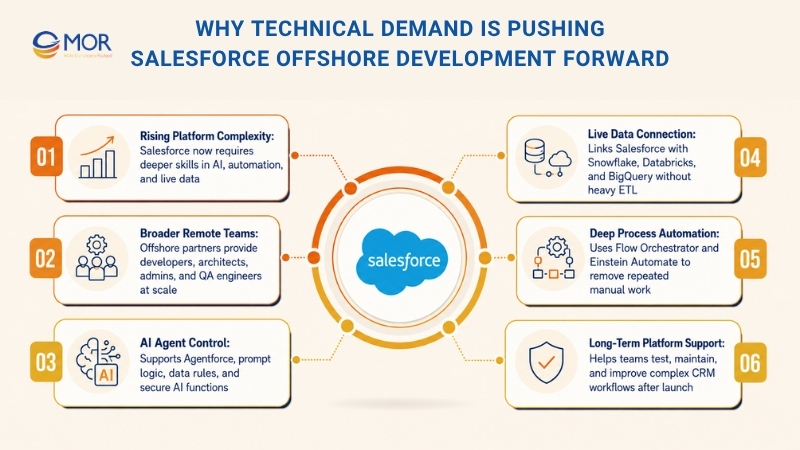
Modern offshore partners now support harder platform tasks, and Salesforce product development outsourcing often covers areas that go far beyond basic setup:
AI Agent Control
Creating autonomous agents takes more than standard Salesforce setup. Teams need working knowledge of Agentforce, prompt logic, data access rules, security settings, and the Einstein Trust Layer. Offshore Salesforce hubs are becoming useful places to train and test these new agent skills, so companies can launch AI functions with stronger control.
Live Data Connection
Companies want Salesforce to connect with enterprise data tools like Snowflake, Databricks, and BigQuery without heavy ETL work. Offshore Salesforce teams can help build these links so businesses store fewer duplicate records, get fresher data, and shorten delays across reports, CRM, and AI use cases.
Deep Process Automation
Salesforce teams now use Flow Orchestrator, Einstein Automate, approval paths, and system links to remove repeated manual work across sales, HR, service, and IT. Offshore developers can support this work over time, from process review and buildout to testing, care, and improvement after launch.
Benefits Of Hiring Salesforce Offshore Development
Salesforce offshore development helps companies support many teams, including sales, marketing, service, and customer success. The platform gives businesses wide CRM options, and offshore Salesforce developers help shape those options around real company needs. Let’s look at how this works for different business sizes.
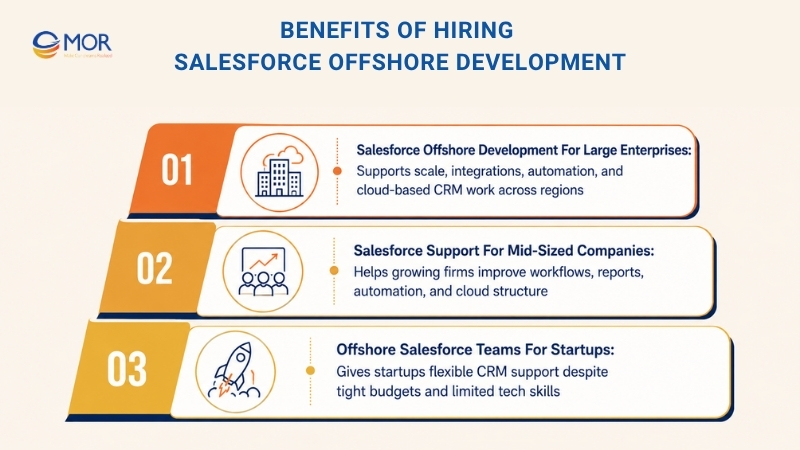
Salesforce Offshore Development For Large Enterprises
Salesforce experts can solve hard business problems for large companies, especially when IT costs are high and user demand keeps growing.
For large enterprises, one major benefit of Salesforce is its cloud model, which supports scale and daily work across many teams. Since data and apps run in the cloud, companies do not need to manage every server, database, or admin task alone. It also helps staff in different regions work from the same CRM without being tied to one office.
This is where skilled Salesforce engineers add value:
- handling rising data volumes and user loads through better system planning;
- building reports and tools that help teams stay aligned;
- connecting Salesforce with systems like ERP, marketing platforms, and analytics tools through Salesforce development services offshore;
- shaping workflows, automation, and apps around each business need.
Salesforce Support For Mid-Sized Companies
A remote Salesforce dedicated team can help mid-sized firms handle rising needs, from custom workflow setup to automation, reports, and cloud structure. These services help companies improve daily work, support growth, and raise team output without stretching internal IT too far.
This is how offshore Salesforce experts bring value:
- adding extra configuration so the platform works better with lean IT teams;
- building budget-friendly CRM changes that match business goals;
- setting up scalable structure and delivery habits for growing data and users;
- creating clear dashboards and helping staff learn how to use Salesforce tools.
Offshore Salesforce Teams For Startups
Many startups deal with tight budgets, limited internal tech skills, and a need to grow fast. For that reason, an offshore Salesforce development team can be a strong fit for early CRM projects.
Salesforce gives startups speed and flexibility when they need to launch a workable system fast. This helps young companies get a custom CRM base, improve work output, and prepare the platform for future growth.
Common Salesforce Offshore Development Engagement Models
Choosing the right offshore Salesforce development model depends on your workload, roadmap length, and level of control. Some companies need a long-term partner, but others only need extra CRM talent for a short project. The right setup helps you manage cost, ease hiring pressure, and keep delivery moving without overloading your internal team.
Model | Best for |
Dedicated team | Long-term Salesforce roadmap |
Filling skill gaps quickly | |
Project-based outsourcing | One-time implementation or migration |
Managed services | Ongoing support and platform care |
Dedicated Team
A dedicated offshore Salesforce team fits best when your business has a long CRM roadmap. This setup often includes Salesforce developers, admins, consultants, QA engineers, and sometimes a solution architect or project manager.
Over time, the team learns your systems, business rules, release cycles, and internal standards. This makes the model useful for ongoing Salesforce customization, multi-cloud growth, third-party links, automation, and AI-related CRM work.
Staff Augmentation
Staff augmentation works well when your internal team already runs Salesforce but is missing certain skills. You may need a Salesforce developer, integration expert, QA engineer, or CPQ specialist for a few months.
This model gives you quick access to trained talent without a long hiring process. It also helps when timelines are tight, the backlog keeps growing, or your team needs more support during a major release.
Project-Based Outsourcing
Project-based outsourcing suits one-time Salesforce setup, migration, or integration work. The scope, schedule, outputs, and budget are often agreed before the project starts.
Companies often use this model for Sales Cloud setup, Service Cloud rollout, legacy CRM migration, data cleanup, dashboard work, or system links. It gives clearer cost control, but it needs a clear brief and steady communication from day one.
Managed Services
Managed services fit companies that already use Salesforce and need steady support. Instead of building a full in-house support team, you can work with an offshore partner for upkeep, bug fixes, user help, performance checks, small changes, and release support.
This model works well after launch, when Salesforce needs regular care to stay useful. It helps your team manage admin tickets, workflow updates, report changes, security checks, AppExchange updates, and ongoing platform improvement without slowing daily work.
Salesforce Offshore Development Services Businesses Can Outsource
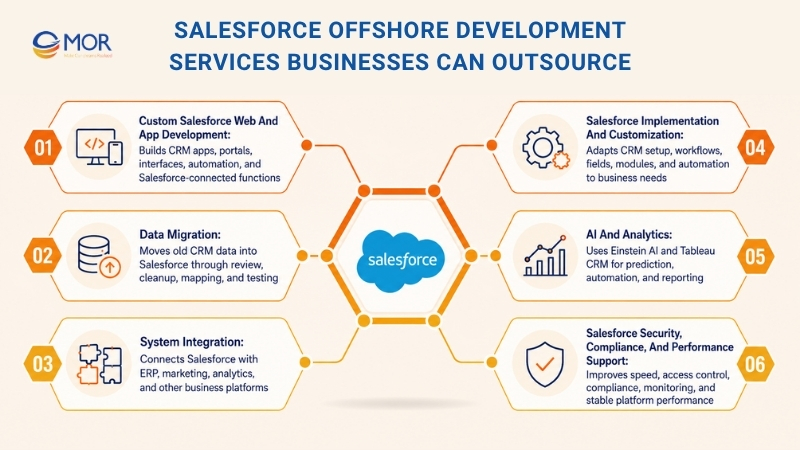
Salesforce offshore development services can cover many types of CRM work, from workflow setup to third-party system links and AI-based customer support. Businesses can use Salesforce custom development offshore when they need custom portals, app logic, automation, and platform changes built around real business processes.
Custom Salesforce Web And App Development
Custom salesforce app development matters when businesses need CRM tools shaped around their daily work. This may include workflow automation, customer portals, Salesforce links with other systems, scalable apps, or other company-specific tasks.
To handle these needs, remote Salesforce specialists build custom web and mobile solutions for the platform. Their work often covers easy-to-use screens, custom functions, and smooth app connections inside the Salesforce setup, including projects that need an offshore Salesforce commerce cloud developer for commerce-related builds.
Core Tasks In Salesforce Web And App Projects:
- Plan and build web and mobile apps based on business needs
- Prepare current apps for stronger product sales and marketing use
- Protect product data with safe encryption methods
- Build clear user interfaces for easy work with Salesforce-based data
Data Migration
Salesforce data migration becomes a key step when a company moves from old systems or another CRM to Salesforce. For a clean move, engineers need to transfer data in a correct, clear, and well-structured way with limited business disruption.
Certified Salesforce experts can manage the full migration cycle, from data review and cleanup to mapping, conversion, testing, checking, and support after launch. This helps companies moving to Salesforce improve data quality, connect better with Salesforce workflows, and face fewer work interruptions during and after the move.
Main Data Migration Work Includes:
- Review and clean old data so records stay correct
- Match source fields with the right Salesforce fields
- Build a migration roadmap with steps, dates, and checks
- Run trial migrations to confirm data quality
- Move the data into Salesforce
System Integration
Connecting Salesforce CRM with company workflows helps businesses lower running costs and make daily operations simpler. Skilled offshore Salesforce teams can handle this work with strong technical knowledge and broad platform experience.
The main task is turning complex Salesforce ideas into working business systems. Salesforce engineers do this through secure, scalable, and process-friendly solution design, buildout, and ongoing care around the Salesforce platform.
Main System Integration Work Includes:
- Connect CRM with ERP, marketing platforms, and analytics tools
- Improve data movement between Salesforce and other company systems
- Match business workflows with Salesforce-based tools for better daily output
- Keep data syncing correctly across all linked platforms
Salesforce Implementation And Customization
Salesforce-focused experts can shape the CRM so the platform better fits each business. The work may cover platform setup, custom functions, outside system links, workflow changes, and other needed updates. The final result is a strong business system that feels natural for the team to use.
Salesforce Setup Work For Technical Teams:
- Adjust the CRM around each company’s business process
- Set up workflows, automation rules, and custom fields
- Build industry-based modules, including offshore Salesforce commerce cloud development when commerce workflows are part of the scope
- Train teams to use the new tools with confidence
AI And Analytics
AI and data analytics work can help businesses stay sharper in customer service, planning, and daily decisions. Salesforce offshore development gives companies access to engineers who can connect these tools with practical workflows.
To help businesses gain more value from AI automation tools, technical teams use Einstein AI and Tableau CRM. These tools support prediction, task automation, and better decision-making, giving teams what they need to spot trends, improve workflows, and forecast sales chances.
Main Work In This Area Includes:
- Use Salesforce Einstein for prediction and useful business signals
- Automate data review to find patterns and support planning
- Build custom dashboards and reports for AI-based analysis
- Add smart chatbots and customer support automation
Salesforce Security, Compliance, And Performance Support
To improve Salesforce performance, developers work on system speed, scalable data design, and strong integrations that can support business growth.
For security, Salesforce developers set up controls like access rules, encryption, multi-factor authentication, and live system monitoring.
For compliance, technical experts take steps to meet standards like GDPR, HIPAA, or SOC 2. This keeps the Salesforce setup fast, safe, and aligned with current business and legal needs.
Key Support Tasks Include:
- Make the platform structure ready for growing users and data
- Add security controls that protect sensitive information
- Review and apply compliance rules for each industry
- Track and improve system performance for stable uptime and reliability
Offshore, Nearshore, And Onshore Salesforce Development Compared
For Salesforce development, companies can pick from offshore, nearshore, and onshore delivery. Each model depends on where the hired technical team is based, and nearshore Salesforce development sits between local hiring and far-distance outsourcing.
So how do these models differ, and when does Salesforce offshore development make the most sense? The table shows the main points.
Criteria | Offshore | Nearshore | Onshore |
Location | Teams based in a far region, like Eastern Europe or APAC for US companies | Teams located in nearby areas, like Eastern Europe for Western European clients | Technical teams based in the same country |
Cost efficiency | Lowest-cost choice with a fair cost and quality balance | Mid-range cost with better working overlap | Highest cost, but easiest local access |
Time zone alignment | Larger time gaps between teams | Smaller time gaps than offshore teams | Full working-hour match |
Talent pool availability | Wide talent base with many skill types | Medium talent access, based on the chosen area | Smaller talent pool, based on the local market |
Scalability | Easy to scale through wider access to developers | Can scale, but depends on the region | Can scale only within local hiring limits |
Cultural compatibility | Work habits may differ and need clear management | Closer work style, with some small gaps | Strong local fit with shared business norms |
Salesforce Offshore Development Cost: What A Business Should Budget
Salesforce offshore development cost can change a lot based on region, team size, skill level, and delivery model. Many companies choose offshore development because it helps them access trained Salesforce teams at a lower monthly cost than local hiring.
Hiring Location | Blended Hourly Rate Used | Lean Team Cost / Month | Standard Team Cost / Month | Advanced Team Cost / Month | Best Fit |
North America | $90-$160/hour | $32,400-$57,600 | $82,800-$147,200 | $122,400-$217,600 | Enterprise builds, local compliance, close teamwork |
Western Europe / Australia | $65-$130/hour | $23,400-$46,800 | $59,800-$119,600 | $88,400-$176,800 | Regional delivery, regulated sectors, complex stakeholder work |
Eastern Europe | $35-$90/hour | $12,600-$32,400 | $32,200-$82,800 | $47,600-$122,400 | Strong technical work at lower cost than Western markets |
Latin America | $30-$85/hour | $10,800-$30,600 | $27,600-$78,200 | $40,800-$115,600 | Nearshore delivery for US firms that need time-zone overlap |
South / Southeast Asia | $25-$60/hour | $9,000-$21,600 | $23,000-$55,200 | $34,000-$81,600 | Cost-friendly Salesforce development, support, customization, and team growth |
The budget for hiring an offshore Salesforce development team can shift based on several main factors:
Team Location
The team’s country has a direct effect on cost. Regions like India, the Philippines, and Eastern Europe are often chosen for skilled yet cost-friendly services. Since living and operating costs are lower in these markets, offshore software outsourcing can give businesses access to strong Salesforce talent at more competitive rates.
Skill Level And Certification
The cost also changes based on the developer’s experience. Senior Salesforce developers and consultants with strong project history and certifications usually cost more than junior or mid-level staff. Lower-cost talent may look appealing, but your team still needs enough skill to match the risk and scope of the project.
Project Size And Technical Scope
The size and difficulty of your Salesforce project will shape the final cost. Work that needs heavy customization, many system links, and advanced functions will take more time and more people, so the budget will rise. Clear project goals and requirements help vendors give more accurate estimates.
Contract Model
Hourly billing, fixed-price work, and dedicated teams all create different cost patterns. Pick the model that fits your budget, timeline, and project needs. Fixed-price contracts give clearer cost limits, while hourly models work better when the scope may change.
Challenges Of Salesforce Offshore Development And How To Control Them
Salesforce offshore development brings clear value, but it can also create delivery risks if the setup is weak. A good plan helps your business handle these risks before they slow the project.
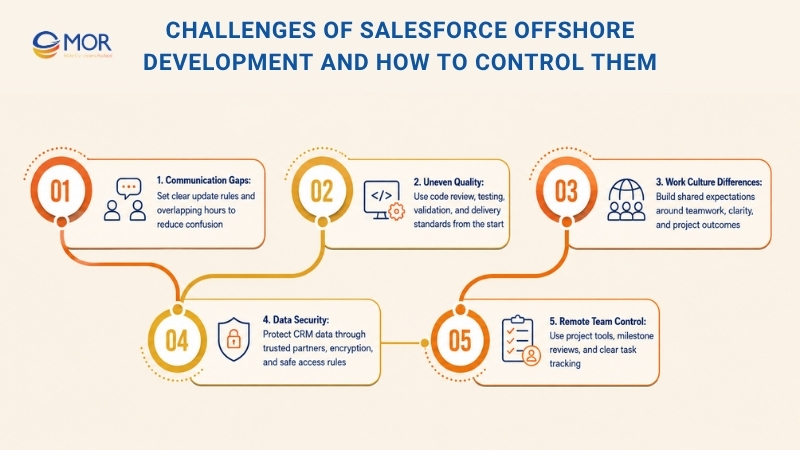
Communication Gaps
Risk: Time zones and language gaps can make updates slower and cause mixed messages.
Fix: Set simple communication rules and use shared tools for regular updates and project talks. Plan overlapping work hours so teams can solve issues faster in real time.
Uneven Quality
Risk: Quality can vary when offshore teams do not follow the same standards as your internal team.
Fix: Use strict QA steps, including code review, testing, and validation. Set quality rules and delivery expectations before the first sprint starts.
Work Culture Differences
Risk: Different work habits can lead to wrong assumptions, weak teamwork, and unclear results.
Fix: Help your internal team and offshore team understand each other’s work style. Build a team culture based on respect, clarity, and shared goals.
Data Security
Risk: Sensitive CRM data must stay protected when outside teams access the system.
Fix: Work with partners that follow strong security practices and data protection laws. Use safe communication tools and encryption to protect business information.
Remote Team Control
Risk: Leading remote Salesforce teams can become difficult without clear project management.
Fix: Use tools like Jira, Trello, or Asana to track work, assign tasks, and watch deadlines. Review milestones and deliverables often so the project stays aligned with goals.
How To Choose A Salesforce Offshore Development Partner
Choosing the right partner for Salesforce offshore development affects project speed, system quality, and long-term cost. A clear checklist helps you compare vendors with less guesswork.
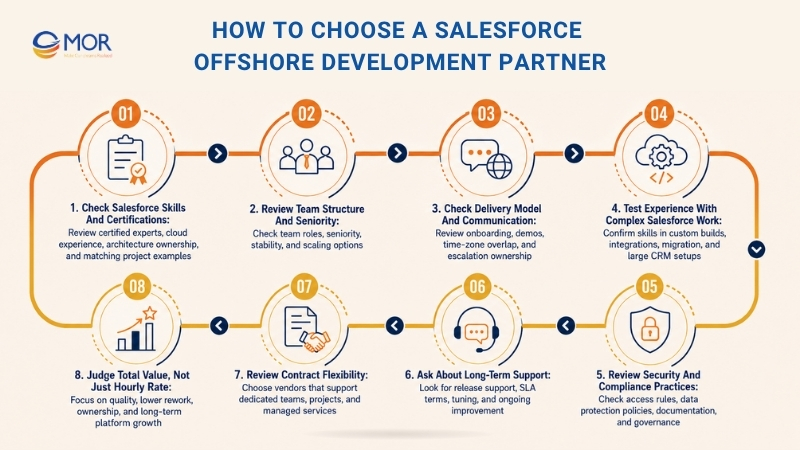
Check Salesforce Skills And Certifications
Certifications show whether the vendor has real Salesforce knowledge or only general development skills. They also help you judge if the team can handle platform decisions, not just coding tasks.
- Review how many certified offshore Salesforce developers and architects the vendor has;
- Check experience across several clouds, not only Sales Cloud;
- Ask who owns architecture decisions, not only who writes the code;
- Request real project examples that match your scope.
A strong partner should show proven Salesforce delivery across Sales Cloud, Service Cloud, Marketing Cloud, Experience Cloud, Revenue Cloud, and Data Cloud. Senior experts should join early so key platform decisions are made before development moves too far.
Review Team Structure And Seniority
A good Salesforce team needs more than developers. You should know who leads the work, who checks quality, and who keeps the project on track.
- Dedicated Salesforce team, not shared staff pulled between many projects;
- Clear roles, including architect, developer, QA, admin, and delivery manager;
- Low staff changes so project knowledge stays inside the team;
- Ability to grow or shrink the team when business needs change.
A reliable vendor should provide stable senior teams and limit constant rotation. This helps clients keep platform knowledge inside the project and scale delivery without repeating onboarding again and again.
Check Delivery Model And Communication
Salesforce offshore work needs clear routines, especially when teams sit in different time zones. A weak communication setup can slow decisions and create rework.
- Clear onboarding plan for your project;
- Agile meetings with regular demos and progress tracking;
- Time-zone overlap that supports daily teamwork;
- One main contact for project control and escalation.
A structured onboarding process and a dedicated engagement lead help keep communication clear. This also supports more predictable delivery for fixed-scope work and long-term cooperation.
Test Experience With Complex Salesforce Work
Simple configuration is not enough for many business systems. The partner should prove they can handle data, integrations, and large CRM environments.
- Background in Salesforce custom builds through offshore teams;
- Links with ERPs, data platforms, and third-party tools;
- Data migration and old-system upgrade work;
- Experience with large environments or multi-country setups.
A capable Salesforce partner should have real experience with complex multi-system projects and app products. These projects need clean architecture, scalable data models, and deep integration skills.
Review Security And Compliance Practices
Salesforce often stores customer records, sales data, service history, and internal workflows. That makes security checks a must before you share access with any vendor.
- Safe access rules and clear data protection policies;
- Experience with regulated sectors when your business needs it;
- Documentation and change control process.
Salesforce offshore development must follow strict security rules when customer data, finance data, or regulated workflows are involved. Companies in finance and other controlled sectors should choose vendors with clear governance, managed access, and full delivery records.
Ask About Long-Term Support
Salesforce work does not stop after launch. Your partner should be ready to support updates, fixes, releases, and new business needs over time.
- Post-launch Salesforce support from offshore teams;
- Release planning and ongoing improvement;
- Support model based on SLA terms;
- Performance checks and platform tuning.
The right partner should support the full lifecycle after launch. Managed services, regular releases, system health checks, and ongoing CRM platform improvement can keep Salesforce useful as your business grows.
Review Contract Flexibility
Your Salesforce needs may change after the first project. A flexible contract makes it easier to scale support without changing vendors too soon.
- Option to hire Salesforce developers offshore as a dedicated unit;
- Project-based delivery for fixed-scope work;
- Managed services for ongoing platform ownership;
A flexible vendor should support all three models. This lets companies begin with one project and later move into a dedicated offshore model without replacing the working team.
Judge Total Value, Not Just Hourly Rate
The lowest rate can become costly if delivery quality is weak. A better test is whether the partner can lower rework, protect the system, and support future growth.
- Faster delivery through skilled offshore Salesforce engineers;
- Less rework due to stronger architecture;
- Lower long-term running cost;
- Ability to support future clouds and products.
Salesforce offshore development should be judged by delivery quality, long-term ownership, and total cost, not only the hourly rate. Strong architecture helps clients avoid repeated rebuilds when the platform grows.
Need A Reliable Partner For Salesforce Offshore Development?
A strong Salesforce plan can stall when the right talent is hard to hire. Your roadmap grows, support tickets pile up, and internal teams spend too much time fixing small CRM issues instead of moving bigger work forward.
That is where MOR Software can support your business. We help companies build Salesforce offshore development teams that fit real project needs, not generic job titles. Our Salesforce services cover salesforce CRM consulting, salesforce custom development, implementation, integration, migration, management, maintenance, and custom workflow buildout.
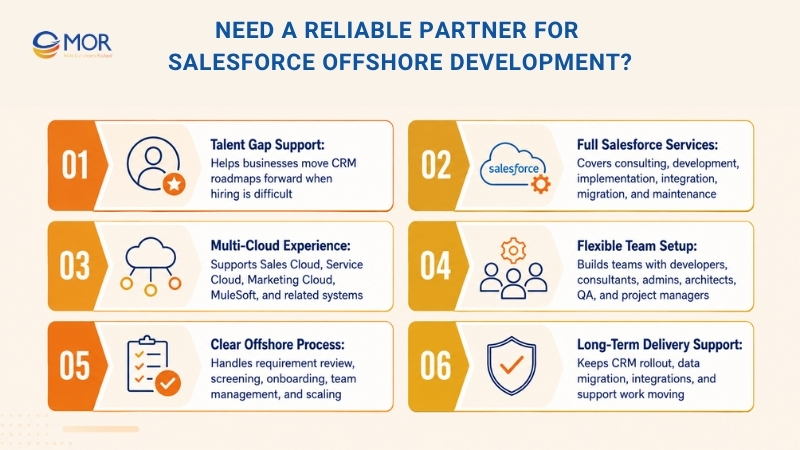
We can support Salesforce work across Sales Cloud, Service Cloud, Marketing Cloud, Community Cloud, Pardot, Field Service Lightning, MuleSoft, and related systems. Our team can include Salesforce developers, consultants, administrators, architects, QA engineers, and project managers based on your roadmap.
MOR Software also supports offshore team setup through clear steps: requirement review, candidate screening, onboarding, team management, and scaling. This helps your business add talent without handling recruitment, payroll, and daily operations alone.
If your business needs offshore Salesforce services for CRM rollout, legacy system connection, data migration, or long-term support, MOR Software can help you build the right team and keep delivery moving.
Conclusion
Salesforce projects move faster when the right team, process, and security rules are in place. Offshore Salesforce teams can support CRM rollout, integration, migration, AI analytics, security checks, and long-term platform care without adding more pressure to your internal team. If your business needs Salesforce offshore development with the right mix of talent and delivery control, MOR Software can help. Ready to discuss your Salesforce roadmap?
Contact us to explore how we can help you build the right offshore Salesforce team and keep your CRM projects moving with confidence.
"Mr. Cong’s guiding philosophy is simplicity, believing that the simplest solutions are often the most powerful. He sees trust, empowerment, and the opportunity to demonstrate one’s abilities as the key elements that set MOR apart from traditional IT companies."
Mac Tien Cong


Division Manager (Hanoi Branch)
MOR SOFTWARE
Frequently Asked Questions (FAQs)
What is Salesforce offshore development?
Salesforce offshore development means hiring a remote Salesforce team in another country to handle CRM setup, coding, integration, testing, and support while your business keeps control of goals and approval.
How does an offshore Salesforce team work?
The offshore team usually joins your project through a dedicated team, staff augmentation, project-based model, or managed service setup. They follow your roadmap, sprint plan, and delivery rules.
What tasks can offshore Salesforce developers handle?
They can handle Sales Cloud setup, Service Cloud work, custom Apex coding, LWC development, Flow automation, data migration, third-party integration, QA, bug fixing, and user support.
Why do companies choose Salesforce offshore development?
Companies use this model to access wider talent, lower hiring pressure, fill skill gaps faster, and keep Salesforce projects moving when local recruitment takes too long.
Is offshore better than hiring an in-house Salesforce team?
It depends on your needs. Offshore works well for flexible staffing, long backlogs, migrations, integrations, and support. In-house hiring may suit businesses that need daily face-to-face control.
How much does offshore Salesforce work cost?
Cost depends on region, role level, certification, project scope, and contract model. Senior architects, CPQ experts, and integration specialists usually cost more than junior developers.
What skills should an offshore Salesforce team have?
A strong team should know Salesforce configuration, Apex, Lightning Web Components, Flow, API integration, data migration, security rules, testing, and release management.
What risks come with Salesforce offshore development?
Common risks include time zone gaps, unclear requirements, weak code review, data security issues, and poor task tracking. Clear documentation and sprint check-ins help control these risks.
How can a business manage an offshore Salesforce team well?
Set clear owners, sprint goals, acceptance rules, meeting times, and reporting habits. Tools like Jira, Slack, Confluence, and GitHub help keep work visible.
When should a company use Salesforce offshore development?
This model fits well when your Salesforce backlog grows faster than your internal team can handle, or when you need certified talent for rollout, migration, integration, or long-term support.
Share


Make Our-Dreams Realized


© 2023 . MOR Software. All Rights Reserved
Sitemap
Privacy Policy
Terms of Use

Rate this article
0
over 5.0 based on 0 reviews
Your rating on this news:
Name
*Email
*Write your comment
*Send your comment
1