


Digital Transformation Maturity Assessment: A Complete Guide for 2026

Buying new software doesn't automatically mean your business is ready for digital growth. Disconnected systems, manual processes, and skill gaps can still hold your teams back. A digital transformation maturity assessment helps you see where your business stands and what needs attention. This guide from MOR Software gives you a clearer picture of digital maturity models, assessment methods, and scoring systems, so you can prioritize improvements with confidence
Key Takeaways
- A digital transformation maturity model measures how well an organization combines technology, people, processes, data, and strategy to achieve business goals.
- Most practical assessments use five maturity levels, but published models differ in their dimensions, scoring rules, and evaluation methods.
- Assessment results become useful when you turn capability gaps into a prioritized roadmap with clear owners, budgets, and measurable outcomes.
What Is Digital Transformation Maturity Assessment?
A digital transformation maturity assessment is a structured evaluation of an organization's ability to adopt, integrate, and manage digital technology across its operations. It examines current capabilities against defined criteria to identify weaknesses, measure progress, and guide future investment.
A useful digital maturity assessment definition focuses on what your business can do consistently. The number of software platforms you own says little about how well your departments share information or complete daily tasks.
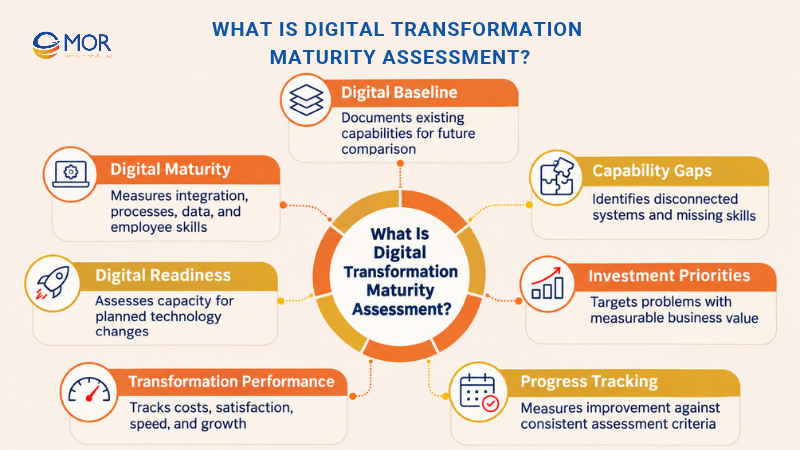
Three related concepts explain different parts of digital progress:
- Digital Maturity: Measures established capabilities, including system integration, process management, data quality, and employee skills.
- Digital Readiness: Evaluates whether an organization has the resources, infrastructure, and workforce capacity to introduce a particular change.
- Digital Transformation Performance: Tracks business outcomes, including operating costs, customer satisfaction, process speed, and revenue growth.
A structured digital maturity assessment gives business leaders four practical advantages:
- Establish a Digital Baseline: Document existing capabilities and create a reference point for future evaluations.
- Identify Capability Gaps: Find outdated systems, inconsistent workflows, and missing skills that slow digital projects.
- Prioritize Digital Investments: Direct technology spending toward problems with measurable business value.
- Track Transformation Progress: Compare results over time using the same assessment criteria.
The main benefit is better decision-making. Leaders can determine where technology investment makes sense before committing resources to another large project.
What Capabilities Should a Digital Transformation Maturity Assessment Cover?
A reliable digital transformation maturity assessment examines the organization as a whole. Technology infrastructure matters, but business strategy, employee adoption, data management, and governance determine how well those systems perform.
The seven dimensions below provide a practical starting point for an enterprise evaluation.
Assessment Dimension | Key Areas to Evaluate |
Digital Strategy and Leadership | Examine strategic goals, executive sponsorship, budget allocation, investment governance, and the connection between digital projects and business KPIs. |
Technology and Infrastructure | Review legacy applications, cloud infrastructure, API connections, platform scalability, integration quality, and the ability to deploy system changes. |
Data, Analytics and AI | Assess data ownership, accuracy, reporting capabilities, access controls, AI readiness, and how teams use business data in decisions. |
Business Processes and Automation | Evaluate workflow documentation, ERP processes, manual data entry, approval cycles, automation coverage, and operational performance. |
Customer Experience | Examine CRM integration, digital channels, customer journey continuity, service quality, personalization, and customer feedback measurement. |
People and Digital Culture | Review digital skills, training programs, technology adoption, cross-department collaboration, leadership support, and change management. |
Cybersecurity and Risk Governance | Assess identity management, access permissions, security monitoring, regulatory compliance, business continuity, and AI governance policies. |
These dimensions work together, but they rarely develop at the same pace. For instance, a company may have strong cloud infrastructure and still rely on spreadsheets to approve supplier payments.
A digital maturity assessment of business processes can expose such gaps through workflow reviews and operational records. It also reveals where system integration or automation could remove recurring manual tasks.
Customer-facing teams may need more detailed criteria. A digital marketing maturity model assessment, for example, examines campaign data, marketing automation, CRM integration, and customer journey measurement.
Industry requirements also shape the assessment. Healthcare providers need strict data access controls, manufacturers focus on connected operations, and retailers depend on accurate inventory and customer records. The same principle applies when evaluating AI solutions for specific industries.
KPMG's Connected Enterprise research reports that organizations investing in connected enterprise capabilities were twice as likely to meet customer expectations, achieve objectives, and deliver returns. The finding comes from research conducted by Forrester Consulting on KPMG's behalf and supports examining capabilities across departments.
The seven dimensions above form an editorial assessment structure. They should be adapted to your business, rather than treated as the official scoring categories of every maturity model.
Five Levels of Digital Transformation Maturity Assessment
Organizations develop digital capabilities at different rates. A five-level model helps describe their current position through observable practices, rather than subjective judgments about how modern their technology appears.
The following digital transformation maturity assessment scale combines common characteristics from established models. Its labels are illustrative, and individual providers may define their stages differently.
Maturity Level | Business Characteristics | Technology and Process Maturity | Improvement Priority |
Level 1: Fragmented | Limited strategy and inconsistent ownership | Manual processes and disconnected applications | Document processes and establish leadership direction |
Level 2: Emerging | Department-level digital initiatives | Basic software adoption and isolated automation | Standardize workflows and coordinate projects |
Level 3: Standardized | Documented strategy and governance | Core platforms, repeatable processes, and partial integration | Improve data quality and cross-team integration |
Level 4: Integrated | KPI-driven management and coordinated operations | Connected platforms, extensive automation, and analytics | Improve performance and expand data-driven decisions |
Level 5: Continuously Improved | Regular capability reviews and adaptive planning | Ongoing system improvement, governed AI, and flexible architecture | Sustain progress and adjust investments based on results |
Level 1: Fragmented Digital Capabilities
At Level 1, departments handle business operations through spreadsheets, emails, and disconnected applications. Technology decisions usually respond to immediate problems, and no consistent digital strategy guides investment.
For instance, sales might record customer information in a CRM while finance maintains separate records in Excel. Teams spend time reconciling information because nobody owns the full data process.
The priority is to document existing workflows, establish process ownership, and identify the systems most responsible for daily delays.
Level 2: Early Digital Adoption
Level 2 organizations have started using digital tools, but progress remains uneven across departments. Individual teams experiment with automation, cloud applications, or customer platforms without a shared implementation plan.
A business may introduce AI software for business to handle routine work, yet struggle to connect the results to existing ERP data. Employees may also return to manual processes when new tools create extra steps.
Leaders should establish common process standards and select projects that address shared operational problems.
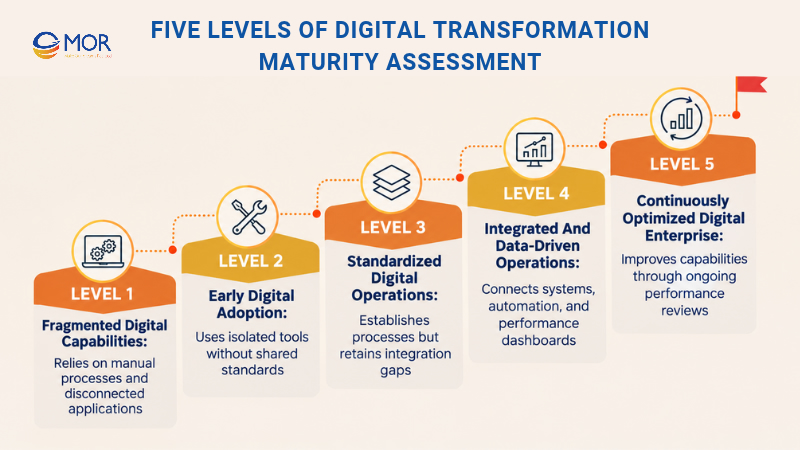
Level 3: Standardized Digital Operations
At Level 3, digital initiatives follow a documented strategy supported by formal responsibilities and measurable goals. Organizations increasingly depend on enterprise platforms, including ERP, CRM, HRM, and business reporting systems.
Core workflows become consistent, and employees receive training for their assigned applications. Still, integration gaps can limit data sharing between finance, operations, sales, and customer service.
Improvement efforts should focus on data governance, API integration, and reliable reporting across departments.
Level 4: Integrated and Data-Driven Operations
Level 4 organizations connect key business platforms and use performance data to manage operations. Automated workflows handle recurring tasks, and managers can track process results through shared dashboards.
For example, integrated ERP and CRM systems can connect order processing, billing, and customer service records. Developments in artificial intelligence in information technology also support forecasting, anomaly detection, and data analysis.
At this stage, teams should measure automation performance, strengthen controls, and improve the speed of operational decisions.
Level 5: Continuously Optimized Digital Enterprise
Level 5 represents an organization that regularly improves its digital capabilities using performance evidence. Technology teams can adjust platforms, business processes, and governance practices as operating requirements change.
AI adoption follows defined data standards and business goals. Leaders review outcomes, update investment priorities, and maintain employee development programs to support new capabilities.
Reaching Level 5 across every dimension isn't necessary for every organization. The appropriate target depends on business value, operating risk, and the cost of further improvement.
Which Digital Maturity Assessment Framework Should You Choose?
Assessment models differ in their intended users, evaluation depth, and scoring methods. A model designed for telecommunications providers may not be appropriate for a small manufacturer or a national standards body.
Choosing a digital maturity assessment framework starts with understanding which business capabilities need evaluation and how the results will guide decisions.
Assessment Model | Evaluation Focus | Best-Suited Organizations |
BCG Digital Maturity Assessment | Digital and AI capabilities across 41 dimensions, supported by comparisons with industry peers | Large enterprises seeking competitive maturity comparisons |
Deloitte Digital Maturity Model | Customer, strategy, technology, operations, and organization and culture | Companies seeking a broad enterprise capability review |
KPMG Digital Maturity Assessment | Eight connected-enterprise capabilities covering customer experience, operations, technology, and people | Customer-focused enterprises evaluating connected business operations |
TM Forum Digital Maturity Model | Customer, strategy, technology, operations, culture, and data | Telecommunications providers and related service organizations |
European Commission Digital Maturity Assessment | Six dimensions covering digital strategy, readiness, people, data, AI and automation, and green digitalization | SMEs and organizations conducting accessible self-assessments |
Prosci Digital Transformation Maturity Model | People, processes, technology, culture, and change management maturity | Organizations preparing employees and operations for transformation |
ISO DMAS / DMQS | Capability evaluation, maturity measurement, and improvement planning | National standards bodies seeking structured digital development |
BCG states that its assessment draws on more than 10 years of research involving over 10,000 companies. Its 41 dimensions support comparisons against peers and digital leaders, making the model relevant to enterprises requiring detailed digital maturity benchmarks.
The digital maturity model Deloitte developed for TM Forum describes five core dimensions, divided into 28 subdimensions and 179 assessment criteria in its published version. TM Forum's newer DMM v5 uses six dimensions, including data, so those two versions shouldn't be treated as identical.
Framework selection also depends on the support available within your organization. Internal IT teams can conduct focused reviews using accessible questionnaires, but independent assessments may uncover weaknesses that internal teams overlook.
Some businesses use digital maturity strategy consulting services to review investment priorities and validate assessment findings. Others need an enterprise AI consulting firm when AI readiness, data architecture, and governance require specialist review.
The main selection criteria are straightforward: assessment scope, available evidence, industry relevance, scoring transparency, and practical outputs. Use the model that answers your business questions, and keep its scoring rules consistent throughout the assessment.
How to Conduct a Digital Transformation Maturity Assessment
An effective digital transformation maturity assessment follows a defined process that connects business objectives with verifiable evidence. The work typically involves leadership, IT, operations, finance, and employees who use business applications every day.
Six steps provide a practical structure for conducting the evaluation.
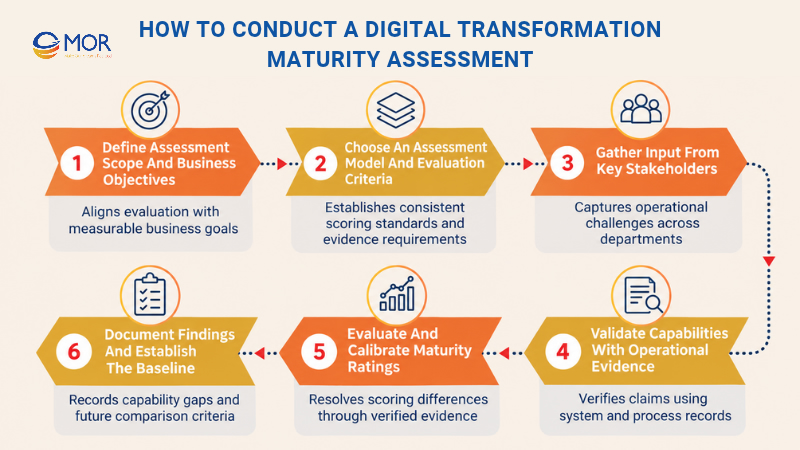
Define Assessment Scope and Business Objectives
Start by identifying the decisions the assessment needs to support. A company preparing for ERP modernization will examine different capabilities than one planning to expand digital customer services.
Set clear boundaries before collecting data. This prevents teams from spending weeks evaluating systems that have little connection to the planned investment.
- Business Objectives: Identify measurable goals involving operating costs, customer service, scalability, or process performance.
- Assessment Scope: Select relevant departments, applications, workflows, business units, and locations.
- Success Criteria: Define the findings, evidence, and recommendations decision-makers expect from the assessment.
Choose an Assessment Model and Evaluation Criteria
Select a digital maturity assessment model that matches the organization's size, industry, and evaluation goals. Published models provide established assessment categories, but customized criteria may better reflect specialized business operations.
Document how scores will be assigned before stakeholders begin answering questions. Each rating should describe observable practices and supporting evidence.
- Framework Selection: Choose an established method or document an internal scoring approach.
- Assessment Dimensions: Define the areas to examine and the indicators relevant to business priorities.
- Rating Standards: Set maturity descriptions, evidence requirements, and rules for incomplete assessments.
Gather Input From Key Stakeholders
Technology teams understand architecture and integration, but frontline staff often know where processes fail. A useful digital transformation assessment combines these viewpoints to identify problems that system reports alone may miss.
Interview people responsible for business outcomes and the employees completing daily tasks. Ask about workarounds, recurring errors, approval delays, and data access problems.
- Leadership Interviews: Review business priorities, digital investment decisions, ownership, and executive support.
- Cross-Functional Surveys: Collect feedback from IT, finance, operations, sales, and customer-facing departments.
- Operational Feedback: Document application limitations, manual work, training gaps, and recurring service problems.
Validate Capabilities With Operational Evidence
Self-reported maturity scores need supporting records. A department may claim that order processing is automated, yet staff still manually correct invoices after each transaction.
Review actual workflows and system records instead of relying entirely on survey answers. Select representative processes to verify that documented practices match daily operations.
- Technology Evidence: Examine architecture diagrams, system inventories, API documentation, deployment logs, and security records.
- Process Evidence: Review workflow diagrams, approval histories, automation logs, error records, and operational KPIs.
- People and Data Evidence: Check training records, application usage, data quality reports, and governance documents.
Evaluate and Calibrate Maturity Ratings
Apply the same criteria to every department or capability under review. Ratings should describe repeatable business practices supported by evidence rather than personal confidence in a particular system.
When stakeholders disagree, examine the underlying records before settling on a score. Record uncertainty where the available information doesn't support a reliable judgment.
- Capability Ratings: Assign maturity levels based on predefined criteria and observed practices.
- Evidence Confidence: Mark ratings as high, medium, or low confidence according to the supporting records.
- Stakeholder Calibration: Compare conflicting assessments and document how the final rating was determined.
Document Findings and Establish the Baseline
The assessment report should make decisions easier for business leaders. Present each capability's current level, supporting evidence, priority gaps, and the business processes affected.
Keep the original assessment records for later comparison. Future reviews need the same definitions and scope to show meaningful progress.
- Assessment Report: Record maturity scores, capability gaps, evidence, and improvement opportunities.
- Accountability: Identify department owners responsible for maintaining and improving each capability.
- Baseline Records: Store assessment dates, scoring rules, evidence sources, and confidence ratings.
The output should support a practical investment discussion. A lengthy report has limited value when nobody knows which problem deserves attention first.
Digital Transformation Maturity Assessment Questionnaire
A structured questionnaire makes evaluation more consistent across departments. Each question should examine an observable capability and identify the records needed to verify the answer.
You can adapt the following questions into a spreadsheet or a digital transformation assessment tool for internal reviews.
Assessment Area | Sample Assessment Questions | Supporting Evidence |
Strategy and Leadership | Does your organization have an approved digital strategy? Do business objectives guide technology spending and project selection? | Strategic plans, approved budgets, project portfolios, KPI reports |
Technology and Infrastructure | Can ERP, CRM, and other core systems exchange information without manual re-entry? Can the current architecture support changing business needs? | System diagrams, API documentation, integration logs, infrastructure reviews |
Data, Analytics and AI | Are data owners and quality standards documented? Do AI initiatives have reliable data sources and defined controls? | Data catalogs, quality reports, access policies, AI project documentation |
Business Processes | Are high-volume workflows documented and measured? Does the organization regularly review manual work and automation opportunities? | Process maps, ERP logs, approval records, cycle-time reports |
Customer Experience | Can teams access consistent customer information across service channels? Does the organization measure customer journeys and resolve recurring service issues? | CRM records, journey maps, customer feedback, service performance reports |
People and Culture | Do employees receive training for the digital tools they use? Are adoption rates measured after new systems launch? | Training records, usage analytics, employee surveys, change plans |
Cybersecurity and Governance | Are access permissions reviewed regularly? Do documented policies govern digital risks, data handling, and system changes? | Access reviews, security assessments, risk registers, audit records |
Marketing departments can extend the customer experience questions through a digital marketing maturity assessment. Relevant evidence includes campaign attribution reports, lead management rules, marketing automation records, and CRM data quality.
Apply a consistent rating scale to each question. Ask stakeholders to attach supporting records and identify whether the evidence reflects an actual operating practice or a planned initiative.
For missing evidence, record "Not Assessed" rather than assigning an unsupported score. Keep confidence ratings alongside the results so decision-makers can distinguish established capabilities from areas requiring further review.
The European Commission also provides an Open Digital Maturity Assessment Tool for organizations seeking a ready-made self-assessment. Its official questions can serve as a reference when designing your own assessment checklist.
How to Calculate Digital Maturity Assessment Score
A scoring system helps compare capabilities within the same organization. It should remain transparent, repeatable, and aligned with the criteria selected before the assessment begins.
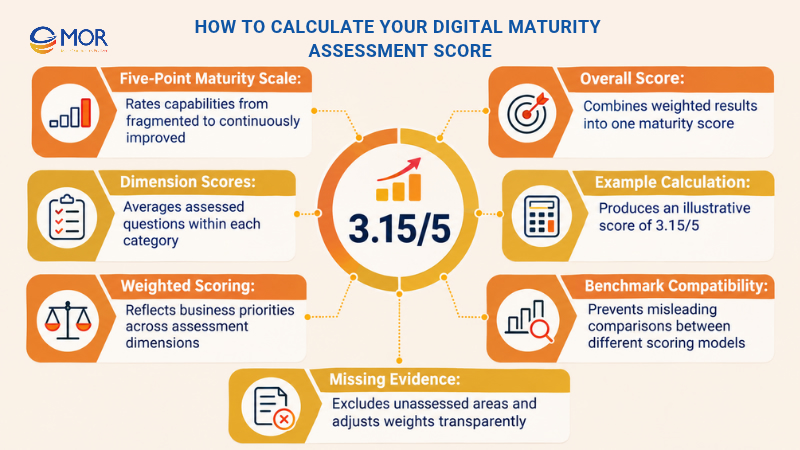
For a basic digital transformation maturity assessment, use a scale of 1 to 5:
- 1: Fragmented: Processes depend on individuals and lack consistent ownership.
- 2: Emerging: Local practices exist, but execution varies across teams.
- 3: Standardized: Documented processes, responsibilities, and performance measures are in place.
- 4: Integrated: Connected systems and measured workflows guide operational decisions.
- 5: Continuously Improved: Teams adjust capabilities regularly using verified performance data.
You can calculate each dimension's score by averaging its assessed questions. When some capabilities matter more to business goals, apply weights to reflect their priority.
The illustrative weighted-score formula is:
Digital Maturity Score = Σ (Dimension Score × Dimension Weight)
Each dimension receives a score between 1 and 5. Its weight represents a percentage of the overall assessment, and all included weights must total 100%.
Consider an organization evaluating three dimensions:
Dimension | Score (1–5) | Weight | Weighted Result |
Digital Strategy | 4 | 40% | 1.60 |
Technology | 3 | 35% | 1.05 |
Data & Analytics | 2 | 25% | 0.50 |
Overall Score |
| 100% | 3.15 / 5 |
The organization's illustrative score is 3.15 out of 5, equivalent to 63% of the maximum score. This figure describes its result under the selected scoring rules, not its market ranking or probability of transformation success.
The difference between dimensions matters more than the final decimal. Here, Data & Analytics scores only 2, making it a priority for further investigation before the company invests heavily in AI.
Actual industry scoring methods can produce very different results. For example, the European Commission's 2025 Digital Decade report reports an average digital maturity score of 40 out of 100 among SMEs assessed through its DMAT approach. Firms working with European Digital Innovation Hubs improved by an average of seven points in their second assessment.
Those figures belong to the Commission's methodology and shouldn't be compared directly with a five-point internal scorecard. Keep each model's original scale and definitions when interpreting results.
If evidence is missing, exclude the unassessed area from the calculation and adjust the remaining weights transparently. Record the missing information so the next assessment can address it.
How to Turn Digital Maturity Assessment Results Into a Roadmap
A digital transformation maturity assessment should lead to clear investment decisions. Prioritize capability gaps based on business value, implementation costs, operational risks, and dependencies, then set measurable targets for each improvement.
Maturity Gap | Recommended Action | Success KPI |
Disconnected Enterprise Systems | Integrate ERP, CRM, and legacy systems through APIs to improve data exchange. | Fewer synchronization failures and duplicate records. |
Manual Business Processes | Automate repetitive approvals, reporting, and data entry through AI workflow automation where appropriate. | Shorter processing times and fewer manual errors. |
Poor Data Quality | Establish data ownership, improve governance, and prepare reliable datasets before AI implementation planning. | Higher data accuracy and fewer reporting inconsistencies. |
Low Employee Adoption | Introduce role-based training, change management, and regular usage reviews. | Higher adoption rates and fewer manual workarounds. |
Limited System Scalability | Modernize legacy applications and cloud infrastructure based on business growth requirements. | Improved system uptime and deployment reliability. |
Assign an accountable owner to each initiative and reassess maturity after measurable changes. In Prosci's Mateco case study, structured change management supported 85% global alignment and a 30% decrease in administrative time, showing how employee adoption and technology improvements can support measurable business results.
Common Digital Maturity Assessment Mistakes to Avoid
Even a structured assessment can produce misleading results when the evaluation criteria are inconsistent or supporting evidence is missing. Poor assessments often lead to misplaced technology spending and unrealistic transformation plans.
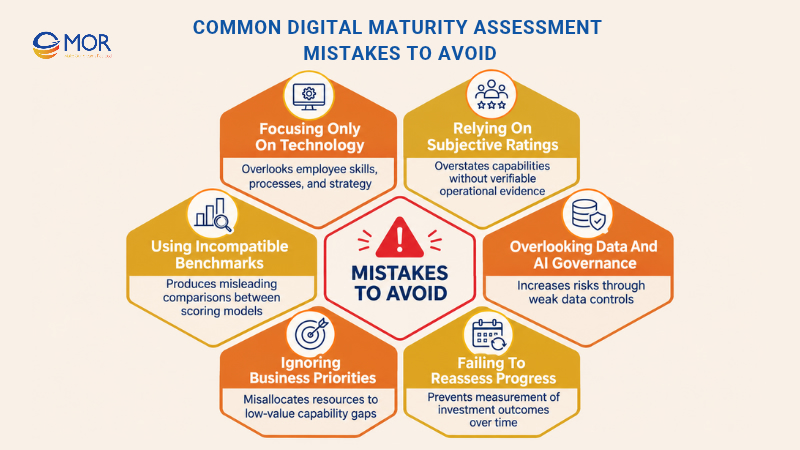
The most common mistakes include:
- Focusing Only on Technology: Counting cloud platforms, AI tools, or software licenses overlooks employee skills, process ownership, and business strategy. Evaluate how the systems perform in daily operations.
- Relying on Subjective Ratings: Employee opinions may overstate digital capabilities. Verify answers through system records, process observations, and measurable KPIs.
- Using Incompatible Benchmarks: Comparing scores from unrelated maturity models creates false conclusions. Use shared definitions and scoring criteria before making direct comparisons.
- Overlooking Data and AI Governance: AI adoption without reliable data, access controls, and defined responsibilities introduces operational risks. Examine these foundations before scoring AI readiness.
- Ignoring Business Priorities: Improving every low-scoring dimension wastes resources when some capabilities have limited business value. Rank gaps according to financial, operational, and risk considerations.
- Failing to Reassess Progress: A one-time report can't measure the effect of future investments. Schedule follow-up evaluations after meaningful changes and maintain consistent assessment rules.
Keep the process evidence-based and tied to decisions. A trustworthy result should tell leaders what needs improvement, why it matters, and how progress will be measured.
How MOR Software Turns Digital Maturity Gaps Into Action
Assessment results often reveal problems that internal teams can't resolve through configuration changes alone. MOR Software helps businesses address those gaps through IT consulting, custom software development, enterprise integration, and application modernization.
Founded in Vietnam in 2016, MOR Software has delivered more than 850 projects across over 10 countries. We connect business requirements with practical engineering work, supporting organizations as they improve their technology and operating processes.
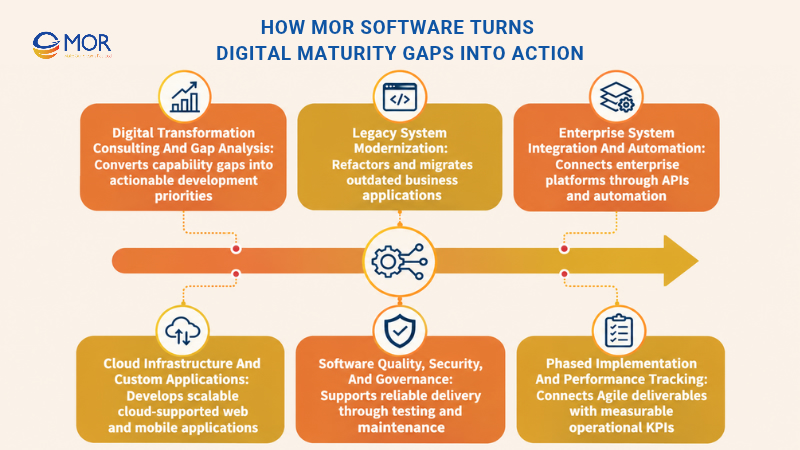
Our capabilities most relevant to digital maturity improvement include:
- Digital Transformation Consulting and Gap Analysis: Our business analysts and IT consultants review existing workflows, system limitations, and project requirements. We help translate documented technology gaps into scoped development work, implementation priorities, and practical delivery plans.
- Legacy System Modernization: Outdated applications can limit integration, scalability, and process changes. MOR Software develops modernization solutions through application redesign, code refactoring, system migration, and connections between legacy and newer platforms.
- Enterprise System Integration and Automation: We develop API connections, Salesforce integrations, and data exchange solutions for enterprise applications. These services address disconnected records, manual data transfers, and workflows that depend on information stored across separate systems.
- Cloud Infrastructure and Custom Applications: Our teams develop web and mobile applications supported by cloud platforms and suitable software architecture. Businesses can address scalability gaps, improve data access, and support new operational requirements.
- Software Quality, Security, and Governance: MOR Software provides QA testing, performance checks, maintenance, and software delivery support. The company has documented ISO 9001:2015 and ISO/IEC 27001:2013 certifications, reflecting its established quality and information security management practices.
- Phased Implementation and Performance Tracking: We use business analysis, Agile development, defined deliverables, and testing throughout software projects. Project goals can be linked to KPIs covering system reliability, process speed, data accuracy, and technology adoption.
Organizations seeking digital maturity assessment and implementation specialists should distinguish diagnostic services from technical execution. MOR Software's documented strength lies in translating identified technology requirements into working software and integrated systems.
A practical example comes from our Salesforce and legacy system integration project for a Japanese company. An 18-member team worked over 15 months to connect Salesforce with the client's existing time-attendance system.
The project used API Gateway, ETL processes, and bidirectional data synchronization to connect legacy PitTouch devices with Salesforce. The completed solution improved data accuracy and simplified workforce management, addressing clear integration and process gaps.
A useful maturity assessment should lead to defined improvements. If your organization needs legacy modernization, enterprise integration, or custom application development, contact MOR Software to discuss the requirements behind your transformation roadmap.
Conclusion
A digital transformation maturity assessment gives your business a clearer view of its technology strengths, operating gaps, and investment priorities. The right model, reliable evidence, and consistent scoring turn scattered findings into an improvement plan you can measure. If your results point to outdated applications, disconnected systems, or missing technical capabilities, MOR Software can support the implementation work.
Contact us to discuss your digital transformation goals and identify practical development priorities for your business.
"Evolution is not a destination, it is a disciplined journey of innovation."
Phung Van Tu


CEO MOR AI
MOR SOFTWARE
Frequently Asked Questions (FAQs)
What is the difference between digital maturity and digital readiness?
Digital maturity measures how consistently an organization uses technology, data, people, and processes to support business operations. Digital readiness examines whether the organization can successfully introduce a planned change, considering its resources, infrastructure, skills, and capacity to adapt.
How long does a digital transformation maturity assessment take?
The duration depends on organizational size, assessment scope, and the amount of evidence required. A focused departmental self-assessment may take several days, while an enterprise-wide evaluation involving system reviews, stakeholder interviews, and detailed scoring can require several weeks.
Who should participate in a digital maturity assessment?
Executive leaders, IT managers, business process owners, operations teams, finance representatives, and customer-facing employees should participate. Risk and compliance specialists may also be involved when the assessment covers information security, governance, regulated data, or business continuity requirements.
Are there free digital maturity assessment tools available?
Yes. The European Commission's Open DMAT provides an accessible option for organizations evaluating digital capabilities. Businesses can also create internal questionnaires using spreadsheets, published assessment dimensions, and documented scoring criteria, though their results won't automatically carry an external certification.
What evidence is needed to assess digital maturity accurately?
Useful evidence includes system architecture diagrams, ERP records, API logs, process documentation, technology usage reports, training records, and operational KPIs. Stakeholder interviews provide added information, but teams should validate claims against real system activity wherever possible.
How often should organizations reassess digital maturity?
Reassessment should follow meaningful changes in technology, operating processes, or business priorities. Many organizations can consider a six-to-twelve-month review cycle, then adjust the schedule according to implementation milestones, available evidence, and the decisions the assessment needs to support.
Do all digital maturity frameworks use the same five levels?
No. Maturity models use different stage names, evaluation dimensions, and scoring methods. Some assess capabilities through five levels, while others use numerical scores or provider-defined benchmarks, making direct comparisons unreliable without consistent definitions and evidence rules.
What is considered a good digital maturity score?
A useful score reflects the organization's business requirements and the assessment model applied. High scores aren't always necessary across every dimension, especially when the cost of further improvement exceeds its expected business value or addresses a capability with limited strategic relevance.
How does AI readiness affect digital transformation maturity?
AI readiness depends on data quality, infrastructure, technical skills, business use cases, and governance controls. An organization may use AI applications but still lack the processes needed to manage their outputs, integrate them with business systems, or track performance.
Can small businesses conduct digital maturity assessments?
Small businesses can begin with a limited set of capabilities, a short questionnaire, and a simple scoring rubric. The assessment should focus on priority workflows, existing software, employee skills, and affordable improvements before considering larger technology investments.
Share


Make Our-Dreams Realized


© 2023 . MOR Software. All Rights Reserved
Sitemap
Privacy Policy
Terms of Use

Rate this article
0
over 5.0 based on 0 reviews
Your rating on this news:
Name
*Email
*Write your comment
*Send your comment
1