


Top 10 Industries That Use AI | 2026 Guide
Many business leaders still struggle to see which industries that use AI are getting real results and which trends are just noise. If you are asking what industries use AI and where the biggest opportunities sit, this MOR Software guide will walk you through the sectors, use cases, challenges, and market shifts that matter most in 2026.
Global AI Market Overview In 2026
The global AI market is growing quickly, and the newest data points to strong annual gains with a solid path through 2029. Based on the chart, the market reached $222.57 billion in 2024 and is likely to rise to $294.71 billion in 2025. After that, the upward trend continues, with forecasts showing it could hit $896.32 billion by 2029, equal to a 32.1% CAGR during the forecast window.
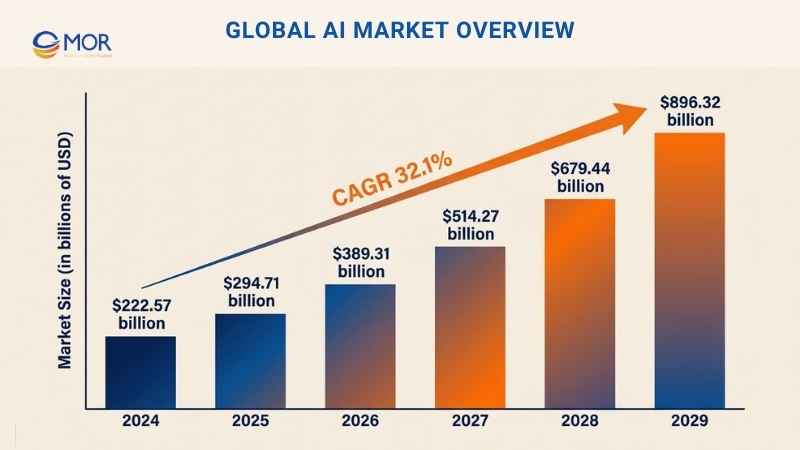
That steep climb makes one thing clear: AI automation has moved past the trial stage and is now becoming a central part of how companies run. Businesses in the industries that use AI are putting more money into software that can automate work, support better choices, improve customer interactions, and help launch new digital products. As adoption grows in healthcare, finance, retail, manufacturing, and logistics, the market will likely keep rising, pushed by demand for machine learning, agentic AI vs generative AI, computer vision, and intelligent automation.
How Businesses Apply AI In Daily Operations
The chart shows that many companies first bring in artificial intelligence to handle automation, yet its value reaches much further than routine work. Today, AI supports many parts of day-to-day business activity, helping teams move faster, make smarter choices, and react more precisely to customer and market changes. In real business settings, AI across business operations usually appears in several key areas:
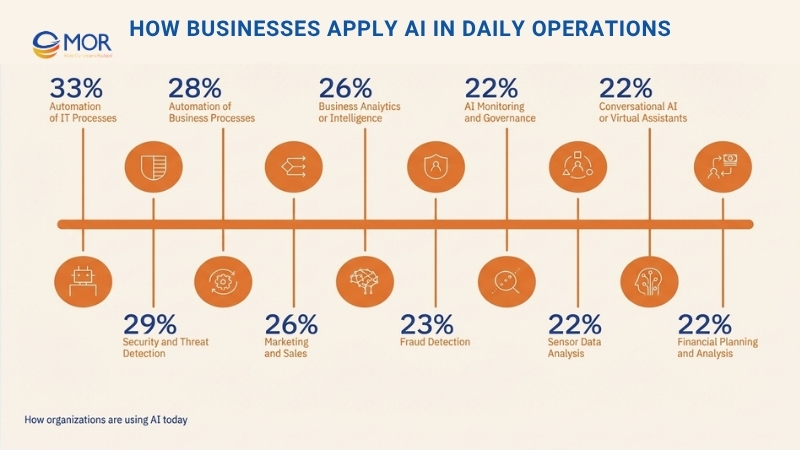
- Data analysis: AI allows companies to review huge amounts of information at speed, spot patterns, find unusual activity, and turn raw data into decisions the business can use.
- Customer experience personalization: Businesses apply agentic AI development services to shape recommendations, content, promotions, and support based on each customer’s actions, interests, and buying history.
- Predictive analytics: AI helps companies estimate what may happen next, including customer demand, sales movement, equipment breakdowns, and stock requirements, so planning becomes more reliable.
- Security: Many businesses use genai integration and customization services to watch for unusual behavior, uncover fraud, strengthen cyber defense, and deal with threats before they become more serious.
- Product development: AI also helps teams move faster by supporting idea testing, design updates, user feedback review, and the creation of smarter products and services that fit market demand more closely.
Taken together, these examples show that AI is no longer tied to a single team or one narrow objective. It is now a practical business tool that supports stronger output, steady growth, and better decisions across the full company.
Top Industries That Use AI Most In 2026
The list of industries that use AI is already broad, since this technology can support many different kinds of business work. For leaders asking what industries use AI and which industries using AI are moving fastest, the answer now includes healthcare, retail, education, finance, logistics, manufacturing, automotive, and hospitality.
Industry Breakdown Of AI Adoption
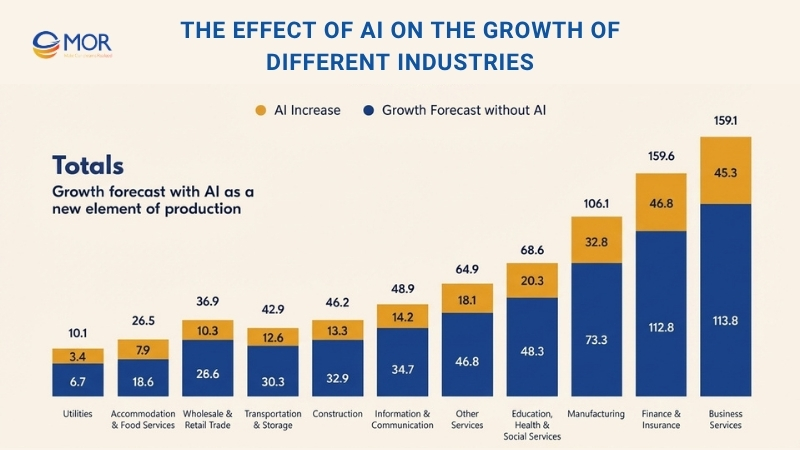
Recent research on AI use cases by industry shows that artificial intelligence is making a real difference in business growth. The examples below show how AI is applied in major sectors and what that looks like in real operations.
AI In Healthcare
For teams asking how is AI being used in the healthcare industry, the answer begins with better patient care, faster research, and smoother medical operations. As one of the leading industries that use AI and machine learning in healthcare, healthcare uses patient information sets used in machine learning to support more tailored treatment based on personal records and genetic data.
AI-based systems also make office work easier, taking on jobs like medical coding and billing so staff spend less time on manual tasks and daily processes run better.
A strong example is IBM Watson Health, which uses AI together with trends like cloud computing to study medical research. Through the collection and sorting of clinical trial details and patient records, the platform delivers guidance for more tailored treatment plans. That leads to better diagnostic precision and more personalized care suggestions.
AI In Banking And Financial Services
In banking and finance, AI is most often used to catch fraud. Machine learning models review transaction behavior in real time so banks can find and stop suspicious activity much faster. When older systems are upgraded with AI tools, financial firms build stronger protection and create a more data-focused banking environment.
A clear example is JPMorgan Chase, which uses AI in financial services for live analysis. That makes it easier to find unusual patterns quickly and helps protect the bank as well as its customers.
AI In Retail And E-commerce
In retail, multimodal AI models study shopper behavior and preferences to give more relevant suggestions, which makes the buying journey better. It also improves stock control, helping stores keep the right inventory levels and lower the risk of excess stock or empty shelves.
Smarter inventory systems built with AI help retailers predict demand with better accuracy, which limits surplus goods and keeps popular products available. Many current AI use cases in retail and machine learning in ecommerce industry start with this balance between personalization and stock planning.
A well-known case is Amazon, which uses AI to suggest products based on browsing activity and buying history. This helps the company improve the shopping experience, which then supports higher sales and stronger customer satisfaction.
AI In Manufacturing
AI in manufacturing, one major use is predictive maintenance. AI models study cloud-based data from machine sensors to estimate when equipment may fail. This early warning method cuts unexpected downtime, lowers repair spending, and improves how well equipment performs overall.
AI also works across factory lines with IoT devices, supporting quality checks, spotting defects right away, and bringing more automated performance into production. Many AI use cases in manufacturing industry begin with these practical production tasks.
A strong real-world case is Siemens, which uses artificial intelligence for predictive maintenance. With a response strategy built on data, the company lowers unplanned downtime and cuts maintenance costs.
AI In Education And Training
On education platforms, AI reviews how students learn and what they prefer, then adjusts learning material to fit each person more closely for a better study experience. The use of AI in training also creates a more responsive learning process that helps teachers and learners alike.
AI-driven analytics also support the creation of risk assessment models, helping financial institutions judge creditworthiness more accurately and tailor banking services in a more personal way.
A good example in education is Coursera, which uses AI to build personalized learning journeys. Since the platform adjusts content to each learner’s habits and preferences, it helps raise engagement and learning results.
AI In Media And Communications
In media and communications, AI helps companies read audience behavior, improve how content is delivered, and make communication more relevant. These systems review viewing habits, reading choices, search activity, and engagement signals to recommend content that fits user interests. This helps media companies keep audiences active for longer periods and raise retention on digital channels.
Entertainment AI also helps with content tagging, speech-to-text conversion, subtitle creation, ad targeting, and the filtering of harmful or unsuitable material. In communication teams, it can support sentiment tracking, chatbot service, and automatic replies, helping businesses handle large volumes of customer contact with less manual effort.
A familiar case is Netflix, which uses AI to suggest films and series based on watch history, preferences, and user behavior. This makes content easier to find, raises user satisfaction, and helps the platform deliver a more personal viewing experience.
AI In Logistics And Transportation
In logistics and transportation, route planning and live tracking are among the most common uses of AI.
Supply chain systems built with machine learning study past and live data to choose the best delivery routes. This helps lower fuel use and improve day-to-day performance. These AI-led industries depend on that speed and visibility to keep goods moving.
AI is also changing logistics through autonomous vehicles and better demand forecasting, which helps supply chain companies cut costs while making deliveries faster.
A strong example is FedEx, which uses AI for smarter parcel sorting and tracking. With AI in place, the company automates sorting work inside distribution centers, which helps packages move more smoothly.
AI In Hospitality
As sustainability becomes a bigger focus in hospitality, hotels are turning to AI to manage resources more carefully. The use of AI in hospitality industry includes smart room controls and energy systems that can improve guest stays. Businesses also use AI and machine learning in hotels to study guest preferences and shape offers around that data. Many AI use cases in hospitality industry begin with this mix of service and resource control.
There are many possible ways to apply AI in hotel operations, yet Hilton gives a strong example through smart energy management. Using sensors and AI systems, the company tracks and adjusts heating, cooling, and lighting based on room use, which helps lower energy spending.
AI In Energy And Oil And Gas
In energy, AI is used for reservoir modeling and production planning. AI systems review geological information and output data to improve reservoir management choices. This leads to stronger production results, more oil and gas recovery, and better field planning. A growing number of heavy industries that use AI now rely on these methods, and many AI use cases in oil and gas industry are built around this goal.
A strong example is ExxonMobil, which shows how AI can support reservoir improvement. With AI-based insight from production data, the company makes better decisions, which helps raise resource recovery and improve field development.
AI In The Automotive Industry
In the automotive field, AI systems process input from sensors and cameras to support functions like self-driving features and driver-assistance tools. AI inside the vehicle also improves the user experience with tools like voice control, route prediction, and richer infotainment. The use of AI in automotive industry keeps expanding in connected vehicles, and the use of AI in automobile industry is now closely linked to smarter mobility. Many businesses studying AI use cases in automotive industry are focused on these same areas.
A clear example is Tesla, which applies AI in its electric vehicles to support autonomous driving features. These AI systems study data from cameras and sensors to power tools like Autopilot and Full Self-Driving (FSD).
Key Benefits Of AI Across Industries
Across every major sector, AI is reshaping how companies operate. In healthcare, finance, retail, and manufacturing, it helps businesses work with more speed, cut wasted effort, and manage spending better. No matter which field you work in, these are some of the main ways it can help you:
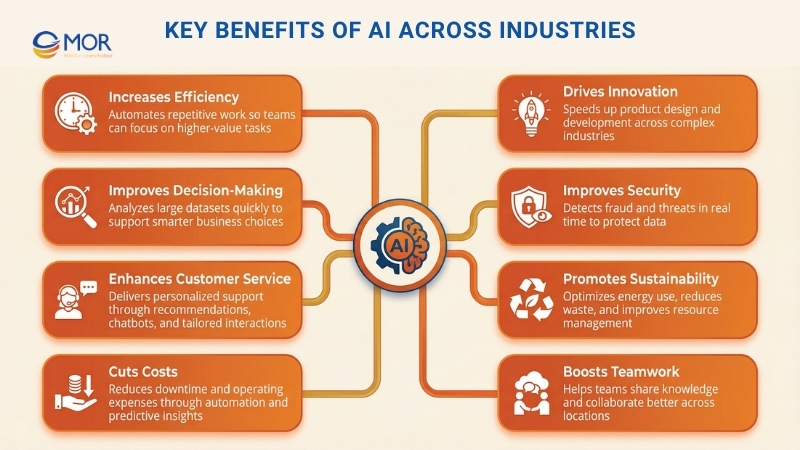
Higher Efficiency
AI takes over repeat work like scheduling, entering data, and handling simple customer requests. That gives you and your team more time for higher-value tasks, raises daily output, and helps work move forward more quickly.
Better Decision-Making
AI can review huge data sets in a short time and turn them into insights you can act on. Whether you need to estimate market changes in finance or study buying behavior in retail, it gives you useful guidance to stay prepared.
Stronger Customer Service
AI improves customer interactions through product suggestions, instant chatbot replies, and more tailored support. That often leads to more satisfied customers and deeper loyalty, especially in retail, e-commerce, and hospitality.
Lower Operating Costs
When AI handles routine work and spots likely problems like machine breakdowns in manufacturing, companies spend less on operations and avoid more downtime. That leads to stronger savings and a more stable workflow.
Faster Innovation
AI helps teams move faster in product design and creative work. In areas like healthcare and automotive, it supports the creation of better treatments or more advanced vehicles in less time, which can strengthen your market position.
Stronger Security
AI can catch fraud and identify security threats as they happen, especially in finance and cyber defense. It helps protect private data and react to danger sooner, which keeps your business and your customers more secure.
More Sustainable Operations
AI helps companies use energy better, limit waste, and manage resources with more care. This matters a lot in areas such as energy, construction, and hospitality, where sustainability now plays a bigger role in long-term planning.
Better Team Collaboration
Tools powered by AI make it easier for teams to work together, exchange knowledge, and solve issues with less friction. As a result, workplaces become easier to manage, even when people are spread across locations or departments.
>>> To understand more effectively about AI and machine learning, let's take a close look on MOR Blog now!
Common AI Adoption Challenges Across Major Industries
AI is changing many industries that use AI around the world, yet the shift also creates real difficulties. Below are some common problems businesses face when they bring AI into different sectors, along with practical ways to deal with them.
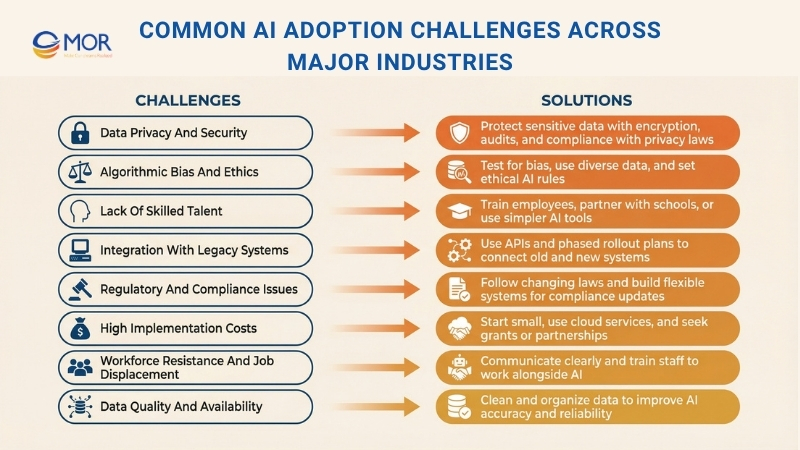
Data Privacy And Security Risks
AI systems depend on large amounts of data to perform well. In sectors like healthcare and finance, that often means private or sensitive information. Many people are concerned that their personal data could be exposed or used in the wrong way.
Solution: You can lower this risk with strong encryption and strict compliance with privacy rules like HIPAA in healthcare or GDPR for wider data protection. Routine security reviews and regular audits also help keep systems protected from outside attacks.
Bias And Ethical Concerns
AI does not always make fair choices. An example is a AI HR software trained with biased data, which may prefer one group over another. Problems like this can appear in banking, recruitment, and healthcare, even in sectors adopting AI at scale.
Solution: To reduce that risk, test your AI systems often for bias. Use information from varied sources and create clear rules for responsible AI use. That gives you a better chance of treating people fairly.
Shortage Of Skilled AI Talent
For many businesses, AI is still a new area, and there are not enough specialists to build, maintain, and improve these systems. This issue is especially serious in industries like manufacturing and logistics.
Solution: One practical step is to train your current staff in AI skills or partner with local colleges and technical schools. Some modern AI tools are also easier to use, so your team can begin without deep technical knowledge.
Legacy System Integration Problems
A lot of companies still depend on older software and infrastructure. Linking modern AI tools to those legacy systems can be difficult and costly.
Solution: Tools such as APIs and middleware can help older and newer systems exchange data more easily. It also helps to introduce AI in stages, so your operations are not disrupted all at once.
Regulatory And Compliance Pressure
Each sector follows its own rules for data use and technology deployment. Since those rules may differ by region or country, companies often struggle to apply AI in a consistent way.
Solution: Keep watching for legal updates and work closely with experts who know the rules in your sector. Your AI setup should also stay flexible enough to adjust when regulations change.
High Setup Costs
Launching AI can require a large investment, especially for smaller companies. Expenses often include software, hardware, and the cost of hiring outside or in-house experts.
Solution: A good approach is to begin with smaller projects that can prove value early. Cloud-based AI tools are often more affordable and easier to expand. Grants, partnerships, and shared programs may also help reduce the first cost.
Employee Resistance And Job Concerns
Some workers may fear that will AI replace software developers or make their tasks harder. This concern appears often in manufacturing, retail, and office settings.
Solution: Honest communication helps. Explain how AI can support employees instead of removing them, and provide training so they can gain new skills and take part in the change.
Poor Data Quality And Limited Data Access
AI only works well when the data behind it is strong. When your data is incomplete, disorganized, or inaccurate, the system can produce weak results. Banking and healthcare often face this issue.
Solution: Put good data management rules in place from the start. Use tools that clean, sort, and organize information before it enters your AI system. That helps the system produce results you can trust.
Now that you have seen the main barriers to AI use in different sectors, it is worth looking at the trends that will shape AI applications in the coming years.
Real-World Case Studies From Industries That Use AI
The earlier section looked at the main ways AI works across sectors. Now we can look more closely at four real examples that show how it is changing operations in healthcare, finance, retail, and manufacturing.
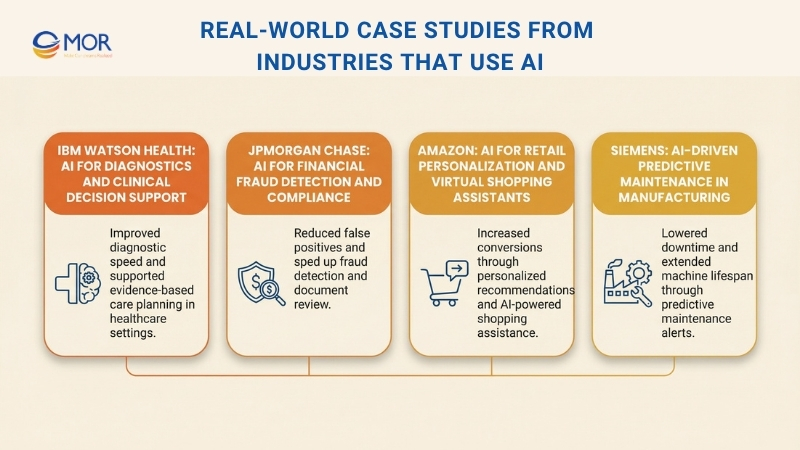
IBM Watson Health In Diagnostics And Clinical Support
IBM Watson Health shows how AI can support medical diagnosis and treatment decisions. The platform reviews large amounts of medical research, patient files, and clinical information to help doctors make evidence-based choices. It also helps radiologists read scans like MRI and CT images with strong accuracy, which cuts down manual effort.
In one major example, Watson was used across a hospital network to automate the review of breast cancer scans and patient records. The platform matched symptoms and treatment history against clinical guidance, then recommended care plans suited to each case. The outcome was a reported 30% increase in diagnostic speed and better alignment with oncology standards, which helped hospitals move patients into care faster and improve outcomes.
JPMorgan Chase In Fraud Detection And Compliance
JPMorgan Chase uses AI to fight fraud and support compliance across its global business. Its AI systems check millions of transactions each day and look for signs of money laundering, account compromise, or unauthorized activity. Since the system uses neural networks, it can adjust as fraud methods change almost in real time.
The company also built its own platform, COiN (Contract Intelligence), to automate loan document reviews and compliance checks. COiN examined 12,000 agreements in seconds, while the same work would take legal teams thousands of hours. JPMorgan said this led to a 50% drop in false positives, along with major cost savings and stronger speed and accuracy in compliance work.
Amazon In Personalization And AI Shopping Support
Amazon uses AI across its retail system, with a major focus on recommendation engines and shopping assistants that respond to user needs. After processing very large sets of behavior data, the company customizes product suggestions, search results, and promotions to create a smoother buying experience.
More recently, Amazon introduced Rufus, a generative AI assistant that replies to product questions, suggests gifts, and helps users shop in a more guided way. It combines reviews, product details, and user information to deliver personalized advice. After Rufus was launched, Amazon saw a 10% rise in click-through and conversion rates, which shows the business value of live personalized AI support.
Siemens In Predictive Maintenance
Siemens uses AI inside smart factories for predictive maintenance and to reduce production downtime. Sensor readings from machinery are sent into machine learning models that estimate wear, equipment failure, and energy loss before those problems appear. This lets the company avoid expensive stops in production.
In one rollout at a plant in Europe, Siemens connected AI with its IoT platform, MindSphere, to track more than 500 machines in real time. The AI system found patterns linked to motor overheating and warned technicians before breakdowns happened. That effort produced a 25% reduction in unplanned downtime and a 15% increase in machine lifespan, which improved output and lowered maintenance spending.
Future Trends Shaping AI Applications
AI continues to grow, and its role in businesses applying artificial intelligence will keep expanding as well. Below are several major trends that are expected to influence the next stage for industries that use AI across many sectors.
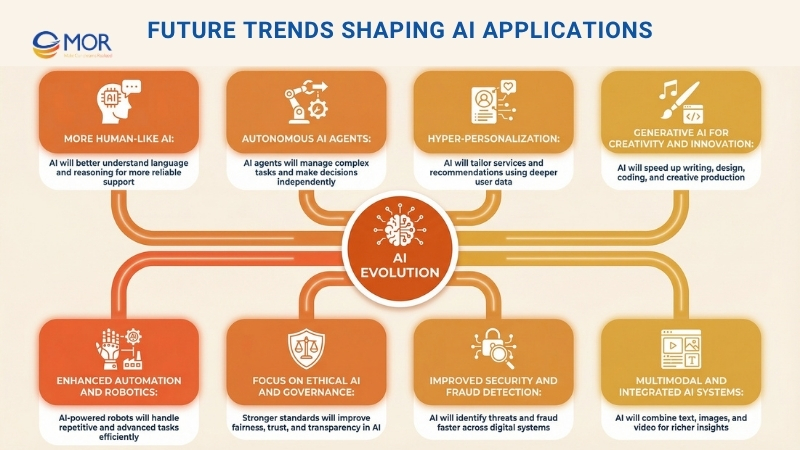
More Human-Like AI Systems
AI will keep improving in understanding, reasoning, and responding, which will make it more helpful in your business and personal life. As areas like natural language processing and coding improve, AI systems will behave in ways that feel more human and provide support you can trust more easily.
Autonomous AI Agents
AI-powered agents will move beyond simple support work. They will take on more advanced tasks like managing schedules, answering detailed questions, and making some decisions for you, which can make both daily life and work more efficient.
Hyper-Personalized Experiences
AI will use larger and richer data sets to create highly tailored experiences for users. Whether you are shopping, watching content, or using financial tools, it will shape recommendations around your preferences, which can make services feel more useful and satisfying. This same shift is also opening room for gen AI use cases in insurance industry, where insurers can tailor communication, claims support, and policy suggestions more closely to each customer.
Generative AI For Creative And Product Work
AI is set to change how content and products are created. It can already help with writing, design, video production, and software work, and that role will grow as companies look for faster ways to build and test ideas. Many teams are now exploring generative AI industry use cases to speed up creative work and product planning without losing quality.
More Automation And Smarter Robotics
Robots supported by AI will take on a larger share of repetitive and advanced work, especially in manufacturing, logistics, and healthcare. This can save time, lower costs, and raise efficiency in fields where AI is used every day.
Greater Focus On Ethical AI And Governance
As AI becomes more common, companies in industries leveraging AI technology will face stronger pressure to follow ethical standards and be more transparent. Businesses will need to deal seriously with bias, privacy, and fairness so that AI creates value in a way people can trust and use with confidence.
Smarter Security And Fraud Prevention
AI will play a larger role in protecting your information by spotting cyber threats and stopping fraud as it happens. That will make digital systems safer and help businesses respond more quickly to new forms of risk.
Multimodal And Connected AI Systems
The next generation of AI will bring together text, images, video, and other data types to produce deeper insight and better decisions. This will strengthen AI applications in areas like healthcare, public services, and entertainment, making digital experiences more useful in everyday life.
As these trends continue to develop, MOR Software can help you prepare for what comes next.
Why Is MOR Software Your Perfect AI Partner In Major Industries?
MOR Software is the right outsourcing AI development partner because we do more than build models. We turn AI into practical tools that solve real problems in daily operations. That matters in major industries, where speed, accuracy, and system fit are just as important as innovation.
We have worked on AI-driven and data-heavy solutions across healthcare, media, construction, fitness, and enterprise operations. Our teams have built healthcare platforms, AI-based spam detection systems, digital news apps, construction management apps, and smart monitoring solutions. This gives us a solid view of how AI must work inside real business environments, not just in isolated demos.
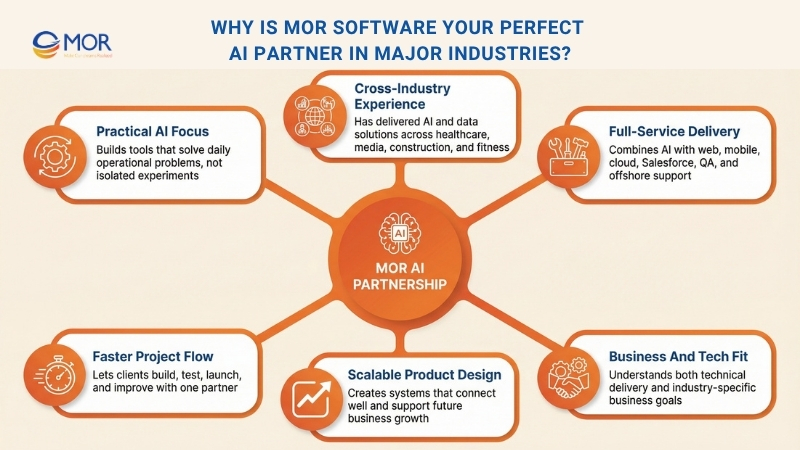
Another strength is our full-service delivery model. We combine AI development with web, mobile, cloud, Salesforce, QA, and offshore development support. That means clients can build, test, launch, and improve one solution with one partner. It keeps projects simpler and helps teams move faster.
We also focus on long-term value. Our offshore AI developers build scalable products that connect well with existing systems and support future growth. With Agile delivery, strong technical talent, and experience across 10+ countries, we know how to turn complex ideas into reliable products.
For companies in major industries, MOR Software is a partner that understands both the technology and the business goal behind it.
Conclusion
The rise of industries that use AI is no longer a future story. It is already changing how businesses plan, serve customers, cut costs, and build new products. From healthcare to manufacturing, the strongest results come from practical use, clear goals, and the right delivery partner. If you are planning your next AI move, MOR Software is ready to help you turn ideas into working solutions. Contact us today.
MOR SOFTWARE
Frequently Asked Questions (FAQs)
What industries use AI the most today?
AI is widely used in healthcare, finance, retail, manufacturing, logistics, education, automotive, energy, and hospitality. These sectors rely on AI to improve operations, speed up decisions, and handle large amounts of data.
Why are so many industries adopting AI now?
AI helps businesses work faster and make better decisions. It can process data at a scale humans cannot match. As tools become easier to use and more affordable, more industries are putting AI into daily operations.
How do industries that use AI improve efficiency?
AI automates repetitive tasks like data entry, scheduling, and monitoring systems. It also reduces errors and helps teams focus on higher-value work, which leads to faster output and smoother workflows.
Which industry benefits the most from AI?
Healthcare and finance often see strong results because they deal with large, complex data. Still, most industries can benefit if AI is applied to the right use case.
How is AI used in the manufacturing industry?
AI is used in manufacturing for predictive maintenance, quality inspection, and production optimization. It helps detect machine failures before they happen, uses computer vision to identify defects, and improves supply chain planning. This leads to reduced downtime, lower costs, and more consistent product quality.
How is AI being used in the healthcare industry?
AI supports healthcare through medical imaging analysis, patient data processing, and personalized treatment planning. It helps doctors detect diseases earlier, assists in drug discovery, and improves hospital operations such as scheduling and resource allocation. This results in faster diagnoses and better patient outcomes.
Is AI only useful for large enterprises?
No. Small and mid-sized businesses also use AI through cloud tools and ready-made platforms. Many AI solutions today are designed to be accessible without large budgets.
What are common use cases across industries that use AI?
Typical use cases include data analysis, demand forecasting, fraud detection, customer personalization, and predictive maintenance. These apply across many sectors.
What challenges do industries face when using AI?
Common issues include poor data quality, lack of skilled talent, high initial costs, and difficulty connecting AI with existing systems. These can slow down adoption if not handled early.
How does AI help improve customer experience?
AI analyzes customer behavior and preferences. It can recommend products, provide instant support through chatbots, and personalize content, which makes interactions more relevant.
Will AI replace jobs in these industries?
AI changes how work is done rather than replacing all jobs. It handles routine tasks, while people focus on decision-making, creativity, and complex problem-solving.
What is the future of industries that use AI?
AI will continue to expand into more business areas. Expect more automation, smarter decision systems, and tools that combine text, images, and data to support better outcomes.
Share


Make Our-Dreams Realized


© 2023 . MOR Software. All Rights Reserved
Sitemap
Privacy Policy
Terms of Use

Rate this article
0
over 5.0 based on 0 reviews
Your rating on this news:
Name
*Email
*Write your comment
*Send your comment
1