


40 Best AI Tools for HR Teams (Updated List for 2026)
HR teams face growing pressure to hire faster, stay compliant, and support people better, all at the same time. Finding the best AI tools for HR often feels overwhelming, with too many platforms and unclear value. In this guide, MOR Software will break down the most practical options for 2026, helping you choose AI HR software that actually fits real HR needs and challenges.
What Is AI HR Software?
AI HR software refers to AI based HR software designed to automate and support a wide range of human resources activities through artificial intelligence. HR professionals, recruiters, and managers use these platforms to work more efficiently across hiring, employee administration, and workforce data analysis.
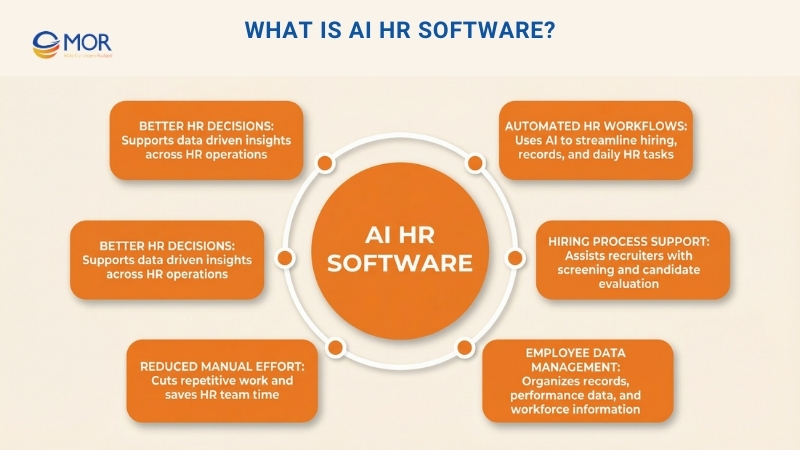
Common capabilities include automating hiring workflows, organizing employee records, and monitoring performance, which helps simplify daily processes and cut down manual effort. In practice, AI HRM software development saves time and supports better decisions across HR operations, making it a strong foundation when teams evaluate the best AI tool for HR needs.
Best AI Tools For HR Teams In 2026
AI continues to reshape how HR teams work, making daily processes faster, more reliable, and easier to control. These platforms support task automation, improve employee experiences, and help teams reach stronger business results across hiring, engagement, and performance management.
Best AI Tools For HR Hiring And Talent Acquisition
Hiring teams face pressure to review more candidates in less time while still making fair and accurate decisions. AI hiring tools support faster screening, clearer shortlists, and more consistent evaluation across growing applicant pools.
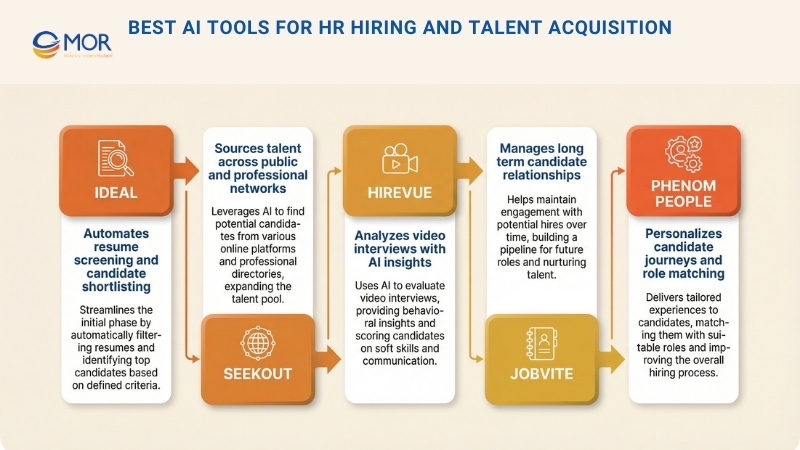
1. Ideal – AI Candidate Screening And Shortlisting
Ideal is an AI driven hiring platform that automates resume screening and matches candidates to open positions based on skills, experience, and job requirements. It uses machine learning to review resumes, rank applicants, and deliver a shortlist of top talent, helping HR teams reduce manual screening time and improve hiring consistency.
- Key Features: Automated resume analysis, candidate-job matching, and shortlist generation.
- Price: Custom pricing available upon request.
2. SeekOut – AI Powered Talent Sourcing
SeekOut applies AI to scan public data sources and professional networks, uncovering candidates who may not appear in standard searches. Its algorithms review skills and work history to narrow results and surface highly relevant talent. This gives human resource development teams access to a broader and more qualified candidate pool in less time.
- Key Features: Diversity focused search filters, a clear talent discovery dashboard, and live skill insights.
- Price: Visit the pricing page.
3. HireVue – Video Interviewing With AI Insights
HireVue uses AI to review video interviews through analysis of speech patterns, tone, and word choice to measure alignment with job expectations. This supports HR teams in assessing candidates more consistently, with attention to both technical ability and behavioral traits.
- Key Features: On demand video interviews, AI based evaluation insights, and adjustable scoring criteria.
- Starting Price: $35K;
4. Jobvite – Candidate Relationship Management Platform
Jobvite provides an AI supported CRM that helps teams stay connected with high potential candidates after interviews end.
The platform tracks candidates over time and delivers insights on who to engage and when, helping teams avoid losing strong talent and keeping everyone informed about hiring progress and status updates.
- Key Features: Candidate pipeline tracking, automated follow up campaigns, and hiring analytics.
- Price: Starting at $400.00 per month; custom pricing available on request.
5. Phenom People – Candidate Experience Personalization
Phenom People applies AI automation to tailor the candidate journey, guiding applicants through each step and suggesting suitable roles based on skills and interests. This improves the hiring experience and supports HR teams in presenting a consistent and attractive employer brand.
- Key Features: AI chatbot development solutions for candidates, role recommendations, and live application analytics.
- Price: Available on request.
Best AI Tools For HR Employee Engagement
Employee engagement tools powered by AI help HR teams listen better and respond faster. These solutions support daily feedback, recognition, and internal communication, which plays a key role when teams compare the best AI tools for HR professionals focused on people experience.
6. Peoplebox.ai – Feedback Automation And Pulse Surveys
Peoplebox.ai automates employee feedback through survey creation, reminder scheduling, and insight generation. It simplifies engagement and pulse surveys, allowing teams to spend more time strengthening workplace culture.
- Key Features: Automated and recurring surveys, anonymous messaging, real time insights, chat based survey bot, automated reminders, Slack and Teams integration, ready to use survey templates, custom questions and drivers.
- Price: The starting price is $7 per user per month; custom pricing is available on request.
7. Bonusly – Recognition And Rewards With AI
Bonusly uses AI as a service to monitor recognition activity and highlight commonly praised behaviors and top contributors.
Through pattern analysis, the system delivers clear insights into team dynamics and supports HR teams in adjusting recognition programs. It also suggests rewards that match personal preferences and recognition history.
- Key Features: AI powered recognition tracking, tailored reward suggestions, and practical team insights.
- Price: Three pricing tiers are available, Appreciate at $2 per seat per month billed yearly, Connect at $5 per seat per month billed yearly, and Achieve at $7 per seat per month billed yearly.
8. Helpjuice – Internal Knowledge Sharing And Documentation
Helpjuice is a well known knowledge base platform that supports both internal and external documentation management. It supports employee engagement through easier content creation and information sharing, making internal communication smoother.
Built in feedback and collaboration features further raise engagement levels and support teamwork across daily workflows.
- Key Features: Rich text editor with collaboration and version control, multilingual support with AI translation, AI enterprise search and chatbot help, unlimited articles and categories, content management tools, and custom branding.
- Pricing: Helpjuice plans start at $249 per month.
Best AI Tools For HR Performance Management
AI driven performance tools help HR teams track progress, support managers, and keep reviews consistent. These platforms play an important role when teams evaluate the best AI tools for human resources that support fair feedback and clear goal alignment.
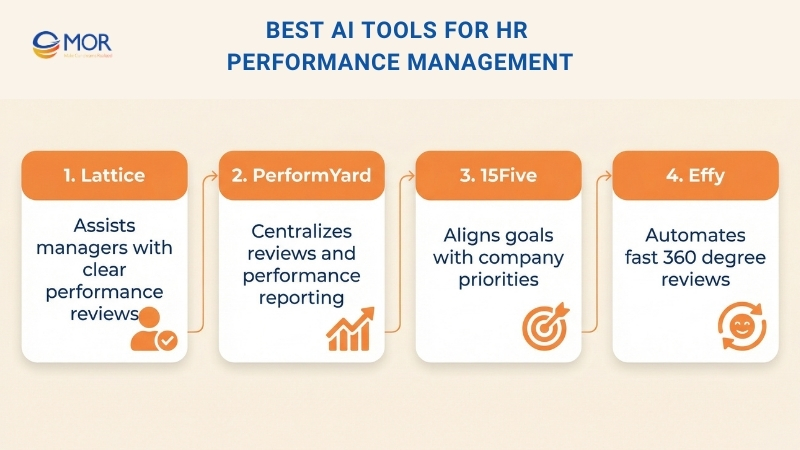
9. Lattice – Performance Reviews With AI Assistance
Lattice applies AI to improve the performance review experience by supporting managers as they write clear and useful feedback.
Its Writing Assist feature recommends language changes that keep feedback direct, inclusive, and effective. The platform simplifies reviews through rewording suggestions, helping managers deliver thoughtful and well structured evaluations.
- Key Features: Writing Assist to improve review clarity, bias reduction support, and feedback trend detection.
- Price: $11 per person per month; visit the pricing page for full details.
10. PerformYard – Performance Feedback And Reporting
PerformYard offers flexible, AI enhanced performance management software that helps HR teams streamline reviews, feedback, goal tracking, and reporting. The platform brings everything into a single interface so managers can easily run consistent performance cycles and gather feedback across teams.
- Key Features: Customizable review workflows, continuous feedback loops, performance analytics, and employee engagement tracking.
- Price: Custom pricing available on request.
11. 15Five – Goal Alignment And Progress Tracking
15Five uses AI to connect individual goals with company priorities, applying ml models to review progress and suggest goal updates.
The system reviews performance data on an ongoing basis and delivers insights that help employees stay aligned with strategic objectives while tracking progress in a clear way.
- Key Features: AI supported goal alignment, progress monitoring, and predictive insights on goal achievement.
- Price: Starts at $7.50 per user per month and goes up to $16 per user per month when billed annually.
12. Effy – AI Supported 360 Degree Reviews
Effy AI allows teams to launch a first 360 degree review very quickly, often within 60 seconds.
The platform manages questionnaire setup, participant matching, progress tracking, and notifications. It also summarizes responses and generates detailed AI based review reports automatically.
- Key Features: Slack integration, support for major project milestones, formal performance reviews, promotion or role change reviews, and probation period assessments.
- Price: Free.
Best AI Tools For HR Growth And Succession Planning
AI powered growth and succession tools help HR teams prepare employees for future roles and leadership paths. These platforms support long term talent planning, which matters when teams assess AI and machine learning in HR tied to development and internal mobility.
13. Cornerstone OnDemand – Skill Gap Identification
Cornerstone OnDemand uses AI to evaluate employee skills and highlight gaps that may slow career growth.
The platform reviews performance data, feedback, and learning behavior to suggest tailored development plans, helping employees build the skills required for future positions. HR teams can track skill progress over time and support structured talent development.
- Key Features: AI driven skill gap analysis, personalized learning recommendations, and employee growth tracking.
- Price: Starts at USD 6 per user per month.
14. Kona – AI Leadership Coaching In Slack
Kona’s AI Leadership Coach provides personalized guidance for remote managers directly inside Slack. It connects with existing documents, training materials, and tools to deliver advice aligned with company values.
Managers can share real workplace challenges with Kona and receive practical guidance within minutes, without leaving Slack or booking a meeting.
- Key Features: Built in integrations, Slack application, and leadership support tools.
- Price: $49 per user per month.
15. Plum.io – Leadership Potential Assessment
Plum.io applies AI to evaluate leadership potential through analysis of behavior patterns, cognitive strengths, and historical performance data.
The system highlights high potential employees and reviews their readiness for advanced roles. With clearer insight into leadership capability, HR teams can design focused development plans and maintain a reliable leadership pipeline.
- Key Features: AI based leadership potential analysis, customized leadership development plans, and growth path mapping.
- Price: Custom pricing available on request.
AI Tools For Employee Wellness And Mental Health Support
AI focused wellness tools help HR teams support mental health in a more consistent and private way. These platforms give employees access to care while helping HR teams understand well being trends across the workforce.
16. Woebot – Mental Health Chatbot
Woebot uses AI to deliver mental health support through a conversational chatbot. The system is trained to detect emotional signals and suggest suitable cognitive behavioral therapy techniques, helping employees manage stress, anxiety, and related challenges.
It provides private, on demand support, which makes mental health resources easier to reach and helps reduce stigma at work.
- Key Features: AI powered chatbot, cognitive behavioral therapy techniques, and 24 hour confidential access.
- Price: Custom pricing available on request.
17. LifeWorks – Wellness Monitoring And Insights
LifeWorks applies AI to monitor employee well being on an ongoing basis through analysis of mental, physical, and emotional health indicators.
Its machine learning algorithm detect patterns and trends at both individual and team levels, giving HR teams clear insights to improve wellness programs. The platform supports early action before issues grow into larger concerns.
- Key Features: AI driven wellness data analysis, live well being insights, and proactive wellness support.
- Price: Custom pricing available on request.
18. Thrive Global – Burnout Risk Detection
Thrive Global uses AI automation services to review employee behavior, including work habits and emotional health signals, to identify early burnout risks.
The system flags warning signs like ongoing stress and heavy workloads, allowing HR teams to step in with tailored wellness actions before burnout sets in. This supports long term productivity and mental well being.
- Key Features: AI based burnout detection, real time risk monitoring, and personalized wellness recommendations.
- Price: Custom pricing available on request.
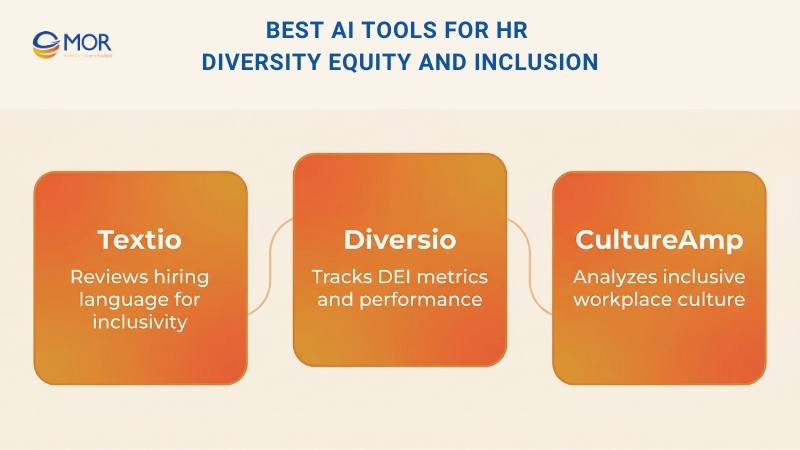
Best AI Tools For HR Diversity, Equity, And Inclusion
AI driven DEI tools help HR teams create fairer hiring practices and healthier workplace cultures. These platforms support consistent measurement and improvement across diversity and inclusion efforts.
19. Textio – Inclusive Hiring Language Analysis
Textio applies AI to review job descriptions and flag wording that may unintentionally discourage candidates based on gender, background, or other attributes.
The system recommends more inclusive phrasing, helping job posts reach a wider range of talent. With this support, HR teams can reduce bias in hiring language and build a more balanced recruitment process that appeals to qualified candidates from diverse groups.
- Key Features: AI powered language review, bias identification, and inclusive job description suggestions.
- Price: Custom pricing available on request.
20. Diversio – DEI Metrics And Reporting
Diversio uses AI to monitor and measure DEI performance in real time, giving HR teams data driven visibility into inclusion efforts.
The platform reviews employee demographics, engagement levels, and related indicators to uncover gaps and highlight areas that need attention. This supports steady progress toward DEI goals through clear data that guides policy and practice updates.
- Key Features: AI driven DEI tracking, live performance analytics, and practical insights for DEI planning.
- Price: Custom pricing available on request.
21. CultureAmp – Inclusive Culture Analytics
CultureAmp uses AI analytics to assess how inclusive an organization’s culture feels by reviewing employee feedback, behaviors, and engagement across teams.
The system highlights areas where inclusion can improve, helping HR teams apply focused actions that support a more welcoming workplace. Tracking diverse employee experiences helps maintain fairness and long term cultural support.
- Key Features: AI driven culture analysis, inclusion focused insights, and employee experience monitoring.
- Price: Custom pricing available on request.
Best AI Tools For HR People Analytics
AI based people analytics tools help HR teams understand workforce data at a deeper level. These platforms support long term planning and allow teams to act on trends instead of reacting too late.
22. Visier – Predictive Workforce Analytics
Visier applies AI to deliver advanced predictive analytics that help HR teams spot patterns and anticipate future workforce needs. Through analysis of historical employee data, its models can forecast talent shortages or excess capacity, supporting more strategic planning.
This data focused approach supports confident workforce decisions and helps HR teams stay ready for upcoming challenges like skill gaps or shifting business demands.
- Key Features: AI driven predictive analytics, workforce planning insights, trend analysis, and talent forecasting.
- Price: Custom pricing available on request.
23. PredictiveHR – Retention And Turnover Analysis
PredictiveHR uses AI to forecast employee turnover through analysis of behavior patterns, engagement levels, and performance data. Its models highlight employees who may be at higher risk of leaving and explain the factors behind those risks.
With these insights, HR teams can take early action through targeted retention plans, helping limit turnover costs and improve employee satisfaction and stability.
- Key Features: AI based turnover risk forecasting, retention strategy guidance, and employee behavior analysis.
- Price: Custom pricing available on request.
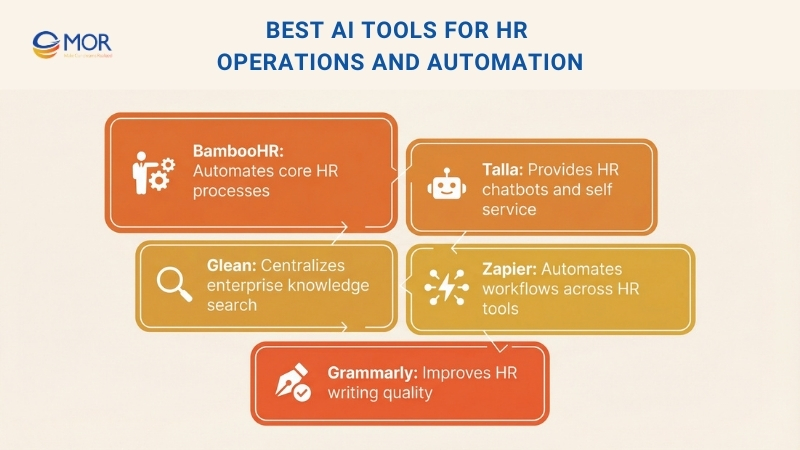
Best AI Tools For HR Operations And Automation
AI powered operations tools help HR teams manage daily tasks with less manual effort and fewer delays. These platforms support smoother workflows and consistent service delivery across core HR processes.
24. BambooHR – HR Process Automation
BambooHR applies AI to automate many routine HR activities, which improves efficiency and lowers manual workload. The platform simplifies employee record handling, benefits tracking, and other repeat tasks, giving HR teams more time to focus on strategic priorities.
- Key Features: AI automation for employee records, automated payroll system support, benefits administration, and HR workflows.
- Price: Custom pricing available on request.
25. Talla – HR Chatbots And Self Service
Talla provides an AI powered HR assistant built to manage employee questions and automate HR service requests. It answers common questions and handles routine tasks, which reduces repetitive work and improves access to HR support for employees.
- Key Features: AI chatbots for FAQs, employee self service automation, and HR task coordination.
- Price: Custom pricing available on request.
26. Glean – Enterprise Knowledge Search
Glean is an AI driven work assistant that centralizes company knowledge and adapts results to each user. It helps employees and HR teams reach accurate and current information quickly.
Using natural language processing, the platform delivers relevant answers and insights, which shortens search time and improves access to internal knowledge.
- Key Features: AI powered enterprise knowledge management, personalized insights, and live information access.
- Price: Custom pricing available on request.
27. Zapier – Workflow Automation Across Tools
Zapier uses AI to automate workflows and cut down manual work like data entry, file handling, and system updates. Through AI powered Zaps, HR teams can manage repeat tasks more smoothly and lower the risk of daily errors.
- Key Features: AI based workflow automation, cross tool task integration, and flexible automation setup.
- Price: Starts at $19.99 per month; full pricing details are available on the website.
28. Grammarly – Writing Quality For HR Communication
Grammarly uses AI to improve written communication across emails, job descriptions, and HR documents. The platform reviews tone, grammar, and clarity to help HR teams communicate more clearly and professionally with candidates and employees.
- Key Features: AI driven grammar and tone checks, writing style guidance, and clarity support for HR content.
- Price: Starts at $12 per month; business plans are available on the website.
>>> Many teams today wonder will AI replace software developers as AI tools take on more coding tasks and shift how products are built. So what is your opinion?
AI Tools For HR Conversational Assistance
AI driven conversational tools help HR teams handle questions faster and keep communication clear. These solutions reduce repetitive work and support better responses across daily HR interactions.
29. ChatGPT – HR Content And Query Support
ChatGPT supports HR teams with routine tasks like drafting job descriptions, writing emails, and responding to employee questions. The system produces clear and relevant content while answering repeated HR inquiries, which improves communication flow and frees HR staff to focus on higher value work.
- Key Features: AI generated content for job descriptions, emails, and employee messages, conversational query handling.
- Price: Custom pricing available on request.
30. Calendly – Scheduling And Interview Coordination
Calendly applies AI to simplify interview and meeting scheduling through automatic time suggestions. With calendar and system integrations, it lowers scheduling conflicts, improves efficiency, and helps both HR teams and candidates find suitable time slots with less effort.
- Key Features: AI powered scheduling automation, calendar integrations, and smart time suggestions.
- Price: Free basic plan, with paid plans starting at $8 per month.
AI Tools For HR Task And Project Management
AI supported task and project tools help HR teams stay organized and aligned. These platforms improve visibility across work items and support smoother collaboration.
31. Trello – Task And Workflow Management
Trello uses AI to support project management for HR teams through task organization, assignment tracking, and workflow automation. AI based automation improves collaboration and helps teams stay productive while managing multiple HR initiatives.
- Key Features: AI enhanced project tracking, task automation, workflow views, and team collaboration tools.
- Price: Free basic plan, with paid plans starting at $5 per month.
32. Zoom AI Companion
Zoom AI Companion is included with Zoom paid plans and acts as an AI assistant for meetings and chats. It creates summaries, prepares meeting recaps, and helps draft chat responses based on tone and length preferences, saving time across daily work.
- Key Features: Meeting summaries, meeting questions, smart recording, thread summaries, chat drafting, sentence completion, and email drafting for events.
- Price: Zoom plans start at $13.32 per user per month when billed annually or $15.99 per user per month when billed monthly.
Best AI Tools For HR Compensation And Benefits
AI powered compensation and benefits tools help HR teams make pay decisions that feel fair and competitive. These platforms support clearer benchmarking and more personalized benefit planning across the workforce.
33. PayScale – Salary Benchmarking And Analysis
PayScale uses AI to deliver live salary benchmarking and compensation analysis, helping HR teams maintain balanced and competitive pay structures.
The platform reviews large volumes of pay data across industries, locations, and roles, allowing organizations to adjust compensation based on current market signals and support fair pay practices. This AI supported approach helps companies remain competitive while attracting and keeping skilled employees.
- Key Features: Real time salary data analysis, compensation benchmarking, and market based recommendations.
- Price: Custom pricing available on request.
34. Gusto – Personalized Benefits Management
Gusto applies AI agent frameworks to tailor employee benefits around individual preferences and life stages.
The system reviews employee data to suggest suitable benefit options, helping HR teams deliver a more personal benefits experience. This improves satisfaction and engagement by aligning benefits with real employee needs.
- Key Features: Personalized benefit suggestions, employee data analysis, and benefits optimization tools.
- Price: Starts at $40 per month per employee, with flexible pricing options available for larger teams.
AI Tools For HR Onboarding And Offboarding
AI driven onboarding and offboarding tools help HR teams guide employees through key transitions with more consistency. These platforms improve first impressions for new hires and create clearer exit processes for departing staff.
35. Enboarder – Remote Onboarding Automation
Enboarder is an AI powered platform that helps teams welcome new employees in a simple and engaging way. It creates interactive activities that help new hires feel included from day one and supports managers in building a positive first experience.
This approach has helped companies see a 20 percent annual drop in early turnover and a 50 percent decrease in offer acceptances that do not lead to a start date. Teams have also reported more than a 65 percent increase in new hire productivity.
- Key Features: Admin dashboard, workflow builder, reporting tools, communication features, event scheduling, mobile video support, people connector, and multi language support.
- Price: Custom pricing available on request.
36. Offboard – Exit And Retention Data Analysis
Offboard uses AI to manage employee exits and monitor retention related data, helping HR teams spot trends linked to turnover.
The platform reviews exit interviews, survey feedback, and related data to identify reasons behind departures and suggest actions that support retention. This supports smooth offboarding while allowing HR teams to address retention risks early.
- Key Features: Exit interview analysis, retention insights, and automated offboarding workflows.
- Price: Custom pricing available on request.
AI Tools For HR Compliance And Risk Control
AI powered compliance tools help HR teams keep up with changing regulations and lower legal exposure. These platforms support consistent monitoring and early risk detection across HR policies and processes.
37. XpertHR – Compliance Monitoring And Alerts
XpertHR uses AI to automate HR compliance checks and help organizations stay aligned with labor laws and regulations, making it one of the best AI automation tools for compliance monitoring in HR. The platform tracks legislative updates and confirms that HR practices comply with federal, state, and local requirements. This reduces legal risk and allows HR teams to act early on compliance issues, protecting the organization from potential penalties.
- Key Features: Compliance tracking, real time legal alerts, and automated compliance reviews.
- Price: Custom pricing available on request.
38. Compliance.ai – Regulatory Risk Tracking
Compliance.ai applies AI to monitor regulatory changes and identify risks tied to HR practices. This positions it among the best AI tools for compliance monitoring in HR for organizations operating in regulated environments. Through analysis of thousands of legal and regulatory sources, it delivers real time updates on changes that may affect business operations.
Its AI driven insights help limit compliance risk and support alignment with new regulations, reducing the chance of legal exposure.
- Key Features: AI based risk detection, live regulatory updates, and compliance monitoring tools.
- Price: Custom pricing available on request.
Best AI Tools For HR Remote And Hybrid Work
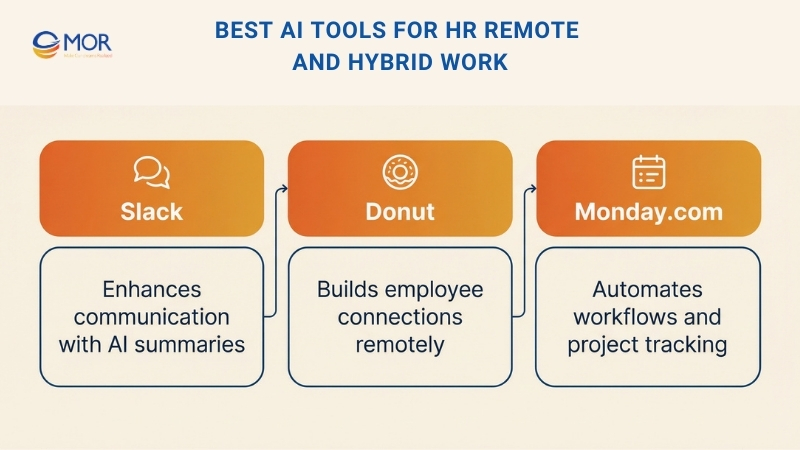
AI powered tools for remote and hybrid teams help HR maintain communication, coordination, and engagement across locations. These platforms support connection, clarity, and workflow visibility when teams no longer share the same office.
39. Slack – Communication And Collaboration AI
Slack, widely used for remote team communication, applies AI to provide personalized search results, channel summaries, and thread recaps. This helps surface important information faster and cuts down the time spent scanning long message histories.
- Key Features: Personalized search, conversation summaries, daily recaps of missed messages.
- Price: Slack Pro costs $7.25 per person per month when billed yearly or $8.75 per person per month when billed monthly. Slack Business+ costs $12.50 per person per month when billed yearly or $15 per person per month when billed monthly.
40. Donut – Employee Connection And Engagement
Donut uses AI to support relationship building in remote and hybrid teams. The platform pairs employees for virtual coffee chats or team activities based on shared interests or roles.
These informal interactions support social bonding, strengthen team relationships, and help employees feel more connected to colleagues and the organization, which improves engagement and morale.
- Key Features: Automated employee matching, virtual coffee chat scheduling, team activities, and engagement analytics.
- Price: Starts at $5 per user per month.
41. Monday.com – Custom Workflow Automation
Monday.com uses AI to automate routine work, improve communication, and deliver visibility into project progress. Its AI features help HR teams automate onboarding tasks, employee check ins, and reporting while keeping work organized without constant oversight.
- Key Features: Workflow automation, project tracking, reporting insights, and task prioritization.
- Price: Starts at $8 per user per month.
Quick Comparison Of Best AI Tools For HR In 2026
This overview gives HR teams a fast way to compare platforms by use case and pricing range. It helps narrow options before taking a deeper look at the tools that match specific business needs.
AI Tool | Best For | Pricing |
Hiring & Talent Acquisition |
|
|
Ideal | Small to mid market HR | Custom |
SeekOut | Enterprise HR | Custom |
HireVue | Enterprise HR | Custom |
Jobvite | SMBs to mid market HR | Custom |
Phenom People | Enterprise HR | Custom |
Employee Engagement |
|
|
PerformYard | SMBs, mid market | Custom |
Bonusly | SMBs, mid market | Starts at $2 per user |
Helpjuice | Mid market, enterprise | Starts at $249 per month |
Performance Management |
|
|
Lattice | SMBs, mid market | Starts at $11 per user |
Peoplebox.ai | SMBs, mid market | Custom |
15Five | SMBs, mid market | Starts at $7 per user |
Effy | SMBs, mid market | Custom |
Employee Growth And Succession Planning |
|
|
Cornerstone OnDemand | Enterprise HR | Custom |
Kona | Mid market, large HR | Custom |
Plum | Mid market, large HR | Custom |
Woebot | All companies | Free and paid |
LifeWorks | Enterprise HR | Custom |
Thrive Global | All companies | Custom |
Diversity, Equity, And Inclusion (DEI) |
|
|
Textio | Enterprise HR | Custom |
Diversio | Enterprise HR | Custom |
CultureAmp | Mid market to large HR | Custom |
Visier | Enterprise HR | Custom |
PredictiveHR | Mid market to large HR | Custom |
BambooHR | SMBs, mid market | Starts at $99 per month |
Talla | SMBs, mid market | Custom |
Glean | Mid market, large HR | Custom |
Zapier | All companies | Free and paid |
Grammarly | All companies | Free and paid |
Conversational Assistance |
|
|
ChatGPT | All companies | Free and paid |
Calendly | All companies | Free and paid |
Task And Project Management |
|
|
Trello | SMBs, mid market | Free and paid |
Zoom Companion | All companies | Custom |
Compensation And Benefits Management |
|
|
PayScale | Mid market to large HR | Custom |
Gusto | SMBs to mid market | Starts at $39 per month |
Onboarding And Offboarding Automation |
|
|
Enboarder | SMBs to large HR | Custom |
Offboard | Mid market to large HR | Custom |
Compliance And Risk Management |
|
|
XpertHR | Enterprise HR | Custom |
Compliance.ai | Enterprise HR | Custom |
Remote Work And Hybrid Enablement |
|
|
Slack | All companies | Free and paid |
Donut | All companies | Custom |
Monday.com | All companies | Starts at $10 per user |
Key Benefits Of Using AI In HR
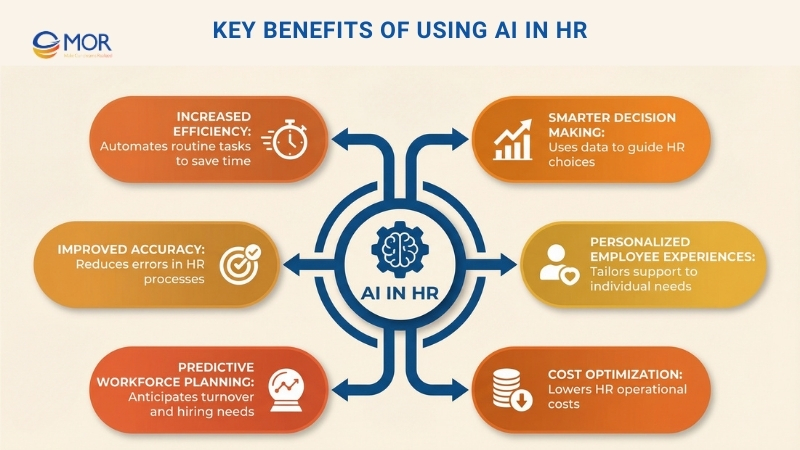
AI tools are reshaping HR operations through faster, more accurate, and more consistent processes, allowing teams to spend more time on people focused work. These improvements are a major reason many organizations now rely on AI HR software and AI based HR software across core HR functions.
Increased Efficiency
AI powered tools handle many routine tasks, including data entry, interview scheduling, and early stage candidate screening.
This shift allows HR professionals to focus on higher value and more personalized responsibilities within their roles.
A CareerBuilder survey reported strong satisfaction among employers that adopted automation for hiring and management. Around 93% said automation helped them save time and work more efficiently.
In the US, HR automation also supports compliance management and labor law tracking, which allows AI for HR professionals to spend less time on administration and more time on meaningful, value adding work.
Smarter Decision Making
With support from AI driven analytics, HR teams can base decisions on clear and reliable data.
AI powered platforms reveal patterns and trends that are often missed through manual review.
Bernard Marr, author of Data-Driven HR: How to Use AI, Analytics and Data to Drive Performance, explains in a Forbes article that HR teams now rely on data and AI to give leaders timely insights, create people focused reports, and keep decision makers informed about real time workforce activity.
He also describes how Juniper Networks uses LinkedIn data to understand where high performing employees come from and where they move after leaving. This approach helps the company map career paths and make better choices around hiring and retention.
In the US, AI HR software also supports DEI initiatives through detection of unconscious bias in hiring, which helps create fairer and more inclusive recruitment outcomes.
Improved Accuracy
AI powered tools lower the risk of human error in areas like payroll processing, benefits administration, and compliance reporting.
Mistakes in manual data entry occur in roughly 4% of cases, which equals about 400 errors for every 10,000 entries, especially when information is entered once without verification. This number does not include errors introduced during analysis, reporting, or data storage.
Poor data quality carries a major cost, with the United States losing close to $3.1 trillion each year as a result.
Automated processes help limit errors caused by oversight, repetition, or fatigue.
AI HR software also supports ongoing compliance with labor regulations that change over time. In the US, platforms that monitor regulatory updates help HR teams align with standards under laws like the Fair Labor Standards Act and the Affordable Care Act, which lowers the risk of expensive penalties.
Personalized Employee Experiences
AI can review individual employee data to deliver tailored suggestions for career growth, learning plans, and wellness support.
Recruitment engagement rates can double when AI creates personalized messages. This level of personalization helps build a more engaged and satisfied workforce.
In the US, AI powered solutions allow HR teams to adapt development programs to individual employee needs, which improves satisfaction and retention rates through focused learning and clearer career growth paths.
Predictive Workforce Planning
AI tools can anticipate future patterns related to employee turnover, hiring demand, and the success of HR policies. One well known example shows that IBM’s AI systems can reportedly identify employees who may leave with up to 95% accuracy.
This level of forecasting helps organizations plan ahead and respond to risks before they turn into larger problems.
In the US, AI driven HR platforms also support turnover prediction through analysis of engagement levels, pay satisfaction, and workplace culture, giving HR teams time to act early and reduce employee attrition.
Cost Optimization
Through automation of routine tasks and smoother HR operations, AI tools help lower overall operating costs.
A case study from Gravity Flow shows that a medical company saved $4,000 per month through automated HR tools, highlighting the financial value of automation.
In the US, AI powered HR platforms also shorten hiring and onboarding cycles, which has helped some organizations save up to $200,000 per year through fewer manual hours and faster employee onboarding.
How To Select The Best AI Tools For HR Teams?
Choosing the right solution takes more than comparing feature lists. You need a clear view of your needs and how the platform fits into daily HR work before making a decision.
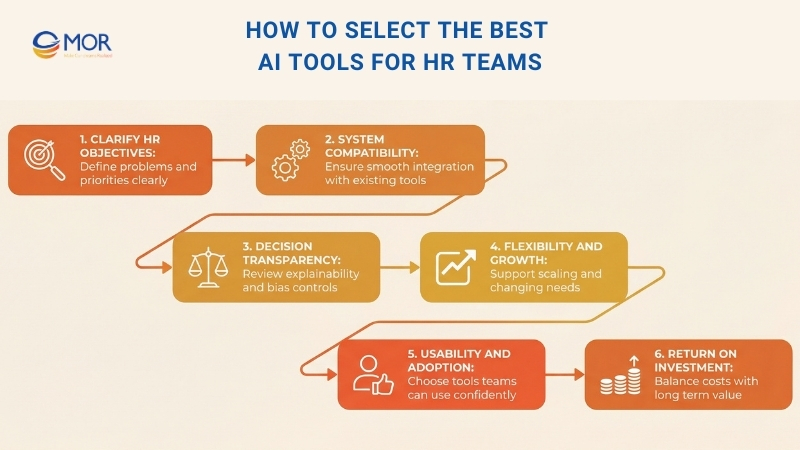
- Clarify your HR challenges and objectives: Before you choose a platform, clearly identify the problems you want to solve. This may include improving hiring speed, strengthening employee retention, or gaining better workforce insights. Since custom AI solutions differ in purpose, setting clear priorities helps you focus on what matters most.
- Review compatibility with your current systems: You want to limit disruption and get value quickly. Check that the tool works smoothly with your existing setup, including ATS, payroll software, learning platforms, and other core systems. Strong language processing and machine learning capabilities also help the platform operate more effectively within your environment.
- Check decision transparency and bias safeguards: Since HR decisions affect real careers, you need AI tools that explain how results are produced. Choose a platform with clear and reviewable decision logic so your HR team can understand and trust its outputs. Built in bias detection and mitigation features also help reduce unfair outcomes across hiring, promotions, and performance reviews.
- Think about flexibility and future growth: Look for tools that allow you to adjust workflows, reports, and automation rules to match how your HR team operates. Scalability matters if you plan to grow the business over time. The platform should continue to support your needs as your workforce and operating regions expand.
- Assess usability and team adoption: An AI solution only works well when your HR team can use it with ease. Review the interface, navigation, and overall accessibility before committing. A learning curve is acceptable, as long as you support adoption with training that helps your team use the tool confidently and get full value from it.
- Weigh return on investment and long term value: Clear and measurable outcomes help justify the cost of any platform. Since pricing varies widely, compare subscription fees with expected gains in efficiency, cost savings, and workflow improvements. Beyond short term returns, think about how the tool supports long range planning, future adjustments, and ongoing HR strategy.
Key Considerations When Adopting AI In HR
AI can improve HR workflows across many areas. At the same time, you need to apply it with care since the technology is still developing.
Below are several important points to keep in mind.
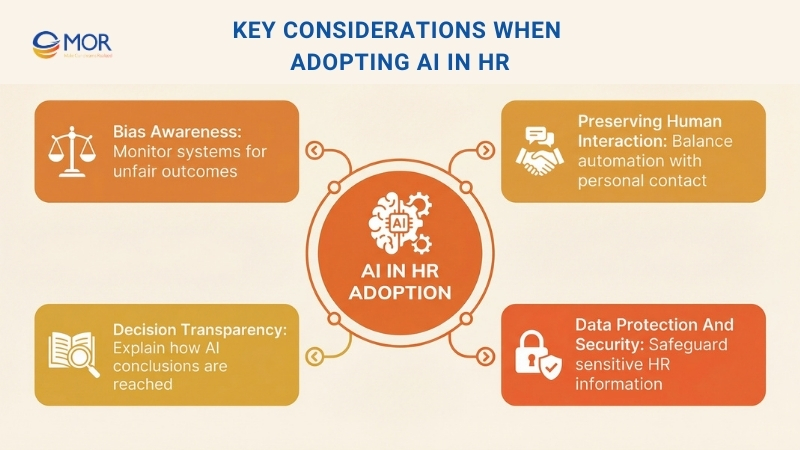
Bias Awareness
AI systems may repeat existing bias when training data is not balanced. This can lead to unfair outcomes in areas like hiring, promotions, or workforce reductions.
To limit this risk, you should review your AI tools on a regular basis to check for bias or uneven results. Ethical use helps support fair decisions and protects both employees and candidates.
Preserving Human Interaction
AI now supports tasks that range from recruitment and onboarding to training and performance reviews. Even so, human interaction remains essential.
When people are removed from the process, the workplace can feel distant or impersonal. You should balance automation with real conversations to keep the work environment supportive and respectful.
Decision Transparency
You need to understand how AI systems reach their conclusions. Many tools rely on complex models and large data sets to guide decisions.
Candidates and employees should know the factors that influence outcomes affecting them. Clear communication builds trust and supports confidence in HR processes.
Data Protection And Security
Select platforms that include strong privacy controls to protect sensitive information. It is also important to confirm that your tools comply with data protection rules like GDPR.
Work closely with security and compliance teams to keep information safe. Strong data protection protects your organization and safeguards personal data belonging to employees and candidates. Using a proxy server can add an extra layer of security through safer data routing and lower exposure to external risks.
Why AI Still Cannot Replace HR Strategy, Culture, Or Empathy
AI plays a strong role in organizing data, spotting patterns, and reducing manual work. Even so, people remain at the center of HR. Strategy, culture, and empathy rely on human judgment, emotional awareness, and trust, areas where technology still falls short.
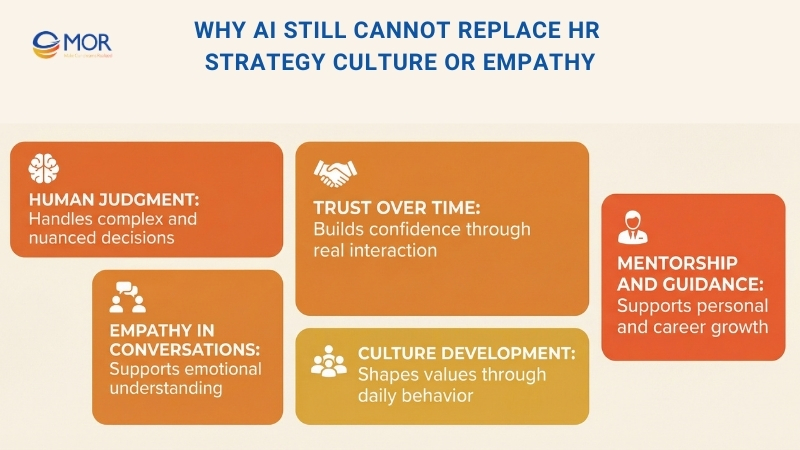
- Human judgment in complex situations: AI can surface insights, but it cannot fully understand context. Decisions around conflict, morale, or career direction often depend on nuance that goes beyond data points or historical trends.
- Empathy in personal conversations: A supportive discussion with an employee facing stress or uncertainty requires emotional sensitivity. AI cannot read body language, tone shifts, or unspoken concerns the way a person can.
- Trust built over time: Trust develops through consistent, honest interaction. During performance reviews or difficult conversations, employees respond to sincerity and presence, not automated responses or system generated feedback.
- Culture shaped by everyday behavior: Workplace culture grows through daily interactions, shared values, and leadership actions. Technology can support communication, but it cannot model integrity, care, or accountability.
- Mentorship and guidance: Coaching employees, especially early in their careers, involves encouragement, patience, and real world perspective. This human guidance helps people grow in ways no algorithm can predict.
AI tools give HR teams time to focus on these essential responsibilities. When systems handle routine tasks, you gain space to listen, guide, and support people more effectively. Used the right way, AI strengthens HR work by freeing you to lead with empathy, build culture intentionally, and create workplaces where people feel valued and understood.
How MOR Software Helps Businesses Build And Integrate AI Tools For HR
At MOR Software, we work with HR and operations teams that need AI outsourcing systems built around how they actually work. We do not push prebuilt platforms or rigid tools. We design HR solutions that match real hiring flows, review cycles, compliance needs, and reporting structures.
Our teams focus on turning AI into a practical layer inside existing HR ecosystems. That includes integrating multimodal AI models with ATS, HRIS integration, payroll systems, internal dashboards, and data warehouses. The goal is simple. AI should support decisions, remove manual effort, and stay transparent for HR teams who rely on it daily.
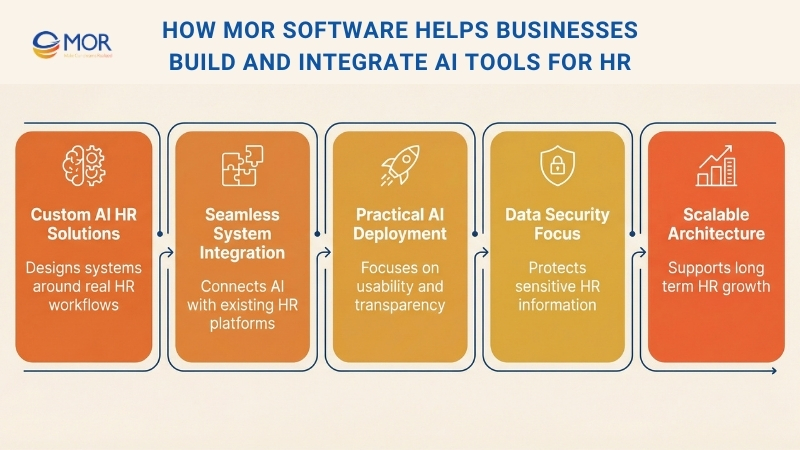
We also place strong emphasis on data handling and long term scalability. HR data is sensitive, so architecture decisions always account for security, access control, and compliance readiness. From early planning to testing and rollout, we help teams move forward with clarity instead of guesswork.
If you want to learn more tips or practical ways to apply AI in HR systems, MOR Software can share real implementation experience across different industries. Contact us to continue the conversation.
Conclusion
AI continues to reshape how HR teams hire, engage, and support people, but results depend on how well these tools fit real workflows. Choosing and applying the best AI tools for HR requires clarity, balance, and the right technical foundation. MOR Software helps businesses design and integrate AI solutions that stay practical, secure, and human focused. If you are ready to move from ideas to real outcomes, contact us to start the conversation.
MOR SOFTWARE
Frequently Asked Questions (FAQs)
What are the best AI tools for HR used for today?
The best AI tools for HR support hiring, employee engagement, performance reviews, analytics, and daily HR operations. They automate repetitive tasks, analyze workforce data, and help HR teams make faster and more informed decisions.
How do AI tools improve the hiring process in HR?
AI tools screen resumes, rank candidates, schedule interviews, and analyze interview responses. This shortens hiring cycles, improves candidate matching, and reduces manual workload for recruiters.
Are AI tools for HR suitable for small and mid sized companies?
Yes. Many AI HR tools offer flexible pricing and modular features. Smaller teams often use AI for resume screening, scheduling, engagement surveys, and basic analytics without large upfront investment.
Can AI tools help reduce bias in HR decisions?
AI can help detect biased language in job descriptions and flag patterns in hiring or reviews. Results still depend on data quality and regular monitoring, so human oversight remains important.
What HR tasks are most commonly automated with AI?
Common tasks include resume screening, interview scheduling, payroll checks, performance feedback collection, employee surveys, and HR chat support for common questions.
How secure are AI powered HR tools?
Most enterprise HR tools include encryption, access controls, and compliance support for regulations like GDPR. Security depends on vendor standards and how well the tool is configured and maintained.
Do AI tools replace HR professionals?
No. AI supports HR teams by handling data heavy and repetitive work. Human judgment is still essential for culture building, conflict resolution, leadership decisions, and employee trust.
How should companies choose the best AI tools for HR?
Start by defining HR pain points, then evaluate integration with existing systems, transparency of AI outputs, usability, scalability, and long term value rather than features alone.
Can AI tools support employee engagement and retention?
Yes. AI tools analyze feedback, engagement trends, performance data, and turnover signals. This helps HR teams act earlier to improve satisfaction and reduce attrition.
What is the biggest risk when using AI tools in HR?
The biggest risks are over automation, poor data quality, and lack of transparency. AI should support decisions, not replace accountability or human involvement in sensitive HR matters.
Share


Make Our-Dreams Realized


© 2023 . MOR Software. All Rights Reserved
Sitemap
Privacy Policy
Terms of Use

Rate this article
0
over 5.0 based on 0 reviews
Your rating on this news:
Name
*Email
*Write your comment
*Send your comment
1