


Elasticsearch Consulting: A Comprehensive Business Guide for 2026
Slow queries, unstable clusters, and rising cloud costs can turn Elasticsearch into a source of frustration. Elasticsearch consulting helps businesses address these problems through expert architecture planning, implementation, performance tuning, and technical support. The right specialists can also prepare search systems for AI and growing data workloads. In this guide, MOR Software will explain the main consulting services, pricing models, project stages, and factors to consider when choosing an Elasticsearch expert.
Key Takeaways
- Elasticsearch consulting covers architecture design, deployment, search relevance, migration, performance tuning, and ongoing support.
- Consulting costs depend on project scope, technical demands, and service models. Hourly rates can range from $25 to $250, based on broad planning estimates.
- Choosing a consultant requires checking technical experience, real project results, delivery methods, and long-term support capabilities.
What Is Elasticsearch Consulting?
Elasticsearch consulting refers to specialist advisory and engineering services that help organizations design, deploy, manage, and improve Elasticsearch environments. Consultants work with internal teams to address technical issues, plan search systems, and align infrastructure decisions with business goals.
Elasticsearch is a distributed search and analytics engine built on Apache Lucene. Companies use it for product discovery, enterprise document retrieval, log analysis, and other data-heavy applications. If you're new to these applications, understanding what is enterprise search provides useful background.
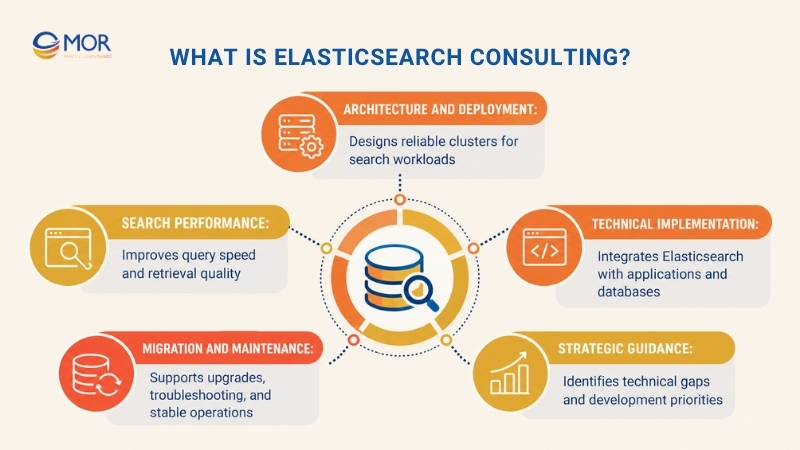
Consulting work typically covers five areas:
- Architecture and deployment: Plan cluster topology, shard allocation, node roles, replication, and infrastructure requirements based on expected workloads.
- Search performance: Review queries, indexing methods, analyzers, and resource use to improve response times and retrieval quality.
- Technical implementation: Connect Elasticsearch with business applications, databases, APIs, and data pipelines.
- Migration and maintenance: Plan version upgrades, move legacy search systems, fix production issues, and support stable operations.
- Strategic guidance: Assess current systems, identify technical gaps, and prepare development roadmaps for new search requirements.
Unlike general software development, an elasticsearch consultancy concentrates on the search engine's architecture, behavior, and operational demands.
Organizations often bring in these specialists for defined projects or technical problems that exceed their internal team's experience.
When Should You Hire an Elasticsearch Consultant?
An elasticsearch consultant becomes valuable when search problems begin affecting customer experience, system reliability, or operating costs. Early technical reviews can prevent smaller issues from turning into expensive production failures.
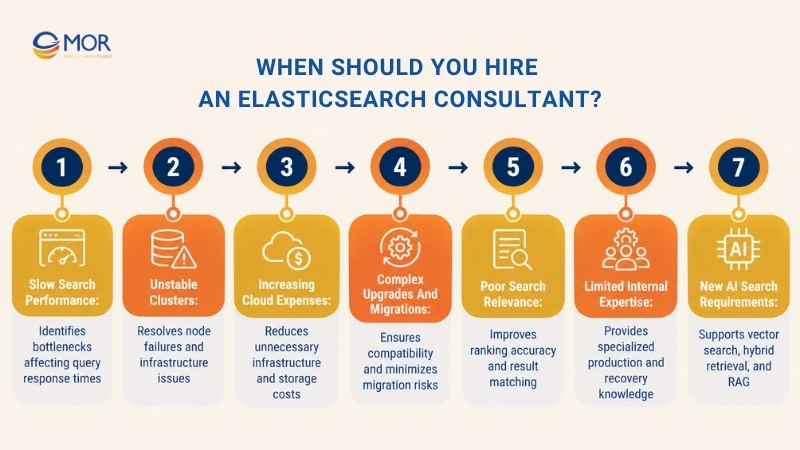
Common situations that call for expert assistance include:
- Slow search performance: Queries take too long because of inefficient Query DSL, unsuitable analyzers, expensive aggregations, or indexing delays. A specialist can profile requests and identify where processing time is spent.
- Unstable clusters: Unassigned shards, frequent node failures, high JVM heap usage, or failed snapshots point to deeper infrastructure problems that need investigation.
- Increasing cloud expenses: Poor shard planning, oversized nodes, excessive replicas, or unnecessary data retention can raise infrastructure spending without improving service quality.
- Complex upgrades and migrations: Moving to newer Elasticsearch versions or changing deployment environments requires compatibility checks, data validation, and rollback planning.
- Poor search relevance: Customers struggle to find products or documents because ranking logic, synonyms, tokenization, or query matching doesn't reflect their intent.
- Limited internal expertise: Your development team may know how to use Elasticsearch APIs but lack experience in cluster recovery, capacity planning, and production incidents.
- New AI search requirements: Introducing semantic retrieval, vector embeddings, hybrid search, or Retrieval-Augmented Generation (RAG) requires decisions about models, indexing, ranking, and infrastructure.
Not every problem requires a long-term consulting contract. A targeted architecture review or performance assessment can provide enough direction for your internal engineers to complete the work.
For a production system with repeated outages or large data volumes, a longer engagement with clear technical ownership is usually more suitable.
Core Elasticsearch Consulting Services
Elasticsearch consulting services cover the main tasks involved in building and maintaining search applications. The scope depends on your existing infrastructure, data requirements, and plans for future development.
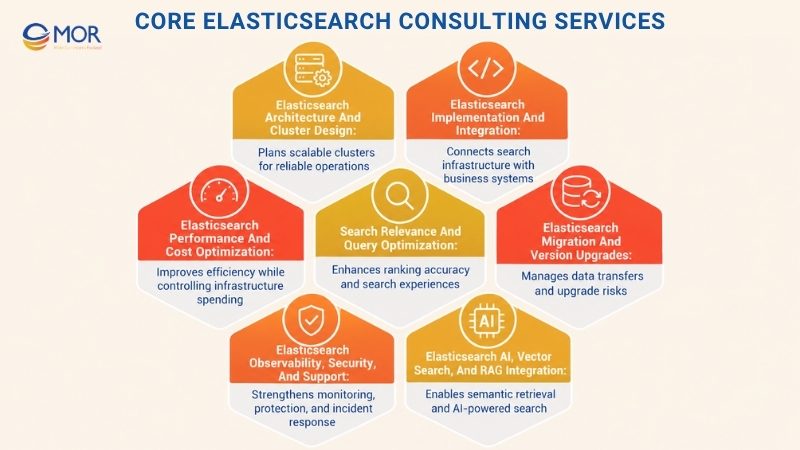
Elasticsearch Architecture and Cluster Design
A reliable Elasticsearch environment starts with an architecture suited to real workloads. Consultants assess data volume, search traffic, indexing patterns, availability targets, and growth projections before recommending a cluster design.
For example, Anyone.com moved 210 million production records to a single Elasticsearch Serverless index. Its migration also required rewriting query and scoring logic, showing why architecture planning must account for application behavior.
Typical architecture services include:
- Cluster topology: Define node roles, primary and replica shards, failure domains, and data placement based on resilience requirements.
- Capacity planning: Estimate storage, CPU, memory, indexing throughput, and query concurrency using representative workloads.
- Deployment design: Evaluate Elastic Cloud, self-managed clusters, Kubernetes, and hybrid environments according to control, staffing, and operating costs.
- Availability planning: Design replication, snapshots, recovery procedures, and security controls that match service-level targets.
- Architecture documentation: Deliver diagrams, sizing estimates, configuration recommendations, and deployment specifications.
For organizations managing extensive data pipelines, architecture decisions should also account for their existing big data platforms.
Elasticsearch Implementation and Integration
Implementation services turn an approved design into a functioning search environment. Consultants configure Elasticsearch, prepare data structures, and connect the search engine to applications and business systems.
The work often extends beyond cluster setup because search quality depends heavily on incoming data and application logic.
Common implementation tasks include:
- Environment configuration: Install or provision Elasticsearch, configure security settings, define cluster resources, and prepare production infrastructure.
- Index and data modeling: Set up field mappings, analyzers, document relationships, and ingestion pipelines suited to the search workload.
- Application integration: Connect REST APIs, backend services, relational databases, message queues, and external data sources to Elasticsearch.
- Elastic Stack configuration: Set up relevant tools, including Logstash, Kibana, and Elastic Agent, for data ingestion and operational monitoring.
- Testing and handover: Validate application behavior, automate deployment where appropriate, and document technical responsibilities.
Data consistency deserves particular attention when source records come from different systems. A sound data integration in business intelligence strategy can help teams prepare and connect data before it enters the search index.
Elasticsearch Performance and Cost Optimization
Search performance often declines when data volumes grow faster than the original architecture anticipated. Query patterns change, shard counts increase, and infrastructure settings that worked during launch may become expensive.
Consultants investigate these issues through workload analysis and controlled performance testing.
Their work typically includes:
- Query profiling: Examine expensive search clauses, aggregations, execution times, and slow-query logs to locate processing bottlenecks.
- Resource tuning: Review shard sizes, caching behavior, JVM heap, CPU usage, disk I/O, and indexing settings.
- Storage management: Apply suitable Index Lifecycle Management (ILM) policies for supported deployments, including rollover and data retention rules. Serverless deployments use their applicable lifecycle features.
- Load testing: Replay representative query patterns and ingestion volumes to measure behavior under expected traffic.
- Cost review: Compare infrastructure spending against actual query volume, storage demand, and performance requirements.
A useful assessment starts with existing metrics. Otherwise, a configuration change may appear successful during testing but fail to improve production performance.
The expected deliverable is a documented set of changes supported by measurable before-and-after results.
Search Relevance and Query Optimization
Fast results have little business value when users cannot find what they need. Relevance engineering addresses the quality and order of search results, using query behavior and user intent as the starting point.
Consultants examine how Elasticsearch interprets search terms, scores documents, and ranks matching records.
Common activities include:
- Query analysis: Review search logs, common queries, failed searches, and user behavior to identify relevance problems.
- Ranking improvements: Adjust BM25 scoring, field boosting, synonyms, analyzers, stemming, and tokenization.
- Search experience development: Implement autocomplete, faceted filters, multilingual matching, and ranking signals where required.
- Relevance testing: Build evaluation datasets and track ranking metrics, including Normalized Discounted Cumulative Gain (NDCG) and Mean Reciprocal Rank (MRR).
For example, a retail platform may rank an out-of-stock product above an available item that better matches the customer's needs. Changes to product attributes, ranking signals, and query logic can help correct that behavior.
Natural language processing also supports more complex search experiences. Teams evaluating natural language processing solutions should consider how linguistic models connect to their existing Elasticsearch setup.
Elasticsearch Migration and Version Upgrades
Migration projects require careful planning because data structures, search behavior, and application dependencies may change between platforms or versions. A failed cutover can interrupt customer-facing services and create difficult recovery work.
An experienced consultant reviews these risks before production changes begin.
Migration work often covers:
- Platform assessment: Review existing Elasticsearch, Apache Solr, OpenSearch, or legacy search environments and document current functionality.
- Compatibility analysis: Identify deprecated APIs, unsupported plugins, mapping changes, and differences in query behavior.
- Data migration: Plan reindexing, ingestion transfers, synchronization, and validation of migrated documents.
- Deployment strategy: Select an appropriate rolling upgrade, staged rollout, or blue-green migration approach where technically supported.
- Recovery planning: Prepare backups, rollback procedures, and cutover acceptance tests to limit service disruption.
Zero-downtime migration may be achievable for certain architectures. Still, the actual risk depends on version compatibility, data volume, write activity, and available infrastructure.
Production migration plans should define acceptable downtime and recovery targets before implementation.
Elasticsearch Observability, Security, and Support
Production clusters require ongoing monitoring and maintenance. Search failures can originate from application code, ingestion pipelines, infrastructure settings, or changes in data volume.
Consultants help teams detect these problems early and establish procedures for resolving them.
Typical services include:
- Cluster monitoring: Track node health, shard status, indexing delays, search latency, and resource consumption using Kibana and Elastic Observability.
- Security configuration: Review role-based access control, TLS encryption, user authentication, audit logging, and access permissions.
- Incident management: Investigate outages, analyze root causes, and prepare response procedures for recurring problems.
- Backup and recovery: Configure snapshots, test restore procedures, and validate recovery point and recovery time objectives.
- Operational support: Prepare runbooks, train internal engineers, and establish escalation paths or managed support contracts.
Elasticsearch training is valuable when an internal team will own daily operations after project delivery. Engineers should learn Elastic search fundamentals, incident investigation methods, and safe configuration practices before the handover is complete.
Elasticsearch AI, Vector Search, and RAG Integration
AI-powered search expands Elasticsearch beyond traditional keyword matching. Embedding models represent content as vectors, allowing search applications to retrieve documents based on semantic similarity.
Elasticsearch vector search consulting addresses the technical decisions involved in designing, integrating, and evaluating these retrieval systems.
Common consulting activities include:
- Vector indexing: Select embedding models, configure dense vector fields, and implement approximate nearest-neighbor search suited to the target workload.
- Hybrid retrieval: Combine BM25 keyword ranking with semantic similarity using methods like Reciprocal Rank Fusion (RRF).
- Model integration: Connect embedding services, rerankers, and large language models to the search application.
- RAG development: Retrieve relevant indexed documents and pass them to a language model to generate responses grounded in enterprise content.
- Quality testing: Compare retrieval accuracy, response latency, embedding costs, and model behavior using representative business queries.
These capabilities already have measurable commercial applications. In an Elastic customer case study, Seismic reported a tenfold improvement in search speed and relevance after adopting Elasticsearch with ELSER, alongside a 20% increase in search usage.
Companies evaluating enterprise search solutions should also assess whether semantic or hybrid retrieval meets their needs before committing to a full AI search architecture.
How an Elasticsearch Consulting Engagement Works
An Elasticsearch consulting project should begin with a clear technical baseline and defined business requirements. The following stages show how consultants commonly organize assessment, implementation, testing, and handover.
Phase | Key activities | Expected deliverables | Completion criteria |
Discovery | Review business goals, search workloads, data sources, and operational needs | Requirements assessment and project scope | Scope agreed |
Assessment | Audit architecture, cluster health, indexing, query performance, and security | Health assessment, risk report, and baseline metrics | Priority issues identified |
Solution design | Plan architecture changes, resource allocation, migration steps, and technical tasks | Architecture design and implementation roadmap | Design approved |
Implementation | Configure Elasticsearch, update search logic, integrate systems, and deploy improvements | Working solution and configuration records | Functional tests passed |
Validation | Run load tests, relevance tests, UAT, and recovery checks | Test results, issue logs, and acceptance report | Agreed targets met |
Handover | Transfer operational knowledge, documentation, and support responsibilities | Runbooks, technical documentation, and support plan | Internal ownership confirmed |
Each phase should have an accountable owner and clear acceptance criteria. For instance, a search performance project could require consultants to document current p95 latency, establish a target, and test the same workload after changes.
Timelines vary considerably. Elastic's published deployment consulting packages specify 2 consulting days for Remote Quickstart, 8 days for Deployment, and 16 consultant-days for Enterprise Deployment.
These are defined consulting allocations rather than universal project durations. A larger migration involving data synchronization, custom application changes, and acceptance testing may take several weeks or months.
External specialists can also remain involved after implementation. A production handover may include a short monitoring period, internal workshops, and an agreed escalation process for outstanding issues.
Elasticsearch Consulting Costs and Pricing Models
Elasticsearch consulting costs depend on consultant expertise, location, project size, and technical requirements. Short troubleshooting engagements typically follow hourly or daily billing, whereas implementation projects and production support require broader contracts.
The following figures are illustrative USD planning ranges, not verified industry averages or published quotes from individual providers. Actual proposals should be checked against the project's scope and service commitments.
Pricing model | Billing basis | Estimated cost ($) | Best suited for | Main cost consideration |
Hourly consulting | Hours worked | 25–250/hour
| Troubleshooting, query tuning, short advisory tasks | Expertise, location, and hours required |
Daily packages | Consulting days | 800–2,000/day
| Audits, cluster health checks, performance assessments | Consultant-day allocation and deliverables |
Fixed-price projects | Agreed project fee | 2,500–30,000+/project
| Deployment, architecture design, migrations | Project complexity and scope changes |
Monthly retainer | Recurring monthly fee | 3,000–8,000+/month
| Continuous guidance and technical maintenance | Included hours and specialist availability |
Managed support | Monthly or annual subscription | 4,999–9,999+/month
| Production monitoring, incident response, ongoing operations | SLA coverage, response times, and incident limits |
Hourly rates vary by geographic market and specialist experience. A consultant handling routine configuration work will usually have a different pricing structure than a senior engineer responsible for a large production migration.
Fixed-price contracts provide greater budget clarity when deliverables are well defined. Scope changes, extra integrations, and unexpected legacy-system issues can still increase the final project cost.
Several factors shape consulting fees:
- Cluster size and complexity: More nodes, shards, indexes, data types, and dependencies require additional assessment and testing.
- Migration requirements: Legacy data structures, version differences, reindexing demands, and downtime restrictions affect project effort.
- Specialist skills: Search relevance engineering, distributed architecture, security, and AI retrieval work can carry different rates.
- Support coverage: Around-the-clock incident response and short SLA windows usually cost more than business-hours advisory services.
- Deployment environment: Cloud-managed systems and self-hosted clusters have different maintenance, security, and infrastructure demands.
Consulting fees represent only part of the budget. Elasticsearch licensing, cloud hosting, storage, backups, model inference, testing environments, and internal staffing may create additional expenses.
Compare proposals against total ownership costs and expected results. A cheaper engagement that leaves operational issues unresolved can become more expensive after deployment.
Elasticsearch Consulting Use Cases by Industry
Elasticsearch supports search and analytics applications across industries that handle large or fast-changing datasets. Consulting priorities differ based on how organizations collect information, serve users, and manage operational risk.
Industry | Elasticsearch application | Consulting priority | Relevant business KPI |
eCommerce and retail | Product discovery, autocomplete, filters, and personalized search | Relevance tuning and query performance | Search conversion rate |
Financial services | Transaction search, log analysis, and fraud investigation | Security, data access, and scalability | Query latency |
Healthcare | Medical document retrieval and clinical knowledge search | Access controls and retrieval quality | Retrieval accuracy |
SaaS and technology | Application search, API integration, and tenant-aware indexing | Data modeling and integration | Search response time |
Legal services | Contract search, case retrieval, and document discovery | Content indexing and ranking | Time to find documents |
Cybersecurity | Security-event analytics, investigation, and SIEM workloads | Ingestion performance and observability | Investigation time |
Retail provides a clear example of the connection between search quality and commercial results. According to an Elastic case study, HSE recorded a 4% increase in website click-through rate after adopting Elasticsearch-based AI search, along with an 8% rise in customer satisfaction.
Other industries prioritize different outcomes. Healthcare organizations may focus on accurate document retrieval and strict access permissions, whereas SaaS providers often need low-latency search across large application datasets.
The right solution also depends on the selected search platform. Businesses reviewing the best enterprise search engines should compare Elasticsearch against their data requirements, operational capacity, and integration needs.
How to Choose the Right Elasticsearch Consultant
Selecting an Elasticsearch consulting partner requires evidence of practical technical experience. Certifications are useful, but production experience and clear project deliverables provide stronger proof of a consultant's ability to meet your requirements.
Use the following criteria when evaluating service providers.
Evaluation criterion | Questions to ask | Evidence to request | Potential warning sign |
Technical expertise | Have you supported clusters with similar workloads? | Architecture examples and technical qualifications | Generic technology claims |
Relevant experience | Have you handled similar search or migration projects? | Case studies and client references | No comparable projects |
Delivery process | What are the project milestones and responsibilities? | Statement of work and project roadmap | Unclear deliverables |
Performance validation | How will search quality and speed be measured? | Benchmarking method and sample reports | No baseline or acceptance targets |
Support capability | Who handles production incidents and escalations? | SLA terms and support procedures | Unclear responsibility boundaries |
Pricing clarity | What is included in the proposed fee? | Itemized scope and pricing terms | Unspecified additional expenses |
Check whether the provider has experience with your deployment model, Elasticsearch version, data volume, and business use case. A strong search relevance specialist may have different skills than an engineer focused on cluster recovery or cloud infrastructure.
Certification can support the assessment, but ask candidates to explain actual projects. An Elastic consulting architect should be able to defend decisions about node roles, shard allocation, failure recovery, and query workloads.
A credible Elasticsearch practice also includes repeatable testing, technical documentation, and a clear handover process. Ask who will perform the work instead of relying only on the credentials of the sales team.
For AI projects, evaluate consulting firms on AI-powered enterprise search experience using Elasticsearch, including retrieval evaluation and production deployment. General AI development experience alone doesn't establish search engineering expertise.
Broader comparisons of top tech consulting firms can help with vendor screening, but the final selection should depend on the technical requirements of your project.
In-House Teams vs Consultants vs Managed Support
The right staffing model depends on how frequently your organization changes its search platform and how much responsibility the internal team can manage.
Some businesses maintain Elasticsearch entirely in-house. Others depend on outside specialists for defined projects or continuous production operations.
Operating model | Best for | Main advantages | Main limitations |
In-house team | Continuous development and daily platform ownership | Internal knowledge and direct control | Hiring costs and specialist skill requirements |
External consulting | Architecture reviews, migrations, and targeted technical projects | Focused technical expertise | Limited engagement duration |
Managed support | Continuous monitoring and incident response | Contracted operational coverage and escalation | Recurring fees and provider dependence |
Hybrid approach | Enterprise systems requiring internal ownership and outside expertise | Flexible staffing and specialist access | Requires clear responsibility boundaries |
An in-house team works well when Elasticsearch supports core applications and requires frequent changes. Yet hiring specialists for occasional migrations or performance investigations may be difficult to justify.
External consultants provide targeted help without requiring permanent staffing. Managed support is more suitable when the business needs continuous monitoring, incident response, and defined service commitments.
A hybrid arrangement can balance these needs. Internal engineers own the application and daily changes, while specialists assist with architecture decisions, major upgrades, or difficult incidents.
The most suitable model should preserve technical knowledge inside your organization. Documentation, access management, and clear handover responsibilities help prevent unnecessary dependence on external providers.
How to Measure Elasticsearch Consulting Results
The success of an elasticsearch consulting engagement should be measured against agreed technical and business targets. Establish a baseline before changing cluster settings, search logic, or application architecture.
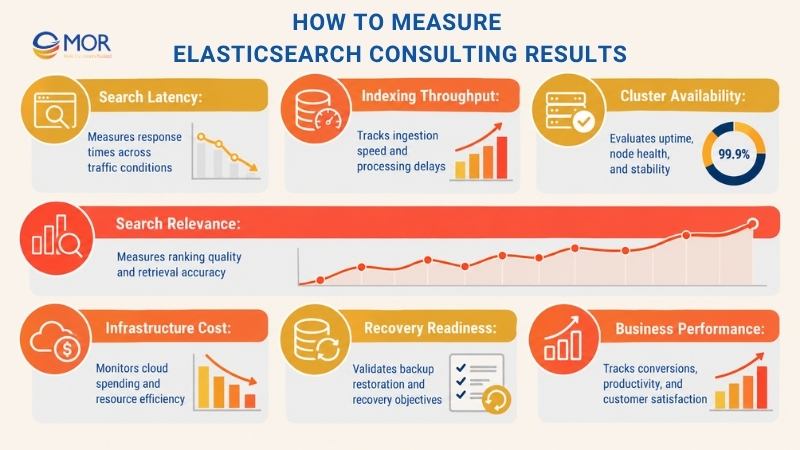
Relevant performance indicators include:
- Search latency: Compare p50, p95, and p99 response times under similar traffic conditions. Percentile measurements reveal delays that average response times may hide.
- Indexing throughput: Track documents indexed per second, ingestion lag, and pipeline failures to assess data-processing capacity.
- Cluster availability: Monitor uptime, node health, shard allocation, and incident frequency to evaluate operational stability.
- Search relevance: Use NDCG, MRR, zero-result rate, and representative query evaluations to measure result quality.
- Infrastructure cost: Track monthly cloud expenses, storage use, resource consumption, and cost per workload unit.
- Recovery readiness: Test snapshot restoration and compare recovery point objectives (RPO) and recovery time objectives (RTO) against business requirements.
- Business performance: Measure search conversion rate, employee search time, customer satisfaction, or incident resolution time when a credible link to the project exists.
For example, lowering p95 search latency from 800 milliseconds to 250 milliseconds would represent a measurable technical improvement. The figures should come from comparable workloads, not different testing environments.
Search relevance requires similar discipline. Consultants should evaluate the same query dataset before and after ranking changes to identify improvements and regressions.
The final report should document completed work, benchmark results, unresolved risks, and ownership of remaining tasks. These records also help internal teams plan future infrastructure spending.
How MOR Software Can Support Elasticsearch-Based Projects
MOR Software supports businesses through IT consulting, custom software outsourcing development, system integration, and AI engineering. Our teams work on application architecture, backend systems, data pipelines, and cloud-based platforms, including projects where Elasticsearch serves as the search engine.
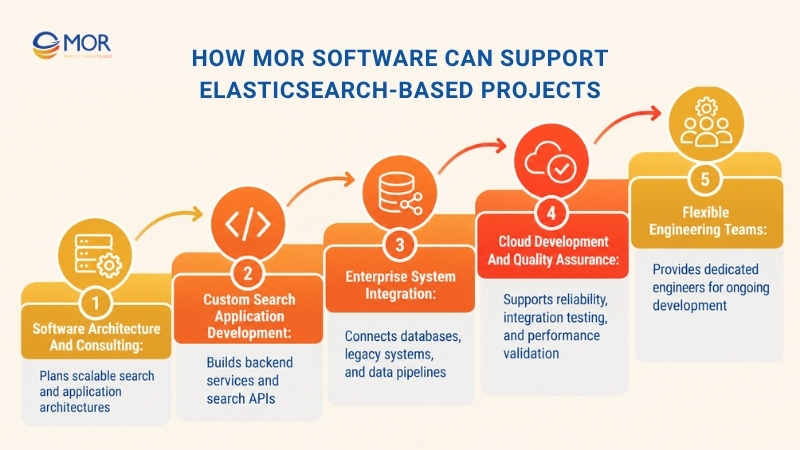
Our experience connects these engineering capabilities to real search requirements:
- Software architecture and consulting: We assess business requirements, review technical dependencies, and plan scalable application designs that support search and data-processing workloads.
- Custom search application development: Our team builds backend services, APIs, and application components needed to connect users and enterprise systems with search functionality.
- Enterprise system integration: We work with legacy systems, databases, APIs, and data migration processes to support consistent information exchange.
- Cloud development and quality assurance: Our development, DevOps, and testing capabilities support application reliability, integration testing, and performance validation.
- Flexible engineering teams: Our offshore development and dedicated team models provide businesses with engineers for defined projects and ongoing software development.
Our work includes an AI-powered semantic search transformation we delivered for a Japanese enterprise. Over 12 months, our team developed a hybrid search solution using Elasticsearch, Python, FastAPI, PySpark, and text embeddings to improve retrieval across complex product data and Japanese-language queries.
This project demonstrates our experience developing Elasticsearch-based search applications within broader AI and data systems. Businesses can contact MOR to discuss search development, system integration, and software modernization requirements.
Conclusion
Elasticsearch consulting gives businesses access to specialist skills for improving search performance, planning migrations, managing infrastructure, and building AI-powered retrieval systems. The right engagement starts with clear requirements, measurable targets, and a practical delivery plan. MOR Software brings software engineering, integration, and AI search development experience to projects involving Elasticsearch.
If your business needs a scalable search application or help connecting existing systems, Contact us to discuss the technical scope and development options.
"Evolution is not a destination, it is a disciplined journey of innovation."
Phung Van Tu


CEO MOR AI
MOR SOFTWARE
Frequently Asked Questions (FAQs)
What does an Elasticsearch consultant do?
An Elasticsearch consultant assesses, designs, implements, and improves search environments. Typical responsibilities include cluster architecture, data indexing, query tuning, system integration, migration, and troubleshooting. Consultants may also provide technical documentation, knowledge transfer, and production support based on the project scope.
How much does Elasticsearch consulting cost?
Costs depend on specialist experience, location, project scope, and support requirements. Broad planning estimates place hourly services around 25–250 and fixed-price projects around 2,500–30,000 or more. These are illustrative figures rather than verified vendor quotations, so request a project-specific proposal.
How long does an Elasticsearch consulting project take?
Short technical assessments may take a few consulting days, while complex migrations and implementations can run for weeks or months. Data volume, cluster architecture, version compatibility, testing requirements, and application integrations determine the schedule. Consultants should define milestones and acceptance criteria before implementation.
When should a company hire an Elasticsearch consultant?
A company should seek specialist assistance when slow searches, unstable clusters, costly infrastructure, or difficult upgrades begin affecting business operations. External expertise is also useful when an internal development team lacks experience with search relevance, distributed systems, or AI-based retrieval.
What is included in Elasticsearch implementation services?
Implementation typically includes architecture planning, environment setup, security configuration, index design, data ingestion, API integration, and deployment testing. Depending on the contract, the provider may also prepare monitoring dashboards, migration plans, operational documentation, and training materials for internal engineers.
Can Elasticsearch consultants improve search performance and relevance?
Yes. Specialists examine query execution, indexing methods, analyzers, ranking signals, and cluster resources to identify performance problems. They use benchmarks and relevance evaluations to measure changes. The results depend on the workload, data quality, current configuration, and agreed project targets.
Do Elasticsearch consultants support cloud and on-premises deployments?
Many consulting providers work with Elastic Cloud, self-managed clusters, Kubernetes, and hybrid environments. Their responsibilities may include architecture design, security configuration, deployment automation, and operational support. Confirm that a prospective provider has experience with your actual hosting environment and Elasticsearch version.
Can an Elasticsearch consultant help migrate from Solr or OpenSearch?
Yes, provided the specialist has experience with the source and destination platforms. Migration work includes compatibility assessments, data mapping, reindexing, query conversion, testing, and cutover planning. Platform differences can affect application behavior, so production changes require careful validation.
Does Elasticsearch consulting include vector search and AI integration?
Many providers support semantic retrieval, dense vector indexing, hybrid search, and RAG pipelines. These projects may include embedding model selection, query ranking, LLM integration, and retrieval testing. Confirm the provider's AI search experience before signing a contract.
What is the difference between Elasticsearch consulting and managed support?
Consulting generally focuses on defined technical objectives, including architecture design, implementation, migrations, and performance assessments. Managed support covers ongoing operations, monitoring, troubleshooting, and incident response under recurring agreements. Some providers combine these services within one contract.
Share


Make Our-Dreams Realized


© 2023 . MOR Software. All Rights Reserved
Sitemap
Privacy Policy
Terms of Use

Rate this article
0
over 5.0 based on 0 reviews
Your rating on this news:
Name
*Email
*Write your comment
*Send your comment
1