


Hire a Remote Software Development Team in 2026: Cost & Tips
Hiring several developers locally can take months when your product already needs more engineering capacity. If you plan to hire remote software development team talent in 2026, team structure, technical fit, delivery ownership, security, and cost deserve as much attention as coding skills. A remote team works as one engineering unit rather than a collection of freelancers. This MOR Software guide will show you what to consider before hiring, how to vet and onboard the right team, what you can expect to pay, and how to manage delivery over the long term.
Reasons to Hire a Remote Development Team
A remote software development team gives companies access to engineering capacity outside their local hiring market. The model fits best when product work is ongoing and several technical roles need to work together.
Demand for these skills remains high. The U.S. Bureau of Labor Statistics projects employment for software developers, QA analysts, and testers to grow 10% between 2025 and 2035, with about 106,100 openings per year during that period.
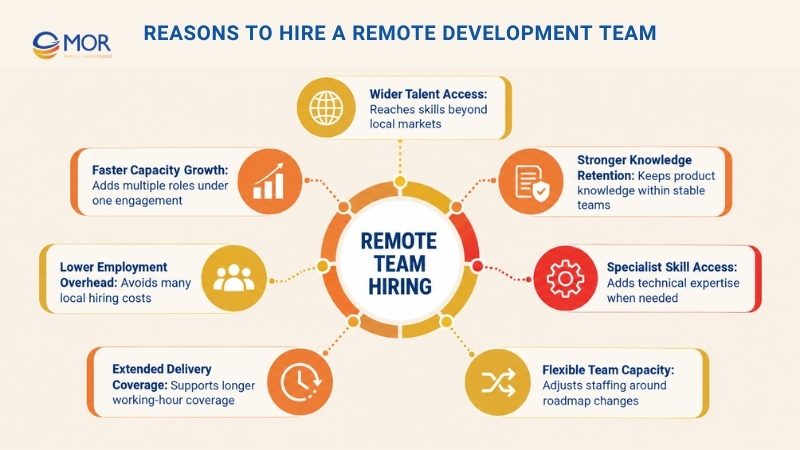
That hiring pressure gives companies several reasons to hire remote software development team capacity instead of depending only on local recruitment:
- Fill local talent gaps: Remote hiring expands access to backend, frontend, cloud, data, AI, mobile, QA, and DevOps engineers. This becomes useful when the required skill set is scarce in your city or country.
- Add capacity faster: Recruiting five separate local employees creates five sourcing, interview, contract, and onboarding cycles. A coordinated team can fill several roles under one engagement.
- Keep product knowledge together: Long-running products need developers who understand architecture, business rules, technical debt, and release history. Stable remote software development teams retain that knowledge better than a changing pool of short-term contractors.
- Bring in specialist skills: A product may need an AI engineer for one phase and cloud or QA automation skills later. Remote hiring expands the technical pool without forcing every skill into permanent headcount.
- Adjust capacity around the roadmap: MVP work, migration, product growth, and maintenance rarely require the same staffing level. A remote team can add or remove roles as those needs change.
- Expand delivery coverage: Teams in different regions can create longer working-hour coverage. This works best when handoffs, ownership, and response rules are defined before development starts.
- Control employment overhead: Salary is only one local hiring cost. Recruitment fees, benefits, equipment, training, HR work, office costs, and replacement time also affect the real spend.
Startups may find this model useful when permanent hiring would move slower than the product roadmap. Our guide to app development for startups discusses related decisions around scope, technical choices, and early product delivery.
A remote team still isn’t the right answer for every task. One isolated bug fix or a tiny design change may fit a freelancer better, and work that requires permanent physical access to hardware or secure facilities may need an on-site team.
Define Scope, Team Structure, and Success Criteria
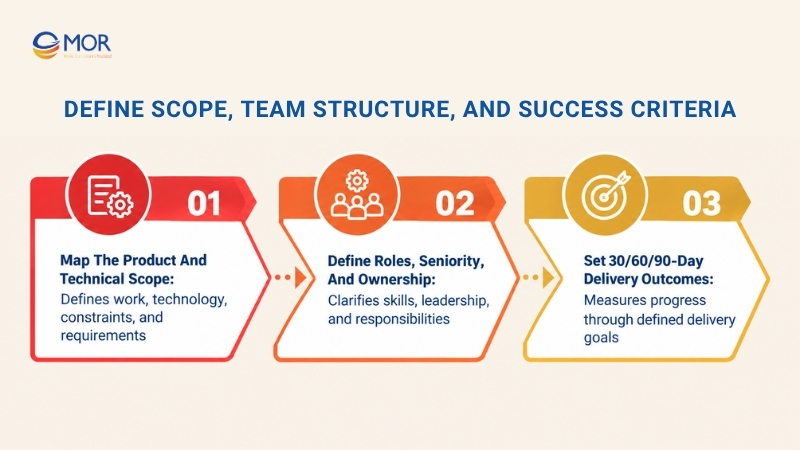
Hiring becomes easier once the product needs are written in terms developers can act on. Before you hire remote software development team resources, map what must be built, who owns each part, and what successful delivery should look like after the team joins.
A vague request like “we need five developers” doesn’t give candidates enough information. A stronger brief connects product stage, technology, roles, ownership, timeline, and measurable output.
Map the Product and Technical Scope
Start with the work itself. A team building a new MVP needs a different mix of skills than one replacing a legacy backend or moving an existing platform to AWS.
- Product stage: Define whether the work covers an MVP, new application, product extension, modernization, migration, or maintenance. Teams still shaping an early product can review MVP development services before fixing the hiring plan.
- Validation stage: Decide how much product validation should happen before full development. The difference between PoC vs MVP can change team size, architecture needs, and development time.
- Technology stack: Record the frontend, backend, database, cloud, APIs, mobile platforms, and infrastructure already in use. If the company plans to build a cloud application, include the cloud platform and current infrastructure constraints as well.
- System limits: Document legacy dependencies, expected traffic, response-time targets, data volume, external integrations, and known technical debt.
- Security and compliance: List GDPR, HIPAA, PCI DSS, SOC 2, or other requirements that apply to the product. These requirements can change architecture, testing, access rules, and team composition.
- Timeline: Map major milestones and launch dates. Avoid creating a deadline before the team has reviewed the scope and dependencies.
AI-heavy products also need a more precise skill map. AI app development may involve data engineering, model integration, backend services, MLOps, cloud resources, and product engineering rather than one generic “AI developer.”
Define Roles, Seniority, and Ownership
Team size alone says little about delivery capacity. Five developers with overlapping skills may leave QA, architecture, cloud operations, or product ownership uncovered.
- Technical leadership: Decide whether the project needs a Tech Lead or Solution Architect. Architecture-heavy products usually need one person responsible for technical direction and key engineering decisions.
- Engineering mix: Map backend, frontend, full-stack, mobile, QA, DevOps, data, AI, and UI/UX roles against the actual backlog.
- Seniority: Match seniority to technical risk. A stable CRUD application may need a different senior-to-mid-level ratio than a high-volume fintech platform.
- DevOps ownership: If your current team lacks CI/CD, cloud, observability, or deployment skills, you may need to hire a DevOps engineer rather than assigning infrastructure work to general developers.
- Product ownership: State who sets priorities and accepts completed work. The remote team still needs one clear source for business decisions.
- Engineering ownership: Assign responsibility for services, components, releases, and technical documentation. A good remote team for software development should know where its responsibility starts and ends.
The same logic applies when you hire a dedicated engineer for one missing skill. That person should enter a defined ownership area rather than become the default owner of every technical issue.
Set 30/60/90-Day Delivery Outcomes
Early delivery goals give the client and team a common reference point. Focus on production progress and ownership rather than online hours.
- First 30 days: Complete environment setup, learn the codebase and product, close initial tickets, and make the first production contribution.
- First 60 days: Take ownership of agreed workstreams with less day-to-day direction. Technical questions should become more focused as product knowledge grows.
- First 90 days: Reach a stable delivery rhythm and take responsibility for measurable product or engineering outcomes.
- Delivery KPIs: Track lead time, release frequency, escaped defects, failed deployments, milestone completion, and rework.
- Business outcomes: Connect engineering work to the product goal. A payment integration might be measured by successful transaction flow, not the number of tickets closed.
Hours logged can support billing, but they shouldn’t become the main definition of success. Delivery quality and ownership reveal much more about the working relationship.
How to Hire a Remote Software Development Team
The process of how to hire a remote team of software developers starts before the first interview. Companies need a hiring brief, the right engagement model, credible delivery evidence, technical testing, commercial terms, onboarding rules, and a way to measure ongoing work.
That sequence matters when you hire remote software development team capacity for a core product. Skipping one stage often pushes the problem into onboarding or delivery, where fixing it costs more.
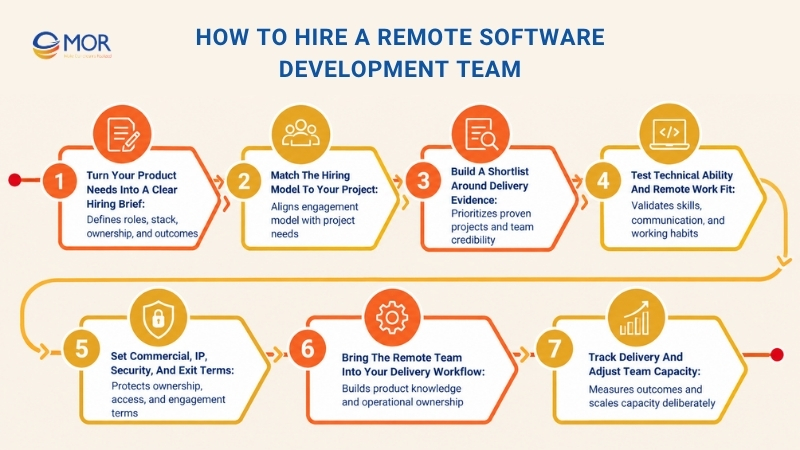
1. Turn Your Product Needs Into a Clear Hiring Brief
Take the scope you mapped earlier and turn it into a document a recruiter, vendor, or candidate can evaluate. Keep it short enough to scan, but detailed enough to rule out mismatched teams.
A useful hiring brief should state:
- Business goal: Define what the product or project needs to achieve.
- Product stage: State whether the team is building, extending, migrating, or maintaining the system.
- Required roles: List the number and type of engineers needed.
- Core stack: Name the languages, frameworks, databases, cloud platforms, and major integrations involved.
- Seniority: State where senior technical judgment is required.
- Delivery ownership: Explain which systems or workstreams the team will own.
- Working model: Set expected overlap hours and meeting cadence.
- Timeline: Share target start dates and key milestones.
- Success measures: Add the 30, 60, and 90-day outcomes already defined.
Avoid turning every technology preference into a hard requirement. A developer who has solved the same architectural problem in Java may still be a stronger fit than someone who has merely listed your exact framework on a CV.
For specialist roles, decide how narrow the search really needs to be. A DevOps engineer executive search makes sense when you need senior technical leadership, but a mid-level cloud engineer may be enough for routine CI/CD and AWS operations.
2. Match the Hiring Model to Your Project
The hiring model shapes control, team continuity, management effort, and delivery ownership. Compare these factors before you hire remote software development team resources.
Model | Best for | Client control | Team continuity | Who manages delivery | Typical commitment |
Dedicated development team | Long-term product development | High | High | Shared between client and provider | Medium to long term |
Staff augmentation | Filling specific skill or capacity gaps | Very high | Medium to high | Mainly the client | Flexible |
Project-based outsourcing | Defined scope and deliverables | Medium | Medium | Mainly the provider | Project duration |
Direct remote employees | Permanent engineering roles | Very high | High | Client | Long term |
Freelancers | Small tasks or short specialist work | High | Low | Client | Short term |
For long-running products, remote dedicated software development teams fit cases where several engineers need shared product knowledge and stable ownership. Staff augmentation suits companies that already have technical leadership and mainly need extra capacity.
3. Build a Shortlist Around Delivery Evidence
A polished website tells you what a vendor wants to sell. Actual project evidence tells you what the team has already delivered.
When you hire remote software development team capacity through a provider, shortlist companies using proof that maps to your own work:
- Relevant projects: Ask for examples involving a similar technology stack, architecture problem, project scale, or business domain.
- Named team members: Review the CVs of developers who may actually join your project. Don’t rely on generic company capability decks.
- Technical depth: Check access to architecture, QA, DevOps, cloud, data, and other skills that could become necessary later.
- Client references: Speak with recent clients and ask what happened when deadlines slipped, requirements changed, or a developer left.
- Team continuity: Ask about average tenure, turnover, bench capacity, and the replacement process.
- Working visibility: Confirm access to Jira, GitHub or GitLab, sprint reports, release records, and other delivery data.
- Security practice: Review NDA handling, access control, repository ownership, employee offboarding, and data rules.
- Pilot option: A short paid engagement gives you delivery evidence before a larger commitment.
Software development companies make sense when you need a coordinated unit. Talent networks work better for targeted individual roles, while direct sourcing gives the client more control at the cost of more recruitment work.
Professional referrals can narrow the search, but they shouldn’t replace technical checks. The same rule applies to software developer remote teams introduced through personal networks.
4. Test Technical Ability and Remote Work Fit
Technical interviews should test the work the developer will actually do. Generic algorithm puzzles rarely show how someone handles your architecture, production constraints, communication, and trade-offs.
Interview the developers who may join the project. Sales staff can explain the engagement, but they can’t prove how a backend engineer writes code or how a Tech Lead handles a difficult system decision.
Use several forms of evidence:
- Project discussion: Ask developers to explain a system they built, what went wrong, and why they chose a certain technical approach.
- Real-ticket exercise: Use a small task similar to your product work. Give enough information to see how the candidate asks questions before coding.
- Code review: Present existing code and ask the developer to identify maintainability, testing, security, or performance issues.
- Architecture exercise: For senior roles, ask how they would structure a service, data flow, integration, or scaling problem.
- Written update: Ask for a short async status report covering progress, blockers, and a proposed solution.
- Time-zone check: Confirm actual working hours and overlap rather than assuming a country automatically provides a certain schedule.
- Paid pilot: Put a small real deliverable through your normal review flow before extending the engagement.
Communication deserves its own test. Strong remote engineers explain blockers early, document decisions, ask precise questions, and know when an issue needs synchronous discussion.
That matters for remote software developer teams because one unclear handoff can block several people at once. The strongest technical candidate still needs working habits that fit distributed delivery.
5. Set Commercial, IP, Security, and Exit Terms
Contracts should cover more than billing. Before you hire remote software development team members, define who owns the code, who can access systems, how replacement works, and what happens when the engagement ends.
Security deserves real budget and process. IBM's 2025 Cost of a Data Breach Report put the global average breach cost at USD 4.44 million, which makes access controls and data handling a business concern rather than contract boilerplate.
Cover these areas before kickoff:
- IP ownership: State ownership of source code, designs, documentation, models, configurations, and other project deliverables.
- NDA terms: Protect confidential business, customer, technical, and product information.
- Repository control: Define where code lives and who owns the organization, repositories, branches, and CI/CD configuration.
- Access management: Apply role-based permissions, MFA, VPN, and separate accounts where the system requires them.
- Data handling: Define approved storage, transfer, processing, backup, and deletion rules.
- Third-party code: Set rules for open-source packages and licensed components.
- Service expectations: Record response times, escalation contacts, delivery responsibilities, and expected availability.
- Replacement terms: State the process when a developer leaves, underperforms, or needs to be replaced.
- Exit terms: Include notice period, documentation, handover, access removal, and transfer of unfinished work.
- Cross-border rules: Have qualified legal and tax advisers review employment classification, privacy, and jurisdiction requirements that apply to your engagement.
Security scope also changes price. A healthcare platform that stores patient data will require a different level of access control, testing, and audit work than an internal prototype.
6. Bring the Remote Team Into Your Delivery Workflow
A signed contract doesn’t make an external team productive on Day 1. Good onboarding gives developers the product knowledge and technical access needed to contribute without spending weeks chasing basic information.
Plan the first month around increasing ownership:
- Before Day 1: Prepare accounts, repositories, environments, architecture notes, backlog access, design files, and communication channels.
- Week 1: Introduce product goals, users, system architecture, deployment process, major technical decisions, and internal stakeholders.
- Week 2: Assign a meaningful task that reaches your normal review flow. Tiny training exercises don’t show how the team works under real project conditions.
- Weeks 3-4: Move selected services, modules, or product areas into independent team ownership where performance supports it.
- Overlap hours: Agree on a regular period for sprint planning, blockers, reviews, and urgent decisions.
- Async updates: Record decisions and status information so developers don’t need a meeting for routine progress.
- Escalation: Define when a blocker moves to the Tech Lead, Product Owner, or client stakeholder.
- Decision records: Keep architecture choices, API contracts, business rules, and release notes in shared documentation.
- Meeting discipline: Keep recurring calls tied to a clear purpose. Too many status meetings eat into coding and review time.
A new remote dedicated software development team should gradually need less operational guidance as product knowledge grows. If the same basic questions continue after several sprints, inspect documentation, ownership, and onboarding before assuming the issue is individual performance.
7. Track Delivery and Adjust Team Capacity
Remote team performance should be visible through delivery data. Monitoring screen activity or counting online hours tells you little about product quality.
DORA now groups software delivery measurement around throughput and instability, including change lead time, deployment frequency, failed deployment recovery time, change fail rate, and deployment rework rate. These measures give engineering leaders a stronger view of delivery than activity tracking.
Track measures that match your product:
- Lead time: Measure the time between approved development work and production release.
- Release frequency: Watch how often usable software reaches users.
- Failure rate: Track deployments that create production problems.
- Rework: Measure unplanned work caused by defects.
- Predictability: Compare planned milestones against completed outcomes.
- Ownership: Check whether developers resolve routine technical issues without constant client direction.
- Knowledge retention: Keep architecture records, deployment guides, API documentation, and runbooks current.
- Team capacity: Add roles when the backlog shows a persistent skill bottleneck rather than reacting to one busy sprint.
Scaling should protect leadership continuity. Adding three developers while replacing the Tech Lead can slow a team because the new members need direction at the same time ownership is changing.
That’s especially relevant for dedicated remote development teams for software companies with multi-year roadmaps. Stable technical ownership often matters more than rapidly increasing headcount.
Top Regions to Hire Remote Software Development Teams
Location affects price, working-hour overlap, hiring depth, English use, and access to specialist skills. Companies that hire remote software development team capacity should compare regions against their delivery needs rather than treating one country as the universal best choice.
Remote development is already normal across the profession. Stack Overflow's 2025 Developer Survey found that nearly one third of developers were working remotely, and 45% of U.S. respondents reported remote work.
Location model | Common regions | Typical cost level | Time-zone overlap | Best for | Main trade-off |
Onshore | Same country as the client | Highest | Full or near-full | Regulated projects, frequent workshops, close stakeholder access | Higher salary and vendor costs |
Nearshore | Latin America, nearby European markets | Medium | High | Agile teams that need regular live meetings and quick feedback | Smaller cost gap than offshore hiring |
Offshore | Vietnam, India, Southeast Asia, Eastern Europe | Low to medium | Partial | Long-term development, larger teams, QA, cloud, mobile, and product engineering | Requires stronger async communication and handoff rules |
Hybrid | Local leadership + nearshore/offshore delivery | Mixed | Managed | Enterprise products that need local ownership plus distributed engineering capacity | More coordination across locations |
Vietnam | Southeast Asia | Low to medium | Partial with US/EU | Web, mobile, cloud, enterprise systems, QA, and long-term offshore teams | Limited full-day overlap with Western teams |
Latin America | Mexico, Brazil, Colombia, Argentina and nearby markets | Medium | High with North America | U.S. companies running frequent sprint reviews, workshops, and product discussions | Rates can approach onshore levels for senior talent |
Eastern Europe | Poland, Romania, Ukraine, Czechia and nearby markets | Medium | High with Europe, partial with North America | Backend, cloud, enterprise software, and engineering-heavy products | Cost varies widely between countries |
India | South Asia | Low to medium | Partial | Large engineering pools, enterprise systems, cloud, QA, and long-running development | Vendor quality varies widely, so vetting matters |
For most companies, the best choice comes down to one trade-off: more working-hour overlap usually costs more, while lower-cost regions require stronger async processes and documentation.
Remote Development Team Cost in 2026
There’s no single 2026 price to hire remote software development team capacity. Geography, seniority, team mix, specialist skills, engagement model, security scope, and project length can move the budget substantially.
Current outsourcing data also shows why a single “average developer rate” can be misleading. Accelerance reported 2026 junior rates around 24-31/hour in Asia, 33-45/hour in Latin America, and 31-39/hour in Europe, while senior bands reached 31-41, 60-75, and 64-76 respectively.
A wider 2026 agency benchmark from Pangea.ai places the rate bands as follows.
Cost factor | What to compare | Estimated 2026 cost |
Geography | Regional vendor/developer rates | Southeast Asia: 15-55/hr; India: 20-65/hr; Latin America: 30-80/hr; Eastern Europe: 30-95/hr; US/Canada: 80-300/hr, depending on seniority
|
Seniority | Junior, Mid-Level, Senior, Lead/Architect | Junior: about 15-110/hr; Mid-Level: 25-160/hr; Senior: 35-220/hr; Lead/Architect: 50-300/hr across major regions
|
Team composition | Developers, QA, DevOps, Product/PM | Typical 5-person agency team: Asia 25K-45K/month; Latin America 35K-55K; Eastern Europe 40K-60K; US 100K-150K
|
Technology | Common stack vs specialist work | Specialist AI, cloud, architecture, and security work often lands near senior or lead rate bands, roughly 50-300/hr depending on region
|
Engagement model | Dedicated team, staff augmentation, project | Dedicated 5-person team: about 25K-150K/month by region; project outsourcing commonly falls around 35-150/hr blended
|
Project duration | Short vs long-running engagement | Offshore/nearshore 5-person team: about 75K-180K for 3 months, 150K-360K for 6 months, or 300K-720K for 12 months
|
Vendor services | Recruitment, PM, communication and development tools | Core recruitment/HR may sit inside the vendor rate; tools and development infrastructure may add roughly 650-2,700/month
|
Compliance/security | Audit, security tooling, penetration testing | A SOC 2 audit can run around 10K-50K, with first-year all-in SOC 2 spending reaching 10K-80K+, depending on company size and scope |
Treat these numbers as planning ranges, not vendor quotes. A five-person team with three senior developers, one QA engineer, and one DevOps engineer will price differently from a five-person full-stack team in the same country.
Project duration also changes the buying decision. A six-week specialist engagement may justify a higher hourly rate, while a two-year dedicated team puts more weight on retention, knowledge continuity, and monthly cost.
Technology can shift the budget fast. AI/ML, cybersecurity, cloud architecture, and older enterprise stacks may command higher rates because the qualified pool is smaller; AI development costs show the same pattern in AI-heavy products.
Look at total delivery cost rather than one hourly number. Rework, slow reviews, client management time, replacement, poor documentation, and production defects can erase an apparent rate saving.
Common Remote Team Hiring Mistakes to Avoid
The most expensive hiring errors often happen before development starts. Companies that hire remote software development team resources need to test delivery fit, ownership, and working habits rather than treating the process like a simple CV search.
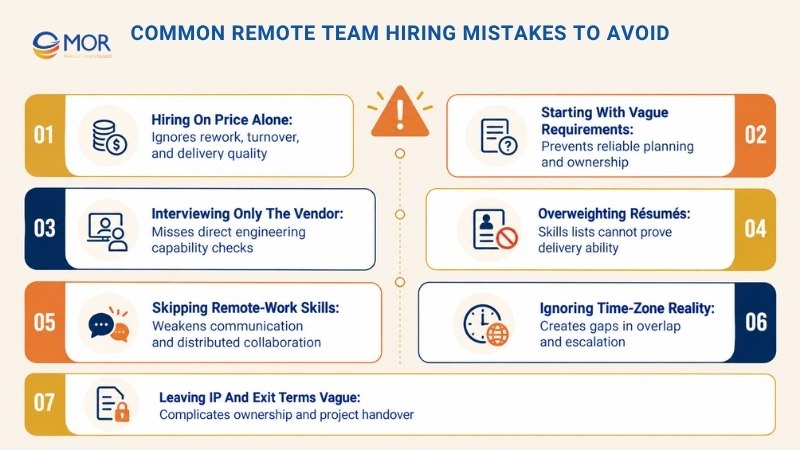
- Hiring on price alone: A lower hourly rate means little when rework, missed releases, or staff turnover increase total spend. Compare cost against delivered output.
- Starting with vague requirements: Developers can’t estimate, plan, or take ownership of an undefined result. Scope the problem before comparing candidates.
- Interviewing only the vendor: Meet the engineers who may work on your project. Sales capability and engineering capability are separate signals.
- Overweighting résumés: A long skills list doesn’t prove good system decisions. Real-ticket tasks, code reviews, and project discussions produce stronger evidence.
- Skipping remote-work skills: Remote engineers need written communication, blocker escalation, documentation habits, and disciplined async work.
- Ignoring time-zone reality: “We work your hours” means little until the schedule is written down. Confirm daily overlap and escalation coverage.
- Skipping the pilot: A small paid pilot tests code quality, communication, review speed, and working fit before a larger commitment.
- Leaving IP and exit terms vague: Ownership and handover become harder to negotiate once a relationship is already ending.
- Treating onboarding as admin: Product knowledge, architecture, business rules, and stakeholder access directly affect engineering output.
A weak onboarding process can make a strong developer look average. Fix the operating setup before assuming the hiring decision itself failed.
How to Choose the Right Remote Development Partner
Partner selection becomes easier once every vendor must answer the same questions. If you plan to hire remote software development team capacity through an agency, ask for evidence rather than broad claims about talent quality.
What to evaluate | Evidence to request |
Technical fit | Similar projects and architecture examples |
Industry experience | Relevant case studies and domain work |
Developer quality | CVs and interviews with proposed engineers |
Vetting process | Technical, communication, and remote-work checks |
Team stability | Retention data and average tenure |
Scalability | Access to additional or specialist roles |
Replacement process | Written replacement terms and timing |
Security | NDA, access controls, security policies, certifications where relevant |
Delivery visibility | Jira, GitHub/GitLab, sprint and release reporting |
Pricing | Rate cards, inclusions, billing rules, change terms |
References | Conversations with recent clients |
Pilot support | Paid real-project trial before expansion |
Pay attention to how a vendor handles questions it can’t answer immediately. A good partner should be able to explain staffing limits, technical risks, hiring lead time, and areas where a different approach may work better.
This is also where the difference between individual recruitment and managed delivery becomes clear. If the client must source every role, coordinate replacements, manage payroll, and create all team processes alone, the arrangement behaves more like direct hiring.
A company looking to hire a remote software development team for a core platform should also ask who owns technical leadership. Without clear architecture and product ownership, adding more developers can simply create more coordination work.
Save Time When Hiring a Remote Software Development Team with MOR Software
Companies often turn to MOR Software JSC when their internal hiring pace no longer matches product demand. Our Offshore Development Center (ODC) model is designed as an extension of the client's internal development team, giving clients access to extra skills and team capacity without taking on every recruitment and operational task themselves.
For businesses ready to hire remote software development team capacity, the value sits in how the team is formed and managed:
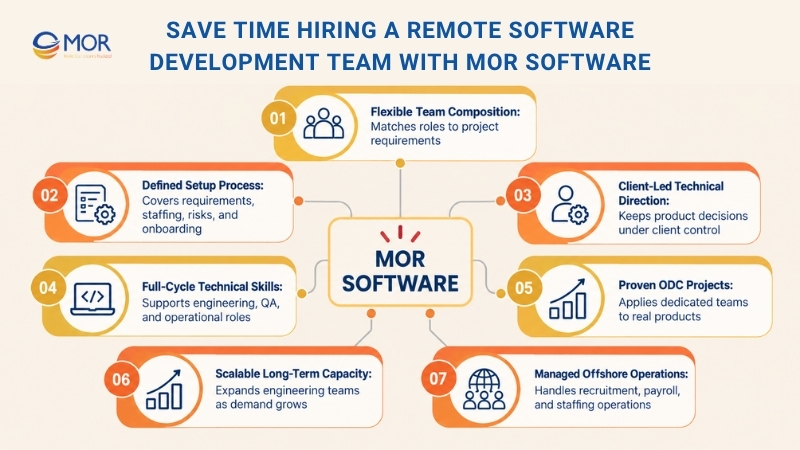
- Build around the skills your project actually needs: Clients can compose an offshore team across roles in the software development cycle and adjust the mix as project needs change. MOR Software's ODC materials describe flexible staffing based on client needs rather than one fixed team template.
- Move through a defined team setup process: We start by clarifying requirements and estimating people and timeline. The proposal can cover rates, collaboration methods, communication channels, risk management, and quality control before candidate selection and onboarding begin.
- Keep technical direction while we handle team operations: The dedicated team works under the client's instruction, while MOR Software manages operational work including recruitment and payroll. Team size can also change based on feedback and new delivery needs. MOR Dedicate teams
- Access skills across the development cycle: MOR's offshore materials list Angular, React, Node, and Python among its technical areas, supported by engineering, QA, and operational team roles.
- Use an ODC model already applied to real products: MOR Software lists offshore projects including the Python-based N-CLOUD CCTV Management System and an e-commerce management system using AWS and PHP. The CCTV project used a four-person team over eight months to build camera management, recording, export, and activity-detection functions.
- Scale a long-running product when demand grows: In the PEOPLE HR platform project, MOR Software supplied a dedicated engineering team and later grew its participation to nearly 100 developers as system demand expanded. A four-engineer unit also handled customer data integration work during the project.
This setup suits product companies and enterprises that need several engineering roles, long-term offshore capacity, or a team that can grow alongside the roadmap. It also works when the internal team wants to retain product and technical direction while MOR Software handles staffing and offshore operations.
Share your product scope, technology stack, required roles, expected team size, and timeline with us. Contact us to discuss an ODC structure that fits your development plan.
Conclusion
A successful decision to hire remote software development team capacity starts with clear scope, the right engagement model, real technical evidence, workable security terms, and disciplined onboarding. Cost matters, but team ownership, continuity, and delivery quality determine what the investment produces.
MOR Software supports companies that need dedicated offshore engineering capacity without building every role internally. If you’re planning to expand your development team, contact us with your project scope, required skills, expected team size, and timeline so we can recommend a suitable delivery model.
"Solutions Director at MOR Software, has extensive expertise in software development and management. He leads innovative projects and provides strategic solutions to enhance business operations, helping clients achieve digital transformation goals."
Pham Huu Canh


Solutions Director
MOR SOFTWARE
Frequently Asked Questions (FAQs)
How much does it cost to hire a remote software development team?
A five-person agency team can range from about $25,000 per month in parts of Asia to $150,000 per month for a U.S. agency, based on current 2026 market benchmarks. The actual figure changes with region, seniority, team mix, specialist skills, project length, and security requirements.
Compare total delivery cost rather than the hourly rate alone. Recruitment, management time, software tools, rework, infrastructure, and developer replacement can change the final budget.
How long does it take to hire a remote development team?
A pre-vetted vendor or established ODC provider can usually form a team faster than direct recruitment because sourcing and employment infrastructure already exist. Timing still depends on role scarcity, team size, seniority, technology, language requirements, and how much client interviewing is required.
Direct recruitment may take longer when each role runs through a separate hiring process. Specialist architects, AI engineers, and senior DevOps talent can also extend the timeline.
What is the ideal size of a remote software development team?
There’s no fixed ideal number. A small MVP may run with four or five people, while an enterprise platform may need separate frontend, backend, QA, DevOps, architecture, data, and product roles.
Start from the backlog and ownership areas rather than choosing a headcount first. Add roles when the work exposes a stable capacity or skill gap.
Which roles should a remote software development team include?
A common product team may include a Tech Lead, backend and frontend developers, QA engineer, DevOps engineer, UI/UX designer, and Product Manager or Project Manager. Mobile, data, AI, Business Analyst, or Solution Architect roles enter when the product calls for them.
The client doesn’t need every role full time. Some specialist skills can join during selected development phases.
Is a dedicated team better than staff augmentation?
A dedicated team fits long-running work where several engineers share product knowledge and delivery responsibility. Staff augmentation fits companies that already have leadership, processes, and a core engineering team but need extra people in selected roles.
Pick based on ownership and management capacity. A company missing only one backend engineer doesn’t need the same model as a company building an entire SaaS platform.
Which countries are best for hiring remote developers?
Vietnam, India, Eastern Europe, and Latin America are established markets, but each serves different business needs. Costs, time zones, English use, technology depth, domain experience, and provider maturity should drive the decision.
Country-level averages can narrow the list, but vendor-level evidence matters more. Two teams in the same location can differ greatly in seniority, retention, QA practice, and delivery management.
How do I verify technical skills before hiring?
Interview the actual engineers and ask them to explain previous technical decisions. Add a real-ticket task, code review, or architecture exercise that matches the work they’ll perform on your product.
A short paid pilot gives stronger evidence than another interview round. It shows code quality, communication, review behavior, time management, and ownership under real working conditions.
How much time-zone overlap does a remote team need?
The answer depends on the work. Product discovery, pair programming, stakeholder workshops, and fast incident response need more real-time overlap than a mature backlog built around async delivery.
Set a recurring window for planning, blockers, reviews, and key decisions. Keep the rest of the day available for focused development rather than forcing full schedule duplication.
How do I protect source code and IP with a remote team?
Put IP assignment, confidentiality, repository ownership, data handling, and access control into the contract before development starts. Keep project code and credentials inside client-approved systems where the engagement calls for client ownership.
Use role-based access, MFA, separate user accounts, documented offboarding, and immediate credential removal when someone leaves the team. Sensitive projects should add security reviews and sector-specific controls where required.
Can I scale a remote development team up or down?
Yes, most dedicated and staff augmentation models support team changes, but the contract should define notice periods and ramp-up expectations. Specialist roles may need more sourcing time than common development roles.
Protect knowledge when people rotate. Documentation, code review, stable technical leadership, and structured handover keep team changes from disrupting delivery.
Share


Make Our-Dreams Realized


© 2023 . MOR Software. All Rights Reserved
Sitemap
Privacy Policy
Terms of Use

Rate this article
0
over 5.0 based on 0 reviews
Your rating on this news:
Name
*Email
*Write your comment
*Send your comment
1