


How to Hire Dedicated Development Team in 2026: Business Guide
As tech talent becomes harder to secure and in-house costs keep rising, many companies choose to hire dedicated development team to stay competitive and scale faster. The challenge is knowing when this model fits and how to do it right without wasting budget. In this guide, MOR Software will explain how to hire effectively in 2026 and avoid common mistakes.
What Is The Dedicated Team Model?
A dedicated development team is a cooperation model where an external group of engineers works closely with your company over an extended period. When businesses decide to hire dedicated development team, they usually compare this setup with other common models like Fixed Price (FP) and Time & Materials (T&M), as all three are widely used in software projects.
When you choose a long-term team built around your goals, you receive specialists selected to match your product direction and technical needs. This reflects a dedicated team approach where skills, experience, and focus are aligned with what your business is trying to build.
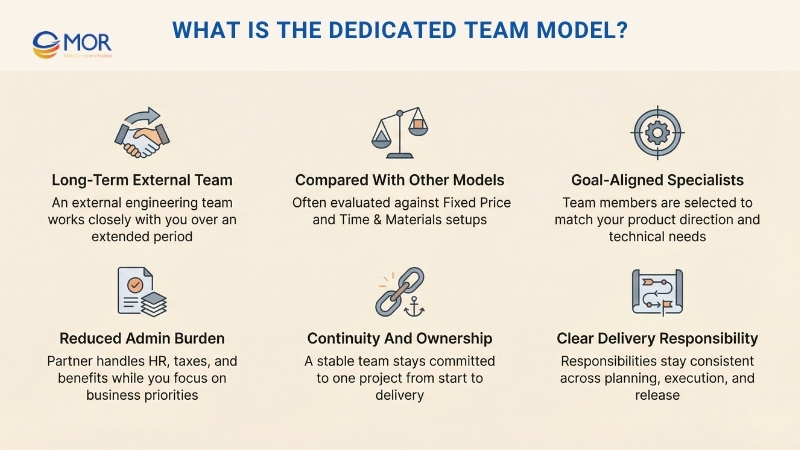
Unlike hiring full-time employees, this setup removes the burden of administration, HR, taxation, and employee benefits. You stay focused on strategic decisions and business priorities, while the external partner takes care of daily operations and team management.
In simple terms, this model gives you a carefully selected group of professionals committed to a single project, working with continuity and clear responsibility from start to delivery.
Who Is In A Dedicated Development Team?
The exact setup of your team depends on your business goals, project scope, and several other practical factors. In most cases, when companies choose to hire dedicated development team, the structure includes several core roles made up of dedicated software developers and supporting specialists listed below.
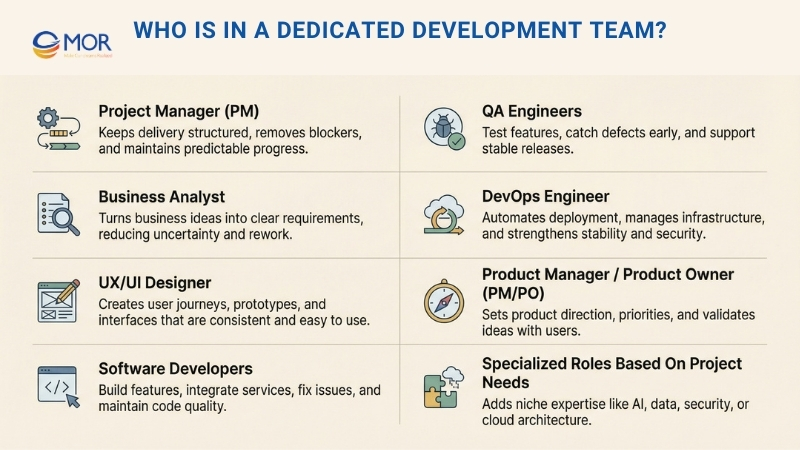
Project Manager (PM)
Project Managers play an important role in keeping teams productive and clients satisfied. In this delivery model, where consistent speed and predictable results matter, a PM keeps workflows structured, removes obstacles, and ensures progress stays on schedule.
Core responsibility:
Create a clear and predictable delivery process so everyone understands their tasks, the purpose behind them, and the deadlines involved.
Day-to-day activities:
- Plan sprints, monitor timelines, and coordinate team activities.
- Communicate directly with the client.
- Track budget, manage risks, and share progress updates.
- Resolve blockers and maintain steady delivery.
Key deliverables:
Weekly updates, structured plans, smooth execution, and minimal disruption.
Business Analyst
A Business Analyst (BA) transforms vague or incomplete business ideas into clear and structured requirements that technical teams can implement. Their main contribution is reducing uncertainty, limiting rework, and keeping delivery predictable, which is often critical when companies decide to hire dedicated IT team support.
Core responsibility:
Translate business logic into well-defined technical requirements.
Day-to-day activities:
- Collect and clarify requirements.
- Map workflows, user journeys, edge cases, and constraints.
- Prepare functional documentation and acceptance criteria.
- Work closely with the PM and developers to remove confusion.
Key deliverables:
Use cases, process diagrams, and detailed requirement documents that developers can follow with confidence.
UX/UI Designer
UX/UI designers provide clear visual and interaction direction throughout the development cycle. They shape intuitive user journeys, clean layouts, and a consistent interface that feels natural and easy for your users to navigate.
Core responsibility:
Turn functional requirements into an intuitive and user-friendly product or application design.
Day-to-day activities:
- Conduct user research through interviews, surveys, and heuristic reviews.
- Create wireframes, user flows, and interactive prototypes.
- Design final screens, UI kits, and interaction patterns.
- Ensure accessibility standards, usability rules, and visual consistency.
- Work closely with developers to confirm the design is implemented as intended.
Key deliverables:
Well-documented design handoffs and a consistent design system ready for development.
Software Developers
Within this delivery model, developers act as the main execution engine that produces real business results. Every supporting role exists to help them work faster, cleaner, and with fewer mistakes, which is why many companies choose to hire dedicated developers team built around experienced dedicated programmers.
Core responsibility:
Develop the core product features and convert requirements, designs, and business rules into functional software.
Day-to-day activities:
- Build features based on specifications provided by the PM or BA.
- Convert design files into real and usable product behavior.
- Connect external services, libraries, and APIs.
- Analyze and resolve technical issues, bugs, and edge cases.
- Review peer code and maintain overall code quality.
- Improve performance, system stability, and scalability.
- Collaborate with QA, designers, and the PM to fine-tune functionality.
Key deliverables:
A stable, maintainable, and high-quality product that performs reliably and improves over time without causing regressions.
QA Engineers
QA engineers have a direct effect on release speed, system reliability, and overall user satisfaction.
Core responsibility:
Confirm that features work as intended, detect issues early, and identify broken flows or unexpected defects.
Day-to-day activities:
- Prepare test plans and detailed test cases.
- Test new functionality through manual checks or automated testing.
- Review edge cases, performance behavior, and usability.
- Confirm fixes and run regression testing.
Key deliverables:
Clear bug reports, structured test suites, and stable production releases.
DevOps Engineer
In many projects, especially smaller ones, DevOps tasks are often handled by developers. They configure CI/CD, manage basic cloud setups, and keep deployments running without disruption.
Still, for larger platforms, multi-environment systems, or products with strict uptime and security needs, the workload grows enough to require a dedicated DevOps engineer. This is common in enterprise stacks that rely on a dedicated team java setup and complex backend environments. For teams that need extra guidance on infrastructure strategy, DevOps consulting services, can fill gaps without slowing delivery.
Core responsibility:
Deliver an automated and secure path from development to production with minimal downtime, manual steps, or operational friction.
Day-to-day activities:
- Build CI/CD pipelines to automate build, test, and deployment flows.
- Manage cloud infrastructure across AWS, GCP, and Azure, and fine-tune environments.
- Apply Infrastructure as Code practices.
- Set up monitoring, logging, and alerting tools.
- Maintain system security, backups, redundancy, and disaster recovery plans.
- Work with developers to smooth release processes and solve environment issues.
- Improve performance, scalability, and cloud cost control.
Key deliverables:
Reliable environments, fast automated deployments, strong system stability, monitoring dashboards, and predictable releases without service interruptions.
Product Manager / Product Owner (PM/PO)
If you need a product-focused team to build an MVP, a SaaS platform, or plan long-term SaaS software development or a complex application for a complex application, a PM or PO is one of the roles with the highest return on investment. In contrast, when you extend an engineering-only setup, this position can be optional, especially if you already have strong product leadership in-house.
Core responsibility:
Set direction, translate goals into a practical plan, and confirm the product logic is sound.
Day-to-day activities:
- Define the product development vision, priorities, and roadmap.
- Break business objectives into epics and individual features.
- Decide what to build and explain the reasoning behind each choice.
- Validate ideas, speak with users, and collect feedback.
- Align the entire team around shared product goals.
Key deliverables:
A clear roadmap, a prioritized backlog, and detailed feature requirements.
Specialized Roles Based On Project Needs
Some products need skills that go beyond the standard team structure. When your project involves complex domains or niche technologies, it is important to share these needs early while forming a dedicated development team for hire. This allows the vendor to prepare the right expertise from the start.
In some cases, machine learning outsourcing, is a practical way to add specialized expertise quickly.
Depending on the scope, you may require specialists such as:
- Machine Learning and AI engineers
- Data engineers
- AR or VR specialists
- Security or compliance experts
- Cloud architects
- Automation engineers
These roles extend beyond the scope of general developers. Adding them helps confirm that unique technical demands are handled by professionals with the right background, without slowing delivery or lowering quality.
Key Benefits When You Hire Dedicated Development Team
When companies decide to hire dedicated development team, they usually look for long-term value, not short-term fixes. This setup supports steady delivery, clear ownership, and better control when projects grow in size or complexity.
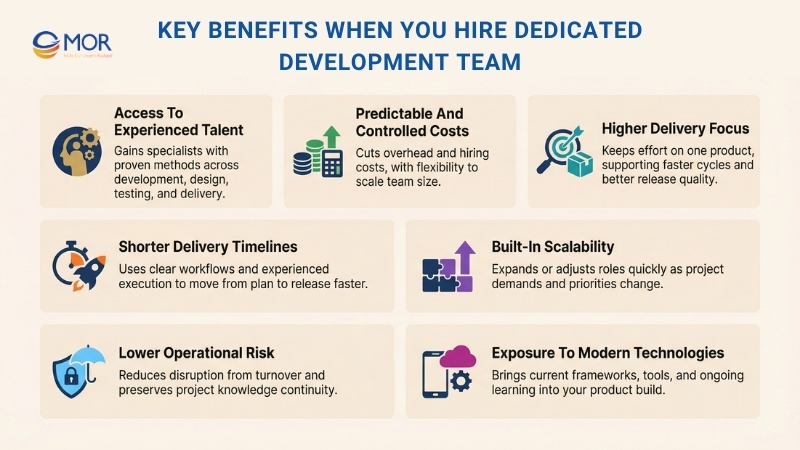
Access To Experienced Talent
Deep Expertise And Focused Skills
A dedicated team consists of professionals with strong backgrounds in software development and related fields. When businesses choose to hire dedicated software development team, they gain access to specialists who know proven methods and follow established industry standards. This level of expertise helps teams deliver reliable and well-structured solutions with fewer mistakes. In addition, these teams often cover a wide range of skills, from backend coding and UX/UI design to testing and coordination, which keeps work moving smoothly and avoids delays.
Broad And Balanced Skill Coverage
These teams usually include developers, designers, testers, and project managers working together. This structure allows every stage of the software development lifecycle to receive proper attention, which supports consistent quality from planning through release.
Demonstrated Delivery History
Another strong advantage comes from proven results. Many teams have delivered projects across different industries and business models, showing they can meet deadlines and stay within agreed budgets. Their past work and portfolios give you clear evidence of capability and help build trust in their ability to deliver your project successfully.
Predictable And Controlled Costs
Reduced Day-To-Day Expenses
Building an internal team brings many ongoing costs, including office space, hardware, software licenses, and infrastructure upkeep. A dedicated remote development team removes most of these expenses since the team works from its own location and manages its own tools. This setup lets you direct more of your budget toward actual product development. If your product runs heavily on cloud services, tracking the cost of cloud computing alongside team rates will keep forecasts accurate.
No Hiring Or Training Overhead
Finding and training full-time staff often takes a lot of time and money. When companies work with a long-term external team, they skip recruitment, onboarding, and training because the specialists already have the required skills. This helps projects start faster and limits unnecessary spending.
Adjustable Team Size
This model also allows easy changes to team size. You can add or reduce people based on current project needs without long-term commitments. This flexibility keeps costs under control while development work continues at a steady pace.
Higher Delivery Focus
Full Attention On One Product
Unlike internal teams that often split time across several initiatives, this setup keeps all effort on a single product. That clear focus helps the team move faster, shorten build cycles, and improve the quality of each release.
Better Use Of Time And Process
These teams rely on structured delivery methods like Agile and Scrum to keep work organized and deadlines realistic. Clear task ownership and close collaboration reduce slowdowns and keep progress steady. Most long-term external teams use Agile practices, which helps them adapt to changing needs, improve step by step, and lower delivery risk while meeting real business goals.
Shorter Delivery Timelines
Clear And Structured Workflows
A dedicated software development team works with defined processes that reduce delays and wasted effort. Clear ownership and an organized workflow help tasks move forward smoothly, which shortens the overall delivery cycle.
Faster Execution From Start To Release
These teams include experienced specialists who can review requirements, plan the work, and move into execution without long ramp-up time. This pace supports quicker development cycles and helps you release products sooner, which strengthens your position in the market.
Flexibility As Business Needs Change
Business priorities and market expectations can shift quickly. This setup allows the team to adjust direction, add new features, or change priorities without slowing progress, keeping the product aligned with current goals and user needs.
Built-In Scalability
Easy Resource Growth
One key advantage of this setup is how easily you can grow the team when needs increase. If you decide to hire dedicated team of developers, adding more engineers, designers, or testers can happen quickly to match rising project demands.
Tailored Team Setup
Every software initiative comes with its own goals and constraints. This model lets you select specialists with the right skills and experience so the team matches your vision from the start. That level of control supports smoother execution and more consistent results.
Flexible Team Adjustment
Project requirements often change over time. As priorities shift or new challenges appear, the team structure can be adjusted to fit each development phase. This flexibility helps maintain efficiency across the full project lifecycle without unnecessary overhead.
Lower Operational Risk
Less Exposure To Staff Turnover
Running an internal development team often involves the risk of people leaving, which can disrupt schedules and slow progress. This setup reduces that risk because the team stays intact and focused on your project over time.
Fewer Delays And Setbacks
These teams bring experience from complex projects, which helps them spot potential issues early and deal with them before they grow. A structured way of working keeps delivery on course and lowers the chance of missed deadlines or failed releases.
Strong Knowledge Continuity
With in-house teams, staff changes can cause loss of key project knowledge. In contrast, this model keeps the same people involved from start to finish, which supports smooth knowledge sharing and consistent progress throughout the project.
Exposure To Modern Technologies
Strong Technical Know-How
A long-term external team stays current with new technologies, frameworks, and programming languages. When companies decide to hire software team support, they gain access to up-to-date technical skills that help improve system performance, security, and scalability.
Ready-Made Tools And Environments
Setting up and maintaining internal development infrastructure often requires high cost and ongoing effort. These teams already operate with their own hardware, software, and tooling, which removes the need for you to invest in extra technical resources.
Ongoing Learning And Improvement
Technology changes quickly, and these teams place strong focus on continuous learning. Their habit of following industry updates helps make sure your product is built with modern, reliable, and well-performing solutions that stay relevant over time.
3 Scenarios To Hire Dedicated Development Team
This delivery model works best for companies facing uncertainty, scaling at speed, or building products that need room to grow over time.
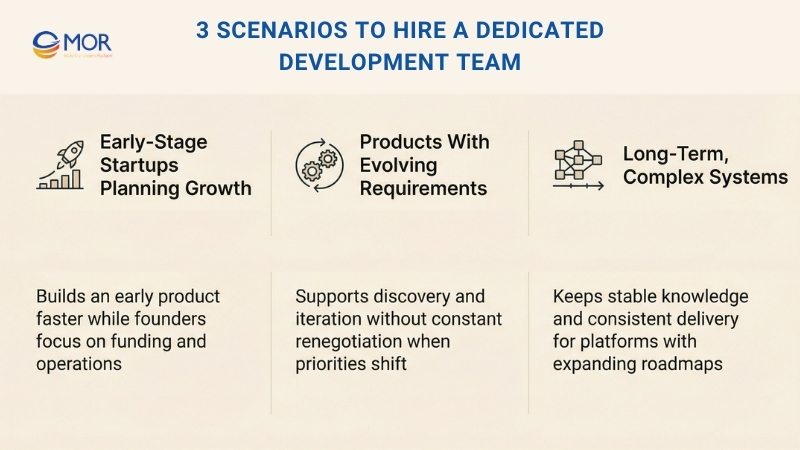
Below are three situations where choosing to hire dedicated development team can be the right move for your business.
Early-Stage Startups Planning Growth
If you run an early-stage startup with growth ahead, it makes sense to hire dedicated development team early on. When you are building the first version, testing assumptions, or preparing for investor discussions, this setup can cut time to market in a meaningful way.
With this setup, you can:
- Form a team quickly without long hiring cycles.
- Reduce spending on recruitment, onboarding, and internal overhead.
- Keep momentum while your internal team focuses on fundraising, operations, sales, or partnerships.
- Add or remove roles as priorities shift, including design, backend, QA, or ML.
While your internal team manages strategy, funding, partnerships, and marketing, the external team keeps product delivery moving. This setup helps many startups move from idea to MVP to early traction much faster.
Products With Evolving Requirements
When your idea lacks clear product market fit and requires a discovery stage, working with a hire dedicated remote development team often makes the most sense.
This setup gives you:
- Enough time and flexibility to shape requirements without paying extra.
- Freedom to adjust direction based on real user feedback.
- Room to experiment through MVP creation, iteration, and refinement.
- A steady monthly cost even when priorities change often.
Discovery work can take several months. This approach provides continuity and capacity to explore properly, without wasting budget on repeated scope changes.
Long-Term, Complex Systems
This model also suits large and long-running initiatives that are likely to expand over time. Products with extended roadmaps, including scaling platforms, SaaS solutions, fintech or healthtech systems, and AI-based tools, gain clear benefits from stability and strong product knowledge when working with a dedicated team of developers for hire.
With this setup, you gain:
- Ongoing retention of technical and product knowledge.
- Consistent implementation across features and releases.
- Simple scaling when the roadmap grows or shifts.
- No risk tied to hiring or letting people go as priorities change.
For this reason, many companies move to this model after the prototype or pre-seed phase, once they need predictable delivery from a stable and committed team.
3 Situations Where A Dedicated Team Is Not Ideal
Even with clear advantages, this model does not suit every situation. There are cases where choosing not to work with a long-term external team is the more practical option.
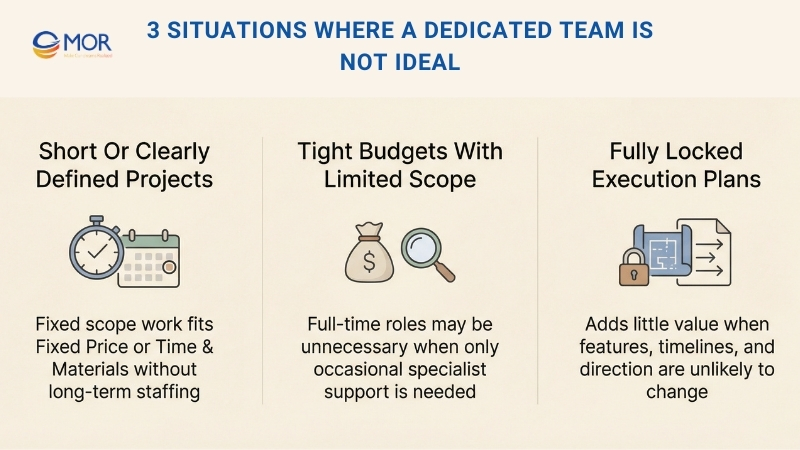
Short Or Clearly Defined Projects
You do not need to bring in a long-term team for small initiatives with fixed and well-defined requirements. When the scope is clear from the start, the main goal is simple execution.
In these situations:
- A fixed-price model works well for short projects where all features are known in advance.
- Time and Materials fits mid-length work where requirements may change slightly, but long-term team stability is not required.
Using a full-time external team in this case is excessive. You would be paying for availability and continuity that the project does not actually need.
Tight Budgets With Limited Scope
When your project budget is fixed with little room to move, this setup is often not the right choice. In many cases, you do not need a full-time designer or a project manager throughout the entire timeline. In this situation:
- A fixed-price contract helps you control and limit total spending.
- A hybrid or Time and Materials model allows you to bring in specialists only when they are needed.
If you are not planning ongoing development, committing to a full-time external team does not make sense and removes the cost advantage.
Fully Locked Execution Plans
This model works best when projects change, grow, and adapt over time.
However, if your project includes:
- A strict and unchanging execution plan.
- A complete and finalized list of features.
- No planned discovery or experimentation phase.
- Very little chance of changing direction.
Then a long-term team setup adds little value.
You would be paying for flexibility and long-term involvement without actually using either.
In these cases, a fixed-price or Time and Materials approach is usually more practical and far more cost-effective.
8 Steps To Hire Dedicated Development Team
You can work with dedicated developers through different channels. Still, when you follow a clear process, you improve your chances of choosing the right people and making the decision successful. Below are the first steps to hire dedicated development team support for your project.
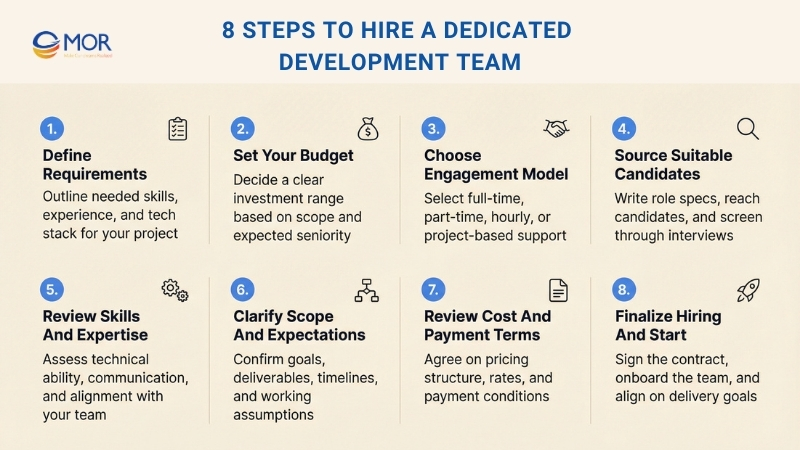
Define Your Requirements
Before you move forward, clearly outline the skills, experience, and expertise your project requires. You should also review the technology stack, relevant industry background, and any other essential needs that support successful delivery.
Set Your Budget
The next step involves defining how much you plan to invest in development. Set a clear budget range for the work ahead. Keep in mind that total cost varies based on the level of skill, experience, and specialization you expect from the team or individual developers.
Choose An Engagement Model
After clarifying requirements and budget, select the engagement structure that fits your situation best. Common options include full-time, part-time, hourly, or project-based setups. Each model works differently depending on project scope, budget limits, delivery timeline, and the level of flexibility you need.
Source Suitable Candidates
Prepare a clear role description that explains your expectations, required qualifications, and technical needs. You should also include the soft skills needed to work closely with project coordinators. After defining these points, use several channels to reach potential candidates. Begin screening through interviews that focus on problem-solving ability, technical strength, and real project experience.
Review Skills And Expertise
Assess each candidate’s technical knowledge, communication style, and cultural alignment with your organization. Check their experience with the tools and technologies your project depends on. You should also look at previous projects, portfolios, professional background, and any contributions they have made to the tech community.
Clarify Project Scope And Expectations
Once you are satisfied with the evaluation, clearly explain the project goals, requirements, and overall objectives to shortlisted candidates. Make sure they understand the full scope, expected deliverables, and any challenges they may face during development.
Review Cost And Payment Terms
After you narrow down your candidates, move on to discussing pricing and payment details. Agree on compensation based on project scope, working hours, or a fixed monthly rate. Factor in each candidate’s skill level, experience, and current market rates. Aim for terms that fit your budget and meet the candidate’s expectations.
Finalize Hiring And Start The Project
In the final step, confirm agreement from both sides and complete the contract with clear details on scope, timeline, deliverables, and related terms. Once everything is signed, onboard the selected candidate and align them with your team’s goals and planned outcomes.
Common Pitfalls When Hiring Dedicated Developers
Choosing the wrong approach can cost you time, budget, and delivery speed. Before moving forward, it helps to understand the basic do’s and don’ts of outsourcing software development projects.
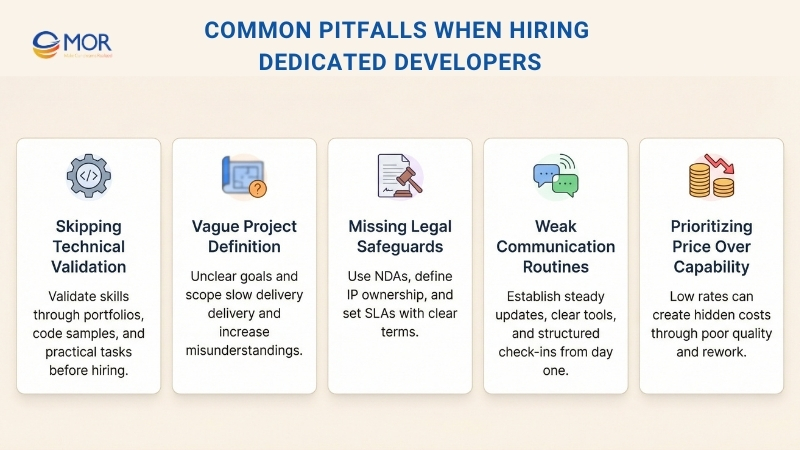
Below are common mistakes you should avoid.
Skipping Technical Validation
Do not assume that every developer with a polished resume is the right choice. Before you hire dedicated developers, always carry out proper technical validation. Review portfolios, check real code samples, and use small problem-solving tasks to assess skill level.
This step matters even more when you plan to build a long-term dedicated software development team for projects like MVP delivery in the USA. Careful screening helps confirm that candidates understand your tech stack and can deliver on time without cutting quality.
Vague Project Definition
Lack of clarity quickly slows progress. When goals, timelines, or scope are unclear, even strong teams can struggle. If you work with a long-term external team, always begin with a clear project brief that outlines core features, user flows, and key deadlines.
Clear documentation limits scope creep and reduces misunderstandings. A software project moves forward smoothly when both sides share the same view of what success looks like from the very beginning.
Missing Legal Safeguards
Working with an external software team, especially across borders, without clear legal terms can quickly create serious problems. Before onboarding begins, you should sign NDAs to protect sensitive data and clearly define IP ownership inside the contract.
You should also confirm that the SLA or Service Level Agreement outlines deliverables, timelines, and penalties for delays. When you work with a long-term external development partner, these legal foundations protect your business and give the collaboration a clear and stable structure. These safeguards are a core part of outsourcing risk management when your team and vendor operate in different regions.
Weak Communication Routines
Poor communication is one of the main reasons software projects fail. When updates are inconsistent or feedback does not reach the right people, delays become unavoidable. If you work with external developers or an offshore team, you need clear communication routines from the start, including weekly check-ins, daily stand-ups, and shared tracking tools.
Using platforms like Slack, Jira, or Trello helps everyone stay aligned. A strong team setup should feel like a natural extension of your internal staff, not a disconnected third party working in isolation.
Prioritizing Price Over Capability
It is easy to choose the lowest price when you work with external developers. In software projects, cheaper options often bring hidden costs. Low rates can result in weak code quality, unstable releases, and higher effort needed for fixes and maintenance.
When you work with web specialists or AI engineers, focus on experience, dependability, and team fit instead of hourly cost alone. Putting budget into a strong development partner supports smoother delivery, fewer problems, and a product that can grow with your business over time.
How Much Does It Cost To Hire Dedicated Development Team?
According to Deloitte’s Global Outsourcing Survey, around 80% of executives plan to maintain or increase spending on third-party outsourcing. Cost savings remain one of the strongest reasons companies choose this path when they decide to hire dedicated development team support. That momentum reflects broader IT outsourcing trends as companies prioritize flexibility and predictable spending.
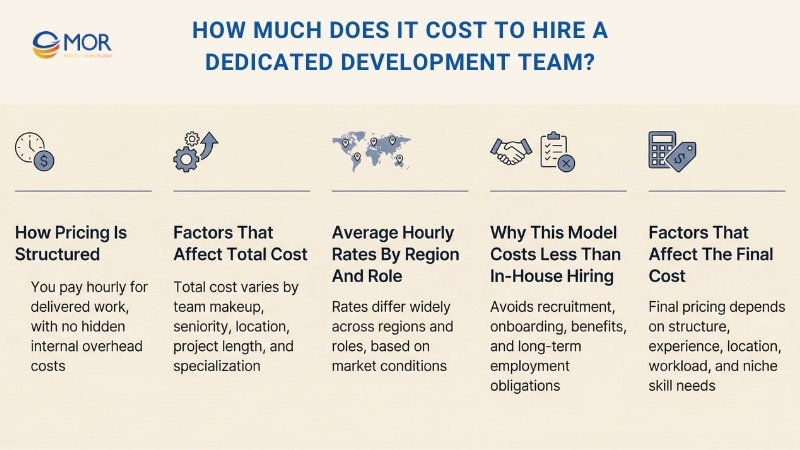
How Pricing Is Structured
The cost model for a long-term external team is intentionally straightforward:
- Each specialist works with an hourly rate, including developers, designers, QA engineers, PMs, and BAs.
- You pay only for the hours that are actually delivered.
- There are no hidden operational costs, including office rent, hardware, software licenses, employee taxes, onboarding effort, or HR administration.
This means your budget is spent on real development work instead of internal overhead. For many organizations, especially startups and teams based in high-cost regions, this structure alone can lead to meaningful savings.
Factors That Affect Total Cost
Even with a clear pricing structure, the final cost is shaped by several key factors:
- Team structure, whether you work with engineers only or a full cross-functional unit.
- Seniority and experience levels within the team.
- Location of the delivery partner, such as Eastern Europe, LATAM, or the US.
- Project length and overall workload.
- The need for specialized skills, including AI, ML, DevOps, or cybersecurity.
If AI is part of your scope, budgeting separately for AI development cost can help you avoid surprises.
Still, the main value stays the same. This model gives you predictable monthly spending, removes internal overhead, and lowers hiring and operating costs, while preserving long-term focus and team continuity.
Average Hourly Rates By Region And Role
Note: Based on market research and publicly available data, the cost to hire dedicated remote developers team usually falls within the ranges shown below. Actual rates vary based on developer seniority, technology stack, and project scope, so these figures should be treated as general guidance rather than fixed pricing.
Role | Eastern Europe (Mid, Senior) | LATAM (Mid, Senior) | US/Canada (Senior) | Southeast Asia incl. Vietnam (Mid, Senior) |
| Backend Developer | ~$35–$65/hr | ~$50–$80/hr | ~$70–$150/hr | ~$20–$55/hr |
| Frontend Developer | ~$30–$60/hr | ~$45–$75/hr | ~$65–$140/hr | ~$18–$50/hr |
| Mobile Developer (iOS/Android) | ~$40–$70/hr | ~$55–$78/hr | ~$80–$160/hr | ~$22–$60/hr |
| Full-Stack Developer | ~$40–$75/hr | ~$35–$65/hr | ~$90–$170/hr | ~$20–$55/hr |
| UI/UX Designer | ~$30–$55/hr | ~$28–$50/hr | ~$60–$120/hr | ~$15–$45/hr |
| QA Engineer | ~$25–$50/hr | ~$30–$50/hr | ~$50–$110/hr | ~$15–$40/hr |
| Project Manager / Product Owner | ~$35–$65/hr | ~$45–$70/hr | ~$70–$150/hr | ~$30–$65/hr |
| Business Analyst | ~$30–$55/hr | ~$30–$50/hr | ~$60–$130/hr | ~$25–$55/hr |
| DevOps Engineer | ~$45–$80/hr | ~$45–$75/hr | ~$90–$180/hr | ~$30–$70/hr |
| ML/AI Engineer | ~$50–$90/hr | ~$60–$90/hr | ~$100–$220/hr | ~$35–$80/hr |
Why This Model Costs Less Than In-House Hiring
Building a full internal team often involves slow and costly steps, including recruitment, screening, onboarding, trial periods, retention efforts, employee benefits, equipment, and ongoing administrative work.
This setup removes those burdens.
You benefit from:
- Faster team setup, measured in days or weeks instead of months.
- Access to professionals who are already vetted.
- No spending on recruitment activities.
- No long-term employment obligations.
- The ability to scale the team up or down as needed.
Factors That Affect The Final Cost
Even though the pricing model is clear, the final amount depends on several elements:
- Team structure, whether you work only with engineers or a full cross-functional group.
- Experience and seniority levels.
- Location of the delivery partner, for example Eastern Europe, LATAM, or the US.
- Project length and workload volume.
- The need for specialized skills, including AI, ML, DevOps, or cybersecurity.
The core value stays consistent. This model offers predictable monthly costs, removes internal overhead, and lowers hiring and operating expenses, while still providing long-term focus and continuity.
Hire Dedicated Development Team From MOR Software
When you hire dedicated development team from MOR Software, you get more than extra engineers. You get a stable team built around your product goals, timelines, and technical needs. We form teams that stay focused on one project, so progress does not reset every few months.
We start by understanding what you are building and how fast it needs to move. From there, we assemble the right mix of developers, QA engineers, and delivery leads. Each role has clear ownership, clear output, and clear communication lines. That structure helps teams move with less friction and fewer handoffs.
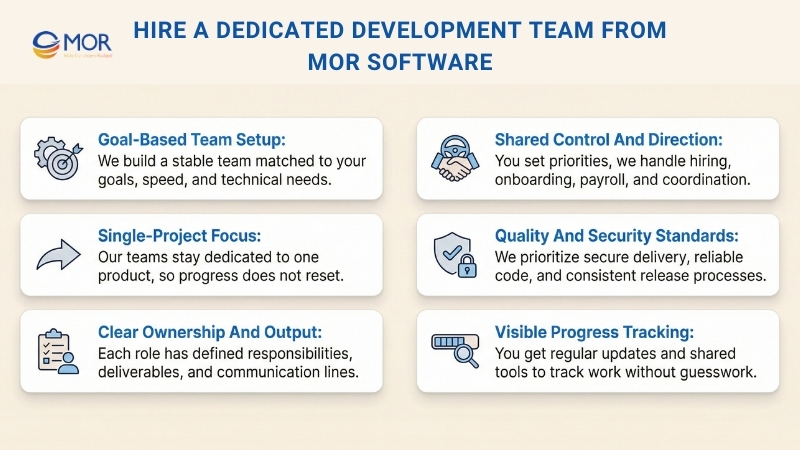
Our dedicated software teams work as part of your business, not a detached vendor group. You keep control over priorities and direction. We handle hiring, onboarding, payroll, and daily coordination. This setup lets you scale the team up or down without long delays or internal overhead.
Security, code quality, and delivery consistency guide how we work. You see progress through regular updates and shared tools, not guesswork. For companies planning long-term products in 2026, this model brings stability, clarity, and room to grow without slowing down.
Conclusion
Choosing to hire dedicated development team is a strategic move for companies that need long-term focus, predictable delivery, and flexible scaling in 2026. When done right, this model reduces risk, controls cost, and keeps product momentum strong. With proven experience in building stable, high-performing teams, MOR Software helps you move faster without losing control. Contact us to discuss your goals and start building a dedicated team that truly fits your business.
MOR SOFTWARE
Frequently Asked Questions (FAQs)
What does it mean to hire dedicated development team?
Hiring a dedicated development team means working with a group of developers and related roles assigned only to your project. The team works long term, follows your priorities, and operates like an extension of your in-house staff.
How is a dedicated development team different from freelancers or project outsourcing?
A dedicated team stays with one product and one client. Freelancers and short-term outsourcing focus on tasks. Dedicated teams build product knowledge over time and support continuous development.
When should a company hire dedicated software development team?
This model fits long-term projects, products with changing requirements, or platforms that need regular updates. It is often used by startups, SaaS companies, and growing businesses.
What roles are usually included in a dedicated development team?
Most teams include software developers, a project manager, and QA engineers. Depending on the project, designers, business analysts, or DevOps specialists may also be included.
How much does it cost to hire dedicated development team?
The cost depends on team size, role mix, experience level, and region. Pricing is usually hourly or monthly, and businesses only pay for productive work time.
Is a dedicated development team a good choice for small projects?
Not always. For short or clearly defined projects, fixed-price or time-based models often work better. A dedicated team is more suitable for ongoing or evolving work.
How do teams communicate and manage work in this model?
Teams usually follow regular meetings, sprint planning, and shared tracking tools. Clear communication routines help keep progress aligned with business goals.
Can the team size change during the project?
Yes. One advantage of a dedicated development team is flexibility. Team members can be added or reduced as priorities and workload change.
What risks should businesses watch out for when hiring a dedicated development team?
Common risks include unclear requirements, weak communication, and poor technical screening. These issues can be avoided with clear contracts, defined goals, and regular collaboration.
Share


Make Our-Dreams Realized


© 2023 . MOR Software. All Rights Reserved
Sitemap
Privacy Policy
Terms of Use

Rate this article
0
over 5.0 based on 0 reviews
Your rating on this news:
Name
*Email
*Write your comment
*Send your comment
1