


Medicine Delivery App Development: Costs, Features & Steps 2026
Medicine delivery app development helps pharmacies and healthcare businesses bring medicine ordering, prescription checks, and home delivery into one platform. Patients can request medications remotely, while pharmacies manage orders, stock, and delivery through connected systems. Building these apps takes careful planning around patient data, legal requirements, and pharmacy workflows. In this guide, MOR Software will cover market trends, core features, development steps, technology choices, and costs to help you plan your project.
Key Takeaways
- Medicine delivery apps connect patients, licensed pharmacies, and couriers through digital ordering, prescription verification, payments, and delivery tracking.
- Development requires careful planning around pharmacy licensing, patient data security, inventory integration, and regulatory rules before launching.
- Development costs depend on the number of applications, integration needs, and project scope. A focused MVP typically costs less than a multi-pharmacy platform with complex workflows.
What Is a Medicine Delivery App?
A medicine delivery app is a mobile or web-based platform that lets patients order prescription and over-the-counter (OTC) medicines from pharmacies for home delivery. It connects customers, pharmacists, delivery partners, and platform administrators through one system.
Unlike ordinary shopping apps, these platforms must account for prescription validity, pharmacy licensing, medicine storage, and patient privacy. Online medicine delivery app development also involves building tools that help pharmacies review orders and manage stock before dispensing medications.
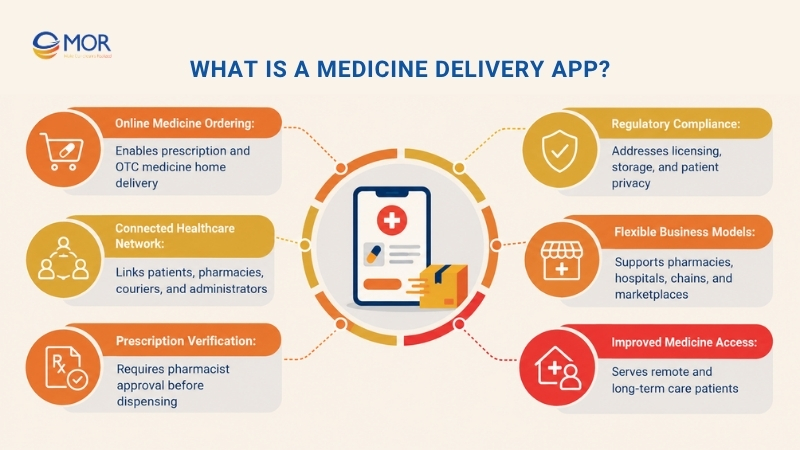
For instance, patients can find a prescribed medicine, submit their prescription, and request delivery. A licensed pharmacy checks the request, prepares the order, and arranges shipment through its delivery network.
Depending on the business model, medicine delivery software can support a single pharmacy, a large pharmacy chain, a hospital, or a marketplace connecting independent pharmacies.
These platforms are particularly useful for patients managing long-term conditions or living far from a pharmacy. A study reported by Ohio State University found that about 46% of U.S. counties had at least one pharmacy desert, an area without a retail pharmacy within 10 miles.
Medicine Delivery App Market Overview
The medicine delivery market continues to expand as more consumers order healthcare products online. Growth in chronic care, digital prescriptions, and mobile payments is also changing how pharmacies serve their customers.
According to Fortune Business Insights, the global ePharmacy market was valued at $150.7 billion in 2025 and is projected to reach $733.38 billion by 2034.
Market Metric | Value | Source |
Global ePharmacy market in 2025 | $150.7 billion | Fortune Business Insights |
Estimated market size in 2026 | $177.79 billion | Fortune Business Insights |
Projected market size in 2034 | $733.38 billion | Fortune Business Insights |
CAGR from 2026 to 2034 | 19.38% | Fortune Business Insights |
These figures cover the wider ePharmacy market, including prescription and OTC sales, rather than the software development market alone.
North America accounts for a large share of online pharmacy spending, supported by established pharmacy chains, insurance networks, and home delivery services. Europe is expanding digital prescription services, while Asia-Pacific markets continue to develop online medicine ordering and healthcare platforms.
Several trends are shaping this demand:
- Recurring medicine delivery: Patients managing long-term conditions benefit from scheduled refills and repeat ordering.
- Telehealth integration: Healthcare platforms connect online consultations with prescription services and pharmacy fulfillment.
- AI-assisted pharmacy operations: AI tools can support prescription data extraction, inventory forecasts, and delivery planning.
- Faster fulfillment: Local pharmacy networks and delivery partners make same-day services possible in eligible areas.
- Digital patient services: Medication histories, caregiver accounts, and pharmacist communication support ongoing care.
For startups, on demand medicine delivery app development creates opportunities to serve local communities through existing licensed pharmacies. Yet market size alone doesn't prove a business will succeed. Order volume, delivery costs, pharmacy partnerships, and repeat purchases still determine whether the model works.
Pharmacies planning new products can also review related healthcare app ideas before selecting a specific service model.
Key Features of a Medicine Delivery App
Medicine delivery platforms generally require four connected interfaces: a customer app, pharmacy panel, delivery partner app, and admin dashboard. Each interface serves different users, but they share order data and status updates.
For medicine delivery mobile app development, teams should first identify the features required to complete an order safely. Extra services can be added once the main prescription and delivery workflows work reliably.
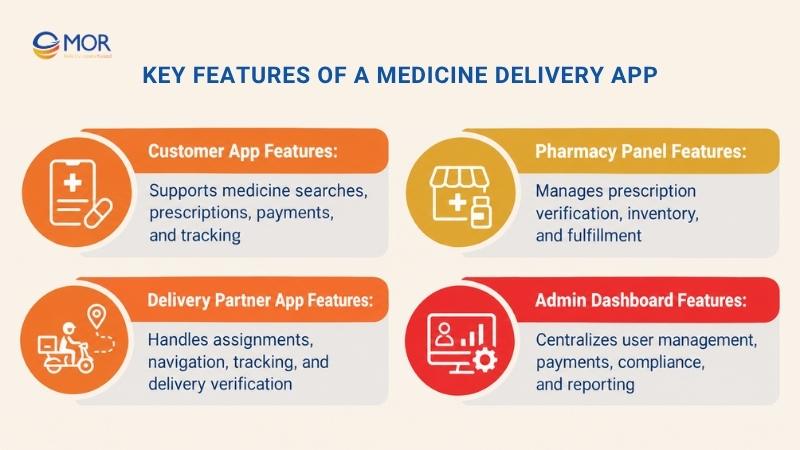
Customer App Features
Patients need a simple way to find medicines, manage prescriptions, and follow their orders. Clear navigation, readable text, and accurate order details are particularly helpful for older users.
- Medicine search: Let patients search by medicine name, brand, generic name, or category using reliable product information.
- Prescription upload: Accept photos or PDF files and display whether a prescription needs review, correction, or approval.
- Secure payments: Support suitable payment methods, price details, delivery fees, and electronic receipts.
- Order tracking: Show order progress, estimated arrival windows, and delivery updates.
- Refill reminders: Alert patients when recurring medicines may need renewal, based on prescription and refill rules.
- Order history: Let users review past orders and request eligible refills without repeating every step.
For example, a patient taking regular medication may use reminders to start the refill process before their current supply runs out. The pharmacy still checks whether another dispensing is authorized.
Pharmacy Panel Features
Pharmacy staff need direct access to prescription details, stock availability, and fulfillment tasks. A clear review queue helps pharmacists handle incoming requests without losing track of orders awaiting clarification.
- Prescription verification: Review prescriptions, record approval decisions, and request missing information before dispensing.
- Inventory management: Track available medicine quantities and synchronize stock across participating locations.
- Order processing: Manage picking, packing, dispatch, cancellations, and order status updates.
- Expiry date tracking: Record medicine batches, expiry dates, and relevant product details to support stock control and recalls.
- Sales analytics: Monitor order volumes, fulfillment rates, frequently requested products, and pharmacy activity.
An accurate inventory feed can prevent customers from ordering medicines that are already unavailable. This matters when one pharmacy serves walk-in customers and online orders from the same stock.
Delivery Partner App Features
Couriers need pickup instructions, route details, and clear delivery requirements. The interface should display only the patient information needed to complete the assigned delivery.
- Delivery assignment: Show available jobs, pharmacy pickup locations, and delivery instructions.
- GPS navigation: Provide directions, route information, and delivery addresses.
- Delivery status updates: Record acceptance, pickup, transit, and completion events.
- Proof of delivery: Capture signatures, one-time passwords (OTP), or identity checks where required.
- Temperature monitoring: Record relevant handling and temperature information for medicines that need controlled transport.
Some prescription deliveries require additional checks or cannot use ordinary unattended drop-off. The courier workflow must reflect the applicable medicine and local delivery rules.
Admin Dashboard Features
Platform administrators need a central view of pharmacies, couriers, orders, and financial records. Administrative tools also help teams investigate problems and maintain reliable service.
- User management: Manage customer accounts, pharmacy partners, delivery personnel, and role permissions.
- Order monitoring: Track orders, fulfillment delays, failed deliveries, and customer support requests.
- Payment management: Review transactions, refunds, delivery fees, and settlements.
- Compliance records: Maintain appropriate access logs, activity records, and account controls.
- Business reporting: Track sales, delivery performance, cancellation rates, and other operational metrics.
For a marketplace with several pharmacy partners, the dashboard should keep each pharmacy's data separate. Administrators can monitor the wider operation without exposing unrelated patient or pharmacy records.
Benefits of Medicine Delivery Apps
Home delivery medicine app development addresses problems faced by patients and pharmacy operators. Customers gain easier access to medication services, while pharmacies can manage digital orders and reach people outside their immediate store area.
The business value depends on how well ordering, pharmacy operations, and delivery work together.
Benefit | Who Benefits | Business or Patient Value |
Improved medicine accessibility | Patients | Makes ordering easier for people with mobility or transport limitations |
Greater ordering convenience | Patients | Limits unnecessary travel and supports remote order requests |
Better refill management | Patients and pharmacies | Helps patients track recurring prescriptions and authorized refills |
Improved order processing | Pharmacies | Gives staff a structured view of online requests and fulfillment tasks |
Wider customer reach | Pharmacy operators | Extends services beyond walk-in customers where licensing permits |
Better operational visibility | Platform operators | Provides data on orders, delivery performance, and pharmacy activity |
Convenience also affects how customers judge pharmacy services. The J.D. Power 2026 U.S. Pharmacy Study reported a satisfaction score of 699 out of 1,000 for mail-order pharmacies, compared with 669 for brick-and-mortar pharmacies.
For pharmacy operators, the opportunity extends beyond a new sales channel. Digital order records can support better stock planning, customer service, and recurring prescription workflows.
Still, those benefits depend on a working pharmacy network. Fast checkout has little value when the medicine isn't available or the delivery can't be completed.
How Does a Medicine Delivery App Work?
A medicine delivery app manages the steps between an order request and the final handoff. Pharmacy delivery app development must account for prescription approval, stock confirmation, and delivery requirements at the right stages.
A typical order follows this process:
Step | Workflow Stage | Responsible Party | Key Action |
1 | Registration and medicine search | Patient | Create an account and find the required medicines |
2 | Prescription submission | Patient | Upload prescription information or request an authorized transfer |
3 | Prescription verification | Licensed pharmacist | Review prescription validity and dispensing requirements |
4 | Inventory confirmation | Pharmacy | Confirm availability, quantity, and fulfillment eligibility |
5 | Payment and dispatch | Pharmacy and platform | Confirm charges, prepare the order, and arrange delivery |
6 | Delivery | Courier | Collect the package and complete the required handoff |
7 | Order completion | Platform | Update order records and send confirmation |
For OTC products, the ordering process can resemble ordinary online shopping, subject to local medicine sale rules. Prescription-only medicines require an authorized dispensing process before shipment.
A prescription image alone doesn't prove that the medicine can be supplied. The pharmacist may need to check the prescriber, medicine details, refill status, or other information.
Once approved, the pharmacy prepares the order and assigns delivery through its courier network. Patients then receive progress updates until the order reaches its destination.
The system should also account for exceptions. If a prescription is invalid, a product is unavailable, or nobody can accept a delivery that requires a handoff, the order must move into a defined review or resolution process.
Types of Medicine Delivery Apps and Leading Examples
Medicine delivery apps use different business models. Some belong to retail pharmacy chains, others work as online pharmacy platforms, and some focus on recurring prescriptions or connected healthcare services.
Established applications provide useful examples for businesses evaluating their own products.
App Type | Leading Example | Market | Distinctive Features |
Digital-first online pharmacy | Amazon Pharmacy | United States | Prescription management, delivery, pharmacist access, and automatic refills |
Retail pharmacy chain app | CVS Health | United States | Prescription refills, pharmacy accounts, and eligible same-day delivery |
Integrated ePharmacy platform | Tata 1mg | India | Medicine ordering, doctor consultations, and lab tests |
Online pharmacy marketplace | PharmEasy | India | Online medicine ordering and diagnostic services |
E-prescription pharmacy app | DocMorris | Germany | Electronic prescription redemption, pharmacy services, and home delivery |
Recurring prescription service | PillPack by Amazon Pharmacy | United States | Dose-organized medicine packets and scheduled refills |
These are established examples of different service models, not a ranking by global market share.
Amazon Pharmacy illustrates how pharmacy services can connect with a large delivery network. In February 2026, Amazon announced plans to expand same-day prescription delivery to nearly 4,500 U.S. cities and towns by the end of the year.
Tata 1mg follows a different approach. Its platform combines medicine ordering with health information, lab testing, and online consultations, creating more points of contact between patients and healthcare services.
Businesses aiming to 'develop medicine delivery app like 1mg' should identify which services fit their audience. A small pharmacy may need ordering and refills, but a larger healthcare platform may need separate consultation, testing, and pharmacy systems.
Subscription-based models deserve attention as well. PillPack organizes eligible medicines into packets based on when patients take them, showing how recurring fulfillment can serve people managing several prescriptions.
For new entrants, choosing a suitable operating model is more useful than copying every feature used by an established platform.
Medicine Delivery App Development Process
A structured development process helps connect business requirements with pharmacy operations and technical delivery. The work begins with defining the service model, not designing the home screen.
If you're planning how to develop an on demand medicine delivery app, the following steps provide a practical starting point.
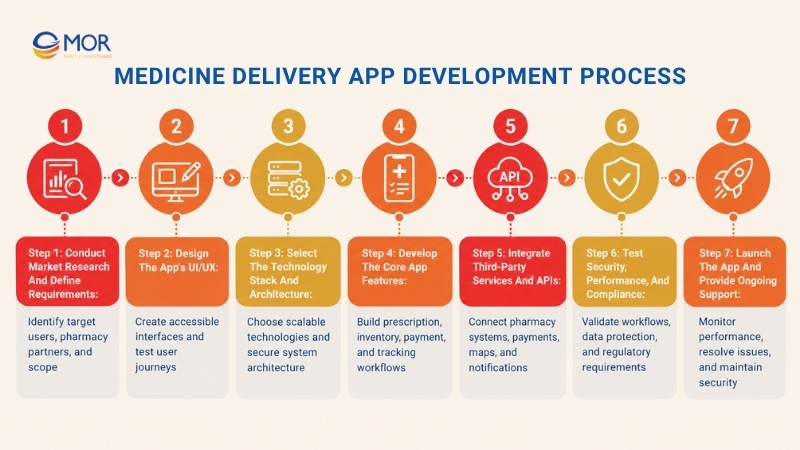
Step 1: Conduct Market Research and Define Requirements
Start by identifying your target patients, service locations, pharmacy partners, and medicine categories. Compare existing pharmacy services to understand where delivery demand remains unmet.
A brief that simply says 'develop medicine delivery app' leaves major decisions unanswered. Define who dispenses the medicine, who handles deliveries, what licenses apply, and which functions belong in the first release.
For on demand medicine delivery app development for startup projects, a limited city or pharmacy pilot can make the first release easier to assess. Broader expansion should follow demand testing and operational readiness.
Founders can use our guide to app development for startups when planning early product scope and delivery priorities.
Step 2: Design the App's UI/UX
Designers should map the patient journey alongside pharmacy and courier workflows. A medicine order may pass through several approval states, so users need clear messages about what happens after submitting a prescription.
Build wireframes and clickable prototypes before development begins. Test medicine searches, prescription uploads, checkout, and order tracking with representative users.
Accessibility matters for older patients. Readable text, clear buttons, simple forms, and understandable error messages can prevent avoidable ordering mistakes.
Step 3: Select the Technology Stack and Architecture
Choose mobile and backend technologies according to user needs, existing systems, and expected order volume. Native development may suit projects needing platform-specific capabilities, while cross-platform development can support shared iOS and Android code.
Plan the database structure around prescriptions, orders, pharmacies, inventory, and delivery events. Define user permissions and secure API communication early, since these affect nearly every part of the system.
A modular architecture also makes future additions easier to manage without rebuilding the entire application.
Step 4: Develop the Core App Features
Development teams build the patient app, pharmacy tools, delivery interface, and administrative functions according to the approved scope. Core work includes account management, medicine catalogs, prescription review, inventory checks, payments, and order tracking.
Backend services need consistent order states. For instance, the system shouldn't release a prescription-only medicine for dispatch while the necessary pharmacist review remains pending.
Each feature should connect to an approved workflow rather than operate as an isolated screen.
Step 5: Integrate Third-Party Services and APIs
Medicine delivery platforms often depend on existing pharmacy software. Pharmacy Management Systems (PMS), e-prescription services, payment providers, mapping APIs, and notification tools each require different integration methods.
Inventory connections need particular attention. If an in-store sale changes stock levels, the online catalog must receive that update before another customer purchases the same remaining item.
Some pharmacy software vendors restrict API access or require partner approval. Confirm these conditions before treating an integration as a small development task.
Step 6: Test Security, Performance, and Compliance
Testing should cover complete order journeys, including invalid prescriptions, rejected payments, unavailable stock, and failed deliveries. Teams also need to check API behavior, device compatibility, performance, and access permissions.
Security reviews should examine encryption, authentication, audit logs, and exposure of patient information. In the United States, HIPAA responsibilities depend on whether the parties qualify as covered entities or business associates under HHS guidance.
Complete applicable legal and pharmacy operational reviews before launch. A successful software test doesn't establish that a pharmacy has permission to operate in every intended market.
Step 7: Launch the App and Provide Ongoing Support
Begin with a controlled rollout involving licensed pharmacy partners and a defined delivery area. Track prescription processing times, stock accuracy, payment failures, customer support requests, and completed deliveries.
Post-launch work includes bug fixes, system monitoring, security updates, and maintenance. Customer feedback can guide later additions like subscriptions, caregiver accounts, or new pharmacy locations.
Businesses planning long-term development should also establish code ownership, release procedures, and support responsibilities before scaling.
Tech Stacks for Medicine Delivery App Development
Technology selection affects development time, integration work, maintenance, and application performance. Most platforms combine mobile applications, web dashboards, backend services, databases, and third-party APIs.
The following technologies are commonly considered for medicine delivery app development projects.
Technology Layer | Recommended Technologies | Primary Purpose |
Mobile frontend | Flutter, React Native, Swift, Kotlin | Patient and courier mobile applications |
Web frontend | React, Angular | Pharmacy and admin dashboards |
Backend | Node.js, Python, Java, .NET | APIs, order processing, and business logic |
Database | PostgreSQL, MySQL | Patient, order, pharmacy, and transaction records |
Cloud infrastructure | AWS, Microsoft Azure, Google Cloud | Hosting, storage, backups, and scaling |
Real-time updates | WebSockets, Firebase Cloud Messaging | Delivery updates and push notifications |
Healthcare integrations | HL7 FHIR, supported pharmacy APIs | Healthcare data exchange and system connections |
Payment and location | Stripe, Google Maps APIs | Eligible payment processing and route information |
Cross-platform tools like Flutter and React Native can be suitable for teams maintaining iOS and Android applications together. Native Swift or Kotlin development may be preferable when specific device capabilities or platform requirements call for separate implementations.
For teams comparing native approaches, MOR Software's guide to custom iOS app development explains the development considerations behind Apple applications.
Backend architecture needs equal attention. PostgreSQL can manage structured transactional records, while APIs connect order data to pharmacy systems, payment services, and delivery tools.
Healthcare interoperability adds another layer. HL7 FHIR supports certain clinical data exchanges, but pharmacy inventory and e-prescription services may rely on separate vendor interfaces or industry-specific standards.
Security choices should match the application's data flows. Role-based permissions, encryption, monitoring, backups, and third-party data handling agreements belong in the technical plan before development reaches production.
Medicine Delivery App Development Cost Breakdown
The medicine delivery app development cost depends on scope, team location, integration requirements, and the number of applications involved. A single-pharmacy ordering app generally requires less work than a marketplace connecting independent pharmacies and delivery partners.
As one published benchmark, Groovy Web's 2026 development guide places basic pharmacy apps at 45,000–90,000, fuller AI-assisted platforms at 90,000–180,000, and enterprise pharmacy systems at 200,000–400,000.
The following table provides an illustrative budget allocation for the first two tiers. These component figures are planning estimates, not verified market averages or quotations from MOR Software.
Development Component | Basic App Cost ($) | Advanced App Cost ($) | Main Cost Drivers |
Customer mobile app | 12,000–22,000
| 25,000–45,000
| Ordering screens, prescriptions, payment, tracking |
Pharmacy management panel | 6,000–12,000
| 15,000–25,000
| Approval workflows, inventory, reporting |
Delivery partner app | 4,000–9,000
| 8,000–17,000
| Routing, GPS, delivery confirmation |
Admin dashboard | 4,000–7,000
| 8,000–15,000
| User roles, operations, reporting |
Backend and API integration | 10,000–18,000
| 18,000–40,000
| Pharmacy connections, order logic, data handling |
UI/UX design | 3,000–6,000
| 6,000–12,000
| Screens, user flows, prototypes |
QA and security testing | 4,000–9,000
| 8,000–17,000
| System testing, security, performance |
Deployment and setup | 2,000–7,000
| 2,000–9,000
| Hosting setup, release, monitoring |
Estimated total | 45,000–90,000
| 90,000–180,000
| Varies by project scope |
All amounts are in USD. The component allocations illustrate possible budgeting within the published project tiers.
A basic application may take several months to develop, depending on the agreed features and available integrations. More complex platforms can take longer, especially when insurance systems, pharmacy networks, and regulatory approvals are involved.
Software development is only part of the total budget. Businesses should also account for:
- Legal and licensing expenses: Pharmacy registration, legal reviews, and applicable regulatory work
- Third-party service fees: Payment processing, maps, messaging, and licensed healthcare data
- Cloud operations: Hosting, storage, backups, and monitoring
- Security assessments: Penetration testing, vendor reviews, and related assurance work
- Ongoing maintenance: Software updates, fixes, support, and infrastructure changes
For a wider mobile project budgeting approach, review how much does it cost to make a mobile application.
A reliable estimate starts with a defined scope. List the required interfaces, pharmacy integrations, medicine categories, user roles, and planned service regions before asking development teams for quotations.
Medicine Delivery App Development Challenges and Solutions
Medicine delivery projects face technical and operational risks that ordinary shopping apps rarely encounter. Prescription validity, stock accuracy, sensitive patient information, and medicine handling can affect the entire order process.
A practical development plan should identify these risks before they appear during testing or launch.
Challenge | Potential Impact | Recommended Solution |
Prescription verification | Delayed, rejected, or improperly processed orders | Create clear pharmacist review steps, approval states, and exception handling |
Regulatory compliance | Delayed launch, restricted operations, and legal exposure | Assess pharmacy licensing, medicine rules, and data obligations early |
Data security | Unauthorized access to sensitive patient information | Apply encryption, role-based access control (RBAC), audit logs, and security testing |
Inventory synchronization | Cancellations and inaccurate medicine availability | Connect pharmacy inventory systems and validate stock updates |
Delivery coordination | Missed delivery windows and failed handoffs | Use delivery status tracking, assignment controls, and exception management |
Cold-chain requirements | Temperature excursions and medicine quality risks | Use qualified handling procedures, suitable packaging, and monitoring where needed |
Scalability | Slow performance and service interruptions | Apply capacity planning, performance testing, and suitable cloud infrastructure |
Regulatory requirements deserve careful review because obligations differ by location and business role. In the United States, pharmacy licensing, DEA rules for controlled medicines, HIPAA, and applicable drug tracing requirements can affect platform design.
The FDA's DSCSA exemptions guidance also shows why development teams must review current rules instead of relying on old compliance checklists.
Operational problems can be just as costly. When a customer orders a medicine that is unavailable, the pharmacy may need to cancel the order, propose an authorized alternative, or contact the prescriber.
Reliable exception handling helps staff resolve these situations without losing track of the request. It also gives administrators better records for quality reviews and future system improvements.
Why Choose MOR Software for Medicine Delivery App Development?
Healthcare platforms require careful coordination between mobile interfaces, backend systems, and the teams using them. MOR Software JSC provides mobile application development, consulting, integration, and testing services that can support businesses planning pharmacy delivery products.
Our medicine delivery app development services approach draws on documented mobile engineering capabilities and experience with healthcare applications. We help clients define technical requirements and select a delivery approach that fits their project.
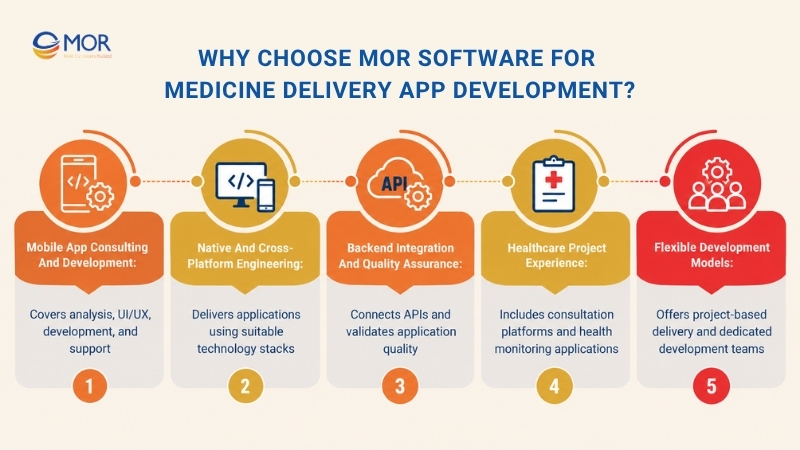
- Mobile app consulting and development: Our mobile app development services cover business analysis, UI/UX design, native and cross-platform development, and application support. These services are relevant to startups and pharmacies planning patient-facing apps and operational portals.
- Native and cross-platform engineering: Our documented project experience includes Swift, React Native, Java, Node.js, and AWS. We select technologies according to the application's user needs, integration requirements, and maintenance plans rather than forcing one stack onto every project.
- Backend integration and quality assurance: We develop API connections between mobile applications, backend services, and external systems. Our mobile QA capabilities cover functional, performance, security, and accessibility testing, supported by ISTQB-certified testing professionals.
- Healthcare project experience: MOR developed an online healthcare consultation platform we built for a large Japanese clinic. The solution connects a patient mobile app with web portals for doctors, clinics, and pharmacies. It supports online consultations and coordinates prescriptions with affiliated pharmacists. Our portfolio also includes a health monitor app case study involving medical device connectivity and patient data management.
- Flexible development models: We provide project-based development and Offshore Development Center (ODC) services. Startups with a defined MVP can work through a scoped project, while established healthcare businesses can hire mobile software development team resources for ongoing engineering work. Our documented delivery process follows Agile practices and includes project management and QA support.
Our experience in healthcare software and mobile engineering provides a basis for planning medicine delivery app development solutions around each client's requirements. Pharmacy-specific workflows, licensing responsibilities, and compliance needs still require assessment for the intended market.
Healthcare startups, pharmacy chains, and medical service providers can discuss their application scope with MOR Software to identify suitable technologies, integrations, development resources, and budget requirements.
Conclusion
Successful medicine delivery app development starts with clear pharmacy workflows, appropriate technical choices, and realistic cost planning. Patient ordering, prescription approval, inventory accuracy, and delivery must work together to support dependable service. MOR Software can assist with mobile development, backend integration, and quality assurance. If you're planning a pharmacy delivery platform, Contact us to discuss your requirements and build a practical development plan.
"Learn from the past, embrace the present, and look forward to the future. The key is to never stop questioning."
Le Manh Hung


CTO MOR Software
MOR SOFTWARE
Frequently Asked Questions (FAQs)
How much does it cost to develop a medicine delivery app?
Medicine delivery app costs vary by complexity, development location, and integration needs. Published estimates range from tens of thousands of dollars for focused pharmacy apps to several hundred thousand for enterprise systems. Prescription workflows, pharmacy integrations, security testing, and ongoing operations influence the final budget.
How long does medicine delivery app development take?
A focused MVP can take approximately three to six months, depending on the team and scope. Larger platforms with several pharmacy integrations may require six to twelve months or longer. Pharmacy licensing, vendor approvals, and regulatory reviews can extend the launch schedule beyond software development.
What are the essential features of a medicine delivery app?
Core features include medicine search, prescription submission, pharmacist review, secure checkout, inventory management, order tracking, and delivery coordination. Most platforms also need a pharmacy dashboard and an admin panel. More complex applications may include insurance connections, caregiver accounts, automated refills, and cold-chain tracking.
Which technology stack is best for a medicine delivery app?
Flutter and React Native are common cross-platform choices, while Swift and Kotlin support native development. Backend options include Node.js, Python, Java, and .NET. The best combination depends on existing pharmacy systems, security requirements, development resources, and the application's expected scale.
What are the most popular medicine delivery apps?
Established examples include Amazon Pharmacy, CVS Health, Tata 1mg, PharmEasy, DocMorris, and PillPack by Amazon Pharmacy. These platforms serve different markets and business models. Their services cover prescription management, pharmacy delivery, recurring medication fulfillment, and related healthcare functions.
How do medicine delivery apps make money?
Revenue can come through pharmacy product sales, delivery charges, marketplace commissions, subscription fees, and approved platform services. The available model depends on the operator's business role and applicable pharmacy rules. Delivery expenses, payment charges, and fulfillment costs determine the margin earned on each order.
Do medicine delivery apps need to comply with HIPAA?
HIPAA applies to covered entities and business associates in the United States, not automatically to every independent healthcare app. Applicability depends on the operator's role and how protected health information is handled. Other privacy, security, and pharmacy regulations may apply even when HIPAA does not.
Can medicine delivery apps handle prescription medicines?
Yes, where applicable laws permit licensed pharmacies to dispense and deliver them. Prescription requests must pass the required validation and professional review steps. Certain medications have extra restrictions involving prescribing, storage, identification, delivery, or controlled-substance rules, so not every medicine qualifies for the same delivery process.
What is the difference between a pharmacy app and a medicine delivery app?
A pharmacy app may support refill requests, medication records, consultations, store information, and prescription management. A medicine delivery app focuses on ordering and fulfillment through home delivery. One platform can combine these functions, particularly when a pharmacy runs its own digital customer service.
Should I build a custom medicine delivery app or use a white-label solution?
White-label software can suit pharmacies needing a standard ordering service and a shorter implementation period. Custom development suits businesses with specific workflows, complex integrations, or multi-pharmacy requirements. Compare long-term maintenance, software ownership, customization limits, and regulatory responsibilities before selecting either approach.
Share


Make Our-Dreams Realized


© 2023 . MOR Software. All Rights Reserved
Sitemap
Privacy Policy
Terms of Use

Rate this article
0
over 5.0 based on 0 reviews
Your rating on this news:
Name
*Email
*Write your comment
*Send your comment
1