


Odoo for Food & Beverage Manufacturing: Features, Benefits & Costs
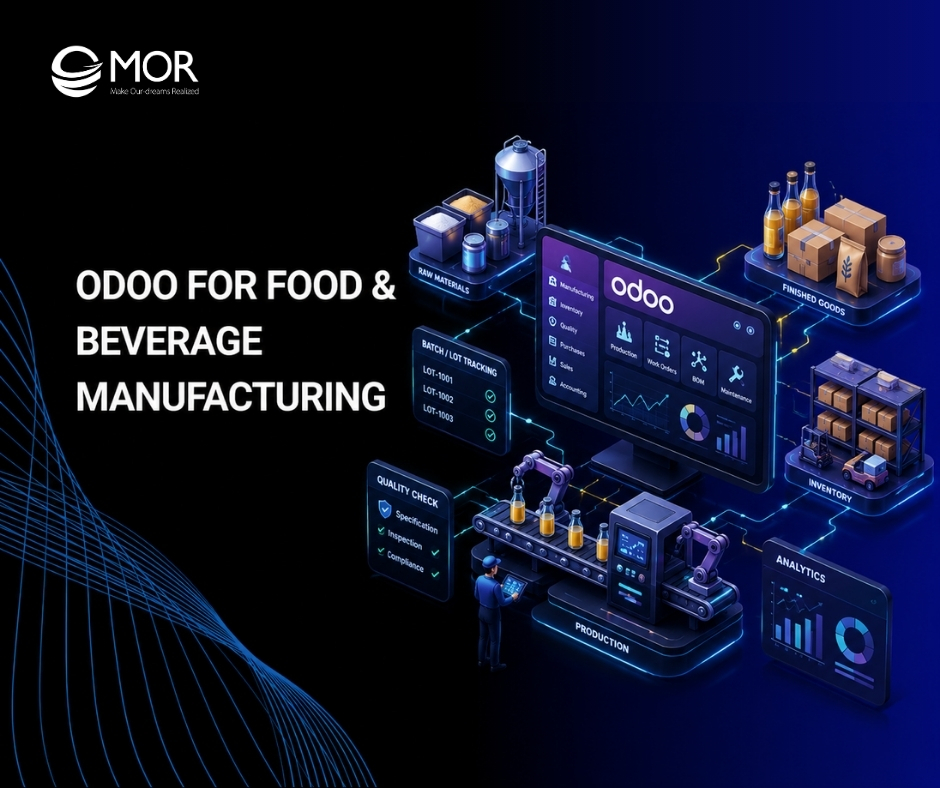
Food producers often lose time chasing batch records, expiry dates, recipe changes, and quality documents across scattered files. Odoo for food & beverage manufacturing gives teams one place to control production, inventory, purchasing, traceability, and costing. In this guide, MOR Software will explain the key features, benefits, modules, setup steps, and cost points behind this Odoo ERP for food producers.
Key Takeaways
- Odoo for food & beverage manufacturing helps connect recipes, batches, expiry dates, quality checks, warehouse moves, and delivery records in one system.
- The platform gives food teams stronger control over traceability, recall response, stock rotation, production planning on Odoo manufacturing, and compliance records.
- A good rollout starts with real factory workflows, clean product data, accurate BOMs, tested quality points, and proper staff training.
Key Features In Odoo For Food & Beverage Manufacturing
Odoo for food & beverage manufacturing helps food teams manage stock, recipes, batches, quality checks, labels, and delivery from one working system. It gives production, warehouse, purchasing, and finance teams the same data, so small mistakes do not turn into costly recalls or wasted stock.
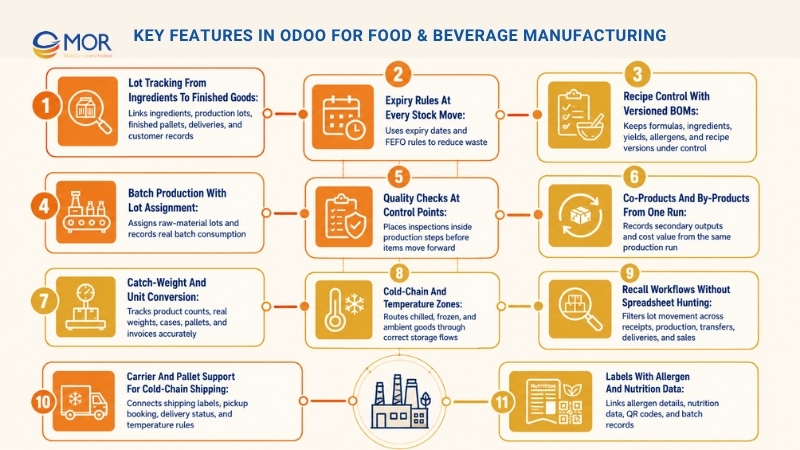
Lot Tracking From Ingredients To Finished Goods
Each received ingredient can be assigned a lot code. Each production order can draw from selected ingredient lots. Each finished pallet can leave the warehouse with its lot record linked. Odoo Lot and Serial Number Tracking gives two-way traceability, so teams can check where a lot came from and where it moved. During a recall, you can select the affected lot, view related sales orders, and contact only the customers tied to that batch. MOR Software can help configure this traceability flow from receipt, production, delivery, and customer records.
Expiry Rules At Every Stock Move
Best-before dates should guide stock movement, not sit in a forgotten field. Removal Dates and Best Before Dates in the lot setup can stop expired stock from moving into production or delivery. FEFO routing lets Odoo for frozen foods manufacturing pick the lot with the nearest expiry date first, so warehouse staff do not need to check every label by hand. The purchasing team can also receive expiry warnings before stock becomes unusable. This helps frozen food factories and chilled-goods teams act before waste piles up.
Recipe Control With Versioned BOMs
A recipe works as a BOM in the production system. The Manufacturing module can store layered formulas with exact ingredient amounts, yield rates, and allergen details. When a formula is changed, a substitute ingredient is added, or a ratio is updated, PLM can create a new BOM version through a change order. This keeps production tied to the approved recipe while R&D keeps a clear record of earlier versions. Odoo for food manufacturing is a strong fit here because recipe accuracy affects costing, labels, and food safety.
Batch Production With Lot Assignment
In food production, a batch may be one sauce run, one yogurt vat, one dough mix, or one beverage tank. The Odoo food manufacturing system can create a separate manufacturing order for each production lot. Raw-material lots can be assigned when the order is confirmed. The system can also record real consumption against planned usage. Variance reports help teams catch yield loss early, before small gaps turn into a bigger cost problem. MOR Software can set up batch logic that matches how your factory actually runs.
Quality Checks At Control Points
HACCP needs clear inspection records at the right control points. Odoo Quality Control Plans can place checks inside selected BOM steps, like a pH check after pasteurization, a weight check after filling, or a metal-detector check before packing. The next step can be blocked until the check is passed. Failed checks can send the item to quarantine and create a corrective-action record. This gives quality teams proof that checks happened at the right time, not after the fact.
Co-Products And By-Products From One Run
A rendering process may produce tallow and bone meal. A brewery may produce spent grain. A juice line may produce pulp. In Odoo for food & beverage manufacturing, By-Products can record each secondary output on the same manufacturing order as the main item. The system can also assign the right cost basis to each output. Margin reports can show the value recovered from the whole run, while yield records stay ready for audit review. MOR Software can help food processing businesses map these outputs into practical costing rules.
Catch-Weight And Unit Conversion
Food products are often sold by weight, billed by case, and stored by pallet. Odoo Units of Measure can manage layered conversions, including kilogram to pound, pound to unit, unit to case, and case to pallet. Rounding rules help avoid accounting gaps that appear when teams force everything into one unit. Catch-weight products, like variable-weight cuts, can track two values in the same movement. That means the system can record the planned count and the real weight together. This helps packaged food manufacturers keep stock and invoices aligned.
Cold-Chain And Temperature Zones
Chilled, frozen, and ambient goods should not move through the same picking flow. The Inventory module can use storage categories and put away rules to send each lot to the right temperature zone at receipt. Pick rules can also keep frozen and chilled items apart during warehouse movement. The system can help stop refrigerated goods from waiting too long in the wrong staging area. Reorder rules by zone can keep safety stock cleaner for each temperature class. This gives food production teams tighter control over cold-chain stock.
Recall Workflows Without Spreadsheet Hunting
When a regulator asks for recall data, days are too slow. The traceability report can filter lots across receipts, manufacturing orders, transfers, deliveries, and sales records. It can show the full movement history without pulling data from several spreadsheets. Lot archiving and quarantine rules can stop affected stock from moving once a recall is confirmed. The audit file can then be prepared from system records, not late-night spreadsheet work. MOR Software can help connect recall logic with stock, production, and delivery workflows.
Carrier And Pallet Support For Cold-Chain Shipping
Frozen pallets need carriers that can handle temperature-controlled routes, pallet labels, and strict pickup times. Odoo Shipping Carriers integration can support label creation, pickup booking, and delivery status updates inside the sales order. Odoo food delivery workflows can also link delivery records with lot and temperature class data. This matters when frozen, chilled, and ambient orders need different handling rules. MOR Software can connect shipping logic with sales, warehouse, and reporting flows, so dispatch teams do not work in a separate system.
Labels With Allergen And Nutrition Data
Food labels often need allergen details and nutrition panels that match the real formula. Odoo can store allergen attributes on raw-material products and show them on the finished product record. QR/Lot codes can print from the delivery order and link packaging back to the batch record. This supports supply-chain programs like GS1 and Safe Quality Food. Studio can also adjust label templates by SKU without asking developers to rebuild each layout. This helps ingredient-based production environments keep product data closer to the label process.
Business Benefits Of Odoo For Food & Beverage Manufacturing
Using Odoo for food & beverage manufacturing can bring clear value to food and beverage teams:
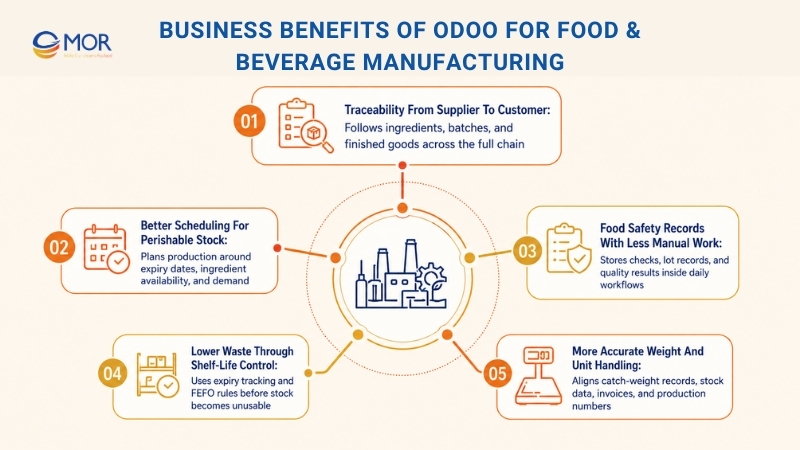
Traceability From Supplier To Customer
The integrated platform helps companies follow ingredients, batches, and finished goods across the full chain, so recall work becomes faster and daily operations run with fewer gaps.
Better Scheduling For Perishable Stock
The system helps food teams plan production around expiry dates, ingredient availability, and customer demand, which supports better output and less rushed decision-making.
Food Safety Records With Less Manual Work
Odoo can keep checks, lot records, and quality results inside the same workflow, so teams spend less time rebuilding records for audits.
Lower Waste Through Shelf-Life Control
Expiry tracking and FEFO rules help teams use stock before it becomes unusable, which is useful for fresh, chilled, and frozen goods.
More Accurate Weight And Unit Handling
The ERP system supports catch-weight items and variable-unit processing, so stock records, invoices, and production numbers match more closely. For food service businesses, related workflows can also connect with Odoo restaurant management when production and outlet operations share data.
>>> Odoo support services help businesses keep Odoo stable after go-live, from user help to upgrades and long-term system care. Let's explore!
Odoo For Food & Beverage Manufacturing: Challenges Faced By Small Producers
Odoo for food & beverage manufacturing matters because food production stays complex, even when the company is small. A bakery with 50 SKUs can face many of the same issues as a large bread producer with 500 SKUs. These include short shelf life, expiry-based stock movement, traceability rules, allergen control, and batch-level quality checks. The difference is that a large company may have a $2M ERP system to manage all of this. A small producer may still be trying to run it through a spreadsheet.
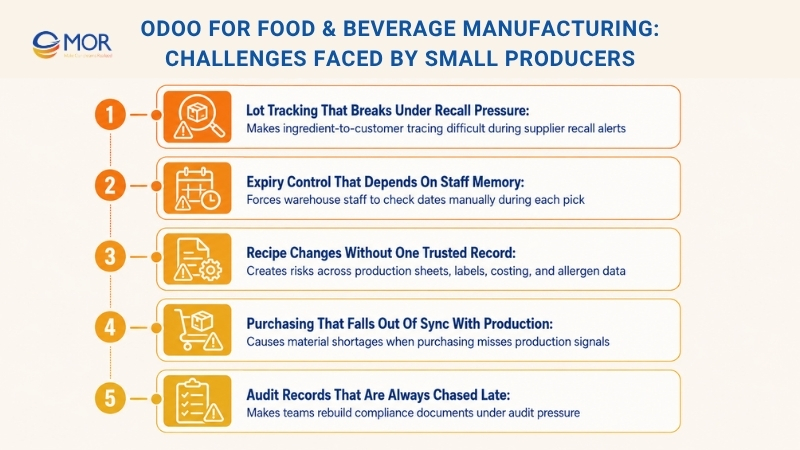
Lot Tracking That Breaks Under Recall Pressure
A supplier sends a recall alert. The producer must find which finished batches used that ingredient lot and which customers received them. Without a proper system, the team may spend days checking production notes, delivery files, and handwritten batch sheets. That assumes the records are complete in the first place.
Expiry Control That Depends On Staff Memory
FEFO (First Expired, First Out) rotation matters for perishable ingredients, but manual control puts too much pressure on warehouse staff. They must check dates each time they pick stock. One missed date can waste an ingredient. Worse, it can affect a full production run.
Recipe Changes Without One Trusted Record
When formulas change, Odoo for food & beverage manufacturing helps keep production instructions, costing, labels, and allergen data tied to one approved record. A supplier swap, a new ratio, or a yield change needs to move through every related process. Without a central system, someone misses the update. That is how the wrong label, wrong cost, or wrong production sheet ends up on the floor.
Purchasing That Falls Out Of Sync With Production
Production teams often know an ingredient is running low before anyone else. Purchasing may only hear about it when someone walks over to say so. In the worst case, the team finds out when a production line has already stopped.
Audit Records That Are Always Chased Late
Retail audits, FSMA rules, and FDA checks all need clear documentation. Small manufacturers often have to rebuild that information under pressure. A better system lets them open the record instead of hunting for it.
Odoo handles these problems through built-in workflows rather than patchwork fixes.
Why Generic Small And Medium Tools Fall Short For Food Manufacturing
Basic accounting tools and simple inventory apps are usually built for companies that buy and sell finished items. They are not made for ingredient-based production. Once a team needs bills of materials, production orders, lot codes, and expiry-led picking, those tools start to fight the real workflow. This is where Odoo for food & beverage manufacturing becomes more useful than a basic back-office setup.
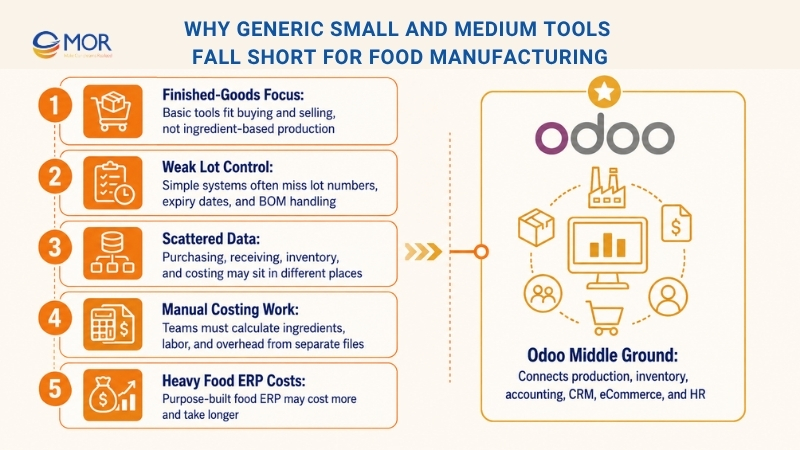
The gaps appear fast. Basic accounting software may count stock, but it often cannot assign lot numbers, manage expiry dates, or handle a BOM. Standalone inventory systems may track lots, but purchasing and receiving can still sit in another place. When teams need the real cost of a finished item, including ingredients, labor, and overhead, they often have to build the number by hand from separate files.
Some small food producers also look at a purpose-built food ERP. These systems can be capable, but many are priced for larger companies, take longer to roll out, and may not cover wider business needs like CRM, eCommerce, HR, and accounting in one place.
Odoo fills the space between basic tools and heavy enterprise systems.
Why Odoo For Food & Beverage Manufacturing Fits Small Food Manufacturers
It works as a full business platform, not only a factory tool. Odoo for food & beverage manufacturing is useful because the shop floor connects with the rest of the business. Inventory connects with purchasing, purchasing connects with accounting, and sales connects with stock. When a production order consumes ingredients, stock changes at once. When a purchase order arrives, the receipt can match the PO and vendor bill. When a customer order comes in, the system can check finished-goods availability and create a delivery. This connection removes many manual handoffs that slow small teams down.
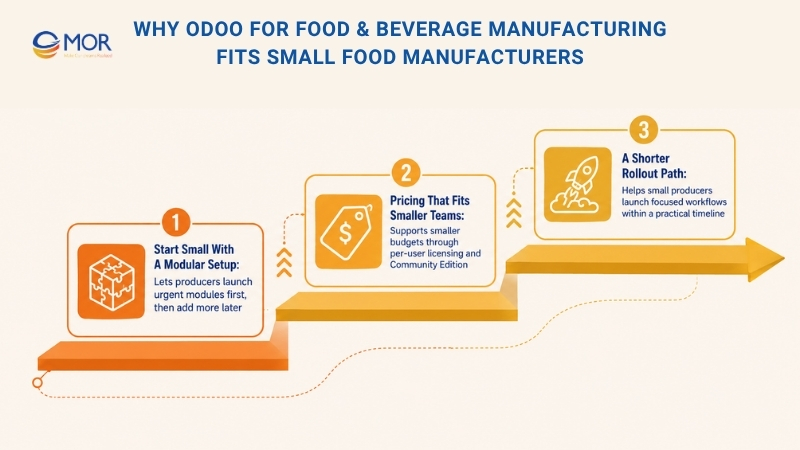
Start Small With A Modular Setup
Small producers can begin with the modules they need first. A small food company does not need to launch every Odoo app on day one. Many start with Inventory and Purchasing to fix urgent stock and supplier issues, then add Manufacturing, Quality, and Accounting when the team is ready. This staged path keeps cost and setup work easier to manage. It also makes Odoo for food industry use cases practical for growing producers, distributors, and mixed food businesses.
Pricing That Fits Smaller Teams
Odoo Enterprise uses per-user licensing, so smaller teams often pay less than they would for many food-specific ERP systems. Community Edition is free and open source, which may suit companies with tight budgets and technical staff. Still, most food manufacturers get more value from Enterprise tools. Lot traceability, quality controls, and the full manufacturing module are usually worth the added cost.
A Shorter Rollout Path
Large ERP projects can take a long time and cost a lot. A focused Odoo rollout for a small food producer can cover inventory, purchasing, basic manufacturing, and accounting in 8 to 16 weeks with the right partner. That is a schedule small businesses can plan around. MOR Software can support the rollout with business analysis, development, integration, testing, and ongoing support, so the setup fits the way your team works.
Best Odoo Modules For Food & Beverage Manufacturing
Odoo for food & beverage manufacturing works as a modular ERP system that connects the main parts of a food business. Procurement, production, quality, inventory, and distribution can all run inside one shared system. Instead of handling food safety through scattered files and manual notes, Odoo places control points inside daily work.
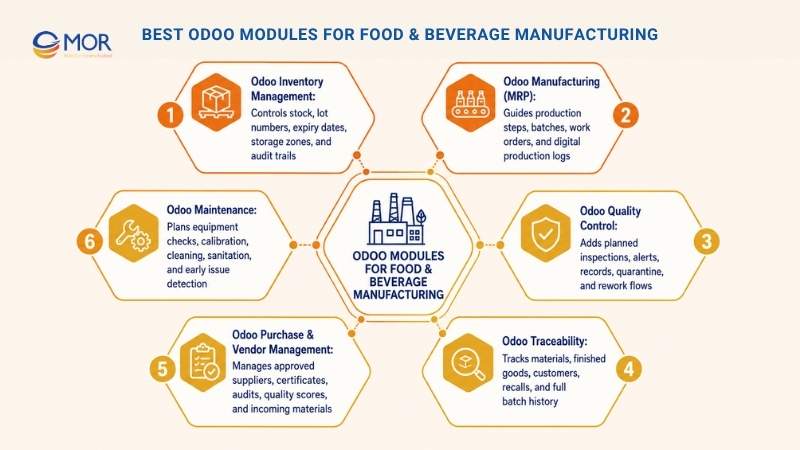
The right mix of Odoo modules can help food businesses:
- Run compliance tasks with less manual work, so teams do not depend on paper checks and repeated admin steps.
- Keep clean audit records by batch, with traceability data ready when teams need proof.
- Control quality standards across production, from raw material receipt to finished goods release.
- Limit staff errors and process risks, using clear rules and system-led steps.
This connected setup makes food safety part of everyday work, not a separate task added later.
These Odoo modules support food safety, traceability, and production control for food and beverage companies.
Odoo Inventory Management
Strong inventory control sits at the center of food safety. When teams cannot see stock movement, expiry status, or storage conditions, spoilage, contamination, and compliance issues become harder to avoid. Odoo Inventory Management gives food businesses live stock control and traceability for safer warehouse operations.
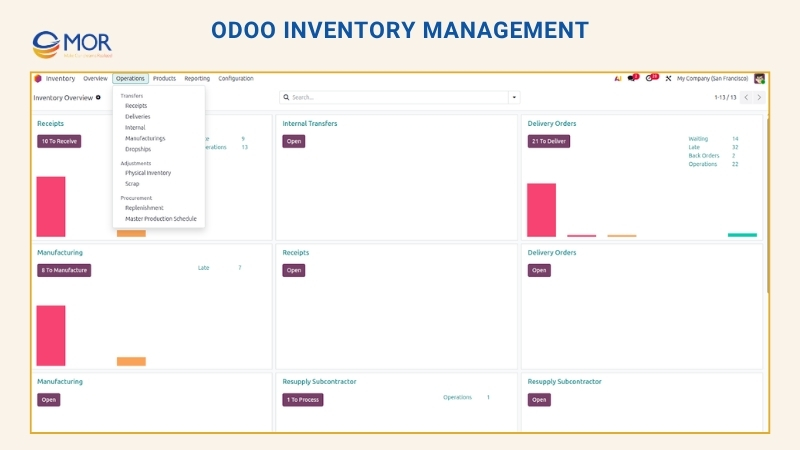
With Odoo Inventory, businesses can:
- Monitor ingredients and finished items live, giving teams clear stock visibility across warehouses and storage zones.
- Control batch codes, lot numbers, expiry dates, and shelf life, helping teams avoid using or shipping expired goods.
- Use FIFO or FEFO rotation rules, so products move through stock within safe time limits.
- Handle chilled and perishable goods through guided stock flows, which lowers contamination risk.
Every stock movement, including receipts, transfers, and deliveries, is recorded with time details. This creates a clear audit trail. Odoo WMS for food distribution is useful here because warehouse teams need fast proof during audits, checks, and recall events. It helps teams respond with speed, accuracy, and more confidence.
Odoo Manufacturing (MRP)
Food safety depends on stable and accurate production work. The Odoo Manufacturing (MRP) module helps each stage follow set production rules, which lowers variation, staff error, and safety risk.
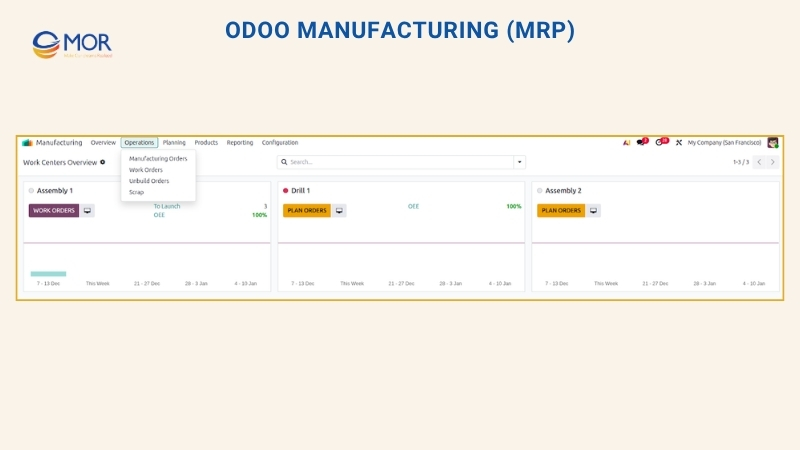
With Odoo Manufacturing, businesses can:
- Set and follow approved SOPs, using Bills of Materials and work orders to guide each production step.
- Connect batches and lots through production, linking raw materials, semi-finished items, and finished goods in one record.
- Control work orders with clear timing, helping teams balance output, quality checks, and safety needs.
- Create digital production logs as work happens, recording who made the product, when it was made, and how it was processed.
When production rules sit inside daily workflows, the system helps reduce mistakes that may cause contamination, rework, or compliance gaps. The result is more stable product quality, better control, and audit-ready production records.
Odoo Quality Control
Quality assurance sits at the center of food safety compliance. If checks happen too late or in the wrong place, problems may reach customers before teams notice them. Odoo Quality Control helps food businesses move from late inspection to planned, process-based quality work.
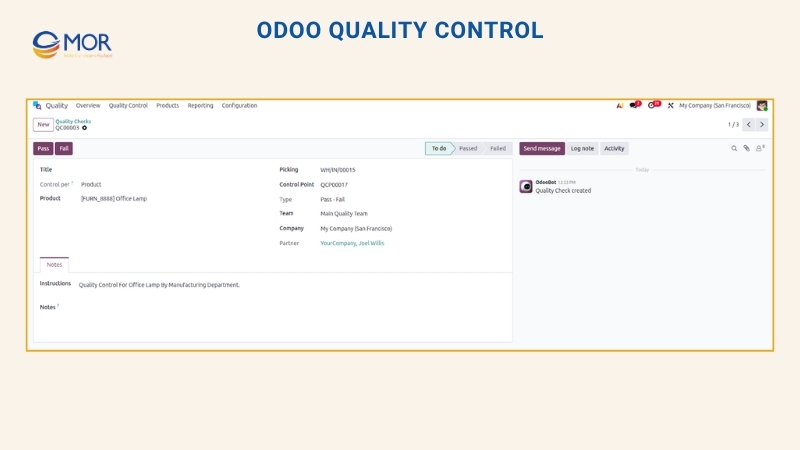
With Odoo Quality Control, organizations can:
- Set inspection steps at each high-risk stage, including raw material receipt, production, and finished goods review.
- Create quality limits and test rules, so automated alerts appear when batches do not meet safety or quality standards.
- Save inspection records in digital form, creating compliance documents with traceability.
- Link quality checks with Manufacturing and Inventory, so failed goods can be blocked, quarantined, or reworked before the next step.
When quality control is part of daily work, Odoo helps teams watch issues sooner and act faster. It lowers the chance that unsafe or non-compliant products reach the market and helps keep product quality steady.
Odoo Traceability
Traceability from source to customer is a firm requirement in food safety and consumer protection. When contamination, label errors, or regulatory issues happen, businesses need to find affected products quickly and act without delay. Odoo Traceability gives food teams clear visibility across the supply chain.
With Odoo Traceability, businesses can:
- Follow raw materials from approved suppliers, through each production step, giving teams source-level control.
- Track finished goods through warehouses, channels, and customers, so downstream movement stays visible.
- Run fast and focused recalls, isolating the affected batches instead of stopping a wider product group.
- Keep full lot and batch history, including supplier data, production timing, and quality results, with fast access.
This traceability gives teams clearer records, easier regulatory reporting, and stronger recall response. It also helps protect consumers and brand trust.
Odoo Purchase & Vendor Management
Food safety starts before production, at the supplier level. Raw materials from unapproved or weakly checked suppliers can put product safety and compliance at risk. Odoo Purchase and Vendor Management helps businesses apply compliance rules from the sourcing stage.
With Odoo Purchase & Vendor Management, businesses can:
- Keep a verified supplier list, so only vendors that meet safety and regulatory rules are used.
- Record supplier certificates, quality scores, and audit history, giving procurement teams better accountability.
- Check incoming materials against set safety rules, reducing contamination risk before production starts.
Supplier control inside the ERP system helps reduce upstream risk, strengthen supply chain discipline, and keep unsafe ingredients out of production.
Odoo Maintenance
Reliable equipment has a direct role in food safety and product quality. Poorly maintained or uncalibrated machines can create contamination risk, uneven output, and compliance problems. Odoo Maintenance helps food businesses manage equipment safety before breakdowns happen.
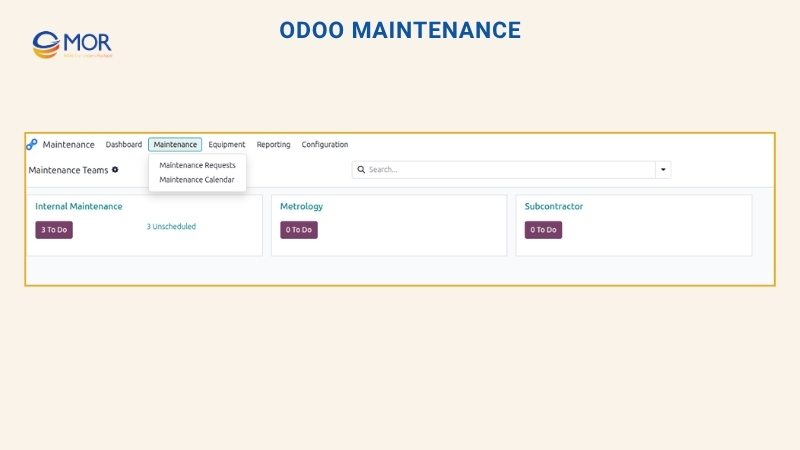
With Odoo Maintenance, organizations can:
- Plan regular checks and preventive maintenance, covering production and processing equipment.
- Track calibration, cleaning, and sanitation schedules, so machines meet hygiene and safety rules.
- Catch machine issues early, limiting downtime and contamination risk.
When maintenance connects with production work, Odoo keeps safety checks tied to equipment, process steps, and staff action. It does not leave maintenance as a late or separate task.
How Odoo Automates Raw Material Procurement For Food & Beverage Businesses
Odoo for food & beverage manufacturing supports procurement from demand planning to supplier follow-up. It connects stock signals, inventory rules, and supplier workflows inside one system. Food and beverage teams can move away from late purchasing and use a more controlled buying process.
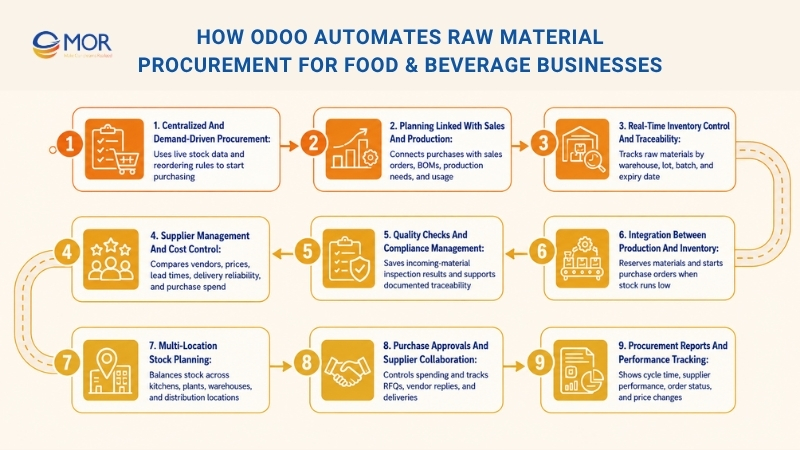
Centralized And Demand-Driven Procurement
Odoo gives teams one place to view stock, purchase activity, and material use. Live data moves across teams, so staff spend less time checking and matching records by hand.
Reordering rules can start procurement when stock drops below the set level. The system can create RFQs and purchase orders based on real demand. This helps teams restock on time without buying too much.
Planning Linked With Sales And Production
Procurement planning in Odoo connects with sales orders, production needs, Bills of Materials, and past usage. Odoo ERP for food distribution helps procurement teams plan purchases with better accuracy, match sourcing with production dates, and respond to demand swings common in food and beverage operations.
Real-Time Inventory Control And Traceability
Odoo Inventory gives teams live stock data across warehouses and storage locations. Raw materials can be followed by lot and batch number, with expiry controls for perishable goods.
FIFO and FEFO rules help teams use older or soon-to-expire stock first, which cuts waste and spoilage. Automated reminders can warn teams before materials pass their usable date.
Supplier Management And Cost Control
With Odoo Purchase, businesses can keep supplier price lists, check lead times, and review delivery reliability. RFQs let buyers compare vendors before purchase orders are confirmed, helping teams make better price choices and build stronger supplier relationships.
Built-in reports help teams review purchase spend, price changes, and possible cost savings.
Quality Checks And Compliance Management
Odoo Quality lets teams set control points for incoming raw materials. Inspection results are saved digitally, and receipt rules can accept or reject items. This supports food safety records and makes audits easier through documented checks and traceability.
Integration Between Production And Inventory
Odoo Manufacturing connects procurement with stock and production. Raw materials can be reserved for production orders, and purchase orders can start when stock is too low. This lowers the risk of production delays caused by missing materials and supports smoother production planning.
Multi-Location Stock Planning
Odoo supports shared procurement for many kitchens, plants, or warehouses. Odoo for food and beverage distribution can show location-based stock and help teams move goods between sites. This helps Odoo for food distributors keep stock balanced across the supply chain and avoid excess inventory at one location.
Purchase Approvals And Supplier Collaboration
Purchase approval flows can be set by order value or product category. Budget controls can also block unapproved spending. Procurement teams can send RFQs and purchase orders digitally, track vendor replies, and follow delivery status, which reduces follow-up work and communication gaps.
Procurement Reports And Performance Tracking
Odoo dashboards show procurement results, including purchase cycle time, supplier delivery performance, and order status. Leaders can review raw material usage, supplier spend, category costs, and price changes over time, which supports better purchasing decisions.
How To Implement Odoo For Food & Beverage Manufacturing
Odoo for food & beverage manufacturing should be planned around the real factory process, not just the software menu. Food and beverage production often depends on recipes, ingredient lots, expiry dates, quality steps, storage rules, production plans, and cost records. Since Odoo Manufacturing helps teams plan, schedule, and run manufacturing orders, the setup should connect production, stock, quality, purchasing, sales, and accounting from the start.
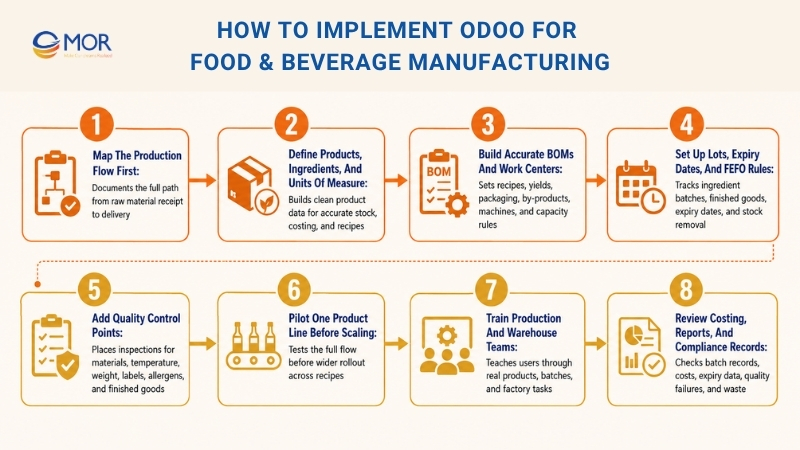
Map The Production Flow First
Before setting up Odoo, write down how production moves from raw material receipt to finished goods delivery. This should cover ingredient buying, warehouse receipt, storage location, batch assignment, recipe preparation, mixing, cooking, filling, packing, quality checks, finished goods storage, and shipment.
This workflow map helps the setup team choose the right Odoo apps, routes, warehouses, locations, and approval steps. It also shows where the business needs paper checks, barcode scans, quality tests, or automatic stock movement. For food and beverage producers, this step should also mark control points, waste areas, rework paths, and recall needs.
Define Products, Ingredients, And Units Of Measure
The next step is to build clean product data. Each raw material, packaging item, semi-finished item, finished good, and by-product should be set up clearly in Odoo. Food and beverage companies also need correct units of measure, since one ingredient may be bought in kilograms, used in grams, stored in bags, and sold inside a finished product.
This setup affects purchasing, stock value, production use, recipe accuracy, and cost reports. If product groups and units are not consistent, the system may show wrong stock, wrong production quantities, and weak cost data. At this point, the team should also decide whether each item is purchased, made, stocked, lot-tracked, or controlled with expiry dates.
Build Accurate BOMs And Work Centers
Once products and units are ready, create Bills of Materials for each recipe or formula. In Odoo, a BOM lists the components and quantities needed to make or repair a product. It can also include production steps and work instructions, which helps food and beverage teams control preparation work.
Each BOM should include correct ingredient amounts, packaging materials, planned yield, semi-finished goods, and by-products. For production lines with several stages, work centers should also be set up. Odoo work centers help process work orders, track costs, plan capacity, organize machines, and follow performance.
For a food producer, work centers may include mixing stations, ovens, bottling lines, packing zones, cold rooms, or inspection points. A correct setup helps the business understand capacity, labor time, machine use, and batch cost.
Set Up Lots, Expiry Dates, And FEFO Rules
Lot tracking is one of the most important setup areas in food and beverage production. Odoo can track products through lots and serial numbers, so businesses can follow received ingredients and finished goods by batch.
For perishable goods, expiry tracking should be added to the right products. Odoo expiration tools help teams watch products by lot number, and FEFO rules can guide stock removal based on expiry timing.
This matters because food businesses must know which ingredient batch went into each finished product batch. If a quality issue appears, the team can trace affected lots faster and avoid holding or recalling unaffected products. The setup team should test lot assignment during receipt, production use, finished goods output, internal transfer, and delivery.
Add Quality Control Points
Quality checks should sit inside the production flow. Odoo Quality lets users create checks through quality control points linked to products, operations, and manufacturing steps.
Food and beverage producers can use these points for raw material inspection, temperature checks, weight checks, packaging checks, allergen checks, sample tests, label review, and finished goods approval. These checks should be quick enough for production staff, yet detailed enough to create a useful record.
The quality setup should also define what happens when a product fails inspection. The business may need a quarantine location, a rework route, a scrap flow, a manager approval step, or a supplier claim process.
Pilot One Product Line Before Scaling
Do not launch all recipes and production lines at once. Start with one product line that includes the main food manufacturing needs, including ingredients, packaging, lots, expiry dates, quality checks, work orders, and finished goods delivery.
This pilot helps the team find setup gaps before the wider launch. The setup team should run the full Odoo flow, from purchase order, receipt, production order, ingredient use, quality check, finished goods creation, delivery, and accounting review. Since Odoo Shop Floor gives operators a visual screen for manufacturing orders and work orders, actual production staff should test it during this stage.
Train Production And Warehouse Teams
Training should match each role’s daily work. Warehouse teams need to receive products, assign lots, check expiry dates, move stock, and handle picking. Production teams need to open manufacturing orders, consume ingredients, record output, complete work orders, and report issues. Quality teams need to complete checks, log failures, and release or block products.
Training should use real products, real batch cases, and real production steps. Food and beverage teams often work under time pressure, so the process must be easy to follow on the factory floor. If the workflow feels too hard, users may go back to paper notes or spreadsheets, which weakens traceability and reporting.
Review Costing, Reports, And Compliance Records
The last step is to check whether Odoo gives the business useful records. Odoo can calculate manufacturing order costs from the BOM, component costs, operation costs, work center costs, and employee costs.
For food and beverage producers, reports should answer daily business questions: Which batches were made? Which ingredients were used? Which lots are near expiry? Which quality checks failed? Which products create the most waste? Which line costs the most? Which finished goods can be sold?
Compliance records also need close review. Odoo can support traceability, expiry control, and quality documents, but the company still needs clear internal SOPs, proper staff training, and local rule alignment. A successful setup is not just about switching on Odoo apps. It means every production, warehouse, quality, and finance task creates data the business can trust.
Implementation Considerations For Odoo In Food & Beverage Manufacturing
When planning Odoo for food & beverage manufacturing, food and beverage companies should look at several factors before rollout:
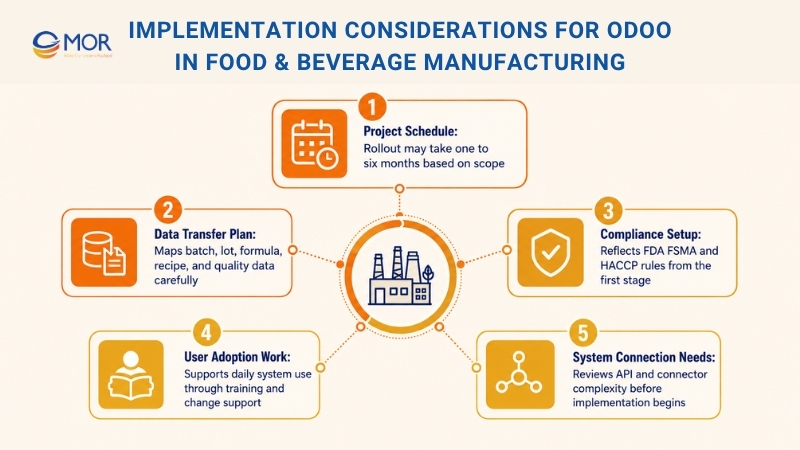
- Project schedule: A normal Odoo rollout for food and beverage businesses may take 1–6 months, based on module scope and the amount of custom work needed.
- Data transfer plan: Food and beverage companies often carry complex data across batch and lot tracking, recipe control, formula records, and quality checks, so data must be mapped with care before migration.
- Compliance setup: Food and beverage rules, including FDA FSMA and HACCP, should be reflected in the Odoo setup from the first stage.
- User adoption work: Training and change support matter because teams need to use the system every day. Odoo’s simple interface and learning resources can make the move easier for users.
- System connection needs: Most food and beverage companies need Odoo to connect with existing tools. Odoo supports this through open APIs and ready connectors, but the complexity should be checked early.
Odoo For Food & Beverage Manufacturing Pricing And Cost Considerations
Odoo for food & beverage manufacturing can start with the free Community edition, while Enterprise pricing often starts from $7.25–$11.25/user/month on the Standard plan. The full cost depends on:
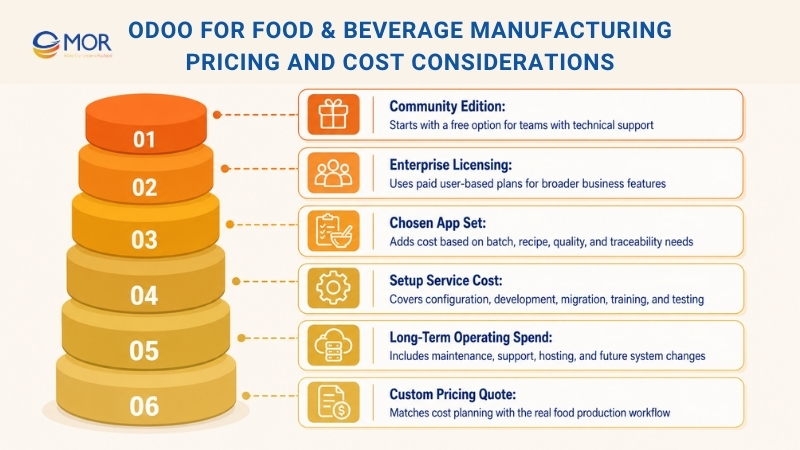
- Number of users and license type: Costs may range from $0 for Community to $24.90/user/month for the Enterprise Custom plan.
- Chosen app set: Food and beverage needs, including batch and lot tracking, recipe and formula control, and quality checks, may add license or setup costs.
- Setup service cost: Configuration, custom development, data migration, user training, and testing may need professional support.
- Long-term operating spend: Annual maintenance, support, cloud hosting, and future changes should be included in the budget.
For a cost estimate that matches your food and beverage workflow, contact MOR Software for a custom Odoo pricing quote.
How MOR Software Helps Implement Odoo For Food & Beverage Manufacturing
Odoo for food & beverage manufacturing works best when the system matches real factory work, not a generic ERP template. MOR Software helps food producers set up Odoo around daily production needs, including recipes, batches, expiry dates, raw material purchasing, quality checks, warehouse moves, and cost tracking.
We begin with process review. Our Odoo developers study how materials enter the warehouse, how batches are planned, how production teams record output, and where quality checks happen. Then we map those workflows into the right Odoo modules, including Inventory, Manufacturing, Purchase, Quality, Accounting, and Reporting.
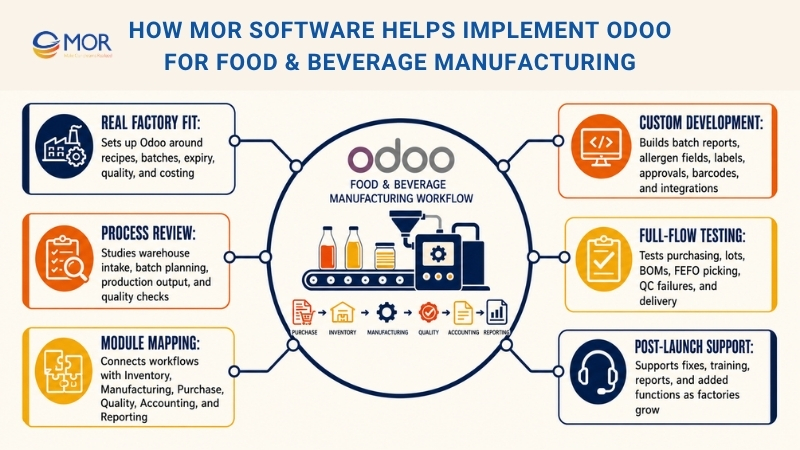
MOR Software also supports custom Odoo ERP development when standard settings do not fit your operation. This may include batch reports, allergen fields, label formats, approval flows, barcode logic, or links with eCommerce, accounting, warehouse, and internal systems.
Testing matters in food manufacturing. We help teams test the full flow before go-live, including purchase orders, lot assignment, BOM consumption, finished goods, FEFO picking, QC failures, and delivery records.
After launch, MOR Software can keep supporting system fixes, user training, new reports, and added functions as the factory grows. This gives businesses a practical Odoo setup that works on the floor, not just in the meeting room.
Conclusion
Odoo for food & beverage manufacturing can help food producers move away from scattered sheets, late audit records, and unclear batch data. The real value comes from a setup that fits your recipes, warehouse rules, quality checks, and costing needs. MOR Software can support process review, Odoo setup, custom development, testing, and long-term improvement. Ready to build a cleaner production system? Contact MOR Software today.
"Mr. Cong’s guiding philosophy is simplicity, believing that the simplest solutions are often the most powerful. He sees trust, empowerment, and the opportunity to demonstrate one’s abilities as the key elements that set MOR apart from traditional IT companies."
Mac Tien Cong


Division Manager (Hanoi Branch)
MOR SOFTWARE
Frequently Asked Questions (FAQs)
What is Odoo for food & beverage manufacturing?
Odoo for food & beverage manufacturing is an ERP setup that helps food producers manage inventory, recipes, batch production, quality checks, purchasing, sales, accounting, and reporting in one system.
Is Odoo good for small food manufacturers?
Yes. Odoo fits small food manufacturers because teams can start with basic modules like Inventory, Purchase, and Manufacturing, then add Quality, Accounting, and extra reports later.
Can Odoo manage batch and lot tracking?
Yes. Odoo can track raw materials, semi-finished goods, and finished products by lot or batch. This helps teams trace products faster during audits, recalls, or quality checks.
Can Odoo track expiry dates and shelf life?
Yes. Odoo can store expiry dates, best-before dates, and removal dates. It also supports FEFO, so teams can use or ship stock with the nearest expiry date first.
Does Odoo support recipe and formula management?
Yes. Recipes can be managed as Bills of Materials. Teams can define ingredients, quantities, packaging items, by-products, yield rates, and work steps for each product.
Can Odoo handle food safety compliance?
Odoo can support food safety records through lot tracking, quality checks, supplier records, inspection logs, and recall reports. Teams still need to configure it based on local rules and audit needs.
Which Odoo modules are most useful for food production?
The main modules include Inventory, Manufacturing, Purchase, Quality, Maintenance, Sales, Accounting, Barcode, and Reporting. The right setup depends on factory size and workflow.
Can Odoo help lower food waste?
Yes. Odoo helps teams track stock age, expiry dates, batch movement, and production demand. Better stock control can cut waste from expired materials, overproduction, and wrong picking.
How long does an Odoo rollout take for a food manufacturer?
A focused rollout can take 1 to 6 months. Timeline depends on modules, custom work, data migration, integrations, staff training, and how many product lines are included.
What should businesses prepare before using Odoo for food & beverage manufacturing?
Before using Odoo for food & beverage manufacturing, teams should prepare product lists, recipes, supplier data, stock records, batch rules, quality checks, warehouse flows, and reporting needs.
Share


Make Our-Dreams Realized


© 2023 . MOR Software. All Rights Reserved
Sitemap
Privacy Policy
Terms of Use

Rate this article
0
over 5.0 based on 0 reviews
Your rating on this news:
Name
*Email
*Write your comment
*Send your comment
1