


Odoo ERP Development Services: The Comprehensive Guide 2026
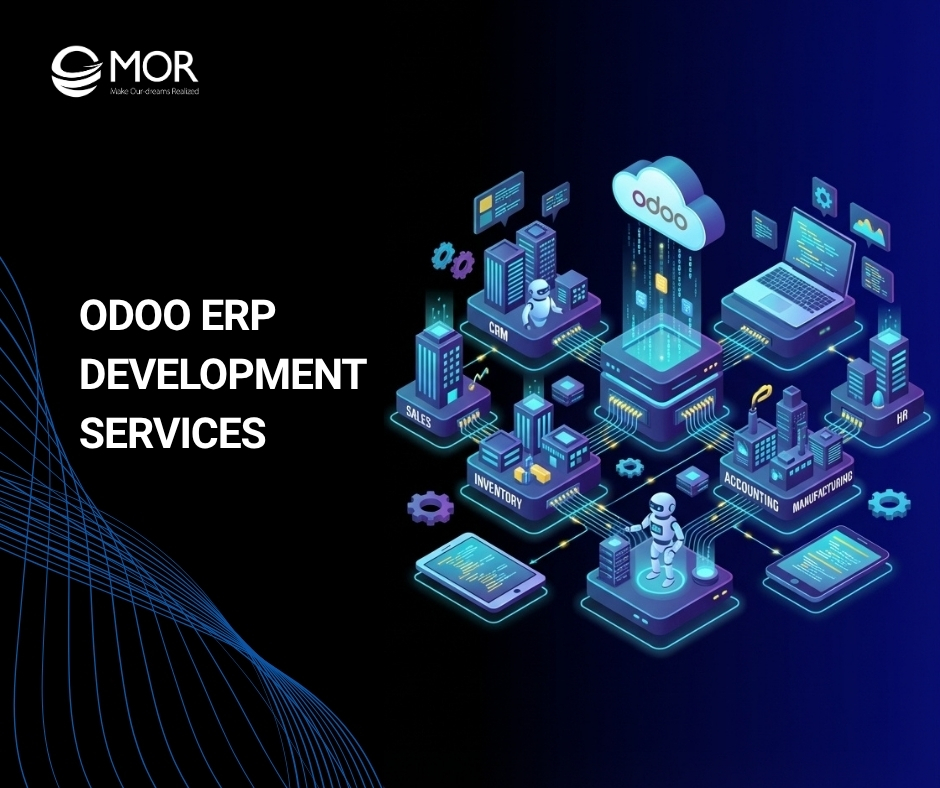
Disconnected tools, messy data, and slow approvals can quietly drag your business down even when sales keep growing. Odoo ERP development services help fix that, but the real challenge is choosing the right Odoo development services to turn the platform into one of your strongest Odoo ERP solutions. In this guide, MOR Software will show you what to look for, what to avoid, and how to make Odoo work for your business.
Unlocking Business Potential With Expert Odoo ERP Development Services
For many companies, Odoo is a practical way to connect sales, stock, accounting, purchasing, CRM, HR, and other tasks in one system. That matters because teams still work with separate tools, duplicate entries, slow sign-offs, and reports that take too much effort to prepare. As a business gets bigger, those weak spots become harder to control, which is why interest in Odoo ERP development services and broader manufacturing Odoo ERP solutions continues to grow.
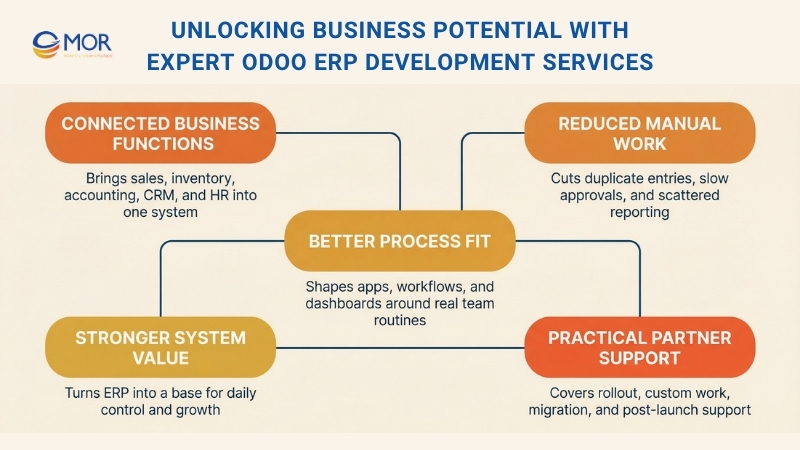
Most businesses are not looking for a basic setup. They want the platform shaped around real team routines, with suitable apps, tidy workflows, useful dashboards, and stable links to outside systems. That is where Odoo development services become valuable. The right Odoo development company can lead the rollout, build what standard apps do not cover, move data from legacy software, and support the system after launch. When that work is done well, the platform stops being just another ERP tool. It becomes a stronger base for daily work, clearer oversight, and steady growth.
Odoo ERP Development Services We Offer
At MOR Software, we handle each Odoo project as a full business platform effort, not as a group of separate jobs. Our broader delivery background already covers consulting, rollout, development, integration, maintenance, QA, and team extension models. Founded in 2016, MOR Software has completed 850+ projects in 10+ countries and works from offices in Ho Chi Minh City, Ha Noi, Da Nang, Tokyo, and Osaka. In January 2026, we also announced a partnership with Odoo, which gave our Odoo ERP development services and wider Odoo services a stronger ERP focus.
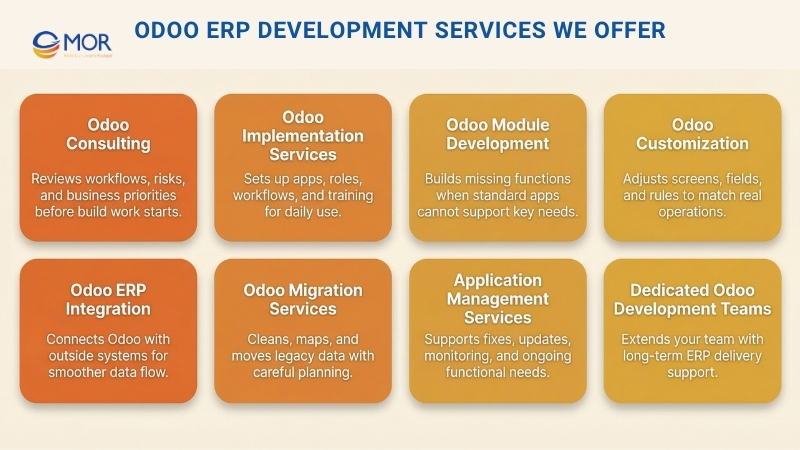
Odoo Consulting
We start with discovery work across your business. That includes reviewing current flows, finding where handovers fail, understanding how data enters the system, and deciding which parts of the platform should remain standard. A company led by sales may need CRM solutions, approvals, and billing sorted first. A manufacturer may need BOMs, production tasks, purchasing, and inventory movement planned before anything else.
This step often decides whether waste stays out of the project or slips into it. A good Odoo development service sets scope, shows risk early, and gives the team a solid direction before build work begins. It keeps decisions tied to business needs instead of guesswork.
Odoo Implementation Services
This is the point where planning turns into a working system. We set up apps, define access rights, shape workflows, arrange master data, and decide what goes into the first live release. Some businesses begin with finance and sales alone. Others include inventory, purchasing, manufacturing, and service from the start.
We do not see this stage as a simple install. We treat it as guided business change. Our Odoo ERP development services support Odoo implementation with clear logic, usable screens, and hands-on training, so your team can move faster from the first day in the system.
Odoo Module Development
Built-in apps cover a wide range of needs, but they do not match every company as they are. Some firms need special approval flows. Others need sector-specific records that are not part of the default setup. Some also require internal control features, contract steps, or service functions with added logic.
That is when Odoo manufacturing module development services make sense. We build on the Odoo framework only when the missing piece matters and the business case is clear, so your team gets what it actually needs without making the system too hard to support later.
Odoo Customization
Changing existing apps can affect forms, fields, dashboards, approval paths, report formats, user views, and rules inside the system. This is often the area where teams feel the value fastest, because the platform begins to reflect their real way of working. That is why custom Odoo development services and Odoo app development and customization services matter for businesses that need a closer fit.
Still, this work needs balance. Too little change leaves people stuck with clumsy workarounds. Too much change makes upgrades and support more difficult. We adjust the process where it truly matters and leave standard logic in place where it already works well.
Odoo ERP Integration
Most companies do not rely on a single system. They also use eCommerce platforms, payment tools, tax software, HR system integration, older databases, shipping tools, or bank connections. Odoo becomes far more valuable when those systems exchange the right data at the right moment.
We manage integration with that larger picture in view. Our work across web, mobile, and Salesforce follows the same pattern, API design, cloud connections, third-party sync, and business data mapping, and those same skills matter here when Odoo CRM, the best CRM for ecommerce, stock figures, invoices, and customer details must move across systems without manual entry.
Odoo Migration Services
Migration is often one of the least understood parts of an ERP rollout. Many businesses look at the new interface first and miss how fast old data can damage a fresh setup. Duplicate contacts, poor SKU names, broken supplier records, or missing accounting history can create disorder within days.
We handle migration as its own workstream. Data must be mapped, cleaned, tested, and checked before the final cutover. As part of our Odoo ERP development services, we also plan upgrades carefully, especially when custom modules and integrations are part of the system, so your business gets a cleaner move and fewer issues after launch.
Application Management Services
Going live is only the start, not the end. Many companies still need help with small fixes, user questions, report updates, version planning, and controlled changes once real use begins. This stage often decides whether long-term ERP value stays safe or slowly fades.
Our application management work includes monitoring, bug fixes, change requests, and day-to-day functional support. MOR’s service background already puts real focus on QA, maintenance, and planned release work, which helps the platform stay useful after launch instead of becoming another internal tool people avoid.
Dedicated Odoo Development Teams
Some businesses are not looking for a one-time vendor. They want an ERP team that can stay close to the company for months or even years. MOR’s team extension model works well for that need. Our offshore delivery approach follows a clear path, requirement review, proposal, candidate checks, onboarding, then team management and scaling as demand changes.
This model fits long ERP programs very well. A growing roadmap may need more than coders alone. It may call for a project manager, business analyst, QA support, integration specialists, and Odoo developers working as part of your extended team, which is why many firms choose Odoo development services in this format for better control and steadier growth over time.
The Strategic Advantages Of Partnering For Odoo ERP Development Services
Working with the right partner can change how much value you get from your ERP investment. Good Odoo ERP development services do more than launch a system. They help you shape it around real work, avoid expensive mistakes, and keep the platform useful as your business changes.
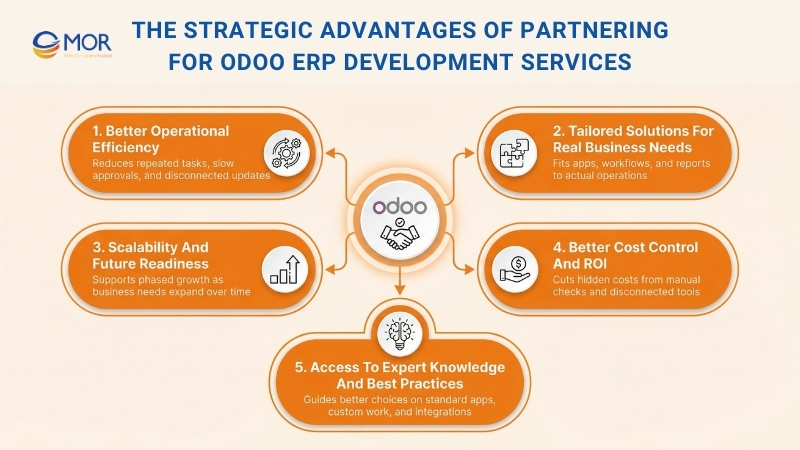
Better Operational Efficiency
When Odoo is built the right way, teams spend less time on repeated entry, slow approvals, and scattered updates. Work moves in a more direct way from one step to the next. Sales teams can check live stock faster. Finance gets cleaner data for transactions. Purchasing can act on better demand signals. Managers no longer need to chase information across spreadsheets and separate platforms.
Emers Vietnam shows this clearly. The company used Odoo for sales, POS, inventory, purchasing, invoicing, and manufacturing accounting software, then reduced inventory reporting, invoicing, and financial reporting time by 50% while raising customer satisfaction by over 40%. That is the kind of result businesses see when the ERP system supports daily work instead of making it harder.
Tailored Solutions For Real Business Needs
Most businesses want one place where their key data lives. The harder part is making that system reflect how the company actually operates. A retailer and a manufacturer may choose the same platform, but their daily needs are not alike. One may care about store orders, channel sync, and POS accuracy. The other may focus on BOMs, routing, replenishment, and production visibility.
That is where Odoo development services matter. Value does not come from having access to apps alone. It comes when sales flow, stock rules, approvals, reports, and handoffs fit the real business in front of you. A partner helps shape that fit so the platform supports the way your teams already work, instead of forcing them into a poor setup.
Scalability And Future Readiness
A lot of companies start with a small tool, outgrow it, and then replace it with something heavier a few years later. Odoo can help you avoid that cycle when the first setup is planned with care. Because the platform is modular, teams can start with a smaller scope and add more apps later as operations expand, new channels open, or stronger controls are needed.
The story of Axxon makes that point clear. Odoo gave local offices a lighter and easier system than SAP for daily work, while still covering inventory, accounting, sales, and later growth into more apps. Growth becomes easier when the base is built well from the beginning.
Better Cost Control And ROI
The cost of ERP is not just about software fees. It also includes manual work, delayed checks, reporting errors, time lost in disconnected tools, and senior staff fixing issues that should not exist in the first place. A well-run Odoo project brings value because it replaces many of those hidden costs with cleaner daily work and fewer avoidable problems.
Leowood is a strong example. Odoo’s connected apps helped the company bring sales, inventory, accounting, and customer data together across channels, and its CEO said they were saving hundreds of thousands each month because they no longer had to rely on separate systems and manual checking. That is the kind of return many businesses are looking for when they compare ERP options.
Access To Expert Knowledge And Best Practices
An ERP rollout needs strong technical skill, but that is only part of the picture. It also needs judgment. Experienced partners know when a request has real business value and when it is just a habit carried over from an old system. They know where standard Odoo can save time, where custom work makes sense, and where integration choices may create problems later.
That is one reason businesses look closely at Odoo ERP development services when they shortlist vendors. Odoo itself links the Official Partner label to trained teams, access to Enterprise source code, direct escalation channels, and a clear ranking model. That label does not tell you everything, but it still gives buyers a useful sign when they are deciding who to trust.
Our Proven Odoo ERP Development Services Process
A strong result rarely comes from rushed ERP work. Odoo ERP development services need a clear path from discovery to launch and then into long-term support. When each step is handled with care, the system is easier to use, easier to grow, and far less likely to create problems after go-live.
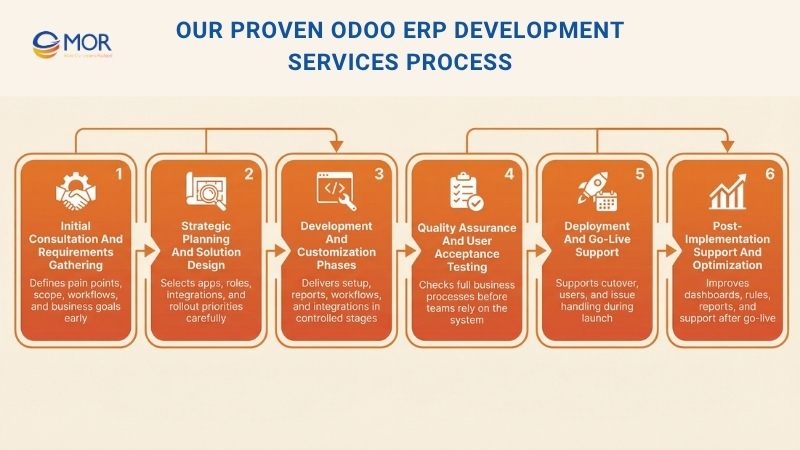
Initial Consultation And Requirements Gathering
We begin with your current process, your pain points, and the business outcome you want to reach. At this point, we look at what is not working today, what should remain, what can change, and what success should look like after launch. Weak discovery is still one of the fastest ways to put an ERP project at risk.
This early stage is also where we draw clear boundaries. We ask which departments are part of the first scope, which outside systems must stay connected, which reports cannot be dropped, and which workflows are only old habits that no longer help the business. Clear answers at this point help the rest of the project stay grounded.
Strategic Planning And Solution Design
After the business problem is understood, we shape the solution around it. That includes choosing the right apps, defining data structure, mapping integration points, setting user roles, deciding rollout order, and drawing a clear line between configuration, customization, and new development. In many ERP projects, this stage decides whether the system stays manageable over time or becomes difficult later.
Our work across web, mobile, and salesforce ERP follows the same basic rule. First we plan, then we align business and technical teams, and after that we move into controlled delivery. We use that same discipline here because good ERP work depends heavily on strong decisions made early.
Development And Customization Phases
Once the design is approved, we move into build work. That may include app setup, screen changes, new reports, workflow rules, module development, and links to outside systems. We usually deliver this work in smaller controlled stages instead of trying to release everything at once.
That approach fits Odoo ERP development services well. MOR’s broader delivery model already uses Agile work with short cycles and visible progress. ERP projects tend to go better when users can review working pieces early, because feedback arrives sooner and changes are easier to make before they become expensive.
Quality Assurance And User Acceptance Testing
Testing in Odoo should not stop at checking whether one button works. It should show whether the full business process works in the right way. Can sales create a quote without mistakes? Does stock move as it should? Does finance receive the right entry? Does the approval flow behave correctly? Can a warehouse user understand the screen without extra guesswork?
At MOR, QA sits inside the wider service model instead of standing apart from it. That helps us catch business logic problems before go-live, not after your team has already started to depend on the system for daily work.
Deployment And Go-Live Support
Go-live is the moment when planning meets real pressure. Users are still learning. Live data is moving through the system. Small gaps become easy to spot very quickly. That is why deployment needs real support around it, not only a handover message and a set of login details.
We prepare the cutover carefully, help users during launch, and keep escalation paths easy to follow. The goal is to help your team settle into the platform with less friction while daily operations stay stable during the move away from older tools.
Post-Implementation Support And Optimization
Once the system is live, the work becomes more practical and more detailed. Users ask for screen updates. Managers want better dashboards. Finance may need report changes. Operations may find a rule that needs to be tightened. That is normal. A good ERP setup should keep improving after launch instead of standing still.
That is why Odoo ERP development services should include structured support after go-live. We handle this stage through maintenance, prioritized improvements, support requests, and follow-up planning. Many of the biggest gains appear after the core setup is stable and teams begin using the platform to improve how work gets done.
Key Factors To Consider When Choosing An Odoo ERP Development Services Partner
Selecting the right partner can shape the success of the whole project. Good Odoo ERP development services do not stop at technical delivery. They also depend on business understanding, clear communication, and a support model that still works after launch.
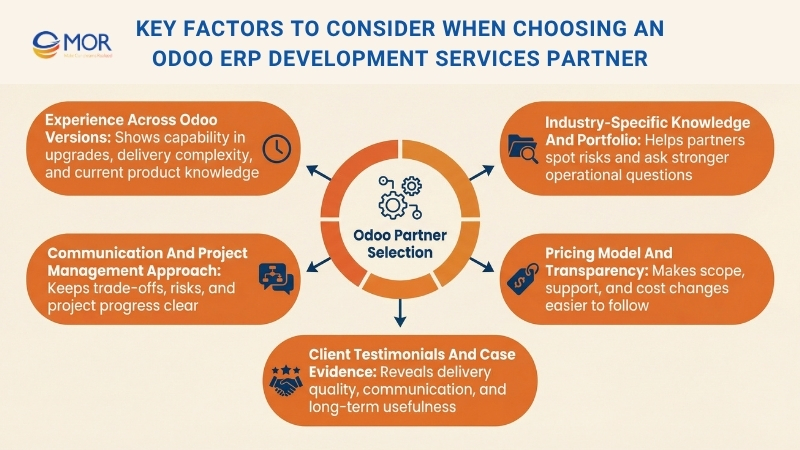
Experience Across Odoo Versions
One of the first things you should review is whether the partner understands how Odoo works in actual delivery, not only in sample presentations. Knowledge of versions matters. Upgrade handling matters too. Experience across small, mid-sized, and complex projects also matters. A provider that mainly delivers simple website projects may find it hard to manage a manufacturing rollout or a finance-heavy ERP environment.
Odoo’s own partner model points to this in a clear way. Official Partners are grouped as Ready, Silver, and Gold according to new enterprise users, the number of certified staff on current versions, and customer retention. That shows the platform itself sees up-to-date product knowledge as an important sign of capability.
Industry-Specific Knowledge And Portfolio
A capable Odoo partner does not have to know your company more deeply than you do. What they must understand is the operating logic behind your business. Retail, manufacturing, healthcare, field service, and wholesale all come with different workflows, reports, controls, and team needs.
That is why the quality of the portfolio matters so much. Odoo’s user stories show this clearly, from Essco Electrical and its service flow to Axxon and its warehouse structure across local sites. When a partner has worked on similar projects before, they usually notice risk sooner and raise stronger questions from the start.
Client Testimonials And Case Evidence
Testimonials never tell the full story on their own, but they do help you judge whether a partner can communicate well, deliver on time, and remain useful after launch. MOR Software already has service materials that highlight customer feedback around professionalism, delivery quality, and long-term collaboration, while its wider project work covers healthcare, HRM, media, enterprise systems, Salesforce, mobile, and offshore delivery.
That wider background matters because ERP projects rarely sit alone. They often connect to apps, websites, legacy systems, mobile processes, or cloud-based tools around the edges. A partner with broader delivery experience is often in a better position to manage those linked parts.
Communication And Project Management Approach
You need a partner that can speak clearly when things are simple and when they are difficult. ERP work always involves choices and trade-offs. Some ideas need to be challenged. Some schedules may need to move. Some data risks must be raised early. When a team avoids direct conversations, the project often becomes more expensive later.
MOR’s service materials regularly highlight Agile delivery, clear progress, transparent communication, and controlled team scaling. That kind of working style is worth looking for in any ERP partner, whether you choose MOR or another provider.
Pricing Model And Transparency
A low quote at the start can easily turn into a costly project later. Many ERP efforts seem small in the early stage, but integration work, migration, support, and change requests can add weight very quickly. That is why you need Odoo ERP development services with a pricing model that makes scope, support, and future work easy to follow.
That does not mean every cost must be fixed on day one. It does mean the partner should be open about what is included, what sits outside the scope, how changes are priced, and what support after launch will look like. Clear cost structure builds trust much earlier in the process.
Why MOR Software Is Your Ideal Odoo Development Partner
The right ERP partner should bring more than technical skill. You also need a team with broad delivery strength, steady support, and a practical view of how businesses actually run. That is where MOR Software stands out in Odoo ERP development services.
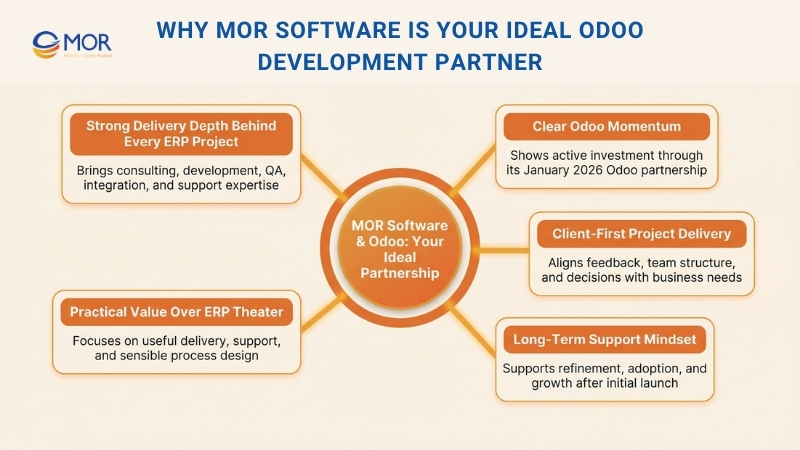
Strong Delivery Depth Behind Every ERP Project
MOR is not stepping into ERP with a limited service background. Our wider business already includes outsourcing programming services, custom software development outsourcing, Salesforce delivery, mobile, web, QA, offshore models, and long-term support. That matters because Odoo projects often require more than pure ERP knowledge. They also need integration thinking, product discipline, and stable delivery control.
Our footprint also helps clients work across borders more easily. MOR’s offices in Vietnam and Japan support cross-market collaboration, while 850+ projects across 10+ countries show that we are used to long projects, mixed working styles, and a wide range of business demands.
Clear Odoo Momentum
In January 2026, MOR Software announced its partnership with Odoo and presented that move as part of a wider push to deliver practical, scalable ERP work built around real operations. That matters because businesses comparing partners do not want a team that is only talking about the platform. They want one that is actively investing in it.
We see that direction as a natural match with what MOR already does well. Odoo needs advisory-led setup, custom work, integration depth, and long-term care for the system. Those layers already sit inside our broader delivery model.
Client-First Project Delivery
ERP projects are full of choices that may look technical on the surface but are actually tied to business operations. We keep the work close to the client’s workflow, team structure, and timing needs. That means quick feedback loops, sessions with the right users, and delivery decisions based on business results rather than polished demonstrations.
MOR’s offshore and service materials show this clearly. Our offshore Odoo developers work closely with clients to define requirements, build teams around real needs, collect feedback often, and adjust team structure when the project grows or changes direction. That approach fits ERP work very well.
Long-Term Support Mindset
Many vendors are comfortable during the first setup phase. Fewer stay as strong during the longer middle stage, when the platform needs refinement, support, extra modules, and steady user adoption across departments. That is often the point where businesses decide if the ERP investment was truly worth it.
Our maintenance model, QA support, and dedicated team structure give us a stronger base for that longer path. We do not see ERP as a one-time release. We treat it as a system that should improve as your business adds channels, opens new locations, or strengthens internal controls.
Practical Value Over ERP Theater
Some ERP sales conversations sound impressive but stay far from day-to-day business reality. We prefer to focus on what companies actually need, clear scope, sensible process mapping, solid integration work, dependable support, and a team that remains helpful after launch.
That is why MOR fits businesses looking for a real partner rather than a basic vendor. We bring product thinking, process discipline, and structured software delivery into Odoo work from early planning to long-term support.
Getting Started: Your Journey To Odoo Excellence
Starting with Odoo should not feel too heavy. In many cases, the best opening step is a focused consultation around how your business works today. We review current systems, identify the biggest process issues, and help you decide whether the platform should replace your existing tools, connect with them, or support them in a more linked setup. That early discussion matters because it gives you a much clearer picture of what the project really needs to solve, instead of pushing you toward a generic plan that does not fit your operations.
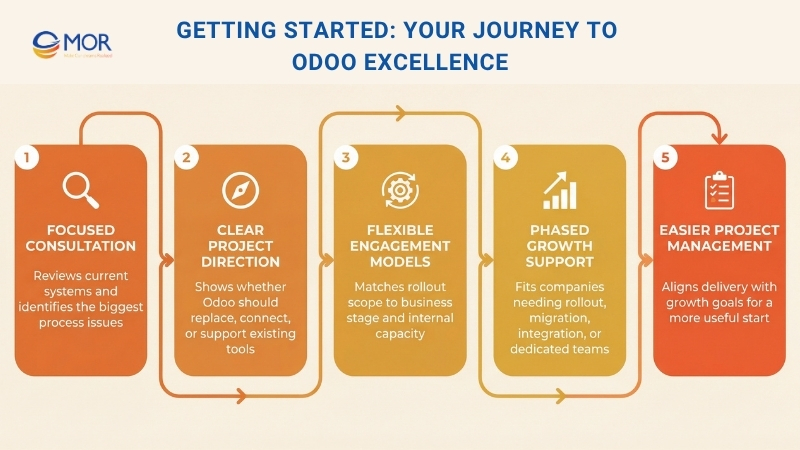
A strong starting point should also help you see which type of engagement suits your business best. Some companies need only a focused rollout with limited customization. Others need a broader release that covers migration, integrations, and long-term support. Some also require a dedicated team because their roadmap will grow in stages across departments or locations. We keep the model flexible for that reason. When the scope fits your business stage, your internal capacity, and your growth goals, the rollout becomes easier to manage and much more useful from the start.
Empower Your Business With Bespoke Odoo Solutions
Odoo is a capable platform, but software alone cannot fix broken workflows, scattered data, or slow handovers between teams. That work happens through planning, build work, rollout, and the support that comes after. For that reason, choosing the right partner matters just as much as choosing the platform itself. If you are now comparing Odoo ERP development services, this is the moment to look beyond broad vendor claims. Check how each team defines scope, handles testing, provides support, and understands the way your business actually operates.
At MOR Software, we bring a growing Odoo practice, a strong software delivery background, flexible team models, and a client-first approach that fits serious ERP work. When you are ready to move from research into action, contact us and let’s build a system that fits your business properly from the ground up.
"Mr. Cong’s guiding philosophy is simplicity, believing that the simplest solutions are often the most powerful. He sees trust, empowerment, and the opportunity to demonstrate one’s abilities as the key elements that set MOR apart from traditional IT companies."
Mac Tien Cong


Division Manager (Hanoi Branch)
MOR SOFTWARE
Frequently Asked Questions (FAQs)
What is the difference between Odoo implementation and Odoo customization?
Implementation focuses on installing the ERP platform and configuring available modules. Customization focuses on modifying features, building new modules, and integrating external systems to meet specific business requirements.
What are Odoo ERP development services?
Odoo ERP development services cover the work needed to make Odoo fit your business. This can include consulting, implementation, module development, customization, integration, migration, testing, and long-term support. The goal is to turn Odoo into a system that matches your real workflows instead of forcing your team into generic processes.
How much do Odoo ERP development services cost?
The cost depends on project size, system complexity, the number of modules, integration needs, and the level of customization. A small setup with light changes costs much less than a multi-department rollout with custom modules and data migration. Support after launch also affects the final budget.
How long does an Odoo project usually take?
Timelines can vary a lot. A small customization project may take a few weeks, while a full ERP rollout may take several months. The final timeline depends on your scope, internal feedback speed, data quality, and whether third-party integrations are required.
Can Odoo connect with my current software?
Yes. Odoo can connect with many outside systems, including eCommerce platforms, payment tools, shipping providers, accounting tools, CRM platforms, and older internal systems. The exact approach depends on your data structure, APIs, and how often information needs to sync.
Do I need custom development if Odoo already has built-in modules?
Not always. Many businesses can start with standard modules and only make a few changes. Custom development becomes useful when your company has special workflows, approval logic, industry-specific records, or reporting needs that standard apps cannot handle well.
Is Odoo a good fit for small and mid-sized businesses?
Yes. Odoo works well for small and mid-sized businesses because it is modular. You can start with only the apps you need, then expand later as your operations grow. That gives businesses more flexibility without forcing them to buy a large, heavy system from day one.
What industries can benefit from Odoo ERP development services?
Odoo can support many industries, including retail, wholesale, manufacturing, healthcare, professional services, logistics, and eCommerce. The main reason is its flexibility. The system can be adjusted for different workflows, reporting needs, and operational structures.
Why is data migration such an important part of an Odoo project?
Bad data can damage a new system very quickly. Duplicate contacts, weak product records, missing financial history, or outdated supplier data can create confusion right after launch. Good migration work helps clean, test, and move data properly so the new system starts from a stronger base.
What should I look for in an Odoo development partner?
You should check their Odoo experience, portfolio, communication style, support model, and understanding of your industry. It also helps to review how they handle scope, testing, integrations, upgrades, and post-launch support. A good partner should be clear, practical, and honest about risks.
Do Odoo ERP development services include support after go-live?
They should. Most businesses need help after launch with bug fixes, user questions, report updates, version planning, and new requests. Post-launch support is important because real users often reveal small issues and new improvement ideas once the system is live.
How do I know if my business is ready for Odoo?
A business is usually ready when current tools are disconnected, reporting takes too much manual work, or teams keep struggling with duplicated tasks and unclear workflows. If your company is growing and your systems are starting to slow people down, it may be time to look at Odoo more seriously.
Share


Make Our-Dreams Realized


© 2023 . MOR Software. All Rights Reserved
Sitemap
Privacy Policy
Terms of Use

Rate this article
0
over 5.0 based on 0 reviews
Your rating on this news:
Name
*Email
*Write your comment
*Send your comment
1