


Top 10 Open ERP Software to Evaluate in 2026: Complete Comparison
Open ERP software gives businesses access to ERP source code under an open-source license, but the download price tells only part of the cost story. Hosting, migration, custom modules, integrations, training, upgrades, and support still require budget. This MOR Software guide will compare 10 platforms based on business functions, technical demands, deployment, customization, and long-term ownership so you can build a practical shortlist.
Key Takeaways
- The top 10 options include Odoo Community, ERPNext, Dolibarr, Tryton, iDempiere, Apache OFBiz, metasfresh, Axelor Open Suite, ADempiere, and Open Mercato.
- A free software license can still lead to sizable implementation, hosting, integration, upgrade, and support costs.
- Your workflows, local accounting rules, technical capacity, deployment plan, and future customization needs should drive the final choice.
Top 10 Open ERP Software for 2026
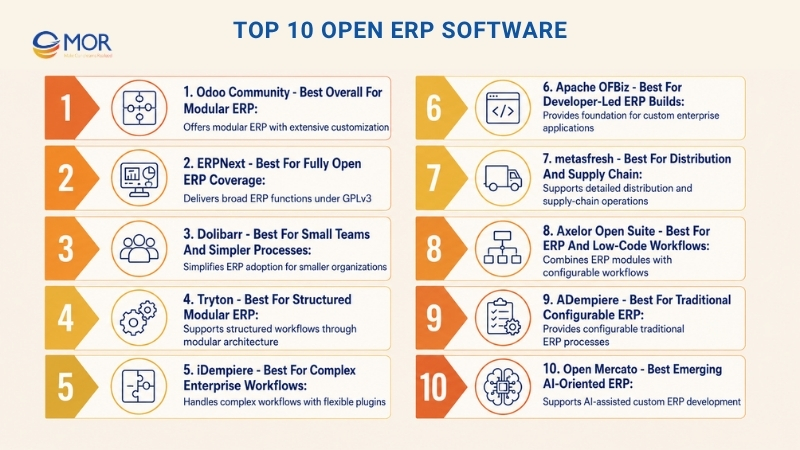
The strongest open ERP software depends on what your company needs after installation, not the length of a product checklist. Our list of open source ERP software covers established ERP suites, developer-led platforms, and a newer AI-oriented option so buyers can compare different approaches.
Rank | Open ERP Software | Best For | Open-Source Model | Deployment | Main Consideration |
1 | Odoo Community | Modular ERP and Odoo ERP customization process | LGPLv3 Community Edition | Self-hosted / partner-hosted | Community and Enterprise differ |
2 | ERPNext | All-in-one ERP for SMBs | GPLv3 | Self-hosted / Frappe Cloud | Smaller ecosystem than Odoo |
3 | Dolibarr | Small businesses and simpler operations | Open-source community project | Self-hosted / hosted providers | Less depth for complex operations |
4 | Tryton | Modular process-driven ERP | 100% open source | Self-hosted / service providers | Technical implementation |
5 | iDempiere | Complex workflows and manufacturing | Community-driven open source | Self-hosted / Docker / partners | Requires ERP expertise |
6 | Apache OFBiz | Developer-led custom ERP | Apache 2.0 | Self-hosted | More platform-led than turnkey |
7 | metasfresh | Distribution and supply chain | Free and open source | Docker / Ubuntu | Setup demands technical skills |
8 | Axelor Open Suite | ERP and low-code workflows | AGPLv3 | Self-hosted / managed options | Smaller ecosystem |
9 | ADempiere | Traditional configurable ERP | Community open source | Docker / Kubernetes / source | Older product lineage |
10 | Open Mercato | AI-oriented ERP development | MIT core | Docker / VPS / developer-led | Young ecosystem |
These license and deployment notes were checked against current project documentation in August 2026. Odoo Community uses LGPLv3, ERPNext uses GPLv3, Axelor Open Suite uses AGPLv3, and Open Mercato keeps its core under MIT while separating its commercial enterprise package.
Odoo Community - Best Overall for Modular ERP
Odoo Community is the open-source foundation of the wider Odoo product family. Companies can start with a limited set of apps, then add more functions as sales, inventory, production, project, and customer processes grow.
The scale of its ecosystem puts Odoo at the top of our ranking. Odoo currently reports 28 million users and more than 40,000 community apps, giving buyers a large pool of extensions and implementation knowledge. Odoo's official site also states that Community is open source and free, while Enterprise adds extra apps, infrastructure, and professional services.
Anyone searching for odoo open source ERP software should check the edition boundary early. Odoo 19 Community carries an LGPLv3 license, while Enterprise uses a separate commercial license.
Key Features
- Modular business apps: Install functions around CRM, sales, purchasing, inventory, manufacturing, projects, and other business processes as requirements expand.
- Inventory and warehouse operations: Connect stock movements, orders, procurement, and fulfillment inside the same business system.
- Manufacturing workflows: Manage production-related data and connect factory operations with inventory and purchasing.
- Website and commerce apps: Link back-office records with web, eCommerce, sales, and customer activities.
- Custom modules and APIs: Developers can adapt business logic and connect external systems around the Odoo architecture.
Pros
- Large application and developer ecosystem
- Broad business-function coverage
- Strong fit for tailored workflows
- Modular adoption path
- Large pool of implementation partners
Cons
- Community and Enterprise functions differ
- Some requirements call for paid apps or custom modules
- Poorly governed custom code can make future upgrades harder
Best For
Companies that need a modular ERP foundation and have access to an experienced implementation team. MOR Software provides Odoo Development for consulting, implementation, custom modules, integrations, and post-launch support.
ERPNext - Best for Fully Open ERP Coverage
ERPNext is a free, open-source ERP published under GPLv3. Frappe states that users can inspect, modify, use, and share the source code, making ERPNext a strong candidate for organizations that place software freedom high on the buying criteria.
Its standard scope spans finance, inventory, sales, purchasing, manufacturing, projects, and related business processes. Companies can self-host the system or choose Frappe Cloud, which shifts infrastructure work such as backups, monitoring, patching, and hosting to a managed environment.
Key Features
- Finance management: Connect accounting records, transactions, reporting, and commercial activity in one ERP database.
- Sales and CRM: Track customers, opportunities, quotations, and sales processes alongside operational data.
- Manufacturing: Handle production planning, materials, stock, and related factory processes.
- Projects and work tracking: Manage tasks, project activity, and time-related records inside the ERP.
- Configurable workflows: Adapt forms, processes, reports, and business rules through the Frappe ecosystem.
Pros
- GPLv3 ERP product
- Broad standard module coverage
- Strong fit for SMB operations
- Self-hosted and managed deployment paths
Cons
- Smaller partner network than Odoo
- Deeper changes require Frappe skills
- Local accounting requirements need market-level checks
Best For
SMBs that want broad ERP functions under an open license and have internal technical staff or an experienced Frappe partner.
Dolibarr - Best for Small Teams and Simpler Processes
Dolibarr takes a lighter approach to open ERP software. Administrators activate the modules they need, which suits smaller organizations that don't want to begin with a heavy configuration project.
Its current module set covers CRM, quotations, orders, invoices, projects, inventory, purchasing, accounting, POS, and manufacturing orders. Dolibarr also supports BOMs, stock changes, lots, serial tracking, and production orders, though buyers with deep factory planning requirements should test those processes against a dedicated production scenario.
Key Features
- CRM and contacts: Store customer, prospect, supplier, and commercial records.
- Sales administration: Manage proposals, orders, invoices, payments, and related documents.
- Stock control: Track products, inventory, shipments, and purchasing activities.
- Project management: Handle projects, opportunities, tasks, events, and timesheets.
- Manufacturing basics: Use BOMs and manufacturing orders for less complex production operations.
Pros
- Lower setup burden than heavier ERP suites
- Modular configuration
- Broad small-business coverage
- Active open-source project
Cons
- Less suitable for highly complex group structures
- Factory planning depth may fall short for demanding plants
- Growth can create a need for deeper ERP functions
Best For
Small companies, service teams, associations, and buyers comparing a CRM ERP software small business setup or a free ERP software for small business against larger ERP platforms.
Tryton - Best for Structured Modular ERP
Tryton describes itself as 100% open-source business software backed by a provider network. Its integrated modules cover financial and analytic accounting, sales, inventory, CRM, purchasing, supply chain, manufacturing, projects, and related processes.
The platform suits teams that value clean module boundaries and controlled process design. Companies evaluating open source manufacturing ERP software should include Tryton when production, stock, procurement, and accounting need to share the same data model.
Key Features
- Financial accounting: Connect core financial records with operating transactions.
- Sales and purchasing: Link customer demand, quotations, procurement, and order activity.
- Inventory management: Track stock locations and product movement through operational processes.
- Production management: Support manufacturing processes linked to materials and stock.
- Modular configuration: Deploy the packages required for a defined business scope.
Pros
- Clean modular design
- Broad process coverage
- Open-source development model
- Professional provider network
Cons
- Smaller ecosystem than Odoo
- Setup can feel technical for business-only teams
- Partner availability varies by market
Best For
Manufacturers and process-led organizations that want a modular ERP and can work with technical staff or an implementation provider.
iDempiere - Best for Complex Enterprise Workflows
iDempiere combines ERP, CRM, manufacturing, supply-chain, and POS capabilities in a community-driven project. Its architecture uses a modular OSGi plugin model and a Java-based technology stack, which gives technical teams substantial control over extensions.
The project also maintains an official Docker image, giving organizations a documented route for self-hosted environments. That flexibility carries responsibility for databases, infrastructure, security, and upgrades.
Key Features
- ERP and finance functions: Connect commercial activity with financial and organizational records.
- CRM and sales: Manage customer data and sales processes within the same system.
- Supply-chain workflows: Coordinate procurement, inventory, orders, and related operations.
- Manufacturing support: Handle production-oriented business processes.
- Plugin architecture: Extend the system through modular OSGi components.
Pros
- Deep business-process coverage
- Community-driven development
- Flexible plugin structure
- Suitable for complex organizations
Cons
- Greater implementation effort
- Requires experienced technical resources
- Interface and administration can feel heavier than newer products
Best For
Mid-market companies, manufacturers, and organizations that value configurable workflows over simple out-of-the-box deployment.
Apache OFBiz - Best for Developer-Led ERP Builds
Apache OFBiz is an open ERP software suite and an application development base. The Apache Software Foundation states that it is completely free under Apache 2.0 and can be extended for custom business requirements.
That distinction matters. OFBiz suits organizations that want engineers to shape an enterprise system around specific processes rather than expecting business users to configure a ready-made ERP in a few screens.
Key Features
- Accounting components: Provide a base for finance-related enterprise processes.
- Order management: Connect products, orders, fulfillment, and customer activity.
- Inventory and warehousing: Support stock and warehouse logic inside custom business applications.
- Manufacturing components: Cover production and MRP-related requirements.
- Development foundation: Let Java teams extend business objects, workflows, services, and interfaces.
Pros
- Apache 2.0 license
- Deep development control
- Mature Apache project
- Good base for tailored enterprise systems
Cons
- High technical barrier
- Project work can be substantial
- Less turnkey than Odoo or ERPNext
Best For
Enterprises and software teams that already have Java skills and want to build a highly tailored business platform on an open foundation.
metasfresh - Best for Distribution and Supply Chain
metasfresh focuses on businesses in industry and trade. Its project documents a three-tier architecture, REST API, web frontend, and installation through Docker or Ubuntu.
Product, warehouse, sales, procurement, manufacturing, and logistics processes make it a relevant option for distributors and product-led companies. Technical setup is heavier than a lightweight SMB tool, so infrastructure and onboarding should enter the evaluation early.
Key Features
- Procurement: Connect supplier activity with purchasing and stock requirements.
- Warehouse operations: Manage product movement and inventory across distribution processes.
- Product data: Maintain the records needed across sales, purchasing, and supply-chain work.
- Manufacturing: Link production with stock and planning requirements.
- REST API: Connect external applications and custom services to ERP data.
Pros
- Strong distribution orientation
- Detailed inventory processes
- Manufacturing support
- Docker deployment path
Cons
- Higher setup effort for small teams
- Requires structured user onboarding
- Smaller service ecosystem than Odoo
Best For
Distributors, wholesalers, and manufacturers that need detailed inventory, procurement, product, and logistics processes.
Axelor Open Suite - Best for ERP and Low-Code Workflows
Axelor Open Suite combines open ERP software modules with a business application platform. Its repository includes CRM, sales, finance, HR, projects, inventory, supply chain, production, purchasing, maintenance, and related modules.
Axelor publishes Open Suite under AGPLv3. Its modular structure makes it attractive when standard ERP functions need tailored processes and internal applications around them.
Key Features
- CRM and sales: Connect leads, customers, commercial processes, and sales activity.
- Finance and cost management: Bring operating transactions into financial workflows.
- Inventory and supply chain: Manage purchasing, stock, suppliers, and fulfillment processes.
- Production: Support manufacturing and MRP-related operations.
- Business process tools: Adapt forms and workflows around company-specific requirements.
Pros
- Broad ERP module set
- Strong process customization path
- Modern project activity
- Good fit for tailored internal workflows
Cons
- Smaller extension ecosystem
- Fewer implementation resources than Odoo
- Complex projects still need development skills
Best For
Mid-sized organizations that need ERP functions plus configurable process applications around specific operating rules.
ADempiere - Best for Traditional Configurable ERP
ADempiere is a long-running community ERP, CRM, and SCM project. Its current documentation provides source downloads plus Docker, Helm, and Operator deployment paths, keeping self-managed installation central to the product model.
The system appeals to buyers that value mature ERP concepts and configuration depth. Teams should still assess the interface, community activity, available partners, and required extensions before committing to production.
Key Features
- Accounting: Manage core financial processes tied to ERP transactions.
- CRM and sales: Connect customer records with commercial operations.
- Procurement: Coordinate supplier and purchasing activity.
- Inventory: Track stock across operational processes.
- Organization management: Support business structures that need configurable ERP rules.
Pros
- Long project history
- Broad traditional ERP scope
- Flexible deployment choices
- Community-driven model
Cons
- Older product lineage
- Technical setup requires experience
- Smaller modern ecosystem than leading alternatives
Best For
Organizations that prioritize traditional ERP depth, configuration control, and self-managed infrastructure.
Open Mercato - Best Emerging AI-Oriented ERP
Open Mercato takes a different route from established open ERP software. It positions itself as an AI-engineering foundation with ready-made CRM and ERP domain modules, reusable architecture decisions, and tooling designed for AI-assisted software development.
Its core uses an MIT license, but a separate Enterprise package carries commercial terms. The project is young, so buyers should treat proof-of-concept testing as mandatory rather than assuming maturity from a promising architecture.
Key Features
- Ready-made ERP domains: Start with business modules around CRM, sales, orders, production, and service delivery.
- Modular architecture: Add modules, APIs, pages, and business entities without directly patching every part of the core.
- AI engineering tools: Supply structured specifications and development skills for AI coding agents.
- Multi-tenant design: Support organization and tenant boundaries inside the application model.
- Modern stack: Use TypeScript, Next.js, PostgreSQL, Redis, and related web technologies.
Pros
- AI-oriented engineering model
- MIT-licensed core
- High developer control
- Modern application stack
Cons
- Young ecosystem
- Short production history
- Smaller partner base
- Enterprise layer has separate commercial terms
Best For
Technical teams experimenting with newer ERP architecture and AI-assisted custom application development.
What Is Open ERP Software?
Open ERP software is enterprise resource planning software whose source code can be inspected and modified under an open-source license. It connects business functions including accounting, CRM, sales, procurement, inventory, manufacturing, projects, and HR around shared records and workflows.
The open source software meaning centers on software freedom rather than a zero-dollar project. ERPNext's documentation, for example, defines open source around the rights to inspect, change, use, and share software.
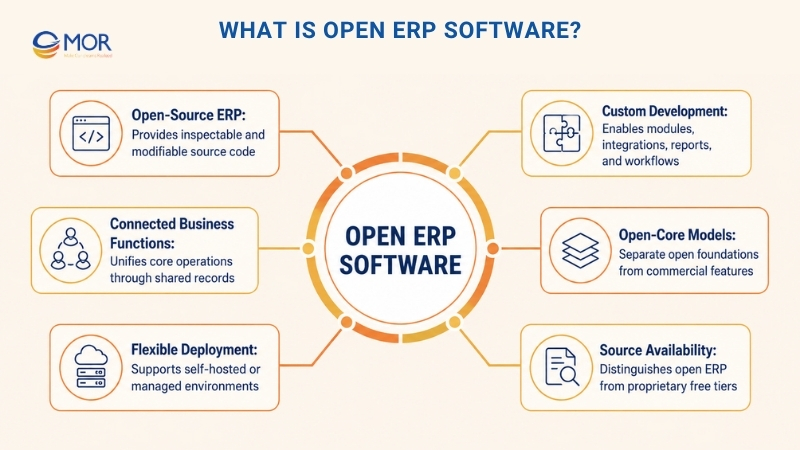
Open-source ERP can run on your own servers, public cloud infrastructure, or environments managed by a specialist. Source access also lets developers build integrations, modules, reports, and business rules when standard configuration doesn't fit the operation.
Two distinctions deserve attention. Open-core products may keep a free core while placing extra functions under commercial terms. Odoo Community and Enterprise follow that pattern. A proprietary free tier, meanwhile, can cost nothing but still keep its source closed.
Those differences help explain why open source software examples and free software often appear together in search results but don't mean the same thing.
Why Do Businesses Choose Open ERP Software?
Companies choose open ERP software when they want more control over business logic, infrastructure, extensions, and long-term technology decisions. Adoption is no longer a fringe software strategy: Mordor Intelligence values the open-source ERP market at USD 5.31 billion in 2026 and projects 9.66% CAGR through 2031.
The wider open-source model also has a strong enterprise case. A Linux Foundation study found that 84% of respondents reported lower software ownership costs, and 84% reported less vendor lock-in from open-source software. Those gains still depend on good governance, technical skills, and realistic operating budgets.
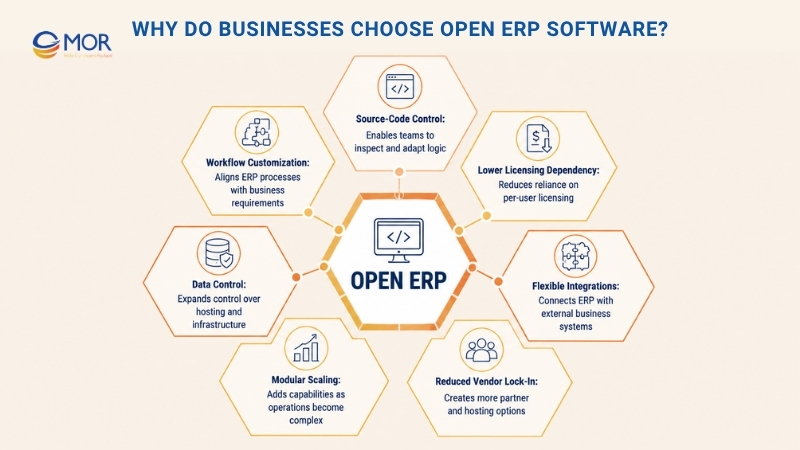
- Gain source-code control: Your technical team can inspect ERP logic, review changes, and adapt areas that don't fit standard processes.
- Customize business workflows: Modules, forms, permissions, reports, and API connections can match business rules more closely than a fixed proprietary package.
- Limit licensing dependency: Open licenses can lower exposure to per-user licensing, but implementation, infrastructure, support, and maintenance still carry cost.
- Control business data: Self-hosting or selected cloud environments give your team more say over database location, backups, access, and infrastructure policy.
- Integrate systems more freely: APIs and source-level development support connections with eCommerce, CRM, banking, logistics, BI, payment, and legacy platforms.
- Scale through modules: Teams can add applications and process areas as operations become more complex instead of launching every department at once.
- Use community ecosystems: Established projects draw on developers, documentation, extensions, forums, and commercial implementation firms.
- Limit vendor lock-in: Source access and flexible hosting create more options when your company needs a new implementation partner or infrastructure model.
How We Evaluated the Best Open ERP Software
Our open ERP software ranking focuses on business fit and implementation reality. A platform can look impressive in a demo and still be the wrong choice when local accounting, integrations, production rules, security, or maintenance enter the project.
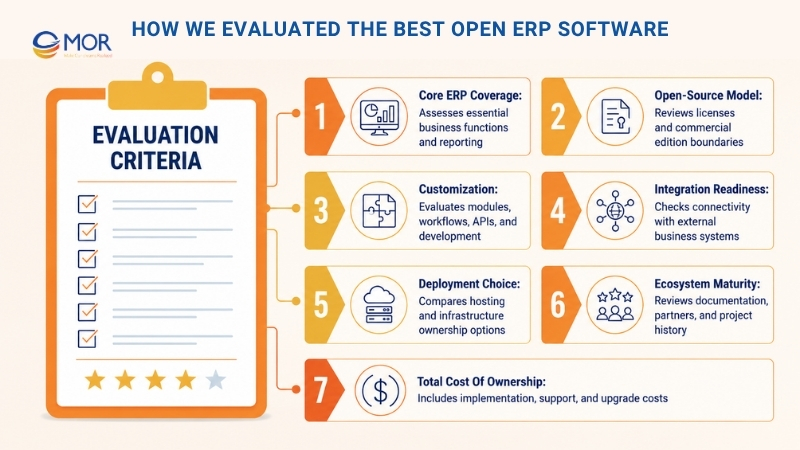
For buyers searching best open source ERP software 2026, we applied the same criteria across all ten products rather than ranking by module count alone:
- Core ERP coverage: We checked finance, CRM, sales, purchasing, inventory, manufacturing, projects, HR, and reporting.
- Open-source model: We reviewed source access, licenses, edition boundaries, and commercial layers that may sit around the open code.
- Customization: We assessed modules, APIs, configurable workflows, reports, forms, and source-level development paths.
- Integration readiness: We looked at connections needed around eCommerce, payments, logistics, banking, CRM, BI, and legacy systems.
- Deployment choice: We considered self-hosting, managed hosting, cloud environments, infrastructure ownership, and partner-led deployment.
- Technical effort: Installation, monitoring, backups, security patches, database administration, and upgrades all affect operational load.
- Ecosystem maturity: Documentation, community activity, extensions, service partners, and public project history influence implementation risk.
- Growth fit: We considered small firms, growing SMBs, distributors, manufacturers, and developer-led enterprise projects.
- Total cost of ownership: License cost carries less weight when migration, custom code, infrastructure, support, and upgrades dominate spending.
- Business fit: The best open source ERP software is the one that supports real processes without creating unnecessary technical debt.
Calculate the Real Cost of Open ERP Software
A free license can make open ERP software look inexpensive at the start. ERP projects often spend much more on process work, data, integration, infrastructure, support, and change management than on the core download.
Budget discipline deserves attention early. Panorama Consulting Group's 2026 ERP research found that more than a quarter of organizations exceeded their project budgets, with extra technology needs cited as the leading reason.
Cost Area | What Businesses Pay For | Why It Matters |
Software / edition | Commercial editions, paid modules, or extensions when required | Open source doesn't mean every related product is free |
Hosting | Servers, cloud resources, storage, backups, networking | Self-hosting moves infrastructure responsibility to your team |
Implementation | Gap analysis, configuration, process mapping, UAT | Poor setup can reproduce broken workflows inside a new system |
Data migration | Cleansing, mapping, transformation, validation | Bad master data weakens reports and daily transactions |
Customization | Modules, reports, UI changes, business rules | Excess custom code can create upgrade debt |
Integrations | APIs, eCommerce, payment, shipping, banking, CRM | ERP normally shares data with other systems |
Training | Administrator, key-user, and end-user training | Adoption affects day-to-day value |
Maintenance | Monitoring, bug fixes, security patches | Production systems need regular technical care |
Upgrades | Testing, module remediation, migration work | Custom environments need extra regression testing |
Support | Internal IT or an implementation partner | Production incidents require defined ownership |
A practical TCO model should cover three to five years. Include implementation, infrastructure, labor, custom development, support, upgrade work, and expected process expansion rather than comparing download prices alone.
The same rule applies when evaluating a best open source business management software ERP 2026 shortlist. A cheaper software open ERP that needs extensive custom code may cost more over time than a product that fits your processes with standard modules.
Choose the Right Open ERP Software for Your Business
Selecting open ERP software starts with operational requirements, not brand recognition. Map what the system must do, then test the shortlisted products against real transactions and user roles.
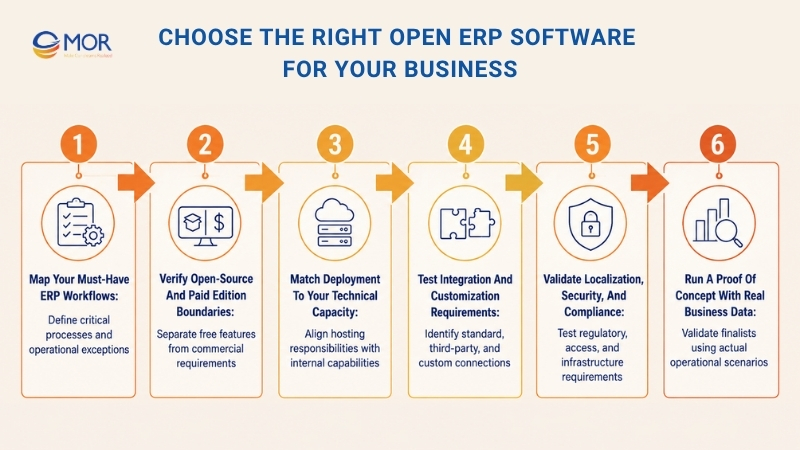
Map Your Must-Have ERP Workflows
Document lead-to-order, procure-to-pay, inventory, warehouse, manufacturing, accounting, projects, HR, reporting, and multi-company processes. Mark which workflows must work on day one and which can wait for later phases.
Keep exceptions in the map too. Returns, partial deliveries, subcontracting, special approval limits, inter-company transactions, and unusual production flows often expose the gaps that a basic demo hides.
Verify Open-Source and Paid Edition Boundaries
Check what the ERP software open source includes before estimating implementation. Record paid extensions, enterprise-only functions, third-party modules, commercial hosting, and professional support separately.
Odoo makes this exercise easy to understand. Community is LGPLv3, while Enterprise has another license and additional functionality. An implementation plan should never assume the two editions contain identical capabilities.
Match Deployment to Your Technical Capacity
Self-hosting gives your company deeper infrastructure control, but it also transfers responsibility for backups, monitoring, security patches, disaster recovery, database administration, and scaling. Managed hosting shifts much of that work to a provider.
Buyer preferences have moved toward cloud ERP. Software Path's analysis of 10,000 ERP selection projects found that cloud preference rose from 56.2% in 2020 to 63.3% in 2025. That trend doesn't make cloud the automatic answer, but it shows why deployment strategy now belongs in the first round of ERP evaluation.
Test Integration and Customization Requirements
List every external system that must exchange data with the ERP. Common dependencies include eCommerce platforms, CRM, payment gateways, shipping tools, banking systems, BI platforms, vertical applications, and legacy databases.
Then classify each connection as standard, third-party, or custom. Excessive changes to core ERP code create future maintenance work, so modular extensions and documented APIs are usually safer than direct core edits.
Validate Localization, Security, and Compliance
Test taxes, currencies, chart of accounts, audit trails, e-invoicing, access roles, and statutory reports for every country where the business operates. An accounting module can be mature and still miss a local rule your finance team needs.
Security needs the same practical test. Review permissions, backups, patch processes, infrastructure ownership, data residency, logs, and incident responsibilities before production.
Run a Proof of Concept With Real Business Data
A proof of concept should recreate your actual operation. Load representative products, customers, suppliers, warehouses, taxes, orders, invoices, production workflows, reports, and user roles into each finalist.
Ask each system to complete the same tasks. This exposes usability gaps, hidden customization, integration work, and training needs much faster than comparing marketing pages.
Deploy Odoo ERP Faster With MOR Software
Choosing Odoo solves only the platform decision. Production success still depends on process mapping, configuration, custom modules, integration, testing, UAT, training, and post-launch ownership. MOR Software's Odoo software ERP development service covers those areas for companies implementing new systems or extending existing deployments.
For organizations that select open ERP software but lack enough in-house Odoo capacity, MOR can support the implementation through consulting, development, flexible staffing, and Application Management Services.
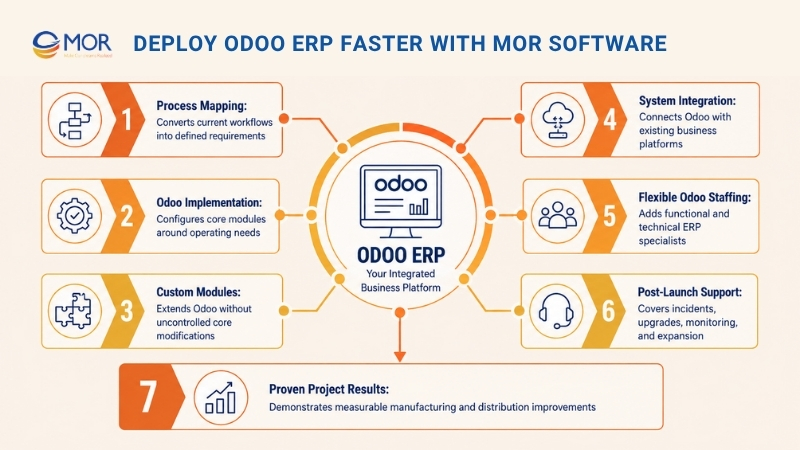
- Map processes before implementation: MOR consultants assess current operations and convert as-is workflows into defined to-be processes. That step keeps configuration tied to business requirements rather than software defaults.
- Implement core Odoo modules: Project scope can include Sales, Purchase, Inventory, Accounting, Manufacturing, and Logistics based on the operating model. MOR's wider Services can support related technical work where the ERP connects to other systems.
- Build maintainable custom modules: MOR develops industry-specific modules and reusable extensions around requirements that standard Odoo functions don't cover. The aim is controlled customization rather than uncontrolled edits across the core.
- Integrate existing systems: APIs and custom connectors can connect Odoo with third-party applications, legacy software, and other business platforms. MOR's Expertise & Industries spans manufacturing, distribution, logistics, retail, financial services, and education in the supplied Odoo materials.
- Add Odoo specialists when needed: Functional consultants can handle business analysis and configuration, while technical developers work on custom modules and integrations. Part-time and full-time engagement models support companies that need extra ERP capacity without building the entire team internally.
- Support the system after go-live: MOR's AMS scope covers incidents, bug fixes, system monitoring, performance work, module expansion, and upgrades. This gives operations teams a defined support path after the implementation phase.
MOR's supplied Odoo materials also document measurable project results. A manufacturing implementation recorded 35% lower inventory holding costs and 50% better production scheduling, while a distribution project reached 99% order fulfillment accuracy and unified inventory across warehouse locations.
MOR Software lists CMMI Level 3, Odoo certificates, ICT recognition, and related quality credentials in its service materials. Its company history also records ISO 9001:2015 and ISO 27001:2013 certification.
You can review MOR's Case Studies, learn more About MOR Software, or Contact MOR Software to discuss an Odoo rollout, migration, integration, or support plan.
Conclusion
The right open ERP software should fit your workflows, technical capacity, deployment policy, and long-term budget without creating unnecessary custom-code debt. Odoo Community leads this comparison for modularity and ecosystem depth, but implementation quality still shapes the result. If Odoo fits your shortlist, MOR Software can support process analysis, implementation, custom development, integrations, training, and ongoing AMS. Contact us to discuss your Odoo ERP requirements and map the right implementation approach.
"Mr. Cong’s guiding philosophy is simplicity, believing that the simplest solutions are often the most powerful. He sees trust, empowerment, and the opportunity to demonstrate one’s abilities as the key elements that set MOR apart from traditional IT companies."
Mac Tien Cong


Division Manager (Hanoi Branch)
MOR SOFTWARE
Frequently Asked Questions (FAQs)
What is open ERP software?
Open ERP software is ERP whose source code is available under an open-source license. Depending on the license, organizations can inspect, run, modify, and extend the system instead of relying only on a proprietary vendor.
What is the best open ERP software in 2026?
Odoo Community is our top overall choice for modularity, ecosystem size, customization, and access to implementation expertise. ERPNext is a strong alternative for teams prioritizing a GPLv3 ERP, while Dolibarr fits smaller and less complex operations.
Is open ERP software really free?
The software license can be free, but the ERP project isn't. Hosting, process analysis, migration, custom modules, integrations, training, maintenance, security, support, and upgrades create real costs throughout the system lifecycle.
What is the difference between open-source ERP and free ERP software?
Open source refers to source-code access and licensing rights. Free ERP describes price. A proprietary vendor can provide a free plan without publishing its source code, so the two terms shouldn't be treated as synonyms.
Is Odoo Community fully open source?
Yes. Odoo 19 Community Edition is licensed under LGPLv3. Odoo Enterprise follows a separate commercial license and adds other functionality, support, infrastructure, and services.
Which open ERP software is best for small businesses?
ERPNext and Dolibarr are practical candidates, depending on process depth. Dolibarr suits simpler sales, invoicing, CRM, stock, and project requirements, while ERPNext supports a broader ERP scope for companies that need manufacturing, finance, inventory, and other connected operations.
Which open ERP system is best for manufacturing?
Odoo Community, ERPNext, Tryton, iDempiere, and metasfresh all deserve evaluation for manufacturing use cases. The right choice depends on BOMs, work orders, planning, costing, traceability, warehouse links, localization, and required shop-floor processes.
Can open ERP software be deployed in the cloud?
Yes. Open-source ERP can run on public cloud infrastructure, a managed provider environment, or a company's own cloud account. Some projects also provide first-party or partner-managed hosting options.
What are the main hidden costs of open-source ERP implementation?
Migration, integrations, custom development, infrastructure administration, testing, training, support, security, and upgrades often make up a large share of TCO. Custom code deserves extra scrutiny because poorly documented extensions can raise future upgrade costs.
How should a business choose between Odoo, ERPNext, and other open ERP platforms?
Map the required workflows, check edition boundaries, test local accounting, assess internal technical skills, calculate three-to-five-year TCO, and run the same proof of concept across finalists. A reliable open source ERP software list should start the research, not make the final decision for you.
Share


Make Our-Dreams Realized


© 2023 . MOR Software. All Rights Reserved
Sitemap
Privacy Policy
Terms of Use

Rate this article
0
over 5.0 based on 0 reviews
Your rating on this news:
Name
*Email
*Write your comment
*Send your comment
1