


Salesforce Slack Integration 2026 [Comprehensive Guide]
Is your business struggling to synchronize customer data and improve internal communication? Implementing salesforce slack integration can help your organization optimize sales, marketing, and customer service processes within a single collaborative workspace. In this article, MOR Software provides insights into a comprehensive solution that connects slack and salesforce efficiently and accelerates decision-making.
What Is Salesforce Slack Integration?
Salesforce slack integration is the combination of two leading platforms: Slack, a communication and collaboration tool, and salesforce CRM, a powerful customer relationship management system. Integrate slack with salesforce allows businesses to unify communication processes and customer data within a single workspace.
With slack and salesforce integration, all important information from salesforce is automatically pushed into the appropriate slack channels. This not only enables teams to access data in real-time but also minimizes constant switching between platforms, thereby accelerating salesforce to slack integration.
Top Features Of Salesforce Slack Integration To Know
When businesses implement salesforce slack integration, understanding the platform’s key features is essential to optimize workflow efficiency. Below are the main features that sales, marketing, and service teams should leverage:
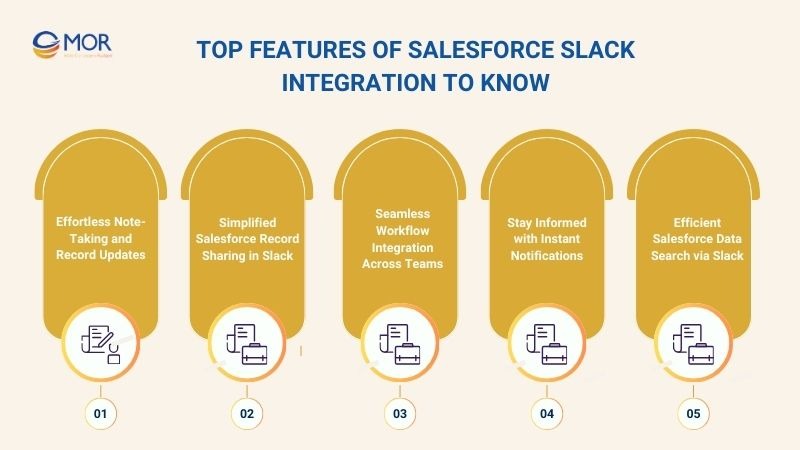
Effortless Note-Taking and Record Updates
With slack for salesforce, taking notes and updating customer information becomes much faster and more efficient than traditional manual methods. Employees can take meeting notes directly in Slack and sync them immediately with salesforce CRM.
Moreover, sales opportunities and customer accounts can be updated easily within Slack without switching to the Salesforce interface. For example, after a client meeting, new sales opportunities or changes in lead status can be recorded and updated in Salesforce with just a few actions in Slack.
Robust Bidirectional Channel Synchronization
Rather than forcing teams to manually replicate data across separate applications, an advanced integration establishes a continuous, real-time bridge between Slack conversations and Salesforce records. This capability allows specific Slack channels to be dynamically mapped and linked directly to critical Salesforce objects, including opportunities, leads, and customer service cases. Every strategic discussion, client update, or internal decision made within Slack is automatically logged back into the corresponding Salesforce record. This ensures that cross-functional teams, from sales executives to customer success managers, always have access to a single, consistent version of the truth without ever experiencing the friction of switching platforms.
Stay Informed with Instant Notifications
Thanks to slack elevate, employees always receive timely notifications about pipeline changes, approval requests, and new leads directly in Slack. These notifications can be customized according to team needs, reducing unnecessary information and ensuring all members receive critical data.
For example, when a critical sales opportunity reaches the “negotiation” stage, an automated alert is sent to the team leader and relevant departments, ensuring no one misses important updates.
Frictionless In-Slack CRM Actions
Empowering field teams and account executives means bringing the full power of Salesforce CRM directly into their daily communication workspace. Through this integration, users can seamlessly search, view, and update core Salesforce records—such as contacts, leads, and accounts—right from the Slack interface using intuitive commands and interactive UI components. By eliminating the cognitive drain of constantly toggling between browser tabs and desktop applications, sales representatives can update pipeline stages, log meeting notes, and move deals forward on the go, significantly boosting daily operational efficiency and data accuracy.
Efficient Salesforce Data Search via Slack
With salesforce integration with Slack, users can use simple commands to query Salesforce data directly from Slack. This allows access to important information without logging into Salesforce, saving time and boosting workflow efficiency.
This search feature is particularly valuable for sales and support teams, enabling them to quickly retrieve data and make accurate, data-driven decisions while maintaining a seamless workflow across departments.
Advanced AI and Agentforce Collaboration
The modern digital workspace reaches its peak efficiency when structured enterprise data is unified with unstructured team knowledge and autonomous AI agents. This integration acts as a comprehensive collaboration hub where structured customer profiles, organic Slack team discussions, and predictive AI agent insights converge in a single workspace. By contextualizing real-time conversational history alongside predictive multimodal AI models, teams can instantly surface hidden trends, receive next-best-action recommendations, and collaborate on complex enterprise solutions with all the necessary telemetry readily available at their fingertips.
>>> Read more topics about Salesforce on MOR Blog right now!
Complete Step-by-Step Guide For Salesforce Slack Integration Setup
Establishing a bidirectional integration between Salesforce and Slack is an exceptional strategy to dismantle operational silos and accelerate collaboration across your business units. As an official Salesforce Consulting Partner committed to delivering high-value digital architecture, MOR Software has restructured this step-by-step deployment guide into a balanced, clear format to help your technical team navigate the integration smoothly.
Step 1: Deploying the Salesforce App for Slack
The integration process begins directly inside your communication environment. To establish the initial link, you must install the native application from the official marketplace.
- Locating the Application: Sign in to your Slack workspace and navigate to the left sidebar. Click on "Add apps"—or select "More" if the application category is hidden from your primary navigation view—and search for "Salesforce" in the provided search bar.
- Executing the Installation: Ensure you have selected the appropriate corporate environment via the workspace switcher at the top of your screen. Click "Install" to navigate to the app's directory page, select "Add to Slack", and grant the necessary cross-platform permissions by clicking "Allow".
- Initial Account Binding: Once the background files are deployed, Slack will automatically redirect you to the authorization screen. Under the "Connect your Salesforce account" header, click "Connect Account" and accept the permission prompts from both ecosystems to securely register the tool under your active workspace applications.
Step 2: Provisioning the Slack Component inside Salesforce
Because this phase involves managing organizational permissions and installing external components, it requires the authorization of a Salesforce System Administrator.
- Accessing the AppExchange: Log into your corporate Salesforce account, click on the system menu icon, and select "Visit AppExchange".
- Acquiring the Managed Package: Use the search console to locate the official Slack app and click the "Get It Now" button on the bottom right.
- Selecting the Environment: After re-authenticating your credentials and opening the login screen, choose whether to deploy the package directly into your production environment or test it within a sandbox first. Upon successful installation, a confirmation email will be routed to your inbox, and you will be directed to the "Installed Packages" menu inside Salesforce Setup.
Step 3: Completing the Account Handshake
With both individual applications successfully hosted on their respective platforms, you must finalize the integration by establishing a secure token handshake between the two systems.
- Initiating Connection from Slack: Return to your target Slack workspace, navigate to the dedicated "Apps" section, and click directly on the newly integrated Salesforce icon.
- Granting Mutual Permissions: Locate the "Connect Account" prompt under the primary account heading. Click "Allow" on the sequential permission screens generated by both Slack and Salesforce to grant mutual cross-platform data access. Once these credentials are verified, your corporate accounts will be seamlessly joined.
Step 4: Sharing Salesforce Records Directly in Slack
One of the most immediate productivity benefits of this integration is the ability to surface core CRM data inside your team's daily conversations without forcing users to cycle through browser tabs.
- Executing the Command: Navigate to any public, private, or group channel where you wish to share customer metrics and type /salesforce followed by the target record name, ID, or relevant criteria.
- Reviewing and Customizing: Select the appropriate item from the search results to generate an interactive preview card that details the customer name, contact logs, and vital sales data. You can append customized comments to the block to provide immediate context for your team.
- Routing to Specific Stakeholders: Hit "Send" to push the record directly into the active channel feed. Alternatively, you can target specific individuals or organizational groups by typing @username or @groupname immediately followed by the record details to share data securely.
Step 5: Structuring Global Automation and Salesforce Alerts
To transform your customer database from a passive log into a proactive notification engine, you can map important CRM changes directly to designated Slack feeds.
- Defining System Triggers: Inside Salesforce, navigate to the "Setup" menu and select "Notification Builder". From this interface, choose which major business events should generate an alert, such as a newly assigned lead, a "Closed-Won" opportunity milestone, or a high-priority customer support ticket.
- Configuring the Delivery Method: Head over to the "Alerts" tab within Salesforce and click "New Alert". After specifying your business logic, scroll down to the "Delivery Options" console, select "Slack" as your primary distribution channel, and assign the exact Slack channel destined to house the automated update stream.
Step 6: Setting Up Granular Channel-Specific Record Monitoring
For high-priority accounts or critical individual projects, teams can configure specific Slack channels to listen for precise field updates on individual Salesforce records.
- Targeting the Record: Launch the Salesforce app within Slack and click on the system lightning bolt icon to access the core menu. Select "Add/edit alerts for a channel" from the dropdown and pick your target communication stream.
- Activating the Stream: Locate the specific record from the database, click "View", and select "Add to [channel name]". Check the box next to each specific update parameter you wish to monitor and click "Save" to finalize the channel's tracking rule.
Step 7: Optimizing Team Feeds with Bulk Alerts
While individual alerts keep teams updated on key accounts, managing high-volume pipelines requires a consolidated bulk alert strategy to protect your workspace from information overload.
- Creating a Consolidated Rule: Access the Salesforce application home screen within Slack and select the "Click Bulk Alert" tool.
- Finalizing Parameters: Choose the designated Slack channel destined to receive the batch updates, specify the overarching record type you wish to monitor, and click "Add To Channel" to apply your global tracking parameters safely.
Top 4 Options For Salesforce Slack Integration With CRM
When implementing salesforce slack integration, businesses have several options to connect key CRM modules with Slack. Here are four prominent options that organizations should consider when planning slack and salesforce integration:
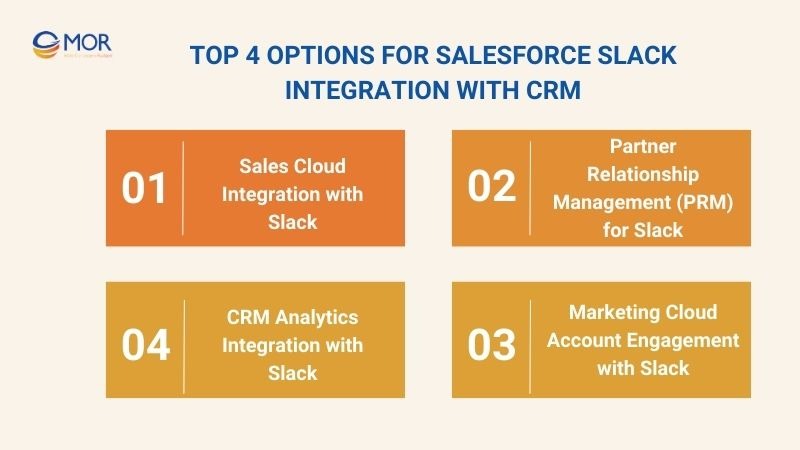
Sales Cloud Integration with Slack
Integrating sales cloud with slack enables sales teams to access Sales Cloud data directly within Slack without constantly switching platforms. Sharing Salesforce records in Slack channels increases transparency among team members and improves collaboration between sales, marketing, and customer support teams.
Example: At a cosmetics store, when a new lead signs up for a product trial:
Real-world Flow:
- Sales reps receive instant notifications in Slack about the new lead.
- The lead information is updated directly in sales cloud, including customer details and product interests.
- Sales opportunities are shared within the Slack channel so that the marketing team can prepare supporting campaigns and customer support can anticipate needs.
Partner Relationship Management (PRM) for Slack
Integrating PRM with slack helps businesses manage partners more efficiently by syncing opportunity data and project updates directly in Slack channels. With slack salesforce integration, sales teams and partners can collaborate seamlessly, reduce delays, and enhance strategic partnership management.
Example: A SaaS software development company working with multiple distribution partners:
Real-world Flow:
- When a partner updates a contract status, a notification is sent immediately to the partner management Slack channel.
- Sales reps review the update and adjust their customer engagement plans accordingly.
- Opportunity records are shared in slack so marketing and support teams are informed and can coordinate promptly.
Marketing Cloud Account Engagement with Slack
Integrating Marketing Automation Cloud Account Engagement with Slack allows marketing teams to receive automated notifications about campaigns, lead engagement, and scoring alerts directly in Slack. With salesforce and slack integration, all customer interaction data is synced in real-time and enabling timely collaboration with sales teams.
Example: An e-commerce company running an email marketing campaign:
Real-world Flow:
- When a lead opens an email or clicks a link, Slack sends notifications to the marketing and sales channels.
- Marketing evaluates the lead score and adjusts the campaign if needed.
- Sales reps are informed promptly to follow up, maximizing conversion opportunities.
CRM Analytics Integration with Slack
Integrating CRM analytics with slack allows businesses to receive dashboards, reports, and data analysis directly in Slack, enabling real-time, data-driven decisions. With slack CRM, complex analytics become easy to understand and share across teams.
Example: A retail company monitoring weekly sales performance:
Real-world Flow:
- Revenue, opportunity, and KPI reports are automatically sent to the management Slack channel.
- Team leaders analyze the data and flag any issues or potential opportunities.
- Other departments access the insights immediately to adjust strategies.
Best Practices For Implementing Salesforce Slack Integration
When implementing salesforce slack integration, businesses should apply best practices to maximize long-term efficiency. Below are some key considerations to ensure a smooth and effective integration process:
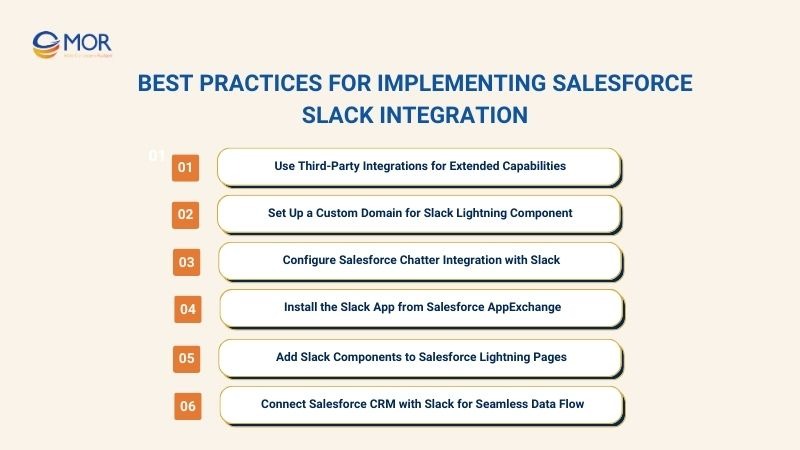
Use Third-Party Integrations for Extended Capabilities
In some salesforce best practices, the default salesforce slack integration features may not fully meet complex business requirements. This is where third-party integrations such as Zapier or Workato come into play, allowing companies to connect Salesforce and Slack with other enterprise systems for a seamless data flow.
Real-world example: A logistics company uses Salesforce to manage customers and Slack for team communication. Additionally, they need to connect with a warehouse management system (WMS). With a third-party tool:
- When a new order is created in Salesforce, details are automatically pushed to Slack and synced with WMS.
- The operations team receives real-time notifications about inventory status.
- The customer service team tracks updates directly in Slack without switching between multiple systems.
The result is fewer errors, faster workflows, and consistent data across all departments.
Set Up A Custom Domain for Slack Lightning Component
When deploying salesforce slack integration, configuring a custom domain for the slack lightning component is considered a best practice. A custom domain provides:
- Enhanced security through safer authentication.
- Reduced risks when accessing sensitive customer data.
- Improved performance with faster response times.
This approach is especially valuable for enterprises handling high volumes of confidential customer and transaction data.
Configure Salesforce Chatter Integration with Slack
Salesforce Chatter is already a powerful tool for internal discussions. By integrating chatter with slack, companies can connect conversations across both platforms, ensuring no important update is missed.
Real-world example: A technology company uses Chatter to discuss product development progress. Once integrated with Slack:
- Updates from Chatter are automatically sent to a dedicated Slack channel.
- Engineers, product managers, and sales teams follow the same conversation stream.
- Decisions and product adjustments are made faster without switching platforms.
Install the Slack App from Salesforce AppExchange
One of the simplest and most reliable best practices is to install the official slack app from salesforce App Exchange. As a native solution, it offers:
- High stability and official Salesforce support.
- Easy deployment without complicated configuration.
- Built-in features such as automatic notifications and Salesforce record sharing in Slack.
This option is especially effective for companies just starting with Salesforce Slack integration, ensuring quick adoption and minimal setup.
Add Slack Components to Salesforce Lightning Pages
Embedding Slack Components into Salesforce Lightning Pages allows employees to interact with Slack directly inside the Salesforce interface. This reduces the need to switch between applications and makes collaboration faster.
Real-world example: A customer support center integrates a Slack Component into their Salesforce Lightning Page. While handling cases:
- Agents can view case details in Salesforce.
- At the same time, they can chat with colleagues via Slack within the same interface.
- The support process becomes smoother and minimizes miscommunication.
This setup helps sales and service teams save time and work more efficiently.
Connect Salesforce CRM with Slack for Seamless Data Flow
Another key best practice is to ensure real-time data synchronization between Salesforce CRM and Slack. This practice helps:
- Eliminate manual data entry and reduce errors.
- Ensure every team operates on the same accurate customer data.
- Strengthen collaboration across sales, marketing, and customer support teams.
What Makes MOR Software The Right Choice For Salesforce Slack Integration?
Implementing Salesforce Slack integration is a complex task that extends beyond technical skills — it requires a partner with industry knowledge, seamless process execution, and customization capabilities tailored to your business needs. MOR Software stands out as an ideal partner because:
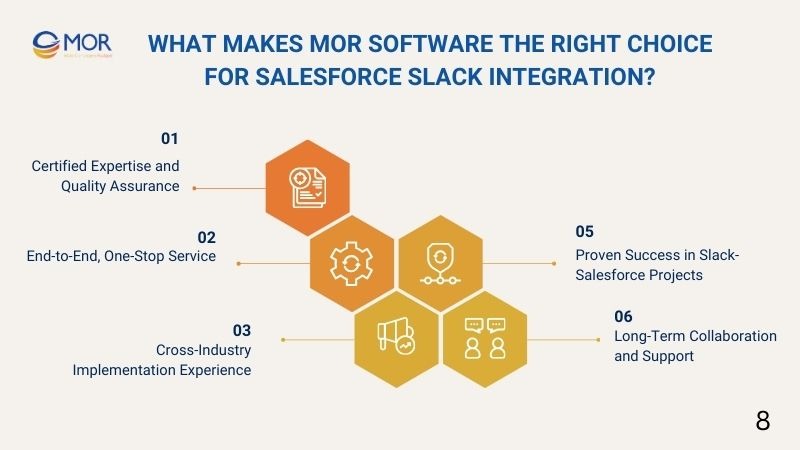
- Certified Expertise and Quality Assurance: MOR Software is a recognized Global Salesforce Consulting Partner and ISTQB Platinum Partner, holding ISO 9001 and ISO/IEC 27001 certifications. Their agile development process, backed by global standards, ensures high-quality delivery and data security.
- End-to-End, One-Stop Service: From business analysis to UI/UX design, backend/frontend development, and CRM maintenance, MOR Software offers comprehensive services that eliminate multi-vendor complexity and ensure seamless salesforce ERP integration.
- Cross-Industry Implementation Experience: MOR has deployed CRM solutions across banking, healthcare, real estate, education, and more. This diversity enables them to deliver domain-aligned, salesforce slack integration strategies tailored to specific business contexts.
- Proven Success in Slack-Salesforce Projects: MOR Software JSC successfully implemented workforce management integrating Salesforce and Slack for a Japanese client.
- Long-Term Collaboration and Support: MOR Software focuses on building long-term partnerships, offering continuous post-deployment support, training, and optimization — ensuring your salesforce slack integration evolves with your business.
Conclusion
Implementing salesforce slack integration with a trusted partner like MOR Software helps your business save time, streamline internal workflows, and boost overall team productivity. Contact MOR Software today to discover how to effectively integrate slack and salesforce, enabling your organization to operate smarter and respond faster in a competitive market.
"Mr. Cong’s guiding philosophy is simplicity, believing that the simplest solutions are often the most powerful. He sees trust, empowerment, and the opportunity to demonstrate one’s abilities as the key elements that set MOR apart from traditional IT companies."
Mac Tien Cong


Division Manager (Hanoi Branch)
MOR SOFTWARE
Frequently Asked Questions (FAQs)
Can Salesforce integrate with Slack?
Yes, Salesforce can integrate with Slack. Salesforce Slack Integration allows real-time syncing of customer data, notifications, and records directly in Slack, enhancing collaboration between sales, marketing, and support teams.
Is Slack still owned by Salesforce?
Yes, Slack is owned by Salesforce. Salesforce acquired Slack to strengthen its ecosystem and enable deeper Salesforce Slack Integration across CRM and communication workflows.
Why did Salesforce pay so much for Slack?
Salesforce paid $27.7 billion for Slack to acquire a leading enterprise collaboration platform, expand its digital workflow capabilities, and drive seamless Salesforce Slack Integration for all customer-facing and internal processes.
How did Salesforce acquire Slack?
Salesforce acquired Slack through a cash-and-stock deal valued at $27.7 billion, officially closing in July 2021. This acquisition enables tighter integration between Slack and Salesforce products for enhanced business workflows.
What are the disadvantages of Salesforce acquiring Slack?
Potential disadvantages include higher costs of ownership, complexity in managing combined systems, and possible user adoption challenges when rolling out Salesforce Slack Integration across large organizations.
Did Salesforce buy Slack?
Yes, Salesforce bought Slack in 2021 to integrate it with its CRM ecosystem and offer enterprises a unified platform via Salesforce Slack Integration.
Share


Make Our-Dreams Realized


© 2023 . MOR Software. All Rights Reserved
Sitemap
Privacy Policy
Terms of Use

Rate this article
0
over 5.0 based on 0 reviews
Your rating on this news:
Name
*Email
*Write your comment
*Send your comment
1