


Talent Management Systems Complete Guide 2026 [Key To Success]
When hiring, onboarding, performance reviews, and training live in separate tools, HR teams lose time and leaders lose sight of talent risk. Talent management systems bring these workflows into one connected place, but the right fit depends on your structure. In this guide, MOR Software will help you understand core functions, benefits, top platforms, and 2026 trends.
Key Takeaways
- Talent management systems connect the employee journey by bringing recruitment, onboarding, performance, learning, succession planning platform, and rewards into a clearer HR flow.
- The right system depends on business needs, including company size, team structure, integration requirements, reporting capabilities, and user adoption goals.
- Custom HR software development can address complex workflow gaps by supporting hiring, training, performance management, and employee retention processes that standard platforms may not fully cover.
The Evolution Of Talent Management Systems
During the 1980s and early 1990s, the talent management system definition was still narrow, with most companies looking inward to train and promote their own people. This created too many mid-level management roles in some businesses. When the economy slowed, many firms changed their structure and started giving more attention to outside hiring. Yet by the late 1990s, many companies saw a clear problem: they were bringing in skilled people and losing them almost just as fast. That pushed HR teams to care more about keeping and growing the people they already had.
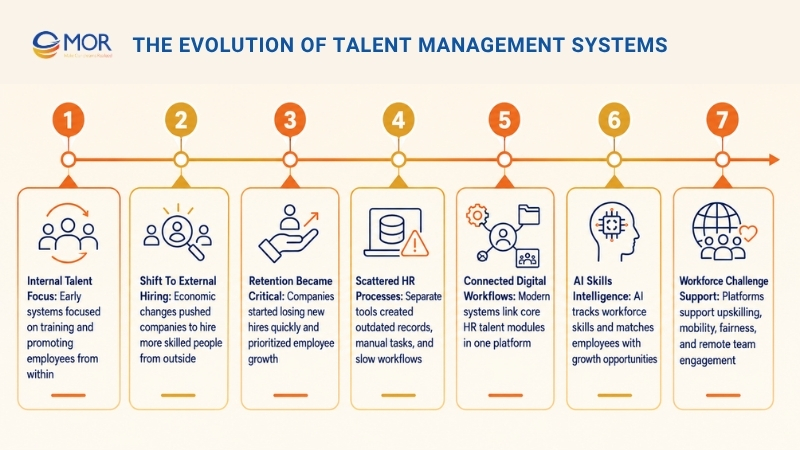
HR teams began adding more people processes, but most of them did not work from one central place. Each function ran on its own, so records became scattered and often old. HR staff and recruiters still spent too much time on paper forms, manual tasks, and slow workflows, leaving little room for bigger people plans.
Talent management systems later gave companies one place to connect the main HR talent modules. Manual work moved into digital workflows, and many repeated tasks became faster across the business.
AI In Talent Management
AI is now moving talent work away from separate tasks and toward a more connected, skills-led model. Modern HRM models can read workforce skills in real time, find missing skills, and match employees with the right growth options, including courses, internal projects, open roles, and career paths. Instead of depending on fixed employee records or yearly reviews, companies can use AI-based data to connect talent choices with business needs and give employees a more useful experience.
As this technology grows, these platforms now play a key role for many companies in many fields. They also help teams solve common workforce issues, including:
- Skill Growth And Workforce Readiness: Find missing skills, plan for future needs, and support ongoing upskilling and reskilling so employees can move into new or changing roles.
- Personal Growth And Internal Movement: Help employees find training, projects, and career options that fit their skills and goals while keeping valuable people inside the company.
- Fair And Inclusive People Practices: Use steady, skills-based data to support fair hiring, growth, and promotion choices across the workforce.
- Remote And Hybrid Teams: Support engagement, development, and performance no matter where people work, using digital tools that help employees and managers stay connected.
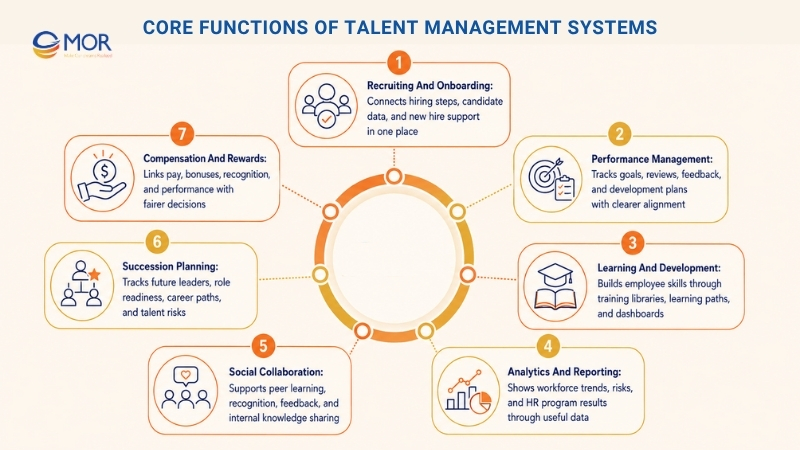
Core Functions Of Talent Management Systems
As a company gets bigger, talent work becomes harder to manage across roles, departments, and locations.
When there is no clear system in place, teams often face broken workflows and weak visibility.
An integrated talent management system solves this issue by bringing major talent functions into one connected and scalable setup.
Recruiting And Onboarding
A strong talent management platform should support your hiring and onboarding work from start to finish in one place. The best talent management systems for recruitment should include:
- Candidate sourcing and tracking from many channels, including job sites, employee referrals, and career pages. This gives hiring teams one clear view of every applicant.
- A simple dashboard for managing job requests, helping hiring managers work together, and keeping all candidate messages in one place.
- Clear interview steps and custom assessment tools to measure each candidate against the needs of the role.
- Onboarding task lists and training plans that help new hires settle into their roles. The platform should also help them find company rules, forms, and key resources without confusion.
- Smooth movement of candidate data into employee profiles after hiring, so human resource development teams do not need to enter the same data again. This keeps one steady record from applicant stage to active employee stage.
When recruitment and onboarding work together, a company can give candidates a better experience and help new employees become productive sooner.
Performance Management
Managing employee performance through talent management systems gives teams more clarity, stronger alignment, and better talent growth. Key tools include:
- Custom review templates that match each job type and skill area.
- Goal-setting tools linked to company goals, so every employee can see how their work supports the bigger plan.
- Live tracking and reports for personal and team goal progress.
- 360-Degree Feedback tools that collect performance input from managers, peers, and other key people.
- Development plans and training suggestions based on skill gaps found during reviews.
When performance talks happen more often, managers can coach people better, and employees know what is expected of them.
Learning And Development
A strong employee development platform brings learning into daily work and helps companies grow skills and careers. Useful functions include:
- A company training library where employees can access eCourses, videos, podcasts, books, and other learning materials on their own.
- Guided learning paths that help employees build new skills based on their role, level, and career goals.
- Social learning tools, including mentor matching and peer learning groups, so teams can share internal knowledge.
- Custom content tools that let subject experts create and share training for special business needs.
- Dashboards that show course sign-ups, training use, and skill growth across employees.
Strong L&D tools help a company grow its talent base over time and keep employee skills close to business goals.
Analytics And Reporting
Talent data helps HR leaders find weak spots and show the value of their talent spending. Good HR analytics tools should support:
- Leadership dashboards that show hiring, retention, diversity, performance, and other workforce data across teams.
- Interactive charts and graphs that let users view trends by department, office, or employee group.
- Custom reports across talent areas, such as time-to-fill for key jobs, turnover risk groups, skill coverage for growth plans, and employee survey results.
- Industry comparison using standard HR data and common workforce measures.
- Alerts when key limits are passed, including turnover risk, open hiring requests, or training budget gaps.
When leaders can see useful data, they can find what needs fixing and make HR programs work better.
Social Collaboration
Social tools are sometimes treated as a small feature, but they can add real value to talent work. Key functions include:
- Community boards where employees can discuss topics like career growth or managing remote teams.
- Peer recognition tools that let people thank teammates for good work, strong values, or helpful behavior.
- Comment areas inside reviews, goals, and growth plans to make feedback more open.
- Expert search tools that help employees find people with the right knowledge inside the company.
When employees can connect, learn from peers, and recognize good work, social tools can support engagement, productivity, and retention.
Succession Planning
Talent management systems should also support succession planning, so companies are ready for future workforce needs and leadership changes. Key tools include:
- Employee profiles that show skills, work history, career interests, and readiness for future roles.
- Tools that help HR teams find high-potential employees who may fit leadership or business-important roles.
- Career path planning that helps employees see how they can grow within the company.
- Leadership growth plans tied to role needs, business goals, and long-term talent plans.
- Risk signals for key roles where resignation, retirement, or internal moves may create gaps.
A clear succession planning process helps companies lower leadership risk, support internal movement, and build a stronger future talent pool.
Compensation And Rewards
Compensation and rewards tools help companies connect pay, performance, contribution, and recognition in a more fair way. Main functions should include:
- Salary planning tools that support pay reviews, pay changes, and workforce budget planning.
- Bonus tools linked to performance results, goal progress, and business results.
- Recognition programs that let managers and peers thank employees for their work.
- Compensation reports that help HR teams review reward sharing and budget use.
- Pay structure views that help leaders make fairer and more data-based pay choices.
When compensation and rewards are managed in the same platform, companies can support fairness, improve motivation, and keep more good employees.
Benefits Of A Talent Management Systems For Organizations
Using a structured talent management platform brings clear business value because it supports stronger talent growth and better company performance.
The benefits of talent management system go beyond daily HR work. It helps companies manage workforce complexity, connect people plans with business goals, and make more steady decisions as they grow.
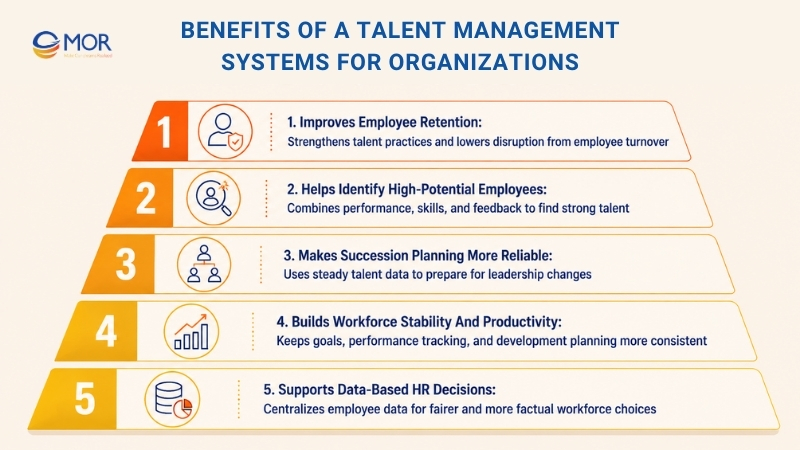
Improves Employee Retention
Talent management has a close link with employee retention.
HR Studies Indicate a clear positive link between good talent management practices and employee retention, with a Pearson correlation of 0.556.
In daily business terms, this means a company with a more steady and structured talent approach has a better chance of keeping strong employees. It can also lower the cost and disruption that come with high turnover.
Helps Identify High-Potential Employees
A people management platform helps companies find high-potential employees in a more organized way by combining performance records, skill reviews, and feedback from many sources.
This matters because McKinsey & Company Research has reported that top performers can be up to 400% more productive than average workers, and up to 800% more productive in very complex jobs.
Without a clear system, companies may miss their strongest people or fail to use their skills well.
Makes Succession Planning More Reliable
Succession planning becomes much more dependable when it uses steady data instead of review cycles that happen only from time to time.
The system helps companies track readiness, follow leadership pipelines, and test different succession plans over time.
This is very useful in large companies, where leadership gaps can create risk across many levels of the business.
When leaders can see internal talent clearly, companies can depend less on outside hiring and make leadership changes faster.
Builds Workforce Stability And Productivity
Workforce productivity depends on stability, continuity, and clear work expectations. Talent management systems support these points by making goal setting, performance tracking, and development planning more consistent across the company.
Companies with mature, data-based talent practices often see lower turnover, which helps teams stay steady and keep work moving.
Over time, this creates a more stable work setting where output is not hurt by constant employee changes.
Supports Data-Based HR Decisions
As companies grow, choices about promotion, workforce planning, and skill development become harder.
A talent management platform helps solve this by bringing scattered employee data into one trusted place.
Leaders can review talent with the same measures, compare performance across teams, and make choices based on facts instead of personal opinions.
This move toward data-based HR decisions helps improve fairness, lower bias, and keep talent spending tied to long-term business goals.
Popular Talent Management Systems To Consider
The right talent management platform will depend on your company size, team setup, hiring volume, and long-term people plan. Some tools are made for large global companies with layered HR work, and others fit growing firms that need easier support for hiring, onboarding, performance reviews, and staff growth. The table below shares 10 common talent management system examples, along with what each one is known for.
Talent Management System | Best Fit | Key Talent Management Features | Why Companies Choose It |
SAP SuccessFactors | Large enterprises and global companies | Recruiting, onboarding, learning, performance goals, pay planning, career growth, succession planning | This is often listed among the best talent management systems for companies that need a large HR setup with workforce planning, people data, and global HR support. |
Workday HCM | Mid-sized to large enterprises | Hiring, talent growth, learning, performance reviews, employee sentiment, skills tracking, career movement | This platform is known for its connected HR setup, clear analytics, and skills-based way of planning employee growth. |
Oracle Fusion Cloud HCM | Large firms with layered HR needs | Recruiting, onboarding, performance reviews, career growth, learning, succession planning, workforce data | This tool helps companies manage the full employee journey in one cloud system, which is useful when HR, talent, and workforce data need to work together. |
Cornerstone OnDemand | Companies that care most about learning and workforce readiness | Learning management, performance reviews, skill growth, talent marketplace, succession planning, career paths | This is one of the best talent management solutions for businesses that want to build employee skills, close skills gaps, and support internal career growth. |
UKG Pro | Mid-sized to large companies, mainly workforce-heavy businesses | Hiring, onboarding, performance, learning, pay, succession planning, workforce analytics | This platform joins HR, payroll, workforce management, and talent tools, so it works well for firms that want talent work tied to daily people operations. |
ADP Workforce Now | Small to mid-sized firms and growing teams | Recruiting, onboarding, learning, performance reviews, pay alignment, employee engagement | This can be a practical choice for companies that want talent tools linked with payroll, HR admin, and basic reporting. |
Dayforce | Mid-sized to large companies | Recruiting, onboarding, performance reviews, engagement, pay, learning, succession planning, career development | This platform covers the employee lifecycle in one place, making it useful for teams that want hiring, growth, engagement, and retention to connect. |
iCIMS Talent Cloud | Companies with high-volume or complex hiring needs | Applicant tracking, candidate relationship management, career pages, onboarding, offer tools, recruitment marketing | This tool is widely known for talent acquisition and works well for companies that need a recruiting platform to attract, engage, and hire people at scale. |
Greenhouse | Growing firms that want more structured hiring | Applicant tracking, interview plans, candidate experience tools, sourcing, hiring workflows, recruiting reports | Greenhouse is often grouped with talent management software vendors that help companies make hiring more consistent, improve interview quality, and use hiring data better. |
BambooHR | Small and mid-sized companies | Hiring, onboarding, employee records, performance reviews, reports, employee experience tools | BambooHR is often chosen by smaller HR teams because it is simple to use and brings core HR, hiring, onboarding, and performance management into one clear platform. |
Talent Management Systems Vs HRMS
Talent management systems and an HRMS help HR teams, but they do not solve the same work. An HRMS mainly handles daily HR tasks, including employee files, payroll, attendance, benefits, and compliance. A talent management system gives more attention to the employee journey, starting with hiring and onboarding, then moving into performance, learning, succession planning, and retention. In many companies, these two tools sit side by side. The HRMS manages the admin side of HR, while the talent management suite helps leaders grow people and keep stronger teams.
Aspect | Talent Management System | HRMS |
Main Focus | Built to attract, grow, engage, and keep employees over time. | Built to run core HR admin work and manage employee records. |
Core Functions | Hiring, onboarding, performance reviews, learning and development, succession planning, pay planning, and workforce analytics. | Employee records, payroll, benefits, work time, leave, compliance, and HR paperwork. |
Strategic Role | Helps with long-term workforce planning, leadership growth, employee development, and retention. | Supports daily HR work, clean data, policy control, and process order. |
User Experience | Often made for employees, managers, recruiters, and HR leaders to complete talent work in one system. | Used mostly by HR teams to handle employee data, requests, records, and admin tasks. |
Data Usage | Uses talent data to find skills gaps, follow performance, predict retention risk, and prepare future leaders. | Uses employee data for payroll, reports, compliance, and HR record control. |
Employee Development | Gives strong attention to career paths, training, regular feedback, and internal movement. | May store basic employee details and training records, but growth is not usually the main goal. |
Integration Value | Works best when linked with HRMS, finance, and business systems for better workforce choices. | Acts as the main employee data source that other HR tools can use. |
Best Suited For | Companies that want better hiring quality, staff performance, learning, engagement, and succession planning. | Companies that need better control over HR operations, employee records, payroll, benefits, and compliance. |
How To Choose Talent Management Systems That Fit Your Business
Choosing the right talent management system is not only about comparing features. It is about finding a platform that fits how your company hires, develops, measures, and retains people.
Before making a decision, businesses should look at their current HR structure, growth plans, existing software, reporting needs, and user readiness. A good TMS should solve today’s talent problems while still being flexible enough to support future changes.
The best choice is usually the system that matches your business model, supports your HR goals, and can be adopted smoothly by both managers and employees.
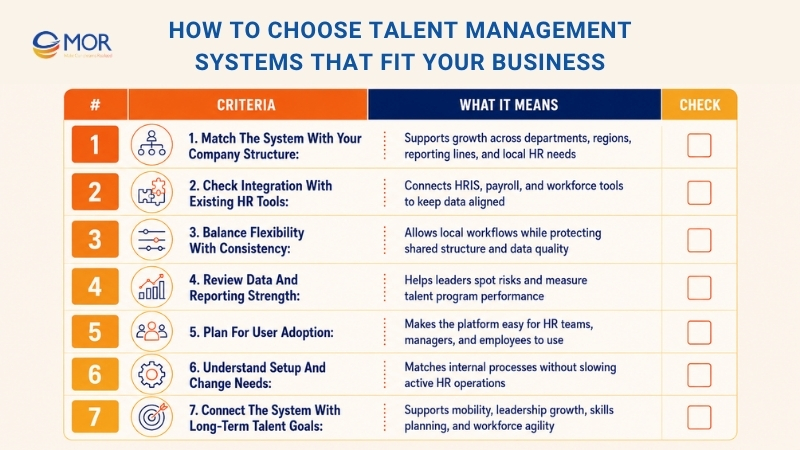
Match The System With Your Company Structure
Start by checking whether the system fits the way your company is organized. A small company may need a simple platform for hiring, onboarding, and performance reviews, while a larger business may need support for multiple departments, locations, job levels, and reporting lines.
You should choose a TMS that can handle your current structure without making daily HR work more complex. At the same time, it should be able to grow with new branches, larger teams, and changing management layers.
If a platform only works well for one office or one small team, it may become difficult to use when your company expands. The right system should make talent management easier as the business grows, not create more manual work.
Check Integration With Existing HR Tools
A talent management system should not work separately from the tools your company already uses. Before choosing one, check whether it can connect with your HRIS, payroll, attendance system, learning platform, workforce planning software, or internal databases.
Strong integration helps HR teams avoid entering the same data many times. It also keeps employee records, performance data, training history, and compensation information consistent across systems.
When comparing TMS options, businesses should ask: Can this platform share data with our current tools? Will it reduce manual updates? Can it support clean reporting across HR functions? If the answer is no, the system may create more work instead of improving the process.
Balance Flexibility With Consistency
A good talent management system should be flexible enough to match different team needs, but structured enough to keep company-wide data clean. This is an important point when choosing a TMS for businesses with many departments, locations, or employee groups.
For example, sales teams, technical teams, and management teams may need different performance goals or review workflows. However, the company still needs a shared system for tracking results, comparing talent data, and making fair decisions.
If a TMS is too rigid, teams may feel forced into workflows that do not match their real work. If it is too open, every team may use it differently, making data hard to compare. The best option gives enough customization while keeping a clear common structure.
Review Data And Reporting Strength
When choosing a TMS, reporting should be one of the main decision factors. A TMS should help leaders understand workforce performance, skill gaps, turnover risks, training progress, and future talent needs.
Look for platforms that offer clear dashboards, customizable reports, predictive analytics, and talent segmentation. These features help HR teams move beyond basic administration and make better decisions based on real workforce data.
A weak reporting system may still store employee information, but it will not give leaders enough insight to plan for growth. The right TMS should turn HR data into useful guidance for hiring, promotion, learning, succession planning, and retention.
Plan For User Adoption
Even a powerful TMS can fail if employees, managers, and HR teams do not use it properly. That is why ease of use should be part of the selection process from the beginning.
Before choosing a system, businesses should review the user interface, workflow steps, mobile access, training needs, and support materials. Managers should be able to complete reviews, approve requests, and track team progress without depending too much on HR.
For employees, the system should make it easy to update profiles, join learning programs, check goals, and follow performance feedback. If the platform feels too complicated, adoption will be low, and the company may not get full value from the investment.
Understand Setup And Change Needs
Enterprise talent management systems often require setup work before they can fit real business processes. Before choosing one, companies should understand how much configuration is needed and whether internal teams can manage it.
Some platforms are easy to set up but may offer limited customization. Others are more powerful but require more time, technical support, and change management. The right choice depends on how complex your HR processes are and how much control you want over workflows.
Businesses should also consider the rollout plan. A good TMS implementation should not interrupt active HR operations. It should include data preparation, process mapping, user training, testing, and clear communication so teams can move into the new system smoothly.
Connect The System With Long-Term Talent Goals
The final step is to check whether the TMS supports your long-term talent strategy. The system should not only manage HR tasks today. It should also help your company build stronger teams in the future.
If your priority is leadership development, choose a platform with strong succession planning and career path features. If your goal is employee retention, look for tools that support engagement, feedback, learning, and performance tracking. If your company is scaling fast, focus on systems that can support workforce planning and internal mobility.
Some companies may first work with MOR Software to define HR workflows, build custom HRM logic, or connect talent data with existing business systems before choosing or rolling out a full platform.
A TMS becomes more valuable when it is tied to business direction. The best system should help your company make better people decisions, develop future leaders, close skill gaps, and build a workforce that can support long-term growth.
Current Trends In Talent Management Software For 2026
The technology behind talent management systems keeps moving fast, and several new ideas are changing how companies manage workforce growth in 2026.
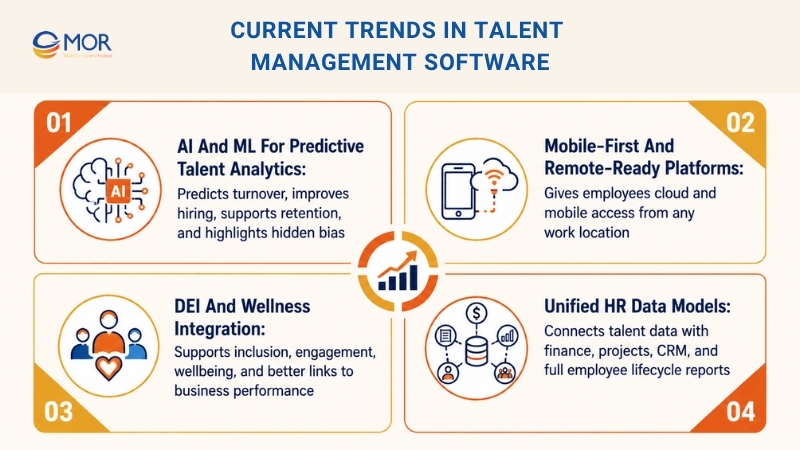
AI And ML For Predictive Talent Analytics
AI and ML have changed how companies manage people data. Companies that use predictive analytics have reported up to 20% better results in talent acquisition work. These tools can now predict employee turnover with much higher accuracy, with some systems reaching up to 17 times the accuracy of older methods.
After that, companies using machine learning in hiring can see a 30% rise in employee retention. MOR Software can help businesses build AI-driven HR tools that support faster screening, better matching, and more useful workforce data. These tools can also find hidden bias in hiring and performance reviews, giving leaders more balanced data for decisions.
Mobile-First And Remote-Ready Platforms
Remote work support is now a must-have part of strong talent software. Modern platforms provide:
- Cloud access to HR data and resources from any location
- Mobile screens for checking schedules, sending leave requests, and contacting HR
- Connection with work tools, including Slack and Microsoft Teams
Companies that support remote talent work may also see better environmental results, since distributed teams often need less office space and travel. This matters more as ESG topics shape how people choose employers.
DEI And Wellness Integration
Modern HR technology platforms now include stronger DEI tools. These systems help create more personal employee experiences that support inclusion and raise engagement. At the same time, more platforms now add wellness tracking, since employee wellbeing has a real link to business performance. When these tools connect with wider business systems, leaders can see how DEI work affects company results.
Unified HR Data Models
Separate HR systems are slowly becoming outdated as unified data models become more common. In 2026, talent platforms connect more smoothly with finance, project management, and CRM systems. Central data helps teams view real-time reports across the full employee lifecycle, which supports decisions based on evidence. Companies that use these connected systems are better placed to raise productivity and employee satisfaction.
How MOR Software Helps Businesses Build Custom Talent Management Systems
Ready-made HR tools do not always fit how a company works. Some teams have special hiring steps, local payroll rules, old HR data, or approval flows that standard platforms cannot handle well.
MOR Software helps businesses design and build custom HR outsourcing and talent management systems based on real workflows. We map how your teams hire, onboard, review performance, train employees, and retain talent. Then we turn those processes into a working software system.
MOR Software can build web apps, mobile apps, Salesforce-based HR solutions, and system integrations. We can also connect your new system with HRMS software development solutions, payroll, time off tracking tools, CRM, ERP, Slack, Salesforce, or legacy systems.
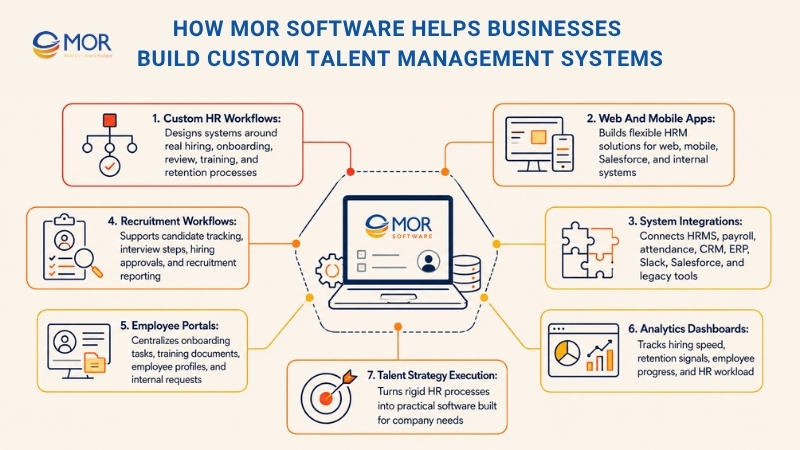
- Recruitment workflows: Candidate tracking, interview steps, hiring approvals, and recruitment automation reports.
- Employee portals: Onboarding tasks, training documents, employee profiles, and internal requests.
- Performance tracking: Goal setting, review cycles, feedback, and manager check-ins.
- Talent development: Learning plans, career paths, mentorship, and skill tracking.
- Analytics dashboards: Hiring speed, retention signals, employee progress, and HR workload.
- System integrations: HRMS, payroll automation, attendance, CRM, ERP, Slack, Salesforce, and legacy platforms.
A relevant example is The Talent Solutions Optimization Initiative. MOR Software supported a talent-focused system covering recruitment, onboarding, employee development, learning programs, retention, and workplace engagement.
When ready-made talent management systems feel too rigid or too costly to customize, MOR Software helps turn your talent strategy into a practical software system.
If your business needs a talent management system built around its real HR workflows, MOR Software can help you plan, develop, integrate, and scale the right solution. Contact MOR Software to discuss your project.
Conclusion
Talent management systems are no longer simple HR add-ons. They help companies hire better, develop employees, keep strong performers, and make smarter people decisions with clearer data. Yet no single platform fits every workflow. Some businesses need ready-made tools. Others need custom HR software built around their real processes.
If your company needs a talent management system that fits your structure, MOR Software can help you plan, build, integrate, and scale it. Contact MOR Software to discuss your project.
"Solutions Director at MOR Software, has extensive expertise in software development and management. He leads innovative projects and provides strategic solutions to enhance business operations, helping clients achieve digital transformation goals."
Pham Huu Canh


Solutions Director
MOR SOFTWARE
Frequently Asked Questions (FAQs)
What is a talent management system?
Talent management system is a software platforms that help companies manage hiring, onboarding, employee performance, training, career growth, and succession planning in one place.
What is the main purpose of a talent management system?
The main purpose is to help HR teams and business leaders attract, develop, and retain employees. It gives teams cleaner data, clearer workflows, and better control over talent planning.
How is a TMS different from an HRMS?
A TMS focuses on the employee growth journey, including hiring, learning, performance, and retention. An HRMS focuses more on core HR tasks like employee records, payroll, attendance, benefits, and compliance.
Which companies need a talent management system?
A growing company may need one when hiring becomes harder to track, performance reviews are inconsistent, or employee development is handled across too many files and tools.
What functions should a good TMS include?
A good TMS should include recruitment, onboarding, performance reviews, learning paths, succession planning, compensation support, reporting, and employee self-service tools.
Can small businesses use a talent management system?
Yes. Small businesses can start with basic functions like hiring, onboarding, and performance tracking. As the team grows, they can add learning, career planning, and reporting modules.
Why do companies replace spreadsheets with talent software?
Spreadsheets work at first, but they become hard to manage as teams grow. Talent software keeps employee data, review records, hiring updates, and learning plans easier to track.
What should businesses check before choosing a TMS?
Businesses should check company size, HR workflow, integration needs, user experience, reporting tools, setup cost, and long-term growth plans before choosing a platform.
How much do talent management systems cost?
The cost depends on company size, user count, modules, setup needs, and vendor pricing. Some platforms charge monthly per user, while custom systems depend on project scope.
Is a custom TMS better than ready-made software?
A custom TMS can be a better fit when a company has special workflows, legacy systems, complex approvals, or data rules that ready-made platforms cannot support well.
Can I access a talent management system from home?
Yes. Most modern talent management systems are cloud-based, allowing employees, managers, and HR teams to securely access the platform from home or any location with an internet connection. Depending on user permissions, they can complete performance reviews, access training materials, update employee information, track goals, and manage talent-related tasks remotely.
Share


Make Our-Dreams Realized


© 2023 . MOR Software. All Rights Reserved
Sitemap
Privacy Policy
Terms of Use
Rate this article
0
over 5.0 based on 0 reviews
Your rating on this news:
Name
*Email
*Write your comment
*Send your comment
1