


Top Wealth Management Software for Financial Advisors
As advisory firms face rising data volume, tighter compliance, and higher client expectations, wealth management software has become a critical foundation for sustainable growth. Many teams still struggle with fragmented systems and limited visibility across portfolios. In this guide, MOR Software will highlight top software platforms by category and show how the right tools help advisors work with more control and confidence.
What Is Wealth Management Software?
Wealth management software refers to a digital system that helps financial advisors and firms attract new clients, manage portfolios, monitor investments, and create tailored financial strategies. Interest in these tools keeps rising as firms move toward data-driven decisions. The global market reached $2.37 billion in 2021 and is expected to grow to $6.29 billion by 2029, showing strong demand for digital wealth tools that support smarter planning and tighter investment control.
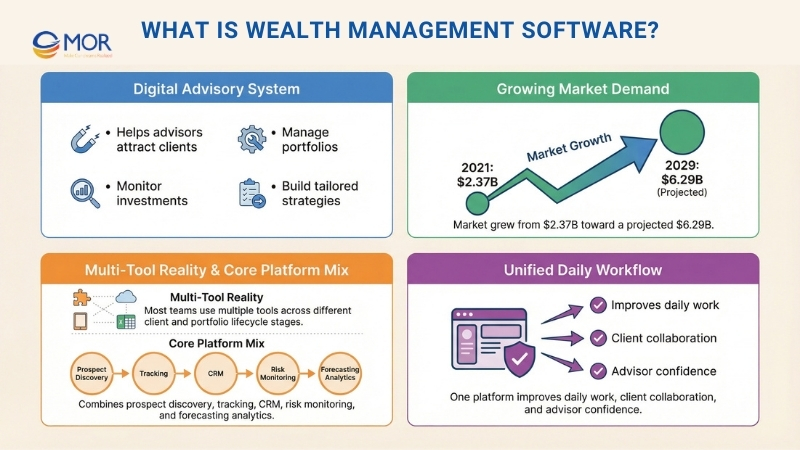
Instead of depending on a single system, most advisory teams rely on several solutions at the same time, with each one supporting a different stage of the client and portfolio lifecycle.
The most effective platforms usually combine:
- Prospect discovery tools to spot high-net-worth prospects earlier
- Portfolio tracking features to track performance and asset allocation
- Client relationship integrations to support long-term client relationships
- Risk monitoring tools to watch exposure and market volatility
- Forecasting and analytics tools to support forecasting and strategic decisions
When these functions come together in one wealth management platform, day-to-day work becomes easier. Advisors gain clearer insights, collaborate more effectively with clients, and provide financial guidance with greater confidence.
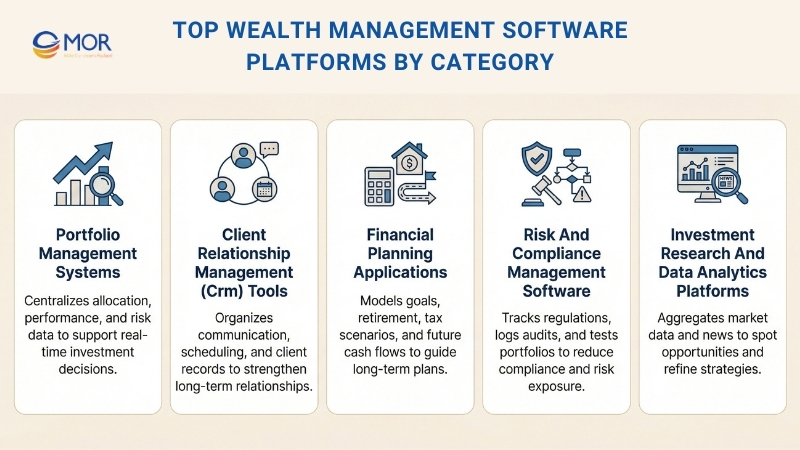
Top Wealth Management Software Platforms By Category
Wealth management software comes in many forms, with each type built to support a specific area of advisory work. Below, we break down the main categories of tools that financial professionals commonly rely on across the industry.
Portfolio Management Systems
Portfolio management systems play a central role for wealth managers because they support the monitoring and control of client investments. These tools act as a centralized system to follow asset allocation, performance, risk exposure, and portfolio changes in real time. When portfolio data is brought together in one place, this investment advisor software helps advisors make better decisions and adjust strategies when conditions change.
Key Capabilities To Consider:
- Live performance monitoring: Lets you review portfolio results on a daily, weekly, or monthly schedule.
- Risk evaluation and reporting: Highlights possible portfolio risks based on market movements and allocation choices.
- Asset allocation support: Helps diversify portfolios across different asset classes more effectively.
- Automated rebalancing functions: Adjusts holdings automatically to keep portfolios aligned with target allocations.
Well-Known Portfolio Management Software:
- Morningstar Direct: Recognized for detailed data and analytics, Morningstar Direct is widely used for portfolio building, research, and performance review.
- Addepar: This platform brings together complex financial data and delivers customizable reports for both individual and institutional clients.
- Orion Advisor Services: A cloud-based solution that helps wealth managers oversee portfolios, manage compliance tasks, and automate client reporting workflows.
Client Relationship Management (CRM) Tools
Client relationship management tools play a key role for wealth professionals who need to manage long-term client relationships with care. Wealth management software in this category supports client communication, meeting scheduling, interaction tracking, and organized data storage in one centralized system. Advisors rely on wealth management CRM software to strengthen relationships, improve client satisfaction, and deliver services that feel more personal.
Many firms also adopt financial CRM software to keep client records consistent across communication and reporting workflows.
Key Capabilities To Consider:
- Complete client profile views: Centralized records that include financial background, preferences, and communication history.
- Flexible report creation: Tools that let you build reports aligned with client goals and individual preferences.
- Automated task handling: Built-in reminders for meetings, follow-ups, and periodic reviews, often supported by CRM with appointment scheduling.
- Integrated communication tracking: Simple ways to log emails, calls, and messages with each client through CRM email automation.
Well-Known CRM Softwares:
- Salesforce Financial Services Cloud: Salesforce is a well-known name in CRM and provides a tailored solution for wealth professionals, supporting efficient client tracking, engagement, and relationship management.
- Redtail Technology: Redtail Technology delivers a user-friendly CRM that connects smoothly with portfolio systems and helps automate many daily client management tasks.
- Wealthbox: Designed specifically for financial advisors, Wealthbox supports client management through an intuitive interface and built-in automation features.
Financial Planning Applications
Financial planning applications support wealth professionals as they build detailed financial plans for clients. These tools help advisors forecast future scenarios, prepare for retirement, manage tax considerations, and map out investment approaches. Used as financial planning software advisors trust, this technology helps clients work toward long-term goals through a clear plan that matches their risk tolerance and personal ambitions.
Key Capabilities To Consider:
- Goal-driven planning tools: Support for building tailored plans based on specific client goals, including retirement, education funding, and estate preparation.
- Cash flow forecasting: Tools that simulate future cash movement using income, spending, and savings data.
- Tax planning support: Features that highlight tax-saving options and help structure efficient tax strategies.
- Decision scenario modeling: Options to test different financial outcomes and understand the impact of key choices.
Well-Known Financial Planning Softwares:
- eMoney Advisor: A widely used solution for end-to-end financial planning, eMoney Advisor provides tools for detailed plan creation and cash flow modeling.
- MoneyGuidePro: Focused on goal-based planning, MoneyGuidePro is easy to use for both advisors and clients, helping teams build long-term plans and monitor progress.
- Naviplan: Naviplan delivers highly customizable planning tools with a strong focus on cash flow management and tax planning needs.
Risk And Compliance Management Software
Risk control and regulatory compliance are core responsibilities in wealth advisory work, since professionals must manage client portfolios within defined rules and standards. Wealth management software in this area helps firms stay aligned with regulations, monitor legal updates, and apply required changes to workflows and reporting. At the same time, risk-focused tools evaluate market exposure and support better decisions to limit potential losses, making them essential software for wealth managers.
Key Capabilities To Consider:
- Regulation monitoring tools: Support compliance with financial rules, including MiFID II and the GDPR.
- Risk evaluation functions: Detect portfolio risks related to market movement, credit exposure, and operations.
- Audit history records: Maintain detailed logs of decisions and changes for review and regulatory checks.
- Portfolio stress testing: Lets advisors test portfolios under extreme or unusual market conditions.
Well-Known Risk And Compliance Softwares:
- Riskalyze: Riskalyze centers on risk analysis and assigns a clear risk score to portfolios, helping clients understand their exposure.
- ComplySci: ComplySci delivers compliance management tools that help firms meet regulatory rules, track internal policies, and reduce conflicts of interest.
- Vanguard’s Personal Advisor Services: Vanguard’s Personal Advisor Services includes integrated risk and compliance features, giving advisors access to dependable data on market volatility and regulatory updates.
Investment Research And Data Analytics Platforms
Investment research and data analytics platforms are essential tools that help wealth professionals base decisions on reliable data. These systems collect information from many sources, including financial statements, market news, and economic indicators, to surface insights around possible investment opportunities. Advisors rely on this wealth management technology platform layer to spot market patterns, assess securities, and refine investment strategies.
Key Capabilities To Consider:
- Broad market data access: Coverage across stocks, bonds, and other asset classes, supported by detailed analytics.
- Tailored reporting options: Tools that let you create reports suited to specific client needs or portfolio structures.
- Investment screening tools: Filters that help narrow down opportunities based on risk level, performance metrics, and sector focus.
- Live news and alerts: Timely updates and notifications for important market movements and events.
Well-Known Investment Research Softwares:
- FactSet: FactSet delivers a comprehensive suite of analytics, research, and tools that support portfolio construction and performance review.
- Bloomberg Terminal: The Bloomberg Terminal provides extensive market data, real-time news, and analytics, making it a key resource for advisors seeking deep market insight.
- Thomson Reuters Eikon: Thomson Reuters Eikon offers detailed analysis, financial news, and data services to support informed investment decisions.
Essential Features Of Wealth Management Software
What should you evaluate when selecting software for wealth management? A strong feature set helps advisory teams deliver reliable service and maintain consistent client experiences.
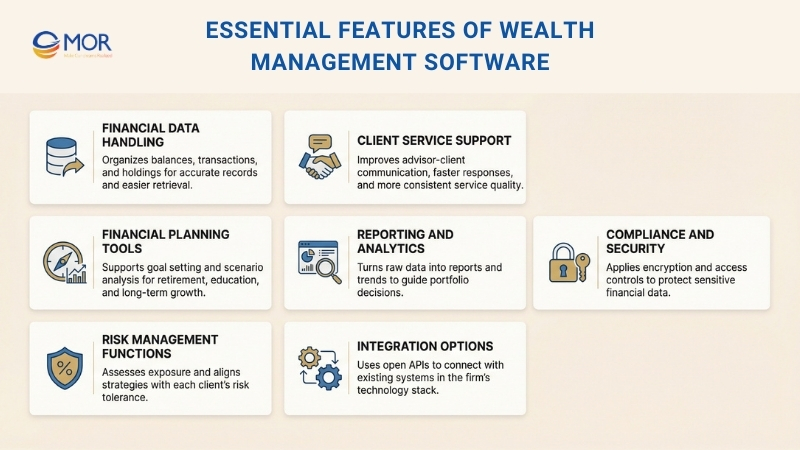
- Financial data handling tools: This function organizes and manages financial information, including account balances, transactions, and investment holdings. It simplifies data entry, ongoing updates, and retrieval, which helps keep client financial records accurate and easy to access.
- Financial planning capabilities: Wealth management software includes tools that support client goal setting across retirement planning, education funding, and long-term wealth growth. Advisors can run scenario analysis and review different financial approaches.
- Risk management functions: Risk-focused tools support investment strategies that align with each client’s risk tolerance. This feature delivers clear visibility, helping advisors make informed choices and address investment risk more effectively.
- Customer service for financial services: This capability supports smooth communication between advisors and clients. Advisory teams can respond to questions faster and maintain a high standard of service and support.
- Reporting and analytics tools: These systems include reporting and analytics features that turn raw data into practical insight. Advisors can create tailored reports, review trends, and make informed decisions to refine client portfolios.
- System integration options: Leading wealth management platforms provide open application programming interfaces (APIs). This allows advisory teams to connect their existing technology stack with the platform. This also supports data integration in business intelligence initiatives, improving reporting accuracy and speed.
- Compliance and security controls: These tools must safeguard sensitive financial information. These solutions apply encryption methods, access controls, and regular security reviews to keep client data protected. Strong cloud data governance practices further support access policies and audit readiness.
Key Benefits Of Wealth Management Software
Modern wealth management software solutions play a growing role as financial services become more complex. Several clear benefits explain why these systems remain in strong demand.
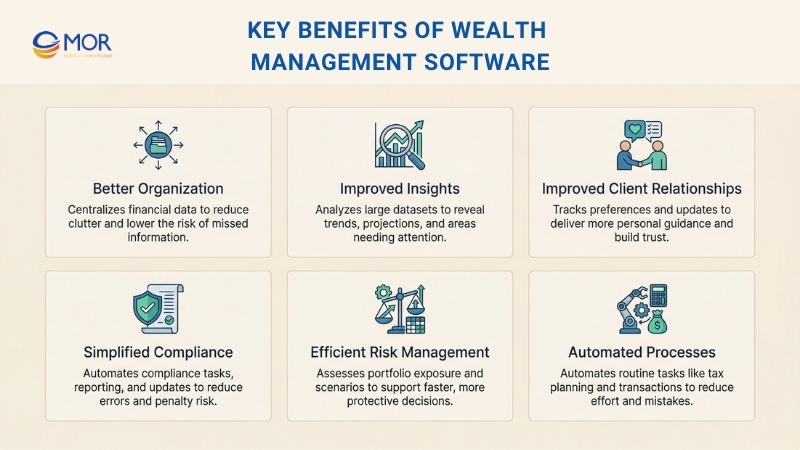
Better Organization
One major advantage of these tools is how they reduce everyday clutter. Wealth management software brings all your financial data into one place, which makes tracking and management much simpler. Instead of working across many spreadsheets or separate systems, you can view investment records, portfolio details, and financial reports from a single platform. This structured setup helps you stay organized and lowers the risk of missing important information.
Improved Insights
Another clear strength of this solution lies in its analytics capabilities. This solution processes large volumes of financial data and turns them into practical insight you can use. It may reveal investment trends, project future performance, and point out areas that need attention. These insights support better decisions and help you refine your investment strategy with more confidence.
Improved Client Relationships
For advisors and wealth managers, strong and lasting client relationships remain essential. Financial adviser software supports clear communication and more personalized service. This helps you track client preferences, share tailored guidance, and provide regular updates on portfolio performance. A consistent level of attention builds trust and increases overall client satisfaction.
Simplified Compliance
The financial sector operates under strict regulation, which can make compliance difficult to manage. Wealth management platforms help you meet required rules and standards with greater ease. It handles routine compliance tasks, prepares required reports, and keeps you informed about regulatory updates. This lowers the chance of compliance issues and reduces the risk of penalties.
Efficient Risk Management
Managing risk is a core part of wealth advisory work. With support from your wealth management systems, you can handle risk in a more structured way. This system uses advanced algorithms to assess exposure across your investment portfolio. It reviews possible risk scenarios and suggests actions to reduce them. When risks appear early, you can respond in time to protect assets and support long-term financial stability.
Automated Processes
Another clear advantage comes from task automation. The platform handles many routine activities, including tax planning and fractional order handling. This reduces manual effort and lowers the risk of mistakes. The platform can calculate tax obligations, produce reports, and process transactions automatically, which lets you spend more time on strategic decisions instead of administrative work.
Wealth Management Software Pricing By Business Size
The pricing of wealth management software depends on firm size and the range of features you need. Below is a general overview based on typical financial services pricing:
- Small businesses ($60,000 to $200,000): Entry-level solutions designed for smaller teams, covering core onboarding functions, portfolio tracking, dashboard access, and basic integration support.
- Midsize businesses ($200,000 to $550,000): More advanced platforms with added capabilities, including robo-advisory tools, deeper analytics, risk assessment features, and CRM connectivity.
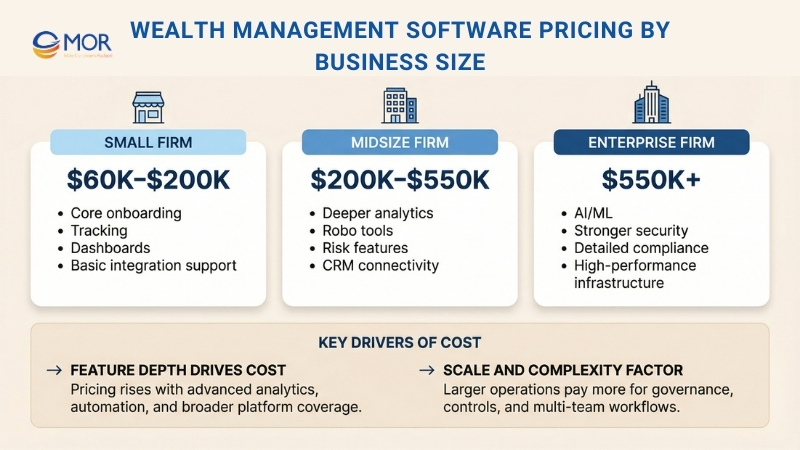
- Large enterprises ($550,000 or more): Full-scale systems built for complex operations, featuring AI/ML capabilities that may involve AI and machine learning development services, stronger security measures, detailed compliance frameworks, and high-performance infrastructure suited for enterprise use. Teams should also account for AI development cost when planning customization.
How To Evaluate Wealth Management Software Tools
Choosing the right wealth management reporting software requires a clear view of how well it supports reporting accuracy, asset visibility, and daily operations. Careful evaluation helps you select tools that fit your data needs today and remain reliable as your reporting demands grow.
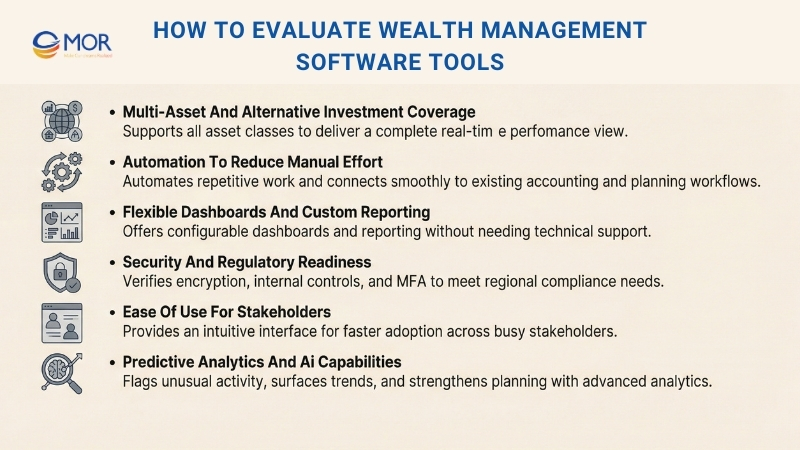
Multi-Asset And Alternative Investment Coverage
Modern reporting tools should support a wide range of asset classes, from hedge funds and private equity to direct alternative investments. This coverage is necessary to bring every asset into one real-time performance view, giving you a complete picture without gaps across portfolios.
Automation To Reduce Manual Effort
Reducing manual work is critical for family office teams handling large data volumes. Wealth management software should automate repetitive tasks and connect smoothly with your existing technology stack, especially for asset tracking, cash flow forecasts, accounting processes, and financial planning activities.
Flexible Dashboards And Custom Reporting
A modern platform should provide configurable dashboards, real-time analytics, and detailed reporting tools that let you view your full financial picture without technical help. A strong reporting setup can break down performance data by entity, family member, ownership share, or asset class, making results easier to understand and review. A CRM dashboard can also help teams review engagement activity alongside performance reporting.
Security And Regulatory Readiness
Each cloud-based system should be reviewed for encryption standards, regulatory alignment, and internal controls that safeguard sensitive data tied to illiquid and private assets. For firms operating under strict regional rules, including those evaluating wealth management software UK, multi-factor authentication remains essential to prevent unauthorized access and compliance issues.
Ease Of Use For Stakeholders
Senior executives, trustees, and key stakeholders often have limited time to learn complex tools. Wealth management systems with a clear and intuitive interface supports faster adoption across family office teams. Simple design helps users make informed decisions with confidence and reduces day-to-day friction.
Predictive Analytics And AI Capabilities
Platforms that use artificial intelligence or predictive analytics help support strategic decision making. These tools can flag unusual activity, surface early trends in asset allocation, and simplify reporting tasks. This approach aligns well with cloud based wealth management software, where advanced analytics improve visibility and support smarter planning decisions. Planning integrations around a clear AI tech stack helps keep these capabilities maintainable and secure.
Wealth Management Software Trends Shaping 2026
In 2026, wealth management continues its shift toward digital-first operations, shaped by AI-driven analytics, automated portfolio oversight, and mobile tools designed for client interaction. Sustainability and ESG-led investment strategies keep gaining traction. Deeper fintech integration and real-time reporting help firms improve efficiency while meeting regulatory needs. Many modern platforms now support these trends through modular tools that handle digital onboarding, analytics, and secure client engagement. This shift is also influenced by generative AI in banking, as automation and insight tools continue to mature.
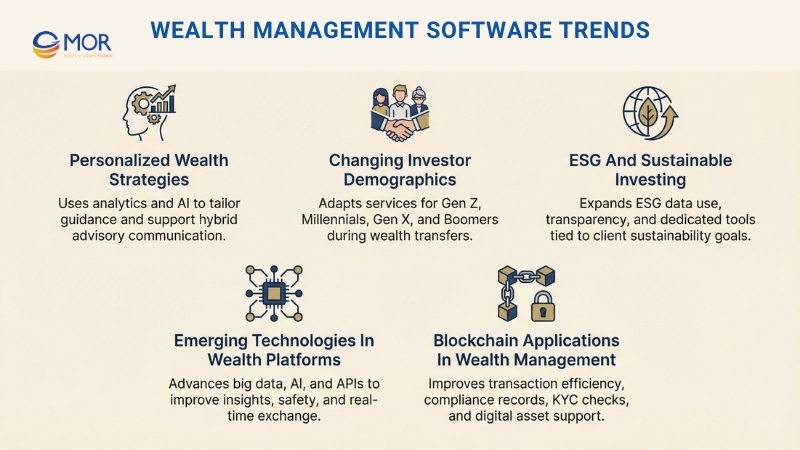
Personalized Wealth Strategies
Personalized services sit at the center of this shift. With stronger data analytics and artificial intelligence, firms gain a clearer view of client behavior than before. This leads to tailored investment guidance that aligns closely with individual financial goals. To keep pace, firms adjust how they operate, refining internal processes and adapting to new expectations. Many now focus on hybrid advisory models and smoother communication, using wealth management software for advisors to connect more effectively with tech-aware investors.
Personalized wealth strategies bring several clear advantages:
- Delivers objective guidance for growing and protecting investments.
- Builds financial plans that reflect each client’s situation and goals.
- Provides ongoing support as client needs change over time.
- Allows advisors to adjust portfolios in response to market movement.
- Offers a more complete approach compared to traditional investment methods.
A report from PwC forecasts that global assets under management will reach $145.4 trillion by 2025, driven by an annual growth rate of nearly 6%. Much of this growth links to rising demand for advisory services, particularly from high-net-worth individuals and family groups seeking more personalized support.
Changing Investor Demographics
Wealth management now faces new challenges as different age groups shape demand across the market. These investors include younger generations, Generation X, and Baby Boomers. This shift comes from changing investment habits, wider use of technology, and large amounts of wealth moving between generations.
Firms are adapting to these changes across their operations. Many update business models and rely more on digital tools. With client data, analytics, and artificial intelligence, services become more tailored to personal preferences. This focus on a new investor mix appears across the entire industry. Morgan Stanley has noted that this transition may influence how banks support clients overall.
Millennials and Generation Z feel comfortable with technology. They expect wealth services that are simple to use and work smoothly online. Premium features also matter to them. Research shows that 44% of investors plan to move funds within two years. Almost half say an easy online experience plays a key role when choosing a provider. To reach these clients, firms invest in new tools, update core systems, and improve how data is used within wealth management software.
The next age group is Generation X. This group matters to advisory firms since many earn high incomes and start receiving inherited wealth. They prefer a balance between personal advice and digital convenience. Providers respond with hybrid models that combine human support with technology, which suits Generation X expectations.
Another major group is the Baby Boomers. They currently hold a large share of global wealth and will pass much of it to younger generations soon. Over the next 25 years, around 45 million households in the US are expected to transfer $68.4 trillion to family members. This transfer pushes firms to adjust how they manage wealth, with many improving services that support smooth and well-structured wealth transitions.
ESG And Sustainable Investing
Sustainable investing now plays an important role across wealth management firms. This approach uses environmental, social, and governance data to guide financial decisions. Many expect this area to become one of the leading trends in wealth management as the industry moves toward 2026.
The financial sector places more focus on environmental and social issues than before. Firms develop new investment approaches that reflect these concerns. Evidence of this shift appeared at the end of 2020, when investments using ESG-based strategies passed $35 trillion.
Investment firms now widely include ESG data in their processes. They launch products built around ESG principles and place strong emphasis on transparency. Clear communication helps investors understand how these products align with stated values.
Several major institutions support ESG-focused strategies, including DBS, UBS, WealthSimple, BlackRock, and Betterment. Many rely on dedicated tools, such as myImpact from BNP Paribas Wealth Management, which helps connect client values with long-term sustainability goals.
ESG analysis brings attention to real-world risks and creates new investment paths. It helps explain how consumer priorities, public spending, asset value, and performance shift over time. Forecasts suggest that ESG-focused investing will rise by 84% to reach $33.9 trillion by 2026, representing about one-fifth of all managed assets. By the second quarter of 2022, global ESG-focused portfolios already held more than $2.77 trillion.
Emerging Technologies In Wealth Platforms
Modern technology continues to reshape how firms manage wealth. Tools like big data, advanced analytics, and artificial intelligence now influence many daily processes. At the same time, the use of Application Programming Interfaces (APIs) keeps growing. Together, these developments are expected to play a major role in wealth management through 2025 and beyond.
Big data and advanced analytics help uncover patterns, track trends, and review investment performance. Firms that apply these tools well can gain an edge. They use data analysis to deliver more personalized services that reflect client needs and preferences, along with stronger investment approaches. Analytics also support better decisions by clarifying consumer demand, government spending behavior, asset valuation, and financial outcomes.
The industry also continues to adopt Artificial Intelligence (AI) at a steady pace. Firms apply AI with a strong focus on safety and regulatory alignment. Most use cases support internal and routine tasks rather than direct client interaction. This trend is expected to continue through 2025. AI helps surface hidden risks, reveal new investment opportunities, and generate insights that support ESG-related compliance.
APIs play another important role in modern wealth systems. These tools connect investment decisions with trading platforms and allow different applications to exchange data in real time. Faster data flow improves access to market information and supports higher-quality decisions. As a result, delays between planning trades and executing them become shorter. Global spending on API management is projected to reach $6.2 billion by the end of 2025.
Blockchain Applications In Wealth Management
Many now view blockchain as a major shift within wealth management. Blockchain works as a secure network that does not rely on banks for transaction validation. This technology supports digital asset trading and strengthens compliance through clearer and more transparent data records.
Wealth management firms explore blockchain to improve client outcomes and raise system efficiency. Most plan to apply it behind the scenes without changing the client experience. This approach helps lower transaction costs, reduce third-party risk, and improve access to capital. It also improves data accuracy while simplifying Know Your Customer checks and identifying links to sanctioned entities.
Several real-world projects show how this technology is applied. Northern Trust works with IBM to develop blockchain solutions for the private equity sector. This technology supports private equity fund operations for Swiss asset manager Unigestion. In parallel, Xapo Bank, a licensed private bank, tests models that combine traditional banking with Bitcoin and stablecoins. Its CEO, Seamus Rocca, describes these efforts as part of a broader shift within the financial industry.
According to The Business Research Company, the Digital Asset Management Market reached $7.38 billion in 2025 and is expected to grow to $14.78 billion by 2029, with a 14.2% CAGR.
Conclusion
Wealth management software now plays a central role in how advisory firms operate, grow, and serve clients with confidence. From portfolio oversight to compliance, reporting, and future-ready analytics, the right platform supports every stage of advisory work. Choosing carefully helps you stay competitive and resilient. If you are planning to modernize or scale your advisory operations, contact us to see how MOR Software can support your goals with practical, tailored solutions.
MOR SOFTWARE
Frequently Asked Questions (FAQs)
What is wealth management software?
Wealth management software is a digital system that helps advisors and firms manage portfolios, client data, financial planning, reporting, and risk analysis in one place.
Who uses wealth management software?
It is used by financial advisors, wealth managers, family offices, private banks, and investment firms that manage client assets and long-term financial plans.
What problems does wealth management software solve?
It reduces manual work, centralizes financial data, improves reporting accuracy, and helps firms manage client portfolios and compliance more consistently.
What features should wealth management software include?
Common features include portfolio tracking, client relationship management, financial planning tools, risk monitoring, reporting dashboards, integrations, and security controls.
How is wealth management software different from portfolio management software?
Portfolio management software focuses mainly on investment performance, while wealth management software covers planning, client communication, compliance, and analytics as well.
Is wealth management software suitable for small advisory firms?
Yes. Many platforms support small firms with essential tools and allow them to add advanced features as the business grows.
How much does wealth management software typically cost?
Costs vary by firm size and complexity. Smaller firms usually spend less, while larger firms invest more for advanced analytics, security, and integrations.
Can these systems integrate with other financial systems?
Most modern platforms connect with custodians, accounting tools, CRM systems, and market data providers through APIs or built-in integrations.
How does wealth management software support regulatory compliance?
It helps track regulations, maintain audit records, monitor client activity, and generate required reports, reducing compliance risk and manual effort.
Is client data secure on these platforms?
Reliable platforms use encryption, access controls, role-based permissions, and regular security reviews to protect sensitive financial and personal data.
Share


Make Our-Dreams Realized


© 2023 . MOR Software. All Rights Reserved
Sitemap
Privacy Policy
Terms of Use

Rate this article
0
over 5.0 based on 0 reviews
Your rating on this news:
Name
*Email
*Write your comment
*Send your comment
1