


TOP 15 AI Solutions for Real Estate Industry in 2026
A brokerage can have an MLS, CRM, property database, and marketing stack yet still lose prospects between qualification, matching, follow-up, and transaction work. AI solutions for real estate connect more of those tasks and turn property data into faster actions. In this guide, MOR Software will review 15 platforms, their pricing, real use cases, and the point where a ready-made product stops fitting your workflow.
Key Takeaways
- AI solutions for real estate companies now cover valuation, leasing, property operations, 3D visualization, site planning, buyer matching, seller prediction, accounting, and investor prospecting. The 15 solutions reviewed are HouseCanary, EliseAI, AppFolio Realm-X, Matterport, Cherre, Cotality, RealScout, REimagineHome, PropStream, TestFit, Lofty, Roof AI, AvidXchange, DealMachine, and Smartzip.
- The right platform depends on the workflow that needs work. AI real estate solutions reviews can be misleading when they rank valuation software, leasing AI, and investor prospecting tools as direct alternatives.
- Lists of top rated AI solutions for commercial real estate often focus on product functions alone. Integration, data access, total cost, human approval, and existing CRM or property systems deserve equal weight.
What Are AI Solutions for Real Estate?
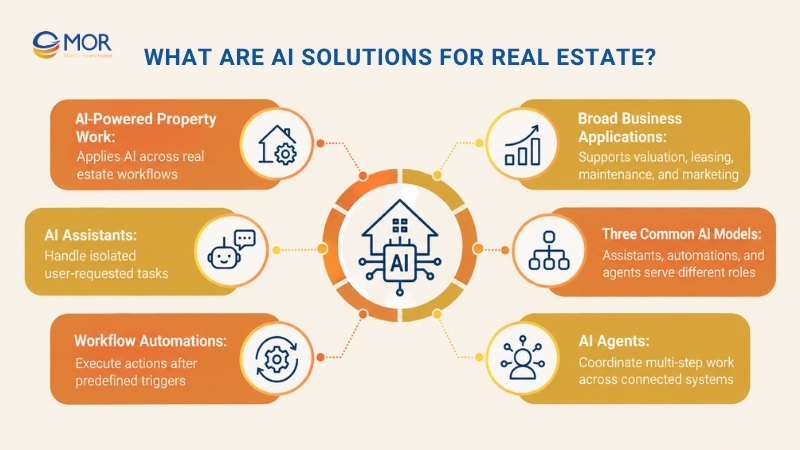
AI solutions for real estate are software systems that apply machine learning, generative AI, computer vision, predictive models, or AI agents to property-related work. Common applications include property valuation, lead qualification, document analysis, market research, leasing, maintenance, portfolio analysis, and marketing.
The range is wide for good reason. McKinsey estimates that generative AI alone could create $110 billion to $180 billion or more in value for the real estate industry, which explains why firms are testing AI far beyond copywriting and basic chatbots.
Three AI models appear most often in real estate operations:
AI model | How it works | Real estate example | Human role |
Assistant | Responds when a user asks for a task | Draft a listing description | Review the result |
Automation | Runs actions after predefined triggers | Route a new inquiry | Set rules and exceptions |
AI agent | Handles connected steps across tools | Qualify a buyer and schedule a viewing | Set permissions and approval points |
Assistants handle isolated requests. Automations follow known rules, while agents can read information, choose an action, call another system, and continue the workflow.
That distinction matters when planning custom real estate app development. A chatbot added to a portal solves a different problem from an agent that reads customer data, searches inventory, writes back to the CRM, and creates the next task.
Why AI Is Becoming Essential in Real Estate
Real estate teams work with property records, tenant messages, lease documents, images, market data, accounting records, and sales activity every day. Much of that information still sits across separate systems, which slows decisions and creates repeated manual work. JLL's 2025 Global Real Estate Technology Survey found that 88% of investors had already started piloting AI and were pursuing an average of five use cases at the same time.
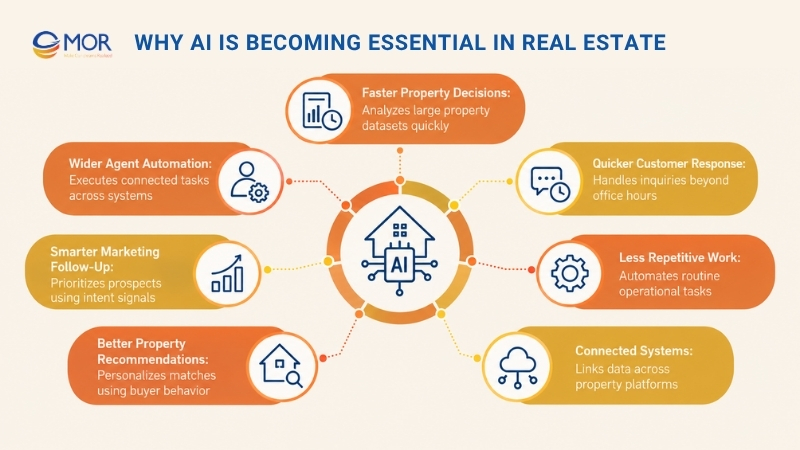
- Faster decisions from property data: AI can process recent transactions, comparable properties, neighborhood trends, inventory, risk factors, and customer activity at a scale that manual research can't match. Valuation and investment teams can reach a working view faster, then apply professional review before making a final decision.
- Quicker response to buyers and tenants: Property inquiries don't follow office hours. AI assistants can answer common questions, qualify prospects, suggest properties, schedule appointments, or classify maintenance requests before a staff member steps in.
- Less repetitive operational work: Lease abstraction, document extraction, maintenance triage, CRM updates, invoice processing, reporting, and follow-up take time without always requiring expert judgment. AI solutions for real estate can handle parts of these workflows and leave teams focused on negotiations, inspections, exceptions, and customer relationships.
- Better use of disconnected systems: CRM platforms, MLS feeds, property management systems, ERP software, spreadsheets, and document repositories often hold different parts of the same workflow. AI becomes more useful when these sources connect, so an output can trigger the next action instead of creating another manual handoff.
- More relevant property recommendations: Recommendation models can consider saved searches, viewed listings, dismissed properties, location preferences, budget signals, and engagement history. That gives agents a richer basis for matching buyers with inventory than fixed filters alone.
- Smarter marketing and follow-up: Some AI solutions for marketing real estate agency workflows combine CRM activity, property-search behavior, lead scores, email campaigns, and automated outreach. Agencies can use these signals to adjust message timing and prioritize prospects showing stronger intent.
- Practical support for agent training: AI-driven training solutions for real estate can help agents rehearse customer conversations, search internal knowledge, review scripts, and receive guidance during daily work. Training moves closer to actual sales and service situations instead of staying inside separate courses.
- Wider automation through AI agents: Traditional automation follows predefined rules. AI agents can interpret a request, retrieve information, work across several systems, complete connected steps, and send uncertain cases to a human reviewer.
AI adoption still needs clear boundaries. Brokers, property managers, appraisers, and investment teams should keep human review where financial exposure, regulatory requirements, or customer commitments call for professional judgment.
The growing number of specialized products also makes platform selection harder. The 15 solutions below address very different workflows, so the useful comparison starts with the business problem each one is designed to solve.
TOP 15 AI Solutions for Real Estate in 2026
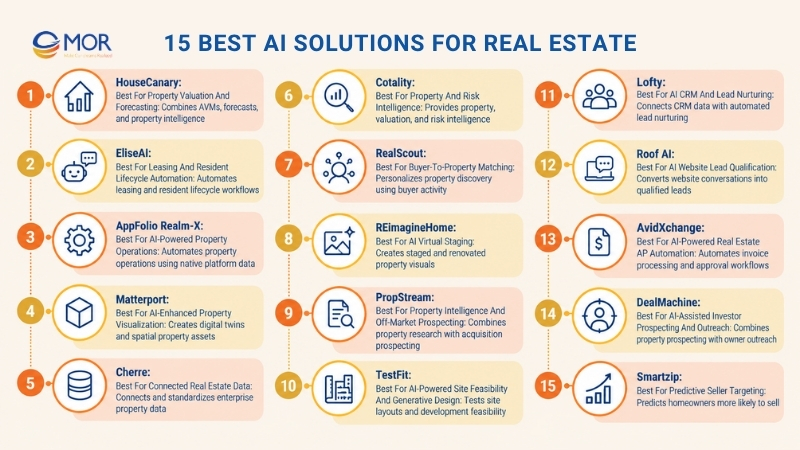
The best AI solutions for real estate depend on the job you need done. HouseCanary focuses on valuation, EliseAI on multifamily operations, Matterport on spatial data, TestFit on site planning, and AvidXchange on accounts payable.
For that reason, these AI solutions for real estate aren't ranked as direct substitutes. Compare their fit, AI function, price, and operating boundaries before creating a shortlist.
Solution | Best fit | Main AI use case | Starting price |
HouseCanary | Investors, lenders, brokers, valuation teams | Property valuation and forecasting | From $19/month |
EliseAI | Multifamily owners and operators | Leasing and resident lifecycle automation | Custom pricing |
AppFolio Realm-X | Professional property managers | AI-powered property operations | Custom pricing, 50-unit minimum on Core |
Matterport | Agents, developers, property marketers | 3D property visualization | Free plan; paid plans scale by active spaces |
Cherre | Institutional investors and asset managers | Real estate data integration | Custom enterprise pricing |
Cotality | Lenders, insurers, appraisers, investors | Property, valuation, and risk intelligence | Custom pricing |
RealScout | Buyer agents, teams, brokerages | Property matching and nurturing | From $149/month with term commitment |
REimagineHome | Listing and property marketing teams | Virtual staging and renovation visualization | From $19/month |
PropStream | Investors and wholesalers | Property intelligence and prospecting | From $99/month |
TestFit | Developers, architects, planners | Site feasibility and generative design | Site Solver from $15,000/year |
Lofty | Agents, teams, brokerages | AI CRM and sales automation | Platform pricing by quote; AI Sales Agent from $60/month |
Roof AI | Brokerages focused on website conversion | Lead capture and qualification | Free; paid from $299/month quarterly |
AvidXchange | Property and finance teams | Accounts payable automation | Custom pricing |
DealMachine | Investors and acquisition teams | Property search and owner outreach | From $99/seat/month |
Smartzip | Listing agents and brokerages | Predictive seller targeting | Custom pricing |
Pricing can change. Check current vendor terms, usage limits, add-ons, and contract requirements before budgeting.
1. HouseCanary: Best for Property Valuation and Forecasting
HouseCanary centers on residential property intelligence. Its data, AVMs, market forecasts, and CanaryAI assistant suit teams that need quick valuation work across individual properties or larger portfolios.
Who it fits: Investors, lenders, agents, brokerages, and portfolio teams that depend on comparables, valuation reports, and forward-looking market data.
AI capabilities:
- Automated valuation models: Analyze property characteristics, transactions, comparable sales, and local signals to estimate value.
- CanaryAI: Lets users ask questions about property and market data in natural language.
- Market forecasting: Adds forward-looking data for market and neighborhood analysis.
- Portfolio monitoring: Tracks groups of properties without rebuilding every analysis manually.
- API access: Sends HouseCanary data into external software and internal analytical systems.
Cost snapshot: Basic costs $19 per month on monthly billing or $190 per year. Pro is $79 per month or $790 per year, Teams is $199 per month or $1,990 per year, and Enterprise pricing is custom. API use and extra reports can add usage charges.
What to weigh: An AVM is an estimate, so formal lending or regulated appraisal processes may still require a licensed professional. Data depth can also vary across markets.
Why it earns a spot: HouseCanary goes deep into valuation rather than spreading its focus across every property workflow. The mix of interface, conversational AI, reports, and API access also gives technical teams several ways to consume the same property intelligence.
2. EliseAI: Best for Leasing and Resident Lifecycle Automation
EliseAI addresses a different part of the property cycle. Its platform works across prospect management, tours, leasing, resident communication, maintenance, renewals, and delinquency.
Who it fits: Multifamily owners and operators with enough inquiry and resident volume to justify broad automation across the renter lifecycle.
AI capabilities:
- LeasingAI: Answers prospect questions, recommends units, and supports tour booking.
- ResidentAI: Handles recurring resident communication around payments, renewals, and maintenance.
- VoiceAI: Extends automated interactions into phone conversations.
- Maintenance automation: Captures requests and coordinates work-order activity.
- Delinquency workflows: Supports reminders and follow-up around unpaid balances.
EliseAI describes its system as an AI layer spanning the prospect-to-resident cycle rather than a single leasing chatbot. Its multifamily platform currently covers leasing, renewals, maintenance, payments, delinquency, and resident communication.
Cost snapshot: EliseAI doesn't publish standard plan prices on its public product pages. Buyers need to request pricing based on portfolio size and selected products.
What to weigh: That sales-led model makes early budget comparisons harder. The platform also targets housing operations, so investment analysis or property development teams will need different tools.
Why it earns a spot: The breadth across the renter lifecycle sets EliseAI apart from tools that stop after lead capture. It suits operators trying to connect prospect communication with resident operations under one AI layer.
3. AppFolio Realm-X: Best for AI-Powered Property Operations
Realm-X sits inside AppFolio Property Manager, which gives its AI access to leasing, accounting, maintenance, communication, and property records already stored in the platform. That native position can remove a lot of manual handoffs.
Who it fits: Professional residential property management companies using AppFolio or considering it as their main operating system.
AI capabilities:
- Realm-X Assistant: Helps staff access property information and complete day-to-day work.
- Realm-X Messages: Applies AI inside communication workflows.
- Realm-X Flows: Runs broader process automation for eligible plans.
- Maintenance workflows: Works alongside scheduling, work orders, and billing.
- Platform data access: Keeps AI tied to information already stored in AppFolio.
Cost snapshot: Core, Plus, and Max all require a quote. Core carries a 50-unit minimum plus minimum spend, and AppFolio states that minimum units and spend also apply to higher tiers. Realm-X Assistant and Messages are listed under Core, while Realm-X Flows appears under Plus.
What to weigh: Realm-X makes the most sense when AppFolio already sits at the center of the property operation. A company on another PMS may be evaluating a platform migration rather than a simple AI purchase.
Why it earns a spot: Native property data gives Realm-X a stronger operational position than a stand-alone chatbot. It can work closer to leasing, maintenance, accounting, and communication records that property teams already use.
4. Matterport: Best for AI-Enhanced Property Visualization
Matterport turns physical properties into digital twins that prospects, owners, and project teams can inspect remotely. Its AI-supported tools also extract spatial information and create visual assets from captured spaces.
Who it fits: Agents, brokerages, developers, commercial property teams, facility managers, and marketers that depend on visual property presentation.
AI capabilities:
- 3D digital twins: Create navigable models of real spaces.
- Defurnish: Removes furniture digitally for cleaner property presentation.
- Property intelligence: Produces room and spatial information from captured scans.
- Digital property assets: Supports images, tours, measurements, and related marketing material.
- Technical outputs: Extends captured spaces into floor plans and other paid deliverables.
Teams applying AI for real estate listings can use digital twins to qualify remote interest before arranging a physical viewing. Matterport also suits development and facility workflows where accurate spatial records matter after marketing ends.
Cost snapshot: Matterport has a free tier, then Starter, Professional, and Business plans priced according to active-space capacity. Schematic floor plans and technical files carry separate fees on eligible plans.
What to weigh: Matterport doesn't manage your CRM pipeline, leasing process, or transaction coordination. Costs also rise as the number of active spaces and paid outputs grows.
Why it earns a spot: Spatial data is its core strength. That gives Matterport a role that sales AI, CRMs, and valuation tools don't cover.
5. Cherre: Best for Connected Real Estate Data
Many institutional property teams don't lack data. They lack one trustworthy way to connect financial, operational, market, and third-party records.
Cherre works as a real estate data management layer for that problem. It collects, standardizes, validates, and connects information before analytics or AI consumes it.
Who it fits: Asset managers, institutional owners, investors, and data teams dealing with many property systems and external data providers.
AI capabilities:
- Data ingestion: Brings internal and third-party information into connected pipelines.
- Standardization: Maps inconsistent records into more usable structures.
- Validation workflows: Adds controls before data reaches analytics or AI.
- Portfolio intelligence: Supports analysis across property and financial datasets.
- AI-ready data: Gives data science and agentic AI projects a cleaner operating layer.
Cost snapshot: Cherre doesn't publish standard subscription tiers for its enterprise platform. Prospective customers book a demo and receive pricing for their scope.
What to weigh: Cherre isn't a lead-nurture product or an agent-facing CRM. Its value depends on your data volume, architecture, integration needs, and internal analytical use cases.
Why it earns a spot: If you need to compare AI-powered solutions for commercial real estate analytics, Cherre deserves attention as the data foundation rather than only the analytics screen. Better model output starts with better-connected records.
6. Cotality: Best for Property and Risk Intelligence
Cotality brings property, valuation, ownership, market, and risk information into enterprise decisions. Its 2026 MCP Server also gives AI models and agents a governed connector to property intelligence.
Who it fits: Lenders, insurers, appraisal businesses, investment firms, portfolio teams, and enterprises that need large-scale property information.
AI capabilities:
- Automated valuation: Supports property value estimation and appraisal processes.
- Risk models: Adds property-level risk information to lending and investment work.
- Market intelligence: Supplies large datasets for portfolio and market analysis.
- AI-ready property data: Structures information for downstream models.
- MCP connectivity: Connects AI systems with governed property intelligence.
Cost snapshot: Pricing varies across Cotality products, datasets, geography, and delivery method. The enterprise Property Intelligence product directs buyers to contact sales, so a universal starting price isn't available.
What to weigh: The scope can be more than a small brokerage needs. Cotality supplies intelligence, but your operational stack still needs a place to execute sales, leasing, or asset-management actions.
Why it earns a spot: Its combination of property information and AI-ready data supports decisions where data quality and risk matter as much as workflow automation.
7. RealScout: Best for Buyer-to-Property Matching
RealScout connects MLS search, buyer activity, property alerts, and agent-branded collaboration. The platform aims to keep buyers engaged inside an agent relationship instead of sending them back to a generic property portal.
Who it fits: Buyer agents, teams, and brokerages that want AI-supported search and database nurturing tied to MLS data.
AI capabilities:
- AI-assisted search: Converts buyer intent into editable property criteria.
- Natural-language alerts: Sends listing updates in a more readable form.
- Behavior-based nurturing: Uses property activity to maintain contact relevance.
- Agent-branded portals: Keeps search and buyer feedback tied to the agent.
- CRM integration: Connects client records with search and nurture activity.
For buyers evaluating AI solutions for real estate agents, RealScout is focused on property discovery and relationship continuity rather than back-office operations.
Cost snapshot: Core costs $179 per month or $149 per month with a 12-month term. Build costs $299 per month with a 12-month term or $249 per month billed annually, while Enterprise uses custom pricing.
What to weigh: MLS coverage and credentialing can affect deployment. The platform also focuses on buyer and database engagement, so property accounting and maintenance remain outside its core scope.
Why it earns a spot: RealScout turns MLS activity into a richer nurture signal. That can be useful when agents need personalization without manually rebuilding searches for every contact.
8. REimagineHome: Best for AI Virtual Staging
REimagineHome handles a narrow but expensive marketing task: turning ordinary listing images into staged or renovated concepts. Teams can test furnishing styles, remove clutter, change finishes, or visualize exterior improvements.
Who it fits: Listing agents, brokerages, photographers, home-improvement teams, and property marketers producing visual assets regularly.
AI capabilities:
- Virtual staging: Adds digital furniture and decor to empty rooms.
- Renovation visualization: Shows possible finish and design changes.
- Decluttering: Removes distracting objects from occupied rooms.
- Exterior redesign: Creates landscaping and curb-appeal concepts.
- Batch workflows: Processes larger groups of listing images on higher plans.
Cost snapshot: Essential is $19 per month. Pro is $36, Advanced is $59, and Agency is $119 per month, with higher tiers carrying larger credit pools.
What to weigh: Some conversational design functions require higher plans. Brokers and agents also remain responsible for disclosure requirements and MLS rules covering digitally changed images.
Why it earns a spot: The entry cost is low compared with enterprise property systems. It also solves one well-defined workflow, which makes ROI easier to test.
9. PropStream: Best for Property Intelligence and Off-Market Prospecting
PropStream combines property records, predictive signals, comps, owner information, investment calculations, and outreach. That makes it one of the more acquisition-oriented AI tools for real estate investors.
Who it fits: Investors, wholesalers, acquisitions teams, and real estate professionals researching off-market properties.
AI capabilities:
- Intelligence Assistant: Answers property-specific questions inside the research process.
- Predictive scoring: Helps prioritize acquisition opportunities.
- Property condition analysis: Uses image-based signals in supported workflows.
- Deal calculations: Connects property research with rental and fix-and-flip analysis.
- Outreach tools: Moves selected properties into calling, mail, email, and skip-tracing workflows.
Cost snapshot: Essentials costs $99 per month or $81 per month on annual billing. Pro is $199 monthly or $165 monthly on an annual plan, and Elite is $699 monthly or $583 per month on annual billing.
What to weigh: PropStream focuses heavily on prospecting and acquisitions. A brokerage centered on buyer representation or a property operator managing tenants may use very little of that acquisition stack.
Why it earns a spot: Research and outreach live close together. An investor can identify a property, analyze it, find ownership data, and start contact work without stitching together several services.
10. TestFit: Best for AI-Powered Site Feasibility and Generative Design
TestFit enters earlier in the property lifecycle. It helps developers and design teams test how a site could work before they commit significant time to detailed design.
That makes it one of the more focused AI solutions for real estate development. Teams can test density, building layouts, parking, zoning inputs, unit mixes, and project economics during feasibility.
Who it fits: Developers, architects, planners, contractors, and pre-development teams evaluating sites.
AI capabilities:
- Generative site planning: Produces layouts based on project and site rules.
- Scenario testing: Lets teams compare different site configurations quickly.
- Yield analysis: Connects layouts with units, parking, quantities, and other feasibility data.
- Site intelligence: Adds zoning and environmental data through optional modules.
- Design export: Moves models into CAD, SketchUp, spreadsheets, and reporting workflows.
Teams using property development management software can treat TestFit as a feasibility input rather than the complete project system. Planning output still needs to move into design, approval, cost, construction, and delivery processes.
Cost snapshot: Parking Solver costs $195 per month. Site Solver starts at $15,000 per year, and Site Solver Portfolio starts at $20,000 per year.
What to weigh: The main generative workflow has a much higher entry cost than agent-focused tools. Data availability also differs by market.
Why it earns a spot: TestFit connects site design with development economics. That is a distinct role compared with AI products aimed at existing buildings or property transactions.
11. Lofty: Best for AI CRM and Lead Nurturing
Lofty combines CRM, IDX websites, lead scoring, marketing automation, and specialized AI agents. It targets sales teams that want lead data and follow-up inside the same platform.
Who it fits: Solo agents, growing teams, brokerages, and larger organizations that want an AI-centered sales and marketing stack.
AI capabilities:
- AI-powered CRM: Keeps behavioral and communication data close to each lead record.
- AI Sales Agent: Handles portions of qualification and follow-up around the clock.
- Lead scoring: Helps agents prioritize contacts based on activity.
- Smart Plans: Runs repeat marketing and nurture workflows.
- IDX integration: Connects property search behavior with CRM activity.
Lofty can fit companies comparing AI email marketing services for real estate alongside CRM functions. It also works for buyers evaluating AI solutions for marketing real estate agency campaigns because the platform links listings, customer records, automation, and digital lead generation.
Cost snapshot: Lofty's main Agent, Team, Broker, and Enterprise plans use request-based pricing. The AI Sales Agent starts at $60 per month for 200 engaged leads, then adds blocks of 100 leads for $30 per month.
What to weigh: Total platform cost isn't visible before a quote. Sales Agent cost also grows as the number of active leads increases.
Why it earns a spot: CRM-native AI has more customer information to work with than a stand-alone writing tool. For lead-driven brokerages, that shared customer record can make automation more useful.
12. Roof AI: Best for AI Website Lead Qualification
Roof AI turns brokerage websites into conversational lead-capture channels. It answers property questions, collects contact details, qualifies intent, and can continue follow-up on higher plans.
Who it fits: Brokerages with meaningful website traffic that want more inquiries converted into organized, agent-ready leads.
AI capabilities:
- Site-wide conversations: Adds real estate AI chat across website pages.
- Lead capture: Collects contact details naturally during conversation.
- Qualification: Captures timeline, financing, property intent, and related signals.
- Lead routing: Sends inquiries to the relevant person or system.
- Automated follow-up: Continues nurture activity on the Intelligence tier.
If you're testing free AI tools for real estate agents, Roof AI has a $0 tier that supports site-wide chat and up to five captured leads each month. That gives smaller teams a practical way to validate the channel before paying for wider qualification.
Cost snapshot: Free costs $0. On quarterly pricing, Core is $299 per month and Intelligence is $599 per month, while Full Service uses custom pricing.
What to weigh: AI qualification and automated follow-up sit above the entry tier. A brokerage still needs other systems for transaction coordination and wider operations.
Why it earns a spot: Roof AI has one clear job: convert website conversations into usable real estate leads. That focus makes it easier to judge against website conversion metrics.
13. AvidXchange: Best for AI-Powered Real Estate AP Automation
AI in property businesses isn't limited to sales. Finance teams may process thousands of supplier invoices across buildings, cost centers, approval rules, and accounting systems.
AvidXchange applies AI to invoice capture, purchase-order matching, approval recommendations, and payments. Its real estate product also connects with accounting systems including MRI, Rent Manager, ResMan, and RealPage.
Who it fits: Property managers, community association firms, commercial real estate companies, and finance teams handling high invoice volume.
AI capabilities:
- Invoice capture: Extracts invoice fields and learns patterns over time.
- AI PO Matching Agent: Compares invoice lines against purchase orders.
- AI Approval Agent: Uses historical decisions to provide approval recommendations.
- Payment automation: Moves approved invoices into supplier payment workflows.
- Accounting integration: Sends AP information between AvidXchange and property accounting systems.
Cost snapshot: AvidXchange uses sales-led pricing based on the selected products, integration scope, and transaction volume. Buyers need a custom quote.
What to weigh: Its AI is focused on AP rather than leasing, asset management, or property marketing. Value also depends on invoice volume and the accounting environment around it.
Why it earns a spot: AvidXchange adds an often-overlooked finance workflow to the real estate AI stack. Its invoice automation product reports AI extraction accuracy above 99%, though teams still retain approval control.
14. DealMachine: Best for AI-Assisted Investor Prospecting and Outreach
DealMachine focuses on off-market acquisition. Its current platform combines nationwide property data, owner enrichment, Driving for Dollars, AI Search, APIs, lists, mail, and team workflows.
Who it fits: Investors, wholesalers, acquisition teams, and companies building property prospecting pipelines.
AI capabilities:
- AI Search: Finds properties and owners through natural-language queries.
- Property enrichment: Connects addresses with ownership and contact information.
- Comps and analysis: Supports quick property evaluation.
- Driving for Dollars: Captures opportunities in target neighborhoods.
- APIs and integrations: Sends property and owner data into outside systems.
Cost snapshot: DealMachine changed its pricing model in July 2026. Basic now costs $99 per seat per month with 10,000 data credits, Pro is $149 per seat with 20,000 credits, and Scale is $599 per package with 100,000 records plus 10 workspace seats.
What to weigh: DealMachine overlaps with PropStream, so compare each platform against your exact list-building, owner-data, mail, API, and team needs. AI Credits and data credits are also separate usage mechanisms.
Why it earns a spot: DealMachine connects field prospecting and digital property research. The current product also moves further into AI-assisted workflow execution rather than stopping at owner lookup.
15. Smartzip: Best for Predictive Seller Targeting
Smartzip targets the listing side of residential real estate. Its SmartTargeting product uses predictive analytics to narrow a geographic farm into homeowners with a higher modeled likelihood of selling.
Who it fits: Listing agents, teams, and brokerages that want to focus prospecting on likely sellers before a property reaches the market.
AI capabilities:
- Seller prediction: Scores homeowners with predictive models.
- Geographic farming: Helps agents focus on defined territories.
- Lead ranking: Prioritizes homeowners for outreach.
- Automated marketing: Connects predicted seller groups with campaign activity.
- Property data: Adds ownership and local property information to prospecting.
Smartzip describes SmartTargeting as a combination of predictive analytics, homeowner targeting, and automated marketing rather than a general CRM.
Cost snapshot: Smartzip doesn't publish a standard price for SmartTargeting or Smart Data on its main public pages. Buyers need to request pricing based on territory and selected services.
What to weigh: Seller prospecting is a narrow use case. Teams still need CRM, transaction, buyer-service, and operational systems elsewhere.
Why it earns a spot: Seller prediction fills a gap left by buyer-search tools. Agents can use the model to narrow a farm before spending money and time on outreach.
Top AI Use Cases Creating Value in Real Estate
The value of AI solutions for real estate becomes easier to judge when you start with a workflow instead of a product name. PwC and ULI's Emerging Trends in Real Estate Europe 2026 survey found that 75% of respondents had used AI or machine learning to assist real estate activities, up from 51% in the prior year's survey.
That adoption now covers much more than content generation. The strongest use cases tend to sit where teams handle repetitive information, time-sensitive customer activity, or large property datasets.
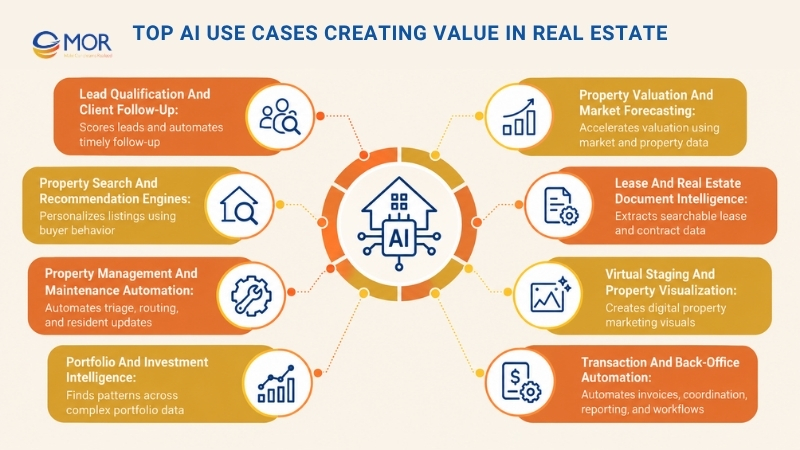
Lead Qualification and Client Follow-Up
Speed often decides which agent gets the conversation. AI can respond when staff are unavailable, collect intent, rank prospects, and pass useful information into a CRM.
- Inquiry handling: Answer routine property and service questions at any hour.
- Lead scoring: Rank prospects using engagement, budget, timing, and behavior.
- Qualification: Capture buyer, seller, financing, and property requirements before handoff.
- Follow-up: Trigger messages when a prospect returns to a listing or stops responding.
- CRM updates: Write captured information back to the customer record.
This is one of the clearer use cases for AI solutions for real estate agents because success can be measured through response time, appointment rate, and lead-to-client conversion.
Property Valuation and Market Forecasting
Valuation involves many inputs. Comparable sales, property characteristics, location, market velocity, and other signals all need to be interpreted before someone makes a financial decision.
- AVMs: Produce fast property value estimates for screening and research.
- Comparable analysis: Identify relevant transactions across larger datasets.
- Market forecasting: Model likely price and demand changes.
- Risk scoring: Add climate, credit, property, or market risk inputs where available.
- Human validation: Keep licensed review in workflows that require a formal appraisal.
AI can make the first analytical pass much faster. It should still expose the data and assumptions behind important financial conclusions.
Property Search and Recommendation Engines
Basic filters ask for beds, baths, price, and ZIP code. Recommendation systems can also learn from what buyers open, save, dismiss, revisit, or share.
- Preference matching: Combine stated requirements with behavioral signals.
- Personalized inventory: Rank available properties for each customer.
- MLS connectivity: Refresh recommendations as inventory changes.
- Feedback loops: Refine matches as the buyer interacts with more listings.
This creates a more useful discovery experience without asking an agent to rebuild every search manually. A custom real estate CRM built for your workflow can take the same approach when standard CRM recommendation logic doesn't fit your market or data model.
Lease and Real Estate Document Intelligence
Commercial leases, inspection reports, disclosures, and contracts contain dates, obligations, clauses, and exceptions that staff may need to locate repeatedly. Document AI can extract structured information and make it searchable.
- Lease abstraction: Pull rent, options, dates, obligations, and key terms into structured records.
- Clause extraction: Find language tied to defined business or legal questions.
- Date tracking: Capture renewal dates, expirations, notice periods, and milestones.
- Document search: Let teams query large repositories through natural language.
- Review support: Flag missing information or unusual terms for human review.
The strongest document workflows write extracted data back into the system that manages the property. A summary sitting in a separate chat window creates another manual step.
Property Management and Maintenance Automation
Property managers handle repetitive but time-sensitive work. Maintenance tickets, renter questions, renewals, payment reminders, and vendor coordination can create queues very quickly.
- Maintenance triage: Classify requests by type and urgency.
- Work-order routing: Send tasks to the right staff member or vendor.
- Resident communication: Give status updates without manual follow-up.
- Predictive maintenance: Use historical asset data to identify patterns before failure.
- Payment workflows: Trigger reminders and route payment-related exceptions.
Connected property management AI can also coordinate with commercial real estate CRM solutions when tenant, leasing, and relationship data must remain aligned.
Virtual Staging and Property Visualization
Visual AI speeds up property marketing and planning. Agents can stage an empty unit digitally, and developers can test renovation ideas before paying for physical changes.
- Virtual staging: Furnish empty spaces for marketing.
- Decluttering: Remove distracting objects from images.
- Renovation concepts: Show possible finish, flooring, or layout changes.
- Digital twins: Let prospects or teams walk through a space remotely.
- Floorplan analysis: Turn spatial captures into usable property information.
NAR's 2025 Technology Survey found that 46% of REALTORS® reported using AI-generated content, while 20% said they use AI tools daily. Visual and listing workflows are becoming a practical part of agent technology rather than a side experiment.
Portfolio and Investment Intelligence
Investment teams often work across market, financial, asset, lease, risk, and property datasets. AI can bring those sources into one analytical process and surface patterns that would take much longer to inspect manually.
- Portfolio aggregation: Connect performance data across assets.
- Opportunity detection: Flag properties or markets that match investment rules.
- Scenario analysis: Test changes in rent, occupancy, cap rates, costs, or other assumptions.
- Risk monitoring: Track asset and market signals over time.
- Capital planning: Support prioritization across competing property needs.
Good portfolio AI needs clean source data and clear definitions. A model cannot fix inconsistent rent-roll fields or duplicate property identities on its own.
Transaction and Back-Office Automation
A closing, acquisition, development project, or property operation creates many small tasks. Meeting notes, approval routing, invoices, status updates, reports, and document checks can consume hours without changing the investment thesis.
- Invoice processing: Extract fields, check purchase orders, and route approvals.
- Transaction coordination: Track dependencies and missing documents.
- Meeting follow-through: Turn calls into summaries, tasks, and ownership assignments.
- Reporting: Draft recurring operational updates using current system data.
- Workflow agents: Move information across approved systems under defined permissions.
The same pattern appears in AI in project management: value comes from connecting information to the next task, not merely producing another summary.
How to Choose the Right AI Solution for Real Estate
A long capability list doesn't tell you if a platform will work inside your operation. Choosing AI solutions for real estate requires a closer look at workflow fit, data, integration, cost, and approval rules.
Start with a measurable process. Then test the product against the systems and people already responsible for that process.
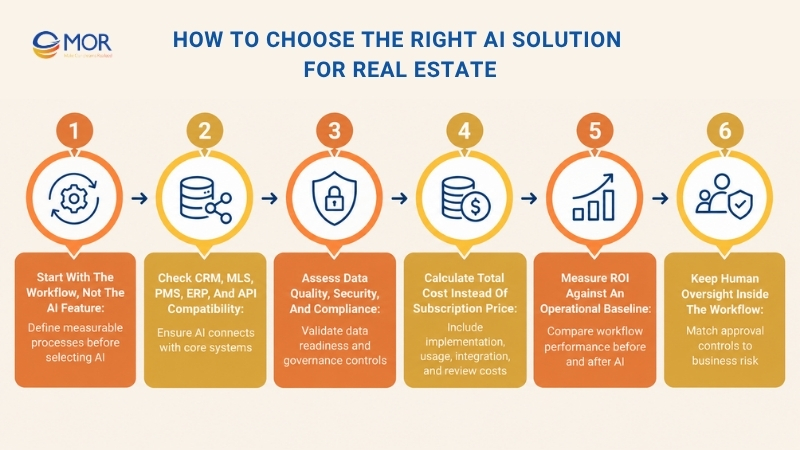
Start With the Workflow, Not the AI Feature
Pick one workflow where delay or repeated manual effort is visible. Good starting points include lead response time, lease-review hours, maintenance resolution, invoice processing, or valuation turnaround.
- Define the baseline: Record current time, cost, error rate, and conversion before adding AI.
- Set the desired result: Decide what should change and how much improvement would justify the spend.
- Map exceptions: List the situations where the system must stop and ask for human review.
- Identify ownership: Give one team responsibility for the result rather than assigning AI to an unclear cross-company initiative.
A precise workflow also makes vendor demos more useful. You can ask the vendor to run your scenario instead of watching a generic product tour.
Check CRM, MLS, PMS, ERP, and API Compatibility
Integration determines what happens after AI produces an answer. A model that identifies a high-intent buyer creates little value if the agent still needs to copy that result into another system.
Check the platforms around the workflow:
- CRM: Can the AI read and write customer records?
- MLS or listing feeds: Can it retrieve current property information within licensing rules?
- PMS: Can leasing, resident, or maintenance actions return to the system of record?
- ERP and accounting: Can finance automation read codes, vendors, invoices, and approvals?
- APIs and webhooks: Can your team connect custom systems without brittle manual exports?
- Data warehouse: Can analytical AI access governed historical data?
Ask vendors about read and write permissions separately. Some integrations can retrieve data but cannot update the source system.
Assess Data Quality, Security, and Compliance
AI quality is tied to the data underneath it. Missing property IDs, duplicate tenants, stale listing feeds, inconsistent lease fields, and weak access rules can quickly undermine a promising pilot.
Deloitte's commercial real estate research found that only 14% of respondents believed their organizations had well-structured data collection and management processes plus strong privacy policies. Data readiness and security were also identified as leading barriers to scaling AI.
Review:
- Completeness: Does the workflow have enough historical and current data?
- Permissions: Can each role access only the records it needs?
- Auditability: Can staff see what the AI read and what action it took?
- Human validation: Which outputs require approval?
- Retention: Where are prompts, outputs, logs, and documents stored?
- Regional rules: Do screening, privacy, marketing, and housing requirements affect the intended workflow?
A small data audit before procurement can save months of integration work later.
Calculate Total Cost Instead of Subscription Price
A $99 monthly subscription can become more expensive once API access, contacts, credits, implementation, add-ons, and staff review are included. Enterprise products may reverse the pattern: a high platform fee may replace several smaller tools.
Map the full cost:
- Licenses and seat fees.
- Usage credits and AI consumption.
- Implementation and onboarding.
- API or data fees.
- Integration development.
- Data cleaning and migration.
- Training.
- Support and maintenance.
- Human review time.
Calculate cost against a business unit that matters. Cost per qualified lead, lease reviewed, property analyzed, invoice processed, or work order closed is more useful than a headline subscription price.
Measure ROI Against an Operational Baseline
AI ROI needs a before-and-after comparison. Pick measures connected to the workflow instead of relying on broad claims about productivity.
For sales, track response time, appointments, qualified leads, and conversion. Property operations can use work-order cycle time, vacancy days, resident response time, collection rate, or staff hours.
Investment and document teams may care about analysis turnaround, review hours, exceptions, or data errors. Finance teams can compare invoice processing cost and approval time.
Run the measurement long enough to capture normal variation. A one-week test during an unusually quiet period can create a false result.
Keep Human Oversight Inside the Workflow
Autonomy should match business risk. Drafting a follow-up email and approving a property acquisition don't need the same control level.
Set approval points before rollout:
- Low-risk actions: Allow automatic classification, summaries, reminders, and data preparation.
- Medium-risk actions: Let AI prepare a recommendation, then ask an employee to approve it.
- High-risk actions: Keep financial commitments, regulated decisions, and sensitive customer actions under direct human control.
- Exceptions: Route uncertain cases to a named person or queue.
- Logs: Store model inputs, outputs, system actions, and approvals where needed.
A controlled pilot gives your team evidence before AI receives wider permissions.
When Off-the-Shelf Real Estate AI Is Not Enough
Packaged AI solutions for real estate work well when your process resembles the vendor's standard workflow. Problems appear when proprietary data, internal decision rules, or connected legacy systems become central to the use case.
That point often arrives after an initial SaaS pilot. The team proves that AI is useful, then discovers that the tool cannot read the right data or execute the next business step.
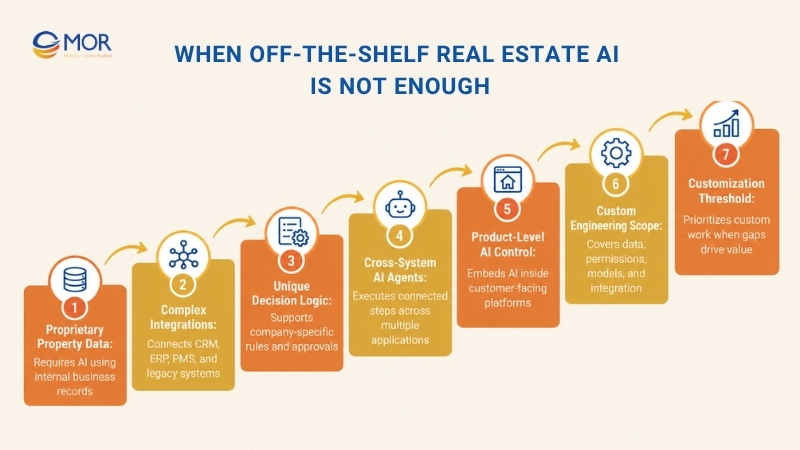
- Proprietary property data: Your models may need historical leases, private transaction records, tenant history, asset data, inspection results, or internal pricing information that a public SaaS product doesn't know.
- Complex integrations: A workflow may span CRM, ERP, PMS, data warehouse, mobile apps, portals, and legacy databases. A separate AI screen adds work if employees still need to move the output manually.
- Unique decision logic: Underwriting rules, asset scoring, lead models, approval processes, recommendations, and maintenance routing may be part of your competitive process. Generic software usually supports standard configurations rather than company-specific logic.
- AI agents across systems: Some tasks require the AI to read one application, check another data source, prepare a decision, update a record, then create a task. That level of execution needs tool permissions, API work, logging, and clear approval boundaries.
- Product control: PropTech firms may want AI inside their customer-facing product rather than sending users to an outside platform. In that case, AI automation services for business processes can support a tailored agent or workflow layer around the existing product.
This is where AI automation services for real estate differ from subscribing to another application. Engineering work covers data pipelines, system connections, permission models, model selection, application logic, testing, and production operations.
For example, a brokerage could connect an AI qualification agent to a custom real estate CRM. The agent could read a new inquiry, check inventory, assign a score, prepare matching properties, update the CRM, and create a follow-up task for the assigned agent.
The same logic applies to development and property operations. A custom system may combine inspection records, photos, schedules, budgets, contractors, and project data when no single SaaS product handles the complete workflow.
Before committing to custom work, compare the gap against the cost. If a ready-made product covers 90% of the process and the remaining 10% has little business value, customization may not pay back.
A custom path makes more sense when the missing workflow affects conversion, operating cost, risk, product differentiation, or proprietary decision-making.
Why Choose MOR Software for AI-Driven Real Estate Solutions?
MOR Software works with companies that need AI connected to real software, data, and daily operations. Our current AI service scope includes feasibility assessment, data engineering, custom multimodal AI models services, generative AI integration, and edge or cloud deployment.
That makes MOR relevant for AI solutions for real estate that extend beyond a stand-alone chatbot. AI services for real estate can sit inside a CRM, property portal, mobile app, ERP, analytics system, or PropTech product.
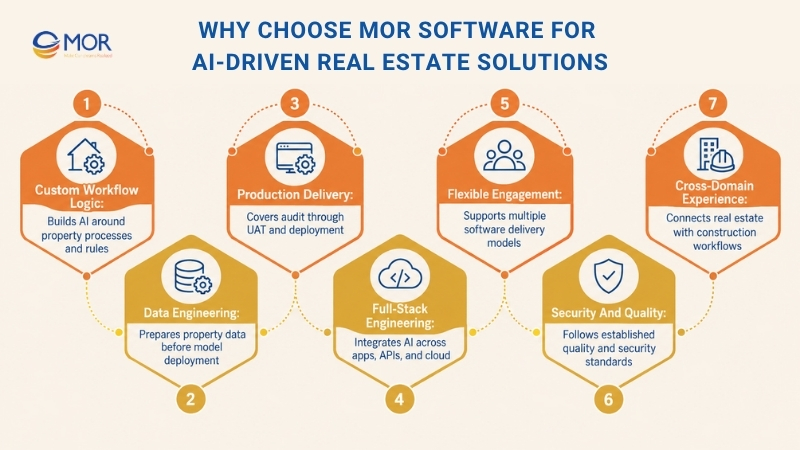
- Custom logic around your workflow: We can design AI around your property data, approval rules, customer journey, and internal processes instead of forcing a fixed SaaS workflow.
- Data engineering before model work: MOR's AI service covers acquisition, cleaning, and annotation. That matters when property or transaction records aren't yet ready for model training or retrieval.
- Production-focused delivery: MOR's published AI process moves through Audit, Strategy, Development, and Integration. UAT and production deployment sit inside that delivery path rather than being treated as an afterthought.
- Software engineering around the AI layer: Our wider teams work across web, mobile, APIs, cloud systems, enterprise applications, databases, and testing. This lets AI become part of the product employees or customers already use.
- Flexible engagement: Staff Augmentation adds specialists to your existing team, Fixed-Price fits defined scopes, and a Dedicated Team supports longer product roadmaps.
- Information security and quality controls: MOR states that its projects follow ISO 9001:2015 and ISO 27001:2013 standards. These controls are relevant when property systems contain customer, financial, or internal business data.
- Cross-domain delivery experience: Real estate projects often touch construction, ERP, mobile workflows, field teams, and reporting. For example, a cross-platform construction app we developed connected job lists, images, reports, directives, drawings, and team chat for a Japanese construction company.
That combination can also support a custom real estate CRM built for your workflow or an AI layer added to an existing property platform.
Share your current systems, target workflow, data sources, and expected result with MOR Software. We can assess whether a packaged tool, custom AI system, or hybrid setup fits the project better.
Conclusion
The right AI solutions for real estate depend on the workflow, data, systems, and result you need to improve. HouseCanary, EliseAI, Matterport, AppFolio, and PropStream solve very different jobs, so product fit matters more than a generic ranking. When packaged software can't support proprietary logic or deeper integrations, MOR Software can help assess a custom or hybrid approach.
Contact MOR Software to discuss your systems, data, and target AI workflow.
"Evolution is not a destination, it is a disciplined journey of innovation."
Phung Van Tu


CEO MOR AI
MOR SOFTWARE
Frequently Asked Questions (FAQs)
What are AI solutions for real estate?
They are software systems that apply machine learning, generative AI, predictive analytics, computer vision, or AI agents to real estate work. Common uses include property valuation, lead qualification, property matching, lease analysis, virtual staging, maintenance, investment research, and back-office automation.
What are the most common uses of AI in real estate?
Common uses include AVMs, buyer-property matching, lead scoring, listing content, virtual staging, lease abstraction, maintenance triage, portfolio analytics, seller prediction, and invoice processing. The best starting point is usually a workflow with measurable delay, cost, or repeated manual work.
What is the best AI solution for real estate companies?
There isn't one platform that fits every property business. HouseCanary fits valuation, EliseAI targets multifamily operations, Matterport handles spatial visualization, RealScout focuses on buyer matching, and PropStream supports investment prospecting.
How is AI used for property valuation?
AI valuation models analyze comparable transactions, property attributes, location, market conditions, and other data to estimate value. These models can speed up screening and research, but regulated transactions may still require a formal appraisal or professional review.
Can AI integrate with a real estate CRM or MLS?
Yes, if the AI platform and target system provide suitable APIs, integrations, or approved data access. Integration can let AI read lead activity, retrieve current listings, update customer records, create tasks, or trigger follow-up without manual copying.
How much do AI solutions for real estate cost?
Costs range from free entry plans to enterprise contracts and custom development. Subscription tools on this list begin around $19 to $299 per month for several common use cases, while products like TestFit start in the thousands per year and enterprise data platforms use custom quotes.
Can AI automate property management workflows?
Yes. AI can classify maintenance tickets, answer resident questions, schedule tours, manage follow-up, assist with renewals, route invoices, and prepare work orders. Human approval should remain where financial, legal, safety, or sensitive customer decisions are involved.
What is the difference between real estate AI software and AI agents?
Traditional AI software usually performs a defined task inside one application. An AI agent can interpret a request, use tools, retrieve data, complete several steps, update systems, and escalate exceptions under configured permissions.
What risks should real estate companies consider before using AI?
Review data quality, privacy, access permissions, model accuracy, integration security, output traceability, and human approval requirements. Property screening, valuation, financial commitments, and customer-facing decisions need tighter controls than low-risk tasks like summarization.
When should a real estate company build a custom AI solution?
Custom AI makes sense when proprietary data, unique business rules, deeper system integration, or product differentiation creates value that standard software can't cover. A hybrid approach can also work, keeping specialized SaaS platforms while developing a custom AI layer for company-specific processes.
Share


Make Our-Dreams Realized


© 2023 . MOR Software. All Rights Reserved
Sitemap
Privacy Policy
Terms of Use

Rate this article
0
over 5.0 based on 0 reviews
Your rating on this news:
Name
*Email
*Write your comment
*Send your comment
1