


Artificial Intelligence Digital Transformation: From Pilot to ROI
AI adoption has moved faster than enterprise value. Many companies can show a working demo, yet few can connect it to a stable workflow, trusted data, or clear financial results. In this guide, MOR Software will explain how artificial intelligence digital transformation moves from a selected business problem to a production system that teams can measure, govern, and scale.
Key Takeaways
- AI creates business value when a company redesigns a workflow around a clear outcome rather than adding a tool to an old process. The business owner, baseline KPI, and approval rules should exist before model selection.
- Data readiness, integration architecture, governance, and user adoption decide whether a pilot can enter daily operations. A strong demo can still fail when it depends on manual exports or unclear ownership.
- Scale should follow proven business results, stable system performance, and a realistic total cost of ownership. Teams need defined monitoring, support, and retirement rules after release.
What Is Artificial Intelligence Digital Transformation?
Digital transformation changes how a company operates, serves customers, and creates value through connected systems. It may replace paper records, link departments through APIs, move workloads to cloud platforms, or rebuild a customer journey around web and mobile applications.
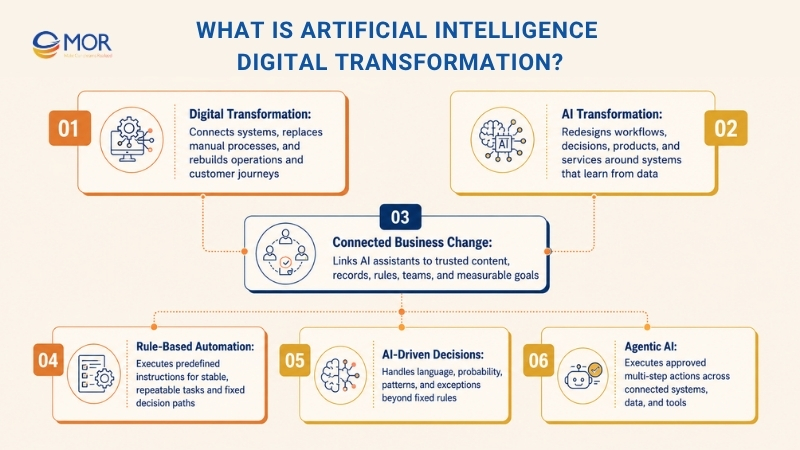
Artificial intelligence digital transformation redesigns workflows, decisions, products, and services around systems that learn from data, detect patterns, generate content, or act across connected tools. The phrase artificial intelligence in digital transformation describes this operating change, not a single software purchase.
A chatbot may answer basic questions, but that alone doesn’t change the business. Real transformation connects the assistant to trusted content, customer records, approval rules, service teams, and measurable goals.
Concept | Primary Goal | Decision Logic | Example | Scope of Change |
Digitization | Convert analog information into digital records | None | Scan invoices into searchable files | One information source |
Digitalization | Improve an existing process through software | Fixed rules | Route invoices through online approval | One process |
Traditional automation | Run repeatable tasks without manual input | If-then rules | Alert staff when stock reaches a set level | Defined task sequence |
Digital transformation | Rebuild operations through connected technology | Rules, analytics, and shared data | Connect CRM, ERP, apps, and reporting | Cross-functional change |
AI transformation | Redesign decisions around learning systems | Prediction, generation, and pattern detection | Predict demand and trigger approved actions | Operating model and products |
Rule-based automation follows instructions written in advance. AI fits cases where language, probability, patterns, or exceptions shape the answer. Agentic AI business applications extend this model through multi-step execution across approved systems, data, and actions.
Why AI Changes Digital Transformation Outcomes
Adoption data shows a wide gap between experimentation and enterprise value. McKinsey’s 2025 State of AI survey found that 88% of respondents reported regular AI use in at least one business function, but only about one-third said their companies had begun scaling AI programs. Many teams have access to models; far fewer have rebuilt the work around them.
The role of artificial intelligence in digital transformation centers on decisions, workflows, and new operating machine learning models. AI-led transformation creates value when teams connect model outputs to real business actions, named owners, and measurable targets.
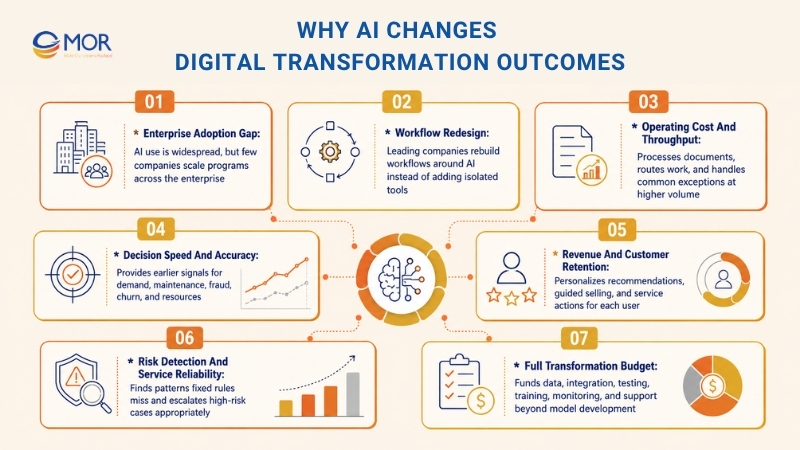
PwC’s 2026 AI Performance Study found that leading companies were twice as likely to redesign workflows around AI instead of adding isolated tools. They were also 2.6 times as likely to report that AI improved their ability to reinvent the business model.
For digital transformation and AI for business leaders, the practical role of AI in digital transformation appears in four outcomes:
- Operating cost and throughput: AI can process documents, classify requests, route work, and handle common exceptions at a higher volume.
- Decision speed and accuracy: Forecasting and anomaly models give teams earlier signals for demand, maintenance, fraud, churn, and resource needs.
- Revenue and customer retention: Recommendation systems, guided selling, and personalized service can match each user with a more relevant action.
- Risk detection and service reliability: AI can review patterns that fixed rules miss, then send high-risk cases to people with the right authority.
Artificial intelligence business transformation also changes the budget. Model development represents one part of the work. Data preparation, system integration, workflow design, testing, training, monitoring, and support need funding from the start.
Key Benefits Of Artificial Intelligence Digital Transformation
Use-case selection should reflect workflow volume, decision complexity, data quality, risk, and measurable value. Strong artificial intelligence digital transformation examples solve a defined operational problem and track the result after release.
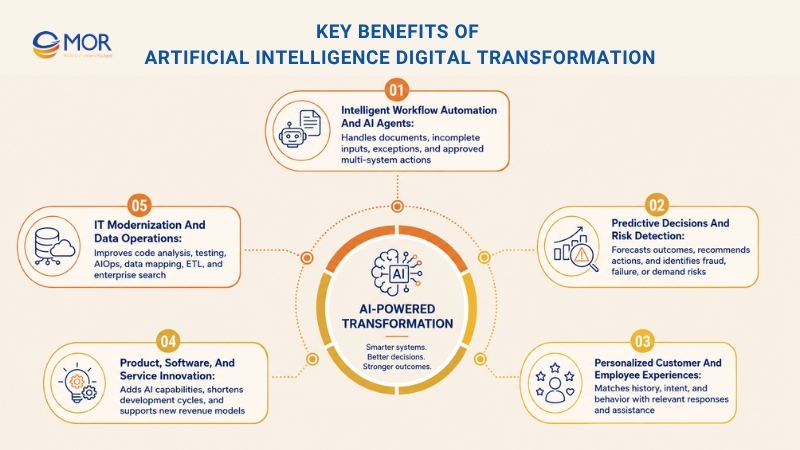
Intelligent Workflow Automation and AI Agents
AI-supported automation handles documents, language, incomplete inputs, and routine exceptions. Common targets include onboarding, invoice processing, claims review, support triage, procurement approvals, and internal requests.
RPA follows a fixed route. AI automation can classify an email, extract data, compare it against policy, and request missing information. An agent may coordinate approved steps across Salesforce, ERP, service software, and internal portals.
An artificial intelligence digital procurement transformation can read supplier quotes, group spend, flag contract gaps, forecast demand, score delivery risk, and route high-value orders for approval.
- Processing time: Hours or days between request receipt and completed action.
- Automation rate: Share of cases completed without manual handling.
- Exception rate: Cases that leave the planned route due to missing or conflicting data.
- Cost per transaction: Labor, software, and review cost for each completed case.
- Human escalation rate: Share of cases sent to a person for a decision.
Predictive Decisions and Risk Detection
Predictive models estimate what may happen based on historical and current data. Prescriptive systems add a recommended action, while descriptive analytics mainly explains past results.
Manufacturers can predict equipment failure, banks can score unusual transactions, and logistics teams can forecast shipment demand. For instance, the U.S. Department of the Treasury reported that data-led fraud controls, including machine learning AI, prevented or recovered more than $4 billion in fraud and improper payments during fiscal year 2024.
- Forecast accuracy: Compare predictions with actual outcomes.
- Downtime avoided: Track interrupted hours prevented through earlier action.
- Loss prevented: Calculate fraud, waste, or service failure caught before completion.
- False-positive rate: Measure normal cases wrongly marked as risky.
- Decision time: Compare how long teams need to approve an action.
Personalized Customer and Employee Experiences
AI can match a person’s history, intent, behavior, and current request with a relevant response. Recommendation engines, next-best-action models, conversational support, guided search, and employee assistants use this pattern.
Access controls should limit which records the system can read, and escalation rules must route sensitive or uncertain cases to a person. Bank of America reported in March 2026 that 20.6 million users interacted with its Erica assistant nearly 700 million times during 2025.
KPI | What It Shows | Typical Data Source |
Conversion rate | Whether recommendations lead to action | CRM or product analytics |
Retention rate | Whether users continue the relationship | Customer records |
Resolution time | How quickly a request reaches an answer | Service desk |
Satisfaction | How users rate the interaction | CSAT or surveys |
Self-service completion | How many users finish without staff help | Chat or portal events |
Product, Software, and Service Innovation
AI can add a capability to an existing product or support a new revenue model. Teams apply generative design, code assistance, test generation, document intelligence, image analysis, and domain assistants to shorten development cycles.
A prototype still needs security review, API testing, quality checks, maintainability, monitoring, and UAT. A clever demo can hide expensive gaps.
MOR Software example: MOR Software built a healthcare application for nurses that included an AI model for spam-review detection. The project also used AWS infrastructure, mobile development, system integration, analytics, and performance monitoring.
Track development cycle time, release frequency, user adoption, revenue per capability, and defect rate against a baseline.
IT Modernization and Data Operations
Legacy systems often block artificial intelligence digital transformation because data remains fragmented, slow, or hard to access. AI can assist code analysis, test creation, incident detection, data mapping, ETL checks, and knowledge search.
- Legacy-code analysis: Map dependencies, outdated libraries, and business rules before migration.
- Intelligent testing: Generate test cases and review regression risk.
- AIOps: Group alerts and identify likely root causes.
- Data mapping: Match fields across CRM, ERP, databases, and external services.
- ETL quality control: Check missing values, duplicates, format conflicts, and failed transfers.
- Enterprise search: Connect approved documents and system records to a searchable layer.
Track deployment time, incident response, data quality, integration latency, and infrastructure cost.
The Technology Stack Behind AI-Driven Transformation
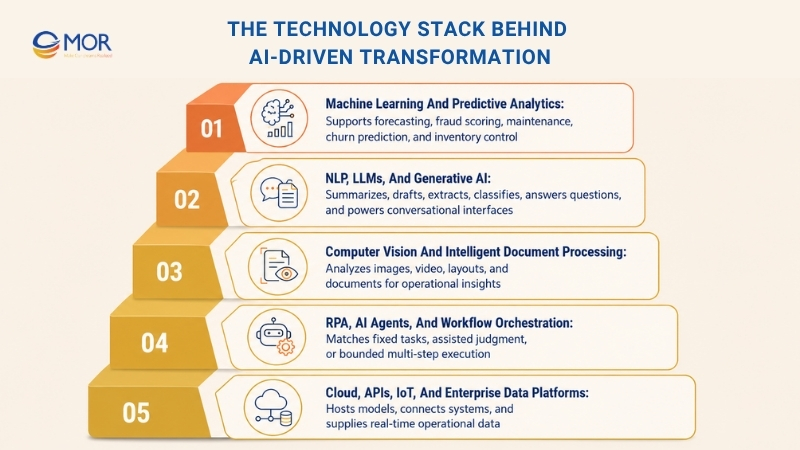
The right stack follows the business problem. Artificial intelligence digital transformation may combine machine learning, language models, computer vision, automation, cloud services, APIs, IoT data, and enterprise platforms.
Machine Learning and Predictive Analytics
Supervised learning finds patterns in labeled data, while forecasting models estimate future values across time. Common uses include demand planning, fraud scoring, equipment maintenance, churn prediction, and inventory control.
NLP, LLMs, and Generative AI
Natural language processing works with written or spoken language. Large language models can summarize documents, draft content, answer questions, extract fields, classify requests, and support conversational interfaces.
General models don’t automatically know your current policies or account records. Retrieval-augmented generation connects a model to selected business sources at request time, supported by access rules, source references, and fallback paths.
Computer Vision and Intelligent Document Processing
Computer vision analyzes images and video, while intelligent document processing combines OCR, layout detection, language models, and business rules.
- Quality inspection: Detect visible defects or missing parts.
- Document processing: Extract names, dates, totals, and line items.
- Operational monitoring: Identify objects or unsafe conditions in approved camera feeds.
RPA, AI Agents, and Workflow Orchestration
RPA, copilots, and agents solve different levels of work. Select the least complex option that meets the business goal.
Technology | Best Fit | Decision Style | Typical Action | Human Control |
RPA | Stable screen tasks | Fixed rules | Copy data and submit forms | Reviews exceptions |
AI Copilot | Work needing judgment | Suggestions | Draft, summarize, and recommend | Approves key actions |
AI Agent | Bounded multi-step work | Planning within rules | Read, call tools, and update systems | Reviews high-risk steps |
Workflow orchestration connects these tools to APIs, queues, approval gates, and logs.
Cloud, APIs, IoT, and Enterprise Data Platforms
Cloud services supply model hosting, compute, storage, and monitoring. APIs connect artificial intelligence and automation service to Salesforce, ERP, web apps, mobile app development, payment systems, and databases. IoT devices add real-time sensor data.
Stack Layer | Main Job | Common Components |
Experience | Present AI to users | Web app, mobile app, chat, dashboard |
Workflow | Coordinate tasks and approvals | Agent runtime, RPA, queues, rules |
AI service | Generate, classify, predict, or detect | LLM, ML model, vision model, OCR |
Integration | Exchange data and actions | REST API, ETL, event bus |
Data | Store trusted records | Database, warehouse, lakehouse, vector store |
Infrastructure | Run and monitor the system | AWS, containers, serverless, observability |
Readiness for Artificial Intelligence in Digital Transformation
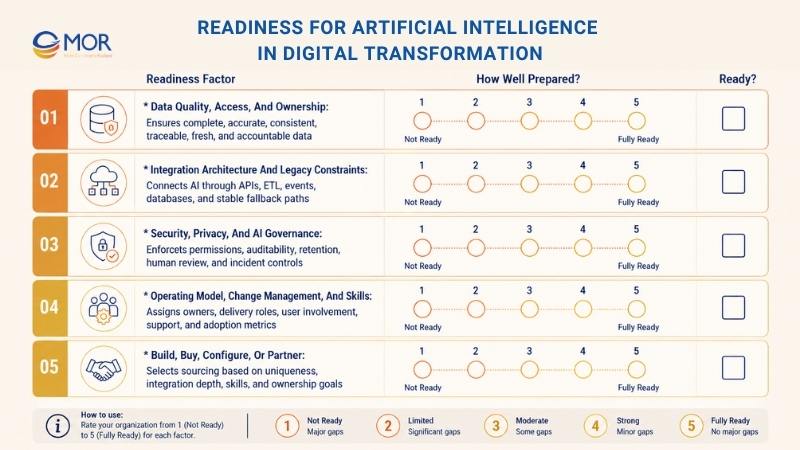
A successful demo doesn’t prove production readiness. The program needs dependable data, connected systems, clear ownership, access controls, trained users, and a support model after launch.
Data Quality, Access, and Ownership
AI output inherits the condition of its input. Duplicated, stale, incomplete, or poorly labeled records weaken decisions even when a demo looks polished.
- Completeness: Confirm that required fields and document types exist across enough cases.
- Accuracy: Compare records against trusted sources before training or retrieval.
- Consistency: Standardize names, dates, units, status codes, and identifiers.
- Lineage: Record where data came from and how it changed.
- Freshness: Match update schedules to the speed of the decision.
- Ownership: Assign a person or team to approve access and quality rules.
Manual CSV exports may work during tests, but they create delays and hidden work at scale. Plan the production data route early.
Integration Architecture and Legacy Constraints
AI must work inside the systems where people complete tasks. APIs, ETL pipelines, events, databases, and third-party platforms decide whether an output becomes an action or another report.
- API coverage: Check whether each system can read and write the required data.
- ETL reliability: Monitor transfers, mapping rules, failed jobs, and totals.
- Event flow: Use events when a model must respond to a new ticket, order, or sensor reading.
- Legacy limits: Identify systems that lack APIs or depend on fragile manual steps.
- Latency and availability: Define acceptable response times and fallback behavior.
- Vendor dependency: Review portability, contract limits, and exit paths.
A monolith may need an API layer first. A stable system with usable interfaces can stay in place during the pilot.
Security, Privacy, and AI Governance
Governance defines where the system may advise, act, or require approval. Treat artificial intelligence & digital strategy management as one operating track so product goals, data access, and accountability stay connected.
- Sensitive-data controls: Limit personal, financial, health, and confidential records.
- Access management: Apply role-based permissions to data, prompts, and actions.
- Audit logs: Record inputs, sources, outputs, approvals, and system changes.
- Retention: Set rules for prompts, generated content, feedback, and logs.
- Human review: Require approval for high-value or high-risk actions.
- Failure controls: Detect prompt injection, data leakage, unsupported answers, and unauthorized tool calls.
- Incident response: Name who pauses the system, investigates, and approves recovery.
Policies need technical enforcement inside the application, API, and approval flow.
Operating Model, Change Management, and Skills
Assign responsibility before AI enters daily work. Shared ownership often becomes no ownership when a source changes or a model fails.
- Executive sponsor: Sets the business result, funding, and cross-team authority.
- Business owner: Owns the workflow, KPI, policy rules, and process decisions.
- Product owner: Manages backlog, acceptance criteria, and release priorities.
- Engineering and data teams: Build models, applications, integrations, and monitoring.
- Security and operations teams: Review controls, incidents, user support, and service levels.
- End users: Test real cases and report gaps or workarounds.
Track adoption, override rate, time saved, and user feedback beside model accuracy.
Build, Buy, Configure, or Partner
The sourcing choice depends on uniqueness, integration depth, available skills, and ownership goals.
Path | Best Fit | Main Advantage | Main Limitation |
Buy | Standard workflow with limited integration | Fast access to a tested product | Fixed process and vendor limits |
Configure | Platform fits but needs rules or data links | Shorter delivery than a full build | Platform boundaries remain |
Build | Unique process, data, experience, or IP | Full control over behavior and roadmap | Higher delivery responsibility |
Partner | Internal team lacks specialist capacity | Adds focused skills and delivery capacity | Needs clear ownership and vendor management |
AI Digital Transformation Roadmap: From Use Case to Enterprise Scale
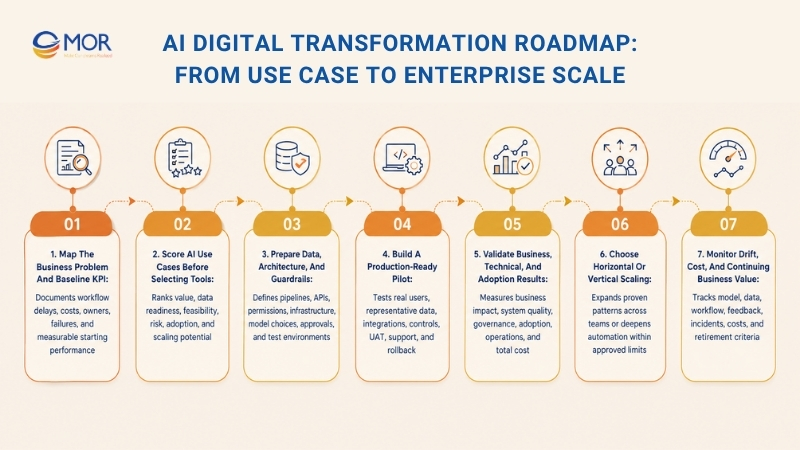
Artificial intelligence and digital transformation from innovation to implementation requires business gates. Artificial intelligence digital transformation should move forward only when each stage provides enough evidence for the next investment.
Map the Business Problem and Baseline KPI
Map the current workflow before discussing models. Record users, delays, errors, costs, handoffs, and the decision that creates business value.
- Outcome: Name a financial or operational result, not a broad aim like 'use AI.'
- Owner: Identify the manager who can change rules and accept results.
- Delay: Measure queues, repeated entry, search time, and approval wait.
- Failure cost: Estimate rework, missed revenue, downtime, or risk exposure.
- Baseline: Capture current cycle time, error rate, volume, cost, and satisfaction.
A useful problem statement remains valid even if AI isn’t the final answer. 'Cut invoice exception review from 40 minutes to 10 minutes' gives the team a testable target.
Score AI Use Cases Before Selecting Tools
Score each use case from 1 to 5. A visible idea may still be a poor pilot when its data or ownership is weak.
Criterion | 1 Point | 3 Points | 5 Points |
Business value | Small local gain | Clear department gain | Material revenue, cost, or risk value |
Data readiness | Missing or unreliable | Partial usable history | Trusted and accessible |
Technical feasibility | Major unknowns | Known links with gaps | Proven methods and accessible systems |
Risk and compliance | Unclear controls | Manageable through review | Low risk or defined controls |
User readiness | No owner or plan | Interested users | Named owner and active user group |
Scaling potential | One narrow case | Reusable in one function | Repeatable across teams or products |
A moderate-value case with clean data may be a better starting point than a high-value case that needs months of preparation.
Prepare Data, Architecture, and Guardrails
Prepare the production path before development starts. The pilot may use a smaller scope, but it shouldn’t depend on temporary methods.
- Data pipeline: Define sources, updates, transformations, quality checks, and ownership.
- API map: List each system the solution must read, update, or trigger.
- Permissions: Separate development, testing, and production access.
- Infrastructure: Estimate volume, storage, compute, and response time.
- Model choice: Compare quality, latency, cost, hosting, and privacy needs.
- Human approval: Mark decisions that need review before action.
- Test environment: Create representative data for integration and UAT.
This stage supports digital transformation through artificial intelligence because it joins the model to real systems and people.
Build a Production-Ready Pilot
Keep the pilot small enough to learn quickly, but complete enough to test daily work. Use real users, representative data, working integrations, and agreed acceptance criteria.
- Real users: Recruit people who perform or manage the target work.
- Representative data: Include normal cases, edge cases, and known failures.
- Complete workflow: Test the path from request to final business action.
- System integration: Connect required CRM, ERP, database, or service tools.
- Control tests: Check permissions, logs, approval, and blocked actions.
- UAT feedback: Record where users correct, ignore, or bypass the system.
- Support and rollback: Define who can pause or reverse a release.
A pilot passes when users complete real work and results meet agreed thresholds.
Validate Business, Technical, and Adoption Results
One model score can’t compensate for weak adoption, high unit cost, or unstable integrations.
Evaluation Layer | Core Question | Example Metric |
Business KPI | Did the target result change? | Cycle time, revenue, loss prevented |
System performance | Does the solution meet quality and speed targets? | Accuracy, latency, completion rate |
Security and governance | Did controls work? | Audit coverage, approval compliance |
User adoption | Do people use and trust it? | Active use, override rate, satisfaction |
Operational support | Can the team run and repair it? | Incident count, recovery time |
Unit cost and TCO | Does value justify continued use? | Cost per case, monthly run cost |
Choose Horizontal or Vertical Scaling
Horizontal growth applies a proven pattern to similar teams or workflows. Vertical growth increases accuracy, autonomy, volume, or workflow depth inside the original process.
Scaling Path | Best Fit | Main Check |
Horizontal | Stable work repeated across departments or regions | Data and policy consistency |
Vertical | High-value work with room for deeper automation | Risk, quality, and operating cost |
Use horizontal scaling when the process and integration pattern repeat. Use vertical scaling when the original use case can handle more decisions within approved limits.
Monitor Drift, Cost, and Continuing Business Value
Models, data, user behavior, and business rules change after launch. Monitoring keeps the full transformation lifecycle tied to current results.
- Model drift: Check accuracy, false positives, and completion rates.
- Data drift: Detect source-format and user-pattern changes.
- Workflow change: Review policies, releases, and product rules.
- User feedback: Track corrections, overrides, and workarounds.
- Infrastructure cost: Watch model calls, compute, storage, and support hours.
- Incidents: Review failed integrations and unauthorized actions.
- Retirement criteria: Pause or replace the system when value drops or risk rises.
Set a review schedule and named owner before scale begins.
How to Measure AI Digital Transformation ROI and TCO
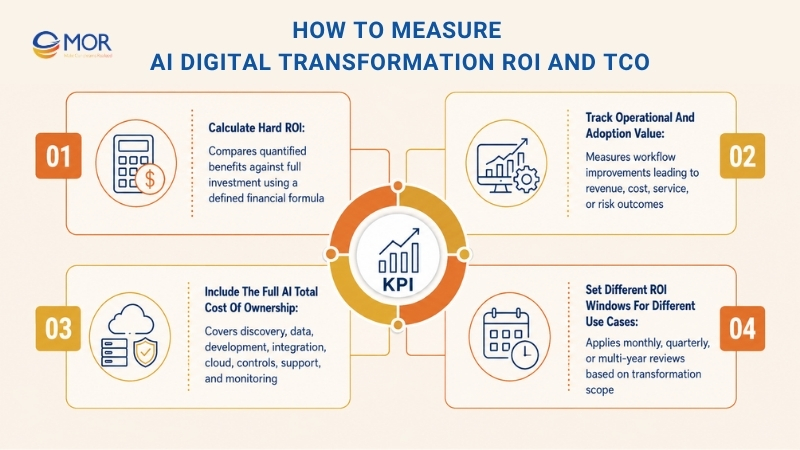
Financial measurement should start before development. IBM’s 2025 CEO study reported that only 25% of AI initiatives had delivered expected ROI, and only 16% had scaled enterprise-wide. Artificial intelligence digital transformation needs a baseline, cost model, and value owner before release.
Calculate Hard ROI
Hard ROI compares quantified financial value with the full investment. Include labor capacity, revenue created or protected, time saved, rework cut, downtime avoided, and loss prevented.
ROI (%) = [(Total quantified benefit - Total investment) / Total investment] × 100
For example, a review system creates $420,000 in annual labor capacity and prevents $80,000 in error costs. First-year development, integration, cloud, training, and support cost $250,000. ROI equals 100%.
Track Operational and Adoption Value
Financial value may lag behind workflow change. Track the measures that lead to revenue, cost, service, or risk results.
Metric | Baseline | Target | Data Source | Review Frequency |
Decision time | 4 hours | 30 minutes | Workflow logs | Weekly |
Completion rate | 62% | 85% | Application events | Weekly |
User adoption | 0% | 70% | Usage data | Monthly |
Satisfaction | 3.4/5 | 4.2/5 | User survey | Monthly |
Employee capacity | 120 cases | 180 cases | Operations report | Monthly |
Rework | 18% | Below 7% | QA records | Monthly |
Include the Full AI Total Cost of Ownership
TCO covers build, run, and scale costs. A low model price can hide larger data, integration, review, and support costs.
- Discovery: Process mapping, gap analysis, use-case scoring, and planning.
- Data: Collection, cleaning, labeling, migration, storage, and quality rules.
- Development: Model services, applications, APIs, workflow logic, and admin tools.
- Integration: CRM, ERP, databases, identity, queues, and legacy adapters.
- Model and cloud fees: Calls, licenses, compute, storage, monitoring, and backups.
- Controls and testing: Access, logs, functional tests, security tests, and UAT.
- Training and support: User guidance, adoption tracking, incidents, and maintenance.
- Monitoring: Drift checks, data fixes, software updates, and retraining.
Project cost per transaction at expected volume. Positive pilot economics may disappear when model calls or human review rise faster than usage.
Set Different ROI Windows for Different Use Cases
One payback period doesn’t fit every AI program.
Use Case Class | Main Value Signal | ROI Window Approach |
Quick win | Hours saved and fewer errors | Review monthly after release |
Core workflow | Throughput, quality, and cost per case | Review quarterly |
Enterprise transformation | Revenue, margin, risk, and capacity | Use phased benefits and multi-year TCO |
Use stage gates instead of promising one fixed return date.
Risks That Keep AI in Digital Transformation Stuck in Pilot Stage
Most pilots stall for operational reasons. Artificial intelligence digital transformation fails to scale when the problem, data, integration, ownership, controls, or cost model remains incomplete. A model can pass technical tests and still create little business value.
Risk | Warning Sign | Business Effect | Mitigation |
Tool-first selection | The team starts with a vendor before naming a KPI | Activity grows without a decision case | Write the problem and baseline before tool review |
Automating a broken workflow | Every old step appears in the new design | Waste and delays remain | Remove needless handoffs and approvals |
Poor data quality | Users don’t trust records or outputs vary | Predictions need repeated correction | Assign data owners and run quality checks |
Unclear data ownership | No one can approve access or correction | Delivery pauses and disputes grow | Name an owner for each source |
Disconnected pilot | Staff export files and paste results elsewhere | Scale adds manual work and error risk | Test production APIs and full workflow paths |
Missing approval controls | The model can take high-risk actions alone | Financial or service errors reach users | Add role limits and approval gates |
No business owner | IT owns the demo after the sponsor leaves | KPI review and process decisions stop | Assign a permanent workflow owner |
Low user trust | Staff ignore outputs or keep hidden manual work | Adoption stays low | Use UAT, explain sources, and track overrides |
Unplanned run cost | Model, cloud, review, and support bills rise | Pilot economics disappear at volume | Model TCO and set cost alerts |
Early scaling | Expansion starts before quality stabilizes | Failures spread across more users | Require business, system, and adoption gates |
No monitoring rule | Performance falls without a response plan | Value declines and risk accumulates | Set thresholds, owners, and stop criteria |
Pilot success covers business value, system stability, controls, adoption, and cost. Each area needs an owner and a pass threshold before expansion. A failed gate should trigger correction, a smaller scope, or a stop decision rather than automatic funding for the next phase. That discipline protects later investment decisions.
Build AI-Ready Business Systems With MOR Software
Many companies already know which workflow needs change. The missing pieces are often system design, custom development, data integration, modernization, testing, and delivery capacity. MOR Software supports artificial intelligence digital transformation through connected software work rather than an isolated model experiment.
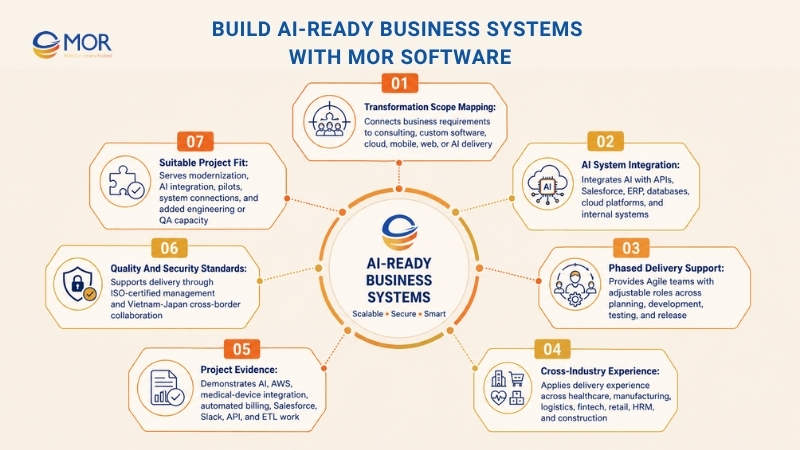
- Map the transformation scope: MOR Software provides IT consulting, digital transformation services, and custom software development outsourcing. The team can connect business requirements to web, mobile, cloud, integration, or AI delivery work.
- Integrate AI with operating systems: Verified services include agentic AI solution development services, web and mobile development, API integration, cloud development, Salesforce services, QC and testing, and software modernization. MOR materials list Python, Java, Node.js, React.js, React Native, AWS, Salesforce, and ETL-based integration among relevant technologies. - Support phased delivery: MOR Software uses Agile methods and provides offshore teams with project managers, business analysts, architects, developers, quality-control staff, and communication support. Clients can adjust team roles and size across delivery stages.
- Apply cross-industry delivery experience: Verified work covers healthcare, manufacturing, logistics, fintech, retail, HRM, media, construction, and workforce management. Salesforce materials also state experience across HRM, manufacturing, logistics, fintech, and retail.
- Use project evidence: We built a healthcare app that applied AI to spam-review detection and used AWS infrastructure. Other projects include an AWS-based hospital system with medical-device integration and automated billing, plus a Salesforce and Slack workforce platform built around API Gateway and ETL.
MOR Software materials list ISO 9001:2015 and ISO 27001:2013 certifications. The company also maintains offices in Vietnam and Japan, supporting quality management, information security work, and cross-border collaboration.
Suitable projects include mid-sized and enterprise modernization, AI CRM integration with web or mobile products, Salesforce and internal system connections, production-ready pilots, and programs that need added engineering or QA capacity. This delivery model also fits end to end digital transformation where business, data, software, and infrastructure teams must work through one plan.
Share your target workflow, current systems, available data, and expected KPI with MOR Software. The team can map a feasible pilot, required integrations, delivery roles, validation gates, and a practical route to production.
Conclusion
Artificial intelligence digital transformation creates value when a company connects a measurable problem to trusted data, working systems, user adoption, and clear financial controls. MOR Software can support that path through AI development, custom software, API and ETL integration, cloud work, modernization, QA, and offshore teams. Contact MOR Software to assess your workflow, define a production-ready pilot, and plan the route from proof to scaled business results.
"Evolution is not a destination, it is a disciplined journey of innovation."
Phung Van Tu


CEO MOR AI
MOR SOFTWARE
Frequently Asked Questions (FAQs)
What is artificial intelligence digital transformation?
Artificial intelligence digital transformation redesigns workflows, decisions, products, and services around systems that learn from data or generate outputs. An insurer may connect document extraction, claim scoring, human review, and payment systems into one controlled process.
How is AI transformation different from digital transformation?
Digital transformation connects technology to wider operational and customer change. AI transformation adds prediction, generation, pattern detection, or bounded action. The phrase 'digital transformation artificial intelligence' often blends these ideas, but AI projects need added data and model controls.
What are the main benefits of AI in digital transformation?
Main benefits include faster work, earlier risk signals, more relevant service, better demand planning, added employee capacity, and new product capabilities. A high-volume process with reliable data and a clear owner usually presents a stronger case than a broad assistant with no measured goal.
Which business processes should adopt AI first?
Start with processes that have high volume, repeated delays, costly errors, or enough historical data. Good candidates include document review, support triage, demand forecasting, fraud scoring, maintenance planning, and internal search.
How do companies assess AI readiness?
Review data quality, integration architecture, controls, ownership, and user adoption. Confirm who owns each source, which APIs exist, where approval applies, how incidents will be handled, and who will run the service after launch.
How much does AI digital transformation cost?
Cost depends on scope, data condition, model choice, integrations, user volume, security needs, and support. Include discovery, data preparation, development, API work, cloud services, testing, UAT, training, monitoring, and maintenance.
How long does an AI transformation take?
A narrow pilot may take weeks or a few months. Enterprise change takes longer because teams must rebuild workflows, connect systems, train users, set controls, and measure results across departments.
How can a business measure ROI from AI transformation?
Use ROI (%) = [(total quantified benefit - total investment) / total investment] × 100. Benefits may include labor capacity, revenue, loss prevention, downtime avoided, and error-cost savings. Track adoption, completion, quality, response time, and cost per case.
Why do AI transformation projects fail to scale?
Common causes include tool-first selection, weak data, disconnected pilots, missing system access, unclear ownership, low user trust, unplanned run costs, and absent monitoring. Each gap becomes more expensive at higher volume.
Should a company build AI internally or hire a partner?
Build internally when your team has the required data, AI engineering, software, security, QA, and support capacity. A partner fits projects with deep integration, tight delivery needs, specialist skill gaps, or a need for flexible capacity.
Share


Make Our-Dreams Realized


© 2023 . MOR Software. All Rights Reserved
Sitemap
Privacy Policy
Terms of Use

Rate this article
0
over 5.0 based on 0 reviews
Your rating on this news:
Name
*Email
*Write your comment
*Send your comment
1