


Top 21 Challenges of Human Resource Management in 2026
The challenges of human resource management in 2026 are no longer limited to hiring, payroll, or policy updates. HR teams now deal with AI adoption, hybrid work, skills gaps, retention pressure, and stronger employee expectations at the same time. In this guide, MOR Software will break down the main human resource management challenges and what businesses should watch closely.
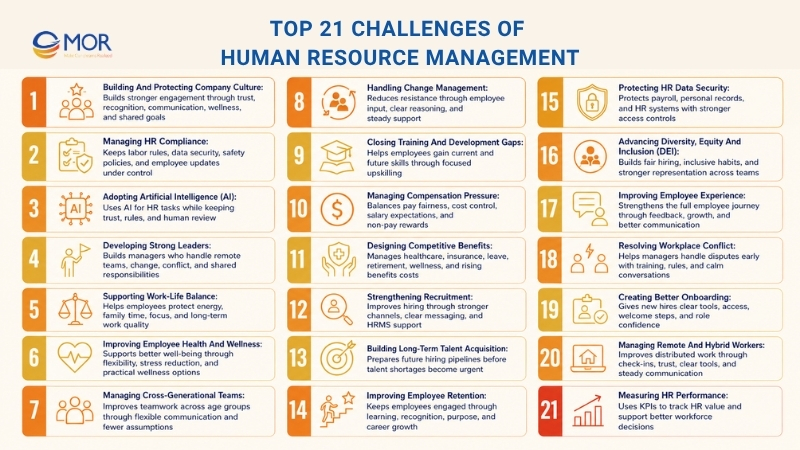
Top 21 Challenges Of Human Resource Management In 2026
HR teams can use their judgment, tools, and people skills to solve many challenges of human resource management and build stronger engagement, growth, satisfaction, and work quality. These human resource management challenges now touch almost every part of the employee journey.
Building And Protecting Company Culture
Many reports show that employees care deeply about workplace culture, sometimes more than a bigger paycheck. MIT Sloan found that a toxic culture can predict employee exits more than 10 times better than pay. Among the topics linked to turnover, including job security and poor handling of COVID-19, compensation ranked only 16th.
Remote and hybrid work have also changed how culture feels day to day. Many employees feel alone, cut off from the company, or less connected with their teams. Some office-based workers may also feel unfairly treated, and this can hurt teamwork and business results.
HR teams can still build a healthy workplace culture, no matter where people work. Useful steps include open talks between staff and managers, clear links between daily work and company goals, praise from leaders for strong work, team volunteer activities, and wellness support. These Organizational challenges in HRM need steady care, not one-time fixes.
Managing HR Compliance
Compliance has always mattered in HR, yet the rules have grown harder to manage. Remote work has made data privacy and security rules more urgent. To handle the challenges of human resource management in this area, HR teams need to work with IT, security staff, or outside experts to review risk and keep company data safe during remote access.
Rules about overtime, work hours, and labor law can also be harder to follow when people work away from the office. The Department of Labor Employment Law Guide can help employers answer common questions and stay on track. Companies with on-site staff, or those bringing workers back, also need clear safety rules after natural disasters and public health events.
HR must know the rules and share updates with employees often. Teams may also run training and create policy materials that make compliance part of daily work. These are common challenges faced in human resource management because one missed rule can create legal, financial, and trust problems.
Adopting Artificial Intelligence (AI)
Artificial Intelligence (AI) is entering many teams and industries, helping automate routine business tasks so employees can spend more time on useful, creative, and higher-value work. For HR leaders, the hard part is often employee resistance. Paychex reported that 98% of U.S. business and HR leaders expected to use AI for recruitment automation in 2024.
Multimodal AI models can also cut down HR admin work, which Paychex says takes more than 25% of the average work week. HR teams are using it to support career planning and skill growth (54%), shape better benefits to attract and keep talent (53%), and improve hiring and retention (50%). This makes AI one of the HR issues organizations face that needs trust, clear rules, and human review.
Developing Strong Leaders
A famous idea linked to football coach Vince Lombardi says some leaders are born, but many are built through effort. Good leadership training can improve almost every part of company performance. It can support output, revenue, profit, customer loyalty, employee engagement, hiring, retention, leadership alignment, brand trust, and more.
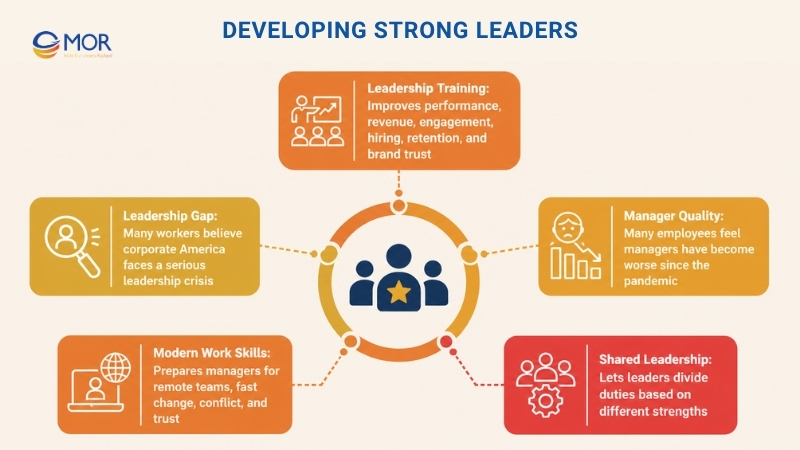
Still, many workers see a leadership gap. A November 2023 survey from U.S. News and The Harris Poll found that 77% of American adults believe corporate America faces a leadership crisis. In the same survey, 56% said managers have become worse than before the pandemic.
Companies can improve this with stronger leadership programs built for modern work. Managers now need skills for remote teams, fast change, conflict, and trust. Another useful tactic is shared leadership, where leaders with different strengths divide duties instead of trying to carry everything alone.
Supporting Work-Life Balance
The pandemic pushed work-life balance into the spotlight, and that focus is still here. Slightly more than two-thirds of companies now give employees flexible schedules. Among the challenges of modern HR platform requirements, balance is one of the most personal because it affects energy, family time, and long-term work quality.
Policy updates can help staff manage work and daily life better. HR can focus on output instead of hours at a desk, review workloads often, and keep demands realistic. HR should also encourage employees to use their vacation time, so people do not feel that long hours are the only path to praise.
Individual challenges in HRM often appear through stress, burnout, and poor boundaries. When companies treat rest as part of good work, employees are more likely to stay focused and healthy.
Improving Employee Health And Wellness
Employee health matters for people and for business results. When staff are unwell or worn out, their work can suffer, and company performance may drop. Gallup found that fewer than one-quarter of workers strongly believe their employers care about their well-being.
Many actions that support work-life balance also support mental and physical health. Flexible hours and part-time remote work can reduce stress for many employees. For on-site staff, standing desks, walking meetings, and healthy snacks can support wellness without a large budget.
Managing Cross-Generational Teams
Modern teams often include several age groups. That can be good because companies gain more ideas and problem-solving styles. Yet different generations may use technology differently, communicate in different ways, and hold different views about work-life balance. These gaps can create weak teamwork and poor communication.
HR can lower the risk of age-based confusion in several ways. One step is to avoid labels and assumptions. Not every older worker dislikes new HR case management tools, and not every younger worker expects too much from an employer. Another step is to use different channels, like email, text, calls, and chat tools, so employees receive messages in ways that work for them.
Teams should also mix people from different age groups. This can help staff learn from each other and bring wider thinking into daily work. The challenges of human resource management become easier to handle when age diversity is treated as a strength, not a problem.
Handling Change Management
Change can be tiring, especially for employees who have already faced several work disruptions. Gartner data shows this clearly: in 2022, only 38% of employees were willing to support company change, down from 74% in 2016.
Gartner also noted that old top-down change methods are part of the issue. Poor job design can make change harder too. Roles should match how work really happens, and heavy approval steps should be reviewed so the company can move with current needs. Technology can play a major part here and make daily work less frustrating.
HR can work with other teams to build a culture that accepts change with less fear. This means bringing employees into decisions and explaining why changes are happening. These challenges in human resource management require trust, plain language, and steady support.
Closing Training And Development Gaps
Most jobs now need more skills than before. HR can work with department leaders to find gaps and help employees build the skills they need for current and future roles. This is one of the challenges of human resource management that directly affects business growth.
Upskilling has become a major trend. It means helping current employees improve their skills so they can take on new duties or move into new roles. Online courses can make training easier to access and more affordable. Amazon and Gallup found that 71% of surveyed workers were very or extremely interested in training to upgrade their skills. A separate KPMG survey pointed to AI as one area where training still needs work.
Managing Compensation Pressure
Pay continues to rise, even with a tight labor market and salary freezes at some major companies. Reports from The Conference Board, Willis Towers Watson (WTW), and Robert Half show this trend. It makes sense because companies are trying to attract and keep workers as prices stay high, many employees keep changing jobs, and people still leave for better pay. Human resource development teams now face pressure around cost control, pay fairness, and clear pay practices, according to WTW.
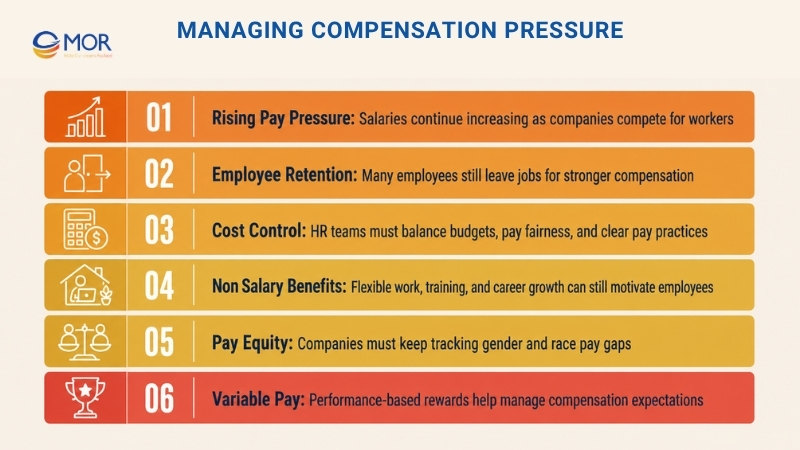
When salary increases are not possible, HR can still motivate employees in other ways. Flexible work, remote options, training, and career growth can carry real value. Companies will also keep paying attention to pay gaps across gender and race, along with more use of performance-based variable pay. These pay concerns are ongoing challenges of human resource management for many businesses.
Designing Competitive Benefits
Employees are not the only ones feeling higher healthcare costs. In the U.S., employer healthcare costs were expected to rise 8.5% in 2024, according to Aon. Companies still need to give workers competitive benefits, including healthcare, dental coverage, life insurance, retirement plans, parental leave, short-term disability insurance, and other perks. At the same time, they must watch their own costs.
Other benefit tools can also help companies of every size manage health-related spending. These include wellness programs, employee assistance programs, telemedicine, chronic condition care, prescription drug support, and health savings accounts. Among the challenges facing human resource management, benefits are tough because employees expect more while budgets stay under pressure.
Strengthening Recruitment
As companies plan for growth, they need a strong hiring strategy. One useful step is meeting candidates where they already spend time. That means using social platforms, job boards, and remote interviews through video tools.
HR teams also need a clear and steady employer message. Good communication tools can help, including a strong Human Resource Management System (HRMS). An HRMS can post open jobs to job boards, manage resumes, and track candidates. These recruiting tasks are common HR issues organizations face when hiring speed and candidate quality matter.
Building Long-Term Talent Acquisition
Recruitment focuses on filling open jobs now, but talent acquisition looks ahead to future staffing needs. One of the challenges facing human resource management is the long-term talent shortage. Korn Ferry estimates that this shortage could reach more than 85 million people by 2030 and leave up to $8.5 trillion in yearly revenue unrealized.
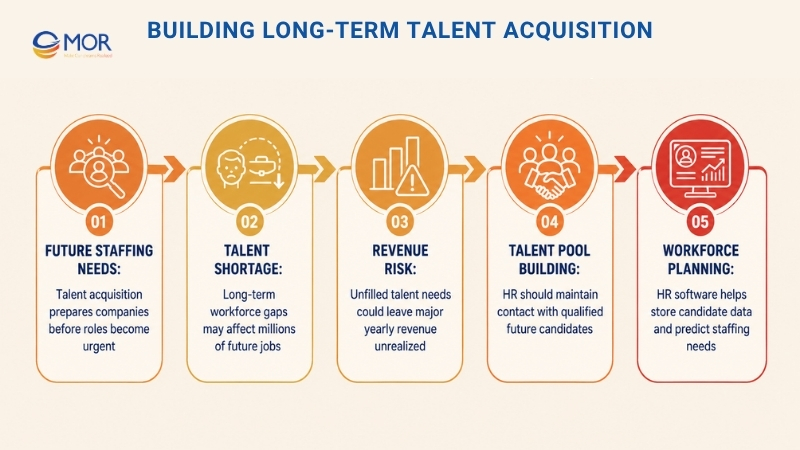
This shows why companies need a strong talent pool before roles become urgent. HR should keep in touch with qualified candidates who may fit future openings. Continuous performance management software that stores candidate data and predicts staffing needs can also help teams plan earlier.
Improving Employee Retention
Employees are spending less time with one company than they used to. At any moment, nearly three-quarters of workers are open to new roles, 29% are actively looking to move within the next six to 12 months, and 20% sometimes browse jobs when something interesting appears, according to Indeed’s 2024 Workforce Insights Report.
Most companies need stronger engagement to improve retention. The strongest drivers often include learning options, clear links between daily work and company goals, and praise for great work. These can be done without a huge budget. This is where human resource management challenges and solutions meet in a very practical way.
Retaining people is one of the challenges of human resource management that affects cost, morale, and team knowledge. When employees see a future inside the company, they are less likely to look elsewhere.
Protecting HR Data Security
IBM’s 2023 Cost of a Data Breach Report found that 95% of organizations had at least one data breach in 2023. The average cost reached a record $4.45 million per incident. Smaller companies with 5,000 or fewer employees carried much of the rising cost, and the most expensive breaches involved employee and customer personal data.
To lower cyber risk and cost, companies need to find the systems and assets most exposed to attack. Then they should give those areas stronger protection. HR can work with IT to create clear security rules and train employees on what those rules mean in daily work.
An HRMS or Human Capital Management (HCM) system can support security through role-based access and two-factor login. These workforce management difficulties are serious because HR holds sensitive employee records, payroll details, and personal information.
Advancing Diversity, Equity And Inclusion (DEI)
Three-quarters of 1,200 HR decision-makers said their companies planned to place more focus on diversity hiring in 2024, according to Jobvite’s 2023 Employ Recruiter Nation Report. Main focus areas included race and ethnicity (47%), gender (44%), age (36%), and LGBTQ+ representation (26%).
Companies know diversity and inclusion are not just about public image. They can also support stronger performance. McKinsey found that companies in the top quartile for racial and ethnic diversity are 39% more likely to beat bottom-quartile peers in financial results. Diverse teams can better reflect changing markets and bring wider life experience into decisions.
To improve DEI, companies should explain the value of these efforts to current employees and build fairer hiring practices. Fair access, clear hiring steps, and inclusive team habits help make DEI one of the challenges of human resource management that businesses can address with steady action.
Improving Employee Experience
A good employee experience means how workers view their daily interactions with the company. When that experience is positive, engagement can rise. Better engagement can then support output, sales, and other business results.
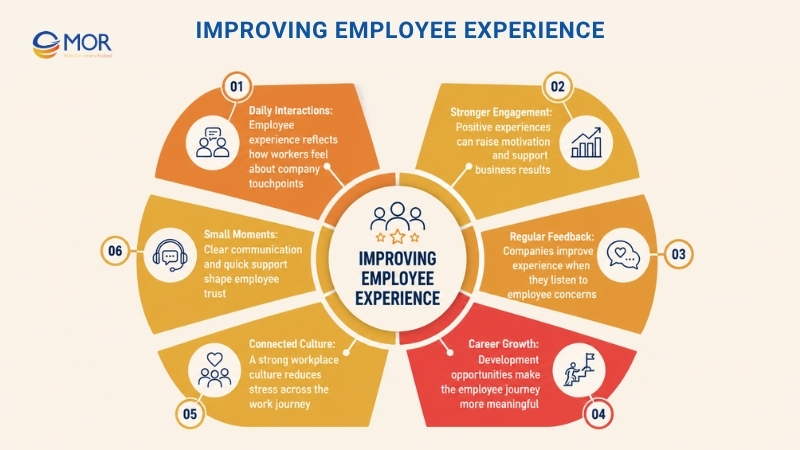
Companies can improve employee experience through regular feedback and real attention to what employees say. Career growth also matters. A strong culture can make the full employee journey feel more connected and less stressful.
This is one of the people management problems that touches every stage of work, from hiring to exit. Small moments, like clear communication or quick support, can shape how employees feel about the company.
Resolving Workplace Conflict
People do not always agree, so conflict is part of work. Disputes may involve business issues, like project goals or company priorities. They may also come from personal tension or outside topics that people bring into work, including politics and global events.
Gartner found that 57% of managers say they are responsible for handling workplace conflict. That duty needs training, not guesswork. Gartner also suggests coaching new managers and rewarding leaders who solve conflict well.
Conflict is one of the challenges of human resource management that can spread fast when managers avoid it. HR can help with clear rules, calm talks, and training that helps leaders step in before small issues grow.
Creating Better Onboarding
Companies with stronger employee onboarding programs tend to see better new hire engagement and stronger retention. A mature onboarding process helps employees understand the company faster and feel prepared for the role.
A few simple steps can help new employees feel welcome, even during virtual onboarding. A personal welcome message is a good start. The company should also make sure new hires have the right tools, devices, and access to do their work well. Branded items, like a company hoodie or water bottle, can help remote employees feel part of the team. HR software can also help organize and improve onboarding tasks.
Poor onboarding is one of the HR problems in 2026 that still costs companies time and talent. New hires need clear steps, not a messy first week.
Managing Remote And Hybrid Workers
In 2023, about 20% of the U.S. workforce worked on a hybrid or fully remote schedule, according to the Census Bureau. Reports still disagree about whether off-site employees are more or less productive than office workers. Still, there is no doubt that remote management creates difficulties, including tracking work output. Fewer face-to-face moments can also cause confusion, employees may spend more time searching for tools or information, and company culture can weaken.
HR teams can take practical steps to manage remote staff. Regular check-ins help, and so does using different channels, including email, chat, phone, and video meetings. Leaders who show trust and confidence can also calm fears during uncertain times.
For companies with workers across borders, remote work can create challenges of global human resource management. Time zones, labor rules, language, and culture all affect how teams work. These are also challenges of human resource management that require clear systems and steady communication.
Measuring HR Performance
HR teams need to show that their work adds value to the company. One way to do this is through workforce metrics and Key Performance Indicators (KPIs).
A good starting point is tracking absenteeism, hiring conversion rate, employee turnover, and employee satisfaction. HR teams should choose the KPIs that fit their company, collect the data, and compare results with industry standards and past company results.
Measuring results is one of the HR management challenges because people's work does not always show value right away. Still, good data helps HR move from guesswork to better decisions.
What Are The Latest Trends In HR Today?
HR is changing as companies deal with AI adoption, new employee needs, hybrid teams, and pressure to prove business value. The latest trends show one clear shift: HR is moving from admin support toward strategic people leadership. These trends also connect to the challenges of human resource management, especially as AI changes work, skills, and employee experience.
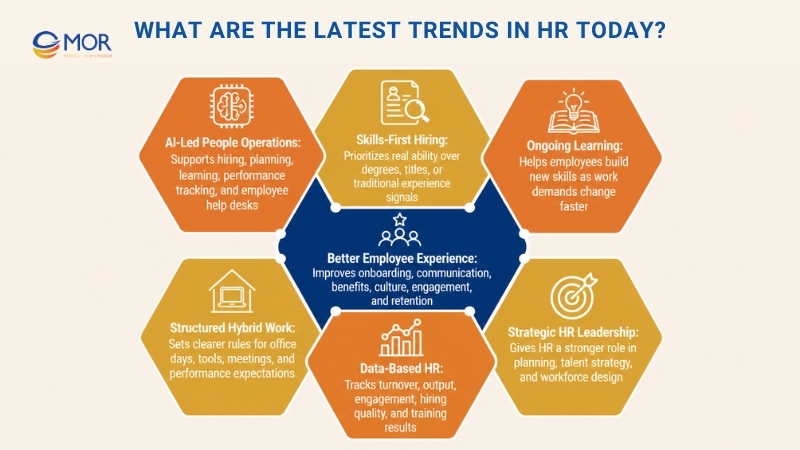
- AI-led people operations: AI now supports hiring, workforce planning, learning, performance tracking, and employee help desks. HR teams need clear rules so AI supports better decisions without removing human judgment.
- Skills-first hiring: Companies are looking more at real ability instead of only degrees or job titles. This helps them find stronger talent and close skill gaps faster.
- Ongoing learning: Employees need faster training because work keeps changing. Deloitte notes that AI can help workers learn and use new skills during daily tasks.
- Better employee experience: HR teams are improving onboarding, communication, flexible benefits, and workplace culture to raise engagement and retention.
- Structured hybrid work: Hybrid work is becoming more planned. Companies are setting clearer rules for office days, team meetings, work tools, and performance expectations.
- Data-based HR: HR leaders now use workforce data to track turnover, output, engagement, hiring quality, and training results. This helps leaders make choices based on evidence instead of gut feeling.
- Well-being and psychological safety: Gartner points to workforce strength and safety in the AI automation era as major HR priorities for 2026. HR needs to protect workers from stress, uncertainty, and skill loss.
- Strategic HR leadership: HR now has a bigger voice in business planning, change work, talent strategy, and long-term workforce design. These trends also connect to challenges of international human resource management and global human resource management challenges, especially for companies with teams across many markets.
Overcome Challenges Of Human Resource Management With MOR Software
The challenges of human resource management are easier to solve when HR teams have the right system behind them. MOR Software builds custom HRMS software solutions that help companies manage people, data, workflows, and daily HR tasks in one connected place.
We support businesses that need more than basic HR analysis tools. Our team can build HR software for recruitment, attendance, system payroll management, performance tracking, training, employee records, and internal communication. This helps HR teams spend less time on manual work and more time on people.
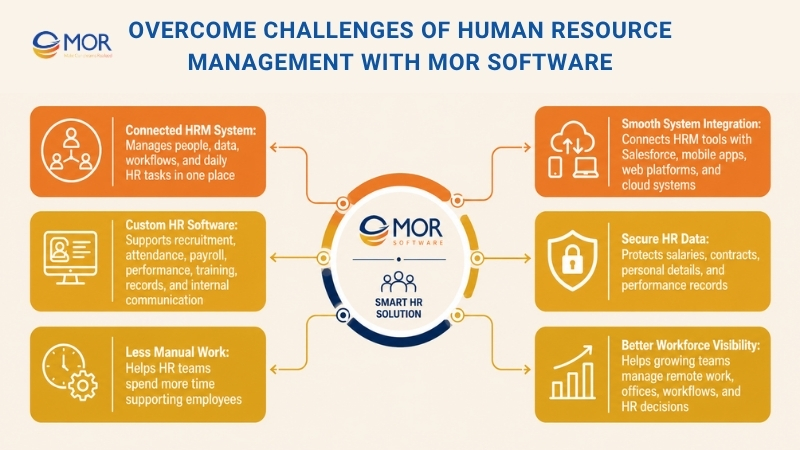
MOR Software also works with Salesforce, mobile apps, web platforms, cloud systems, and system integration. That means we can connect your HRM system with existing tools instead of forcing your team to change everything at once.
Security matters, too. HR data includes salaries, contracts, personal details, and performance records. We build systems with clear access control, stable infrastructure, and safe data handling.
For companies growing across offices or remote teams, a custom HRM solution can bring better visibility and smoother workflows. With MOR Software, HR teams can handle daily work faster, make decisions with cleaner data, and support employees with less friction.
Conclusion
The challenges of human resource management in 2026 show how much HR has changed. Culture, compliance, AI, hiring, retention, remote work, and workforce data now shape how companies grow and keep talent. Businesses need better systems, clearer processes, and smarter tools to manage these issues with less friction.
MOR Software helps companies build practical HRM solutions for recruitment, performance, training, payroll, and workforce management. Contact us to discuss your HR software needs.
MOR SOFTWARE
Frequently Asked Questions (FAQs)
What are the main challenges of human resource management?
The main challenges include hiring skilled people, keeping employees engaged, managing payroll, following labor laws, handling remote teams, protecting HR data, and building a strong company culture.
Why is HR management difficult for growing businesses?
As a business grows, HR teams handle more employees, more records, more rules, and more daily requests. Manual processes can slow everything down and cause mistakes.
How do HR teams deal with employee retention?
HR teams can support retention through fair pay, career growth, regular feedback, better communication, and recognition. Employees stay longer when they feel valued and see a future at work.
Why is compliance one of the biggest HR challenges?
Labor laws, tax rules, data privacy rules, and workplace policies change often. HR teams must keep records accurate and update employees when new rules affect them.
How does remote work create new HR problems?
Remote work can make communication, culture, productivity tracking, and onboarding harder. HR teams need clear rules, regular check-ins, and the right tools to support remote employees.
How can companies solve the challenges of human resource management?
Companies can use HR software, clear policies, better training, strong leadership, and employee feedback. The goal is to make HR work faster, cleaner, and more people-focused.
Why is employee experience important in HR?
Employee experience affects engagement, trust, and retention. A poor experience can lead to low morale, weaker performance, and higher turnover.
How does technology help with the challenges of human resource management?
Technology helps HR teams manage attendance, payroll, recruitment, performance reviews, training, and employee records. It also gives leaders cleaner data for better decisions.
What role does leadership play in HR success?
Managers shape daily employee experience. Good leaders communicate clearly, handle conflict well, support growth, and help teams stay aligned with company goals.
What is the future of HR management?
The future of HR will focus on AI tools, skills-based hiring, flexible work, workforce data, employee well-being, and stronger people strategy. These trends will change how companies handle the challenges of human resource management.
Share


Make Our-Dreams Realized


© 2023 . MOR Software. All Rights Reserved
Sitemap
Privacy Policy
Terms of Use

Rate this article
0
over 5.0 based on 0 reviews
Your rating on this news:
Name
*Email
*Write your comment
*Send your comment
1