


Data Analyst vs Data Scientist: What’s the Differences?
Choosing between data analyst vs data scientist roles can be confusing because each works with data, yet their outputs differ. Analysts explain business performance through reports and dashboards, while data scientists use statistics, programming, and machine learning to predict outcomes. In this guide, MOR Software will compare their daily work, skills, tools, education, salary, career paths, and fit for business teams.
Key Takeaways
- Data analysts focus on reports, KPIs, trends, and known business questions, while data scientists spend more time on predictive models and experiments.
- SQL, data cleaning, and communication matter across the two roles, but data scientists usually need deeper Python, statistics, probability, and machine learning skills.
- Companies may need analysts, scientists, and data engineers together once reporting grows into predictive systems supported by reliable data pipelines.
Data Analyst vs Data Scientist: Quick Comparison
The quickest way to understand data analyst vs data scientist is to compare what each person produces. A data analyst turns existing business data into answers. A data scientist uses historical data to build predictions, experiments, or models that work on new data.
The same distinction sits behind a data scientist vs data analyst comparison. Demand around these skills keeps growing too. The World Economic Forum reports that 94% of U.S. employers expect AI and information-processing technologies to change their operations by 2030, with Big Data Specialists and AI and Machine Learning Specialists among the country's fastest-growing roles.
Comparison Area | Data Analyst | Data Scientist |
Primary goal | Explain performance and find useful business findings | Predict outcomes and solve complex data problems |
Main questions | What happened? Why did it happen? | What may happen later? What should improve? |
Typical outputs | Reports, dashboards, KPI analysis | Models, experiments, predictions |
Data | Mainly structured business data | Structured and unstructured data |
Statistics | Descriptive and applied statistics | Higher-level statistics and probability |
Programming | SQL, spreadsheets, Python or R depending on role | Python or R, SQL, ML libraries |
Machine learning | Limited or role-dependent | Common in many roles |
Business interaction | Frequent stakeholder reporting | Product, engineering, research, and business collaboration |
Technical depth | Moderate | Generally deeper |
Common progression | Senior analyst, BI analyst, analytics manager | Senior data scientist, ML or AI-focused roles |
The IBM data analyst vs data scientist difference follows a similar output split: analysts interpret existing data, while scientists often create models that forecast or classify. A business analyst vs data scientist comparison is different because business analysts usually focus more on requirements, processes, and stakeholder needs than statistical modeling.
What Does a Data Analyst Do?
In data analyst vs data scientist teams, the analyst usually works closer to recurring business questions. Their work starts with usable data and ends with an answer that managers, marketers, finance teams, or operations staff can apply.
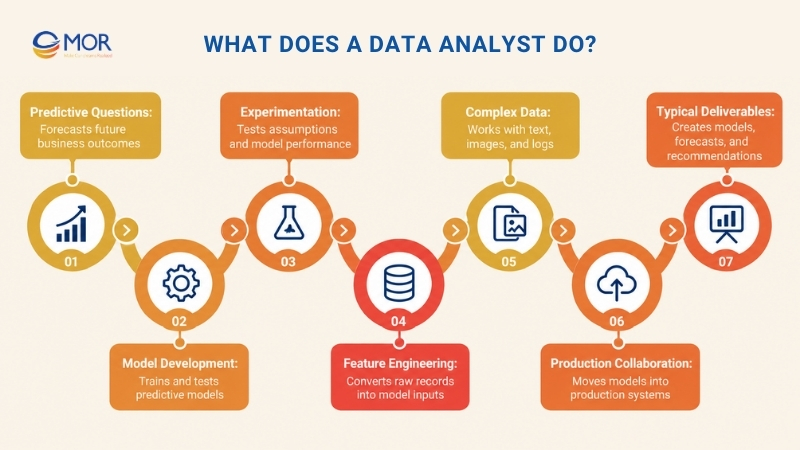
- Business questions: Analysts study what happened, why a KPI moved, and where performance changed across products, locations, customer groups, or time periods.
- Data preparation: They collect, clean, organize, validate, and query records before analysis starts.
- Reporting: Dashboards and recurring reports track sales, costs, retention, inventory, conversion, and other business metrics. Strong data integration in business intelligence keeps those reports connected to reliable source systems.
- Visualization: Tableau, Microsoft Power BI, and spreadsheets turn dense datasets into charts that business teams can read quickly.
- Decision support: Analysts translate patterns into recommendations. HR teams, for instance, can use HR analytics tools to study turnover, recruitment, attendance, or workforce performance.
- Typical deliverables: Common outputs include KPI dashboards, sales reports, ad hoc analysis, cohort analysis, presentations, and short-range projections.
Take a retail company with falling conversion rates across several regions. Its analyst could compare traffic, product availability, promotion periods, order value, and checkout data to locate where performance started to slip.
What Does a Data Scientist Do?
The data scientist side of data analyst vs data scientist work starts when a problem calls for prediction, classification, experimentation, or a model that learns from past records. The role carries more programming and mathematical depth because the result often needs to work on future data.
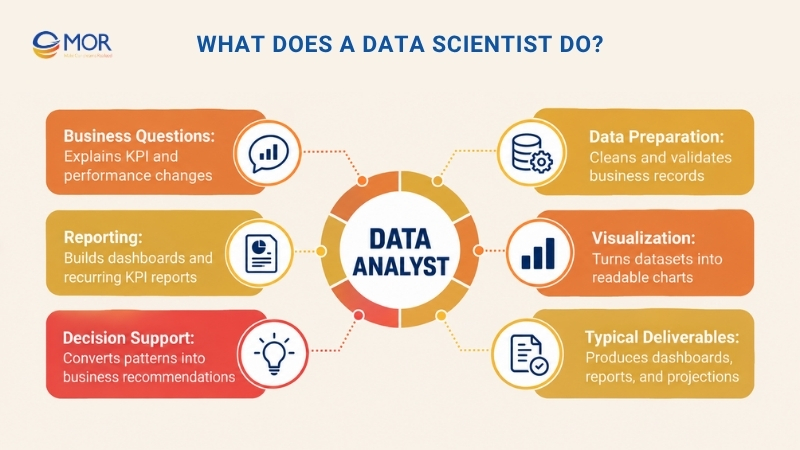
- Predictive questions: Data scientists estimate demand, churn, fraud risk, customer response, equipment failure, or other future outcomes. Many projects connect directly to predictive analytics use cases.
- Model development: They select algorithms, train models, compare results, tune parameters, and test performance on unseen records.
- Experimentation: Scientists test assumptions, compare model versions, and measure relationships between variables and outcomes.
- Feature engineering: Dates, categories, text, transactions, and behavioral records need to be converted into useful model inputs.
- Complex data: Text, images, sensor records, application logs, and large event datasets may become part of the work.
- Production collaboration: Scientists often work with data engineers, software developers, and machine learning engineers to move models into production systems.
- Typical deliverables: Outputs may include predictive models, recommendation systems, forecasts, classifications, experiments, and automated scores.
Return to the retail example. Instead of explaining why sales fell last quarter, a data scientist could predict demand by product and region. Understanding machine learning vs AI also keeps predictive modeling separate from the wider AI category.
Skills and Tools: Where the Two Roles Differ
The skill gap in data analyst vs data scientist roles is real, but it isn't a hard wall. SQL, data cleaning, visualization, and business thinking cross over often. The largest differences appear in statistics, programming depth, machine learning, and model production.
Python's growth reflects that technical shift. Stack Overflow's 2025 Developer Survey reported a 7 percentage point increase in Python adoption from 2024 to 2025, linking the rise to AI, data science, and back-end development.
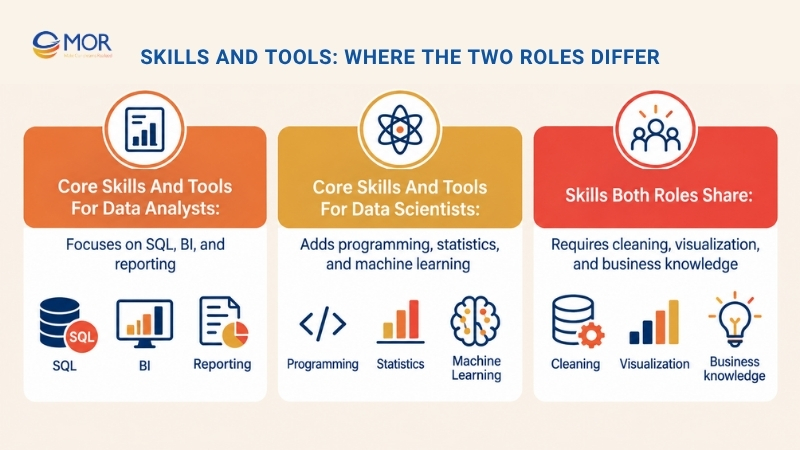
Core Skills and Tools for Data Analysts
Analysts spend much of their time querying, checking, summarizing, and presenting business data. Their toolset supports fast investigation and readable reporting.
- SQL and databases: SQL retrieves, joins, filters, and groups records stored in relational databases.
- Excel and spreadsheets: Spreadsheets remain useful for calculations, pivot tables, quick checks, and smaller datasets.
- BI tools: Tableau and Microsoft Power BI support dashboards, interactive reports, and KPI tracking.
- Data cleaning: Analysts fix missing values, duplicate records, inconsistent labels, and formatting problems.
- Statistics: Descriptive statistics, correlation, distributions, sampling, and basic tests support common analyst work.
- Communication: Analysts need to explain findings to people who may never open SQL or Python.
A data analyst vs data engineer vs data scientist comparison becomes useful here. Analysts interpret prepared data, data engineers build the systems that move it, and data scientists use those foundations for predictive modeling.
Core Skills and Tools for Data Scientists
Data scientists need more programming and mathematical depth because their models must be trained, tested, and sometimes connected to live software.
- Python or R: Python appears across many ML workflows, while R remains common in statistics-heavy projects.
- SQL: Scientists still need SQL to retrieve and shape training data.
- Statistics and probability: Regression, distributions, testing, sampling, and probability guide model choices.
- Machine learning: Classification, regression, clustering, recommendation methods, and model evaluation appear across many roles.
- ML libraries: pandas, NumPy, scikit-learn, PyTorch, and TensorFlow support data processing and modeling.
- Cloud and distributed tools: Large datasets may require managed notebooks, cloud storage, distributed processing, or dedicated compute resources.
The ideas behind Google Cloud data science vs data analytics and Oracle data science vs data analytics still lead to a familiar split: analytics monitors and explains business data, while data science adds model-driven predictions and experiments. Teams can also compare AI vs machine learning vs deep learning when deciding which technical layer a project actually needs.
Skills Both Roles Share
Job titles vary between companies, so overlap can be substantial. One senior analyst may write Python daily, while a data scientist in another company may spend a large share of the week querying SQL tables.
- Data access: Each role needs dependable access to databases, APIs, files, or data warehouses.
- Data cleaning: Bad input data damages dashboards and models alike.
- Exploratory analysis: Analysts and scientists inspect trends, gaps, distributions, and unusual records.
- Visualization: Charts support reporting, exploratory work, and model explanation.
- Business knowledge: Technical work needs to answer a real operational or commercial question.
- Data storytelling: Stakeholders still need a clear answer after the technical work ends.
A data engineer vs data scientist vs data analyst team works best when ownership stays clear. Someone builds the data path, someone turns records into business findings, and someone handles predictive modeling when the problem requires it.
Education and Experience Requirements for Data Analysts vs Data Scientists
Education shows another clear difference between the roles. Analyst positions often accept a wider mix of business, economics, statistics, and technical backgrounds, while data science jobs commonly ask for stronger mathematics, programming, or previous technical work.
Formal degrees still appear in job descriptions, but practical work counts too. A solid SQL project, dashboard, experiment, or trained model gives an employer direct evidence of what you can do.
Requirement | Data Analyst | Data Scientist |
Common academic background | Business, economics, statistics, computer science, STEM | Computer science, statistics, mathematics, engineering, data science |
Mathematics | Foundational statistics | Deeper statistics, probability, linear algebra |
Programming | SQL is common; Python or R depends on the role | Strong Python or R plus SQL |
Machine learning | Usually optional | Frequently requested |
Portfolio | Dashboards, SQL projects, business analysis | Modeling, experiments, ML projects |
Previous experience | Entry routes can be broader | Often benefits from analytics, engineering, research, or technical work |
The Coursera data science vs data analytics difference reflects a similar learning path. Analytics study often starts with spreadsheets, SQL, visualization, and business questions, then data science moves further into programming, statistics, and ML.
People planning that move can use the best machine learning courses to build the missing technical layer. A data scientist vs data engineer vs data analyst career decision should still begin with the daily work you want, since pipelines, reporting, and predictive models rely on different strengths.
Salary and Job Outlook for Data Analysts vs Data Scientists
Pay adds another practical layer to data analyst vs data scientist decisions. Data science salaries often run higher because many jobs ask for deeper programming, statistics, and machine learning skills, but industry, location, company size, and experience can change the final number sharply.
Salary.com's September 1, 2026 data lists a U.S. average of $97,717 for data analysts and $118,415 for data scientists. Senior-level averages also rise to $120,410 and $134,102, respectively.
Metric | Data Analyst | Data Scientist |
Current U.S. average salary | $97,717/year | $118,415/year |
Entry-level salary | $63,420 to $75,312/year | $68,862 to $81,011/year |
Senior level, 5 to 8 years | $120,410/year | $134,102/year |
Expert level, 8+ years | $156,138/year | $179,830/year |
Job outlook | +12% from 2025 to 2035* | +35% from 2025 to 2035 |
Major salary drivers | Location, industry, experience, SQL/BI skills, company size | Location, industry, experience, ML depth, technical scope, company size |
The U.S. Bureau of Labor Statistics projects 35% employment growth for data scientists from 2025 to 2035, with about 24,800 openings per year. BLS doesn't maintain one occupation called "Data Analyst," so the analyst-side table uses Operations Research Analysts as a related analytical occupation, where employment is projected to grow 12%, with about 7,500 openings per year.
Salary estimates and government labor data measure different things. BLS, for example, reports a 2025 median annual wage of $120,230 for data scientists and $88,940 for Operations Research Analysts.
Career Paths and How the Roles Progress
Career progression varies by industry and employer. Team structure can change titles quickly, so it makes more sense to track ownership and technical depth rather than assume every company follows one fixed ladder.
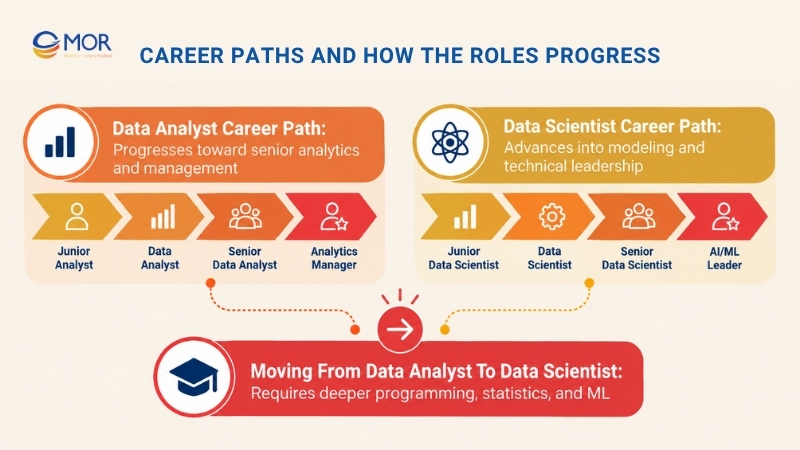
Data Analyst Career Path
Analysts can stay close to BI and reporting or move toward product analytics, management, engineering, or data science.
- Junior analyst: Works on cleaning, recurring reports, spreadsheets, and basic SQL.
- Data analyst: Owns KPI analysis, business questions, dashboards, and stakeholder requests.
- Senior data analyst: Handles harder analysis, mentors teammates, and helps define metrics.
- BI or analytics specialist: Focuses on reporting systems, dashboard design, and business intelligence.
- Analytics lead or manager: Sets priorities and connects business teams with analytical work.
The data scientists vs data analyst boundary becomes less tidy at senior levels. Experienced analysts may own complex experiments, while senior scientists may spend more time on technical direction and cross-team decisions.
Data Scientist Career Path
Data scientists usually deepen their work in modeling, experiments, applied AI, or technical leadership.
- Junior data scientist: Supports exploratory analysis, baseline models, and data preparation.
- Data scientist: Owns model development, testing, and analysis for defined use cases.
- Senior data scientist: Solves harder model problems and guides technical choices.
- Lead or principal data scientist: Shapes model strategy and reviews work across larger programs.
- Specialist path: A scientist may focus on NLP, computer vision, recommendation systems, experimentation, or ML engineering.
Companies also need to separate science from infrastructure. The data engineer vs data analyst vs data scientist model places pipeline ownership, analytical interpretation, and predictive work into distinct areas.
Moving From Data Analyst to Data Scientist
The transition is realistic because analysts already build experience in SQL, cleaning, visualization, and business reasoning. The main gaps are usually stronger programming, statistics, ML, and end-to-end model work.
- Strengthen Python or R: Move beyond short scripts into repeatable analytical and modeling workflows.
- Build statistics depth: Study probability, inference, regression, sampling, and model evaluation.
- Learn ML fundamentals: Understand the difference between machine learning and AI before moving into deeper model work.
- Practice evaluation: Learn validation, error metrics, overfitting, data leakage, and baseline comparison.
- Build complete projects: Connect raw data, cleaning, training, testing, and a usable output.
- Study production systems: Pipelines, APIs, cloud tools, and deployment make the move more practical.
A data scientist vs data engineer vs data analyst comparison can also prevent a wrong career turn. If building pipelines interests you more than training models, data engineering may fit better.
Data Analysts vs Data Scientists: Which Role Fits Your Business Better?
For a company, data analyst vs data scientist should begin as a problem-definition question before it becomes a hiring decision. Reports, forecasts, ML models, and production data systems solve different needs, so a strong hire can still struggle when the role doesn't match the work.
McKinsey's 2025 State of AI survey found that 88% of organizations regularly use AI in at least one business function, yet only about one-third report scaling AI across the enterprise. That gap puts more pressure on data quality, technical ownership, engineering, and delivery processes.
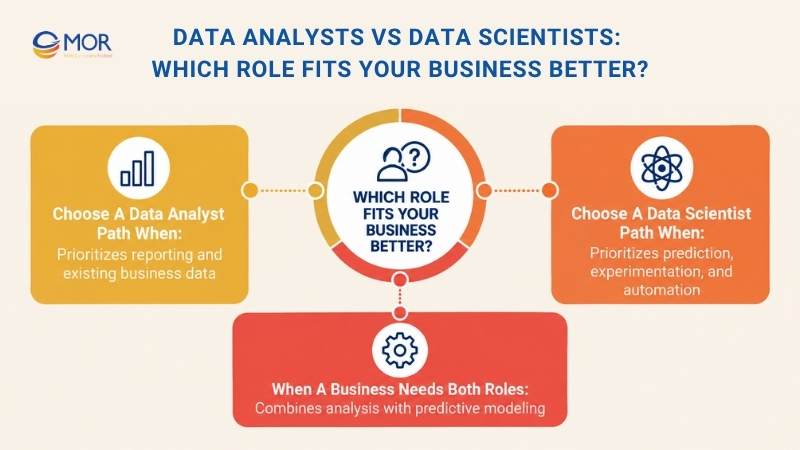
Choose a Data Analyst Path When
A data analyst fits teams that need clearer reporting and stronger decisions based on data they already collect.
- Defined questions: You need answers about sales, retention, marketing, inventory, costs, or customer behavior.
- Reporting demand: Managers need dashboards and recurring KPI reports they can read quickly.
- Stakeholder contact: The role will translate business requests into analysis and explain the result.
- Low ML demand: The immediate problem doesn't require prediction or automated model scoring.
For hiring plans, data analyst vs data scientist vs data engineer helps separate the needs. If your source data already reaches a clean warehouse, an analyst may solve the current problem faster than a modeling hire.
Choose a Data Scientist Path When
Data science fits problems where prediction, recommendation, experimentation, or model-based automation sits at the center.
- Predictive work: You need forecasts, churn scores, risk models, recommendations, or classifications.
- Programming depth: The employee will spend substantial time in Python or R.
- Statistical depth: Experiments, uncertainty, testing, and model validation appear regularly.
- Open problems: The person needs room to test assumptions and turn a broad business need into a measurable modeling task.
Production ML may also require engineering skills beyond the scientist role. Knowing what a machine learning engineer does helps companies assign model development and production software work to the right people.
When a Business Needs Both Roles
Growing data teams often need analysts and scientists together. Analysts expose patterns and performance gaps, then scientists turn suitable questions into forecasts, classifications, or decision models.
Data engineers support that work through ETL jobs, warehouses, ingestion services, and data pipelines. The data engineer vs data analyst vs data scientist split maps a common flow: prepare the data, interpret what happened, then model future outcomes where prediction has business value.
Build Production-Ready Data and AI Systems With MOR Software
Knowing data analyst vs data scientist responsibilities helps you choose talent, but production systems also need data engineering, integration, testing, deployment, and software development. A model sitting in a notebook has limited business use until it connects to dependable data and a working application.
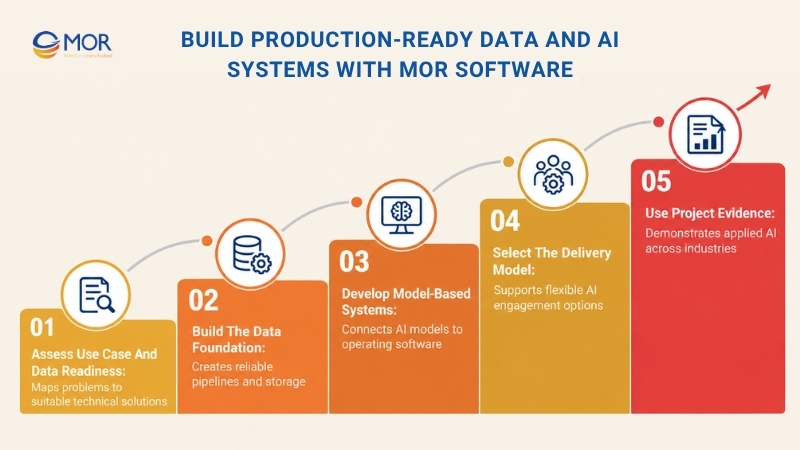
At MOR Software, we support that technical layer through AI and software engineering services tied to business requirements.
- Assess the use case and data readiness: Our AI service portfolio includes Feasibility Assessment. This stage helps map the business problem to analytics, data engineering, automation, or custom model work.
- Build the data foundation: Data Engineering is part of our AI service set. Reliable pipelines and storage support reporting, training datasets, and downstream applications.
- Develop model-based systems: Our capabilities include Custom Model Service and Generative AI Integration, plus edge and cloud deployment for projects that need AI connected to operating software.
- Select the delivery model: MOR Software JSC supports Staff Augmentation, Fixed-Price Model, and Dedicated Team engagements for AI work. Our wider software services also include project-based and Offshore Development Center delivery.
- Use project evidence: MOR materials document an AI-Powered Semantic Search Transformation project and an AI Person Counter & Demographic Detection project. Our listed industry coverage includes Finance and Banking, Manufacturing, Human Resource Management, and Food and Beverage.
A data analyst vs data engineer vs data scientist decision can reveal which skills belong inside your company and which engineering work needs outside support. If you need to turn data into an integrated AI or software system, contact MOR Software to discuss your data readiness, technical roles, and delivery model.
Conclusion
The data analyst vs data scientist choice depends on the problem, modeling depth, and data foundation already in place. Strong teams often connect data analytics and science with engineering rather than treat each role as isolated.
MOR Software supports that work through data engineering, custom AI models, integration, and flexible development teams. Contact us to map the right roles and technical setup for your project.
"Evolution is not a destination, it is a disciplined journey of innovation."
Phung Van Tu


CEO MOR AI
MOR SOFTWARE
Frequently Asked Questions (FAQs)
What is the main difference between a data analyst and a data scientist?
A data analyst usually explains existing business data through reports, dashboards, trends, and KPI analysis. A data scientist works more with prediction, experiments, statistics, and machine learning models. SQL, cleaning, visualization, and business reasoning overlap, but scientist roles usually require more programming and mathematics.
Is a data scientist higher than a data analyst?
No universal hierarchy puts one role above the other. A senior analyst may own major business decisions, while a junior scientist may carry less organizational responsibility. Compare job scope, technical depth, ownership, and seniority rather than assuming that the word 'scientist' automatically means a higher position.
Can a data analyst become a data scientist?
Yes. Analysts already gain useful experience in SQL, data cleaning, visualization, and business analysis. The move usually requires stronger Python or R, probability, statistics, machine learning, and model evaluation. Building complete model projects can prove those new skills to employers.
Which role uses more Python, a data analyst or data scientist?
Data scientists generally use Python more often because training models, running experiments, and processing data rely heavily on code. Analysts may use Python for cleaning, automation, or deeper analysis, but many analyst roles spend more time in SQL, spreadsheets, Tableau, or Power BI.
Do data analysts need machine learning skills?
Many analyst jobs don't require machine learning. SQL, spreadsheets, BI tools, descriptive statistics, cleaning, and communication usually come first. ML becomes more useful in predictive analytics, product analytics, or jobs close to data science, especially when an analyst plans to move into modeling later.
Which role requires more mathematics?
Data science usually requires more mathematics. Probability, statistical inference, regression, model evaluation, and linear algebra appear more often in scientist work. Analysts still use statistics, but daily work is often closer to descriptive analysis, rates, trends, distributions, sampling, and business metrics.
Is data analysis easier to learn than data science?
Data analysis often has a shorter entry path because learners can begin with spreadsheets, SQL, BI tools, and descriptive statistics. Data science adds deeper programming, statistics, machine learning, and model testing. Senior analyst work can still become highly complex, especially across large business datasets.
Do data analysts and data scientists use SQL?
Yes. SQL appears across many analyst and scientist jobs because business data often sits in relational databases or warehouses. Analysts use it heavily for reporting and investigation. Scientists use SQL to build training datasets, check inputs, study model results, and prepare records for experiments.
Can a company need both data analysts and data scientists?
Yes. Analysts can monitor performance and find business patterns, while scientists create predictive models for suitable problems. Data engineers and software developers may join the same team when data needs to move reliably between source systems, models, applications, and production services.
What should a business hire first, a data analyst or a data scientist?
Start with the problem. A company lacking reliable reporting, KPI definitions, and regular analysis will usually gain more immediate value from an analyst. If clean historical data already exists and the goal involves prediction, recommendation, experimentation, or model-based automation, a scientist may fit better.
Share


Make Our-Dreams Realized


© 2023 . MOR Software. All Rights Reserved
Sitemap
Privacy Policy
Terms of Use

Rate this article
0
over 5.0 based on 0 reviews
Your rating on this news:
Name
*Email
*Write your comment
*Send your comment
1