


Data Warehouse Consulting Services: Complete Guide for 2026
Data warehouse consulting services help businesses turn disconnected data into reliable reporting systems, modernize legacy infrastructure, and manage growing cloud costs. Experienced consultants assess existing data sources, design warehouse architecture, and build pipelines that support business intelligence and AI. But choosing the right service takes more than picking a cloud platform. In this guide, MOR Software will cover the main services, business benefits, supported technologies, consulting providers, pricing models, and use cases for 2026.
Key Takeaways
- Data warehouse consulting covers architecture planning, cloud migration, ETL/ELT development, performance tuning, governance, and business intelligence integration.
- Snowflake, Google BigQuery, Amazon Redshift, Microsoft Fabric, Databricks, and Azure Synapse support different workloads, budgets, and technical requirements.
- The right consulting partner should have proven project experience, clear deliverables, strong data security practices, and a pricing model that fits your business.
What Are Data Warehouse Consulting Services?
Data warehouse consulting services provide expert support for planning, designing, building, migrating, and improving enterprise data warehouses. Consultants assess your current systems, identify gaps in data management, and create an architecture that supports accurate reporting and long-term growth.
These engagements may cover strategic advice, technical development, or ongoing system management. The scope depends on your data sources, existing infrastructure, and business goals.
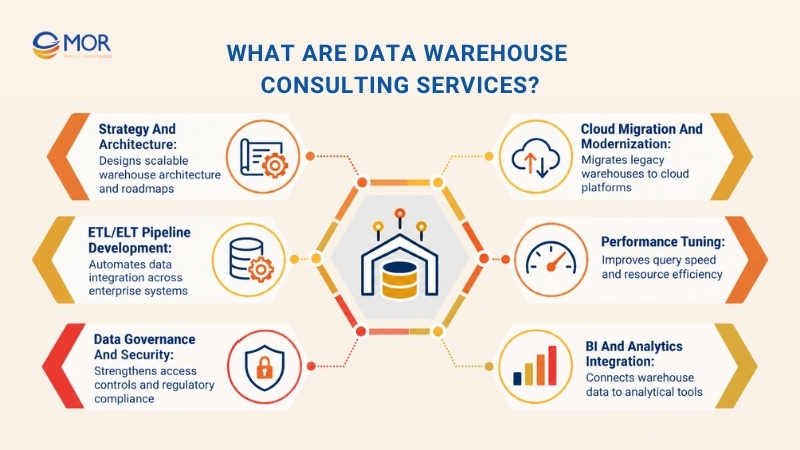
The six main services include:
- Strategy and architecture: Consultants assess existing databases, reporting needs, and data flows before designing warehouse architecture. They select suitable platforms, define data models, and create a roadmap that accounts for future storage and processing needs.
- Cloud migration and modernization: Teams move legacy warehouses from on-premises systems to Snowflake, BigQuery, Redshift, or other cloud platforms. They also update old schemas and pipelines, validate migrated records, and plan a controlled cutover to limit downtime.
- ETL/ELT pipeline development: Engineers build automated workflows that collect and process data across ERP systems, CRM platforms, databases, APIs, and third-party applications. Tools like dbt, Apache Airflow, AWS Glue, and Azure Data Factory support reliable data movement.
- Performance tuning: Specialists review slow queries, database structures, partitioning, and compute workloads. They adjust the warehouse design to improve processing speed and keep infrastructure spending under control.
- Data governance and security: Consultants establish access permissions, encryption, data quality rules, audit logs, and lineage tracking. These controls support applicable requirements under GDPR, HIPAA, and internal security policies. Our guide to cloud data governance covers this area in greater detail.
- BI and analytics integration: Data engineers connect warehouse datasets to Power BI, Tableau, Looker, and other reporting tools. They also prepare structured information for forecasting, machine learning, and AI applications.
For businesses managing many disconnected systems, business intelligence solution integration helps establish consistent data flows between operational applications and analytical reports.
Why Are Data Warehouse Consulting Services Important in 2026?
Enterprise data has become harder to manage as organizations adopt more cloud applications, AI automation tools, and analytics systems. Data warehouse consulting services address the architecture and data quality issues that often stand between these investments and useful business results.
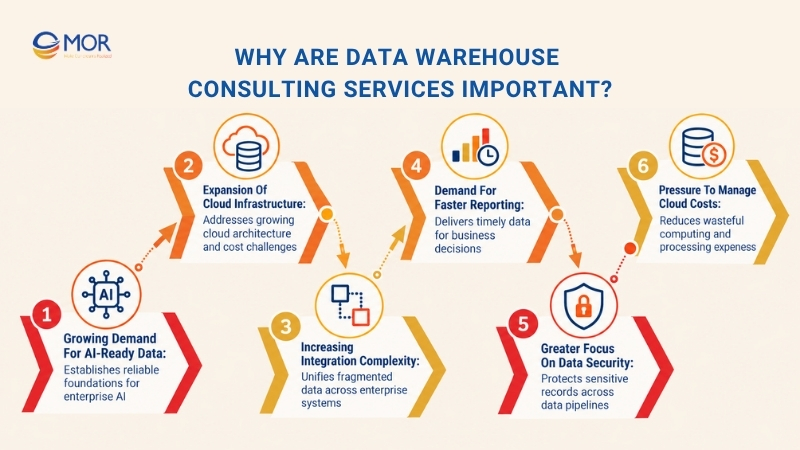
Several developments explain the growing need for specialized support.
- Growing demand for AI-ready data: McKinsey's 2025 State of AI research found that 88% of respondents reported AI use in at least one business function. Yet only 7% said their organizations had fully scaled AI. Reliable data pipelines, shared business definitions, and controlled access are among the requirements for moving AI projects into regular operations.
- Expansion of cloud infrastructure: Gartner forecasts worldwide Infrastructure as a Service spending of $287 billion in 2026, growing 29.3% over 2025. This wider cloud investment creates new decisions around workload placement, capacity, architecture, and operating expenses.
- Increasing integration complexity: Enterprise records now sit across Salesforce, SAP, Microsoft Dynamics 365, finance systems, and custom applications. Without consistent data models, different departments may calculate the same business metric differently.
- Demand for faster reporting: Finance teams need timely revenue figures, retailers track inventory across channels, and logistics firms monitor delivery performance. Consultants design structured datasets and refresh schedules that match how quickly each department needs information.
- Greater focus on data security: Sensitive records travel through ingestion pipelines, warehouse layers, and analytical tools. Companies need stronger access controls, traceable data movement, and clear retention rules.
- Pressure to manage cloud costs: Poorly configured compute clusters, full-table scans, and unused workloads can create spending that doesn't match business value. Consulting teams identify these problems through workload analysis and cost monitoring.
These requirements also affect AI projects. Businesses planning an enterprise AI platform need trustworthy data sources and consistent definitions before connecting enterprise information to production AI systems.
Common Platforms Supported by Data Warehouse Consulting Services
Choosing a warehouse platform starts with your data volume, analytical workloads, cloud environment, and internal engineering skills. Providers of cloud data warehouse consulting services assess these requirements before recommending a technical stack.
Each platform has different strengths and cost considerations.
Platform | Main strength | Best for | Key consideration |
Snowflake | Independent compute scaling, SQL analytics, and data sharing | Enterprise BI and analytical workloads | Compute credit management |
Google BigQuery | Serverless SQL analytics and Google Cloud integration | Large datasets and GCP-based businesses | Query and capacity costs |
Amazon Redshift | AWS-native warehousing and integration | Organizations using AWS infrastructure | Cluster sizing and workload planning |
Microsoft Fabric | Unified data services and Power BI integration | Microsoft-focused organizations | Shared capacity usage |
Databricks | Lakehouse architecture, data engineering, and machine learning | Combined analytics and ML workloads | Engineering requirements |
Azure Synapse Analytics | Azure-based analytical processing | Existing Synapse deployments | Long-term platform roadmap |
Snowflake suits teams that want managed SQL analytics and flexible compute resources. Google BigQuery works well for serverless analytics, and Amazon Redshift often fits companies already invested in AWS services.
Microsoft Fabric connects warehouse workloads with OneLake and Power BI. For businesses evaluating Microsoft data warehouse consulting services, common priorities include capacity planning, data access, and migration from existing Azure systems.
Databricks is another option when the same data platform must support analytical queries, large-scale processing, and machine learning. Teams with mixed on-premises and cloud systems may also need a hybrid cloud strategy before selecting their warehouse architecture.
The best platform depends on actual workloads. Experienced consultants test query performance, integration compatibility, security controls, and expected operating costs before committing to an implementation.
A big data analytics platform may also be part of the target architecture when an organization processes high-volume events, unstructured records, or streaming data alongside standard BI workloads.
Benefits of Hiring Data Warehouse Consulting Services
Data warehouse consulting services give companies access to specialized skills and structured delivery practices. Their value becomes easier to measure when projects target clear problems in reporting, data quality, performance, or infrastructure spending.
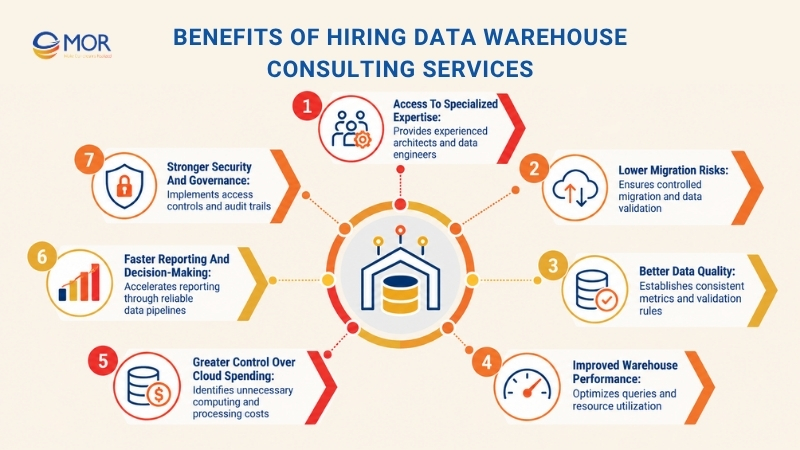
The main benefits include:
- Access to specialized expertise: Experienced architects and data engineers understand warehouse modeling, ETL/ELT tools, cloud infrastructure, and data governance. Your business gains access to these skills without recruiting a separate specialist for every technical area.
- Lower migration risks: A consulting team maps dependencies, tests converted records, and defines rollback conditions before moving production workloads. This is valuable when legacy systems support financial reporting or daily operations.
- Better data quality: Consultants establish validation rules, common business definitions, and tested transformation logic. Finance, sales, and operations teams can work with the same approved metrics.
- Improved warehouse performance: Data engineers identify inefficient queries, excessive scans, and resource bottlenecks. Better partitioning, workload separation, and data modeling help systems handle growing analytical demand.
- Greater control over cloud spending: Flexera's 2026 State of the Cloud Report estimates wasted cloud spending at 29%. Warehouse consultants can assess idle compute, inefficient query patterns, and unnecessary data processing, then track savings against actual usage.
- Faster reporting and decision-making: Reliable ingestion pipelines and BI-ready datasets shorten the time needed to prepare reports. Business teams spend less effort reconciling spreadsheets or correcting conflicting figures.
- Stronger security and governance: Consultants design access permissions, audit trails, and data protection controls around operational needs. IBM's 2025 Cost of a Data Breach Report placed the global average breach cost at $4.44 million, reinforcing the financial importance of enterprise security.
- Long-term technical support: Documentation, monitoring, and knowledge transfer make the warehouse easier to maintain as new data sources and reporting requirements appear.
Companies seeking end-to-end data warehouse consulting services should confirm that the contract covers the required advisory, engineering, testing, and support stages.
Measure those benefits through agreed KPIs. Useful metrics include query response time, data freshness, failed pipeline runs, reporting accuracy, and monthly warehouse spending.
How to Choose the Right Data Warehouse Consulting Services
The right provider depends on the problem your business needs to solve. A company planning its first warehouse has different requirements from an enterprise migrating years of financial records or fixing high cloud bills.
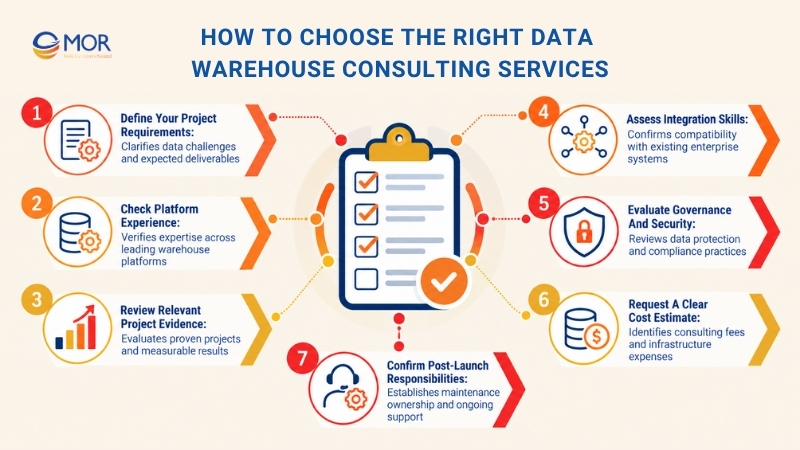
Start with the work you need completed, then examine the provider's technical ability and delivery approach.
- Define your project requirements: Identify the sources, reporting problems, target users, and expected results. Determine if you need architecture advice, implementation, migration, performance tuning, or long-term support.
- Check platform experience: Ask about completed work with Snowflake, BigQuery, Redshift, Databricks, and Microsoft Fabric. The best cloud data warehouse consulting services should base platform recommendations on your workload rather than a preferred vendor.
- Review relevant project evidence: Request case studies that explain the client's starting problem, technologies, delivery scope, and measured results. Good data services examples include pipeline diagrams, quality test methods, and reporting outcomes.
- Assess integration skills: The provider should understand your ERP, CRM, databases, APIs, and reporting tools. Legacy application interfaces can create major delays when discovered late in the project.
- Evaluate governance and security: Review permission models, encryption, data lineage, incident procedures, and knowledge of relevant regulations. Ask how sensitive records are protected during migration and testing.
- Select a suitable delivery model: A fixed-scope assessment may need a small advisory team. A long migration could require architects, data engineers, QA specialists, and project managers for several months.
- Request a clear cost estimate: Examine consulting fees, licensing, cloud usage, migration testing, and maintenance. Unclear ownership of infrastructure expenses can create disputes after deployment.
- Confirm post-launch responsibilities: Establish who manages failed pipelines, schema changes, performance issues, and access requests after the warehouse enters production.
Migration planning deserves special attention. The best data warehouse migration strategy consulting services should document validation criteria, parallel-run requirements, cutover approval, and recovery procedures.
A complete statement of work should identify deliverables, milestones, acceptance tests, technical ownership, and support terms. You can also review established top technology consulting firms to understand how providers differ in their areas of expertise.
Top 10 Mid-Sized Data Warehouse Consulting Companies in 2026
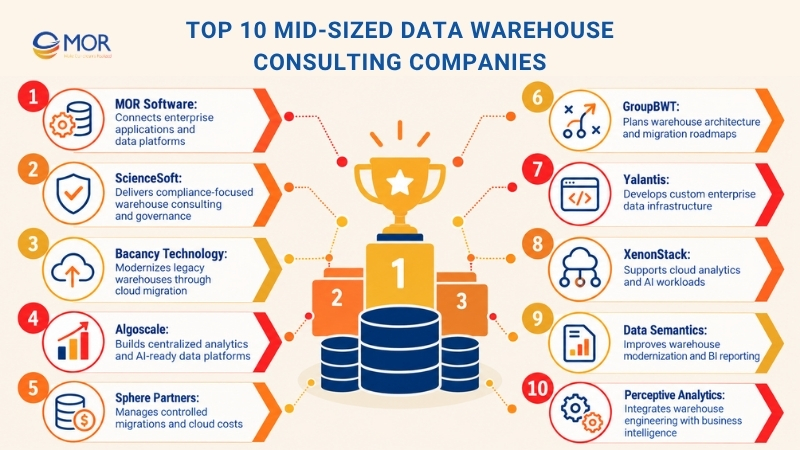
Finding qualified data warehouse consulting services becomes easier when companies are grouped by their main strengths. The following shortlist focuses on specialist providers and firms serving mid-market clients, including companies that also support larger enterprise projects.
MOR Software appears first as our featured engineering partner. The order is editorial, rather than an independently verified performance ranking, and firm sizes vary.
Company | Main service focus | Best for |
MOR Software | Enterprise data integration and custom engineering | Businesses connecting data platforms with software systems |
ScienceSoft | Data warehouse consulting and governance | Regulated organizations |
Bacancy Technology | Cloud migration and legacy modernization | Replacing older warehouses |
Algoscale | Data engineering and analytics | Data-intensive businesses |
Sphere Partners | Warehouse migration and cloud cost management | Controlled migrations |
GroupBWT | Architecture planning and advisory | Data strategy and roadmap projects |
Yalantis | Data warehousing and integration | Custom enterprise data platforms |
XenonStack | Data engineering and cloud analytics | AI and analytics workloads |
Data Semantics | Data warehouse modernization and BI | Reporting and data management |
Perceptive Analytics | Data warehousing and business intelligence | Analytics engineering and reporting |
1. MOR Software
MOR Software is a Vietnam software development outsourcing and IT consulting company established in 2016. We work on enterprise applications, cloud systems, software integration, and data engineering, making our services relevant to businesses building or upgrading analytical infrastructure.
Our experience includes a Salesforce and legacy-system integration project for a Japanese HRM company. We developed an API Gateway and used ETL processes to migrate legacy data, enabling real-time synchronization between Salesforce and the client's attendance management system.
Our related capabilities cover:
- Enterprise API and database integration.
- ETL-based data migration and synchronization.
- Cloud application development and data preparation.
- Dedicated engineering teams and maintenance support.
For warehouse-specific work, we assess the target platform, required skills, integration scope, and implementation needs during project discovery.
Best for: Businesses seeking custom software engineering, enterprise integration, and data platform development support.
2. ScienceSoft
ScienceSoft has provided data warehousing services since 2005 and has broader data analytics experience dating to 1989. Its consulting teams work across architecture design, implementation, migration, performance improvement, and data governance.
The company has experience serving healthcare, banking, insurance, manufacturing, and other regulated industries. It also provides Data Warehouse as a Service (DWaaS), which includes managed warehouse infrastructure and administration.
Main capabilities include:
- Warehouse assessment and architecture design.
- Cloud migration and ETL/ELT development.
- Data governance, security, and managed support.
Best for: Organizations needing structured warehouse consulting, compliance-focused solutions, and ongoing operational support.
3. Bacancy Technology
Bacancy Technology focuses on data warehouse migration and modernization, particularly for businesses replacing legacy infrastructure. Its supported source systems include Teradata, Oracle, Netezza, SQL Server, and other established enterprise platforms.
The company works with Snowflake, Databricks, BigQuery, and Microsoft Fabric. Its migration approach includes SQL conversion, pipeline rebuilding, data reconciliation, and phased cutover.
Core services cover:
- Legacy warehouse assessment and cloud migration.
- SQL, schema, and ETL transformation.
- Governance, validation, and performance improvement.
Best for: Companies planning legacy data warehouse replacement or large cloud migration programs.
4. Algoscale
Algoscale provides data engineering, analytics, and AI services for organizations managing fragmented or high-volume information. Its warehouse practice includes architecture planning, data modeling, system integration, implementation, and ongoing support.
The company also works with data lakes, lakehouses, and BI platforms. This makes it relevant when warehouse data supports reporting and machine learning workloads.
Its main capabilities include:
- Warehouse strategy and architecture.
- ETL/ELT pipelines and data integration.
- Data quality, governance, and analytics preparation.
Best for: Businesses building centralized analytical platforms and AI-ready data foundations.
5. Sphere Partners
Sphere Partners provides cloud data migration, warehouse architecture, and engineering services. Its teams work across Snowflake, Databricks, AWS, Azure, and Google Cloud.
The company places strong emphasis on phased migration, reconciliation, and controlled cutover. In a published wealth management project, Sphere reports migrating 50 TB of Teradata data, translating 2,000 SQL objects, and cutting infrastructure costs by 60%.
Relevant services include:
- Warehouse migration and modernization.
- Data validation and pipeline rebuilding.
- Cloud performance and cost management.
Best for: Organizations migrating business-sensitive workloads while protecting reporting continuity.
6. GroupBWT
GroupBWT works on data warehouse architecture, technical assessment, and migration planning. The company focuses on defining the target architecture and identifying risks before development begins.
Its consultants evaluate data models, current infrastructure, governance needs, and cloud platform choices. Project deliverables can include architecture documents, risk registers, implementation roadmaps, and knowledge-transfer plans.
Its core services include:
- Architecture assessment and gap analysis.
- Platform selection and migration planning.
- Data governance and cost planning.
Best for: Businesses needing a structured warehouse strategy before committing to implementation.
7. Yalantis
Yalantis provides data warehousing and engineering services alongside custom enterprise software development. The company works on data architecture, integration, cloud migration, and analytical infrastructure.
Its approach connects warehouse design to existing applications and business processes. It also supports data governance, ETL/ELT development, and reporting integration.
Main capabilities include:
- Data warehouse design and implementation.
- Data pipelines and system integration.
- Cloud migration and analytics support.
Best for: Enterprises developing custom data infrastructure alongside business applications.
8. XenonStack
XenonStack works across data engineering, cloud infrastructure, AI, and analytics. Its services address modern data architectures, automated data workflows, and the preparation of information for analytical applications.
The company's DataOps and cloud engineering focus is relevant to teams dealing with growing pipeline complexity. Businesses should confirm the exact warehouse platforms and delivery scope during evaluation.
Areas of work include:
- Data engineering and integration.
- Cloud data architecture and modernization.
- Analytics and AI-related data systems.
Best for: Organizations connecting data engineering projects with cloud analytics and AI workloads.
9. Data Semantics
Data Semantics works in data management, warehouse modernization, and business intelligence. Its consulting services address architecture planning, data integration, analytics development, and improvements to enterprise reporting.
The company also focuses on connecting information across business systems and building datasets suitable for reporting tools. This is relevant to organizations dealing with inconsistent records or fragmented departmental reporting.
Main services include:
- Warehouse strategy and implementation.
- Data integration and modernization.
- Business intelligence and reporting support.
Best for: Enterprises improving data consistency, warehouse performance, and BI reporting.
10. Perceptive Analytics
Perceptive Analytics provides data warehouse consulting and analytics services, including cloud implementation and reporting integration. Its work addresses common data team problems like slow queries, legacy infrastructure, and limited internal engineering capacity.
The company's service portfolio includes Snowflake, BigQuery, Power BI, Tableau, and related analytics technologies. It also provides engineering support for ongoing development and maintenance.
Relevant capabilities include:
- Warehouse consulting and migration.
- Data engineering and cloud implementation.
- Reporting, BI integration, and managed support.
Best for: Businesses that need data warehouse engineering tied closely to business intelligence and reporting.
Typical Timelines and Pricing Models for Consulting Services
The duration and cost of data warehouse consulting services depend on project complexity, existing infrastructure, integration requirements, and data volume. A small architecture assessment needs fewer resources than a legacy migration involving years of data and hundreds of dependent reports.
Typical Data Warehouse Consulting Project Timelines
Consulting engagements often start with a technical assessment before moving into design and implementation. The following ranges provide planning estimates for common project types.
Project type | Illustrative timeline | Main deliverables |
Initial assessment and consulting | 2–4 weeks | Requirements, gap analysis, architecture recommendations |
Architecture design and planning | 3–6 weeks | Data models, platform selection, technical roadmap |
Initial warehouse implementation | 8–16 weeks | Core pipelines, warehouse models, initial BI integration |
Enterprise warehouse migration | 4–12+ months | Migrated workloads, reconciliation, controlled cutover |
Performance tuning | 2–8 weeks | Query improvements, performance testing, cost controls |
Managed support | Ongoing | Monitoring, maintenance, issue resolution |
These ranges are estimates, not guaranteed delivery periods. Projects with complex legacy dependencies, strict security requirements, or large reporting estates may need longer schedules.
For a migration, the first phase should identify all systems connected to the warehouse. Otherwise, an apparently finished data transfer may still leave dashboards, scheduled reports, or downstream pipelines running against the old system.
Common Data Warehouse Consulting Pricing Models
Consulting firms use different pricing models based on project scope, technical complexity, and delivery requirements. The estimated costs below provide a starting point for budgeting data warehouse consulting services in 2026.
Pricing model | How it works | Estimated cost ($) | Best suited for |
Fixed-price consulting | One agreed fee for defined deliverables | 2,500–50,000 per project
| Assessments, strategy, and architecture reviews |
Time and materials | Payment based on actual hours worked | 50–250+ per hour
| Changing requirements and complex development |
Dedicated team | Recurring payment for an assigned engineering team | 25,000–80,000 per month for a managed team
| Long-term warehouse development and migration |
Milestone-based pricing | Payments tied to approved project stages | 30,000–250,000+ per project
| Large implementations and cloud migrations |
Managed service retainer | Regular fee for operational support and maintenance | 3,000–25,000+ per month
| Post-launch maintenance and ongoing support |
Contracts described as end to end data warehouse consulting services should specify whether implementation, testing, documentation, and support are included in the quoted price.
Cost also depends on the number of source systems, historical data volume, SQL conversion work, security needs, and cloud consumption. Budget for infrastructure, licenses, data transfer, and ongoing support alongside consulting fees.
Our guide to cloud computing cost explains the infrastructure charges that can affect warehouse operating budgets. Request a scoped estimate and cost assumptions before approving the project.
Common Use Cases for Data Warehouse Consulting Services
Data warehouse consulting services support different business needs across finance, healthcare, retail, manufacturing, technology, and logistics. The architecture changes according to each industry's data sources, reporting speed, security requirements, and analytical workloads.
Industry | Common data challenge | Consulting application |
Banking and finance | Fragmented transaction records and regulatory reporting | Consolidated financial datasets, audit trails, and risk analysis |
Healthcare | Disconnected clinical, claims, and operational data | Secure data integration, patient analytics, and claims reporting |
Retail and eCommerce | Sales, stock, and customer records spread across systems | Customer analytics, inventory forecasting, and sales reports |
Manufacturing | Disconnected ERP, production, and sensor records | Production analytics, maintenance forecasting, and supply chain reporting |
SaaS and technology | High-volume events and subscription activity | Customer behavior analysis, churn tracking, and revenue reporting |
Logistics and transportation | Separate fleet, delivery, and tracking systems | Route analytics, operational monitoring, and delivery performance analysis |
In banking, consultants help align transaction records and reporting definitions across systems. Financial data also requires documented access policies and traceable changes for internal reviews and regulatory requirements.
Healthcare projects place greater emphasis on protecting patient information and connecting clinical data sources. Retailers focus more heavily on product-level metrics, stock availability, order trends, and customer behavior.
Manufacturing and logistics often depend on combining batch records with sensor or event streams. A warehouse may work alongside a data lake or streaming platform when the business needs large-scale processing and near-real-time analysis.
The same principle applies across industries: each source needs clear ownership, reliable transformation rules, and shared business definitions before departments can trust the results.
Conclusion
Data warehouse consulting services help businesses create reliable data architecture, improve reporting, manage cloud migrations, and control long-term infrastructure costs. The right partner should match your existing systems, project scope, technical needs, and budget. At MOR Software, we support enterprise data initiatives through custom engineering, cloud development, API integration, and ETL-related work.
Contact MOR Software to discuss your data infrastructure needs and define a practical engineering plan.
"Evolution is not a destination, it is a disciplined journey of innovation."
Phung Van Tu


CEO MOR AI
MOR SOFTWARE
Frequently Asked Questions (FAQs)
What are data warehouse consulting services?
Data warehouse consulting services help businesses plan, design, build, migrate, and manage analytical data platforms. Consultants assess existing infrastructure, recommend suitable technologies, and establish data structures that support accurate reporting and long-term growth.
What services does a data warehouse consultant provide?
A consultant may handle data architecture, platform selection, dimensional modeling, ETL/ELT planning, cloud migration, performance tuning, and governance. Some firms also provide implementation, monitoring, and maintenance through dedicated engineering teams.
When should a business hire data warehouse consultants?
Consider hiring specialists when reports return conflicting figures, queries take too long, or data remains disconnected across applications. A consulting engagement is also useful before major cloud migrations, warehouse replacements, or new analytics projects.
What is the difference between data warehouse consulting and data engineering?
Consulting focuses on technical decisions, architecture, platform selection, and project planning. Data engineering carries out the work through pipelines, transformations, models, integrations, and system maintenance, though one provider can perform both roles.
Which cloud platforms do data warehouse consulting companies support?
Common platforms include Snowflake, Google BigQuery, Amazon Redshift, Databricks, Microsoft Fabric, and Azure Synapse Analytics. Support varies by provider, so confirm experience with your preferred platform and existing business applications.
Can data warehouse consulting services help with cloud migration?
Yes. Consultants can assess legacy workloads, design a migration roadmap, plan schema conversion, and establish reconciliation checks. Engineering teams then migrate data and reports in stages, using approval and rollback procedures to limit disruption.
How much do data warehouse consulting services cost?
Costs depend on the project scope, technical complexity, data volume, and pricing model. A defined assessment usually costs less than a full implementation or migration, which also involves engineering, testing, cloud infrastructure, and ongoing maintenance.
How long does a data warehouse consulting engagement take?
A focused assessment may take a few weeks, and an initial warehouse implementation can take several months. Large enterprise migrations may extend beyond a year when they involve extensive legacy code, historical data, and reporting dependencies.
Can data warehouse consulting services lower infrastructure costs?
Consultants identify unnecessary compute usage, slow queries, poor storage design, and inefficient data refreshes. Improvements to workload sizing, partitioning, processing schedules, and resource monitoring can lower spending when measured against a reliable baseline.
How do I choose the right data warehouse consulting services?
Start by defining the business problem, required platforms, integrations, and expected results. Check each provider's project history, engineering skills, security practices, pricing terms, and post-launch support before signing a contract.
Share


Make Our-Dreams Realized


© 2023 . MOR Software. All Rights Reserved
Sitemap
Privacy Policy
Terms of Use

Rate this article
0
over 5.0 based on 0 reviews
Your rating on this news:
Name
*Email
*Write your comment
*Send your comment
1