


10 Best HR Software Consultants to Maximize HRIS ROI in 2026
Choosing an HR platform is only one part of the work. Requirements, data migration, API connections, system configuration, testing, and user adoption can determine whether that investment pays off. A HR software consultant connects those technical tasks with real HR processes and business goals. This MOR Software JSC guide will explain what these consultants do, when to hire one, and which firms deserve consideration in 2026.
Key Takeaways
- HR software consultants support HRIS integration selection, implementation, migration, integration, testing, training, and post-launch improvement.
- MOR Software, OutSail, HRchitect, Amodo, Accenture, Deloitte, HR Path, Mercer, Cielo Talent, and Bambee are key providers to consider in 2026.
- Compare platform expertise, integration skills, industry experience, support, and measurable HRIS ROI before choosing a consulting partner.
What Is an HR Software Consultant?
An HR software consultant is a specialist who connects human resources processes with enterprise HR technology stack. The consultant reviews how HR teams work, identifies system gaps, recommends suitable technology, and supports projects involving selection, setup, migration, integration, or system improvement.
The role sits between HR, IT, and business operations. A consultant may work across HRIS, HRMS, HCM, payroll, applicant tracking systems, learning management systems, performance tools, and workforce management platforms. HiBob describes this type of consulting around needs assessment, strategy, implementation, migration, integrations, and adoption.
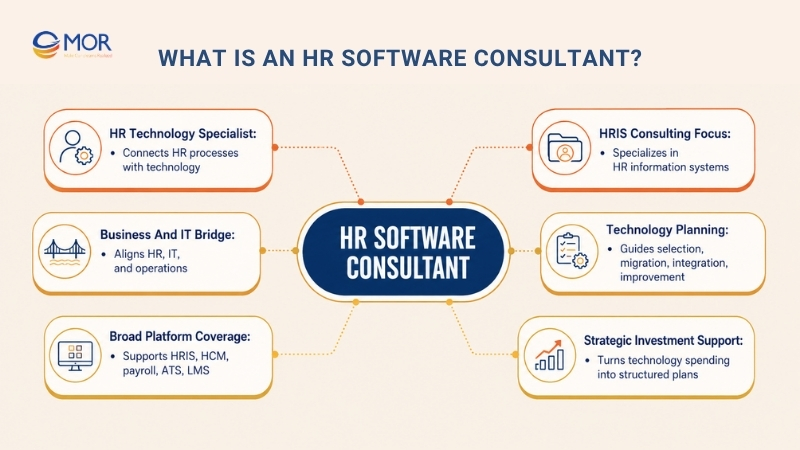
An HRIS software consultant usually focuses more closely on Human Resources Information Systems. An HR consultant has a wider remit that can include policy, compensation, workforce planning, compliance, or organization design without direct responsibility for software.
Mercer's 2026 research also points to growing pressure around HR technology: more than half of HR leaders identify rolling out new HR technology or improving existing platforms as a top priority. A consultant gives that investment a business and technical plan rather than treating the project as a basic software purchase.
What Does an HR Software Consultant Do?
A HR software consultant can join at the discovery stage or enter later when an implementation has stalled. The scope changes by project, but most engagements connect business requirements, system design, data, testing, and adoption.
A strong HR system consultant also defines who owns each decision. That prevents HR, IT, finance, payroll, and the software vendor from making conflicting assumptions during delivery.
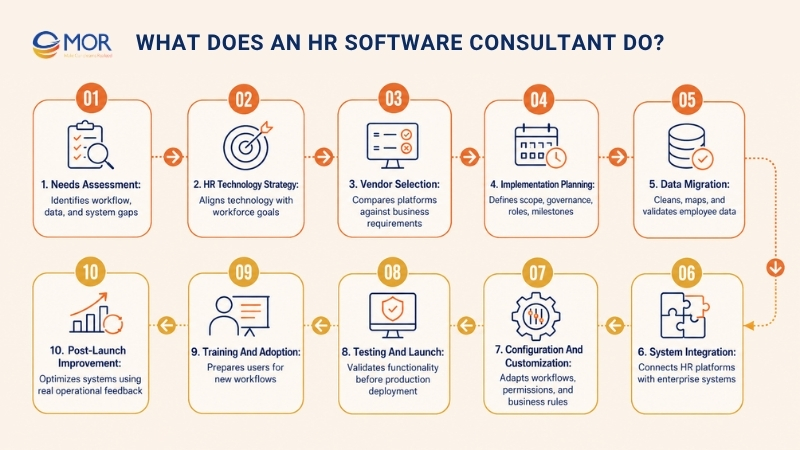
- Needs assessment: Review HR workflows, manual work, reporting gaps, data problems, compliance requirements, and user pain points. A Gap analysis then separates process issues from actual technology needs.
- HR technology strategy: Connect system decisions with hiring plans, workforce growth, employee experience, reporting goals, and IT architecture. The result should state what stays, what changes, and what must connect.
- Vendor selection: Turn requirements into scorecards, RFP questions, demo scenarios, and evaluation criteria. Consultants can compare HRIS or HCM products against business workflows instead of judging vendor presentations alone.
- Implementation planning: Define scope, milestones, roles, dependencies, governance, and acceptance criteria before configuration starts. This work also identifies who owns payroll validation, security decisions, integrations, and UAT.
- Data migration: Inspect legacy records, remove duplicate data, map fields, define transformation rules, and prepare migration tests. Employee IDs, compensation records, job history, leave balances, and organizational structures need particular care.
- System integration: Connect HR platforms with payroll, ERP, finance, ATS, LMS, identity management, timekeeping, and internal applications. APIs, middleware, ETL pipelines, webhooks, and batch jobs may all form part of that architecture.
- Configuration and customization: Set organizational structures, approval flows, roles, permissions, forms, notifications, reports, and business rules. Custom development becomes relevant when standard configuration can’t match a required process.
- Testing and launch: Run functional tests, integration tests, migration checks, security checks, and UAT before production. Defect ownership and acceptance rules should already be agreed before testing begins.
- Training and adoption: Prepare administrators, human resource development teams, managers, and employees for the new workflow. Training often needs separate materials for different user groups rather than one long product demo.
- Post-launch improvement: Review support tickets, unfinished configurations, reports, adoption data, and process bottlenecks after go-live. Some problems only appear once real payroll runs, onboarding cycles, or performance reviews enter the system.
The work can require functional consultants, solution architects, developers, data specialists, and QA teams rather than one person. Large or custom projects often need a cross-functional consulting team.
HR Software Consultant vs Vendor Team vs In-House Expert
A HR software consultant, vendor implementation team, and internal HRIS specialist can all support the same project, but they solve different problems. TechnologyAdvice makes a similar distinction between independent consultants, temporary resources, and consulting firms based on project scope, timeline, cost, and ownership.
The right model depends on how much independent advice, platform knowledge, custom technical work, and ongoing ownership you need.
Companies that already run an HR advisory practice may also rely on HR consultancy software to manage clients, projects, documents, billing, or internal workflows. That type of software supports the consultancy itself, while an HR technology consulting partner works directly on the client's HR systems and implementation needs.
Factor | Independent/Consulting Partner | Vendor Implementation Team | In-House HRIS Expert |
Best for | Independent advice and project delivery | Deploying one vendor's platform | Continuous system ownership |
Vendor neutrality | Usually higher | Low | Depends on experience |
Platform knowledge | Cross-platform or specialist | Deep product knowledge | Strongest in current systems |
Custom integration | Often available | Usually defined by package scope | Depends on technical skills |
Internal workload | Lower | Moderate | High internal ownership |
Long-term ownership | Project or support contract | Often ends after rollout | Strong |
Cost model | Project, retainer, or team model | Implementation package | Salary and employment cost |
Vendor teams make sense when configuration stays close to the product's standard model. They already know the platform and have direct access to product resources.
Independent partners become more useful when the project spans several systems or needs an outside view of vendor claims. They can also represent the client's requirements during vendor discussions.
An internal expert gives you continuity after go-live. Yet one person may not cover solution architecture, API design, ETL, payroll configuration, change management, and testing at the same depth.
Complex programs often combine all three. A consulting partner may lead architecture and delivery, the software vendor handles product-specific setup, and the internal team keeps process ownership.
Custom work adds another role. An HRIS software engineer can build integrations, extensions, internal portals, automation, and other functions that standard configuration doesn't cover.
When Should You Hire an HR Software Consultant?
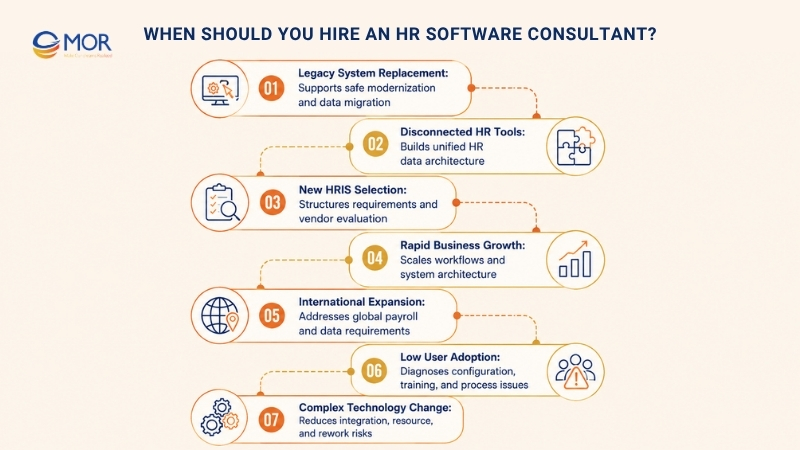
Hiring an outside specialist makes sense when HR technology work starts crossing functional, data, and technical boundaries. A HR software consultant is particularly useful when errors could create payroll problems, duplicate employee records, broken integrations, or expensive rework.
Look for these situations:
- Replacing legacy HR software: Your current platform has outdated workflows, hard-coded rules, poor reporting, or limited integration options. Migration knowledge becomes especially useful when years of employee data must move safely.
- Too many disconnected HR tools: Recruitment, employee records, payroll, learning, performance, and reporting sit in separate systems. Integration planning can create a cleaner source-of-truth model.
- Selecting a new HRIS: The vendor market feels difficult to compare and internal requirements remain vague. External advisors can structure requirements, demos, scorecards, RFPs, and commercial evaluation.
- Scaling rapidly: Headcount growth exposes approval delays, spreadsheet-heavy administration, inconsistent onboarding, and reporting gaps. System architecture must support the larger operating model.
- Expanding internationally: New locations introduce local payroll, language, security, tax, reporting, and data requirements. Global HR systems also need consistent master-data rules.
- Low software adoption: Managers keep using spreadsheets, HR completes work outside the platform, or employees avoid self-service functions. The cause may sit in configuration, process design, training, or the platform choice itself.
- Complex integrations: HR data needs to flow into ERP, finance, identity management, payroll, collaboration tools, or custom applications. API ownership and data rules become part of the project.
- Major organizational changes: M&A, restructuring, shared-service redesign, and HR transformation often change organizational structures and system requirements at the same time.
- Insufficient internal resources: HR knows the process, but the team lacks time for data mapping, testing, documentation, and project control. IT may face the same capacity problem.
- Poor HRIS ROI: The business bought many modules but still depends on manual work. A health check can identify unused functions, duplicated tools, weak adoption, and process gaps.
A large Accenture project shows how quickly system fragmentation can grow. BT Group had accumulated more than 200 disparate HR systems before moving toward a global cloud solution for 107,000 employees across 44 countries. That scale is extreme, but the same problem starts much earlier when separate tools multiply without a shared architecture.
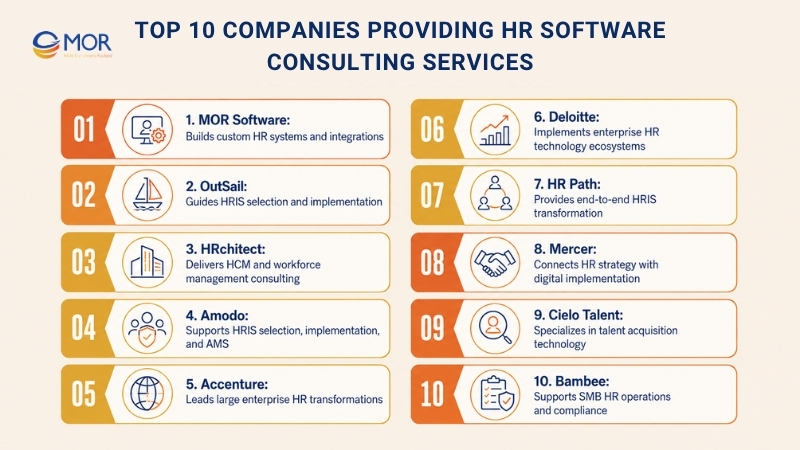
Top 10 Companies Providing HR Software Consulting Services in 2026
The best provider depends on the problem you’re solving. Some firms focus on HRIS buying and vendor evaluation. Others handle HCM deployment, change programs, managed support, or custom engineering.
Our editorial shortlist covers different buyer profiles rather than presenting one universal ranking. Businesses researching the best HR software selection consultants should first separate vendor-selection specialists from implementation firms and custom software partners.
Consultant | Main Focus | Best Fit | Key Capability |
MOR Software | Custom HRMS software development solutions and IT consulting | Custom or complex HR systems | Development and integration |
OutSail | HRIS selection | Software buyers | Vendor selection |
HRchitect | HCM and WFM consulting | Mid-market and enterprise | Implementation |
Amodo | HR technology consulting | HRIS transformation | Selection and implementation |
Accenture | Enterprise transformation | Global enterprises | Large transformation programs |
Deloitte | HR transformation | Large organizations | HR technology integration |
HR Path | HRIS transformation | Global organizations | End-to-end HRIS delivery |
Mercer | HR strategy and technology | Enterprises | HR transformation |
Cielo Talent | Talent technology | Recruitment-heavy organizations | Talent acquisition technology |
Bambee | SMB HR support | Small businesses | HR operations and compliance |
1. MOR Software
Headquarter: Ho Chi Minh City, Vietnam
Main Focus: Custom HR software development, integration, and IT consulting
MOR Company fits companies that need more engineering depth than a standard HRIS implementation package provides. Its service portfolio covers software outsourcing development, Salesforce, offshore development, QA and testing, and IT consulting, while Human Resource Management appears among its industry areas.
That technical scope becomes useful when HR workflows require custom applications, legacy modernization, API work, cloud architecture, or system extensions. MOR can also form dedicated engineering teams containing business analysts, developers, QA specialists, project managers, and other delivery roles.
MOR's HR experience includes the PEOPLE project, an HR management ecosystem in Japan covering recruitment, staff evaluation, planning, and target management. The engagement grew into a four-year project with nearly 100 MOR developers involved, and the team also supported customer data integration.
Another workforce project connected internal employee data with Salesforce and Slack. MOR used API Gateway and ETL for data exchange and legacy migration, giving the team direct experience with workforce data integration rather than HR interfaces alone.
Key services:
- Custom HRM solution: Build HRM platforms, modules, employee portals, and workflow applications around company-specific processes.
- HR system integration: Connect HR data with Salesforce, internal applications, databases, APIs, collaboration tools, and other enterprise systems.
- Legacy modernization: Refactor or replace aging HR applications when maintenance cost and technical limits block further development.
- Cloud development: Build cloud-based HR applications and supporting infrastructure for growing user and data loads.
- Quality assurance: Test functional flows, system connections, performance, security, and user journeys before production releases.
- Dedicated development teams: Add business analysts, developers, QA staff, architects, and project roles without building every capability internally.
2. OutSail
Headquarter: Denver, Colorado, United States
Main Focus: HRIS vendor selection and implementation support
OutSail focuses heavily on the buying stage. Its platform includes HRIS vendor data, requirements tools, scorecards, proposal review, shortlist support, and advisors who guide buyers through evaluation.
The company also continues into implementation through consultant matching. Its implementation partners can handle data conversion, process mapping, system setup, and user training after software selection.
That model fits buyers who haven't chosen a platform yet and want structured help comparing vendors. OutSail states that its buyer service is funded through commissions from the selected software vendor and discloses that model to customers.
Key services:
- HRIS requirements: Turn business goals and HR processes into must-have and preferred requirements.
- Vendor shortlisting: Match company requirements against HRIS options and narrow the initial market.
- RFP support: Structure vendor questions, demos, evaluation tasks, and proposal analysis.
- Software comparison: Compare pricing estimates, service models, capabilities, pros, and cons.
- Implementation matching: Connect buyers with consultants familiar with the selected HR platform.
3. HRchitect
Headquarter: Frisco, Texas, United States
Main Focus: HCM and workforce management consulting
HRchitect works across HCM and contingent workforce management advisory, selection, implementation, project management, change management, and post-go-live support. Its global headquarters is in Frisco, Texas.
Platform expertise listed by the company includes Dayforce, iCIMS, Paylocity, UKG, and WorkForce Software. HRchitect also states that its implementation consultants average 15 years of experience, which can matter for complex configuration and rollout programs.
Its advisory work starts earlier than implementation. The company runs People, Process & Operations Assessments and supports evaluation and selection before deployment begins.
Key services:
- System assessment: Review current HCM and WFM tools against future business requirements.
- Evaluation and selection: Compare platforms using requirements and planned future-state processes.
- Implementation: Manage configuration, integrations, rollout, and platform-specific delivery work.
- Change management: Prepare stakeholders and users for new processes and technology.
- Post-go-live support: Resolve system issues and continue platform improvement after launch.
4. Amodo
Headquarter: Montreal, Canada
Main Focus: HRIS advisory, implementation, and support
Amodo describes itself as an independent HR technology consulting and recruiting firm focused on Human Capital Management. Its service set covers vendor selection, implementation, and support or AMS.
Its selection work maps HR business processes and technical requirements before going to market. Amodo can also manage RFPs, proofs of concept, demonstrations, sandbox work, and vendor evaluation.
During implementation, the company uses requirement mapping, training, prototyping, testing, go-live, and hypercare. Its Montreal office is listed at 2001 Boulevard Robert-Bourassa.
Key services:
- Vendor selection: Match business processes, IT requirements, budget, and strategy against HR platforms.
- Implementation: Manage configuration and rollout once a platform has been selected.
- Integration: Connect HR applications to the surrounding technology environment.
- Training: Prepare HR staff, administrators, managers, and end users for production use.
- AMS support: Provide functional and technical help after implementation.
5. Accenture
Headquarter: Dublin, Ireland
Main Focus: Enterprise HR technology transformation
Accenture serves large organizations that need HR technology work tied to wider operating-model and workforce change. Its HR transformation practice connects data, technology, talent strategy, AI automation, organization design, and managed services.
Its ecosystem covers major HR technology vendors, including Workday, Oracle, SAP, UKG, Microsoft, and ServiceNow. Accenture also uses internal tools including myConcerto and Transformation GPS to support planning and large technology programs.
The fit is strongest when an HR project crosses countries, business units, systems, and change programs. Accenture's Dublin entity is listed at 1 Grand Canal Square.
Key services:
- HR technology strategy: Connect workforce plans, data, HR architecture, and technology investment.
- Cloud transformation: Move fragmented or legacy HR environments toward cloud platforms.
- AI and people analytics: Apply workforce data and AI to skills, organization, and HR decision processes.
- Data migration: Plan data movement during large HCM replacement programs.
- Transformation management: Coordinate technology, process, organization, and adoption across enterprise programs.
6. Deloitte
Headquarter: Global network, with primary Deloitte Global offices in London and New York
Main Focus: Enterprise HR transformation and workforce strategy
Deloitte's HR Transformation practice covers strategy, design, implementation, payroll, workforce management, ServiceNow, Workday, SAP SuccessFactors, Oracle, and other HR technology areas.
Its scale is relevant for large HCM environments. Deloitte reports 2,500+ global Oracle practitioners and more than 500 Oracle HCM Cloud projects, including large payroll implementations involving organizations with more than 200,000 employees.
Deloitte works as a network of independent member firms rather than one global client-service company. Deloitte Global lists primary offices in London and New York, so buyers should identify which member firm will contract and deliver the work in their region.
Key services:
- HR transformation: Redesign HR operating models, service delivery, and technology around business requirements.
- Technology implementation: Deploy enterprise HCM, payroll, workforce management, and HR service platforms.
- System integration: Connect large HR ecosystems and related enterprise applications.
- Change enablement: Prepare leaders, managers, and users for revised workflows and system behavior.
- Operational support: Continue support after deployment through HR operations and technology services.
7. HR Path
Headquarter: Global operations
Main Focus: End-to-end HRIS transformation
HR Path positions its model around three connected areas: Advise, Implement, and Run or Outsource. It supports HR transformation, HRIS digitalization, technical and functional implementation, and payroll operations across Europe, the Americas, and Asia-Pacific.
Its platform work spans major enterprise HR products. Current HR Path material references Workday, SAP, SAP SuccessFactors, Oracle, Talentsoft, Cornerstone, Cegid, PeopleSoft, Sage, and other systems.
This breadth suits organizations that need one partner across planning, implementation, integration, support, and payroll-related work. Current Workday roles also cover requirements, configuration, testing, UAT, training, rollout, and production support.
Key services:
- HRIS assessment: Review the current HR environment and identify priorities for system change.
- Transformation roadmap: Build a phased route across HR processes, technology, and operating models.
- Implementation: Configure and deploy HRIS or HCM applications.
- Integration: Connect HR systems, payroll, analytics, and external data sources.
- Change management: Support testing, training, deployment, and user adoption.
8. Mercer
Headquarter: New York, United States
Main Focus: HR strategy and digital implementation
Mercer combines workforce consulting with digital implementation. Its current services cover HR transformation, digital workplace programs, workforce management, payroll, and HR technology platforms, including Workday and UKG.
The firm fits organizations where software replacement is part of a wider HR operating-model or workforce program. Mercer can connect technology choices with employee experience, change work, organization design, and workforce strategy rather than treating implementation as an isolated IT project.
Mercer maintains offices across 130 markets, including its New York location at 1166 Avenue of the Americas. Historical Mercer material also identifies the firm as headquartered in New York City.
Key services:
- Legacy assessment: Review older HR systems and fragmented processes before replacement.
- Transformation strategy: Connect HR technology choices with workforce and business goals.
- Implementation: Support digital HR platform deployment.
- Workflow redesign: Rework HR processes around the target operating model.
- Adoption support: Guide communication, training, and change after platform rollout.
9. Cielo Talent
Headquarter: Wauwatosa, Wisconsin, United States
Main Focus: Talent acquisition strategy and HR technology
Cielo Talent is a more specialized choice. Its consulting practice centers on talent acquisition, recruitment technology, and related HCM processes rather than every HR function.
Its HR Technology consulting covers advisory work, implementation, custom integrations, post-production support, and hands-on configuration of talent acquisition and HCM systems.
Cielo's global headquarters moved to Wauwatosa, Wisconsin, in 2024. The company lists the current location at 10100 W Innovation Drive.
A client example gives some scale to its talent focus. Cielo reports that Quest Diagnostics lowered time-to-fill by 60% through its partnership.
Key services:
- Technology assessment: Review the current recruiting and talent technology stack.
- HR technology integration: Connect ATS, HCM, recruitment, and related talent applications.
- Workflow configuration: Configure recruiting systems around actual hiring processes.
- Automation: Remove repetitive recruiter work through connected workflows and technology.
- Adoption consulting: Support system use, process changes, and post-production work.
10. Bambee
Headquarter: Los Angeles, California, United States
Main Focus: HR support for small businesses
Bambee targets smaller U.S. businesses rather than large HRIS transformation programs. Its model combines a dedicated HR manager with HR Autopilot for policies, onboarding, termination processes, audits, employee training, and performance tracking.
That makes Bambee relevant when a small company needs practical HR support plus software-backed workflows. Businesses searching for HR compliance software and consulting services may find this model closer to their needs than enterprise HCM consulting.
Its legal contact address is listed in Los Angeles, California. Bambee says it serves businesses across all 50 U.S. states and supports companies with up to 500 employees.
Key services:
- Dedicated HR support: Pair small businesses with an HR manager for ongoing guidance.
- Policy management: Create, update, distribute, and track HR policies.
- Onboarding workflows: Manage documents, employee records, training, and new-hire processes.
- HR audits: Identify gaps in policies and current HR practices.
- Performance processes: Track goals, feedback, and employee performance records.
How to Choose the Right HR Software Consulting Company
Provider names matter less than provider fit. Before contacting firms, map your project against five areas: requirements, platform skills, industry evidence, total cost, and support after go-live.
A local search for an HR software consultant near me can produce nearby providers, but location alone says little about HRIS delivery capability. Remote and global teams can work well when governance, communication, data controls, and ownership are defined.
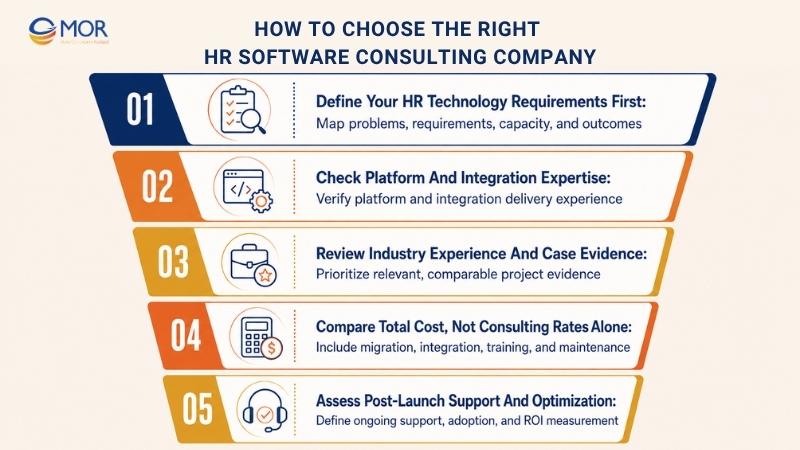
Define Your HR Technology Requirements First
Start with business problems, not product names. If requirements are vague, vendors and consulting companies will fill the gap with their own assumptions.
Turn the project into a short requirements map before comparing providers.
- Current pain points: Record manual work, duplicate data, reporting delays, payroll audit issues, approval bottlenecks, and user complaints.
- Must-have requirements: List functions the target system must support for daily operations, compliance, security, and reporting.
- Preferred requirements: Keep convenience improvements separate so they don't distort the core selection process.
- Growth plans: Account for expected headcount, new entities, markets, employee types, and HR operating-model changes.
- Business outcomes: Define measurable goals around processing time, system usage, data accuracy, reporting, or platform consolidation.
- Internal capacity: Identify which tasks HR, IT, payroll, finance, and security teams can actually own during the project.
When comparing the best HR software selection consultants, ask to see how each firm converts these requirements into vendor evaluation criteria. A polished demo means little if the scoring model doesn't reflect your real processes.
Check Platform and Integration Expertise
Platform knowledge should match the systems already in your architecture. Ask which HRIS, HCM, payroll, ATS, LMS, ERP, identity, and integration technologies the consulting team has worked with recently.
Then examine the technical layer. HR projects often fail outside the visible interface, where APIs, ETL jobs, employee IDs, security roles, and data mappings connect one platform to another.
- Platform skills: Confirm hands-on experience with the products in your shortlist.
- API experience: Review previous REST, SOAP, webhook, middleware, or vendor API work where relevant.
- Payroll connections: Ask how the team handles pay data, time records, benefits, deductions, and reconciliation.
- ERP and finance integration: Confirm how organizational, employee, and cost data will move across systems.
- ATS and LMS connections: Map candidate-to-employee transitions and learning records before implementation.
- Identity management: Review SSO, provisioning, deprovisioning, and permission structures.
- Existing infrastructure: Document databases, data warehouses, cloud platforms, and legacy applications that must remain.
A consulting company that can configure Workday but can't support your custom integration layer may leave a gap. The reverse can happen too, so compare functional and engineering capacity together.
Review Industry Experience and Case Evidence
Relevant case evidence tells you more than a long client-logo page. Ask for projects involving organizations with similar workforce structures, process rules, security needs, and integration complexity.
Industry experience becomes especially useful in finance, healthcare, manufacturing, retail, and other sectors where HR data connects with operational systems. MOR Software, for example, lists Human Resource Management among its focus industries and has delivered HRM and workforce integration projects documented in its project materials.
- Company size: Compare the provider's previous projects with your employee count and organizational structure.
- Industry rules: Ask where sector-specific requirements changed system design or testing.
- System similarity: Prioritize evidence involving the same HRIS, HCM, payroll, or integration stack.
- Delivery scope: Check whether the provider handled consulting only or also configuration, development, migration, testing, and launch.
- References: Speak with previous clients when the project value and risk justify deeper due diligence.
Case studies should explain the starting problem, delivery work, and result. A list of technologies without those three elements gives weak evidence.
Compare Total Cost, Not Consulting Rates Alone
An inexpensive consulting quote can become costly after scope changes, integration gaps, migration rework, or delayed launch. Build a total-cost view before choosing a provider.
Compare the commercial model against the work that actually needs to happen.
- Consulting fees: Check hourly, fixed-price, retainer, and dedicated-team structures.
- Software licenses: Separate vendor subscription costs from professional services.
- Integration work: Price APIs, middleware, custom connectors, and external system changes.
- Migration: Include data cleaning, mapping, trial migrations, reconciliation, and historical data decisions.
- Customization: Define which changes use native configuration and which need engineering.
- Training: Account for administrators, HR teams, managers, and employee materials.
- Maintenance: Include support, platform changes, new integrations, and future releases.
- Rework risk: Ask what happens when requirements change or UAT identifies large gaps.
Compare assumptions line by line. Two proposals with similar totals may contain very different levels of migration, testing, documentation, and post-launch support.
Assess Post-Launch Support and Optimization
Go-live closes the implementation project, but the system keeps changing. New employees, policies, integrations, vendor releases, reporting requests, and organizational changes create ongoing work.
Post-launch support should have an operating model rather than a vague promise of 'help when needed.'
- Hypercare: Define response ownership during the first production cycles.
- Troubleshooting: Set processes for configuration, integration, data, and permission issues.
- Training: Plan refresher sessions and administrator knowledge transfer.
- System changes: Agree how new workflows, reports, integrations, and modules enter the backlog.
- Health checks: Review system usage, open issues, manual work, and support patterns at agreed intervals.
- Adoption measurement: Track whether managers and employees actually use the new workflows.
- ROI measurement: Compare the baseline against processing time, tool consolidation, data quality, support volume, or other agreed KPIs.
McKinsey found that organizations committing to implementation rigor, people goals, and proper resourcing were 3.4 times more likely to achieve and sustain performance gains for more than three years. The same principle applies to HRIS work: support after launch deserves a defined budget, owner, and measurement plan.
Conclusion
The right HR software consultant should connect HR requirements, data, integrations, delivery, and adoption to measurable business outcomes. Provider fit matters more than brand size, especially when custom workflows or legacy systems shape the project. MOR Software brings HR domain experience together with custom development, Salesforce integration, QA, cloud, and dedicated engineering teams. Contact MOR Software to discuss your HR system requirements and build a delivery plan around your current technology stack.
"Solutions Director at MOR Software, has extensive expertise in software development and management. He leads innovative projects and provides strategic solutions to enhance business operations, helping clients achieve digital transformation goals."
Pham Huu Canh


Solutions Director
MOR SOFTWARE
Frequently Asked Questions (FAQs)
What does an HR software consultant do?
An HR software consultant reviews business requirements and helps plan, select, implement, integrate, migrate, test, and improve HR systems. Scope can range from vendor evaluation to full HRIS delivery. Some consultants focus on functional HR work. Others add architecture, data engineering, API integration, development, QA, training, or managed support.
How much does an HR software consultant cost?
Pricing depends on geography, consultant seniority, platform specialization, project length, and delivery model. Firms may charge hourly rates, fixed project fees, retainers, or dedicated-team fees. Compare the full scope rather than the rate alone. Migration, integrations, customization, training, testing, and support can change total project cost far more than a small hourly-rate difference.
When should a company hire an HR software consultant?
Consider external help when selecting a new HRIS, replacing legacy technology, joining disconnected systems, preparing a large migration, or entering a major HR transformation. Consulting also makes sense when your internal HR or IT team lacks time for project management, configuration, data work, testing, or vendor coordination.
What is the difference between an HR consultant and an HRIS consultant?
An HR consultant may work across policies, talent, compensation, workforce planning, organization design, compliance, and other people topics. An HRIS consultant focuses more closely on HR technology and related processes. Some firms combine the two disciplines. That model can work well when process redesign and software changes need to happen together.
Can an HR software consultant help select an HRIS?
Yes. Selection consultants can gather requirements, create RFPs, build vendor shortlists, prepare demo scenarios, compare proposals, and create weighted scorecards. Vendor neutrality still needs scrutiny. Ask how the consultant gets paid and whether referral commissions or platform partnerships influence recommendations.
Can HR software consultants manage data migration?
Many implementation firms support migration planning, mapping, cleaning, validation, trial loads, and production migration. Technical depth varies between providers. Ask who owns source-data quality and reconciliation. Payroll, compensation, benefits, employee IDs, reporting structures, and historical records need agreed validation rules.
Do HR software consultants provide system integration services?
Many do, but integration capacity varies. Some firms configure native connectors, while engineering-led providers can build APIs, middleware, ETL pipelines, or custom services. Request architecture examples before selecting a partner. Your HR platform must exchange data reliably with payroll, ERP, finance, identity, ATS, LMS, and other required systems.
How long does an HR software implementation take?
There is no universal timeline. Company size, modules, integrations, data quality, countries, customization, testing, and internal availability all affect delivery time. A focused implementation may take months. Large global HCM replacements can run much longer, especially when payroll, several entities, and legacy systems sit inside the scope.
What should I ask an HR software consultant before hiring them?
Ask about recent projects, platform certifications, industry experience, migration method, integration skills, UAT, support, staffing, pricing assumptions, and measurable results. Also ask who will actually work on your project. If you're ready to schedule a consultation for core HR software implementation, send the provider your current systems, target scope, employee count, integrations, timeline, and main pain points before the call.
Should I choose an independent consultant or an HR technology consulting firm?
An independent consultant can fit a focused assessment, selection project, or specialist role. A consulting firm usually brings broader capacity when the work requires project managers, functional specialists, developers, data staff, and testers. Consider long-term ownership too. Businesses researching HR software for HR consultants are usually looking for a product, which is a different buying decision from selecting a consulting partner.
Share


Make Our-Dreams Realized


© 2023 . MOR Software. All Rights Reserved
Sitemap
Privacy Policy
Terms of Use

Rate this article
0
over 5.0 based on 0 reviews
Your rating on this news:
Name
*Email
*Write your comment
*Send your comment
1