


Top 10 Mobile App Development Companies in Singapore in 2026
Choosing a mobile app development companies in Singapore gets harder once your app needs APIs, payment flows, ERP or CRM links, security controls, QA, and long-term support. Two agencies may list the same iOS, Android, Flutter, and React Native skills yet run projects very differently. In this guide, MOR Software will compare 10 providers based on mobile engineering scope, project fit, delivery model, published proof, pricing signals, and the points you should check before signing.
Key Takeaways
- Singapore’s mobile market is mature, but buyer needs keep getting more technical. Backend connectivity, data security, cross-platform delivery, AI functions, cloud systems, and post-launch ownership now shape vendor selection as much as UI design.
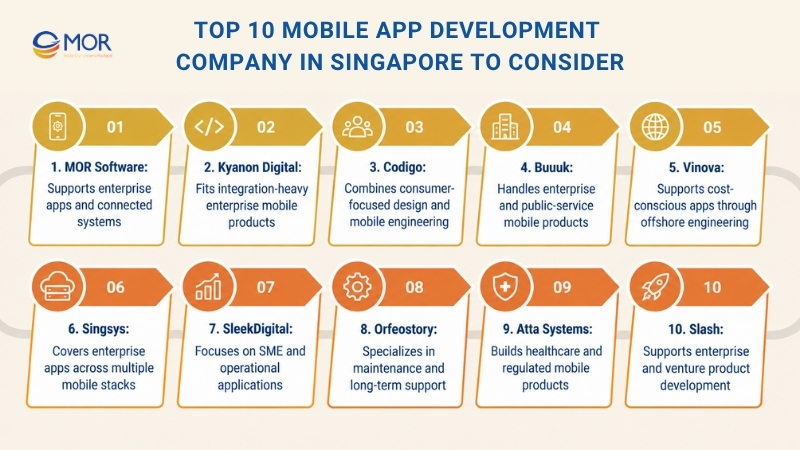
- MOR Software, Kyanon Digital, Codigo, Buuuk, Vinova, Singsys, SleekDigital, Orfeostory, Atta Systems, and Slash make up the 10 providers covered in this guide. Each fits a different project profile rather than one universal use case.
- Price alone won’t tell you whether a partner fits. Compare the assigned team, engineering location, API depth, QA process, code ownership, security scope, support SLA, and evidence from related projects.
Singapore Mobile App Development Market in 2026
Singapore has reached a point where mobile products often connect directly to day-to-day business systems. A customer app may pull ERP inventory, accept payments, read loyalty data, call an AI service, and send transaction data into analytics tools in one session.
The economic data backs up that shift. IMDA reported that Singapore’s digital economy reached S$128.1 billion in 2024, equal to 18.6% of GDP. The same report found that 95.1% of SMEs adopted at least one of six measured digital areas, covering cybersecurity, cloud, e-payments, e-commerce, data analytics, and AI.
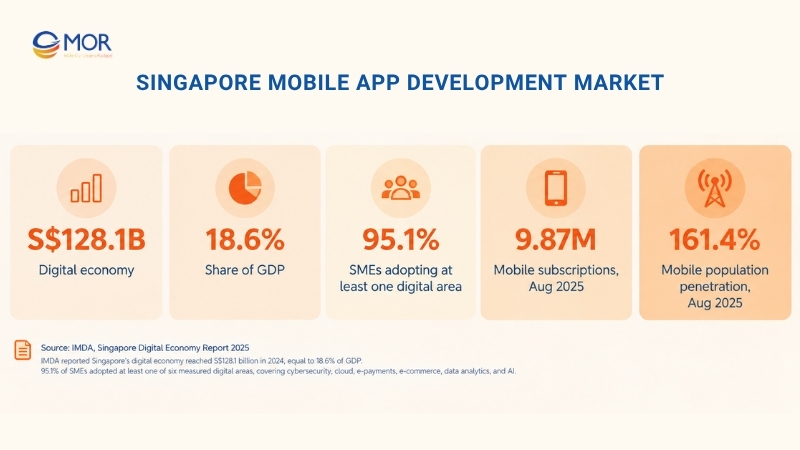
IMDA’s latest published figure visible in its July to December 2025 telecom table shows 9,865,400 4G and 5G subscriptions in August 2025, equal to 161.4% mobile population penetration.
That level of adoption raises the bar for a mobile app development company in Singapore. Product teams now have to think about older devices, API reliability, authentication, payment flows, release cycles, analytics, app-store rules, and security at the same time.
AI adoption adds another layer. IMDA reported SME AI adoption rising from 4.2% in 2023 to 14.5% in 2024, so more mobile products will call AI models or AI-enabled business systems rather than work as isolated screens. Readers tracking this shift can also review our guide to the latest mobile app development trends.
IMDA’s monthly data shows 5G subscriptions rising from 2.45 million in January 2025 to 2.8751 million in June, an increase of about 17.4%. The jump came through growth in post-paid and pre-paid 5G plans.
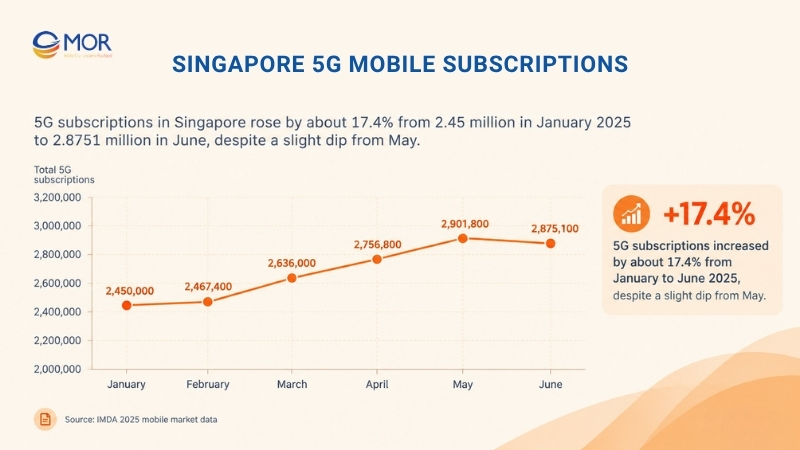
This connectivity base supports richer mobile workflows, but the network alone won’t make an app reliable. Architecture, backend response time, local caching, device testing, and release ownership still decide how the product behaves in daily use.
Top 10 Mobile App Development Company In Singapore To Consider In 2026
Many providers on a list of mobile app development companies in Singapore appear similar at first glance. iOS, Android, Flutter, React Native, UI/UX, APIs, and maintenance appear across most service pages.
The differences show up deeper in the engagement. An experienced mobile app development company in Singapore should be able to explain architecture, backend ownership, QA, delivery location, security controls, support, and why its proposed stack fits your product.
Company | Core Mobile Capabilities | Suitable Project Types | Delivery Footprint | Estimated Pricing |
MOR Software | Native, cross-platform, PWA, UI/UX, APIs, QA, modernization, maintenance | Enterprise apps, connected products, long-term development | Vietnam and Japan | Approx. US25-49/hr
|
Kyanon Digital | Native iOS/Android, Flutter, React Native, Xamarin, PWA, APIs, QA | Enterprise and integration-heavy products | Singapore and regional delivery | US25-49/hr
|
Codigo | Native iOS/Android, React Native, UX/UI, backend, APIs | Consumer and brand apps | Singapore plus regional teams | Approx. US100-149/hr
|
Buuuk | iOS, Android, wearables, integrations, UX/UI | Enterprise and public-service products | Singapore plus regional delivery | US100-149/hr
|
Vinova | iOS, Android, React Native, Flutter, Cordova, APIs | SMEs, offshore builds, product extensions | Singapore plus Vietnam | Under US$25/hr
|
Singsys | Swift, Kotlin, Flutter, React Native, Xamarin, QA | Enterprise, government, business apps | Singapore plus India | US25-49/hr
|
SleekDigital | React Native, Flutter, backend, ERP, workflow systems | SME and operational apps | Singapore | US25-49/hr
|
Orfeostory | iOS/Android, customization, security, maintenance | Long-term maintenance and SME apps | Singapore | US100-149/hr
|
Atta Systems | Native, React Native, Flutter, backend, AI/ML | Healthcare and regulated products | Singapore plus Romania | US50-99/hr
|
Slash | iOS, Android, cross-platform, custom software | Enterprise products and venture builds | Singapore plus regional teams | US25-49/hr
|
Pricing above uses published vendor or directory bands rather than MOR Software estimates. Rates change based on team seniority, contract length, delivery location, and scope, so use them for shortlisting rather than budgeting.
The profiles below go deeper than a standard directory card. If you want a wider global comparison as well, MOR Software has also reviewed leading custom mobile app development companies.
1. MOR Software
MOR Software was established in 2016 and works across Vietnam and Japan. Our mobile work sits inside a wider engineering practice that covers frontend, backend, APIs, cloud, QA, modernization, and offshore teams, so the mobile layer doesn’t have to become a separate technical island.
We support native and hybrid applications, Progressive Web Applications, mobile UI/UX, backend integration, testing, modernization, wearable software, embedded products, maintenance, and long-term engineering. That range makes us a practical mobile app development company in Singapore for businesses whose app must connect to larger business systems.
- Website: morsoftware.com
- Established: 2016
- Delivery locations: Ho Chi Minh City, Hanoi, Da Nang, Tokyo, Osaka, and Nagoya
- Team scale: 250+ engineers and specialists in MOR Software’s published 2026 company data
- Engagement models: Project-based delivery, dedicated teams, offshore development center, and team extension
MOR Software’s published profile lists a general billing range of US25-49 per hour and a 250+ team size. The same company material places mobile work beside custom software, QA, AI, cloud, Salesforce, and offshore development.
Best Matched Projects: Enterprise mobile products, native iOS and Android apps, cross-platform systems, backend-connected applications, modernization work, and long-running products that need engineering after the first release.
Where We Fit
MOR fits Singapore businesses whose mobile product has to talk to ERP, CRM, payments, healthcare systems, commerce platforms, internal databases, or third-party APIs. The team can cover business analysis, UI/UX, mobile engineering, backend work, integration, QA, and maintenance under one delivery setup.
A second fit is offshore team extension. Companies that already have a product owner, CTO, or internal engineering group can add mobile, backend, QA, and project roles without building a full local team. Our mobile app development services at MOR Software give a closer view of that scope.
Mobile Engineering Scope
- Native Mobile Development: We build iOS and Android applications when performance, platform APIs, device functions, or platform-specific controls need separate codebases.
- Cross-Platform Development: Shared-code delivery suits business products that need iOS and Android coverage without maintaining two full application stacks.
- Backend And API Integration: Mobile apps can connect to internal servers, cloud services, enterprise platforms, web portals, and third-party APIs.
- Mobile UI/UX: Our process covers user flows, interface design, product logic, and usability before development moves too far.
- QA And Performance Testing: MOR covers functional, accessibility, performance, security, and UX testing through its mobile QA practice.
- Modernization: Existing applications can be redesigned, re-architected, or refactored when old code, UX, or platform support starts blocking product work.
- Maintenance And Support: Teams can handle bug fixes, operating-system changes, release work, performance tuning, and planned product updates.
Reasons To Shortlist
- Broader Engineering Coverage: Mobile engineering can sit beside backend, cloud, web, API, and QA work under one partner.
- Different Mobile Approaches: Our published mobile scope includes native, hybrid, PWA, wearable, and embedded products.
- QA Inside The Delivery Model: Testing covers several layers rather than treating QA as the last task before release.
- Long-Term Product Work: MOR handles maintenance and modernization after launch, which suits products built around a longer roadmap.
- Flexible Team Setup: A client can choose a full project team or extend its internal group through offshore delivery.
Points To Validate Before Hiring
- Assigned Delivery Team: Confirm the exact mobile, backend, QA, BA, DevOps, and project roles your scope needs.
- Singapore Collaboration Model: Set working-hour overlap, approval paths, meeting cadence, and stakeholder responsibilities early.
- Production Support Scope: Put response times, release ownership, monitoring, incident handling, and maintenance boundaries into the agreement.
Evidence From A Similar Project: Dan Tri News App
MOR Software JSC developed the Dan Tri News App with Swift, Kotlin, .NET, and Python through a 10-person team over 24 months. Dan Tri serves more than 10 million daily readers across 172 countries, so the app needed stable performance across a large and varied user base.
The product supports iOS 10+ and Android 5.0+ across smartphones and tablets. Users can adjust font sizes, personalize news categories, receive breaking-news notifications, and share articles through social channels.
MOR used Swift for iOS, Kotlin for Android, and .NET plus Python for backend services and performance work. The project shows our experience in native mobile development, backend integration, cross-device delivery, and long-term product engineering under heavy content demand.
MOR also has mobile case studies across healthcare, IoT, construction, coworking, and booking systems. This gives Singapore businesses another proof point when they need a custom mobile app development company in Singapore with broader software engineering skills.
2. Kyanon Digital
Kyanon Digital was founded in 2012 and has built a regional engineering model around Singapore and Southeast Asia. Its mobile scope covers native iOS and Android, Flutter, React Native, Xamarin, PWA, API integration, QA, DevOps, modernization, and L1-L3 post-launch support.
The company reports 500+ consultants and engineers across Vietnam, Singapore, Thailand, Australia, and Malaysia. Published pricing sits at US25-49 per hour for Vietnam-based engineering.
- Website: kyanon.digital
- Established: 2012
- Delivery locations: Singapore, Vietnam, Thailand, Australia, and Malaysia
- Team scale: 500+
- Engagement models: Agile outsourcing, dedicated teams, and team augmentation
Best Matched Projects: Enterprise apps that need backend connectivity, several integrations, formal QA, security controls, and engineering support after launch.
Where This Provider Fits
Kyanon fits businesses building apps around ERP, CRM, eCommerce, loyalty, payments, SaaS, AI, warehouse, or operational systems. That gives it a natural place on a shortlist for an enterprise mobile app development company in Singapore.
Its service mix also suits long-running products where the mobile application forms one layer of a bigger system. Clients can engage a full team or add roles to an existing product group.
Mobile Engineering Scope
- Native Mobile Development: iOS and Android for device-heavy or platform-specific products.
- Cross-Platform Development: Flutter, React Native, and Xamarin for shared-code delivery.
- Backend And API Integration: APIs and enterprise-system connectivity.
- Mobile UI/UX: Product design and mobile experience work.
- QA And Performance Testing: Functional, performance, security, UX, and accessibility checks.
- Modernization: Refactoring and updating existing mobile products.
- Maintenance And Support: L1-L3 work after production release.
Reasons To Shortlist
- Enterprise Scope: Mobile, backend, DevOps, QA, and integration sit inside one engineering practice.
- Regional Delivery: Singapore-facing work connects to a larger Southeast Asian team.
- Post-Launch Coverage: Support continues after the first app-store release.
Points To Validate Before Hiring
- Local Roles: Ask which positions will work directly through Singapore and which will sit offshore.
- Compliance Scope: Define the client and vendor responsibilities for regulated data and documentation.
- Assigned Engineers: Review the proposed team rather than judging only the company-wide service list.
For companies comparing top mobile app development companies in Singapore, Kyanon stands out most when the mobile layer sits inside a larger enterprise system rather than a small isolated MVP.
3. Codigo
Codigo has operated in Singapore since 2010 and focuses heavily on design-led consumer and enterprise products. Its mobile practice includes native development, React Native, secure payment connections, bespoke CMS work, and API integration.
The company says it has spent more than 100,000 hours developing apps across more than 14 years. MediaPlus’s September 2026 verification lists roughly 104 people on LinkedIn, an office at Midview City, and an estimated US100-149 hourly band.
- Website: codigo.co
- Established: 2010
- Delivery locations: Singapore plus regional offices
- Team scale: About 100 based on recent public verification
- Engagement models: Product design and software development projects
Best Matched Projects: Consumer-facing apps, transaction-heavy mobile products, loyalty systems, branded customer apps, and products where UI/UX and engineering need close coordination.
Where This Provider Fits
Codigo fits buyers who care about customer journeys and interface quality as much as backend delivery. Its published work spans consumer apps, commerce, financial services, transport, retail, and branded mobile products.
That profile suits a mobile app development company in Singapore shortlist where product design carries commercial weight. Projects that depend on payments, customer accounts, content, and API-fed services also match its published skill set.
Mobile Engineering Scope
- Native Mobile Development: Native apps for iOS and Android.
- Cross-Platform Development: React Native.
- Backend And API Integration: Existing API consumption, payment gateways, and bespoke CMS connections.
- Mobile UI/UX: User research, wireframes, user flows, and interface design.
- QA And Performance Testing: Buyers should confirm the testing plan at proposal stage.
- Modernization: Ask for related references if your project involves old code.
- Maintenance And Support: Confirm ownership and pricing after first release.
Reasons To Shortlist
- Design And Engineering Together: Codigo treats UX research and mobile delivery as connected work.
- Consumer Product History: Its public portfolio includes several recognizable Singapore-facing products.
- API Experience: Good fit for customer apps that draw data or transactions from other systems.
Points To Validate Before Hiring
- Delivery Location: Ask where design, mobile, backend, and QA roles sit.
- Support Ownership: Confirm who works on releases after production.
- Commercial Terms: Agree on project minimums and ongoing rates before discovery expands.
For buyers comparing a web and mobile application development company Singapore projects can rely on, Codigo becomes especially relevant when the browser and mobile experience share design and backend logic.
4. Buuuk
Buuuk started in 2008 and has a long Singapore mobile portfolio covering government, enterprise, transport, retail, logistics, and wearables. The company works across iOS, Android, tablets, enterprise deployment, Bluetooth, GPS, push notifications, real-time functions, and connected backend systems.
Clutch lists 10-49 employees, a US$50,000+ minimum project size, and an average US100-149 hourly band.
- Website: buuuk.com
- Established: 2008
- Delivery locations: Singapore plus regional delivery
- Team scale: 10-49 on Clutch
- Engagement models: Custom product, enterprise software, UX/UI, and wearable development
Best Matched Projects: Government applications, enterprise products, connected services, logistics apps, wearables, and mobile products that depend on real-time data.
Where This Provider Fits
Buuuk fits complex product work where a mobile screen connects to operational processes or external services. Public examples include myENV, NextRide, logistics tools, loyalty apps, and mobile products tied to enterprise workflows.
A recent Buuuk page reports 150+ products shipped, and its myENV example lists 500,000+ downloads.
That record makes Buuuk relevant when evaluating a mobile app development company in Singapore for public-facing or enterprise software where delivery proof matters more than a low starting rate.
Mobile Engineering Scope
- Native Mobile Development: iOS and Android.
- Cross-Platform Development: Confirm the proposed shared-code stack for your project.
- Backend And API Integration: Existing-system and API connections.
- Mobile UI/UX: Product strategy, design, and user journeys.
- QA And Performance Testing: Confirm device coverage and test ownership during scoping.
- Modernization: Ask for current references if replacing an older mobile product.
- Maintenance And Support: Buuuk states that the same team can continue monitoring, OS updates, and later product work.
Reasons To Shortlist
- Singapore Project Record: Public work includes government and large enterprise use cases.
- Connected Product Work: Mobile apps can link to real-time services and business systems.
- Wearable Coverage: The company has published logistics and wearable work beyond phones.
Points To Validate Before Hiring
- Budget Threshold: The published project minimum may exclude smaller MVPs.
- Assigned Team: Check which roles stay in Singapore and which sit elsewhere.
- Release Plan: Define support cadence, monitoring, and product ownership after launch.
5. Vinova
Vinova was founded in 2010 and combines a Singapore client-facing presence with engineering resources across Vietnam and other regional locations. Its mobile practice covers Android, iOS, React Native, Flutter, Cordova, backend work, and wider software development.
Clutch lists 50-249 employees, a US$1,000+ project minimum, and an average hourly rate below US$25. The same profile shows Singapore as headquarters and Ho Chi Minh City as one of its engineering locations.
- Website: vinova.sg
- Established: 2010
- Delivery locations: Singapore, Vietnam, Malaysia, Australia, and the US
- Team scale: 50-249 on Clutch
- Engagement models: Project delivery, staff augmentation, and offshore engineering
Best Matched Projects: Cost-conscious apps, MVPs, product extensions, team augmentation, and Singapore projects that can use Vietnam-based engineering.
Where This Provider Fits
Vinova’s model suits companies that want Singapore-side account access without paying for a fully onshore engineering team. Its own mobile page lists Android, iOS, React Native, Flutter, and Cordova, plus post-launch maintenance.
That mix makes Vinova a practical mobile app development company in Singapore for SMEs and product teams that accept offshore development as part of the delivery model. It also fits mobile products connected to web or backend work.
Mobile Engineering Scope
- Native Mobile Development: Android and iOS.
- Cross-Platform Development: React Native, Flutter, and Cordova.
- Backend And API Integration: Supporting backend and system connectivity.
- Mobile UI/UX: Design can sit within the wider development scope.
- QA And Performance Testing: Confirm test roles and device coverage before kickoff.
- Modernization: Ask for product references close to your current stack.
- Maintenance And Support: Vinova publishes continued maintenance after launch.
Reasons To Shortlist
- Regional Cost Model: Vietnam engineering supports a lower published hourly band.
- Platform Breadth: The mobile team works across native and shared-code technologies.
- Team Extension: Staff augmentation gives existing internal teams another hiring route.
Points To Validate Before Hiring
- Engineering Location: Map each role to its actual delivery office.
- Relevant Proof: Request apps similar in integration depth, users, and data needs.
- Support Ownership: Set SLA and release responsibilities before production.
Buyers comparing software development services in Singapore may also prefer Vinova when mobile work is only one part of a larger backlog.
6. Singsys
Singsys was founded in 2009 and operates through Singapore and India. Its mobile service covers Swift, Kotlin, Flutter, React Native, Xamarin, Ionic, prototyping, business analysis, QA, cybersecurity work, deployment, maintenance, and support.
The company’s current site lists 250+ team members, 17+ years of experience, and 1,500+ projects. Clutch gives Singsys a US25-49 hourly band and a US$5,000+ project minimum.
- Website: singsys.com
- Established: 2009
- Delivery locations: Singapore and Lucknow, India
- Team scale: 250+ according to Singsys
- Engagement models: Project delivery and enterprise development
Best Matched Projects: Enterprise applications, government-linked work, fintech, commerce, logistics, and products requiring native or shared-code delivery.
Where This Provider Fits
Singsys fits buyers who want mobile engineering paired with UI/UX, web, eCommerce, cloud, security, and QA. The company also publishes separate service lines for native and cross-platform mobile work.
For a mobile app development company in Singapore serving cost-aware enterprise projects, the combination of Singapore client access and India-based engineering is worth comparing. The model can support larger teams without a fully local cost base.
Mobile Engineering Scope
- Native Mobile Development: Swift for iOS and Kotlin for Android.
- Cross-Platform Development: Flutter, React Native, Xamarin, and Ionic.
- Backend And API Integration: Backend systems and business-system connections.
- Mobile UI/UX: Discovery, research, prototyping, and interface design.
- QA And Performance Testing: Singsys publishes an in-house QA process and ISTQB-certified testers.
- Modernization: Existing applications can be updated or rebuilt.
- Maintenance And Support: Technical support, monitoring, upgrades, bug fixes, and version changes.
Reasons To Shortlist
- Platform Coverage: Buyers can compare native and several cross-platform routes.
- Published QA Practice: Testing sits inside the stated delivery process.
- Long-Term Support: Maintenance continues beyond production release.
Points To Validate Before Hiring
- Team Mapping: Ask which roles sit in Singapore and which sit in India.
- Project Proof: Request work matching your sector and integration needs.
- Security Scope: Define audit, testing, encryption, and access-control work in the contract.
Companies comparing React Native app development companies Singapore teams may also want to review Singsys alongside providers that focus more narrowly on React Native.
7. SleekDigital
SleekDigital was founded in 2017 and operates in Singapore. It focuses on mobile products, custom software, enterprise app modernization, web development, and UX/UI, with a strong bias toward SME and operational software.
Clutch lists 10-49 staff, a US$10,000+ project minimum, and US25-49 per hour. Its technology profile includes Flutter, React Native, Node.js, Django, AWS, and Azure.
- Website: sleekdigital.sg
- Established: 2017
- Delivery locations: Singapore
- Team scale: 10-49
- Engagement models: Custom software and project delivery
Best Matched Projects: SME mobile products, internal workflows, operational tools, ERP-connected applications, customer apps, and projects with fairly clear boundaries.
Where This Provider Fits
SleekDigital works well when the mobile product acts as an interface for real business processes. That can include quoting, project management, CRM activity, internal records, customer updates, field work, or ERP-connected tasks.
A buyer looking for ROI-driven mobile app development for Singapore SMBs may find this model more practical than hiring a much larger enterprise vendor. Local delivery can also make workshops and stakeholder communication easier.
Mobile Engineering Scope
- Native Mobile Development: Confirm native requirements if your product needs deep platform-specific work.
- Cross-Platform Development: Flutter and React Native appear in its current Clutch technology profile.
- Backend And API Integration: ERP, CRM, web, and operational-system connections.
- Mobile UI/UX: UX strategy, usability testing, and user research.
- QA And Performance Testing: Confirm the exact mobile test plan for your release.
- Modernization: Clutch lists enterprise app modernization as part of the service mix.
- Maintenance And Support: Agree on post-launch scope and hours before development begins.
Reasons To Shortlist
- SME Fit: The company focuses on smaller and midmarket business needs.
- Singapore Presence: Local client communication avoids a separate onshore layer.
- Operational Software: Mobile development can sit beside ERP and workflow work.
Points To Validate Before Hiring
- Programme Size: Check staffing capacity if several product teams need to work at once.
- Stack Choice: Ask why React Native, Flutter, native, or web-first fits your product.
- Long-Term Capacity: Confirm who supports the app as usage and system links grow.
This profile makes SleekDigital a relevant mobile app development company in Singapore when the goal is a focused business tool rather than a large regional programme.
8. Orfeostory
Orfeostory has worked in Singapore since 2011. Its mobile work covers development, customization, maintenance, Android and iOS support, security patches, monitoring, authentication, encryption, and ongoing technical work.
Clutch lists 10-49 employees, a US$5,000+ project minimum, and US100-149 per hour. Its mobile focus spans iOS, Android, hybrid apps, and iPad development.
- Website: orfeostory.com
- Established: 2011
- Delivery locations: Singapore
- Team scale: 10-49
- Engagement models: Development, customization, and maintenance projects
Best Matched Projects: SME applications, existing apps that need continued technical ownership, security work, monitoring, updates, and controlled maintenance budgets.
Where This Provider Fits
Orfeostory makes sense when an application already exists but needs a stable team after release. Its maintenance service covers corrective, preventive, adaptive, and one-off work, plus security patches and device updates.
That makes the firm a relevant mobile app development company in Singapore for businesses worried about ageing libraries, operating-system updates, API issues, or support gaps after the original developer leaves.
Mobile Engineering Scope
- Native Mobile Development: iOS and Android appear across its public mobile portfolio.
- Cross-Platform Development: Confirm the shared-code stack during technical discovery.
- Backend And API Integration: The wider company service includes APIs and Singpass-related integrations.
- Mobile UI/UX: Current public work covers interface and application customization.
- QA And Performance Testing: Maintenance materials discuss crashes, memory, load time, and network latency monitoring.
- Modernization: Updating and customizing older apps fits its published service model.
- Maintenance And Support: This is one of Orfeostory’s clearest differentiators.
Reasons To Shortlist
- Maintenance Depth: The company puts more public detail into long-term support than many app agencies.
- Security Work: Encryption, authentication, vulnerability monitoring, and patching appear in current service pages.
- Local Presence: Singapore-based communication can suit SMEs that want direct access to the vendor.
Points To Validate Before Hiring
- Platform Depth: Ask for projects on the same native or cross-platform stack.
- Security Testing: Clarify internal checks versus independent penetration testing.
- SLA Terms: Set response time, resolution targets, and release windows in writing.
9. Atta Systems
Atta Systems was founded in 2015 and has offices in Singapore and Bucharest. Its mobile team works across native iOS and Android, React Native, Flutter, backend systems, cloud infrastructure, UX/UI, AI, computer vision, and connected products.
Clutch lists 10-49 employees, a US$25,000+ minimum project, and US50-99 per hour. Its current service mix assigns 40% to mobile app development.
- Website: atta.systems
- Established: 2015
- Delivery locations: Singapore and Romania, plus virtual offices in the US and UK
- Team scale: 10-49 on Clutch
- Engagement models: End-to-end digital product development
Best Matched Projects: Healthcare, regulated software, enterprise applications, connected products, and mobile systems where data privacy and backend architecture carry heavy requirements.
Where This Provider Fits
Atta Systems fits projects where product design and engineering have to account for sector rules, sensitive data, or technically demanding workflows. Its public portfolio covers healthcare, fintech, government, education, and mobility products.
That makes Atta a strong candidate when comparing an enterprise mobile app development company in Singapore against smaller generalist agencies. Its Singapore office also gives local buyers a regional contact point.
Mobile Engineering Scope
- Native Mobile Development: iOS and Android.
- Cross-Platform Development: React Native and Flutter.
- Backend And API Integration: Backend systems, cloud infrastructure, and external-system connections.
- Mobile UI/UX: Product research, UX, interface work, and technical assessment.
- QA And Performance Testing: QA and testing are listed as part of its product delivery.
- Modernization: Ask for direct references where legacy replacement forms part of the scope.
- Maintenance And Support: Native iOS and Android service pages include support and maintenance.
Reasons To Shortlist
- Healthcare Experience: Mobile work spans medical and health monitoring products.
- Product Engineering Depth: Backend, UX, cloud, mobile, and data work can sit inside one engagement.
- Regulated Use Cases: Public projects give buyers more relevant proof than broad capability statements.
Points To Validate Before Hiring
- Project Minimum: Smaller MVPs may sit below its normal commercial range.
- Delivery Location: Confirm which roles work through Singapore and which sit in Romania.
- Compliance Ownership: Define documentation, security reviews, and testing responsibilities before kickoff.
One example is Eupnoos, a respiratory monitoring product developed with React Native, Swift, Java, Firebase, Nest.js, Azure, and AWS. Atta reports 5,000+ shipyard workers in Singapore field testing and 3,500+ forced expiratory trials.
10. Slash
Slash was founded in Singapore in 2016 and works across product design, custom software, mobile development, cloud work, AI, modernization, UX/UI, IoT, and staff augmentation. The company uses a regional delivery model rather than concentrating engineering in one city.
Clutch lists 50-249 employees, a US$25,000+ minimum project size, and US25-49 per hour. Its mobile work covers iOS and Android, and its broader service mix suits products that span more than one software layer.
- Website: slash.co
- Established: 2016
- Delivery locations: Singapore plus regional engineering locations
- Team scale: 50-249
- Engagement models: Product delivery, custom software, team augmentation, and enterprise engineering
Best Matched Projects: Enterprise digital products, venture builds, mobile applications connected to broader platforms, and products that require continuing design and engineering work.
Where This Provider Fits
Slash fits organizations building a product rather than purchasing a narrow app build. Mobile can sit beside backend services, cloud work, UX/UI, product design, AI, modernization, and staff augmentation.
That wider scope makes Slash a mobile app development company in Singapore worth checking for venture and enterprise programmes. Buyers should still map the team location carefully because the delivery model spans several countries.
Mobile Engineering Scope
- Native Mobile Development: iOS and Android development appears in its mobile profile.
- Cross-Platform Development: Shared-code mobile delivery can support products targeting more than one OS.
- Backend And API Integration: Custom software and cloud work support connected mobile architectures.
- Mobile UI/UX: Product design and UX/UI sit inside the company service mix.
- QA And Performance Testing: Confirm dedicated QA roles in the proposed team.
- Modernization: Clutch lists enterprise application modernization as a current service line.
- Maintenance And Support: Define team continuity and release ownership during procurement.
Reasons To Shortlist
- Broader Product Work: Mobile development can connect to cloud, backend, AI, and product design.
- Regional Engineering: Distributed teams suit companies already used to remote delivery.
- Enterprise Experience: Public reviews cover business and AI-based software projects.
Points To Validate Before Hiring
- Contracting Entity: Confirm which legal entity owns the engagement.
- Assigned Team Location: Ask where each engineering and product role will work.
- Post-Launch Ownership: Put maintenance, release work, and resource continuity into the agreement.
A buyer looking for a top mobile app development company in Singapore should still compare Slash against providers whose project evidence is closer to the planned product. Company size alone doesn’t settle fit.
Mobile App Development Cost in Singapore
Mobile app pricing in Singapore varies because labels like 'simple', 'medium', and 'enterprise' hide a lot of technical difference. Platform choice, backend work, APIs, security, payments, UX, QA, AI, and support can move a budget by tens of thousands of Singapore dollars.
SleekDigital’s 2026 guide gives a useful planning reference for a professional agency engagement. Treat these values as budget bands, not fixed market prices or MOR Software quotations.
Project type | Estimated cost in Singapore | Main cost drivers | Typical fit |
Lean MVP | S15,000-S40,000 | Core screens, one platform, basic login, simple backend, few integrations | Startups, validation, internal pilots |
Cross-platform business app | S40,000-S90,000 | Flutter or React Native, APIs, database, notifications, business workflows, QA | SMEs, customer apps, operational tools |
Complex operational or enterprise app | S80,000-S180,000+ | ERP/CRM links, payments, custom backend, security, offline logic, analytics, complex permissions, scale | Enterprises, regulated sectors, connected systems |
The first build is only part of total cost of ownership. MediaPlus estimates annual app maintenance at roughly 15%-20% of the original development budget, with first-year spending sometimes running higher because real users expose bugs, UX gaps, and production bottlenecks.
That means a S90,000productmayneedaroundS13,500-S$18,000 per year under the 15%-20% planning rule. Cloud hosting, third-party services, security work, analytics, app-store changes, and larger new modules can sit outside that amount.
A cross-platform codebase can lower duplicated iOS and Android work, but it doesn’t remove backend or integration cost. ERP synchronization, payment gateways, offline data, role-based permissions, AI calls, and real-time logic can outweigh the mobile UI budget.
Offshore and hybrid delivery can change the cost structure as well. Singapore keeps product ownership, governance, workshops, and sector requirements close to the business, while engineering work can run through Vietnam, India, Romania, or other regional centers.
For a deeper cost model, read MOR Software’s guide to how much it costs to build a mobile app.
How to Choose a Mobile App Development Partner in Singapore
The best mobile app development companies in Singapore won’t all fit the same brief. A healthcare product with patient data needs a different team profile than a retail loyalty app, a construction tool, or a simple booking MVP.
Start with the business job the app must handle, then test each vendor against that requirement. This makes vendor comparison less subjective and gives you better questions for discovery calls.
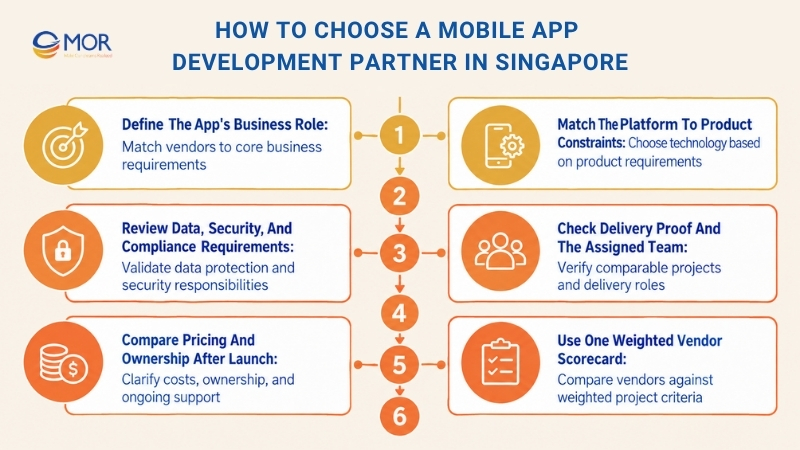
Define the app's business role
Write down the main user, action, connected systems, and business result before discussing Flutter, Swift, or Kotlin. Technical choices become easier once the product role is fixed.
A consumer app may depend on retention and payment flows. An internal operations app may care more about permissions, offline work, ERP data, and reliability.
- Customer-facing products: Check UX research, analytics, push notifications, payments, and app-store experience.
- Internal operations: Check identity, permissions, offline access, ERP or CRM links, and device management.
- Commerce: Review inventory, payment, promotion, loyalty, returns, and customer-data flows.
- Logistics: Check maps, location, scanners, notifications, offline use, and real-time status.
- Healthcare and finance: Give more weight to access controls, audit trails, security testing, data handling, and sector rules.
A company buying Singapore app development for a regulated workflow should ask for regulated project proof rather than accepting a polished consumer-app portfolio as evidence.
Match the platform to product constraints
Native iOS and Android give teams direct access to Apple and Google platform APIs. Cross-platform tools can reuse a large part of the codebase, which can lower duplicated work for products whose requirements fit that model.
Flutter and React Native remain common choices for shared-code business apps. PWAs suit products that need quick web access and lower installation friction.
- Native iOS: Choose Swift when iOS-specific APIs, Apple hardware, high graphical demand, or tight platform control drives the product.
- Native Android: Kotlin suits Android-first products that rely heavily on Android APIs or devices.
- React Native: A good fit for JavaScript-based teams and many business apps targeting iOS and Android.
- Flutter: Useful when the team wants one UI codebase and consistent visual behavior across platforms.
- PWA: Fits lighter mobile experiences that benefit from browser distribution.
If Apple-specific work sits at the center of your product, MOR Software’s guide to custom iOS app development explains the native route in more detail. Teams still deciding on technology can compare the top mobile app development frameworks and review established hybrid mobile application development company.
The choice should follow product requirements rather than agency habit. A vendor that proposes React Native for every brief or native development for every brief deserves a harder technical question.
Review data, security, and compliance requirements
Singapore’s PDPA applies to private organizations processing personal data, including mobile app developers. The PDPC states that developers must address requirements around consent and notification for the collection, use, and disclosure of personal data.
Map personal data before development starts. Account data, payment records, health details, location, device identifiers, uploaded documents, and analytics events can all create separate handling requirements.
- Consent and notification: Define what data is collected and why.
- Authentication: Review password, MFA, Singpass, SSO, or enterprise identity needs.
- Encryption: Cover data in transit and at rest where the risk calls for it.
- Permissions: Limit user and admin access according to role.
- Retention: Decide how long personal data remains in production systems.
- API security: Review token handling, secret storage, rate limits, and authorization.
- Logging: Keep audit information without exposing sensitive data inside logs.
- Security testing: Define code review, vulnerability checks, and penetration testing before launch.
A mobile app development company near me in Singapore can make workshops easier, but a nearby office doesn’t answer these technical questions. Ask who actually owns the architecture and security work.
Check delivery proof and the assigned team
Company portfolios often show the finished interface but little about what happened behind it. Ask how many users the app served, what integrations were built, who owned QA, and which team handled production incidents.
The person selling the project may never write or review the code. Meeting the proposed technical lead before signing closes that gap.
- Comparable mobile work: Request projects with similar user volume, integration depth, sector rules, or device needs.
- Named delivery roles: Map the PM, BA, designers, mobile engineers, backend engineers, QA, and DevOps roles.
- Technical proof: Ask for architecture samples, testing plans, API examples, and release methods that can be shared.
- Delivery ownership: Identify Singapore-based work and offshore work separately.
- References: Speak to clients where the engagement resembles yours.
An app programmer Singapore business already trusts can handle a narrow coding task. Larger connected products usually need design, backend, testing, product, and release roles around that developer.
MOR Software’s guide on how to hire mobile app developers covers team screening in more detail.
Compare pricing and ownership after launch
A cheap build can become expensive when the agreement leaves out source code, cloud accounts, app-store ownership, documentation, analytics, or production support. Put those items into the commercial comparison before choosing the lowest quote.
Fixed-price contracts suit defined scopes. Time-and-material or dedicated-team models fit products whose backlog will change through user feedback and business needs.
- Fixed price: Check assumptions, exclusions, acceptance rules, and change-request charges.
- Time and material: Review role rates, reporting, approval rules, and budget controls.
- Dedicated team: Confirm minimum commitment, team composition, replacement rules, and scaling terms.
- Code ownership: The contract should state ownership of source code, repositories, documentation, and build pipelines.
- Cloud ownership: Client-controlled AWS, Azure, GCP, Firebase, or related accounts can simplify future vendor changes.
- Store ownership: App Store Connect and Google Play Console accounts should normally sit under the client organization.
- Support SLA: Set incident priorities, response targets, maintenance windows, and release responsibilities.
A web app development Singapore quote may appear lower than a native mobile proposal because browser products avoid some store and device work. Compare like-for-like scope before deciding.
Use one weighted vendor scorecard
A scorecard stops sales polish from carrying too much weight. Give the largest weight to proof and technical work that match your actual product.
This sample allocation totals 100%, but you can shift it. A fintech product may put more weight on security, while a consumer MVP may move weight toward product design and release speed.
Evaluation factor | Suggested weight |
Relevant project evidence | 20% |
Mobile and backend engineering | 20% |
Security and compliance readiness | 15% |
Integration capability | 15% |
Delivery team and communication | 10% |
QA and release process | 10% |
Post-launch support | 10% |
The best mobile app development company in Singapore is the provider whose evidence matches your project, budget, team model, and risk profile. Treat the scorecard as a buying tool rather than a universal ranking.
Questions to Ask Before You Sign a Mobile App Contract
A contract should answer the operating questions that a sales proposal often skips. This is where buyers separate an attractive estimate from a delivery model they can manage after kickoff.
These questions also help when comparing a top mobile app development companies in Singapore against a smaller specialist, an offshore team, or a freelancer.
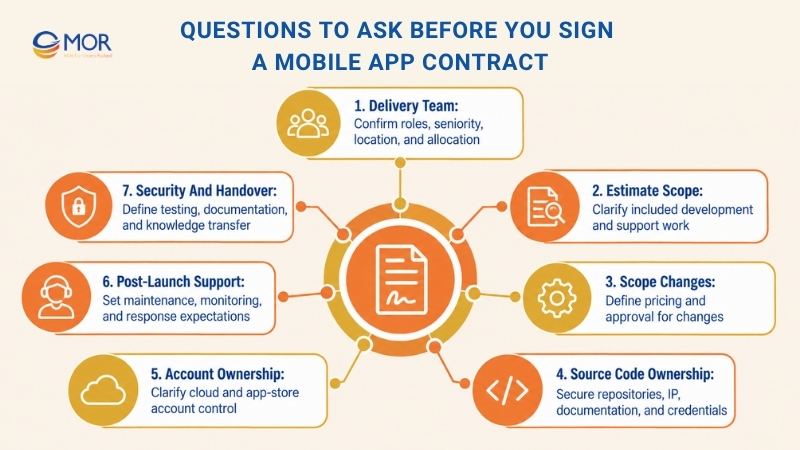
- Who will build the app? Ask for the actual team roles, seniority, location, and expected allocation. Meet the technical lead where possible.
- What is included in the estimate? Separate discovery, UI/UX, mobile development, backend, APIs, QA, cloud work, release, and support.
- How are scope changes priced? Define the approval path, estimation method, and budget control for change requests.
- Who owns the source code? Put repository ownership, IP, documentation, credentials, and handover duties in the contract.
- Who owns cloud and app-store accounts? Keep AWS, Azure, GCP, Firebase, App Store Connect, and Google Play Console under clear ownership.
- What happens after launch? Set expectations for bug fixing, monitoring, OS changes, releases, response times, and maintenance.
- How is security tested? Ask about code review, dependency checks, access controls, vulnerability testing, and independent penetration testing where needed.
- What does handover include? Request architecture notes, API documentation, deployment steps, environment details, test assets, and knowledge transfer.
A polished sales deck can’t replace these answers. The top mobile app development companies in Singapore should be able to explain the operating model without hiding behind generic methodology slides.
Conclusion
Choosing a mobile app development company in Singapore comes down to project fit, engineering depth, integration work, QA, ownership, and support after release. Price matters, but it’s only one part of the buying decision. MOR Software supports native, cross-platform, backend-connected, and long-term mobile products through teams in Vietnam and Japan.
Review our mobile app development services or contact us to discuss your platforms, integrations, expected users, timeline, and the right delivery setup for your project.
MOR SOFTWARE
Frequently Asked Questions (FAQs)
What do mobile app development services in Singapore usually include?
A typical engagement covers discovery, product requirements, UI/UX, iOS or Android development, cross-platform engineering, backend APIs, QA, deployment, app-store release, and maintenance. Wider projects can also include cloud systems, analytics, ERP or CRM integration, payments, AI functions, and production monitoring.
How much does mobile app development cost in Singapore?
SleekDigital’s 2026 planning bands place a simple one-platform MVP around S15,000-S40,000, a cross-platform business app around S40,000-S90,000, and complex operational products around S80,000-S180,000+. Backend scope, security, APIs, payments, AI, native work, and support can move the final budget.
How long does it take to develop a mobile app in Singapore?
A narrow MVP can take a few months. A medium business product often takes longer because design, APIs, testing, and store approval add work. Enterprise apps may run six months or more when ERP, payments, offline logic, security testing, migration, and several stakeholder groups enter the scope.
Should I choose native, Flutter, or React Native development?
Choose native Swift or Kotlin when platform-specific APIs, hardware access, graphics, or tight OS behavior drive the product. Flutter and React Native suit many cross-platform business apps because teams can share a large part of the codebase across iOS and Android. The product requirement should drive the decision.
Can mobile apps integrate with ERP, CRM, and payment systems?
Yes. Teams commonly connect apps to ERP, CRM, payment gateways, inventory, identity services, analytics, cloud databases, and internal APIs. The main work sits in authentication, data mapping, sync rules, error handling, permissions, and backend architecture rather than the mobile screens themselves.
How do I evaluate a mobile app development company in Singapore?
Check comparable project evidence, assigned team roles, backend depth, platform experience, QA, data security, communication, support, and source-code ownership. Ask where the engineers work and meet the technical lead before signing. Portfolio screenshots alone don’t prove that a vendor can handle your system requirements.
Does the whole development team need to be based in Singapore?
No. Local, offshore, and hybrid models can all work. Singapore-based product ownership may sit beside engineers in Vietnam, India, Romania, or another location. Confirm time-zone overlap, technical leadership, escalation paths, code access, meeting cadence, and which entity signs the contract.
Who should own the mobile app source code and cloud accounts?
The client should normally have clear contractual ownership of the source code, Git repositories, cloud accounts, production credentials, App Store Connect account, and Google Play Console. The agreement should also cover documentation, CI/CD access, design files, APIs, infrastructure details, and handover support.
What post-launch mobile app support should be included?
Post-launch work can cover monitoring, bug fixing, OS compatibility, dependency updates, security patches, performance tuning, analytics review, release management, and planned product changes. Ask for response times and scope limits so 'maintenance' doesn’t become an undefined monthly charge.
How does Singapore's PDPA affect mobile app development?
The PDPA affects how private organizations collect, use, disclose, retain, and protect personal data. App teams should map personal data, consent flows, user notifications, access rules, retention periods, third-party data sharing, security controls, and deletion processes before release rather than addressing them after development.
Share


Make Our-Dreams Realized


© 2023 . MOR Software. All Rights Reserved
Sitemap
Privacy Policy
Terms of Use

Rate this article
0
over 5.0 based on 0 reviews
Your rating on this news:
Name
*Email
*Write your comment
*Send your comment
1