


Odoo Implementation Cost: A Complete Pricing Guide 2026
Odoo implementation cost can feel hard to predict when licensing, customization, integrations, data migration, and support all shape the final budget. Many businesses ask how much does Odoo implementation cost before they know what scope really drives the price. In this MOR Software’s guide, we’ll break down pricing ranges, cost drivers, and planning tips for 2026.
How Much Does Odoo Implementation Cost In 2026?
Odoo implementation cost in 2026 can change a lot from one project to another. A basic launch that covers only finance and CRM will cost far less than a global rollout with manufacturing, inventory, accounting, HR, compliance reports, and custom integrations.
For companies in the US and larger global organizations, the cost of Odoo implementation often falls within these general ranges.
2026 Odoo Rollout Budget Ranges
Project Scope | Estimated Project Budget In 2026 |
MVP / Focused Launch | $50,000 - $120,000 |
Mid-Size Business Rollout | $120,000 - $300,000 |
Enterprise / Multi-Region Setup | $300,000 - $500,000+ |
These figures mainly cover the work needed to implement the system. Licensing, hosting, and long-term support may be planned as different budget items.
The final price depends on the number of modules, the user count, the amount of data for odoo migrations services, and the level of connection between Odoo and your current systems. A company with simple daily processes can often stay near the lower end. A business with several legal entities, currencies, warehouses, compliance rules, and live system connections will normally need a higher budget.
Odoo Customization Cost Benchmarks For The US Market
Customization is one of the main reasons an Odoo project budget can change.
Odoo already handles many standard business workflows. Costs rise when the platform must follow special approval rules, industry steps, report layouts, dashboards, user permissions, or internal operating policies.
US Odoo Customization Budget Benchmarks For 2026
Customization Area | Common Price Range | Effect On Budget |
Interface / Dashboard Updates | $500 - $2,500 | Low |
Workflow Automation For Approvals And Routing | $1,500 - $7,000 | Medium |
Advanced Reports / CFO Dashboards | $1,200 - $5,000 | Medium |
Industry Rules For Manufacturing And Traceability | $5,000 - $25,000 | High |
New Module Setup Or Extensions | $4,000 - $20,000+ | High |
US Consulting Rate Benchmarks For 2026:
- Basic configuration work: $75 - $110/hour
- Complex enterprise setup: $110 - $150/hour
Customization Budget Effect By Delivery Approach
Implementation Approach | Budget Effect |
Use standard Odoo processes | Baseline |
Align workflows with moderate configuration | +15% to 30% |
Recreate many old legacy workflows | +30% to 70% |
The biggest pricing issue is usually not whether Odoo can handle a workflow. The real question is how far your company wants to keep old ways of working instead of making processes simpler during ERP adoption.
Odoo Integration Cost For Connected Business Systems
Odoo implementation prepares the ERP setup. Integration makes that setup work with the other tools your business already uses.
For many mid-market and enterprise projects, system integration may take 20% to 35% of the full implementation budget. Live data sync, weak documentation, older software, and strict security rules can push the cost up fast.
US Odoo Integration Budget Benchmarks For 2026
Integration Category | Expected Cost Range | Sample Platforms |
Ready-Made Connector | $1,000 - $3,000 | Shopify, WooCommerce |
Standard API Connection | $3,500 - $8,000 | Stripe, ShipStation |
Several Connected Systems | $10,000 - $30,000 | CRM + WMS + finance tools |
Legacy ERP Connection | $15,000 - $40,000+ | AS400, custom ERP |
Budget Effect Of Integration Complexity
Complexity Level | Effect On Timeline | Effect On Budget |
Basic connector | Baseline | No change |
Real-time sync across several apps | +20% to 35% time | +20% to 40% cost |
Old or poorly documented system | +40% to 60% time | +30% to 70% cost |
Integration spending usually grows when:
- APIs are old or not explained well
- Data fields differ across systems
- Live updates are needed
- Security and permission rules are tight
- Different teams use different business tools
Many ERP budget problems come from integration work, not from basic module configuration.
Odoo Data Migration Cost And Common Budget Gaps
Data migration can seem easy during early discussions. The work often becomes more complex after teams review old system data.
Customer details may appear more than once. Inventory records may be stored in spreadsheets. Finance data may follow uneven field names. Sales and CRM records may include old or inactive information. Before migration, these records need cleaning, mapping, checking, and testing.
US Odoo Data Migration Budget Benchmarks For 2026
Migration Scope | Expected Cost Range |
Basic Contact / SKU Upload | $1,000 - $3,000 |
2-3 Years Of Finance Records | $5,000 - $15,000 |
Multi-Year Historical Records | $8,000 - $25,000 |
Complex Manufacturing Records | $10,000 - $30,000+ |
Data Quality Effect On Budget
Data Condition | Effect On Timeline | Effect On Cost |
Clean And Organized | Baseline | No change |
Some Inconsistency | +25% time | +15% to 30% cost |
Messy Or Split Across Many Sources | +40% to 70% time | +25% to 60% cost |
Low-quality data can slow down go-live, add more testing work, and make users less confident in the new ERP system.
Combined Cost Impact Summary
Cost Area | Common Share Of Total Implementation Budget |
Customization | 25% to 45% |
Integration | 20% to 35% |
Data Migration | 10% to 25% |
Core Configuration And Project Management | 15% to 25% |
For an enterprise rollout of $250,000, the budget could be split this way:
- Customization: around $75K - $110K
- Integration: around $50K - $85K
- Migration: around $25K - $60K
These three areas usually explain why Odoo implementation costs move up or down so much.
Main Factors That Shape Odoo Implementation Cost
Two businesses can select the same ERP platform but still have very different project budgets. Odoo implementation cost depends less on the software itself and more on how deeply the system must support daily work.
A company that uses Odoo development services only for finance and CRM has a smaller scope. A manufacturer that needs production planning, inventory traceability, procurement, accounting, and warehouse operations will need more setup work and more careful testing.
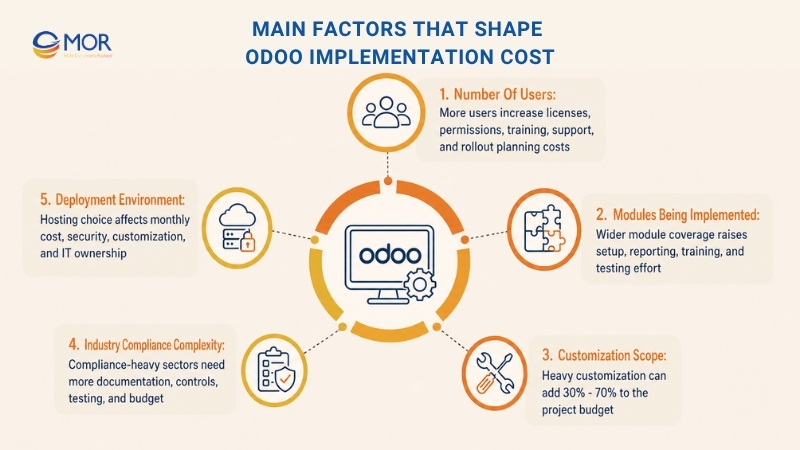
Number Of Users
User volume affects licenses, permissions, training, support, and change planning.
A team with 20 users may only need simple access rules and a few training sessions. A business with 300 users in finance, sales, warehouse, and operations will need role-based permissions, training for each department, user testing, and a support structure.
A larger user base also creates more report needs, approval routes, and support questions after launch.
Modules Being Implemented
Most companies do not launch every Odoo app at once. They often begin with the main modules that solve the most urgent business problems.
Common first modules include:
- CRM for sales pipelines and customer visibility
- Accounting for finance tracking and reporting
- Inventory for stock movement and warehouse control
- Manufacturing for production processes and planning
Wider module coverage means the project needs more coordination. Every department has its own data, workflows, approvals, reports, and training needs.
Customization Scope
Odoo customization can help Odoo match your business, but too much tailoring can raise cost and future support effort.
Common areas for customization include:
- Workflow changes
- Report layouts
- Approval structures
- Personalized dashboards
- Industry-specific rules
Careful customization can improve user adoption. Heavy customization can make upgrades harder and increase support costs later.
Industry Compliance Complexity
Some sectors need stronger reporting, traceability, audit history, security controls, and data checks.
Healthcare, fintech, manufacturing, logistics, and distribution often need more planning. Compliance can shape system design, data permissions, approval rules, documentation, and testing.
These needs may increase the budget, but ignoring them can create business and legal risks later.
Deployment Environment
Deployment choices affect hosting, security, scale, IT ownership, and long-term spending.
Common options include:
- Odoo Online for standard SaaS solutions development
- Odoo.sh for managed cloud hosting with more flexibility
- Cloud IaaS for enterprise-level scale
- On-premise hosting for strict control or compliance needs
The best option depends on customization needs, internal IT skills, data rules, and future growth plans.
Odoo implementation cost factors rarely come from only one area. The final budget shows how users, modules, workflows, integrations, and compliance needs must work together inside one connected ERP setup.
Odoo Deployment Cost Comparison: Cloud, On-Premise, And Managed Hosting
Odoo implementation cost can also change based on the way the system is deployed. Hosting choices affect speed, scale, customization freedom, security duties, and future maintenance work.
Before companies approve an ERP roadmap, they often compare Odoo Online, Odoo.sh, cloud infrastructure, and on-premise hosting.
Related Reading: Cloud Manufacturing Software Development: Benefits, Types & Cost
2026 US Deployment Budget Comparison
Deployment Option | Common Monthly Cost | Best Suited For | Main Point To Review |
Odoo Online (SaaS) | Included in subscription | Standard business processes | Less room for customization |
Odoo.sh Managed Cloud | $100 - $400/month | Growing SMBs and mid-market teams | Good balance of control and support |
Cloud IaaS (AWS/Azure/GCP) | $300 - $1,000/month | Enterprise-scale systems | Strong scalability |
On-Premise | $500 - $1,500+/month equivalent | Strict compliance environments | More internal IT work |
Odoo Online is a strong fit for businesses that can use standard features with limited changes. Odoo.sh works better for teams that need custom development with managed hosting support. Cloud IaaS gives large companies more control over infrastructure. On-premise hosting can suit organizations with strict internal rules or data sovereignty needs.
Choosing the deployment model early can prevent costly hosting changes after the project has already started.
Hidden Costs That Can Raise Odoo Implementation Cost
ERP budgets may look complete in the first planning meetings. After work begins, smaller cost items often become visible.
These expenses are normal, but many teams do not plan enough budget for them. For mid-sized and enterprise rollouts, hidden or secondary ERP spending may reach $10,000 to $60,000+ per year, based on company size and system scope.
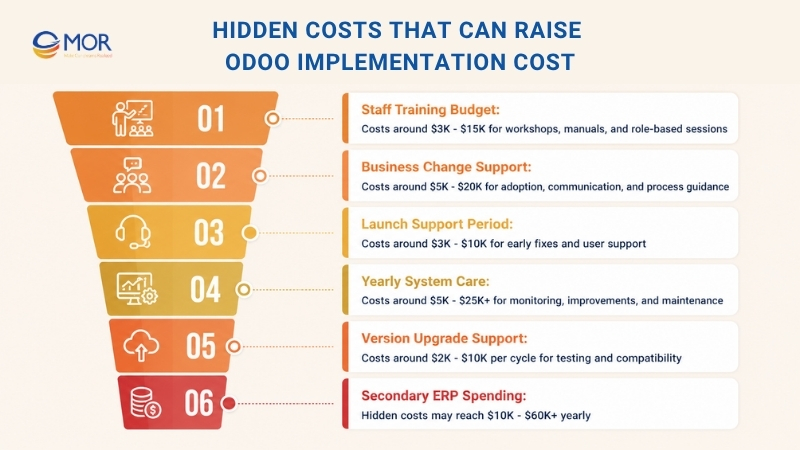
Staff Training Budget ($3K - $15K)
Training helps employees understand how to use the new system in the right way. Workshops, user manuals, role-based lessons, and admin sessions help reduce mistakes after launch.
Business Change Support ($5K - $20K)
ERP adoption changes daily routines for many teams. Communication plans, stakeholder updates, process walkthroughs, and user support help employees adjust with less confusion.
Launch Support Period ($3K - $10K)
After go-live, users often need support for reports, workflows, access rights, and small system fixes.
Related Reading: ERP AI Chatbot Development: Features, Use Cases & Benefits
Yearly System Care ($5K - $25K+)
Maintenance includes system monitoring, speed tuning, small improvements, bug fixes, and configuration changes.
Version Upgrade Support ($2K - $10K per cycle)
Odoo updates can need compatibility reviews, testing, and changes to custom modules.
Planning these costs before the project starts gives leaders a clearer picture of real ERP ownership.
ERP Implementation Lifecycle And Project Method
ERP projects usually run better when the rollout has a clear process. Without a defined project method, teams may deal with scope changes, missed needs, weak testing, and pressure on the budget.
For enterprise Odoo implementation, the full project budget often falls between $50,000 and $500,000+, depending on company size, integrations, customization, and data migration.
A normal Odoo implementation service often follows these stages, and some teams also compare a success pack Odoo option with partner-led delivery models.
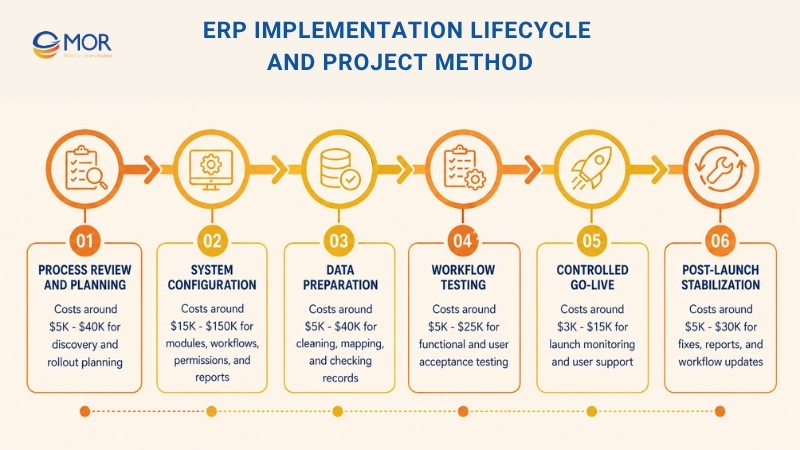
Process Review And Planning (~$5K - $40K)
The project team studies current workflows, existing tools, integration needs, compliance rules, and rollout goals. Careful discovery helps reduce costly changes later.
System Configuration (~$15K - $150K)
Odoo modules, workflows, access permissions, report structures, and approval rules are set up to support daily business work.
Data Preparation (~$5K - $40K)
Teams clean, map, organize, and check data before migration. This step helps protect report quality after the system goes live.
Workflow Testing (~$5K - $25K)
Functional testing and user acceptance testing check whether workflows, integrations, permissions, and reports operate correctly.
Controlled Go-Live (~$3K - $15K)
The ERP system is launched in a planned way. The team watches for issues and helps users during the switch.
Post-Launch Stabilization (~$5K - $30K)
After launch, the system is improved. Teams solve small problems, adjust workflows, update reports, and help users adopt the platform.
A clear project method lowers uncertainty and keeps the ERP investment connected to business goals.
Odoo Implementation Cost By Industry In 2026
Odoo implementation cost differs across industries because each sector has its own workflows, compliance needs, data structure, and system connections.
Industry | Common US Implementation Budget In 2026 | Main Cost Drivers |
Manufacturing | $150K - $500K+ | Production workflows, inventory traceability, supply chain integration |
Retail And E-commerce | $80K - $300K | Omnichannel links, payments, and live inventory sync |
Healthcare | $120K - $400K | Compliance, data security, system validation |
Distribution And Logistics | $100K - $350K | Warehouse links, vendor coordination, shipment tracking |
SaaS And Digital Businesses | $70K - $250K | Billing workflows, CRM links, analytics reporting |
The average cost of Odoo implementation for manufacturing is often higher because production rules and traceability need more detailed setup. Retail and eCommerce projects usually focus on payments, inventory updates, and sales across several channels. Healthcare and fintech teams often need stronger security and compliance planning.
When Odoo becomes more closely tied to daily operations, the implementation budget often grows.
Odoo Implementation Cost By Business Function
Odoo ERP implementation cost also changes by department. Finance, sales, HR, operations, and supply chain teams all need different workflows, reports, permissions, and integrations.
Business Area | Common US Implementation Budget In 2026 | Main Cost Drivers |
Finance | $40K - $150K | Reporting setup, compliance, and accounting integrations |
CRM / Sales | $25K - $120K | Data sync, customer lifecycle workflows, marketing integrations |
Supply Chain | $50K - $200K | Inventory tracking, vendor processes, logistics links |
HR | $20K - $90K | Payroll alignment, employee data migration, compliance reports |
Operations | $70K - $250K+ | Production workflows, traceability, operational reporting |
Many organizations roll out Odoo by business function. Finance and CRM may go live first, then manufacturing, supply chain, and analytics can follow in later phases.
This phased model lowers risk and gives users more time to get used to the new system.
Annual Odoo Maintenance Cost After Go-Live
Once Odoo is live, the budget moves from project spending to yearly ownership.
Maintenance helps keep the ERP system safe, stable, updated, and matched to changing business processes. Most businesses should plan around 15% to 25% of the original implementation budget each year.
2026 US Annual Odoo Maintenance Budget Breakdown
Cost Category | Common Yearly Cost | Coverage |
Support And Monitoring | $12K - $40K | Issue handling, user help, system checks |
Version Updates | $3K - $15K | Annual upgrades, compatibility work |
System Improvements | $6K - $30K | Workflow changes, small feature updates |
Hosting And Infrastructure | $700 - $8K | Cloud, managed hosting, or on-premise upkeep |
Maintenance matters more when companies use custom workflows or integrations. Without steady support, small issues can become reporting delays, workflow mistakes, or upgrade problems.
Practical Odoo Implementation Cost Scenarios For 2026
Cost ranges are useful, but leaders often need real-world budget examples. The examples below show how Odoo implementation cost can look for different business sizes.
Scenario | Common Budget | Typical Scope |
SMB / Focused MVP | $50K - $120K | Finance, CRM, limited integrations, basic data migration |
Mid-Market Rollout | $120K - $300K | Several modules, ERP integrations, structured reporting |
Enterprise Multi-Region | $300K - $500K+ | Multi-entity finance, compliance, advanced integrations |
An SMB launch usually focuses on speed and core workflows. A mid-market rollout often includes integrations, reporting, and stronger governance. An enterprise project may need multi-company accounting, regional compliance, advanced permissions, and several connected platforms.
These cases show that scope and business complexity usually affect cost more than the ERP platform itself.
How To Lower Odoo Implementation Cost Without Cutting Needed Scope
Lowering Odoo implementation cost does not mean removing important features. It means managing scope, reducing rework, and making better rollout decisions.
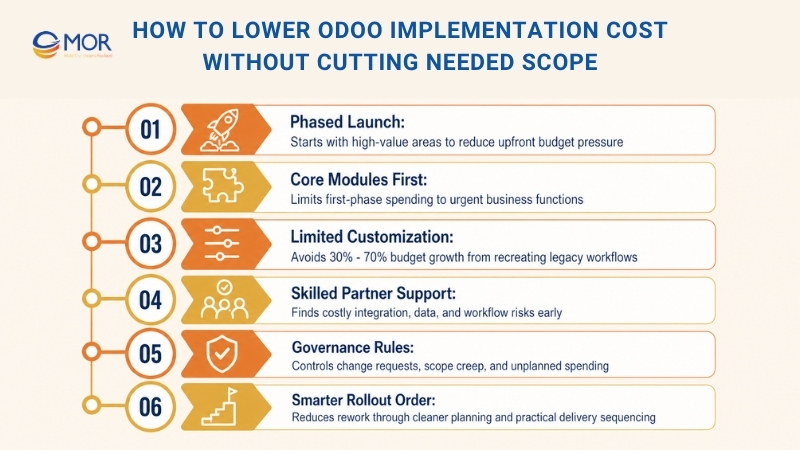
Start With A Phased Launch
Begin with high-value areas like finance, CRM, or inventory. A phased rollout helps teams learn the system before more departments are added.
Focus On Core Modules First
Choose the modules that solve the most urgent business issues. Extra features can be added after the main operation becomes stable.
Avoid Heavy Customization
Do not rebuild every old workflow inside Odoo. Standard processes and moderate configuration often lower cost and make future upgrades easier.
Work With A Skilled Partner
An experienced implementation partner can find integration risks, data problems, and workflow gaps early. This helps reduce costly fixes later.
Set Governance Rules Early
Clear scope rules, decision owners, and change control help stop budget creep.
Cost control comes from better planning, cleaner delivery, and smarter rollout order.
Odoo Licensing And Subscription Cost Structure In 2026
Before companies finalize Odoo implementation cost, they need to separate the Odoo license cost from the work needed to implement the system.
Odoo ERP pricing follows a subscription model for Enterprise users. Community Edition is free and open source, but it needs stronger technical ownership from your internal team. Odoo’s official pricing page lists One App Free, Standard, and Custom plans, and Standard and Custom provide all apps under one user-based fee. It also explains that implementation services, custom code maintenance, and Odoo.sh hosting are not part of the normal subscription. (Odoo)
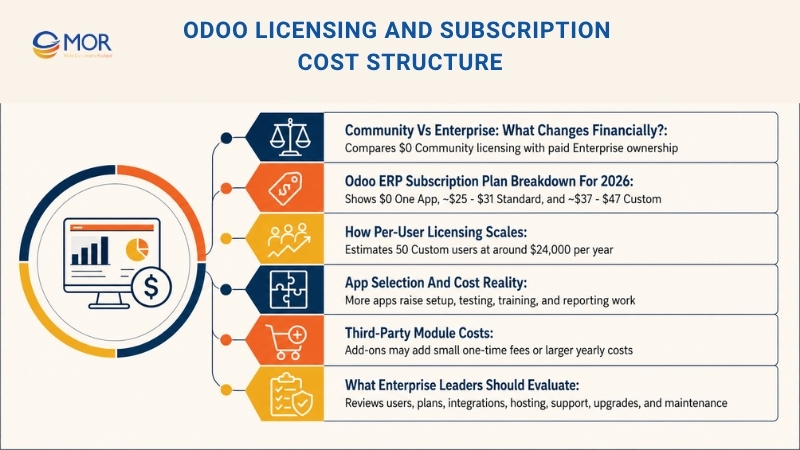
Community Vs Enterprise: What Changes Financially?
Community and Enterprise can both support ERP needs, but each option has a different cost structure.
Community Version
- License fee: $0
- No official vendor support
- No Odoo.sh managed hosting
- Fewer advanced apps and enterprise features
- More work for internal IT teams
- More self-managed upgrade and maintenance effort
If your team asks, “is Odoo free,” Community can be a fit for businesses with strong technical staff, lower compliance risk, and simpler workflows.
Enterprise Version
- Subscription based on user count
- Full app suite access
- Vendor support and bug fixes
- Upgrade services
- Managed cloud choices
- Stronger fit for structured growth and multi-department use
Odoo enterprise is often the better choice for mid-market and larger companies that need official support, integrations, multi-company operations, or advanced customization.
Odoo ERP Subscription Plan Breakdown For 2026
Odoo Enterprise usually gives companies three plan options.
Odoo Software Price Overview
Plan | Common US Price Per User / Month | Best Fit |
One App | $0 (single app limit) | Small teams testing Odoo |
Standard | ~$25 - $31 | SMB unified ERP rollout |
Custom | ~$37 - $47 | Mid-market and enterprise deployments |
Standard Package
- Access to core apps
- SaaS hosting
- No custom modules
- Limited API flexibility
- Fit for companies with standard workflows
Custom Package
- Full app access
- API access for integrations
- Multi-company support
- Odoo.sh hosting option
- Custom workflow flexibility
- Better fit for integration-heavy or enterprise projects
For companies with several entities, outside API needs, custom workflows, or advanced reporting, the Custom plan is often needed.
How Per-User Licensing Scales
Odoo licensing becomes easier to forecast after the user count is clear.
Example:
50 users on a Custom plan
$40 x 50 users x 12 months = around $24,000 per year
At 200 users, licensing can reach about $96,000 per year.
Licensing often costs less than many traditional ERP platforms, but it should still be planned across three to five years. More users, new departments, and extra entities can raise recurring spending.
Not every worker needs a full paid license. Some outside users, customers, suppliers, or partners may use portals, which can reduce licensing pressure.
App Selection And Cost Reality
Odoo’s paid plans are mostly user-based, not app-based. More apps do not always raise the subscription fee directly.
The work around those apps is what increases:
- Configuration time
- Training effort
- Testing scope
- Integration complexity
- Reporting setup
- Change management
Licensing may remain easy to predict, but implementation spending rises when the system must support more business depth.
Third-Party Module Costs
The Odoo marketplace offers many third-party modules. Some modules are free, while paid options may cost a small one-time fee or a larger yearly amount.
Common enterprise add-ons include:
- Shipping connectors
- Advanced reporting tools
- Payroll extensions
- Warehouse management improvements
- Industry compliance modules
One add-on may not move the budget much. Several modules used across many teams can become a serious cost item.
What Enterprise Leaders Should Evaluate
When planning licensing, CFOs and IT leaders should review:
- Expected user growth
- Standard vs Custom plan needs
- Integration requirements
- Hosting approach
- Multi-company setup
- Upgrade planning
- Support model
- Long-term maintenance effort
Licensing is not usually the largest part of Odoo implementation cost, but it becomes the recurring base of ERP ownership.
Total Cost Of Ownership For Odoo ERP
The first project budget often gets the most attention. Long-term ownership can matter just as much.
A TCO view helps leaders see Odoo ERP implementation cost beyond software licenses, including implementation, licensing, hosting, maintenance, support, upgrades, and later improvements. Some teams may use an Odoo pricing calculator as a starting point, but a full model should also include internal effort and future system changes.
Implementation Vs Lifecycle Cost
Cost Area | Common US Cost Range | Included Work |
Implementation | $50,000 - $500,000+ | Configuration, integrations, data migration, training |
Lifecycle Costs (Annual) | $20,000 - $120,000+ | Licensing, hosting, maintenance, support |
Implementation prepares the system for daily use. Lifecycle costs keep it stable, secure, updated, and useful after launch.
Subscription Renewals
Licensing is one of the easiest recurring costs to predict. It increases when more paid users are added.
Plan Type | Common Monthly US Cost Per User | Sample Yearly Cost |
Standard | ~$25 - $31 | 100 users ≈ $30K/year |
Custom | ~$37 - $47 | 100 users ≈ $45K/year |
Subscription costs should be checked every year because team size, plan needs, and regional pricing may change.
Maintenance Costs
Maintenance cost depends on how much the ERP system changes after go-live.
Support Level | Common Annual Cost | Coverage |
Basic Support | $8,000 - $25,000 | Small updates, monitoring |
Advanced Support | $25,000 - $60,000+ | Optimization, adjustments, ongoing improvements |
Companies with many custom modules, integrations, or compliance rules often need a stronger support plan.
Hosting Lifecycle Costs
Deployment choices affect yearly infrastructure spending.
Deployment Option | Common Cost Range | Notes |
Odoo Online (SaaS) | Included in subscription | Predictable recurring cost |
Odoo.sh Managed Cloud | ~$200 - $1,500/month | Based on usage |
On-Premise Hosting | $5,000 - $25,000/year | Infrastructure plus IT resources |
Hosting should be planned around scale, security, customization, and internal IT ownership.
Support Contracts
Support may come from an internal team, a partner, or a mixed model.
Support Setup | Common Cost | Best Fit |
Internal ERP Team | Variable payroll cost | Large enterprises |
Vendor Support Partner | $15,000 - $50,000/year | Mid-market to enterprise |
A strong support setup helps reduce downtime, solve workflow issues, and keep users confident after launch.
TCO planning helps leaders look past launch cost and understand what ERP ownership will require in later years.
Business Value Companies Can Gain From Odoo Implementation
Odoo implementation is more than a software project. It can help departments share data, manage workflows, and make decisions with less friction.
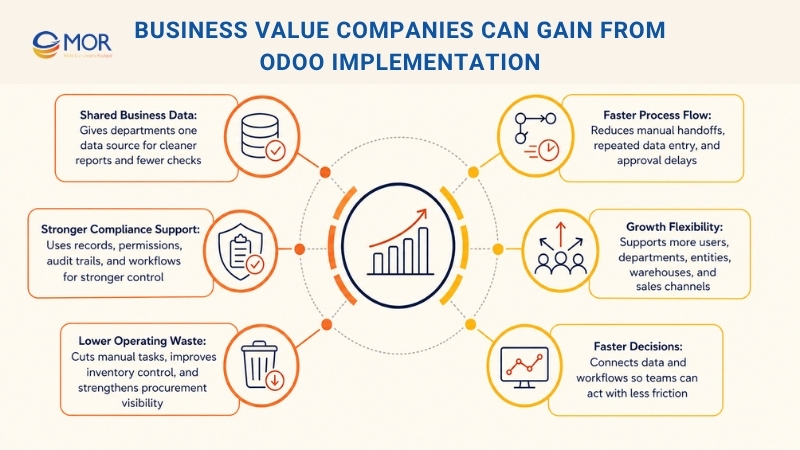
Shared Business Data
Finance, sales, inventory, operations, and management teams work from the same data source. This improves report accuracy and reduces time spent checking separate systems.
Faster Process Flow
Standard workflows reduce manual handoffs, repeated data entry, and disconnected approvals. Teams can handle orders, invoices, stock changes, and reports more quickly.
Stronger Compliance Support
Central records, user permissions, audit trails, and organized workflows help support better compliance management.
Growth Flexibility
Odoo can support more users, departments, entities, warehouses, and sales channels as the company grows.
Lower Operating Waste
Savings often come from fewer manual tasks, clearer reports, stronger inventory control, and better procurement visibility.
A well-planned Odoo rollout helps companies create connected operations where data and workflows support faster decisions.
Odoo Implementation Partner Pricing And Expected ROI
Odoo implementation cost can also depend on the partner’s location, seniority, delivery model, and project complexity.
In the US market, senior local consultants may charge $120 to $180/hour. Nearshore teams may cost $60 to $110/hour, while offshore specialists may range from $25 to $60/hour.
Many enterprises choose a hybrid delivery model. Local consultants help with strategy, governance, and stakeholder communication, while offshore teams support configuration, development, testing, and documentation.
ROI often appears within 12 to 20 months after go-live, based on user adoption, workflow automation, and reporting gains.
Improvement Area | Common Result |
Manual work reduction | 30% to 55% |
Order processing speed | 20% to 40% faster |
Inventory cost reduction | 10% to 25% |
Administrative productivity | 15% to 35% |
When Odoo is implemented with care, companies can reduce manual work, improve data quality, speed up operations, and make stronger decisions.
Sample Odoo Implementation Cost Budget For A US Business
A sample budget can make Odoo implementation cost easier to understand. The example below shows how a mid-sized US company might plan its first-year ERP budget.
Budget Item | Estimated Cost |
Licensing (30 users) | ~$8,500 - $9,000/year |
Core Implementation | ~$50,000 - $60,000 |
Integrations | ~$10,000 - $15,000 |
Data Migration | ~$6,000 - $10,000 |
Training | ~$5,000 - $8,000 |
Hosting | ~$2,000 - $3,000/year |
Maintenance (Year 2+) | ~$15,000 - $20,000/year |
Projected First-Year Total: ~$90,000 - $105,000
This example shows that implementation, integrations, and training often make up the largest upfront spending. Licensing, hosting, support, and maintenance shape the long-term cost of ERP ownership.
Why Choose MOR Software As Your Odoo Implementation Partner
Choosing the right Odoo implementation services partner can strongly affect cost control, user adoption, and long-term ERP value.
MOR Software helps businesses with ERP planning, business process review, system integration, outsourcing development software, and long-term technical support. Our team helps companies connect Odoo with real operating needs instead of treating ERP as a basic software setup.
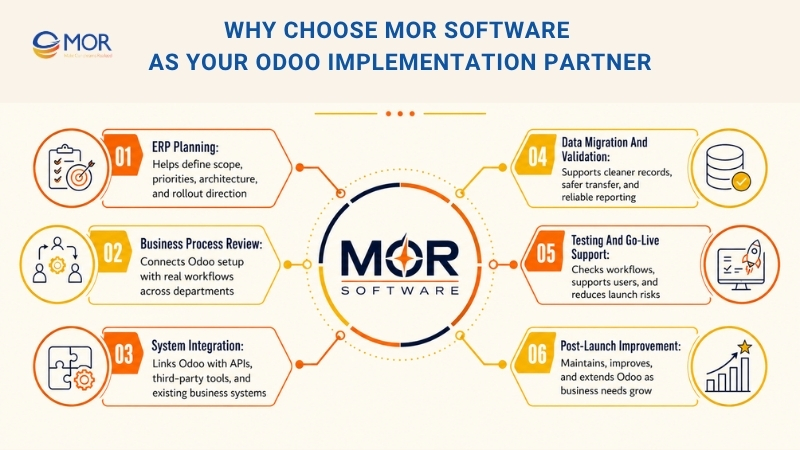
With experience in enterprise software, system integration, cloud solutions, and custom development, we help businesses plan Odoo implementation around clear scope, stable architecture, clean data migration, and user-friendly workflows.
Our delivery approach focuses on:
- Clear discovery and business process mapping
- Practical implementation planning
- Odoo manufacturing module configuration and customization
- API and third-party system integration
- Data migration and validation
- Testing and go-live support
- Post-launch maintenance and improvement
For companies working across finance, sales, inventory, manufacturing, distribution, HR, or eCommerce, MOR Software helps turn Odoo into a connected business management system that supports daily operations and future growth.
Conclusion
Odoo implementation cost depends on scope, users, modules, customization, integrations, data quality, hosting, and long-term support. A clear budget helps your team avoid delays, reduce rework, and plan ERP adoption with fewer surprises. With the right roadmap, Odoo can become a connected system for finance, sales, inventory, manufacturing, HR, and operations. If your business needs a reliable Odoo implementation partner, contact us to discuss your project with MOR Software.
MOR SOFTWARE
Frequently Asked Questions (FAQs)
How long does an Odoo implementation take?
Small or focused Odoo rollouts usually take 2 to 4 months. Mid-market projects often require 4 to 8 months. Enterprise or multi-region implementations may take 9 to 15 months. Timeline depends on modules, integrations, data quality, customization, testing, and internal decision speed.
How long to see ROI?
Many companies begin seeing measurable ROI within 12 to 20 months after go-live. ROI usually comes from faster reporting, less manual work, better inventory control, cleaner workflows, and stronger data visibility. The timeline depends on adoption quality and post-launch optimization.
How should ERP implementation budgets be structured?
ERP budgets should follow a total cost of ownership approach. This means planning for implementation, licensing, hosting, integrations, training, support, maintenance, and future upgrades. A three-to-five-year budget view helps companies avoid underestimating recurring ERP costs.
Is Odoo cheaper than SAP?
Odoo is often more affordable than SAP for many SMB and mid-market companies because its subscription model and modular structure can reduce licensing and implementation pressure. The best choice still depends on business complexity, industry requirements, integration needs, and long-term growth plans.
Why do ERP implementation budgets exceed initial estimates?
Budgets often increase because of scope changes, poor data quality, underestimated integrations, unclear workflows, and extra training needs. Many issues appear after detailed process mapping begins. Strong discovery, clean governance, and early data preparation help reduce overruns.
Why is planning and analysis important before ERP implementation?
Planning and analysis help connect ERP decisions with real business needs. Teams can define modules, users, workflows, data requirements, integrations, and testing plans before implementation begins. This makes the budget more accurate and reduces expensive changes later.
Why are training and change management critical for ERP adoption?
Training helps employees use Odoo correctly. Change management helps teams understand new workflows, responsibilities, and reporting processes. Without both, users may resist the system or continue using old spreadsheets and manual workarounds.
Share


Make Our-Dreams Realized


© 2023 . MOR Software. All Rights Reserved
Sitemap
Privacy Policy
Terms of Use

Rate this article
0
over 5.0 based on 0 reviews
Your rating on this news:
Name
*Email
*Write your comment
*Send your comment
1