


Offshore Odoo Development: Reduce Costs Without Sacrificing Quality
Offshore Odoo development lets businesses build, customize, and maintain Odoo ERP through skilled teams based overseas. It can lower hiring costs and give companies access to specialized ERP talent without expanding their internal workforce. Yet success depends on technical skills, clear requirements, and effective team management. In this guide, MOR Software will cover offshore Odoo services, benefits, risks, development processes, and partner selection.
Key Takeaways
- Offshore Odoo development gives businesses access to skilled ERP developers at competitive rates, without the long-term costs of building an in-house team.
- A reliable offshore team handles Odoo implementation, customization, integration, migration, and ongoing support through a defined development process.
- Choosing the right partner requires checking Odoo expertise, code quality, communication practices, security controls, and long-term support.
What Is Offshore Odoo Development?
Offshore Odoo development is the practice of outsourcing Odoo ERP implementation, customization, integration, migration, and maintenance to a development team in another country. Businesses use this model to access specialized technical skills and manage software development costs without hiring permanent employees locally.
An offshore team may include Odoo developers, functional consultants, business analysts, project managers, and QA engineers. These specialists work remotely with your internal stakeholders to configure ERP modules, develop custom functions, and connect Odoo with existing business systems.
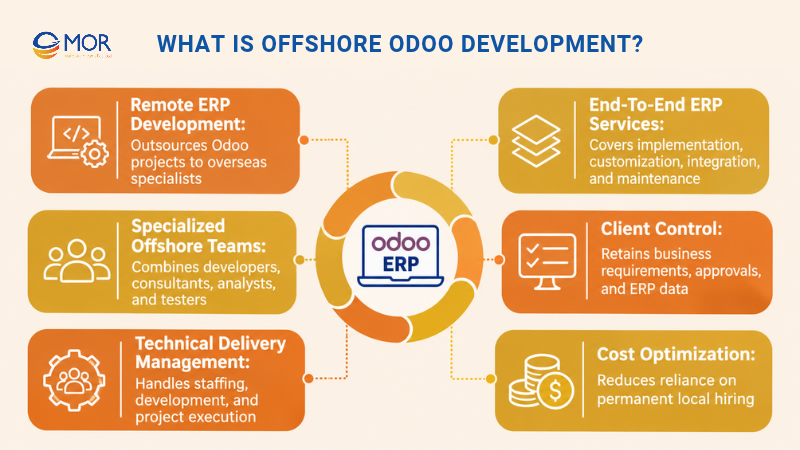
The company retains control over business requirements, project approvals, and ERP data. Meanwhile, the offshore provider manages technical delivery according to an agreed scope and schedule.
Odoo offshore development differs from onshore outsourcing mainly in the location of the development team. It also differs from in-house development because the external provider handles staffing, technical resources, and day-to-day development work.
For example, a UK retailer could work with a Vietnam-based Odoo team to connect Shopify orders with Odoo Inventory and Accounting. The offshore developers would handle system configuration and data synchronization, while the retailer would approve workflows and test the results before launch.
How Does the Offshore Odoo Development Process Work?
The offshore Odoo development process follows a structured approach to remote collaboration, software delivery, and ongoing maintenance. Each stage defines how the offshore team works with your business to turn ERP requirements into a working system.
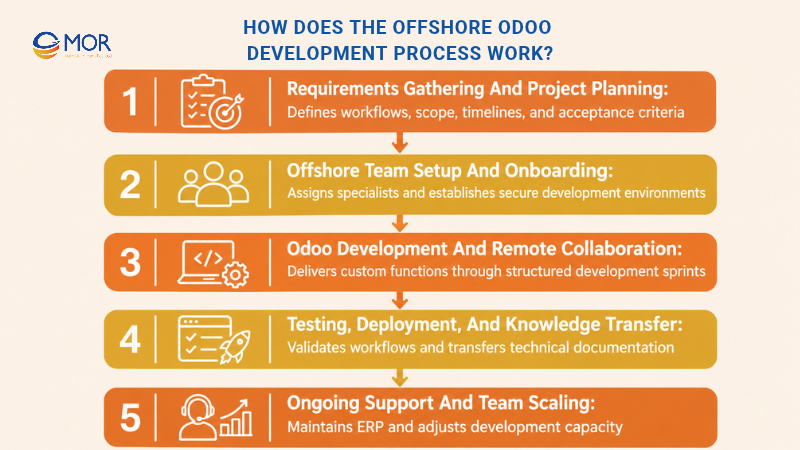
Requirements Gathering and Project Planning
The process begins with remote discovery meetings between your business stakeholders and the offshore team. Developers and consultants examine existing workflows, identify system gaps, and determine which Odoo modules fit your operational needs.
The team then prepares a project scope covering technical requirements, deliverables, timelines, and responsibilities. Clear acceptance criteria help prevent disagreements later, especially when custom workflows involve several departments.
Offshore Team Setup and Onboarding
Once the scope is approved, the provider assigns Odoo developers, functional consultants, and QA specialists based on project needs. Larger projects may also require a solution architect and a dedicated project manager.
The team establishes communication channels, working-hour overlap, and task management tools like Jira or Microsoft Teams. Secure repository access, development environments, and database permissions are configured before coding begins.
For longer engagements, businesses may choose a dedicated development team for hire to maintain consistent technical resources throughout the project.
Odoo Development and Remote Collaboration
Offshore developers configure standard Odoo modules and create custom functions when business requirements go beyond the built-in capabilities. Work is organized into development sprints with agreed tasks and review dates.
Project managers track progress through demonstrations, code reviews, and regular meetings. Your internal team can review completed functions, request adjustments, and approve each delivery before development moves forward.
This approach keeps technical work aligned with business expectations.
Testing, Deployment, and Knowledge Transfer
Before deployment, the offshore team runs functional, integration, and performance tests. Business users then complete user acceptance testing (UAT) to confirm that workflows match the agreed requirements.
Developers coordinate data migration, production setup, and release planning with the client. Technical documents, configuration records, and user training materials support the handover.
A controlled launch also needs database backups and a recovery plan.
Ongoing Support and Team Scaling
After launch, offshore developers monitor performance, fix defects, and maintain custom Odoo modules. Businesses can request new integrations, workflow changes, or version upgrades as their operations grow.
The development team can expand during major projects and contract when fewer resources are needed. Regular knowledge sharing helps maintain continuity, especially when new developers join the project.
What Services Do Offshore Odoo Development Teams Offer?
Offshore Odoo development services cover the technical work needed to implement, adapt, and maintain Odoo ERP. The exact scope depends on your current systems, business processes, and long-term ERP plans.
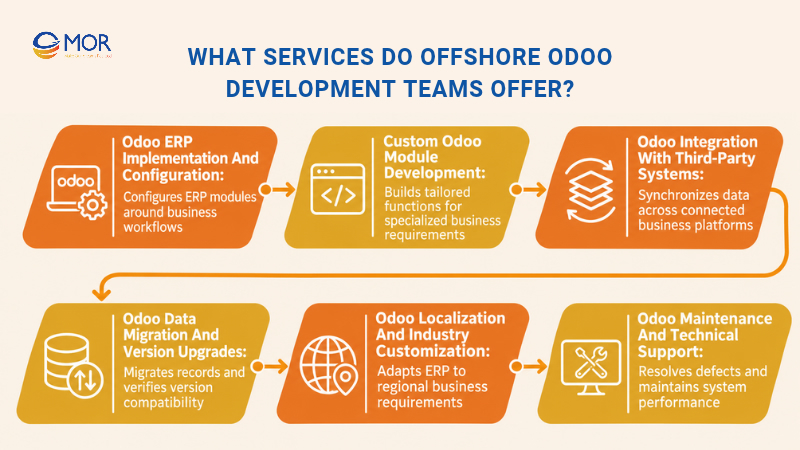
Odoo ERP Implementation and Configuration
Offshore teams set up Odoo ERP around your operational requirements. The work includes business analysis, gap assessment, module selection, configuration, and deployment planning.
Standard Odoo applications like Sales, CRM, Inventory, Accounting, and Manufacturing can support connected business processes. Developers should assess these built-in functions before proposing custom code, which adds maintenance work and future upgrade costs.
For example, a manufacturing business may connect purchase orders, stock movements, and production schedules within Odoo.
Custom Odoo Module Development
Custom module development addresses business requirements that standard Odoo applications can't fully support. Developers use Python, PostgreSQL, the Odoo ORM, and XML views to create functions that fit existing operations.
Common requests include approval workflows, specialized reports, and industry-specific business rules. Good Odoo ERP customization follows modular coding practices, allowing developers to maintain and update individual components without disrupting unrelated functions.
Odoo Integration With Third-Party Systems
Offshore teams connect Odoo with platforms like Shopify, WooCommerce, Salesforce, payment gateways, and shipping services. These integrations support order processing, inventory updates, customer records, and financial data exchange.
Reliable Odoo API integration requires accurate data mapping, authentication, error handling, and clear synchronization rules.
Odoo introduced its external JSON-2 API in version 19.0. According to the official Odoo API documentation, external API access on Odoo's hosted pricing plans is available under the Custom plan, rather than One App Free or Standard.
Teams should check hosting arrangements, API permissions, and subscription terms before starting integration work.
Odoo Data Migration and Version Upgrades
Offshore developers support businesses moving away from legacy ERP systems or upgrading older Odoo databases. The work includes data extraction, field mapping, cleaning, validation, and reconciliation.
Custom modules also require compatibility checks before major version upgrades. Developers use staging databases and regression tests to identify problems before production deployment.
For a detailed explanation of migration planning, review MOR Software's guide to Odoo migration and upgrade services.
A reliable migration plan accounts for downtime, backups, and the accuracy of historical records.
Odoo Localization and Industry Customization
Companies operating across countries need ERP configurations that match regional tax rules, accounting practices, currencies, and reporting requirements.
Offshore teams configure Odoo localization packages and adapt workflows for different business units. Manufacturing companies may require production tracking, while retailers may need country-specific invoices and payment methods.
Local finance or compliance specialists should review regulatory settings before deployment. Technical configuration alone doesn't confirm legal compliance.
Odoo Maintenance and Technical Support
Odoo requires ongoing maintenance after deployment, particularly when businesses rely on custom modules or external integrations.
Offshore support teams resolve defects, examine performance issues, update components, and investigate failed data transfers. Service-level agreements define response times, responsibilities, and escalation procedures.
Long-term support also covers technical documentation and upgrade planning, which helps businesses keep the ERP system aligned with changing operations.
Why Do Businesses Choose Offshore Odoo Development?
Businesses turn to offshore Odoo development when they need ERP expertise without committing to a large internal technical team. Lower staffing expenses, access to specialists, and flexible delivery arrangements are the main reasons.
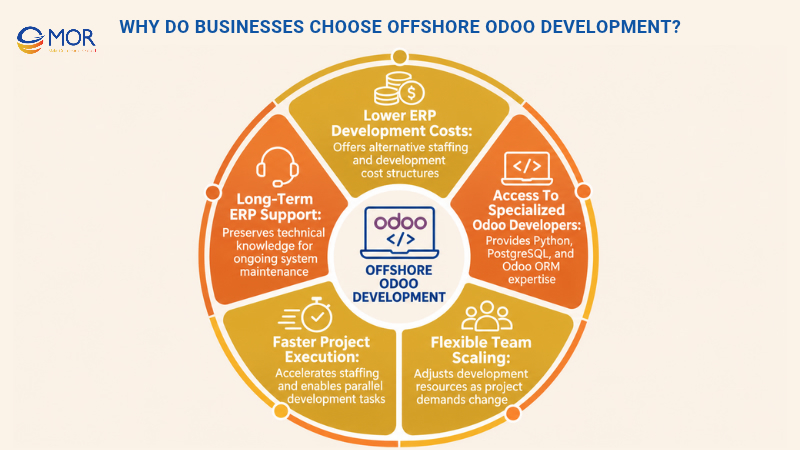
Lower ERP Development Costs
Hiring local developers involves salaries, recruitment, equipment, and administrative expenses. The US Bureau of Labor Statistics reported a median annual wage of $135,980 for software developers in May 2025, before considering additional employer costs.
Offshore teams can provide different labor cost structures, particularly in markets like Vietnam. Yet the final savings depend on developer productivity, project management, and rework.
A useful comparison covers in house payroll vs outsourcing, along with the total offshore software development cost.
Access to Specialized Odoo Developers
Odoo combines business process knowledge with technical development skills. Projects involving custom modules and complex integrations often require expertise in Python, PostgreSQL, Odoo ORM, and system architecture.
An experienced Odoo offshore developer understands how data models, access permissions, and standard modules work together. Offshore providers can also supply functional consultants and testers when the project requires broader expertise.
This helps companies avoid recruiting separate specialists for every stage of ERP development.
Flexible Team Scaling
Offshore staffing allows businesses to adjust development capacity as workloads change. A project may need more developers during integration and testing, followed by a smaller support team after deployment.
This flexibility is useful for businesses that don't require permanent ERP development resources. The offshore staff augmentation model can also add specialized talent to an existing internal team.
For instance, a company preparing a large ERP migration may temporarily add developers to handle custom module updates.
Faster Project Execution
An established offshore provider can assign available developers without a lengthy internal recruitment process. Development and testing tasks can also run in parallel when the project has clear dependencies.
Sprint planning, defined responsibilities, and regular demonstrations help teams maintain delivery schedules. Delays still occur when requirements are incomplete or business users take too long to approve changes.
A prepared project scope makes a greater difference than team size alone.
Long-Term ERP Support
An offshore team that stays involved after deployment retains knowledge of custom code, integrations, and business workflows.
That familiarity makes future maintenance and system changes easier to manage. Developers can investigate recurring issues, update modules, and support new business requirements without rebuilding their understanding of the ERP system.
Businesses also gain a more consistent support arrangement instead of relying on contractors for each new request.
What Are the Risks of Offshore Odoo Development?
Offshore Odoo development introduces risks that can affect delivery schedules, system performance, and data protection. Most problems arise from weak project governance, poor technical standards, or unclear responsibilities.
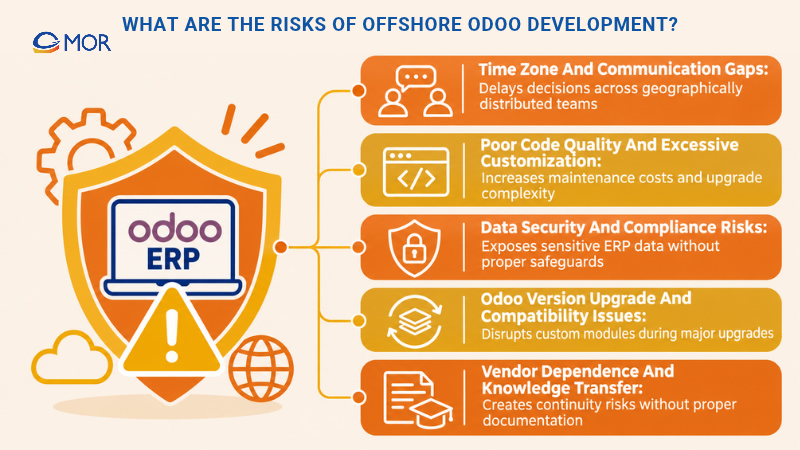
Time Zone and Communication Gaps
Offshore teams and clients may work in different time zones, limiting opportunities for real-time discussion. A delayed answer about an approval rule or integration requirement can hold up development.
Language differences also create problems when technical requirements contain unclear terms.
Agree on shared working hours, meeting schedules, and response expectations before the project begins. Written specifications and sprint demonstrations help teams confirm their understanding.
For complex workflows, visual diagrams and acceptance criteria communicate requirements more accurately than lengthy email discussions.
Poor Code Quality and Excessive Customization
Poorly designed custom modules can make Odoo difficult to maintain. Common problems include unnecessary changes to standard behavior, incorrect ORM usage, and limited automated testing.
Custom code may work during initial deployment but fail when other modules change. The repair work can consume a large share of the future ERP budget.
Set coding standards and require technical reviews before accepting new modules. A standard-first approach also limits changes that Odoo already supports through configuration.
Odoo code quality should be evaluated through maintainability, test coverage, and compatibility, not delivery speed alone.
Data Security and Compliance Risks
Offshore developers may need access to employee records, customer information, financial transactions, and other sensitive ERP data. Poor access controls can expose these records or allow unauthorized changes.
The financial risk is substantial. IBM's 2026 Cost of a Data Breach Report puts the global average breach cost at $4.99 million, a reminder that external system access requires careful control.
Businesses should define least-privilege permissions, secure remote connections, and clear data handling agreements. Non-disclosure agreements and audit logs add further accountability.
For cross-border data transfers, review GDPR and other applicable privacy requirements before granting production access.
Odoo Version Upgrade and Compatibility Issues
Odoo releases new versions that can change application behavior, data models, and supported development methods. Custom Python modules, XML views, and integrations may require updates before they work with a newer release.
Odoo's official upgrade guidance states that each major version receives three years of support. It also explains that databases containing custom modules need compatible module versions before an upgrade can proceed.
Offshore teams should maintain module documentation and test upgrades in staging environments. Regression testing can expose broken workflows before the updated system reaches business users.
Vendor Dependence and Knowledge Transfer
Heavy reliance on an offshore provider can create problems when the contract ends or key developers leave.
Businesses may struggle to maintain custom modules if they lack source code access, technical documents, or deployment instructions. Unclear intellectual property terms can complicate ownership further.
Define repository access, documentation standards, and knowledge transfer requirements in the contract. Keep business data under company-controlled accounts where possible.
A documented exit plan allows another team to continue development without rebuilding the entire system.
How to Choose the Right Offshore Odoo Development Company
Choosing an offshore Odoo development company requires more than comparing hourly rates. The right provider should understand Odoo's technical structure, your industry workflows, and the controls needed for long-term ERP delivery.
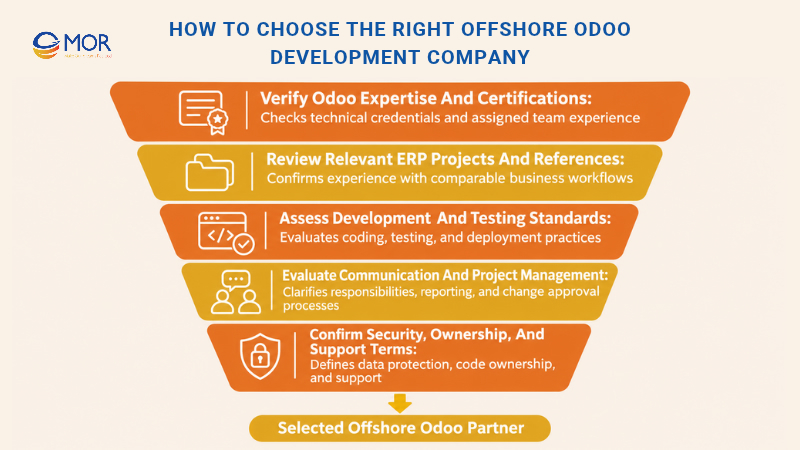
Verify Odoo Expertise and Certifications
Check whether the company has experience with Odoo Community and Enterprise, including implementation, integrations, and custom development.
Developers should understand Python, PostgreSQL, the Odoo ORM, and module architecture. Ask how they handle upgrades and avoid unnecessary custom code.
You can verify partner status and certifications through Odoo's official directory. A qualified Odoo implementation partner should also explain which certified specialists will work directly on your project.
Company credentials matter, but the assigned team's experience deserves equal attention.
Review Relevant ERP Projects and References
Ask potential partners for examples of Odoo projects involving similar workflows, industries, or system requirements.
A manufacturing project may require production planning and inventory tracking. A retail implementation could involve Shopify integration, payment processing, and stock synchronization.
Review the scope, technical decisions, delivery responsibilities, and verified business results. Client references can help confirm how the provider handles changes and issues.
You can also compare providers through MOR Software's list of top offshore software development companies 2026.
Assess Development and Testing Standards
Review how the provider manages code changes, testing, and deployment. Ask about Git repositories, code reviews, automated tests, and CI/CD pipelines.
The team should explain its approach to functional testing, integration testing, and UAT. Custom modules need additional checks because changes may affect standard Odoo workflows.
Request sample technical documentation or a walkthrough of a test environment. These materials often reveal more about delivery quality than a general sales presentation.
Evaluate Communication and Project Management
A good offshore partner establishes clear communication rules before development begins.
Confirm who manages requirements, tracks tasks, approves changes, and handles urgent issues. Regular sprint reviews allow stakeholders to check progress before problems accumulate.
Tools like Jira, Microsoft Teams, and shared documentation platforms support remote collaboration. Communication skills also matter during technical discussions, especially when business requirements change.
Ask for a sample project report to see how the provider documents progress, risks, and decisions.
Confirm Security, Ownership, and Support Terms
Check the contract for data protection, intellectual property ownership, confidentiality, and post-launch responsibilities.
Businesses should retain agreed rights to custom code, technical documentation, and project records. Support agreements need clear response targets and procedures for urgent incidents.
Before you hire offshore Odoo developers, confirm who controls production access, manages backups, and approves deployment changes.
The contract should also explain how knowledge transfer works if you move to another provider.
Partner With MOR Software for Offshore Odoo Development
MOR Software is a Vietnam-based software development outsourcing company founded in 2016. We support international businesses through enterprise software development, system integration, and offshore engineering teams.
Our approach connects technical delivery with business requirements. We assess existing workflows, identify development needs, and plan ERP solutions around the client's operations.
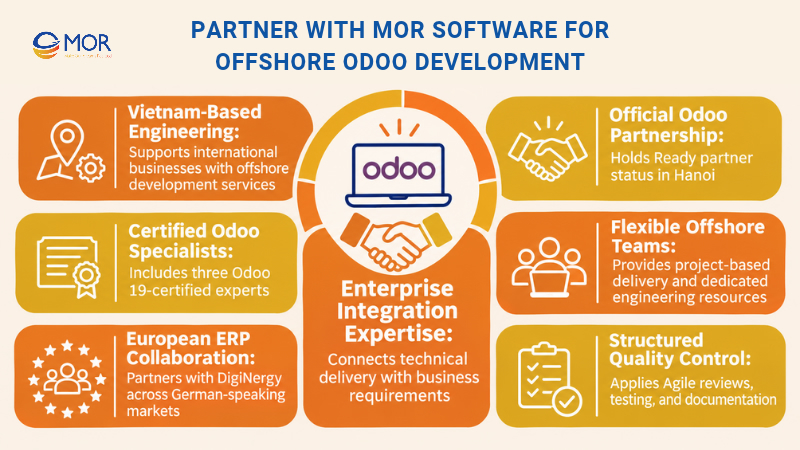
MOR Software also has a formal relationship with Odoo. The official Odoo partner directory lists our Hanoi branch as a Ready partner with three Odoo 19-certified experts.
Our Odoo capabilities also extend through international partnerships. On September 14, 2026, MOR Software announced its partnership with DigiNergy, a German technology company. The agreement focuses on Odoo ERP opportunities across Germany, Austria, and Switzerland, combining regional business consulting with our technical delivery resources.
Our offshore delivery approach focuses on the following areas:
- Odoo Development Expertise: We combine Odoo knowledge with Python development, enterprise software engineering, and system integration experience.
- Flexible Offshore Teams: Our offshore development services support project-based delivery and dedicated teams built around client requirements.
- Structured Quality Control: We apply Agile practices, development reviews, testing, and technical documentation throughout software delivery.
- International Collaboration: Our experience supporting overseas clients helps us coordinate requirements, project delivery, and long-term technical work.
For companies considering outsourcing to Vietnam, MOR Software provides a way to access engineering talent backed by established delivery processes.
Our team can discuss your Odoo implementation, customization, migration, or ongoing support requirements and help define a suitable development plan.
Conclusion
Offshore Odoo development can help businesses manage ERP costs, access specialized developers, and scale technical resources according to project needs. Strong results depend on clear requirements, maintainable code, secure access, and reliable communication. MOR Software supports companies planning Odoo implementation, customization, migration, and long-term ERP development. Our team can review your requirements and recommend a suitable offshore engagement model.
Contact us to discuss your Odoo project and request a tailored development proposal.
"Mr. Cong’s guiding philosophy is simplicity, believing that the simplest solutions are often the most powerful. He sees trust, empowerment, and the opportunity to demonstrate one’s abilities as the key elements that set MOR apart from traditional IT companies."
Mac Tien Cong


Division Manager (Hanoi Branch)
MOR SOFTWARE
Frequently Asked Questions (FAQs)
Is offshore Odoo development suitable for small businesses?
Yes. Small businesses can outsource specific Odoo tasks without maintaining a permanent ERP development team. A limited engagement may cover standard module setup, reporting changes, or one system integration. A well-defined scope helps control expenses and prevents unnecessary customization during the early stages of ERP adoption.
How long does an offshore Odoo development project take?
Timelines depend on the scope, number of modules, integration needs, and data quality. Small customizations may take days or weeks, while complete ERP implementations often require several months. Discovery, development, testing, migration, and user training all contribute to the schedule. Accurate estimates require a detailed requirements review.
Is it safe to outsource Odoo development to another country?
Offshore Odoo work can be managed securely when companies apply access controls, encrypted connections, confidentiality agreements, and proper monitoring. Developers should receive only the permissions needed for their tasks. Data protection agreements and local compliance reviews are also necessary when sensitive business information crosses national borders.
What is the difference between hiring an offshore Odoo developer and an offshore Odoo development company?
An individual developer usually handles assigned technical work, while an offshore company can provide developers, consultants, testers, and project management under one contract. A company may be better suited to complex ERP projects requiring several skills. Individual specialists can fit smaller tasks when your internal team manages delivery.
Can offshore developers work with Odoo Community and Enterprise?
Yes. Offshore developers can configure and customize Odoo Community and Enterprise, subject to each edition's available functions and licensing terms. Enterprise includes proprietary applications and support arrangements that differ from Community. Hosting choices also affect integration options, deployment control, and the technical work developers can perform.
Can offshore Odoo developers upgrade an existing ERP system?
Yes. Offshore teams can support upgrades from older Odoo versions and migrations from other ERP platforms. The process includes data preparation, custom-module updates, compatibility checks, and testing. Production changes should follow a tested migration plan with backups, reconciliation checks, and agreed recovery procedures.
Share


Make Our-Dreams Realized


© 2023 . MOR Software. All Rights Reserved
Sitemap
Privacy Policy
Terms of Use

Rate this article
0
over 5.0 based on 0 reviews
Your rating on this news:
Name
*Email
*Write your comment
*Send your comment
1