


Text Annotation Services: Types, Cost and How to Choose Providers
Raw text alone gives AI models little guidance on which words, meanings, or patterns to learn. Text annotation services turn this data into structured labels for natural language processing (NLP), machine learning, and large language models (LLMs). Poor labels can lead to wrong predictions, weak search results, and unreliable automation. This MOR Software guide will cover annotation types, workflows, quality checks, costs, and outsourcing options. You'll also learn how to assess providers before investing in an AI training project.
Key Takeaways
- Text annotation turns unstructured language into labeled datasets for NLP, machine learning, and LLM training. Common tasks include entity recognition, classification, sentiment analysis, and intent detection.
- Annotation quality depends on clear labeling rules, trained reviewers, gold-standard datasets, and regular quality checks. Human-in-the-loop workflows combine machine speed with human judgment.
- Text annotation pricing varies by task complexity, data volume, language, and review needs. Compare delivery models, request pilot results, and check the provider's quality metrics before signing a contract.
What Is Text Annotation?
Text annotation is the process of adding labels, tags, or metadata to unstructured text so machine learning models can recognize language patterns, meaning, and intent. These labels turn raw words and sentences into data that NLP systems can use for training, fine-tuning, testing, and automated analysis.
The source material can include customer emails, support tickets, product reviews, contracts, medical records, chat transcripts, and LLM conversations. Annotators mark relevant words, phrases, sentences, or entire documents based on predefined rules.
For example, consider the sentence: "I ordered an iPhone from Apple yesterday, but it arrived damaged." An annotation project might identify 'iPhone' as a product, 'Apple' as an organization, 'yesterday' as a date reference, and 'damaged' as a product issue.
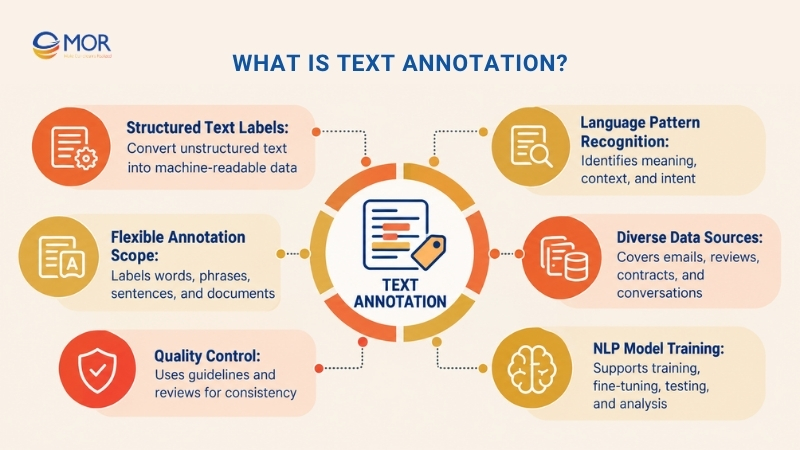
Professional text annotation services manage this work through trained annotators, labeling guidelines, review procedures, and structured dataset delivery. Projects that involve image, audio, or video data may require additional annotation services tailored to those formats.
Text annotation and text labeling are often used interchangeably. Some teams use 'labeling' for assigning categories to entire documents and 'annotation' for marking individual text spans, but that distinction isn't universal.
The decision about what to annotate in a text depends on what the model needs to predict. Inconsistent labeling can confuse a model, especially when words have different meanings across industries or languages.
Types of Text Annotation Services for NLP and LLMs
Different NLP tasks require different labeling methods. A chatbot needs to recognize user intent, a legal AI system must identify contract clauses, and a sentiment model examines the opinions expressed in customer feedback.
The main types of text annotation services cover seven areas.
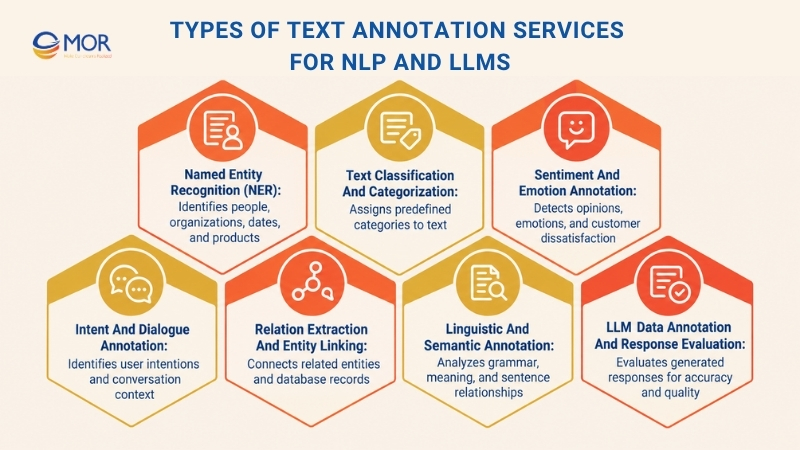
Named Entity Recognition (NER)
Named entity recognition identifies and classifies particular words or phrases, including people, companies, locations, dates, products, monetary values, and technical terms. Annotators mark the exact boundaries of each entity and assign a label that matches the model's taxonomy.
The CoNLL-2003 named entity recognition benchmark uses four main entity categories: persons, organizations, locations, and miscellaneous entities. Business applications often require custom labels for products, account identifiers, medications, or legal terms.
For instance, financial firms may annotate bank names, transaction amounts, and account references so AI systems can extract structured information from transaction reports.
Text Classification and Categorization
Text classification assigns predefined categories to sentences, messages, or whole documents. These labels can represent subjects, departments, document types, priority levels, policy categories, or customer requests.
A support platform might classify incoming tickets as billing, technical support, cancellation, or account access. Some messages need more than one label, particularly when customers report several issues in the same conversation.
Classification schemes can also follow a hierarchy. An insurance claim may fall under 'vehicle insurance' and a narrower category like 'collision damage,' allowing models to route documents more accurately.
Sentiment and Emotion Annotation
Sentiment annotation identifies the attitude expressed in text, commonly positive, negative, or neutral. More detailed projects classify emotions, dissatisfaction, urgency, or opinions about individual product features.
Take the review: "The camera works well, but the battery barely lasts a day." A basic sentiment model might struggle with this mixed opinion, whereas aspect-based annotation assigns a positive label to the camera and a negative label to battery life.
Businesses use these labels to analyze customer reviews, monitor complaints, study product satisfaction, and identify support conversations that require attention.
Intent and Dialogue Annotation
Intent annotation labels the purpose behind a user's message. It helps conversational AI systems distinguish questions, requests, commands, complaints, and actions that require a response.
Consider "Cancel my subscription after this month." The main intent is subscription cancellation, and the timing phrase provides a slot value that the chatbot must interpret before taking action.
Dialogue annotation extends this work across conversations. Annotators may track speaker roles, topic changes, unresolved requests, handoffs, and conversation outcomes so AI assistants can follow a discussion across several turns.
Relation Extraction and Entity Linking
Relation extraction identifies meaningful connections between entities. Entity linking goes further by matching a text mention to a specific record in a database or knowledge base.
A legal document may connect a company to an obligation, payment date, or contract term. An AI system reviewing financial news might link a company name to its official business record, preventing confusion between organizations with similar names.
These labels support knowledge graphs, document intelligence, search engines, and retrieval systems that need to understand relationships rather than recognize isolated words.
Linguistic and Semantic Annotation
Linguistic annotation records the grammatical structure of language through part-of-speech tagging, dependency parsing, and coreference resolution. These techniques help models identify sentence structure and determine how words relate to each other.
For example, coreference annotation identifies that 'the manager,' 'Sarah,' and 'she' refer to the same person across a document. Semantic role labeling can mark who performed an action, what happened, and who received the action.
These tasks support machine translation, document analysis, language research, and NLP systems that process complex writing.
LLM Data Annotation and Response Evaluation
LLM annotation covers training examples and judgments about generated text. Annotators may label instruction-response pairs, rank competing answers, check factual support, evaluate retrieved evidence, or flag responses that violate a policy.
A financial assistant, for instance, may produce two explanations of the same report. Human reviewers can rank those answers based on factual accuracy, completeness, clarity, and compliance with the source document.
This work supports supervised fine-tuning (SFT), reinforcement learning from human feedback (RLHF), and LLM evaluation. An LLM text data annotation outsourcing service may also recruit domain experts to assess responses that require medical, legal, or financial knowledge.
How Text Annotation Services Work
A typical text annotation project moves through requirements analysis, label design, annotator training, production, and quality review. Each stage addresses a different risk, and the early decisions shape the quality of the final dataset.
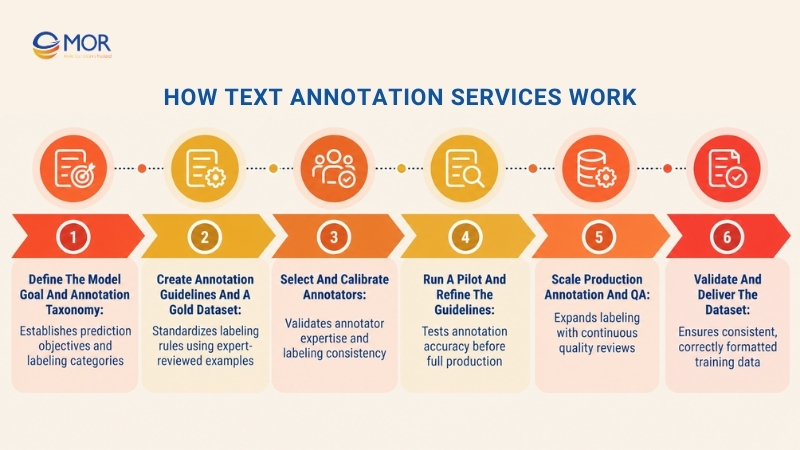
Define the Model Goal and Annotation Taxonomy
Start by identifying what the AI model should predict and which labels will support that task. A customer service model might need refund requests, billing complaints, product issues, and escalation categories rather than broad positive or negative sentiment alone.
The taxonomy must define label boundaries, overlapping categories, hierarchy, and expected outcomes. Teams should also decide how to handle messages that don't fit any approved category.
Create Annotation Guidelines and a Gold Dataset
Annotation guidelines explain every label through definitions, examples, counterexamples, and rules for uncertain cases. They should describe how annotators handle nested entities, slang, mixed sentiment, incomplete sentences, and conflicting signals.
The project team then creates a gold-standard dataset reviewed by qualified experts. These reference labels become the basis for training annotators and checking production quality.
Select and Calibrate Annotators
The right annotators need suitable language skills and subject knowledge. A clinical NLP project may require medical reviewers, whereas product classification can use trained general annotators following a clear taxonomy.
Calibration tests compare annotator decisions against the gold dataset before production begins. Disagreements expose unclear instructions and help managers decide where further training is needed.
Run a Pilot and Refine the Guidelines
A pilot tests the annotation process on a representative sample of real data. It should include straightforward examples, unusual language, overlapping labels, and cases likely to cause disagreement.
The team measures label consistency and reviews errors before expanding production. This stage also helps estimate annotation time, project cost, and staffing requirements for text data annotation services.
Scale Production Annotation and QA
Once the pilot meets the agreed quality targets, annotators work through the remaining data in controlled batches. Teams may use automated pre-labeling, human correction, sampled reviews, and double annotation for difficult records.
This stage often combines data collection and labeling when new records enter the project continuously. Senior reviewers resolve disputes, track recurring mistakes, and update instructions when new language patterns appear.
Validate and Deliver the Dataset
The final stage checks label consistency, missing fields, formatting errors, and compliance with the agreed schema. Providers commonly deliver NLP datasets in JSON, CoNLL, BIO tagging structures, CSV, or formats used by the client's machine learning pipeline.
The work should also support feedback after model testing. If an intent classifier repeatedly misreads cancellation requests, those failed examples can guide new annotation batches and further training.
Companies choosing data labeling outsourcing should establish who owns the annotation guidelines, review process, and final quality decisions. Clear responsibilities make it easier to manage production batches and correct errors before delivery.
Manual vs Automated vs Human-in-the-Loop Annotation
Text annotation can be performed manually, automatically, or through a combination of human reviewers and AI models. The suitable approach depends on dataset size, language difficulty, budget, and the consequences of labeling mistakes.
Automation has made clear progress. A 2023 study published in PNAS examined 6,183 text samples and found that ChatGPT's zero-shot annotation accuracy exceeded crowd-worker performance by about 25 percentage points on average across the tested tasks. These findings support automated labeling for certain classification tasks, but performance still needs testing against each project's own data and labels.
Free AI text annotation tools may lower software expenses through open-source platforms, but annotation review, taxonomy design, and project management still require staff time.
Approach | Best for | Human involvement | Quality potential | Scalability | Main limitation |
Manual annotation | Complex, small-scale, domain-specific tasks | Humans label and review records | Strong on ambiguous text when reviewers are trained | Limited by staffing | High labor cost and slower processing |
Automated annotation | Large datasets with stable, simple labeling rules | Humans handle setup and periodic checks | Strong on well-defined tasks after validation | High | Errors in unusual or ambiguous language |
Human-in-the-loop (HITL) | Production NLP and LLM projects requiring scale and review | AI suggests labels; humans check and correct them | Balances speed and human judgment | High when review effort is well managed | Requires model setup, review workflows, and ongoing QA |
Companies developing AI systems across borders must also decide where to place their engineering teams. MOR Software's guide to the best countries to outsource software development can help assess development locations, though annotation workforce requirements should be evaluated separately.
How to Measure Text Annotation Quality
High annotation accuracy depends on measurable controls at each project stage. A provider's claim of '99% accuracy' means little unless you know the sample size, reference dataset, review method, and task difficulty.
Research published in NeurIPS Datasets and Benchmarks 2021 estimated at least 3.3% labeling errors on average across 10 widely used benchmark test datasets. Those benchmarks covered text, images, and audio, demonstrating why even established evaluation datasets require label audits.
A dependable text annotation service should report quality at the label and batch levels, not through one overall score.
Quality metric | What it measures | Why it matters | When to monitor |
Inter-annotator agreement (IAA) | Consistency between annotators using measures like Cohen's kappa or Krippendorff's alpha | Reveals unclear labeling rules and subjective decisions | Pilot and production |
Gold-set accuracy | Agreement with expert-approved reference labels | Checks whether annotations meet the expected standard | Calibration and each production batch |
Per-label precision | Correctness of individual entity or class labels against a reference set | Finds weak categories hidden by average accuracy | Pilot, QA, and final audit |
Rework rate | Share of records requiring correction or relabeling | Tracks quality problems and additional labor cost | Each batch |
Reviewer disagreement | Cases that need adjudication | Highlights unclear guidelines and difficult examples | Throughout annotation |
Edge-case error rate | Errors involving rare, ambiguous, or complex text | Tests reliability beyond straightforward records | Pilot and targeted audits |
Class balance | Distribution of labels across the dataset | Identifies gaps that may affect model training | Data preparation and delivery |
Annotation drift | Changes in labeling decisions over time | Detects declining consistency or outdated rules | Weekly or per batch |
Guideline version history | Changes to definitions and labeling decisions | Supports traceability and consistent rework | Whenever instructions change |
Quality targets should reflect the task. Clinical entity extraction may need tighter acceptance rules than basic topic classification, and ambiguous sentiment may produce lower agreement than straightforward document categorization.
Text Annotation Use Cases Across NLP and LLMs
Businesses use annotated text to train AI systems that process customer language, business documents, and generated responses. The required labeling approach changes with the industry, source data, and decisions that the model must support.
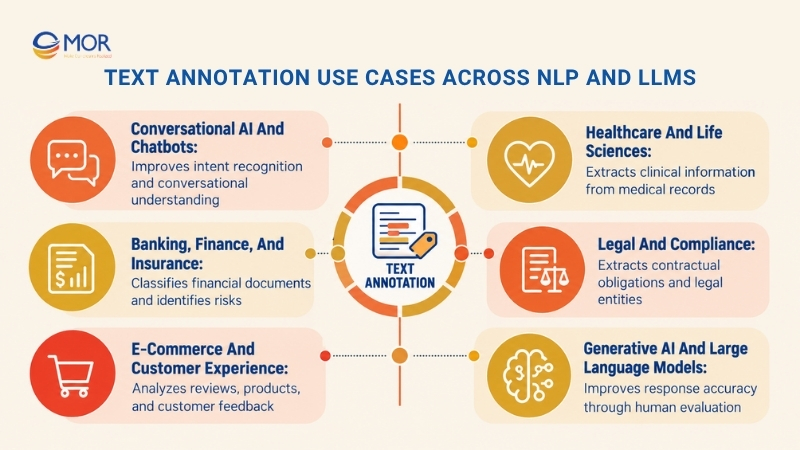
Conversational AI and Chatbots
Chatbots use intent labels, entity recognition, and dialogue annotation to interpret requests and select suitable responses. A retail assistant may distinguish between tracking an order, requesting a return, reporting damage, and updating payment information.
Conversation labels also capture unresolved issues, customer frustration, and escalation points. These annotations help teams test whether the assistant handles real support conversations as intended.
Healthcare and Life Sciences
Healthcare NLP systems process clinical notes, prescriptions, medical reports, and patient communication. Typical annotations identify symptoms, medications, diagnoses, dosage information, medical procedures, and personally identifiable information.
Projects involving medical text annotation services often require reviewers familiar with clinical terminology. For instance, distinguishing a suspected condition from a confirmed diagnosis depends on the surrounding medical language, which generic entity recognition may misread.
Banking, Finance, and Insurance
Financial institutions use annotated text to classify complaints, extract entities from documents, identify risk signals, and analyze customer requests. Know Your Customer (KYC) workflows may require labels for names, addresses, company identifiers, and transaction references.
Financial language contains abbreviations, product-specific terms, and regulatory expressions. Domain-aware labels help AI models distinguish routine account activity from messages that need further review.
Legal and Compliance
Legal annotation covers contract clauses, parties, obligations, jurisdictions, dates, and document categories. Contract review systems use these labels to find renewal terms, payment conditions, termination rights, and other details within lengthy agreements.
The same approach supports eDiscovery and compliance monitoring. Accurate relationship labels help the model connect a contractual obligation to the party responsible for fulfilling it.
E-commerce and Customer Experience
Retail and e-commerce teams annotate product descriptions, customer reviews, support tickets, and user-generated content. These datasets support product attribute extraction, sentiment analysis, moderation, and automated ticket classification.
For example, a review mentioning slow delivery and good product quality contains two different signals. Aspect-based annotation allows the model to separate shipping dissatisfaction from positive product feedback.
Generative AI and Large Language Models
Generative AI systems require human-reviewed examples for supervised fine-tuning, preference ranking, retrieval evaluation, and safety testing. Annotators assess whether generated answers follow instructions, reflect source documents, and address the user's request.
LLM projects also use preference data to compare responses and identify unsupported claims. Domain specialists become especially valuable when evaluating answers involving technical documents, legal terms, or financial information.
Companies planning to build AI applications may also need external engineering teams to handle model integration, backend development, and deployment. Our guide to the best IT outsourcing companies can help you compare development partners for these technical requirements.
Text Annotation Services Cost and Pricing Models
Text annotation services can cost a few cents per label or several thousand dollars for a managed project. Pricing depends on the annotation unit, volume, language, technical difficulty, reviewer expertise, and quality requirements.
For a public benchmark, Label Your Data lists NLP entity annotation starting at $0.02 per entity and time-based annotation at $6 per annotator hour. These are one provider's published rates, not industry averages.
The table below combines that starting benchmark with illustrative planning ranges for other billing models. Actual quotes may fall outside these ranges, particularly for specialized or regulated work.
Pricing model | Estimated cost ($) | Suitable projects | Main cost driver | Buyer consideration |
Per entity | 0.02–0.10+ per entity
| NER, entity extraction | Entity complexity, nesting | Easy to forecast when the entity count is known |
Per record | 0.05–1+ per record
| Classification, sentiment, intent | Text length, number of labels | Suitable for short, standardized records |
Per document | 1–20+ per document
| Legal, healthcare, finance | Length, domain complexity | Long documents may require detailed review |
Per character/token | Custom quote | Large text collections | Annotation density, text volume | Define exactly what counts as billable text |
Per hour | 6–60 per hour
| Complex or changing annotation tasks | Expertise, workforce location, QA | Track productive hours and review effort |
Fixed project | 3,000–10,000+
| Projects with defined scope | Volume, deadlines, QA requirements | Agree on revisions and acceptance criteria |
Managed retainer | 3,000–10,000+ per month
| Ongoing annotation programs | Team size, workload, management | Agree on capacity and monthly deliverables |
Note: Except for the cited vendor starting rates, these figures are indicative budget assumptions, not verified market averages.
The total budget should account for more than first-pass labeling. Data preparation, project management, platform licenses, senior review, double annotation, secure processing, and rework all add expense.
Changes to the taxonomy can be especially costly. A new label definition introduced halfway through production may require thousands of completed records to be reviewed again.
Providers may also use different billing units for similar work. Ask each company to separate labeling, QA, tooling, and management charges so you can compare the full project cost.
If the project also requires offshore AI engineers, consult offshore software development rates by country when planning that separate budget. Developer rates and annotation unit prices measure different types of work, so keep them distinct in your estimates.
For accurate budgeting, request a pilot on your own records. The sample should reflect real data length, ambiguity, languages, and review requirements before you agree on larger production volumes.
How to Choose a Text Annotation Service Provider
Choosing a provider requires more than comparing hourly rates or company size. Your team needs evidence that the vendor can interpret the target language, apply the taxonomy consistently, protect sensitive data, and deliver files that your models can use.
The best text annotation services company for your project is the one that meets your quality targets on representative data at a workable total cost.
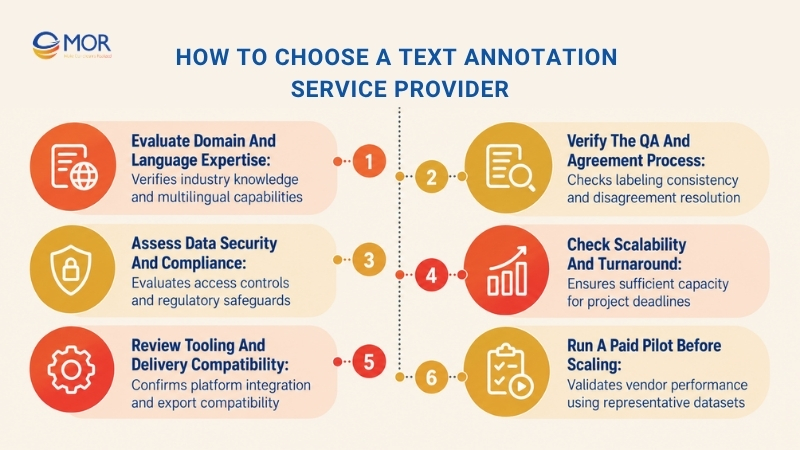
Evaluate Domain and Language Expertise
Check whether annotators understand the vocabulary, grammar, and industry terms found in your dataset. A general labeling workforce may handle product categories well but struggle with medical diagnoses, financial language, or multilingual customer complaints.
For multilingual text annotation services, ask about native speakers, regional dialects, code-switching, and review coverage. LXT reports coverage across more than 1,000 language locales, but a large network alone doesn't prove quality in your required language.
Verify the QA and Agreement Process
Ask the provider to explain its gold-standard dataset, calibration tests, inter-annotator agreement metrics, and adjudication process. The team should report errors by label and batch so you can identify weak areas before they spread across the dataset.
Request examples of how reviewers handle difficult records. A credible QA process documents disagreements, changes to labeling rules, and the steps taken to correct recurring mistakes.
Assess Data Security and Compliance
Sensitive text may contain customer identities, financial details, medical information, or internal company records. Review access controls, non-disclosure agreements, audit logs, data retention policies, and deletion procedures before sharing production data.
For regulated projects, check the provider's applicable ISO 27001 credentials and its GDPR or HIPAA obligations. Ask for evidence covering the actual delivery environment, subcontractors, and data-handling process rather than accepting broad compliance claims.
Check Scalability and Turnaround
Large annotation projects need enough trained reviewers to meet deadlines without weakening quality. Ask how the provider recruits, trains, and manages additional annotators when workloads increase.
Crowdsourcing platforms can fit straightforward, high-volume tasks. Services associated with clickworker data annotation, for example, follow a distributed contributor model, so buyers should establish how workers are screened and results reviewed.
Companies often outsource text annotation services when internal teams lack capacity, specialized language skills, or the time to manage daily labeling work. A managed partner becomes more useful when the project requires ongoing coordination, reporting, and reviewer supervision.
Review Tooling and Delivery Compatibility
The provider should work with your labeling environment and export data in the format required by your ML pipeline. Common tools include Label Studio, Prodigy, Doccano, Amazon SageMaker Ground Truth, and custom enterprise platforms.
Clarify whether your team needs annotation platform setup, data import, annotator staffing, quality review, or model integration. These tasks require different skills and affect the quote.
Check that the provider can import existing labels, support human review, maintain taxonomy versions, and deliver validated files without extensive conversion work.
Run a Paid Pilot Before Scaling
Test shortlisted vendors using the same representative dataset and written guidelines. Include unusual entities, mixed-language messages, sarcasm, and records that experienced reviewers may interpret differently.
Agree on accuracy targets, turnaround, reporting, and correction rules before the pilot starts. The results will provide stronger evidence than marketing claims or a general promise of quality.
For teams weighing the wider benefits of IT outsourcing, compare the total work involved in internal staffing against outsourced data labeling. Include supervision, training, rework, and data handover in the decision.
Common Text Annotation Challenges and Solutions
Annotation projects often fail when the labeling rules can't handle real language. Customers use slang, change topics, omit details, and express mixed opinions, leaving reviewers to interpret statements in different ways.
A good production plan identifies these difficulties during the pilot and assigns clear rules for handling them.
Challenge | Impact on dataset/model | Recommended solution |
Ambiguous label definitions | Different annotators assign conflicting labels | Write clear definitions, examples, and counterexamples |
Overlapping categories | Models learn inconsistent class boundaries | Define multi-label rules and label priority |
Nested entities | NER systems miss or misclassify entity spans | Set rules for nested and overlapping entities |
Sarcasm and implicit sentiment | Sentiment predictions miss the intended meaning | Include difficult examples and expert review |
Code-switching and multilingual text | Wrong labels appear across mixed-language records | Use suitable language reviewers and mixing rules |
Limited domain knowledge | Medical, legal, or technical terms get mislabeled | Assign trained domain specialists |
Annotator disagreement | Dataset consistency declines | Use calibration and senior adjudication |
Annotation drift | Labels change meaning across production batches | Track agreement and guideline versions |
Poor sampling | Rare but costly errors remain unnoticed | Review samples across classes and difficulty levels |
Class imbalance | Models perform poorly on rare categories | Track class distribution and collect targeted examples |
Sensitive information | Data exposure and compliance risks increase | Mask identifiers and restrict dataset access |
Premature scaling | Weak rules generate large volumes of incorrect labels | Complete a pilot before expanding production |
Keep an escalation option for records that don't match the approved rules. Forcing every ambiguous example into a category creates label noise and makes later model debugging harder.
The underlying issue often starts before labeling begins. For further planning, MOR Software's guide to data labeling outsourcing covers the wider decisions involved in sourcing and managing annotation work.
Turn Annotated Text Into Production AI With MOR Software
Text annotation prepares the data that AI models learn from. Companies then need reliable data pipelines, suitable models, application integration, and production deployment to turn those datasets into working AI systems.
MOR Software JSC supports this work through our AI development services, covering feasibility assessment, data engineering, custom AI models, Generative AI integration, and cloud deployment.
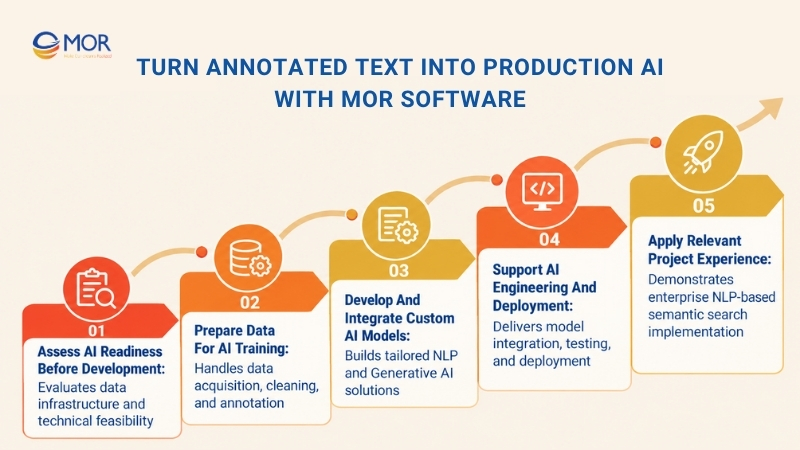
- Assess AI readiness before development: Our Feasibility Assessment reviews your data infrastructure, business goals, and expected KPIs. We help teams identify whether their existing text datasets, technical resources, and development plan support the proposed NLP or LLM application.
- Prepare data for AI training: MOR Software's Data Engineering service covers data acquisition, cleaning, and annotation as part of broader data preparation. This fits companies dealing with inconsistent records, fragmented sources, or datasets that need further technical work before model development.
- Develop and integrate custom AI models: Our Custom Model Service focuses on deep learning models tailored to business requirements. We also provide Generative AI integration and application development capabilities for projects involving language understanding, automated classification, intelligent search, or AI-assisted workflows.
- Support AI engineering and deployment: MOR's AI technology stack includes Python, FastAPI, TensorFlow, Amazon SageMaker, Databricks, Qdrant, Docker, and Kubernetes. Our delivery process covers auditing, strategy, development, integration, user acceptance testing (UAT), and production deployment.
- Apply relevant project experience: MOR Software's AI-Powered Semantic Search Transformation project involved an NLP-based search solution for a Japanese enterprise. It demonstrates our experience developing search systems that process business data and help users find relevant information.
Our services fit startups and enterprises that need to prepare data for AI, build custom NLP applications, modernize search, or integrate language models into existing systems. We support fixed-price projects, staff augmentation, and dedicated engineering teams depending on the scope and delivery needs.
Companies planning an NLP or LLM project can share their dataset requirements, target workflows, and integration goals with MOR Software. Our team can assess the technical scope and recommend a suitable development approach.
Conclusion
Text annotation services give NLP and LLM teams structured data for training, evaluation, and reliable language processing. The right provider should match your annotation needs, quality targets, budget, and data security requirements. A pilot can reveal costly labeling problems before production begins. If your project also requires data engineering, custom AI models, or system integration, MOR Software can assess the technical scope and development options. Contact us to discuss your AI project and plan the work ahead.
"Evolution is not a destination, it is a disciplined journey of innovation."
Phung Van Tu


CEO MOR AI
MOR SOFTWARE
Frequently Asked Questions (FAQs)
What are text annotation services?
Text annotation services involve labeling unstructured text with metadata that AI models can use for training and evaluation. Common tasks include entity recognition, sentiment analysis, text classification, and intent detection. Professional providers also manage annotator training, labeling guidelines, quality checks, and dataset delivery.
What is the difference between text annotation and text labeling?
The terms usually refer to the same general process. Text labeling often describes assigning categories to sentences or documents, whereas annotation can also involve marking specific words, relationships, or linguistic structures. The exact distinction depends on the project and the provider's terminology.
What are the most common types of text annotation?
The main types include named entity recognition (NER), text classification, sentiment annotation, intent labeling, relation extraction, entity linking, and linguistic annotation. LLM projects also require instruction-response labeling, answer ranking, factuality checks, and retrieval evaluation. Each technique serves a different model training or testing goal.
How do text annotation services improve NLP and LLM accuracy?
Consistent annotations provide reliable examples that models can learn from. Clear label definitions, gold-standard datasets, trained reviewers, and quality audits limit labeling mistakes. Better data supports more dependable predictions, document extraction, classification, and generated responses, though the results also depend on model design and evaluation.
Is human text annotation still necessary with large language models?
Yes. LLMs can generate preliminary labels and handle straightforward classification tasks, but human review remains useful for ambiguous language, specialized knowledge, and high-risk decisions. Many production teams use human-in-the-loop workflows that combine automated pre-labeling with expert checks.
How much do text annotation services cost?
Pricing varies according to the annotation unit, text length, task difficulty, domain expertise, and quality requirements. Published vendor rates can start at $0.02 per NLP entity, whereas complex managed projects may cost thousands of dollars. Request a pilot-based quote that includes QA, management, and potential rework.
When should companies outsource text annotation?
Outsourcing makes sense when annotation volume exceeds internal capacity or requires specialized language and domain skills. Managed providers can also handle recruitment, reviewer training, and production coordination. In-house annotation remains suitable when labeling requirements change frequently or data access must remain tightly controlled.
How is text annotation quality measured?
Common measures include inter-annotator agreement, gold-set accuracy, per-label precision, rework rate, and error rates across difficult examples. Providers should report these metrics during pilot testing and production. Quality targets must reflect the annotation task and the risks associated with incorrect labels.
How do providers protect sensitive text data?
Providers protect sensitive data through access permissions, non-disclosure agreements, secure processing environments, audit logs, and defined retention policies. Personal identifiers may also be removed or masked before annotation. Buyers should review applicable regulatory requirements and verify the provider's actual security procedures.
What should you look for in a text annotation service provider?
Evaluate the provider's domain knowledge, language coverage, QA process, security controls, delivery capacity, and platform compatibility. Ask for sample outputs and pilot results using your own taxonomy. A suitable partner should explain how it handles ambiguous records, reviewer disagreements, deadline changes, and corrections.
Share


Make Our-Dreams Realized


© 2023 . MOR Software. All Rights Reserved
Sitemap
Privacy Policy
Terms of Use

Rate this article
0
over 5.0 based on 0 reviews
Your rating on this news:
Name
*Email
*Write your comment
*Send your comment
1