


AI Data Annotation Outsourcing: Benefits and Options to Choose
A mislabeled object, sentence, or audio segment can push an AI model toward the wrong pattern. Researchers found at least 3.3% label errors across ten common machine learning test sets, including at least 6% in ImageNet. That risk grows as datasets add video, speech, LiDAR, documents, and multimodal records. This MOR Software guide will cover how AI data annotation outsourcing works, where it fits, which providers deserve attention, and how to protect quality when volume starts climbing.
Key Takeaways
- Outsourcing works best when your team owns the ontology, golden dataset, acceptance rules, and model feedback loop.
- Provider fit depends on data type, domain knowledge, security needs, delivery model, and cost per accepted label.
- A representative pilot should test quality, rework, communication, tool fit, and delivery speed before production begins.
What Is AI Data Annotation Outsourcing?
AI data annotation outsourcing means hiring an external provider to label, review, and validate the data used to train an AI outsourcing model. The provider may supply annotators, manage the full workflow, or work through an annotation platform connected to your systems.
The team turns raw images, video, text, audio, documents, or sensor records into labeled training data. These labels may include categories, bounding boxes, segmentation masks, named entities, speaker tags, or quality scores. Verified labels become ground truth that models use during training, testing, and validation.
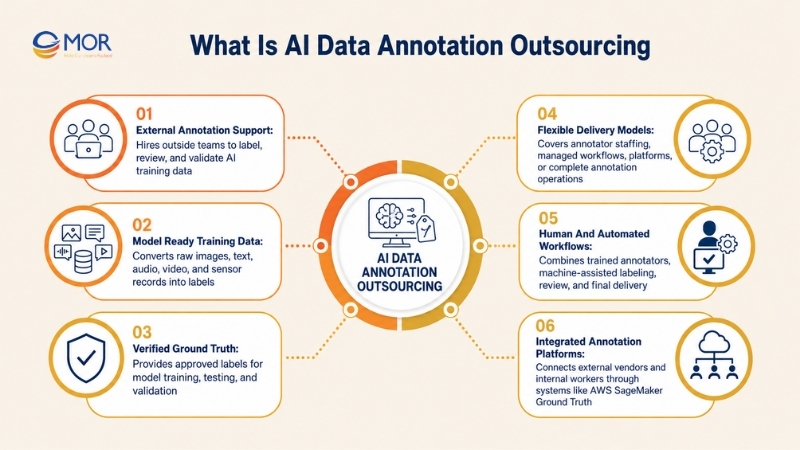
For example, an autonomous AI agent company may send road images to an external team. Annotators draw boxes around cars, cyclists, and pedestrians, while QA reviewers check each label before the dataset enters the model pipeline.
Outsourcing may cover human labor only or the full operation, including guidelines, team training, automated pre-labeling, review, and final delivery. AWS SageMaker Ground Truth, for instance, supports internal workers, external vendors, and machine-assisted labeling within the same workflow.
How AI Data Annotation Outsourcing Works
A reliable annotation workflow needs more than a vendor and a batch of raw files. We recommend setting the business goal, quality rules, and delivery format before moving through the following stages.
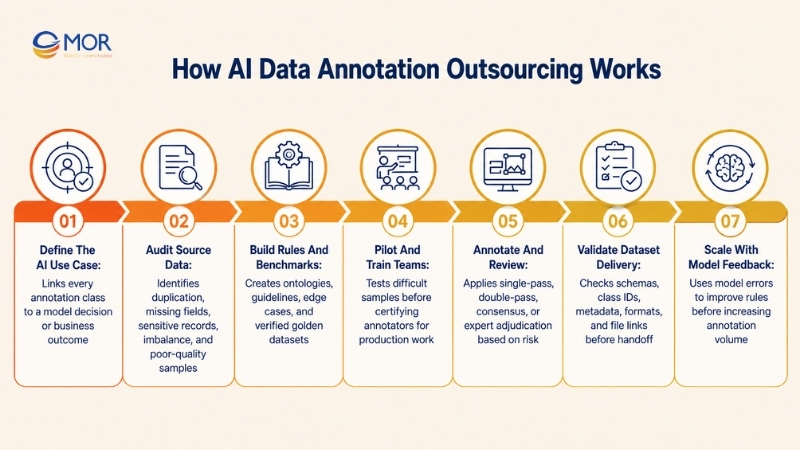
- Map the AI use case: Define what the model must detect, classify, rank, generate, or predict. Tie every label to a model decision or business outcome.
- Audit the source data: Review volume, format, duplication, missing fields, class balance, sensitive records, and low-quality samples. Flag data that needs cleaning before annotation.
- Build the ontology: Name each class, attribute, relation, and allowed value. Record class boundaries so similar labels don’t overlap.
- Write annotation guidelines: Add positive cases, negative cases, exclusions, edge cases, screenshots, and escalation rules. Version the document so each batch links to one approved rule set.
- Create a golden dataset: Ask internal experts to verify a representative sample. This set becomes the benchmark for onboarding, calibration, QA, and vendor comparison.
- Run a pilot batch: Test accuracy, throughput, tool fit, communication, and rework on a small but difficult sample. A pilot built only from easy records gives a false sense of readiness.
- Train the annotation team: Use certification tasks, scored examples, and review sessions. Repeat training when the ontology changes or error patterns appear.
- Annotate and review: Choose single-pass labeling for simple tasks, double-pass review for higher-risk work, consensus mechanisms labeling for subjective judgments, and expert adjudication for unresolved cases.
- Deliver the dataset: Match the model pipeline’s format, including JSON, COCO, YOLO, Pascal VOC, CSV, XML, DICOM, or a client schema. Validate field names, class IDs, file links, and metadata before handoff.
- Feed model errors back into annotation: Turn false positives, false negatives, low-confidence cases, and production failures into new examples. Update the golden set when those cases reveal weak rules.
- Scale controlled batches: Raise volume after several batches meet the same acceptance threshold. Sudden team growth can cause guideline drift, so new annotators need the same tests as the original group.
Why Outsource AI Data Annotation?
AI data annotation outsourcing services give AI teams access to trained people, delivery processes, and annotation tools without building every part internally. The gains come from faster setup and flexible capacity, but only when the provider can keep rules stable across batches.
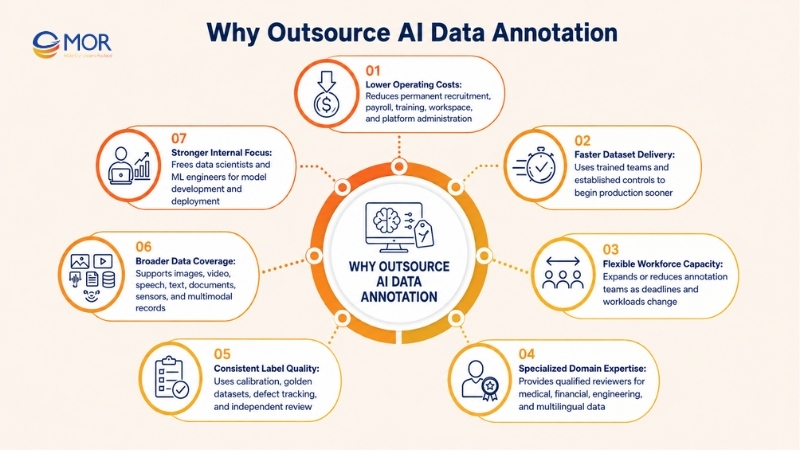
The main business gains usually appear across the following areas.
- Lower fixed operating costs: Skip permanent recruiting automation, payroll, training, workspace, and tool administration for workloads that change month to month.
- Shorten dataset delivery: Start with trained teams and established project controls instead of waiting for a new internal group to reach full output.
- Adjust capacity when demand changes: Add reviewers for a release deadline, then lower the team size after the backlog clears.
- Access domain knowledge: Assign specialist reviewers to medical scans, financial documents, autonomous mobility scenes, multilingual text, or engineering data.
- Keep labels consistent: Use calibration rounds, golden datasets, defect categories, and independent review instead of relying on informal checks.
- Use fit-for-purpose tools: Apply pre-labeling, ontology controls, reviewer queues, progress reports, and automated validation without funding a separate internal platform project.
- Support varied data types: Work across images, video, speech, text, documents, sensor data, and multimodal records under one delivery plan.
- Protect internal focus: Data scientists and ML engineers can spend more time on model design, error analysis, experiments, and deployment.
- Add language coverage: Native speakers can review tone, intent, local terms, accents, and cultural meaning that general annotators may miss.
- Maintain delivery continuity: Backup staffing and documented workflows keep work moving when an annotator leaves or volume spikes.
CloudFactory cites analyst estimates that about 80% of AI project time goes to data preparation, labeling, and processing. Moving repeatable work to a managed team can free expensive technical staff for model work that needs their skills.
The commercial case is also growing. Oxford Economics estimated that the US data annotation industry contributed $5.7 billion to GDP in 2024 and projected $19.2 billion by 2030.
Still, more volume doesn’t fix weak rules. Poor guidelines, vague QA targets, or hidden subcontracting can turn a low unit rate into expensive rework.
Top 10 AI Data Annotation Outsourcing Companies in 2026
The best provider depends on your data, security rules, domain, volume, and internal operating model. Teams researching the cost of outsourcing AI data annotation 2025 should treat old unit rates as rough history because 2026 projects now include more expert review, multimodal work, and model evaluation.
We compared ten companies based on delivery model, service focus, pricing structure, and support for language or computer vision data.
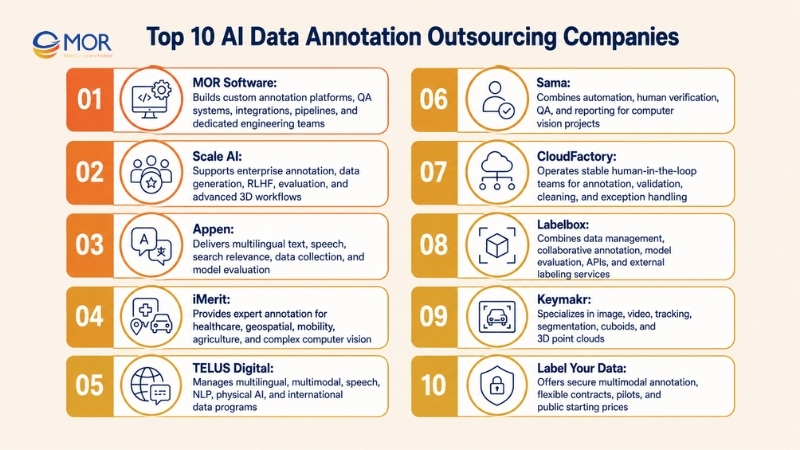
Company | Delivery model | Core strength | Best fit | Pricing model | Verified cost indication (USD) | LLM and NLP fit | CV and 3D fit |
MOR Software | Project-based or dedicated offshore software development team | Custom annotation systems, QA automation, integrations, and AI data pipelines | Tailored annotation operations | Hourly, monthly team, or fixed project | Custom quote | Custom scope | Custom scope |
Scale AI | Managed platform and workforce | Training data, evaluation, and 2D/3D workflows | Large AI labs and enterprise programs | Enterprise contract or self-serve | Enterprise custom; first 1,000 BYO labeling units at no cost | Strong | Very strong |
Appen | Global contributor network and managed programs | Multilingual text, speech, search, and model evaluation | Global language projects | Per task, project, or managed program | Custom quote | Very strong | Moderate |
iMerit | Managed expert teams | Regulated and high-complexity data | Healthcare, geospatial, and autonomous mobility | Project or dedicated team | Custom quote | Strong | Very strong |
TELUS Digital | Enterprise managed workforce | Multilingual and multimodal delivery | Large international AI programs | Contract and volume-based | Custom quote | Very strong | Strong |
Sama | Managed annotation workforce | Human-verified computer vision and multimodal work | Mobility, robotics, retail, and AI software medicals | Managed project | Custom quote | Moderate | Strong |
CloudFactory | Managed human-in-the-loop teams | Stable production teams and process control | Long-running annotation operations | Managed project or dedicated team | Custom quote | Moderate | Strong |
Labelbox | SaaS platform plus labeling services | Data management, annotation, and model evaluation | Teams needing software and external labelers | LBU usage plus service fees | 500 free LBUs monthly; workforce fees separate | Strong | Strong |
Keymakr | Managed computer vision specialist | Image, video, 3D point cloud, and physical AI | Robotics, retail, security, and visual AI | Per label, project, or dedicated team | Custom quote | Limited | Very strong |
Label Your Data | Managed specialist provider | Secure multimodal work and flexible pricing | Sensitive or compliance-heavy projects | Hourly, per object, per task, or fixed project | Starts at $0.015 per keypoint object, $0.02 per entity or bounding box, and about $6 per annotator hour | Strong | Strong |
MOR Software
Best suited to: Companies that need a custom AI data annotation platform, reviewer portal, QA dashboard, data pipeline, API integration, or dedicated offshore engineering team.
MOR Software approaches annotation as an AI engineering and delivery problem rather than a crowdsourcing marketplace. Its project-based and Offshore Development Center models support custom team composition, Agile delivery, QC and testing, DevOps, access controls, and long-term maintenance.
A typical engagement may cover ontology tools, annotation interfaces, ETL pipelines, cloud storage links, reviewer queues, automated checks, reporting, and integration with model training systems. MOR can also build around Python, AWS, web technologies, mobile app development outsourcing, or internal enterprise systems, depending on the client’s stack.
Main strengths:
- Custom architecture tied to the client’s workflow
- Engineering, QA, and integration under one delivery plan
- Project-based and dedicated-team models
- Vietnam-based delivery for longer product programs
Limitations:
- No public self-service annotation marketplace
- Workforce size, domain training, and unit pricing need project scoping
Pricing: Custom quote based on team size, architecture, data type, security, and delivery model.
Scale AI
Best suited to: Large AI labs, autonomous systems, public-sector programs, and enterprise teams that need data collection, annotation, RLHF, evaluation, and model feedback in one system.
Scale’s Data Engine covers data generation, annotation, curation, RLHF, and evaluation. Its automotive tools also support 2D, 3D, mapping, LiDAR, and sensor-fusion workloads.
Main strengths:
- Strong enterprise tooling and program management
- Support for computer vision, generative AI, and model evaluation
Limitations:
- Enterprise costs aren’t publicly listed
- Buyers should review data hosting, dependency, and exit terms
Pricing: Enterprise contracts require a quote. Self-serve users bringing their own workforce receive the first 1,000 labeling units at no cost.
Appen
Best suited to: Multilingual text, speech, search relevance, conversational AI in healthcare, domain-specific evaluation, and global data collection.
Appen runs managed data programs and a large contributor network. Its current AI data service highlights coverage across 170 countries and domain specialists in 50 fields, which suits language-heavy projects and expert review programs.
Main strengths:
- Broad language and regional reach
- Text, speech, search, image, video, and model evaluation support
Limitations:
- Distributed teams need strict calibration and QA
- Crowdsourced work may suit simple tasks better than long-running domain programs
Pricing: Custom quote based on task type, language, reviewer skill, volume, and management needs.
iMerit
Best suited to: Healthcare AI, geospatial systems, autonomous mobility, agriculture, and complex computer vision.
iMerit combines full-time annotators, solution architects, and domain experts. Its services cover medical imaging, geospatial data, 2D and 3D perception, NLP, and pre-labeling workflows for sensor-rich projects.
Main strengths:
- Strong domain depth in regulated and technical work
- Medical, geospatial, LiDAR, image, and video capability
Limitations:
- Specialist programs can cost more than general labeling
- Small classification projects may not need its full delivery model
Pricing: Custom project or dedicated-team quote.
TELUS Digital
Best suited to: Enterprise multilingual datasets, speech, NLP, search, multimodal systems, and international AI programs.
TELUS Digital provides data collection, annotation, and model training support for multilingual and multimodal systems. Its 2026 service position also covers physical AI and agentic systems, which expands the work beyond standard text and image labels.
Main strengths:
- Global delivery and broad language coverage
- Text, speech, image, video, and model training data
Limitations:
- Corporate procurement and minimum commitments may slow small pilots
- Pricing and team structure need direct confirmation
Pricing: Custom contract based on volume, language, domain, and delivery controls.
Sama
Best suited to: AI applications in various industries 2026 such as Computer vision, autonomous mobility, robotics, ecommerce, retail, medical imaging, and 3D data.
Sama combines automation with human-verified annotation, validation, and model evaluation. It supports computer vision, NLP, multimodal, sensor, and 3D data under managed delivery.
A Swift Medical project recorded a 97% average internal quality score, a 230% rise in throughput between week 1 and week 10, and a 66.7% drop in rejections over the same period. The case shows why tight QA feedback matters more than raw headcount.
Main strengths:
- Strong image, video, segmentation, and tracking work
- Managed QA and production reporting
Limitations:
- Managed delivery may not fit a tiny one-time batch
- Pricing requires a scoped conversation
Pricing: Custom quote based on data type, volume, QA target, and project duration.
CloudFactory
Best suited to: Long-running human-in-the-loop operations that need stable teams, quality control, and close contact with internal AI staff.
CloudFactory provides managed workforces for data acquisition, cleaning, annotation, QA, model validation, and exception handling. Its teams support computer vision, NLP, medical imaging, retail, agriculture, and document projects.
Main strengths:
- Dedicated teams for ongoing work
- Process ownership, workforce management, and QA
Limitations:
- Less suitable for buyers seeking software only
- Managed programs need more setup than open crowdsourcing
Pricing: Custom quote, often structured as an inclusive managed service or dedicated workforce.
Labelbox
Best suited to: AI teams that need data management, collaborative annotation, model-assisted labeling, model evaluation, and access to external labelers.
Labelbox lets teams annotate internally, use their own vendor, or request professional labeling services. Its LBU billing model charges different units for images, text, documents, video, medical imagery, and live multimodal data.
Main strengths:
- One platform for cataloging, annotation, model work, and review
- API, SDK, ontology, collaboration, and QA tools
Limitations:
- LBU usage can be harder to forecast across data types
- Foundry inference, SSO, HIPAA, and labeling services can add separate charges
Pricing: Free accounts receive 500 LBUs per month. Professional labeling services and enterprise add-ons require separate pricing.
Keymakr
Best suited to: Image, video, 3D point cloud, autonomous mobility, robotics, retail, security, and physical AI.
Keymakr uses in-house teams and proprietary tools for bounding boxes, polygons, segmentation, keypoints, tracking, cuboids, and 3D point clouds. Its service scope also includes data collection, validation, automatic annotation service, and generative AI data.
Main strengths:
- Detailed computer vision and 3D task coverage
- In-house annotation teams and layered QA
Limitations:
- Narrower fit for speech-heavy or multilingual NLP programs
- Public unit prices aren’t listed
Pricing: Custom quote using pay-per-label, project, or dedicated-team terms.
Label Your Data
Best suited to: Sensitive multimodal datasets, flexible pilots, computer vision, NLP, audio, LiDAR, and projects that need public starting rates.
Label Your Data supports image, video, text, audio, and 3D point cloud work. Its site lists ISO 27001-certified and GDPR-aligned workflows, flexible pricing, and no required long-term contract.
Main strengths:
- Public starting prices and a cost calculator
- Hourly, per-object, per-task, and project terms
Limitations:
- Smaller delivery scale than the largest global providers
- Complex projects still need a custom calculation
Pricing: Starts at $0.015 per keypoint object, $0.02 per NLP entity, $0.02 per bounding box object, and about $6 per annotator hour.
How to Choose an AI Data Annotation Outsourcing Partner
A fair vendor review compares providers against the same sample and acceptance rules. Company size and client logos don’t prove that a team can label your data correctly. We use this scorecard to compare quality, domain knowledge, security, staffing, tooling, and commercial terms.
Evaluation criterion | Suggested weight | Evidence to request | Common red flag |
QA system | 20% | Review flow, gold-set scores, IAA, IoU, F1, audit samples | Generic “99% accuracy” claim |
Domain knowledge | 15% | Similar datasets, reviewer credentials, case evidence | No comparable project |
Security and compliance | 15% | ISO 27001, SOC 2, DPA, access model, subcontractor list | Unclear data location |
Workforce scaling | 15% | Available team size, ramp plan, retention, backup staffing | Heavy use of unknown subcontractors |
Tooling and integration | 10% | API docs, export formats, SSO, cloud links | Proprietary format lock-in |
Pilot performance | 10% | Accuracy, throughput, rework, response time | Refusal to run a pilot |
Communication and governance | 10% | Project owner, reporting cadence, escalation plan | No accountable owner |
Commercial terms | 5% | Rate card, minimums, QA fees, warranty, exit terms | Low base rate with hidden add-ons |
Ask each shortlisted provider to label the same representative sample. Score accepted output, rework, reviewer comments, issue response, and format accuracy rather than raw speed alone.
Review the workforce model too. Confirm which people are employees, contractors, crowd workers, or subcontractors, then ask how the vendor trains replacements when someone leaves.
Ownership terms deserve equal attention. Your company should retain the ontology, guideline versions, golden set, validation scripts, audit logs, accepted labels, and any custom code paid for under the contract.
Pricing needs a full-cost view. Compare annotation labor, QA, platform use, project management, rework, integration, specialist review, and exit support, then calculate cost per accepted label.
Which Data Annotation Tasks Can You Outsource?
Most AI data annotation services cover one data type or a mix of formats. Choose the task based on what the model must learn, the precision needed, and the cost of a wrong label.
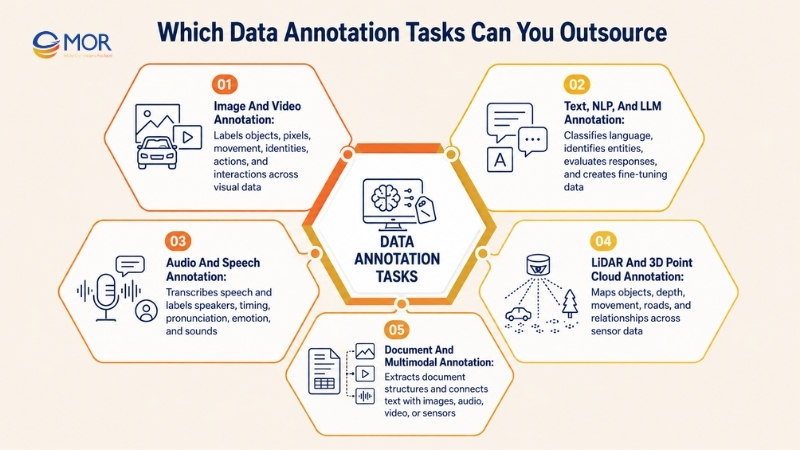
MOR Software groups the most common outsourced annotation work into five data categories
Image and Video Annotation
Computer vision projects need spatial labels that explain what appears in a scene and where it appears. Video adds time, identity, motion, and interaction across frames. Depending on the use case, an external team may handle the following visual annotation tasks.
- Image classification: Assigns one or more classes to a whole image
- Bounding boxes: Marks objects for detection models
- Polygon annotation: Traces irregular shapes with higher spatial detail
- Semantic segmentation: Labels each pixel by class
- Instance segmentation: Separates individual objects in the same class
- Keypoint annotation: Marks joints, facial landmarks, or object parts
- Object tracking: Follows one object across video frames
- Action recognition: Labels events, activities, and interactions over time
Text, NLP, and LLM Annotation
Text work ranges from short classification tasks to expert review of long model outputs. Language data needs clear rules for ambiguity, local usage, implied meaning, and domain terms.
Teams can assign the following text and LLM tasks to trained annotators or domain reviewers.
- Text classification: Groups documents, tickets, reviews, or messages
- Named entity recognition: Marks people, firms, products, locations, dates, and technical terms
- Sentiment and emotion: Labels opinion, tone, and emotional signals
- Intent detection: Trains chatbots and service routing systems
- Relation extraction: Connects entities, events, and claims
- Prompt-response evaluation: Scores correctness, relevance, tone, and safety
- RLHF and preference ranking: Compares model responses under defined rubrics
- Supervised fine-tuning data: Creates and reviews high-quality prompt-response pairs
- Search relevance: Judges how well results match a query
Multilingual work needs native-language reviewers and local QA. TELUS Digital reported a project that built a multilingual dataset containing 1 million labeled utterances, a useful example of the scale needed for global language systems.
Audio and Speech Annotation
Speech systems need labels for words, speakers, timing, pronunciation, and background sounds. Noise, overlapping speech, code-switching, and strong accents raise review time. Common audio annotation assignments include:
- Speech transcription: Converts spoken content into text
- Speaker diarization: Marks when each speaker talks
- Speaker identification: Links speech to known or anonymous speakers
- Phonetic labeling: Tags phonemes, pauses, stress, and pronunciation
- Emotion annotation: Records tone, urgency, or intent
- Sound-event detection: Identifies alarms, engines, machinery, animals, or environmental sounds
LiDAR and 3D Point Cloud Annotation
Three-dimensional annotation explains depth, position, movement, and object relationships across sensor data. The task often combines LiDAR, radar, camera feeds, maps, and calibration data.
- 3D cuboids: Marks vehicles, people, equipment, and structures
- Point-level segmentation: Assigns a class to each point
- Sensor fusion: Aligns labels across LiDAR, radar, and cameras
- Movement-path labeling: Tracks movement through 3D space
- Lane and road annotation: Marks boundaries, signs, curbs, and drivable areas
An embodied AI data annotation outsourcing service may also label robot actions, manipulation steps, human demonstrations, and sensor feedback. These projects need strong tooling and domain review because small spatial errors can affect navigation or control.
Document and Multimodal Annotation
Business documents mix text, layout, tables, handwriting, signatures, and images. Multimodal projects add links between those elements and audio, video, or sensor records. External teams can prepare these records through the annotation tasks listed below.
- OCR region annotation: Marks text blocks, fields, tables, and handwriting
- Document classification: Sorts invoices, claims, contracts, forms, or medical files
- Key-value extraction: Links field names to their values
- Layout annotation: Marks headings, paragraphs, images, tables, and reading order
- Multimodal alignment: Connects text with images, speech, video, or sensors
Choose Outsourced, In-House, or Hybrid Annotation
No single model fits every dataset. External annotation suits high-volume or changing workloads, while internal teams keep tighter control over proprietary data and direct access to domain experts. Use the comparison below to match the model with your dataset and internal resources.
Decision factor | Outsourced annotation | In-house annotation | Hybrid annotation |
Initial setup | Fast when the vendor has trained teams and tools | Slower due to hiring and process design | Moderate |
Volume scaling | High | Limited by internal hiring | High for standard work |
Domain knowledge | Depends on vendor capability | Strong when internal experts label data | Internal experts guide external teams |
Data control | Lower unless private infrastructure is used | Highest | High for sensitive subsets |
Feedback loop | Can weaken without close collaboration | Direct and continuous | Shared through structured review |
Cost structure | Variable and usage-based | Higher fixed cost | Mixed |
Tool ownership | Vendor or shared platform | Internal | Internal core with external execution |
Best fit | High-volume or fluctuating workloads | Proprietary, regulated, or research-heavy data | Complex programs needing scale and control |
Model-assisted internal labeling can work well when the data contains trade secrets, regulated records, or research findings. Internal experts review machine-generated labels, keep the data in a private environment, and send only sanitized or lower-risk subsets outside.
External teams still make sense for repetitive classification, large image backlogs, transcription, document tagging, and routine QA. A hybrid model often works better for healthcare, finance, defense, industrial systems, and expert-heavy LLM evaluation.
Location affects cost, language access, time-zone overlap, and legal exposure. Searches for AI data annotation outsourcing philippines often reflect interest in English-speaking offshore teams, yet buyers should compare data residency, reviewer skill, retention, and QA rather than location alone.
What Are the Challenges of AI Data Annotation Outsourcing?
External annotation moves data, process knowledge, and quality control across company boundaries. Weak contracts or unclear ownership can create risk long after the first dataset ships. MOR Software recommends reviewing these challenges before data moves outside your organization.
Challenge area | Possible business effect | How to limit the challenges |
Data leakage | Proprietary datasets or customer records may be exposed | Minimize shared data, encrypt transfers, limit access, and define deletion terms |
Vendor concentration | One provider may gain too much operational control | Keep internal documentation and qualify a backup provider |
Unclear subcontracting | Unapproved third parties may handle the data | Require a full subcontractor list and approval rights |
Inconsistent labeling | New workers may read the same rule differently | Use golden datasets, calibration tests, and stable teams |
Loss of internal knowledge | Edge cases may stay with the vendor | Hold joint error reviews and keep guideline ownership internally |
Hidden rework costs | Low rates may exclude corrections and rule changes | Define acceptance thresholds, warranties, and revision fees |
Weak quality metrics | A broad accuracy rate may hide class-level defects | Use IoU, F1, precision, recall, IAA, and rework rate |
Annotation bias | Reviewer background may shape subjective labels | Use varied reviewers and targeted audits |
Language errors | Non-native reviewers may miss tone or local meaning | Assign native annotators and regional QA |
Platform lock-in | Proprietary formats can make migration costly | Define exports, API access, and exit support |
Security gaps | Weak controls may breach GDPR, HIPAA, or residency rules | Audit certificates, hosting, permissions, and incident plans |
Workforce transparency | Poor working controls may create legal or brand exposure | Review employment terms, training, supervision, and delivery locations |
Sensitive healthcare, finance, biometric, defense, and industrial data may need VPC, private cloud, on-premises tools, or a hybrid workflow. Labelbox, for example, documents controls that keep personally identifiable customer information away from external labeling workers.
A strategic risk also appears when one vendor serves direct competitors. Keep the ontology, golden set, annotation history, scripts, and audit records under your ownership, and involve internal experts in disputed cases.
AI Data Annotation Outsourcing Best Practices
Selecting a capable provider solves only part of the delivery problem. Your team still needs to control quality definitions, annotation assets, data access, and the model feedback loop through the practices below.
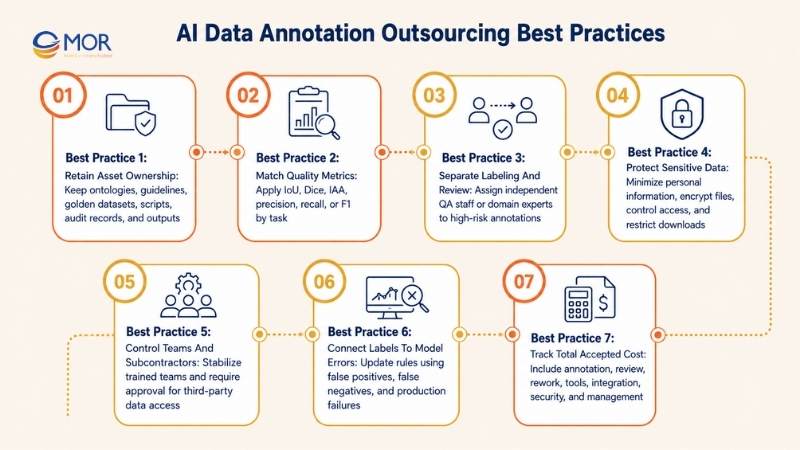
- Keep ownership of annotation assets: Put the ontology, guidelines, golden datasets, scripts, audit records, and final outputs in the contract.
- Match metrics to the task: Use IoU for boxes, Dice score for segmentation, IAA for subjective work, and precision, recall, or F1 for classification.
- Write visual guidelines: Add clear examples, exclusions, edge cases, and escalation paths. Version every change.
- Separate labeling and review: Independent QA staff or domain experts should approve high-risk work.
- Keep trained teams stable: Frequent turnover raises onboarding time and label drift.
- Route hard records to experts: Medical, legal, finance, and engineering decisions need qualified reviewers.
- Protect sensitive records: Remove unneeded personal data, encrypt files, apply role access, and restrict downloads.
- Control subcontractors: Require written approval before any third party handles the dataset.
- Connect labels to model errors: Feed false positives, false negatives, low-confidence records, and production failures back into the guidelines.
- Track cost per accepted label: Count annotation, review, rework, tools, integration, management, and security.
- Watch rare classes: Overall accuracy can hide poor results in small but high-value groups.
- Review each unusual sample: An AI data annotation outlier falls outside normal patterns and may reveal a missing rule, weak class boundary, or bad source file.
- Set change control: Record how new labels or revised rules affect price, delivery, and completed batches.
- Plan vendor exit: Define exports, knowledge transfer, account closure, and verified data deletion before production starts.
Launch a Pilot and Scale the Annotation Workflow
A pilot should reveal whether a provider can meet your standards under real production conditions. MOR Software recommends testing these areas before approving a larger workload.
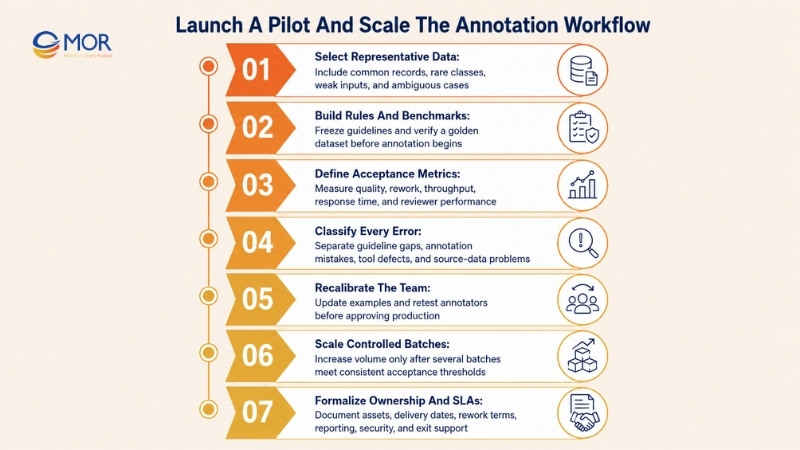
- Select representative data: Include common records, rare classes, poor inputs, and ambiguous cases.
- Set a useful pilot size: Choose enough items to expose consistency issues without creating a large sunk cost.
- Freeze guideline version one: Record class definitions, exclusions, examples, and escalation rules.
- Build the golden set: Ask internal experts to verify benchmark labels before the provider begins.
- Define acceptance metrics: Use precision, recall, F1, IoU, Dice, IAA, rework rate, and throughput where they fit.
- Track operating metrics: Measure onboarding time, response time, reviewer output, rejected items, and issue resolution.
- Classify every error: Separate guideline gaps, annotator mistakes, tool defects, source-data problems, and expert disagreements.
- Run calibration again: Update examples and retest the team before approval.
- Scale in controlled batches: Raise volume in steps after several batches meet the same threshold.
- Keep internal ownership: Store the ontology, rules, audit logs, gold set, accepted labels, and decision history in your systems.
- Write the SLA: Define delivery dates, acceptance rate, rework window, incident response, reporting, staffing changes, and exit support.
Label Your Data publicly provides a free pilot and cost calculator, while Scale gives self-serve users a limited free labeling allowance. Those entry points can help teams test tool fit, but the best pilot still uses your actual data and acceptance rules.
MOR Software can support custom annotation systems, AI data pipelines, automated QA checks, reviewer portals, cloud links, and dedicated offshore teams. Contact MOR Software to map the workflow before committing to a large production batch.
Conclusion
The future of AI data annotation outsourcing will move toward expert review, model-assisted labeling, multimodal data, and tighter links between annotation and production errors. Scale still matters, but accepted-label quality, data control, and fast feedback will decide value. MOR Software helps companies build custom annotation systems, QA automation, AI pipelines, and dedicated delivery teams. Contact MOR Software to plan a workflow that grows without losing control of quality.
"Evolution is not a destination, it is a disciplined journey of innovation."
Phung Van Tu


CEO MOR AI
MOR SOFTWARE
Frequently Asked Questions (FAQs)
What is AI data annotation outsourcing?
The service assigns labeling, review, validation, or model evaluation to an external provider. The provider may supply workers, manage the full process, run a platform, or build a dedicated team.
Why do companies outsource AI data annotation?
Companies need faster access to trained workers, flexible capacity, domain review, and structured QA. The model works best when the client still owns the ontology, golden set, and acceptance rules.
What types of AI data can an outsourcing company annotate?
Providers can label images, video, text, audio, documents, LiDAR, radar, 3D point clouds, and multimodal records. Task support depends on the vendor’s tools and reviewer skills.
How much does AI data annotation outsourcing cost?
Cost depends on data type, object density, language, domain, QA depth, platform fees, security, and rework. Public rates are rare, so compare cost per accepted label after a pilot.
How do annotation vendors measure labeling quality?
Common measures include IoU, Dice score, precision, recall, F1, inter-annotator agreement, acceptance rate, and rework rate. The metric must match the annotation task.
Is it safe to outsource sensitive AI training data?
It can be safe under strict controls. Use data minimization, encryption, role access, approved locations, private infrastructure where needed, deletion rules, and audited incident procedures.
Should a company outsource annotation or keep it in-house?
Outsource repeatable or changing-volume work. Keep highly proprietary, regulated, or research-heavy data internal, or use a hybrid model that sends sanitized records outside.
What should an annotation pilot project include?
Include common data, rare classes, hard examples, a golden set, fixed guidelines, acceptance metrics, cost tracking, and an error review. Avoid pilots built only from clean records.
How long does an outsourced data annotation project take?
A small pilot may take days or weeks. Production timelines depend on volume, complexity, training time, team size, QA layers, and how often guidelines change.
Which AI data annotation outsourcing company is the best?
No provider leads every use case. Match the company to data type, domain depth, security, scale, tool ownership, pricing model, and the amount of governance your team wants to retain.
Share


Make Our-Dreams Realized


© 2023 . MOR Software. All Rights Reserved
Sitemap
Privacy Policy
Terms of Use

Rate this article
0
over 5.0 based on 0 reviews
Your rating on this news:
Name
*Email
*Write your comment
*Send your comment
1