


Top HR Management Solutions for Finance Industry in 2026
Financial institutions handle payroll, compensation, employee PII, certifications, access rights, and audit records inside the same HR environment. That raises the bar for HR technology far above basic leave tracking. This MOR Software guide will compare the top HR management solutions for finance industry teams based on security controls, payroll depth, auditability, integrations, workforce planning, and real finance-sector fit.
Key Takeaways
- Finance firms should rank audit trails, RBAC, segregation of duties, payroll controls, data governance, and compliance reporting above broad module counts.
- Workday, Oracle, and SAP fit complex global institutions, while Dayforce, UKG, ADP, Darwinbox, Deel, Rippling, and HiBob solve narrower workforce needs.
- Product selection is only one part of the project. Data migration, system integration, permission design, testing, and change management shape the result after purchase.
What Finance Companies Need From HR Management Software
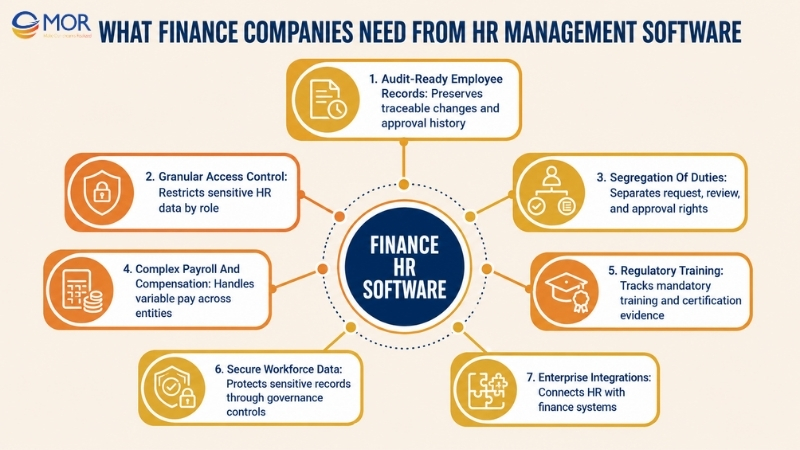
An HR management system stores employee records and runs workforce processes. Finance companies need much tighter controls because HR data connects directly to payroll, compensation management, regulatory training, permissions, and audit evidence.
Security pressure makes this a practical concern. The 2025 Verizon Data Breach Investigations Report analyzed more than 22,000 security incidents and 12,195 confirmed breaches, while third-party involvement reached 30%. Finance HR teams therefore need to think about access, vendors, interfaces, and data movement as part of the buying decision.
- Audit-ready employee records: Keep a traceable history of record changes, approvals, users, timestamps, and administrative actions. Finance teams may need this evidence during internal audit, payroll review, control testing, or regulator requests.
- Granular access control: Separate access to salary, bonus, bank details, tax records, performance reviews, and employee PII. A branch manager shouldn't automatically see the same information as payroll, HR leadership, or system administrators.
- Segregation of duties: Divide request, review, approval, and administrative rights across different roles. Maker-checker logic is especially relevant when employee changes trigger pay, access, or accounting entries.
- Complex payroll and compensation: Support bonuses, incentives, commissions, variable pay, several entities, regional rules, different currencies, and off-cycle changes. Payroll errors can quickly become finance reconciliation problems.
- Regulatory training: Record mandatory courses, policy acknowledgements, certifications, license renewal dates, and completion evidence. Finance firms often need proof that specific workers completed required training before carrying out regulated duties.
- Secure workforce data: Apply encryption, retention policies, privacy controls, access monitoring, and region-aware storage rules. Sensitive HR records require the same governance discipline used for other regulated business information.
- Workforce analytics: Give HR and finance usable headcount, compensation, turnover, skills, succession, hiring, and workforce-cost data. Leaders need defensible numbers for planning rather than separate spreadsheets that disagree at month end.
- Enterprise integrations: Connect the HR platform to ERP, identity management, accounting, expense, time, payroll, and reporting tools. The benefits of integrated finance and HR solutions for companies become tangible when one approved employee change reaches the downstream systems that depend on it.
A finance-grade HRMS should therefore act as a controlled system of record. Convenience matters, but governance decides whether the platform can support regulated work at scale.
How We Evaluated HR Solutions for Financial Services
A generic HR software list can rank products by user interface or module breadth. Our scoring gives finance-sector controls much more weight because a bank, insurer, lender, asset manager, or fintech carries different exposure than a typical office-based employer.
To compare the top HR management solutions for finance industry buyers, we used six weighted areas. Scores below are MOR Software Joint Stock Company editorial assessments based on documented vendor capabilities and finance-sector fit, not vendor ratings.
Evaluation factor | Weight | What we evaluated |
Security, compliance & auditability | 25% | RBAC, audit history, approval control, privacy |
Payroll & workforce administration | 20% | Payroll depth, compensation, time, entity support |
Integrations & data architecture | 15% | ERP, finance, identity, APIs, shared data |
Talent & workforce intelligence | 15% | Recruiting, skills, performance, planning, analytics |
Finance-industry fit | 15% | Banking, insurance, fintech, branch operations |
UX, implementation & value | 10% | Adoption, setup effort, support, TCO |
Finance-industry fit receives its own score because horizontal capability doesn't prove suitability for regulated operations. We checked whether each vendor speaks directly to financial services, banking, insurance, payroll governance, branch staffing, finance integration, or related operating needs.
Price gets a smaller weight. Subscription fees tell only part of the story once data migration, integration work, UAT, training, security design, administration, and ongoing support enter the budget.
A highly ranked platform may still be a poor match for your company. A global bank needs deeper governance than a 150-person fintech, and a branch network may care more about scheduling and payroll than global succession planning software solutions.
Top 10 HR Management Solutions for Finance Industry
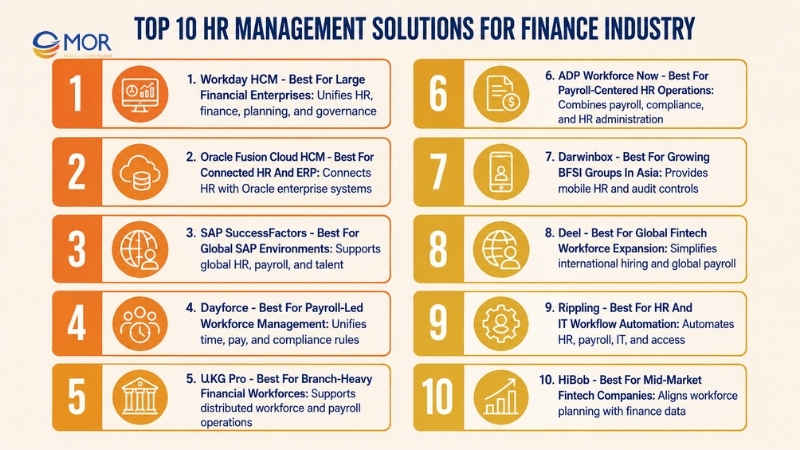
The most popular HR systems don't solve the same problem in the same way. Workday and Oracle connect people data closely with enterprise finance, SAP brings strong global HR and payroll depth, while products like Deel and Rippling target international growth or cross-functional automation.
Rank | Solution | Best for | Finance-specific strength | Payroll/global capability | Key trade-off |
1 | Workday HCM | Large financial enterprises | Unified HR and finance model | Strong enterprise/global reach | Heavy implementation |
2 | Oracle Fusion Cloud HCM | Oracle-centered enterprises | HR and ERP connection | Strong global HCM | Complex configuration |
3 | SAP SuccessFactors | Global SAP environments | Global HR, payroll, talent | Payroll localization in 60 countries | Partner/admin effort |
4 | Dayforce | Payroll-led institutions | Time, pay, compliance rules | Strong payroll model | Module planning required |
5 | UKG Pro | Branch-heavy workforces | Scheduling and labor visibility | Strong enterprise workforce ops | Better fit for complex teams |
6 | ADP Workforce Now | Payroll-centered HR | Payroll, compliance, marketplace | Strong US focus | Less unified than large HCM suites |
7 | Darwinbox | Asia-focused BFSI | Mobile HR and audit controls | Strong regional depth | Global fit varies |
8 | Deel | Global fintech growth | Cross-border hiring and payroll | 100+ payroll countries | Less traditional HCM depth |
9 | Rippling | HR and IT automation | Identity, apps, HR, payroll | Growing global coverage | Modular scope can grow |
10 | HiBob | Mid-market fintech | HR, planning, finance alignment | Strong mid-market model | Less bank-grade depth |
1. Workday HCM - Best for large financial enterprises
Workday HCM fits banks, insurers, investment firms, and financial groups that need HR, finance, talent, planning, and workforce data governed across complex structures.
Overall Rating: 9.4/10
Capability Depth: 9.7/10
Ease of Adoption: 8.3/10
Value for Money: 8.6/10
Finance Differentiator: Workday connects HR, finance, operations, workforce planning, security, and reporting on a shared platform built for large organizations.
Workday supports organization structures, recruiting, compensation, talent, time, workforce planning, payroll connections, security domains, approvals, audit history, and reporting. Its banking proposition also connects workforce planning with finance data, branch planning, risk controls, and operational reporting.
Workday reports that banking customers can create financial reports 75% faster through its reporting and analytics tools. That Workday banking use case shows why shared finance and workforce data can carry more value than a stand-alone HR database.
Among the best HR systems for large companies, Workday stands out when finance leaders also need headcount modeling, workforce-cost planning, controlled approvals, and governed reporting. The trade-off comes during deployment, where data conversion, security domains, integrations, business processes, and reporting rules need experienced ownership.
Strengths
- Unified data model: HR and finance teams can work from connected worker and organizational data
- Strong governance: Security domains, approvals, audit history, and delegated administration fit large institutions
- Workforce planning: Headcount plans can connect with labor cost and organizational assumptions
- Extensibility: APIs and Workday Extend support company-specific workflows
Trade-offs
- Large implementation scope: Configuration and migration require a formal program
- Specialist administration: Complex reporting and security often need trained owners
- Country differences: Native payroll availability varies across markets
Finance Use Cases
- Global banks: Standardize worker lifecycle controls → Consistent governance across entities
- Investment firms: Model workforce cost scenarios → Better headcount planning
- Large insurers: Govern compensation approvals → Stronger control over sensitive pay changes
Best fit: Large financial organizations that need deep HR governance tied closely to enterprise finance and planning.
2. Oracle Fusion Cloud HCM - Best for connected HR and ERP
Oracle Fusion Cloud HCM suits financial institutions that already run Oracle ERP or want a common enterprise data and application model across HR and finance.
Overall Rating: 9.2/10
Capability Depth: 9.5/10
Ease of Adoption: 8.2/10
Value for Money: 8.6/10
Finance Differentiator: Oracle connects core HR, payroll, talent, contingent workforce management, planning, and wider Oracle business applications through a shared cloud suite.
Oracle's financial-services HCM proposition covers hire-to-retire processes, common workforce data, localized workflows, talent, career growth, and regulatory requirements. Oracle Fusion Cloud HCM also includes HR, talent, workforce management, and payroll applications within one cloud family.
That shared architecture becomes useful when HR events must feed accounting, budgeting, identity, or enterprise reporting. Employee transfers, organizational moves, and compensation updates can move through controlled business processes rather than relying on repeated manual exports.
Oracle also fits institutions with several entities and regional operating models. But configuration can become demanding when the business carries long-standing policies, custom security rules, complex integrations, or extensive legacy data.
Strengths
- Common enterprise foundation: HR can sit close to Oracle finance and ERP workloads
- Broad workforce scope: Core HR, payroll, recruiting automation, learning, talent, and workforce management work in one suite
- Configurable workflows: Organizations can model approval paths and localized processes
- Enterprise reporting: HR and business data can feed wider Oracle reporting environments
Trade-offs
- - Setup depth: Large implementations require careful configuration ownership
- - Oracle skills: Teams may need specialist knowledge for extensions and integrations
- - Migration workload: Legacy structures need disciplined data mapping before cutover
Finance Use Cases
- Banks on Oracle ERP: Connect people and finance records → Fewer reconciliation handoffs
- Insurance groups: Standardize regional HR processes → Stronger organizational control
- Financial groups: Link workforce planning with enterprise systems → Better cost visibility
Best fit: Finance enterprises that want HR inside a broader Oracle technology and ERP environment.
3. SAP SuccessFactors - Best for global SAP environments
SAP SuccessFactors fits multinational banks and insurers that need global core HR, payroll, recruiting, learning, performance, and compensation alongside an existing SAP estate.
Overall Rating: 9.0/10
Capability Depth: 9.4/10
Ease of Adoption: 8.0/10
Value for Money: 8.3/10
Finance Differentiator: SAP brings global HR, payroll localization, talent processes, and finance integration into a mature enterprise ecosystem.
SAP SuccessFactors Employee Central manages employee master data, organization structures, job structures, pay information, and regional requirements. Employee Central Payroll adds continuous payroll, anomaly checks, local tax support, and native links to core HR, benefits, time, payroll, and finance; SAP lists localization for 60 countries.
A finance-sector example comes from Bank Islam's SAP SuccessFactors program. The bank adopted Employee Central, Employee Central Payroll, Learning, Recruiting, and Performance & Goals to replace paper-heavy HR processes and improve workforce data visibility.
SAP's breadth works well for global organizations that already understand SAP governance and integration patterns. Smaller finance firms may find the administration, implementation partner dependence, and setup effort too heavy for their operating model.
Strengths
- Global core HR: Supports organization and employee administration across many regions
- Payroll depth: Continuous payroll and country localization support complex pay operations
- Talent coverage: Recruiting, learning, performance, and compensation share the suite
- SAP alignment: Strong fit for institutions already running SAP business systems
Trade-offs
- Implementation effort: Large programs often need specialist partners
- Administration complexity: Configuration can become demanding for lean HR teams
- Regional variation: Some requirements still depend on localization and project design
Finance Use Cases
- Multinational banks: Standardize global employee records → Consistent group-level HR data
- Insurers: Track required learning → Better compliance evidence
- SAP-led enterprises: Connect payroll with finance → Cleaner downstream reporting
Best fit: Large international finance groups that already rely on SAP and need global HR depth.
4. Dayforce - Best for payroll-led workforce management
Dayforce works well when payroll accuracy, time, workforce management, compliance rules, and employee administration sit at the center of the HR program.
Overall Rating: 8.9/10
Capability Depth: 9.1/10
Ease of Adoption: 8.6/10
Value for Money: 8.6/10
Finance Differentiator: Dayforce runs time, pay, HR, and workforce rules in one people platform, which limits handoffs between scheduling and payroll.
Dayforce's financial-services solution covers payroll, HR, talent, self-service, learning, recruiting, compliance, and workforce skills. Its compliance model uses configurable rules, role-based security, continuous calculations, and a common dataset across scheduling, time, and pay.
This architecture suits finance firms where time changes, pay rules, allowances, or workforce schedules create payroll exposure. Teams can review issues before payroll closes rather than discovering problems after accounting reconciliation.
Dayforce also provides managed payroll services for firms that want external operational support. But buyers should map required modules early because final scope depends heavily on payroll countries, workforce rules, managed services, and talent needs.
Strengths
- Connected time and pay: Scheduling, time, and payroll share rules and data
- Compliance controls: Role-based security and rules support governed payroll work
- Self-service: Employees can access schedules, time, pay, and HR tasks directly
- Finance-sector references: Dayforce lists banks, credit unions, insurers, and investment firms among customers
Trade-offs
- Module planning: Buyers need to define payroll, WFM, talent, and service scope early
- Configuration work: Complex rules still need careful testing
- Country coverage: Delivery models can differ across regions
Finance Use Cases
- Credit unions: Connect time and payroll → Fewer late payroll corrections
- Banks: Apply consistent pay rules → Better payroll control
- Financial service centers: Track labor cost before close → Earlier variance review
Best fit: Financial institutions where payroll and workforce operations need to run under the same set of rules.
5. UKG Pro - Best for branch-heavy financial workforces
UKG Pro fits banks, credit unions, and insurers that need HR, payroll, talent, scheduling, time, workforce management, and analytics across distributed teams.
Overall Rating: 8.8/10
Capability Depth: 9.0/10
Ease of Adoption: 8.5/10
Value for Money: 8.5/10
Finance Differentiator: UKG combines HCM with workforce management depth for branch staffing, labor visibility, time, payroll, and compliance.
UKG states that nearly 1,000 banks, credit unions, insurance providers, and other financial institutions use its HCM and workforce management products. The UKG financial-services page also connects its tools to payroll, compliance, strategic workforce planning, analytics, time, talent, and HR service delivery.
Branch networks benefit from scheduling and workforce data that can match staffing with customer demand, skills, and availability. UKG's banking solution also gives managers labor-cost and overtime information while supporting current payroll and time records for audit work.
UKG Pro targets larger organizations with complex workforce operations. Smaller fintech firms may get more value from lighter platforms if they don't manage extensive shifts, branches, time rules, or workforce forecasting.
Strengths
- Branch workforce support: Scheduling and time tools suit distributed service locations
- Payroll connection: Time data can flow into payroll under common workforce rules
- Enterprise HCM: HR, talent, payroll, analytics, and workforce operations share the product family
- Labor visibility: Managers can review staffing, overtime, attendance, and cost patterns
Trade-offs
- Enterprise orientation: Smaller organizations may buy more capability than they need
- Setup requirements: Workforce rules demand careful policy mapping
- Reporting learning curve: Complex analytics may require trained administrators
Finance Use Cases
- Retail banks: Match branch staffing to demand → Better labor allocation
- Credit unions: Control time and payroll rules → More consistent pay processing
- Insurers: Track workforce trends → Better staffing and retention planning
Best fit: Finance organizations with distributed offices, branch schedules, and workforce-management complexity.
6. ADP Workforce Now - Best for payroll-centered HR operations
ADP Workforce Now fits US-centered financial-services employers that want established payroll processing connected to HR, talent, benefits, compensation, reporting, and integrations.
Overall Rating: 8.6/10
Capability Depth: 8.8/10
Ease of Adoption: 8.5/10
Value for Money: 8.4/10
Finance Differentiator: ADP brings mature payroll operations together with employee-level compliance data, credentials, talent tools, analytics, and a large integration marketplace.
ADP's financial-services solution supports payroll, compliance, talent, workforce data, employee certifications, recruiting, learning, bonuses, compensation, time, and HR reporting. Its Marketplace and API Central also connect ADP worker data with recruiting, benefits, time, ERP, accounting, and other business systems.
That mix works well for US financial firms where payroll accuracy and employment compliance carry more weight than deep global HCM planning. ADP also suits businesses that want access to a large partner ecosystem rather than one vendor for every adjacent process.
The trade-off is architecture. A firm using many add-ons and partner products may face more integration governance than a company running Workday or Oracle as a broader enterprise system of record.
Strengths
- Payroll maturity: Strong fit for recurring US payroll and tax administration
- Compliance records: Supports employee-level compliance reporting and credential tracking
- Marketplace: Broad partner coverage expands HR and payroll workflows
- Data tools: Workforce reporting supports compensation and retention analysis
Trade-offs
- Integration dependency: Some processes depend on connected products
- Global unity: International operations may need a broader ADP setup
- Configuration depth: Complex organizations still need specialist administration
Finance Use Cases
- Multi-state finance firms: Centralize payroll processing → More consistent administration
- Advisory firms: Track employee credentials → Better compliance records
- Regional financial groups: Connect payroll to business tools → Fewer manual transfers
Best fit: US-heavy financial-services employers that prioritize payroll and practical HR administration.
7. Darwinbox - Best for growing BFSI groups in Asia
Darwinbox fits banks, insurers, NBFCs, and financial groups that need mobile-first HR, payroll connections, audit controls, recruiting, employee lifecycle workflows, and regional flexibility.
Overall Rating: 8.5/10
Capability Depth: 8.9/10
Ease of Adoption: 8.6/10
Value for Money: 8.7/10
Finance Differentiator: Darwinbox puts audit trails, compliance reporting, configurable workflows, core HR, and mobile access inside a BFSI-focused HCM proposition.
Its BFSI solution addresses centralized employee records, manual HR work, disconnected HR systems, high-volume hiring, field employees, and compliance. The platform also supports front-end audit trails, audit dashboards, mobile HR access, and configurable data flows across the employee lifecycle.
Darwinbox's 2026 BFSI analysis puts audit history, RBAC, regulatory training, sensitive-data governance, and audit-grade reporting at the center of platform evaluation. That focus makes it relevant to finance buyers comparing recruitment and HR solutions for finance sector companies rather than generic employee portals.
Regional fit deserves attention during procurement. A company operating across Asia and the Middle East may see stronger alignment than a global bank whose payroll, localization, and regulatory model centers elsewhere.
Strengths
- BFSI positioning: Product design addresses finance-sector HR requirements directly
- Mobile HR: Distributed and field staff can access HR functions from mobile devices
- Audit support: Front-end trails and reports support compliance review
- Recruiting scale: Bulk hiring and screening tools suit large recruitment programs
Trade-offs
- Regional fit varies: Buyers should confirm localization for every country
- Ecosystem depth: Global enterprise integrations require detailed review
- Configuration governance: Flexibility needs strong internal ownership
Finance Use Cases
- Regional banks: Standardize employee lifecycle workflows → More controlled HR administration
- Insurers: Track audit evidence → Faster compliance review
- Lending firms: Run high-volume recruiting → Better hiring operations
Best fit: Growing BFSI organizations in Asia that want modern HR administration plus regulator-aware controls.
8. Deel - Best for global fintech workforce expansion
Deel fits fintech companies and finance employers that hire across countries and need global payroll, employer-of-record services, contractor management, compliance, and HR administration.
Overall Rating: 8.3/10
Capability Depth: 8.5/10
Ease of Adoption: 9.0/10
Value for Money: 8.4/10
Finance Differentiator: Deel focuses on international hiring, payroll execution, worker administration, compliance, and cross-border workforce data.
Deel's finance solution supports HR, global payroll, EOR, contractor management, compliance monitoring, integrations, and payroll reporting. The company states that payroll supports worker payments in 100+ countries and maintains more than 110 directly owned entities for global employment operations.
A useful real case comes from BCG's Deel payroll program. BCG centralized payroll across six countries, while its workforce in the cited region grew 30% over four years, moving from roughly 600-700 employees to more than 1,200.
For a fintech expanding internationally, this can make Deel one of the best HR software for startups candidates once cross-border employment becomes a bigger issue than traditional enterprise talent administration. A regulated multinational bank should still compare its audit, learning, succession, planning, and governance requirements with deeper HCM suites.
Strengths
- Global hiring model: Supports employees and contractors across many countries
- Payroll reach: International payroll can sit inside one operating platform
- Compliance Hub: Regulatory alerts support cross-border workforce administration
- Integrations: APIs connect Deel with HR and finance systems
Trade-offs
- HCM depth: Traditional succession and enterprise planning are not its main strength
- Cost structure: EOR and cross-border services can raise total spend
- Bank fit: Large regulated banks need deeper governance validation
Finance Use Cases
- Fintech expansion: Hire without immediate entity setup → Faster market entry
- Global payroll teams: Consolidate country providers → Fewer vendor handoffs
- Distributed finance teams: Manage workers centrally → Better global workforce visibility
Best fit: International fintech and finance companies where cross-border employment drives HR complexity.
9. Rippling - Best for HR and IT workflow automation
Rippling fits technology-led finance firms that want employee records, payroll, IT provisioning, identity access, device management, learning, and cross-system workflows connected through one worker record.
Overall Rating: 8.1/10
Capability Depth: 8.4/10
Ease of Adoption: 8.9/10
Value for Money: 8.3/10
Finance Differentiator: Rippling links HR changes to payroll, application access, device actions, permissions, learning, and accounting integrations.
Its financial-services product can trigger updates when an employee changes role, automate onboarding into payroll and workplace apps, connect accounting systems, track learning, and manage offboarding access. Rippling also lists 650+ integrations and provides policy, workflow, permission, and reporting tools on one workforce data model.
That structure makes Rippling relevant for workflow automation solutions for HR and finance departments. A promotion can trigger pay changes, application rights, management access, and other policy actions without asking several departments to repeat the same employee update.
Large banks should still test deeper governance, global payroll, succession, workforce planning, and regulator-facing reporting before committing. Rippling has strong automation breadth, but a complex bank may require capabilities that sit deeper in Workday, Oracle, or SAP.
Strengths
- Cross-functional automation: HR events can trigger payroll and IT actions
- Identity connection: Joiner, mover, and leaver processes can change app permissions
- Accounting links: Payroll data can connect to tools like NetSuite and other accounting systems
- Training: Financial-services learning content can be assigned by role or department
Trade-offs
- Modular scope: Cost and administration can grow as products are added
- Enterprise governance: Large banks need deeper validation
- Product breadth: HR, IT, and finance ownership needs clear internal governance
Finance Use Cases
- Fintech firms: Automate employee onboarding → Fewer cross-team handoffs
- Finance technology teams: Tie access to job changes → Faster permission updates
- Growing firms: Connect payroll and accounting → Less manual posting work
Best fit: Technology-heavy financial businesses where HR and IT operations intersect every day.
10. HiBob - Best for mid-market fintech companies
HiBob's Bob platform fits growing fintech, payments, software-led finance, and mid-market companies that want core HR, talent, compensation, planning, payroll links, and finance planning in a modern interface.
Overall Rating: 7.9/10
Capability Depth: 8.0/10
Ease of Adoption: 9.1/10
Value for Money: 8.2/10
Finance Differentiator: Bob connects people data, headcount planning, compensation, payroll, and finance planning around a shared employee data foundation.
Bob's current HCM platform covers Core, Talent, Payroll & Benefits, Planning, Finance, and Bob AI. Its finance suite connects headcount, compensation, forecasting, budgeting, and financial metrics, while Core provides role-based self-service, workflows, approvals, APIs, SSO, and audit-ready process history.
This makes Bob attractive when finance and HR leaders spend too much time reconciling headcount and workforce-cost assumptions. HiBob's finance proposition centers on shared workforce data, planned-versus-actual tracking, headcount forecasting, and cost reporting.
Its lighter operating model makes adoption easier for growing organizations. Yet a regulated multinational bank should compare audit controls, regional payroll depth, learning governance, and complex organization security against enterprise suites before signing.
Strengths
- Modern UX: Employees and managers get a simpler HR experience
- HR-finance alignment: Workforce planning and finance planning share people data
- Planning tools: Headcount and compensation plans can use current employee records
- Integration support: APIs and marketplace connections extend the HCM stack
Trade-offs
- Enterprise depth: Complex bank governance requires extra validation
- Payroll scope: Native payroll availability differs by market
- Regulated training: Buyers should compare compliance-learning depth carefully
Finance Use Cases
- Mid-market fintech: Plan headcount costs → Better budget alignment
- Payments companies: Run compensation cycles → Shared HR and finance controls
- Growing finance firms: Replace spreadsheet planning → Cleaner workforce forecasts
Best fit: Mid-market financial technology companies that value adoption, people analytics, and HR-finance planning.
Best HR Platforms by Financial Services Business Type
The top HR management solutions for finance industry organizations differ by operating model. A single ranking can't account for country footprint, entity structure, branch count, payroll rules, regulatory training, IT environment, or workforce mix.
Use the matrix as a starting point, then test the products against real workflows from your company.
Financial organization | Main priorities | Strong candidates |
Global banks | Governance, global HR, analytics, complex structures | Workday, Oracle, SAP |
Regional banks & credit unions | Payroll, branch staffing, compliance | UKG, Dayforce, ADP |
Insurance groups | Talent, licensing, learning, multinational workforce | Workday, SAP, Oracle |
Asset & investment firms | Talent, compensation, analytics, security | Workday, Oracle, Dayforce |
Global fintech | International hiring, payroll, fast expansion | Deel, Rippling |
Mid-market fintech | UX, analytics, automation, moderate complexity | HiBob, Rippling |
Asia-focused BFSI | Regional localization and HCM depth | Darwinbox |
Global banks need strong data governance, access control, complex organization models, finance integration, and global reporting. Workday, Oracle, and SAP deserve the earliest review when several legal entities and regions share one HCM program.
Regional banks and credit unions often care more about branch staffing, time, payroll, compliance, and practical manager workflows. UKG and Dayforce bring deeper workforce-management logic, while ADP remains relevant for payroll-centered US operations.
Insurance groups should examine licensing, training, compensation, recruiting, and international workforce administration. Workday, SAP, and Oracle have the scale to support large organization structures and broader talent programs.
Fintech firms need a different mix. Deel suits cross-border hiring, Rippling links HR changes with IT and payroll, and HiBob connects people planning more closely to finance planning.
No company should select software from the rank number alone. The right shortlist starts with operating requirements and ends with workflow testing.
How to Choose HR Software for a Finance Organization
A shortlist of the top HR management solutions for finance industry teams becomes useful only after you test the systems against your own controls. Use real payroll rules, user roles, approval chains, reports, employee records, and integrations during vendor evaluation.
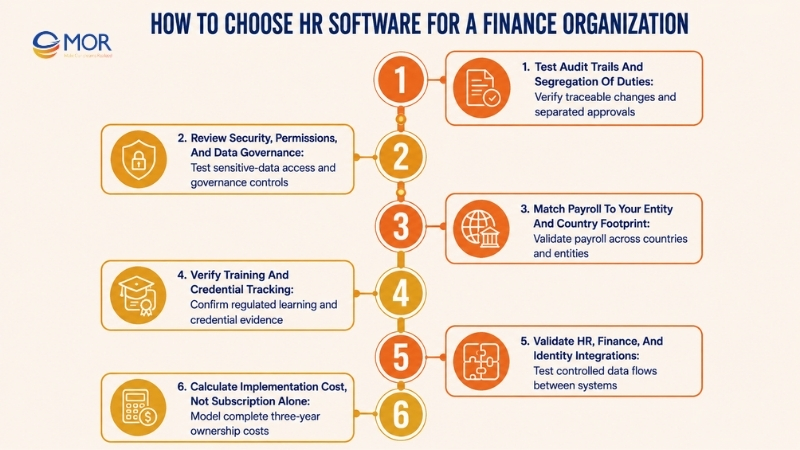
Test Audit Trails and Segregation of Duties
Ask vendors to show a real employee change from start to finish. Check who created it, who approved it, what changed, when each action happened, and whether administrators can alter the history.
Then test maker-checker processes. A compensation update, bank account change, job transfer, or administrator-rights change should support different request and approval roles where your control policy requires separation.
Audit evidence should be searchable and exportable. If the vendor demo stops at 'we log changes,' ask to see the log.
Review Security, Permissions, and Data Governance
Map employee data into sensitivity classes before selecting a product. Salary, bonus, identity documents, bank data, tax details, medical information, performance notes, and investigation records shouldn't share identical access rules.
Test RBAC, SSO, MFA, administrator rights, data retention, and regional data controls. Also review how the platform handles integrations because permission design can break when sensitive fields move into downstream systems.
Ask who can export data in bulk. Export rights often receive less attention than screen-level permissions, yet they can expose far more information at once.
Match Payroll to Your Entity and Country Footprint
List every country, legal entity, currency, payroll calendar, tax requirement, bonus type, commission rule, allowance, deduction, and off-cycle process before product demos. A vendor saying 'global payroll' isn't enough.
Ask which payroll engines are native, which countries use partners, and how results move into finance. Review general-ledger mapping, payroll journals, reconciliation, retro pay, corrections, and audit support.
Also test future markets. A product that fits three current countries may become expensive if expansion requires new providers or custom interfaces.
Verify Training and Credential Tracking
Financial institutions often need proof that employees completed required learning or maintained valid credentials. Ask the vendor to demonstrate enrollment rules, expiration dates, reminders, policy acknowledgement, completion history, and reporting.
Role changes should also trigger learning where relevant. A person moving into a regulated function may need new training before access or duties change.
Recruiting belongs in the same conversation. Skills, background checks, job eligibility, and onboarding evidence can affect whether an employee is ready for regulated work.
Validate HR, Finance, and Identity Integrations
Map every inbound and outbound interface before procurement. Common connections include ERP, accounting, finance planning, identity platforms, expense tools, time systems, payroll, data warehouses, and BI.
Look for solutions that sync HR and finance systems for seamless workflows when a worker change affects cost, access, or payroll. The goal is controlled data flow, clear ownership, retry logic, error monitoring, and traceable updates.
Ask vendors to distinguish native connectors, certified partner connectors, APIs, middleware, and custom work. Those labels carry different support and maintenance burdens.
Calculate Implementation Cost, Not Subscription Alone
Subscription price is only the visible layer. Build a three-year TCO model that includes migration, integration, security design, process configuration, UAT, training, administration, partner work, support, and future change requests.
Count internal time too. HR, payroll, finance, security, IT, legal, and business managers will spend hours mapping rules, reviewing designs, testing workflows, and fixing data.
A lower software quote can become the expensive option if the company needs heavy custom work after signing. Ask finalists for a cost model tied to your real scope, not a standard sales package.
Finance HR Software Implementation Risks to Plan For
Finance HR projects tend to fail in familiar places: bad source data, copied legacy processes, weak access design, insufficient payroll testing, and integrations that were 'almost done' at go-live.
Treat implementation as a controlled business change rather than a software installation. The product can only apply the data, rules, permissions, and processes that the project team defines.
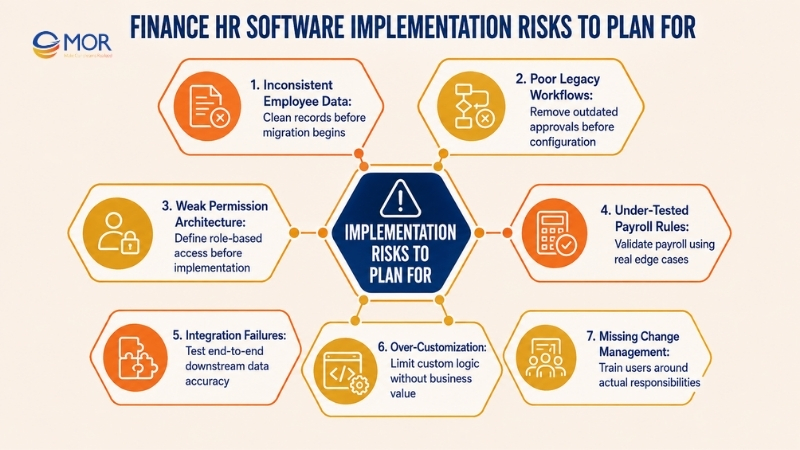
- Migrating inconsistent employee data: Clean duplicates, old job codes, invalid cost centers, missing manager links, stale bank details, and mismatched identifiers before migration. Data cleansing after go-live costs more because teams are already using the new records.
- Replicating poor legacy workflows: Map the current process, then remove dead approvals and unclear ownership. Copying every historic workaround into a new HRMS creates a more expensive version of the old system.
- Weak permission architecture: Build a role matrix before configuration starts. Separate HR, payroll, finance, manager, auditor, employee, and system-administrator rights according to business need.
- Under-testing payroll rules: Run parallel payroll cycles and reconcile gross-to-net results, taxes, deductions, bonuses, retro changes, off-cycle payments, and accounting output. Payroll UAT needs real edge cases rather than a clean sample employee.
- Ignoring integrations: Test data movement end-to-end. An API can return 'success' while downstream finance records still land under the wrong entity, department, cost center, or account.
- Over-customizing the platform: Keep configuration close to standard processes where the business doesn't gain real value from custom logic. Custom extensions add testing, documentation, upgrade, and support work.
- Skipping change management: Use integrated change management solutions for finance and HR teams when policy, approvals, payroll work, manager duties, and finance reporting all change together. Train each user group around its actual tasks rather than giving everyone the same system walkthrough.
- Launching without audit validation: Test logs, approvals, access history, role changes, reports, exports, and evidence retrieval before production. Ask an internal control owner to review the system rather than leaving final approval only to the implementation team.
A controlled go-live still needs monitoring after launch. Track payroll corrections, failed interfaces, access requests, support tickets, incomplete employee records, and manual workarounds during the first reporting cycles.
Invest in HR Management Solutions for the Finance Industry
Even the top HR management solutions for finance industry organizations can leave gaps around legacy data, internal workflows, custom integrations, modernization, and long-term development. MOR Software JSC can support that work through HRM software development, system integration, IT consulting, modernization, salesforce outsourcing development, testing, and offshore engineering models.
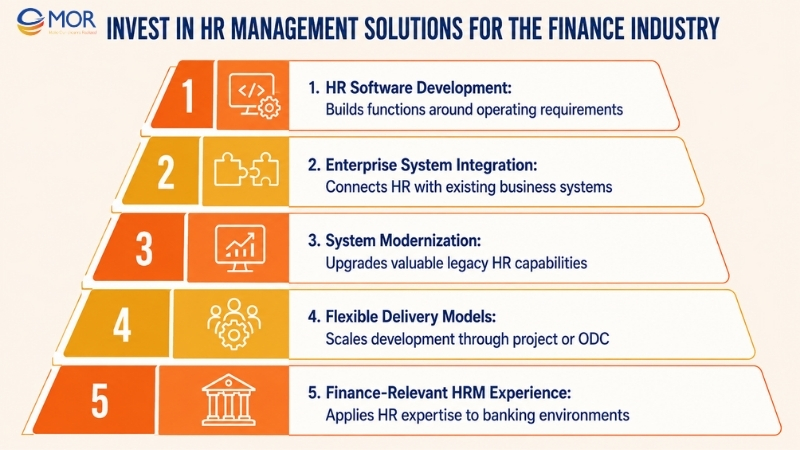
- Build HR functions around your operating model: MOR Software lists Human Resource Management among its domain areas. Its HR domain modules cover Talent Acquisition, Core HR, Compensation & Benefits, and Talent Management, while its services include system migration and modernization.
- Connect HR with existing enterprise systems: MOR's engineering capabilities cover technologies including Java, Node.js, Python, JavaScript, Salesforce, and AWS across its documented service materials. The company also provides IT consulting, software development, Salesforce development, QC & Testing, and offshore development.
- Modernize without rebuilding every component: Existing HR systems may still contain useful data, processes, or business logic. MOR's materials include system migration, modernization, maintenance, software architecture consulting, digital transformation consulting, and application modernization, giving companies several paths between 'keep everything' and full replacement.
- Scale development through flexible delivery models: MOR supports project-based work and Offshore Software Center models. Its service documentation describes Agile development, DevOps and QA support, information-security management, and delivery teams that can extend the client's internal organization.
- Apply HRM experience to finance use cases: MOR's PEOPLE case study involved a large HR management ecosystem in Japan covering staff evaluation, recruiting, planning, targets, and internal operations. MOR supplied a dedicated development team, built new functions, advised on technology, and assigned four engineers to customer-data integration; the source also notes adoption among corporate users, especially commercial banks.
The PEOPLE project gives the MOR section direct relevance to finance HR technology rather than generic software delivery. MOR's case-study file records work on scaling the platform and integrating customer data as demand grew.
Before you commit to another platform or force internal rules into standard modules, map the workflows, integrations, migration needs, permission model, and custom functions that remain. Contact MOR Software to review whether custom development, system modernization, integration, testing, or an ODC model fits the project.
Conclusion
The right top HR management solutions for finance industry shortlist starts with your control model, payroll footprint, integrations, and workforce structure. Workday, Oracle, SAP, Dayforce, UKG, ADP, Darwinbox, Deel, Rippling, and HiBob serve different needs, so test real workflows before buying. If standard software still leaves migration, integration, or custom HR gaps, contact MOR Software to assess the technical scope and choose a suitable development model.
"Solutions Director at MOR Software, has extensive expertise in software development and management. He leads innovative projects and provides strategic solutions to enhance business operations, helping clients achieve digital transformation goals."
Pham Huu Canh


Solutions Director
MOR SOFTWARE
Frequently Asked Questions (FAQs)
What are the top HR management solutions for finance industry companies?
Workday HCM, Oracle Fusion Cloud HCM, SAP SuccessFactors, Dayforce, UKG Pro, ADP Workforce Now, Darwinbox, Deel, Rippling, and HiBob cover the strongest mix in this comparison. The right choice depends on regulation, payroll footprint, entity structure, workforce type, integrations, and company scale.
What HR software capabilities matter most for financial institutions?
Prioritize audit history, RBAC, segregation of duties, payroll controls, regulatory training, data governance, workforce reporting, and enterprise integrations. Finance firms should also test how sensitive compensation and employee PII move between HR, payroll, finance, identity, and reporting systems.
How is HR software for banks different from general HR software?
Banking HR systems need tighter governance around access, audit evidence, regulatory training, payroll, credentials, and approval separation. Branch staffing and labor-cost visibility can also matter. A generic system may manage employee records well but still fall short on regulated-workforce controls.
Which HR management platform is best for global banks?
Workday, Oracle, and SAP are strong starting points for multinational banks because each supports large organization structures, global HR, talent, security, integrations, and enterprise reporting. Final selection should still depend on payroll countries, ERP strategy, data architecture, and governance requirements.
Which HR solution works best for fintech companies?
Deel suits cross-border hiring, Rippling fits HR-IT automation, and HiBob supports mid-market people and finance planning. For smaller companies researching the best HR software for small businesses, lighter products may fit better than enterprise HCM suites if regulation and organizational complexity remain modest.
Can HR software support segregation of duties and audit trails?
Yes, but depth varies. Enterprise HCM products can record approvals, changes, timestamps, administrators, and role permissions. During demos, test a sensitive workflow like compensation change or payroll-data update and ask the vendor to show the full evidence trail.
How should finance firms evaluate payroll and compliance coverage?
Start with countries, legal entities, currencies, pay schedules, taxes, bonuses, deductions, and local rules. Confirm which payroll engines are native, where partners are involved, how regulatory updates are handled, and how payroll results reach finance and reporting.
What integrations should finance HR software support?
Common targets include ERP, finance planning, accounting, identity management, expense, time, payroll, data warehouses, and BI tools. Review API ownership, connector type, error handling, data mapping, monitoring, and support responsibility before signing the contract.
How much does HR management software for financial services cost?
Costs vary by employee count, modules, countries, payroll scope, integrations, implementation partner, migration, support, and custom work. Compare three-year TCO rather than subscription fees alone, since enterprise implementation and administration can become a large part of total spend.
How long does an HR management system take to implement?
Timeline depends on organization size, data quality, integrations, payroll countries, security design, and process complexity. A focused fintech rollout can move much faster than a global bank program. Build the schedule around data, UAT, payroll validation, integration testing, and user readiness.
Share


Make Our-Dreams Realized


© 2023 . MOR Software. All Rights Reserved
Sitemap
Privacy Policy
Terms of Use

Rate this article
0
over 5.0 based on 0 reviews
Your rating on this news:
Name
*Email
*Write your comment
*Send your comment
1