


10 Biggest AI Adoption Challenges For Enterprises in 2026
AI experimentation is moving faster than many companies can turn it into day-to-day business value. The biggest AI adoption challenges now sit around strategy, data, ROI, system integration, workforce readiness, governance, cost, and agent oversight rather than access to AI tools alone. This MOR Software guide will break down where adoption stalls and what enterprises can do to move promising AI use cases toward reliable operations.
Key Takeaways
- Enterprise AI adoption often stalls when organizations deploy tools before defining business outcomes, data requirements, ownership, production criteria, and measurable KPIs.
- Data readiness, legacy integration, workforce adoption, governance, and cost control work as connected problems. Weakness in one area can stop a technically sound AI system from scaling.
- Enterprises need to measure AI at several levels, including usage, workflow performance, financial value, output quality, and risk. Tool adoption alone doesn't prove business value.
Why AI Adoption Challenges Persist in 2026
AI use has become common, but enterprise-wide scale remains rare. McKinsey's 2025 global survey found that 88% of organizations used AI in at least one business function, yet only 7% had fully scaled AI across their organizations.
That gap explains many enterprise AI adoption challenges. Companies can buy copilots, connect an LLM API, or run a promising proof of concept in weeks. Changing real workflows takes much more work across data, architecture, governance, people, ownership, and measurement.
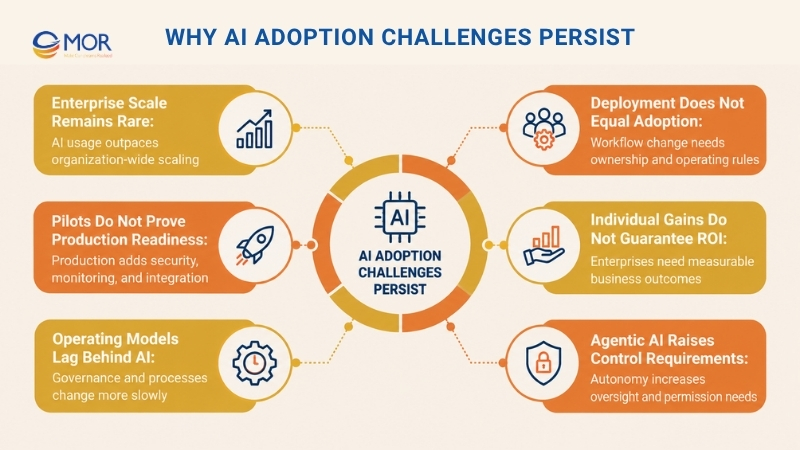
- Deployment doesn't equal adoption: An active license says little about workflow change. Teams need AI embedded into useful tasks, backed by clear ownership and operating rules.
- Pilots don't prove production readiness: A demo may work on curated data. Production brings identity management, APIs, latency, security, monitoring, failure handling, and maintenance into the picture.
- Individual gains don't guarantee enterprise ROI: One employee may finish a task faster with generative AI. The company still needs to prove lower process cost, shorter cycle time, higher throughput, better quality, or additional revenue.
- Operating models can lag behind AI capability: Decision rights, approval processes, training, and data access often move slower than model capability. Understanding AI in digital transformation helps place AI inside a wider change program rather than treating it as a stand-alone tool rollout.
- Agentic AI raises the control requirement: Agents can call tools, access applications, and complete connected tasks. The growing discussion around generative AI enterprise challenges risks adoption strategies now extends into permissions, observability, human approval, and failure recovery.
The main barriers to AI adoption are tightly connected. Fixing a model without fixing the environment around it usually moves the bottleneck somewhere else.
10 AI Adoption Challenges Blocking Enterprise Scale
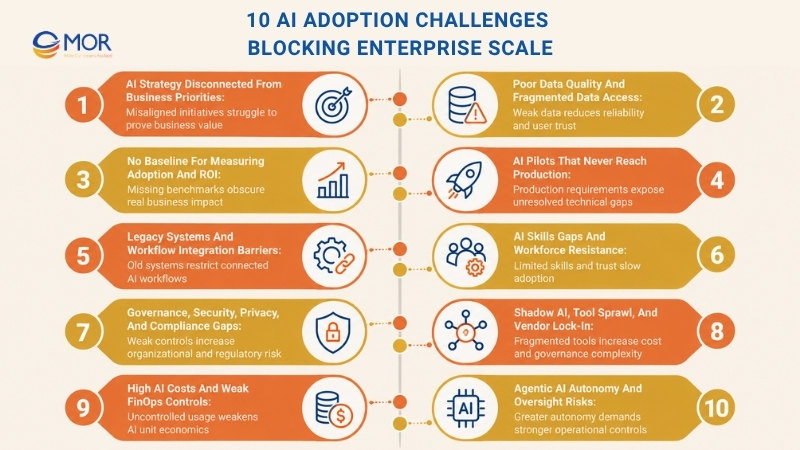
Enterprise AI tends to stall at the points where technology meets business operations. The ten areas below cover strategy, data, ROI, production, integration, people, governance, tooling, cost, and autonomous systems.
Each barrier needs a different response. A data problem calls for data engineering, for instance, while weak business ownership needs a decision before more code gets written.
1. AI Strategy Disconnected From Business Priorities
Many organizations start with a model, AI platform, or executive request before defining the business problem. Teams then create pilots that look interesting but compete for budget without a shared basis for comparison.
Why this blocks adoption: A viable AI initiative needs a defined outcome, an accountable owner, baseline performance, and success criteria. AI adoption challenges and decision making often collide here because technical teams may prove that AI works without proving that the selected use case deserves production investment.
Business consequences:
- Budget fragmentation: Several teams fund overlapping experiments with limited business value.
- Conflicting objectives: Technical teams measure model performance while business leaders expect financial or operational gains.
- Endless pilots: Projects remain active because nobody defined a production gate.
- Weak portfolio choices: Leaders can't compare competing AI initiatives on one set of criteria.
- Fading sponsorship: Early enthusiasm drops when teams can't show progress against an agreed outcome.
Ways to address it:
- Map value first: Link each use case to revenue, cost, productivity, risk, service quality, or customer outcomes.
- Score use cases: Compare value, feasibility, data readiness, implementation effort, and operational risk.
- Set the baseline: Record current process performance before development.
- Assign ownership: Give each initiative a business owner and a technical owner.
- Plan as a portfolio: Use an AI implementation planning process to fund related initiatives under one roadmap instead of isolated experiments.
How MOR Software can help: Our AI feasibility assessment can examine the target business case, current data, technical constraints, and delivery scope before engineering starts. That assessment gives your team a firmer basis for deciding what should move into strategy, development, and integration.
2. Poor Data Quality and Fragmented Data Access
AI depends on accurate, current, accessible data. Enterprise information often sits across ERP systems, CRM platforms, documents, data warehouses, SaaS applications, internal databases, and older systems that use different definitions for the same business entity.
Why this blocks adoption: Weak source data travels into training sets, retrieval systems, and agent workflows. Gartner reported that 63% of organizations either lacked or were unsure whether they had the right data-management practices for AI, and it projected that 60% of AI projects unsupported by AI-ready data would be abandoned through 2026.
Business consequences:
- Conflicting answers: Models respond differently based on which enterprise source they retrieve.
- Long preparation cycles: AI teams spend large portions of project time cleaning and reconciling data.
- Low user trust: Stale or incorrect answers make employees stop relying on the system.
- Weak traceability: Teams can't confirm where a retrieved fact came from or who owns it.
- Access risk: Sensitive records can enter an AI workflow without the right permissions.
- Poor RAG performance: Weak indexing, metadata, or document quality lowers retrieval accuracy.
Ways to address it:
- Prioritize use-case data: Map the sources required for the first production workflows instead of cleaning every enterprise dataset.
- Standardize definitions: Align business units on key entities, fields, ownership, and quality rules.
- Build ETL or ELT pipelines: Create dependable movement between source systems and AI-ready stores.
- Validate continuously: Check completeness, freshness, duplicates, and schema changes.
- Control access: Carry source permissions into retrieval and downstream AI workflows.
- Curate RAG corpora: Store approved knowledge in structures that support accurate retrieval and citation.
- Track lineage: Record where data originated and how it changed before reaching the model.
How MOR Software can help: Our data engineering work covers data acquisition, cleaning, annotation, and preparation for AI workloads. We can also connect enterprise data to custom AI applications and generative AI systems through integration work designed around the target use case.
3. No Baseline for Measuring Adoption and ROI
Many companies measure logins, prompt volume, licenses, or active users after AI goes live. Those figures show activity, but they don't tell leaders whether the business process improved.
Why this blocks adoption: Adoption rate and financial return answer different questions. The business impact AI adoption challenges create becomes hard to prove when no one records pre-AI cycle time, labor effort, quality, error rate, cost, or revenue performance.
WRITER's 2026 survey found that 79% of organizations faced AI adoption difficulties, while only 29% reported significant ROI from generative AI. Its research covered 1,200 C-suite executives and 1,200 non-technical employees using AI at work.
Business consequences:
- Unproven productivity: Teams say work feels faster but can't show the difference.
- Harder funding decisions: Leaders have little evidence for the following investment round.
- Misleading dashboards: High-use and high-value initiatives can appear similar.
- No exit point: Low-value projects continue because nobody defined stopping conditions.
- Inflated savings: Teams report cost gains without comparing them against a credible baseline.
Ways to address it:
- Capture current performance: Measure the workflow before AI enters it.
- Track business metrics: Use cycle time, throughput, error rate, revenue, cost per task, or labor hours where relevant.
- Separate use and value: Report adoption metrics alongside operational and financial metrics.
- Set payback conditions: Define the expected gain and the investment needed to reach it.
- Include TCO: Count model fees, data work, integration, infrastructure, testing, support, and maintenance.
- Measure per workflow: Business units need local metrics rather than one enterprise average.
How MOR Software can help: MOR Software's feasibility assessment and audit stage can map technical requirements against the business metrics you plan to track. That gives the completed AI system a measurable target before development begins.
4. AI Pilots That Never Reach Production
A proof of concept can look impressive in a controlled environment. Real users, live data, access rules, API dependencies, peak workloads, error handling, and support requirements tend to expose gaps that a demo never had to solve.
Why this blocks adoption: The challenges of implementing AI business solutions become much more visible at the production boundary. A pilot proves technical possibility, but production asks whether the system can work reliably inside an existing operation every day.
Business consequences:
- Pilot purgatory: Proofs of concept run for months without a scale or stop decision.
- No usable system: Business teams watch demos but still rely on the old workflow.
- Temporary architecture: Experimental code becomes harder to replace as the pilot grows.
- Late security work: Risk reviews uncover requirements after major engineering decisions have been made.
- Experiment churn: Funding moves to the next idea before previous pilots produce value.
Ways to address it:
- Define production early: Write down target users, data sources, integrations, security needs, load, monitoring, and support requirements before the pilot.
- Set an exit date: Give each experiment a fixed decision point.
- Agree on thresholds: Define go, revise, and stop conditions before testing begins.
- Test real dependencies: Connect representative data and systems during the pilot.
- Plan operations: Include monitoring, updates, incident handling, and maintenance in scope.
- Fund fewer pilots: Prioritize the use cases with the strongest path into real workflows.
How MOR Software can help: Our documented AI delivery process moves through Audit, Strategy, Development, and Integration, followed by UAT and production deployment. This structure lets production requirements enter the discussion before a prototype grows into a hard-to-maintain system.
5. Legacy Systems and Workflow Integration Barriers
Enterprise AI needs to exchange data and actions with ERP systems, CRM software, databases, APIs, internal applications, identity services, and business rules. Older platforms may expose limited APIs, rigid schemas, batch-only data, or custom logic that nobody wants to touch.
Why this blocks adoption: The challenges adopting enterprise AI infrastructure become expensive when AI sits outside the workflow employees already use. A strong model still creates friction if staff must copy data into another tool and move the answer back into the core application.
Business consequences:
- Long integration schedules: Hidden dependencies appear once engineering reaches production systems.
- Isolated AI tools: Pilots work alone but can't complete end-to-end business tasks.
- Manual handoffs: Employees become the integration layer between AI and core systems.
- Risky workarounds: Quick connectors bypass normal security or audit controls.
- Limited scope: Legacy constraints stop promising use cases before they reach high-value processes.
Ways to address it:
- Map dependencies: Document each source, API, write-back action, permission, and event the AI workflow needs.
- Add middleware: Place a controlled service layer between AI services and older applications.
- Modernize selectively: Replace or refactor components that block high-value workflows rather than launching a full rewrite.
- Keep architecture modular: Separate model services, orchestration, data access, and business logic.
- Use retrieval where suitable: RAG can expose approved knowledge without forcing source data into a new transactional system.
- Design for existing work: Put AI functions inside the applications employees already rely on where possible.
How MOR Software can help: We combine system integration, cloud deployment, generative AI integration, and custom software development for this type of problem. Our engineers can connect AI components to existing applications and data sources without treating full platform replacement as the default path.
6. AI Skills Gaps and Workforce Resistance
An enterprise AI program needs more than data scientists. Data engineering, software engineering, infrastructure, security, product ownership, domain expertise, governance, and business adoption all shape the result.
Why this blocks adoption: Weak AI literacy creates practical AI adoption issues across teams. Employees may distrust model outputs, fear role changes, or use unapproved tools that feel easier than the official system.
Prosci's recent research across 1,107 professionals found that 63% of organizations cited human factors as a primary challenge in AI implementations. Technical delivery can keep moving during that resistance, but enterprise adoption rarely follows on its own.
Business consequences:
- Hiring delays: Scarce AI specialists slow project starts and scale-up plans.
- Overloaded developers: Existing engineering teams absorb unfamiliar model, data, and infrastructure work.
- Weak output review: Users can't judge when an AI response needs correction.
- Communication gaps: Domain experts and technical teams describe the same process differently.
- Uneven adoption: One department becomes highly AI-assisted while another avoids the approved tools.
- Knowledge concentration: A small group becomes the only team able to operate the system.
Ways to address it:
- Train by role: Teach employees how AI fits the tasks they perform instead of giving everyone the same course.
- Include domain experts: Bring business specialists into prompt, retrieval, evaluation, and acceptance work.
- Create cross-functional teams: Pair engineering with security, product, business, and data owners.
- Define human review: Make approval points explicit for higher-risk outputs and actions.
- Document operating practices: Record evaluation methods, escalation rules, and ownership.
- Add outside capacity: Bring in AI engineering support when hiring would delay delivery.
Employee concerns often include a wider question: will AI replace software developers? Clear role design and communication can prevent that uncertainty from turning into resistance.
How MOR Software can help: MOR Software supports project-based delivery, staff augmentation, and dedicated team models. These models give clients access to AI, data engineering, integration, and software development capacity without waiting for every specialist role to be hired internally.
7. Governance, Security, Privacy, and Compliance Gaps
Enterprise AI may process customer information, internal documents, employee data, source code, contracts, or proprietary records. Wider use also adds models, APIs, users, integrations, and automated actions that need defined control.
Why this blocks adoption: AI adoption challenges in organizations grow quickly when teams can't answer basic questions about access, data flow, output ownership, audit records, and accountability. Security reviews then become a late-stage blocker rather than part of solution design.
Business consequences:
- Unauthorized data use: Sensitive records enter public or unapproved AI services.
- Inconsistent permissions: Users gain model access that exceeds the permissions in source systems.
- Compliance exposure: AI-generated decisions or content may not meet internal or external requirements.
- Harder audits: Teams can't reconstruct which model, data, or prompt produced an output.
- Biased results: Poor evaluation lets unfair patterns reach users or business processes.
- Delayed releases: Security and legal reviews uncover gaps close to launch.
A deeper review of AI bias and ethical concerns shows why data quality, testing, and human review need to appear inside system design rather than as a late checklist.
Ways to address it:
- Classify use cases: Set risk levels based on data sensitivity and the action AI can take.
- Control identity: Apply authentication and role-based access across AI workflows.
- Set usage rules: Define approved models, data types, use cases, and prohibited activities.
- Keep audit records: Log model calls, major decisions, access events, and human overrides.
- Evaluate outputs: Test quality, bias, unsafe behavior, and domain-specific failure cases.
- Add approval gates: Require human sign-off before higher-risk actions.
- Review vendors: Check data handling, retention, security, and portability before sending sensitive workloads to third parties.
How MOR Software can help: Our role centers on solution architecture, custom development, integration, deployment, and maintenance. We can translate governance requirements into data flows, permission logic, application controls, and production processes during the engineering stage.
8. Shadow AI, Tool Sprawl, and Vendor Lock-In
Employees often start using generative AI before the enterprise has selected approved tools. Separate business units may then buy their own assistants, model subscriptions, RAG products, or automation tools, creating a fragmented environment within months.
Why this blocks adoption: Tool sprawl raises cost and weakens visibility. It also makes enterprise AI platforms harder to govern when each business unit follows different data, model, security, and procurement rules.
Business consequences:
- Shadow data flows: Sensitive information enters tools the security team hasn't approved.
- Duplicate spending: Teams pay for products that solve similar tasks.
- Poor visibility: IT can't see which models process company data.
- Inconsistent quality: The same business question receives different answers across departments.
- High switching cost: Proprietary workflows and APIs make migration harder later.
- Fragmented controls: Governance policies work on one platform but not another.
Ways to address it:
- Inventory current use: Map sanctioned and unsanctioned AI tools across business units.
- Create an approved catalog: Give employees safe choices for common work instead of relying on bans alone.
- Set evaluation criteria: Compare security, data handling, integration, cost, model choice, and portability.
- Centralize policies: Apply common rules for identity, logging, and sensitive data.
- Use modular interfaces: Keep high-value business workflows separated from one vendor's proprietary layer where practical.
- Plan the exit: Review data export, model portability, API dependencies, and migration requirements before signing long contracts.
How MOR Software can help: Our custom AI and integration work can be designed around the client's application stack, cloud environment, data sources, and selected third-party services. That approach supports vendor choice without forcing every workflow into one packaged AI product.
9. High AI Costs and Weak FinOps Controls
Model subscriptions are only one line in an AI budget. Data preparation, cloud compute, vector databases, API calls, engineering, integration, security testing, evaluation, monitoring, and maintenance all add to total cost.
Why this blocks adoption: AI ROI enterprise adoption challenges 2026 become harder to manage when a cheap pilot turns into a costly production workload. Token use, inference volume, retrieval calls, storage, and agent loops can change unit economics as usage grows.
Business consequences:
- Budget drift: Production spend moves beyond the assumptions used in the business case.
- Lower expected return: Higher operating costs weaken payback forecasts.
- Model overspend: Teams use premium models for tasks that don't need them.
- Tool duplication: Similar capabilities sit across several contracts.
- Maintenance overhead: One-off systems require more engineering attention over time.
- Scale hesitation: Leaders pause expansion because future costs remain hard to predict.
A realistic model needs more than the initial project quote. Our guide to understanding AI development costs covers the engineering and operating factors that should enter the budget before production.
Ways to address it:
- Calculate TCO: Include implementation and ongoing operating costs.
- Track unit economics: Measure spend per workflow, transaction, active user, or accepted output.
- Match model to task: Reserve larger models for workloads where their capability justifies the price.
- Control consumption: Apply quotas, caching, model routing, batching, or usage limits where they fit.
- Remove duplicates: Consolidate tools that solve the same problem.
- Reuse components: Share retrieval, authentication, monitoring, and integration services across use cases.
- Review spend regularly: Compare cloud and API consumption against the value produced.
How MOR Software can help: We can assess architecture, deployment options, integration requirements, and development scope before implementation. MOR Software's AI services include custom model work plus edge and cloud deployment, so architecture can match workload needs instead of applying one setup to every project.
10. Agentic AI Autonomy and Oversight Risks
Agentic AI raises a different class of AI adoption problems because the system can do more than produce text. An agent may retrieve data, call APIs, update applications, coordinate tasks, and choose a following action based on the state of a workflow.
Why this blocks adoption: Broader autonomy increases the cost of incorrect data, excessive permissions, weak instructions, or poor monitoring. IBM cites Gartner's forecast that 33% of enterprise software applications will include agentic AI by 2028, up from less than 1% in 2024, which makes operational controls more pressing as adoption expands.
Business consequences:
- Wrong actions: Agents act on incomplete or outdated information.
- Excessive access: An agent receives broader system permissions than its task requires.
- Poor traceability: Teams struggle to reconstruct long tool-call chains.
- Runaway consumption: Repeated calls or loops raise inference and API costs.
- Weak accountability: Business owners can't explain why an automated step occurred.
- Unsafe autonomy: High-risk actions happen without the needed human approval.
The generative AI enterprise challenges risks adoption discussion becomes much more operational once software can take action. Teams need to decide which decisions remain recommendations and which may become automated tasks.
Ways to address it:
- Use least privilege: Give each agent only the permissions required for its assigned work.
- Define approval rules: Keep human sign-off for higher-risk actions.
- Log execution: Record tool calls, inputs, outputs, decisions, and overrides.
- Set boundaries: Limit task duration, retries, spend, and permitted actions.
- Test failure cases: Simulate missing data, conflicting instructions, tool errors, and unexpected responses.
- Monitor production behavior: Watch quality, latency, cost, and error patterns after launch.
- Increase autonomy gradually: Expand permissions only after stable performance has been demonstrated.
How MOR Software can help: We can design controlled agentic workflows through feasibility assessment, generative AI integration, custom AI development, system integration, and deployment work. Application logic, data connections, permissions, and human checkpoints can be shaped around the risk of each use case.
How to Prioritize AI Adoption Challenges Before Scaling
Trying to fix every problem at once usually creates a large transformation program with unclear ownership. Prioritization works better when your team scores barriers against business value, risk, dependencies, and urgency, then addresses the blockers that prevent high-value use cases from moving forward.
A practical AI enterprise adoption challenges 2026 review should start with observable signals. One weak point often exposes another, so the first action needs to remove the dependency that blocks the following stage.
Challenge signal | Primary risk | Primary owner | First action | Priority trigger |
No measurable business case | Wasted investment | Business + AI lead | Define outcome and baseline | No KPI before pilot |
Fragmented or unreliable data | Poor model output | Data team | Map priority data sources | Users don't trust outputs |
Pilot can't reach production | Lost investment | Product + engineering | Define production gate | Pilot exceeds its decision date |
Weak governance | Security or compliance exposure | Security + legal | Establish controls | Sensitive data enters the workflow |
Low workforce adoption | Low realized value | Business + HR | Role-based enablement | Usage doesn't change the workflow |
Rising AI spend | Margin erosion | Finance + engineering | Track unit economics | Cost grows faster than value |
Start with blockers that can stop the use case completely. Missing data access, for example, deserves attention before interface refinement because the model can't produce dependable results without the required source information.
Dependencies also matter. A company may list governance as its largest concern, yet the immediate work could be data classification and identity mapping because those controls depend on knowing which information the AI will touch.
Priority should change as the project moves. Early stages tend to focus on use-case value and data readiness, while production raises integration, security, cost, monitoring, and adoption issues.
How to Measure Whether AI Adoption Is Creating Value
One metric can't tell you whether enterprise AI works. Usage, employee proficiency, process performance, financial value, quality, and risk answer separate questions, and leadership needs to see them together.
The challenges of AI in business often become measurement problems after launch. A team can report thousands of prompts per month yet still create no measurable gain if employees rework most outputs or the AI sits outside the highest-cost part of the workflow.
Measurement layer | What to track | Example metrics | What it tells leaders |
Adoption | Actual use | Active users, workflow penetration | Are teams using AI? |
Proficiency | Effective use | Task completion, rework, escalation | Are employees using it well? |
Operational performance | Process change | Cycle time, defect rate, throughput | Did the workflow improve? |
Financial value | Economic result | Cost saved, revenue lift, cost per task | Is AI creating business value? |
Quality | Output reliability | Accuracy, acceptance rate, error rate | Can teams trust the output? |
Risk | Controlled operation | Policy violations, incidents, overrides | Is the system safe to scale? |
Record the baseline before deployment. If invoice review currently takes 14 minutes per document, that number gives your team something concrete to compare against after AI enters the process.
Keep utilization and proficiency separate as well. Employees may open an AI tool daily but still copy weak results into a manual process, so active users alone can overstate progress.
Financial metrics should connect to workflow metrics. Shorter handling time has value only when it lowers labor cost, increases capacity, improves service, or supports another measurable business outcome.
Quality deserves equal attention. Faster outputs that increase error rates, rework, or escalation can move a KPI in the wrong direction.
Risk metrics complete the picture. Policy violations, unauthorized access, agent overrides, and security incidents show whether growth in AI usage is creating new exposure.
Review the measurement set after major workflow or model changes. The metrics that made sense during a pilot may no longer capture value once the system reaches larger teams or more complex processes.
Navigate AI Adoption Challenges With MOR Software
AI adoption can stall for very practical reasons: the data isn't ready, a legacy platform lacks the right interface, internal engineers are already overloaded, or a promising prototype doesn't have a production architecture. MOR Software supports these technical parts of the adoption journey through feasibility assessment, data engineering, custom AI development, gen AI platform intergration, system integration, and deployment services.
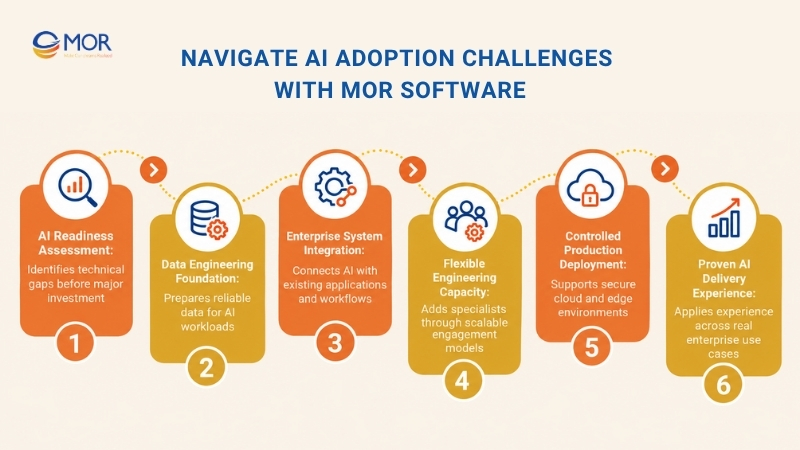
- Assess AI readiness before committing resources: Our Feasibility Assessment reviews the current data setup, technical requirements, and expected KPIs. We use that work to identify gaps early and define a realistic engineering scope for the selected use case.
- Strengthen the data foundation for AI: Our Data Engineering services cover data acquisition, cleaning, annotation, and preparation. This work supports training, retrieval, and inference where fragmented or poor-quality information would otherwise limit reliability.
- Connect AI with existing business systems: We combine generative AI integration, system integration, and custom software development to connect AI functions to applications, enterprise data, APIs, and existing workflows. That can keep a company from turning AI adoption into a full replacement project for systems that still serve useful business functions.
- Fill gaps in AI engineering capacity: MOR Software supports Staff Augmentation, Fixed-Price, and Dedicated Team engagement models. Clients can add specialists for a defined project or maintain a longer-running engineering team when internal capacity is limited.
- Move AI workloads into controlled production environments: Our AI service materials cover Custom Model Service plus Edge & Cloud Deployment. The documented AI stack includes TensorFlow, OpenCV, Amazon SageMaker, FastAPI, Databricks, Docker, Kubernetes, vLLM, and Qdrant, while the delivery process covers Audit, Strategy, Development, Integration, UAT, and production deployment.
- Apply delivery experience to real AI use cases: MOR Software has documented an AI-Powered Semantic Search Transformation for a Japanese enterprise and an AI Person Counter & Demographic Detection project for retail analytics. Our AI materials also identify manufacturing, retail, and finance and banking among relevant industry areas.
This approach fits companies that already see a viable AI use case but face technical feasibility, data, integration, engineering capacity, or pilot-to-production barriers. It also fits teams that need custom AI behavior tied to proprietary data or business workflows rather than another stand-alone tool.
If those problems match your project, start by sharing the target workflow, current data sources, application stack, and expected outcome. MOR Software can assess the technical gaps and define the engineering, integration, and deployment work needed, helping you make a more grounded choice when choosing the right AI development partner.
Conclusion
Most AI adoption challenges reinforce one another. Poor data lowers output quality, weak governance hurts trust, low trust slows workforce use, and weak adoption makes ROI harder to prove. Enterprises need measurable use cases, reliable data, system integration, defined ownership, workforce support, and ongoing monitoring to move beyond experiments. MOR Software can support that journey through AI assessment, engineering, integration, and production delivery tied to your actual business systems.
Contact us to discuss your AI use case, technical barriers, and the steps needed to move it toward production.
"Evolution is not a destination, it is a disciplined journey of innovation."
Phung Van Tu


CEO MOR AI
MOR SOFTWARE
Frequently Asked Questions (FAQs)
What are the biggest AI adoption challenges in 2026?
The main barriers include unclear business strategy, weak data readiness, uncertain ROI, pilot-to-production gaps, legacy integration, skills shortages, workforce resistance, governance, shadow AI, rising costs, and agentic AI oversight. These problems often connect, so companies need to address dependencies rather than treating each item as a separate technology issue.
Why do AI adoption projects fail after the pilot stage?
Pilots often use limited data, controlled users, and temporary architecture. Production adds integration, security, scalability, monitoring, ownership, maintenance, and support requirements. Projects stall when teams haven't defined production criteria, measurable KPIs, a decision date, or the engineering work needed after the proof of concept.
How can companies measure ROI from AI adoption?
Start with a pre-AI baseline, then track process metrics and financial outcomes together. Useful measures include cycle time, throughput, error rate, labor hours, revenue lift, cost per task, total operating cost, and output acceptance. Adoption metrics matter too, but login counts alone can't show ROI.
How does poor data quality affect AI adoption?
Poor data can create inaccurate retrieval, inconsistent answers, hallucinations, stale recommendations, and weak model performance. It also makes traceability and access control harder. Companies should map the data needed for each use case, define ownership, improve quality, preserve permissions, and monitor data freshness.
What role does change management play in AI adoption?
Change management connects the AI system to the people expected to use it. Employees need role clarity, relevant training, clear rules for human review, and a reason to trust the workflow. Weak communication can lead to low adoption, shadow AI use, or resistance even when the technology performs well.
How can enterprises integrate AI with legacy systems?
Enterprises can use APIs, middleware, modular service layers, data pipelines, and selective modernization. RAG can also expose approved information stored in older repositories. Integration planning should map data reads, write-back actions, identity, permissions, latency, and failure handling before the AI workflow reaches production.
What security and privacy risks can slow AI adoption?
Common risks include sensitive-data leakage, excessive access, weak audit trails, unsafe model outputs, third-party data handling, and unauthorized AI tools. Enterprises need identity controls, approved-use policies, logging, vendor review, output evaluation, and human approval for higher-risk actions.
How can organizations control shadow AI and tool sprawl?
Start with an inventory of AI tools already used across teams. Set an approved catalog, common procurement criteria, data rules, access policies, and logging requirements. Giving employees safe alternatives tends to work better than relying only on restrictions, especially when teams already depend on AI for daily work.
How much does enterprise AI adoption cost?
Total cost can include data preparation, model access, cloud compute, vector storage, software engineering, system integration, security testing, governance work, employee training, monitoring, and maintenance. Cost varies by architecture and workload, so companies should estimate TCO and track unit economics before scaling.
What new adoption challenges come with agentic AI?
Agentic systems add autonomy, tool access, identity, permissions, long execution chains, and the risk of incorrect actions. Enterprises need execution limits, least-privilege access, logging, human approval gates, rollback procedures, cost controls, and production monitoring before giving agents broader authority.
Share


Make Our-Dreams Realized


© 2023 . MOR Software. All Rights Reserved
Sitemap
Privacy Policy
Terms of Use

Rate this article
0
over 5.0 based on 0 reviews
Your rating on this news:
Name
*Email
*Write your comment
*Send your comment
1